oil type FORD MUSTANG 1969 Volume One Chassis
[x] Cancel search | Manufacturer: FORD, Model Year: 1969, Model line: MUSTANG, Model: FORD MUSTANG 1969Pages: 413, PDF Size: 75.81 MB
Page 307 of 413
07-01-16
General Transmission bervice
07-01-16
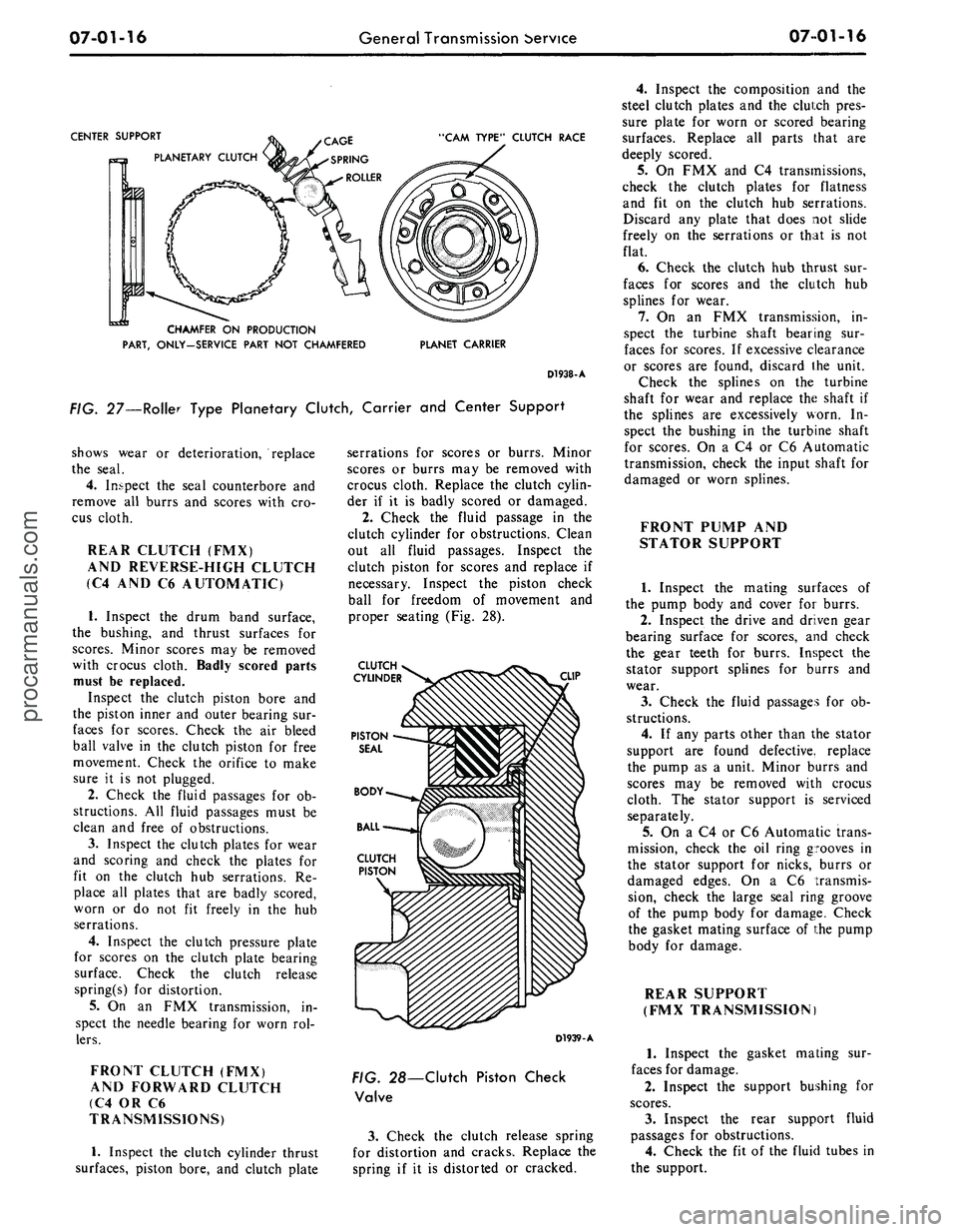
CENTER SUPPORT
PLANETARY CLUTCH
"CAM TYPE" CLUTCH RACE
CHAMFER ON PRODUCTION
PART, ONLY-SERVICE PART NOT CHAMFERED
PLANET CARRIER
D1938-A
FIG. 27—Roller Type Planetary Clutch, Carrier and Center Support
shows wear or deterioration, replace
the seal.
4.
Inspect the seal counterbore and
remove all burrs and scores with cro-
cus cloth.
REAR CLUTCH (FMX)
AND REVERSE-HIGH CLUTCH
(C4 AND C6 AUTOMATIC)
1.
Inspect the drum band surface,
the bushing, and thrust surfaces for
scores. Minor scores may be removed
with crocus cloth. Badly scored parts
must be replaced.
Inspect the clutch piston bore and
the piston inner and outer bearing sur-
faces for scores. Check the air bleed
ball valve in the clutch piston for free
movement. Check the orifice to make
sure it is not plugged.
2.
Check the fluid passages for ob-
structions. All fluid passages must be
clean and free of obstructions.
3.
Inspect the clutch plates for wear
and scoring and check the plates for
fit on the clutch hub serrations. Re-
place all plates that are badly scored,
worn or do not fit freely in the hub
serrations.
4.
Inspect the clutch pressure plate
for scores on the clutch plate bearing
surface. Check the clutch release
spring(s) for distortion.
5.
On an FMX transmission, in-
spect the needle bearing for worn rol-
lers.
FRONT CLUTCH (FMX)
AND FORWARD CLUTCH
(C4 OR C6
TRANSMISSIONS)
1.
Inspect the clutch cylinder thrust
surfaces, piston bore, and clutch plate
serrations for scores or burrs. Minor
scores or burrs may be removed with
crocus cloth. Replace the clutch cylin-
der if it is badly scored or damaged.
2.
Check the fluid passage in the
clutch cylinder for obstructions. Clean
out all fluid passages. Inspect the
clutch piston for scores and replace if
necessary. Inspect the piston check
ball for freedom of movement and
proper seating (Fig. 28).
CLUTCH
CYLINDER
PISTON
SEAL
CLIP
D1939-A
. 28—Clutch Piston Check
Valve
3.
Check the clutch release spring
for distortion and cracks. Replace the
spring if it is distorted or cracked.
4.
Inspect the composition and the
steel clutch plates and the clutch pres-
sure plate for worn or scored bearing
surfaces. Replace all parts that are
deeply scored.
5.
On FMX and C4 transmissions,
check the clutch plates for flatness
and fit on the clutch hub serrations.
Discard any plate that does not slide
freely on the serrations or that is not
flat.
6. Check the clutch hub thrust sur-
faces for scores and the clutch hub
splines for wear.
7.
On an FMX transmission, in-
spect the turbine shaft bearing sur-
faces for scores. If excessive clearance
or scores are found, discard the unit.
Check the splines on the turbine
shaft for wear and replace the shaft if
the splines are excessively worn. In-
spect the bushing in the turbine shaft
for scores. On a C4 or C6 Automatic
transmission, check the input shaft for
damaged or worn splines.
FRONT PUMP AND
STATOR SUPPORT
1.
Inspect the mating surfaces of
the pump body and cover for burrs.
2.
Inspect the drive and driven gear
bearing surface for scores, and check
the gear teeth for burrs. Inspect the
stator support splines for burrs and
wear.
3.
Check the fluid passages for ob-
structions.
4.
If any parts other than the stator
support are found defective, replace
the pump as a unit. Minor burrs and
scores may be removed with crocus
cloth. The stator support is serviced
separately.
5.
On a C4 or C6 Automatic trans-
mission, check the oil ring grooves in
the stator support for nicks, burrs or
damaged edges. On a C6 transmis-
sion, check the large seal ring groove
of the pump body for damage. Check
the gasket mating surface of the pump
body for damage.
REAR SUPPORT
(FMX TRANSMISSION)
1.
Inspect the gasket mating sur-
faces for damage.
2.
Inspect the support bushing for
scores.
3.
Inspect the rear support fluid
passages for obstructions.
4.
Check the fit of the fluid tubes in
the support.procarmanuals.com
Page 361 of 413
07-03-21
FMX Transmission
07-03-21
Tool—1175-AB
Tool— T50T-100-A
D1962-A
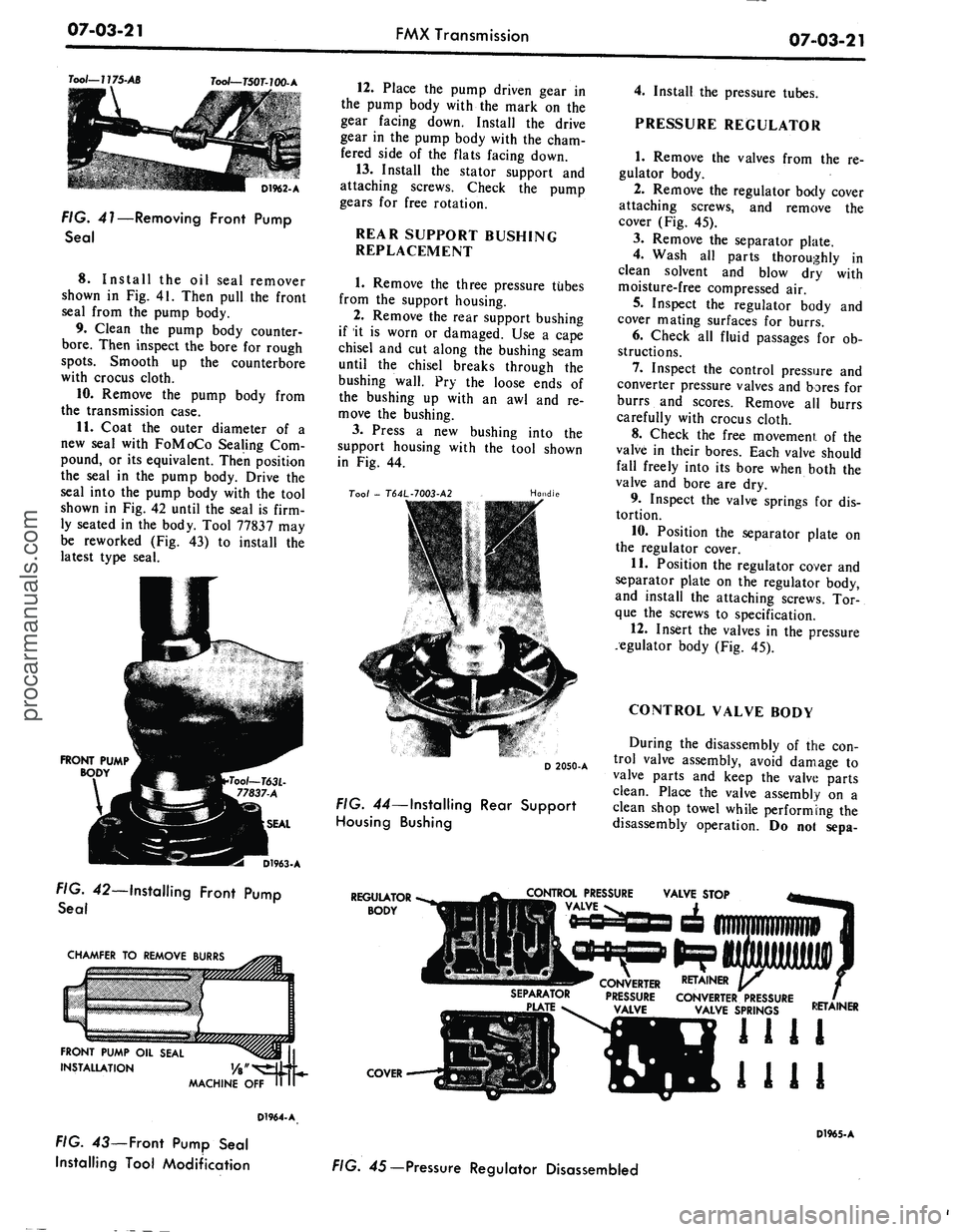
FIG. 41—Removing Front Pump
Seal
8. Install
the oil
seal remover
shown
in Fig. 41.
Then pull
the
front
seal from
the
pump body.
9. Clean
the
pump body counter-
bore.
Then inspect
the
bore
for
rough
spots.
Smooth
up the
counterbore
with crocus cloth.
10.
Remove
the
pump body from
the transmission case.
11.
Coat
the
outer diameter
of a
new seal with FoMoCo Sealing
Com-
pound,
or its
equivalent. Then position
the seal
in the
pump body. Drive
the
seal into
the
pump body with
the
tool
shown
in Fig. 42
until
the
seal
is
firm-
ly seated
in the
body. Tool 77837
may
be reworked
(Fig. 43) to
install
the
latest type seal.
FRONT PUMP
BODY
D1963-A
FIG. 42—Installing Front Pump
Seal
CHAMFER
TO
REMOVE BURRS
FRONT PUMP
OIL
SEAL
INSTALLATION
MACHINE
OFF
D1964-A
FIG.
43—
Front Pump Seal
Installing Tool Modification
12.
Place
the
pump driven gear
in
the pump body with
the
mark
on the
gear facing down. Install
the
drive
gear
in the
pump body with
the
cham-
fered side
of the
flats facing down.
13.
Install
the
stator support
and
attaching screws. Check
the
pump
gears
for
free rotation.
REAR SUPPORT BUSHING
REPLACEMENT
1.
Remove
the
three pressure tubes
from
the
support housing.
2.
Remove
the
rear support bushing
if
it is
worn
or
damaged.
Use a
cape
chisel
and cut
along
the
bushing seam
until
the
chisel breaks through
the
bushing wall.
Pry the
loose ends
of
the bushing
up
with
an awl and re-
move
the
bushing.
3.
Press
a new
bushing into
the
support housing with
the
tool shown
in
Fig. 44.
Too/
-
T64L-7003-A2
Handle
D 2050-A
FIG. 44—Installing Rear Support
Housing Bushing
4.
Install
the
pressure tubes.
PRESSURE REGULATOR
1.
Remove
the
valves from
the re-
gulator body.
2.
Remove
the
regulator body cover
attaching screws,
and
remove
the
cover
(Fig. 45).
3.
Remove
the
separator plate.
4.
Wash
all
parts thoroughly
in
clean solvent
and
blow
dry
with
moisture-free compressed
air.
5.
Inspect
the
regulator body
and
cover mating surfaces
for
burrs.
6. Check
all
fluid passages
for ob-
structions.
7.
Inspect
the
control pressure
and
converter pressure valves
and
bores
for
burrs
and
scores. Remove
all
burrs
carefully with crocus cloth.
8. Check
the
free movement
of the
valve
in
their bores. Each valve should
fall freely into
its
bore when both
the
valve
and
bore
are dry.
9. Inspect
the
valve springs
for dis-
tortion.
10.
Position
the
separator plate
on
the regulator cover.
11.
Position
the
regulator cover
and
separator plate
on the
regulator body,
and install
the
attaching screws.
Tor-
que
the
screws
to
specification.
12.
Insert
the
valves
in the
pressure
regulator body
(Fig. 45).
CONTROL VALVE BODY
During
the
disassembly
of the con-
trol valve assembly, avoid damage
to
valve parts
and
keep
the
valve parts
clean. Place
the
valve assembly
on a
clean shop towel while performing
the
disassembly operation.
Do not
sepa-
REGULATOR
BODY
CONTROL PRESSURE
VALVE
SEPARATOR
CONVERTER RETAINER
PRESSURE CONVERTER PRESSURE
VALVE SPRINGS
COVER
RETAINER
1111
1111
D1965-A
FIG. 45— Pressure Regulator Disassembledprocarmanuals.com