air filter FORD MUSTANG 1969 Volume One Chassis
[x] Cancel search | Manufacturer: FORD, Model Year: 1969, Model line: MUSTANG, Model: FORD MUSTANG 1969Pages: 413, PDF Size: 75.81 MB
Page 16 of 413

02-01-05
Brakes
02-01-05
1.
Disconnect the master cylinder
from the booster assembly and secure
away from the booster without discon-
necting the brake tubes.
2.
Reinstall the air filter assembly
on the booster if it was removed with
the master cylinder (Fig. 8).
3.
Install and tighten the master
cylinder retaining nuts to retain the
air filter assembly securely against the
booster body and to seal the booster
bellows against air leaks.
4.
Place the gauge against the
master cylinder mounting surface of
the air filter assembly.
5.
Adjust the push rod screw to
provide a slight tension against the
inner edge of the adjustment gauge
slot. (Approximately 5 pounds of ten-
sion against the push rod is required
to assure that the push rod is firmly
seated in the booster assembly.)
6. Remove the retaining nuts from
the booster master cylinder mounting
studs.
7.
Install the master cylinder on the
brake booster and tighten the retain-
ing nuts to the specified torque.
The push rod length verification of
the Bendix power brake booster
assemblies is accomplished as follows:
1.
Disconnect the master cylinder
from the booster assembly and secure
away from the booster without discon-
necting the brake tubes.
2.
Adjust the push rod screw to
provide a slight tension against the
inner edge of the adjustment gauge
slot. (Approximately 5 pounds of ten-
sion against the push rod is required
to assure that the push rod is firmly
seated in the booster assembly.) See
Figure 8.
3.
Install the master cylinder on the
brake booster and tighten the retain-
ing nuts to the specified torque.
Do not set up side forces on the
push rod as it may break the valve
plunger.
This is an approximate adjustment
only. To verify the adjustment, look
through the make-up (rear) port of the
master cylinder when installing the
master cylinder to the booster. The
master cylinder piston should not
move more than 0.015 inch as it con-
tacts the push rod. No movement
(exact contact) is ideal.
HYDRAULIC SYSTEM BLEEDING
AND CENTRALIZING OF THE
DIFFERENTIAL VALVE
When any part of the hydraulic sys-
tem has been disconnected for repair
or replacement, air may enter the sys-
tem and cause spongy pedal action.
Bleed the hydraulic system after it has
been properly connected, to be sure
that all air is expelled.
MANUAL BLEEDING
The Lincoln Continental hydraulic
brake system is to be bled only with
pressure bleeding equipment.
The primary and secondary (front
MANIFOLD CHECK VALVE-2365 19-25 IN. LB.
TIGHTEN RETAINING NUTS
TO SECURE AIR FILTER
AGAINST BOOSTER BODY
AND BELLOWS
ADJUST PUSH ROD SCREW TO
PROVIDE A SLIGHT TENSION
(APPROXIMATELY 5 LBS.)
AGAINST THE GAUGE
PUSH ROD GAUGE
and rear) hydraulic brake systems are
individual systems and are bled separ-
ately. Bleed the longest line first on
the individual system being serviced.
During the complete bleeding opera-
tion,
DO NOT allow the reservoir to
run dry. Keep the master cylinder res-
ervoirs filled with Ford Fluid—Extra
Heavy Duty — Part Number C6AZ-
19542-A (ESA-M6C 25-A). The extra
heavy duty brake fluid is colored blue
for identification purposes. Do not
mix low temperature brake fluids with
the specified fluid during the bleeding
operations. Never re-use brake fluid
which has been drained from the hy-
draulic systems.
1.
If the master cylinder is
equipped with a bleed screw, loosen
the bleed screw. Push the brake pedal
down slowly through its full travel.
Close the bleeder fitting and return
the pedal to the fully released posi-
tion. Repeat this operation until fluid
is free of air bubbles, then tighten the
bleeder screw. Do not use the second-
ary piston stop screw, located on the
bottom of the master cylinder to bleed
the brake system. Loosening or re-
moving this screw could result in dam-
age to the secondary piston or stop
screw.
2.
To bleed the secondary (rear)
brake system, position a suitable 3/8
inch box wrench (Fig. 9) on the bleed-
er fitting on the brake wheel cylinder.
Attach a rubber drain tube to the
bleeder fitting. The end of the tube
should fit snugly around the bleeder
fitting.
APPROXIMATELY 45°
PUSH ROD ADJUSTMENT-MIDLAND-ROSS
FIG. 8—Brake Booster Push Rod Measurement
PUSH ROD ADJUSTMENT-BENDIX
H1589-A
H1300-B
. 9—Wrench for Bleeding
Brake Hydraulic System
3.
Submerge the free end of the
tube in a container partially filled with
clean brake fluid, and loosen the
bleeder fitting approximately 3/4 turn.
4.
Push the brake pedal down slow-
ly through its full travel. Close the
bleeder fitting, then return the pedal
to the full-released position. Repeat
this operation until air bubbles cease
to appear at the submerged end of the
bleeder tube.
5.
When the fluid is completely free
of air bubbles, close the bleeder fitting
and remove the bleeder tube.
6. Repeat this procedure at the
brake wheel cylinder on the oppositeprocarmanuals.com
Page 56 of 413
FROM MASTER CYLINDER
ACTUATOR AIR FILTER
EXISTING SCREW
VIEW IN CIRCLE
W
SOLENOID
ACTUATOR TO REA
BRAKE TUBE
DIFFERENTIAL VALVE
UATORTUBE
VIEW IN CIRCLE T
FROM ACTUATOR
TO REAR BRAKES
GLOVE BOX
CONTROL MODULE
VIEW V
VIEW U
H1653-A
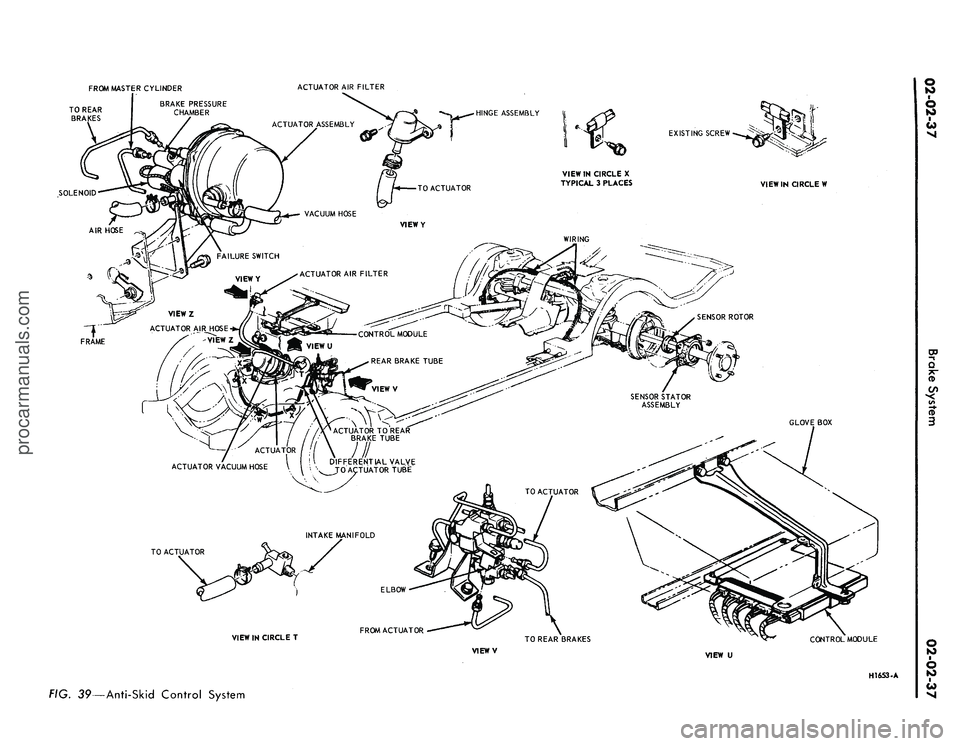
FIG. 39—Anti-Skid Control Systemprocarmanuals.com
Page 57 of 413
02-02-38
Brake System
02-02-38
2.
Disconnect the actuator solenoid
and warning switch harness connectors
from the control module.
3.
Remove the two wiring harness
grommets from the dash panel and
push the wiring harness and connec-
tors through the openings in the dash
panel.
4.
Working in the engine compart-
ment loosen the hose clamp and re-
move the air hose from the air filter.
5.
Remove the engine air cleaner-
Loosen the hose clamp and remove
the vacuum hose from the vacuum
manifold fitting.
6. Raise the vehicle on a hoist.
7.
Disconnect the exhaust pipes
from the exhaust manifold and sup-
port with wire to provide access to the
actuator assembly.
8. Remove the bolt retaining the
actuator ground wire to the rear outer
corner of the engine right bank.
9. Loosen the tube nuts and discon-
nect the brake system hydraulic tubes
from the hydraulic valve housing.
10.
Remove the three nuts retaining
the actuator assembly to the actuator
support bracket.
11.
Remove the three bolts that re-
tain the actuator mounting bracket to
the side rail and remove the mounting
bracket.
12.
Remove the actuator assembly
from the vehicle and place it on a
bench.
13.
Remove the air and vacuum
hoses from the actuator.
INSTALLATION
1.
Install the air and vacuum hoses
on the new actuator.
2.
Place the actuator assembly into
position under the vehicle, routing the
air and vacuum hoses up between the
engine and fender apron and inserting
the solenoid leads through the holes in
the firewall.
3.
Position the ground wire to the
rear of the engine block and install re-
taining bolt.
4.
Position the actuator mounting
bracket to the frame side rail and in-
stall the three retaining bolts.
5.
Position the actuator assembly
to the mounting bracket and install
the three retaining nuts.
6. Connect the hydraulic tubes to
the hydraulic valve assembly and
tighten the tube nuts to specifications.
7.
Connect the exhaust pipes to the
exhaust manifolds.
8. Lower the vehicle.
9. Pull the actuator solenoid and
brake warning switch wiring harness
through the two holes in the dash
panel from inside the car. Seat the
wiring harness grommets in the dash
panel.
10.
Connect the actuator solenoid
and brake warning switch wiring har-
ness connectors to the control mo-
dules.
'
11.
Position the control module in
the bracket under the glove box and
install the retaining screw.
12.
In the engine compartment con-
nect the air hose to the air filter and
position the hose clamp.
13.
Connect the vacuum hose to the
engine vacuum manifold fitting. In-
stall the engine air cleaner.
14.
Bleed the rear brake system and
centralize the pressure differential
valve.
15.
Raise the rear wheels. Apply
the brakes with the rear wheels turn-
ing to verify proper operation of the
anti-skid control system.
ANTI-SKID CONTROL MODULE
REMOVAL
Refer to Fig. 39.
1.
Remove the retaining strap hold-
ing the harnesses.
2.
Remove the screw that attaches
the forward end of the control module
retainer to the support assembly.
3.
Lower the forward end of the
control module and retainer from the
support assembly; move the module
and retainer forward slightly until the
flange clears the slot in the support
assembly.
4.
Disconnect the five wiring har-
ness plugs from the control module.
5.
Remove the control module from
the vehicle.
INSTALLATION
1.
Connect the five wiring harness
plugs to the control module. Only one
arrangement is possible.
2.
Position the control module in
the retainer, orienting the module per
the markings on it, and insert the re-
tainer flange into the slot at the rear
of the support assembly.
3.
Pivot the retainer and control
module upward and align the screw
hole in the forward end of the retainer
with the hole in the support bracket
assembly. Install the retaining screw.
4.
Test the vehicle on the hoist to
verify correct operation of the skid
control system.
5.-
Secure the wiring to the module
support extension with the retaining
strap.
ANTI-SKID CONTROL SENSOR
REMOVAL
Refer to Fig. 39.
1.
Raise the vehicle on a hoist.
2.
Remove the rear wheel and tire
assembly.
3.
Remove the three Tinnerman
nuts (3) and remove the brake drum.
4.
Disconnect the sensor lead from
the rear wiring harness.
5.
Unseat the sensor lead grommet
pushing it to the inside of the brake
assembly.
6. Remove the four nuts that retain
the sensor to the backing plate and
pull the axle shaft, sensor assembly
and wheel bearing assembly from the
axle housing.
7.
Press the wheel bearing retainer
and wheel bearing off the axle shaft
(Refer to Part 4-2).
8. Remove the sensor assembly and
press the rotor off the shaft with tool
T69P-2B384-A Detail 2 and TOOL
1225-DA.
INSTALLATION
1.
Press a new rotor onto the axle
shaft. Install a new sensor assembly
on the shaft with tool T69P-
2B384-ADetail 1 and TOOL 1225-
DA, and press the bearing and bear-
ing retainer onto the shaft (Refer to
Part 4-2).
2.
Insert the axle shaft assembly in
the rear axle housing onto the four
backing plate retaining bolts, feeding
the sensor lead through the hole in the
backing plate.
3.
Seat the sensor lead grommet in
the backing plate.
4.
Install the four nuts on the re-
taining bolts and tighten to specifica-
tions.
5.
Connect the sensor lead to the
rear wiring harness and install two re-
taining straps.
6. Install the rear brake drum and
retain with the Tinnerrhan drum re-
taining nuts.
7.
Install the rear wheel and tire as-
sembly and tighten the wheel nuts to
specifications.
8. Test the vehicle on the hoist to
verify proper operation of the skid
control system.procarmanuals.com
Page 108 of 413
03-03-03
Automatic Air Leveling System
03-03-03
COMPRESSOR LINE
AIR
CYLINDER LINE INTAKE PORT EXHAUSTPORT
ADJUSTMENT SCREW
MOUNTING BRACKET
HEIGHT CONTROL VALVE
REAR SUSPENSION UPPER
ARM
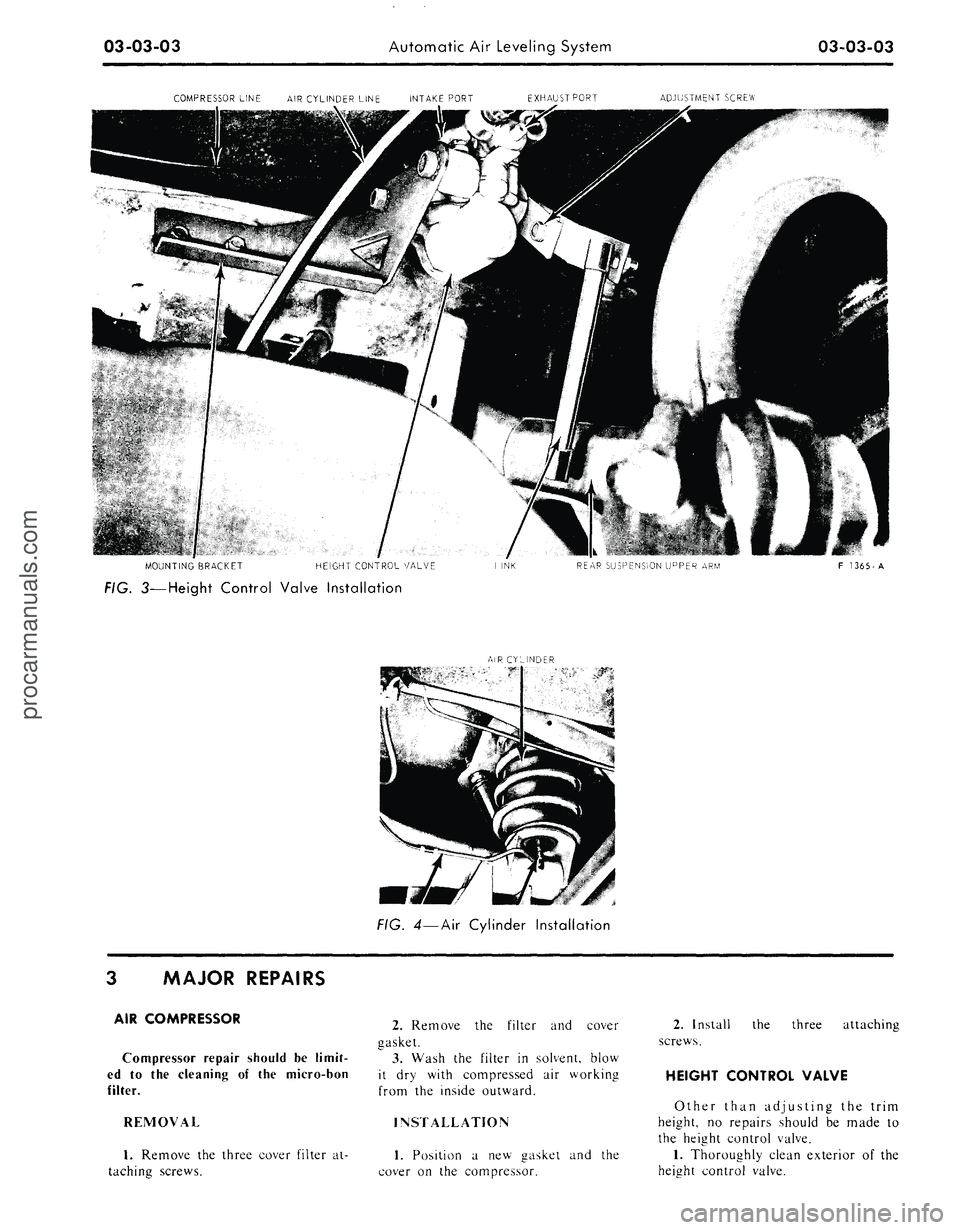
FIG. 3—Height Control Valve Installation
Al R CYLINDER
F 1365-A
FIG. 4—Air Cylinder Installation
3 MAJOR REPAIRS
AIR COMPRESSOR
Compressor repair should
be
limit-
ed
to the
cleaning
of the
micro-bon
filter.
REMOVAL
1.
Remove
the
three cover filter
at-
taching screws.
2.
Remove
the
filter
and
cover
gasket.
3.
Wash
the
filter
in
solvent, blow
it
dry
with compressed
air
working
from
the
inside outward.
INSTALLATION
1.
Position
a new
gasket
and the
cover
on the
compressor.
2.
Install
the
three attaching
screws.
HEIGHT CONTROL VALVE
Other than adjusting
the
trim
height,
no
repairs should
be
made
to
the height control valve.
1.
Thoroughly clean exterior
of the
height control valve.procarmanuals.com
Page 317 of 413
07-02-09
C4 Automatic Transmission
07-02-09
11.
Remove the handle from the se-
lector lever.
12.
Install the selector housing and
lever assembly as shown in Figure 8.
Torque the attaching bolts 4-6 ft-lbs.
13.
Connect the dial indicator light.
14.
Install the pointer back-up
shield on the housing and lever assem-
bly.
15.
Install the dial housing and
tighten the attaching screws.
16.
Install the selector lever handle
and tighten the attaching screw.
17.
Position the selector lever in the
D position.
18.
Raise the vehicle. Install the
transmission manual lever rod to the
selector lever. Adjust the manual link-
age.
19.
Lower the vehicle and check the
transmission operation in each selo:c-
tor lever detent position.
BAND ADJUSTMENT
INTERMEDIATE BAND
1.
Clean all the dirt from the band
adjusting screw area. Remove and dis-
card the locknut.
2.
Install a new locknut on the ad-
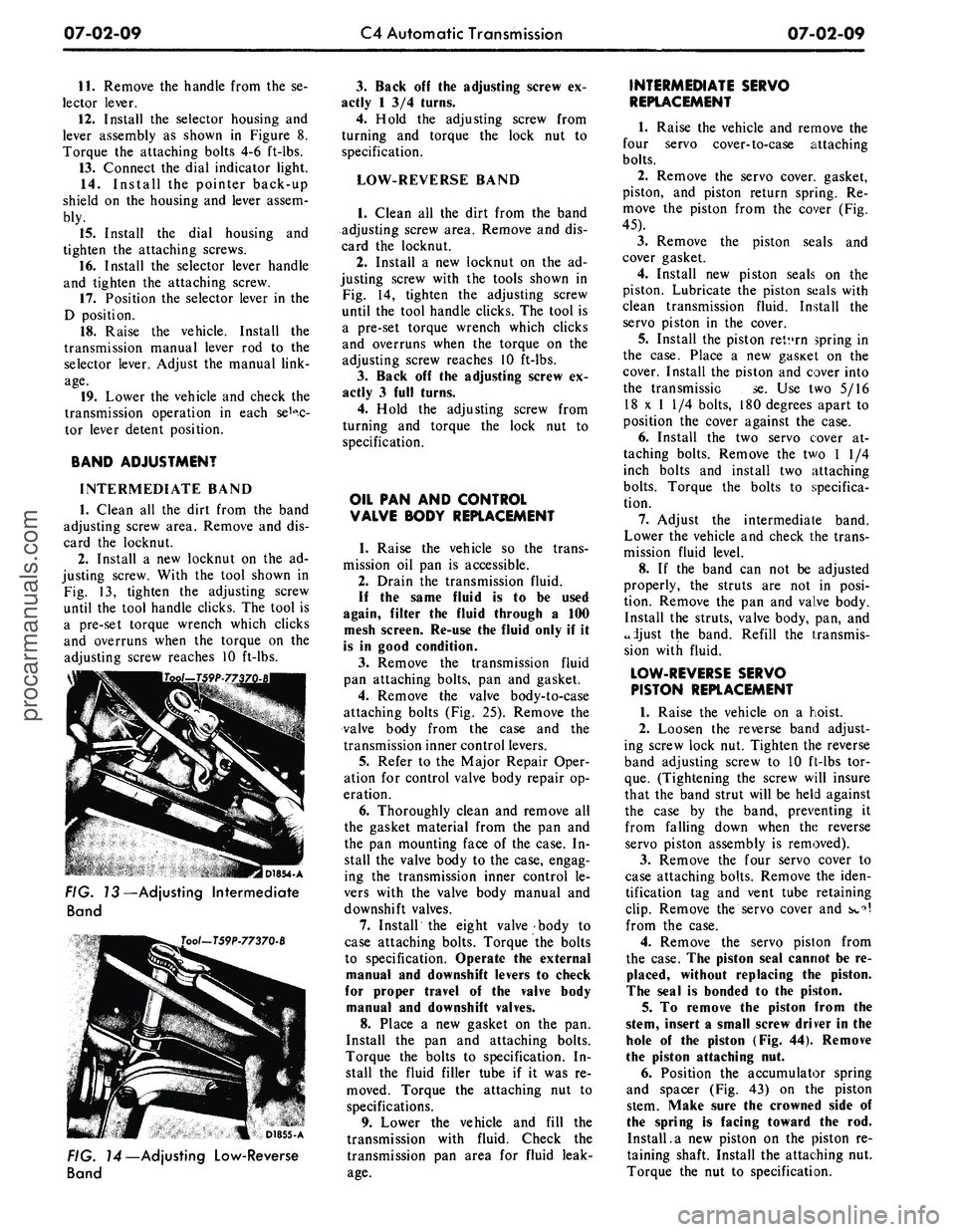
justing screw. With the tool shown in
Fig. 13, tighten the adjusting screw
until the tool handle clicks. The tool is
a pre-set torque wrench which clicks
and overruns when the torque on the
adjusting screw reaches 10 ft-lbs.
I D1854-A
FIG. 13—Adjusting Intermediate
Band
Tool-T59P-77370-B
D1855-A
FIG. 14—Adjusting Low-Reverse
Band
3.
Back off the adjusting screw ex-
actly 1 3/4 turns.
4.
Hold the adjusting screw from
turning and torque the lock nut to
specification.
LOW-REVERSE BAND
1.
Clean all the dirt from the band
adjusting screw area. Remove and dis-
card the locknut.
2.
Install a new locknut on the ad-
justing screw with the tools shown in
Fig. 14, tighten the adjusting screw
until the tool handle clicks. The tool is
a pre-set torque wrench which clicks
and overruns when the torque on the
adjusting screw reaches 10 ft-lbs.
3.
Back off the adjusting screw ex-
actly 3 full turns.
4.
Hold the adjusting screw from
turning and torque the lock nut to
specification.
OIL PAN AND CONTROL
VALVE BODY REPLACEMENT
1.
Raise the vehicle so the trans-
mission oil pan is accessible.
2.
Drain the transmission fluid.
If the same fluid is to be used
again, filter the fluid through a 100
mesh screen. Re-use the fluid only if it
is in good condition.
3.
Remove the transmission fluid
pan attaching bolts, pan and gasket.
4.
Remove the valve body-to-case
attaching bolts (Fig. 25). Remove the
valve body from the case and the
transmission inner control levers.
5.
Refer to the Major Repair Oper-
ation for control valve body repair op-
eration.
6. Thoroughly clean and remove all
the gasket material from the pan and
the pan mounting face of the case. In-
stall the valve body to the case, engag-
ing the transmission inner control le-
vers with the valve body manual and
downshift valves.
7.
Install the eight valve body to
case attaching bolts. Torque the bolts
to specification. Operate the external
manual and downshift levers to check
for proper travel of the valve body
manual and downshift valves.
8. Place a new gasket on the pan.
Install the pan and attaching bolts.
Torque the bolts to specification. In-
stall the fluid filler tube if it was re-
moved. Torque the attaching nut to
specifications.
9. Lower the vehicle and fill the
transmission with fluid. Check the
transmission pan area for fluid leak-
age.
INTERMEDIATE SERVO
REPLACEMENT
1.
Raise the vehicle and remove the
four servo cover-to-case attaching
bolts.
2.
Remove the servo cover, gasket,
piston, and piston return spring. Re-
move the piston from the cover (Fig.
45).
3.
Remove the piston seals and
cover gasket.
4.
Install new piston seals on the
piston. Lubricate the piston seals with
clean transmission fluid. Install the
servo piston in the cover.
5.
Install the piston retvrn spring in
the case. Place a new gasicet on the
cover. Install the piston and cover into
the transmissic se. Use two 5/16
18 x 1 1/4 bolts, 180 degrees apart to
position the cover against the case.
6. Install the two servo cover at-
taching bolts. Remove the two 1 1/4
inch bolts and install two attaching
bolts.
Torque the bolts to specifica-
tion.
7.
Adjust the intermediate band.
Lower the vehicle and check the trans-
mission fluid level.
8. If the band can not be adjusted
properly, the struts are not in posi-
tion. Remove the pan and valve body.
Install the struts, valve body, pan, and
adjust the band. Refill the transmis-
sion with fluid.
LOW-REVERSE SERVO
PISTON REPLACEMENT
1.
Raise the vehicle on a hoist.
2.
Loosen the reverse band adjust-
ing screw lock nut. Tighten the reverse
band adjusting screw to 10 ft-lbs tor-
que.
(Tightening the screw will insure
that the band strut will be held against
the case by the band, preventing it
from falling down when the reverse
servo piston assembly is removed).
3.
Remove the four servo cover to
case attaching bolts. Remove the iden-
tification tag and vent tube retaining
clip.
Remove the servo cover and s»»^
from the case.
4.
Remove the servo piston from
the case. The piston seal cannot be re-
placed, without replacing the piston.
The seal is bonded to the piston.
5. To remove the piston from the
stem, insert a small screw driver in the
hole of the piston (Fig. 44). Remove
the piston attaching nut.
6. Position the accumulator spring
and spacer (Fig. 43) on the piston
stem. Make sure the crowned side of
the spring is facing toward the rod.
Install.a new piston on the piston re-
taining shaft. Install the attaching nut.
Torque the nut to specification.procarmanuals.com
Page 341 of 413
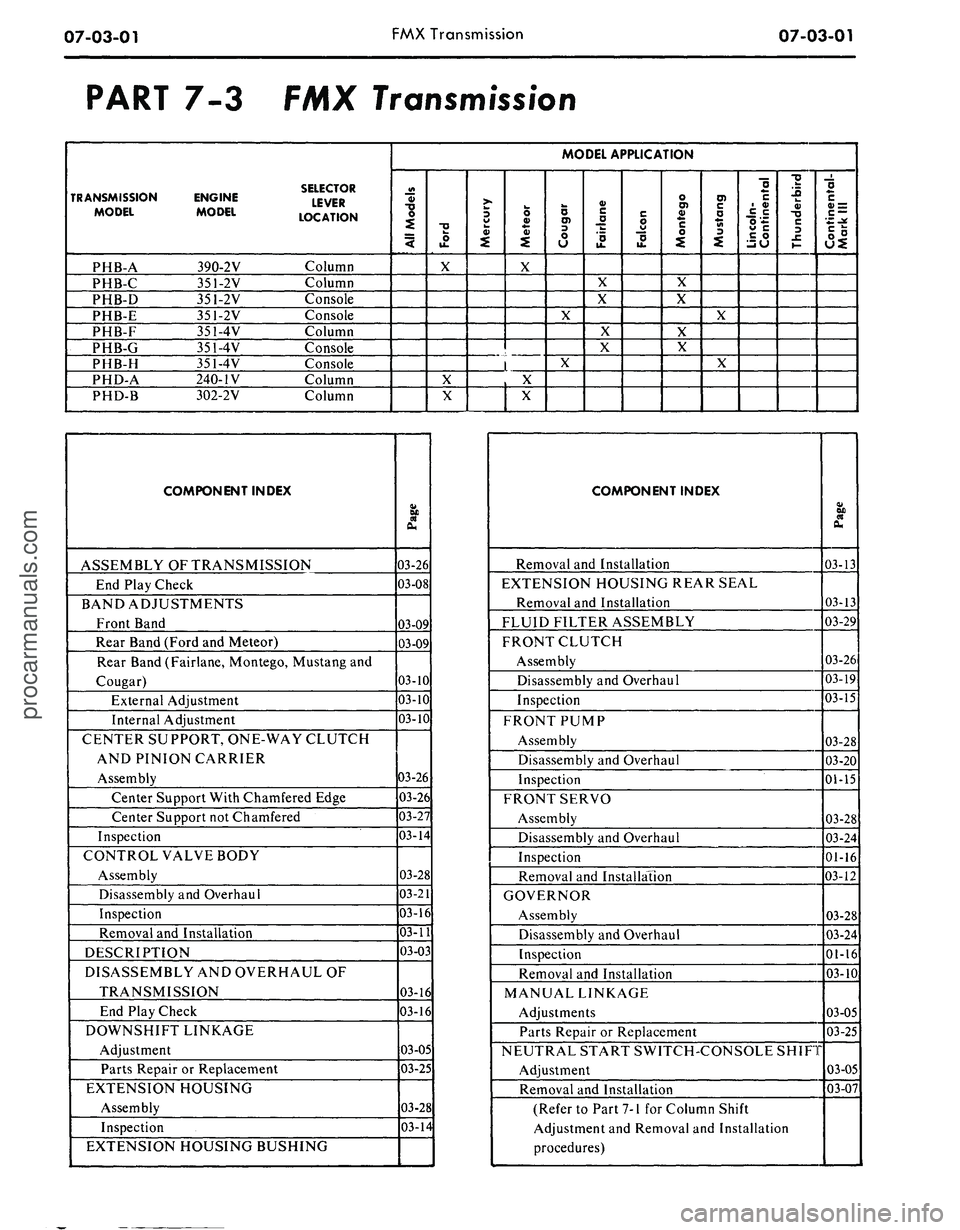
07-03-01
FMX Transmission
07-03-01
PART
7-3 FMX
Transmission
SELECTOR
TRANSMISSION ENGINE LEVER
MODEL MODEL LOCATION
PHB-A 390-2V Column
PHB-C 351-2V Column
PHB-D 351-2V Console
PHB-E 351-2V Console
PHB-F 351-4V Column
PHB-G 351-4V Console
PHB-H 351-4V Console
PHD-A 240-1V Column
PHD-B 302-2V Column
MODEL APPLICATION
All
Models
Ford
X
X
X
Mercury
Meteor
X
X
X
Cougar
X
X
Fairlane
X
X
X
X
Falcon
Montego
X
X
X
X
Mustang
X
X
Lincoln-
Continental
Thunderbird
Continental-
Mark III
COMPONENT INDEX
ASSEMBLY
OF
TRANSMISSION
End Play Check
BAND ADJUSTMENTS
Front Band
Rear Band (Ford
and
Meteor)
Rear Band (Fairlane, Montego, Mustang
and
Cougar)
External Adjustment
Internal Adjustment
CENTER SUPPORT, ONE-WAY CLUTCH
AND PINION CARRIER
Assembly
Center Support With Chamfered Edge
Center Support
not
Chamfered
Inspection
CONTROL VALVE BODY
Assembly
Disassembly
and
Overhaul
Inspection
Removal
and
Installation
DESCRIPTION
DISASSEMBLY
AND
OVERHAUL
OF
TRANSMISSION
End Play Check
DOWNSHIFT LINKAGE
Adjustment
Parts Repair
or
Replacement
EXTENSION HOUSING
Assembly
Inspection
EXTENSION HOUSING BUSHING
Page
03-26
03-08
03-09
03-09
03-10
03-10
03-10
03-26
03-26
03-27
03-14
03-28
03-21
03-16
03-11
03-03
03-16
03-16
03-05
03-25
03-28
03-14
COMPONENT INDEX
Removal
and
Installation
EXTENSION HOUSING REAR SEAL
Removal
and
Installation
FLUID FILTER ASSEMBLY
FRONT CLUTCH
Assembly
Disassembly
and
Overhaul
Inspection
FRONT PUMP
Assembly
Disassembly
and
Overhaul
Inspection
FRONT SERVO
Assembly
Disassembly
and
Overhaul
Inspection
Removal
and
Installation
GOVERNOR
Assembly
Disassembly
and
Overhaul
Inspection
Removal
and
Installation
MANUAL LINKAGE
Adjustments
Parts Repair
or
Replacement
NEUTRAL START SWITCH-CONSOLE SHIFT
Adjustment
Removal
and
Installation
(Refer
to
Part 7-1
for
Column Shift
Adjustment
and
Removal
and
Installation
procedures)
1
Page
03-13
03-13
03-29
03-26
03-19
03-15
03-28
03-20
01-15
03-28
03-24
01-16
03-12
03-28
03-24
01-16
03-10
03-05
03-25
03-05
03-07
procarmanuals.com
Page 350 of 413
07-03-10
FMX Transmission
07-03-10
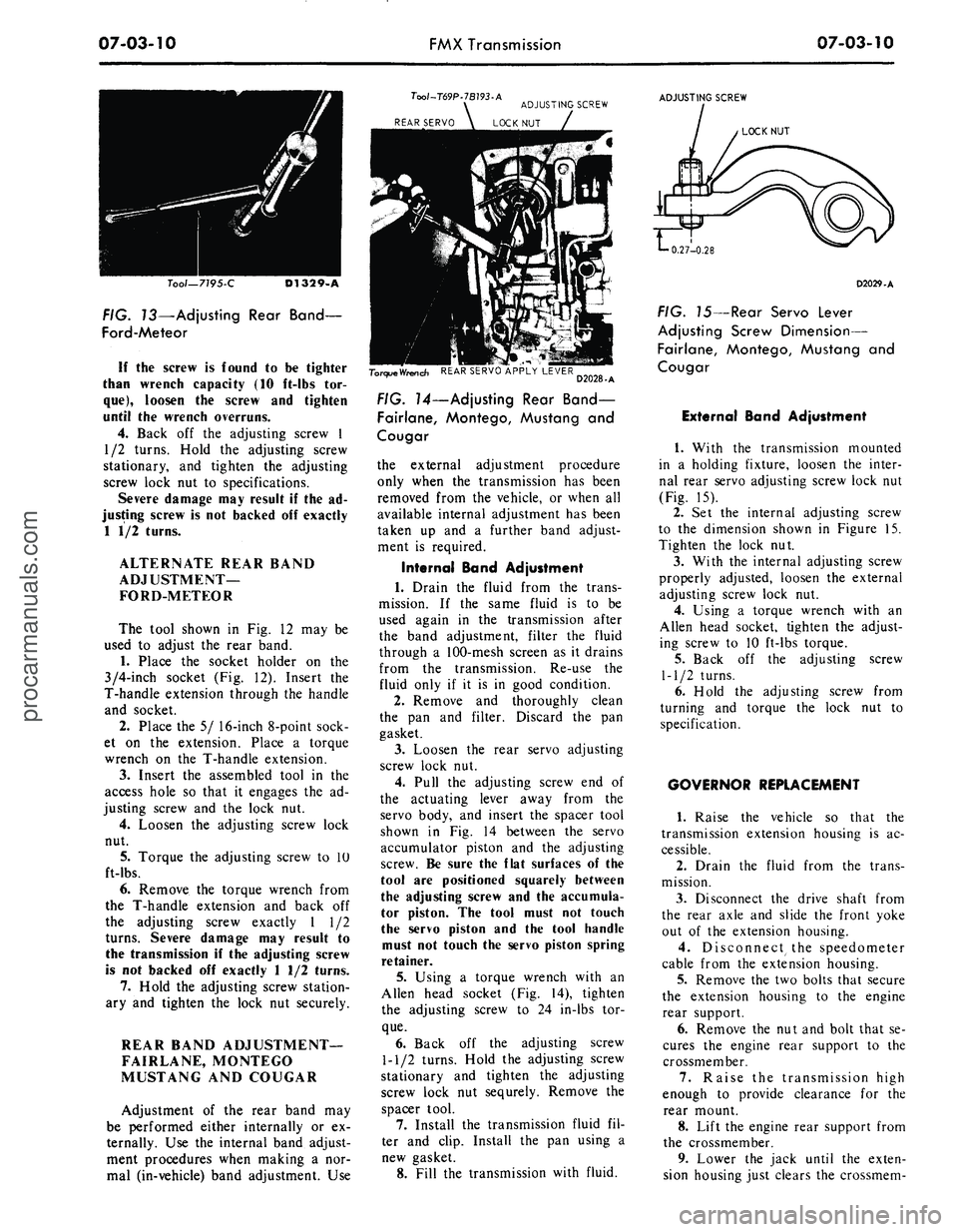
Too/-T69P-7B793-A
ADJUSTING SCREW
REAR SERVO \ LOCK NUT
Tool—7795-C
D1329-A
FIG. 13—Adjusting Rear Band—
Ford-Meteor
If
the
screw
is
found
to be
tighter
than
wrench
capacity
(10
ft-lbs
tor-
que),
loosen
the
screw
and
tighten
until
the
wrench
overruns.
4.
Back off the adjusting screw 1
1/2 turns. Hold the adjusting screw
stationary, and tighten the adjusting
screw lock nut to specifications.
Severe damage may result if the ad-
justing screw is not backed off exactly
1 1/2 turns.
ALTERNATE REAR BAND
ADJUSTMENT—
FORD-METEOR
The tool shown in Fig. 12 may be
used to adjust the rear band.
1.
Place the socket holder on the
3/4-inch socket (Fig. 12). Insert the
T-handle extension through the handle
and socket.
2.
Place the 5/ 16-inch 8-point sock-
et on the extension. Place a torque
wrench on the T-handle extension.
3.
Insert the assembled tool in the
access hole so that it engages the ad-
justing screw and the lock nut.
4.
Loosen the adjusting screw lock
nut.
5.
Torque the adjusting screw to 10
ft-lbs.
6. Remove the torque wrench from
the T-handle extension and back off
the adjusting screw exactly 1 1/2
turns.
Severe
damage
may
result
to
the
transmission
if the
adjusting
screw
is
not
backed
off
exactly
11/2
turns.
7.
Hold the adjusting screw station-
ary and tighten the lock nut securely.
REAR BAND ADJUSTMENT—
FAIRLANE, MONTEGO
MUSTANG AND COUGAR
Adjustment of the rear band may
be performed either internally or ex-
ternally. Use the internal band adjust-
ment procedures when making a nor-
mal (in-vehicle) band adjustment. Use
ADJUSTING SCREW
LOCK NUT
I
IN
TorqueWrench REAR SERVO APPLY LEVER
D2028-A
FIG. 14—Adjusting Rear Band—
Fairlane, Montego, Mustang and
Cougar
the external adjustment procedure
only when the transmission has been
removed from the vehicle, or when all
available internal adjustment has been
taken up and a further band adjust-
ment is required.
Internal Band Adjustment
1.
Drain the fluid from the trans-
mission. If the same fluid is to be
used again in the transmission after
the band adjustment, filter the fluid
through a 100-mesh screen as it drains
from the transmission. Re-use the
fluid only if it is in good condition.
2.
Remove and thoroughly clean
the pan and filter. Discard the pan
gasket.
3.
Loosen the rear servo adjusting
screw lock nut.
4.
Pull the adjusting screw end of
the actuating lever away from the
servo body, and insert the spacer tool
shown in Fig. 14 between the servo
accumulator piston and the adjusting
screw.
Be
sure
the
flat
surfaces
of the
tool
are
positioned
squarely
between
the
adjusting
screw
and the
accumula-
tor
piston.
The
tool must
not
touch
the servo
piston
and the
tool
handle
must
not
touch
the
servo
piston
spring
retainer.
5.
Using a torque wrench with an
Allen head socket (Fig. 14), tighten
the adjusting screw to 24 in-lbs tor-
que.
6. Back off the adjusting screw
1-1/2 turns. Hold the adjusting screw
stationary and tighten the adjusting
screw lock nut sequrely. Remove the
spacer tool.
7.
Install the transmission fluid fil-
ter and clip. Install the pan using a
new gasket.
8. Fill the transmission with fluid.
D2029-A
FIG. 15—Rear Servo Lever
Adjusting Screw Dimension—
Fairlane, Montego, Mustang and
Cougar
External Band Adjustment
1.
With the transmission mounted
in a holding fixture, loosen the inter-
nal rear servo adjusting screw lock nut
(Fig. 15).
2.
Set the internal adjusting screw
to the dimension shown in Figure 15.
Tighten the lock nut.
3.
With the internal adjusting screw
properly adjusted, loosen the external
adjusting screw lock nut.
4.
Using a torque wrench with an
Allen head socket, tighten the adjust-
ing screw to 10 ft-lbs torque.
5.
Back off the adjusting screw
1-1/2 turns.
6. Hold the adjusting screw from
turning and torque the lock nut to
specification.
GOVERNOR REPLACEMENT
1.
Raise the vehicle so that the
transmission extension housing is ac-
cessible.
2.
Drain the fluid from the trans-
mission.
3.
Disconnect the drive shaft from
the rear axle and slide the front yoke
out of the extension housing.
4.
Disconnect the speedometer
cable from the extension housing.
5.
Remove the two bolts that secure
the extension housing to the engine
rear support.
6. Remove the nut and bolt that se-
cures the engine rear support to the
crossmember.
7.
Raise the transmission high
enough to provide clearance for the
rear mount.
8. Lift the engine rear support from
the crossmember.
9. Lower the jack until the exten-
sion housing just clears the crossmem-procarmanuals.com
Page 353 of 413
07-03-13
FMX Transmission
07-03-13
EXTENSION HOUSING
BUSHING AND REAR SEAL
REPLACEMENT
1.
Disconnect the drive shaft from
the transmission.
2.
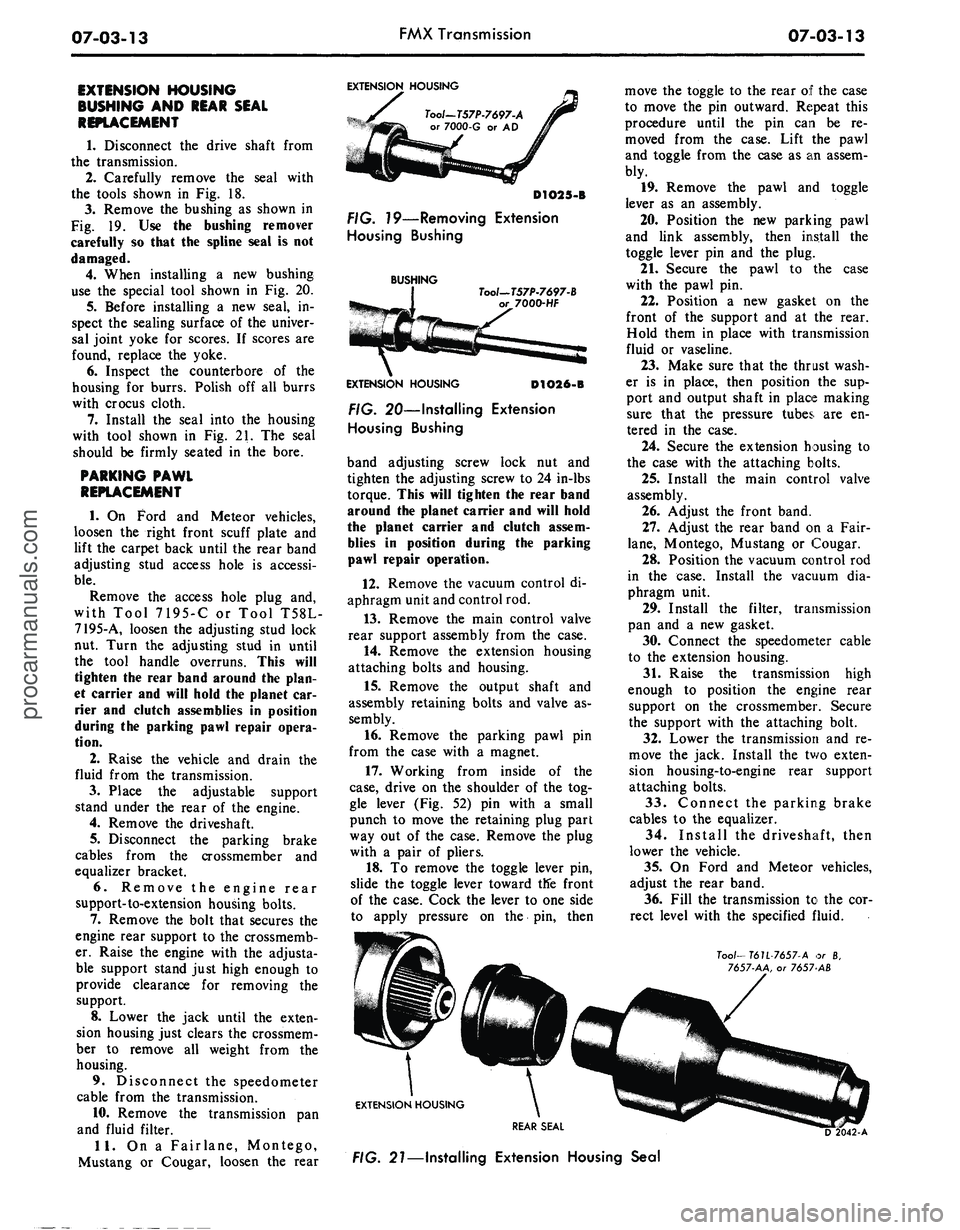
Carefully remove the seal with
the tools shown in Fig. 18.
3.
Remove the bushing as shown in
Fig. 19. Use the bushing remover
carefully so that the spline seal is not
damaged.
4.
When installing a new bushing
use the special tool shown in Fig. 20.
5.
Before installing a new seal, in-
spect the sealing surface of the univer-
sal joint yoke for scores. If scores are
found, replace the yoke.
6. Inspect the counterbore of the
housing for burrs. Polish off all burrs
with crocus cloth.
7.
Install the seal into the housing
with tool shown in Fig. 21. The seal
should be firmly seated in the bore.
PARKING PAWL
REPLACEMENT
1.
On Ford and Meteor vehicles,
loosen the right front scuff plate and
lift the carpet back until the rear band
adjusting stud access hole is accessi-
ble.
Remove the access hole plug and,
with Tool 7195-C or Tool T58L-
7195-A, loosen the adjusting stud lock
nut. Turn the adjusting stud in until
the tool handle overruns. This will
tighten the rear band around the plan-
et carrier and will hold the planet car-
rier and clutch assemblies in position
during the parking pawl repair opera-
tion.
2.
Raise the vehicle and drain the
fluid from the transmission.
3.
Place the adjustable support
stand under the rear of the engine.
4.
Remove the driveshaft.
5.
Disconnect the parking brake
cables from the crossmember and
equalizer bracket.
6. Remove the engine rear
support-to-extension housing bolts.
7.
Remove the bolt that secures the
engine rear support to the crossmemb-
er. Raise the engine with the adjusta-
ble support stand just high enough to
provide clearance for removing the
support.
8. Lower the jack until the exten-
sion housing just clears the crossmem-
ber to remove all weight from the
housing.
9. Disconnect the speedometer
cable from the transmission.
10.
Remove the transmission pan
and fluid filter.
11.
On a Fairlane, Montego,
Mustang or Cougar, loosen the rear
EXTENSION HOUSING
Tool-T57P-7697-A
or 7000-G or AD
D1O25-B
FIG. 79—Removing Extension
Housing Bushing
BUSHING
Tool—T57P-7697-B
7000-HF
EXTENSION HOUSING
D1O26-B
FIG. 20—Installing Extension
Housing Bushing
band adjusting screw lock nut and
tighten the adjusting screw to 24 in-lbs
torque. This will tighten the rear band
around the planet carrier and will hold
the planet carrier and clutch assem-
blies in position during the parking
pawl repair operation.
12.
Remove the vacuum control di-
aphragm unit and control rod.
13.
Remove the main control valve
rear support assembly from the case.
14.
Remove the extension housing
attaching bolts and housing.
15.
Remove the output shaft and
assembly retaining bolts and valve as-
sembly.
16.
Remove the parking pawl pin
from the case with a magnet.
17.
Working from inside of the
case,
drive on the shoulder of the tog-
gle lever (Fig. 52) pin with a small
punch to move the retaining plug part
way out of the case. Remove the plug
with a pair of pliers.
18.
To remove the toggle lever pin,
slide the toggle lever toward tlfe front
of the case. Cock the lever to one side
to apply pressure on the pin, then
move the toggle to the rear of the case
to move the pin outward. Repeat this
procedure until the pin can be re-
moved from the case. Lift the pawl
and toggle from the case as an assem-
bly.
19.
Remove the pawl and toggle
lever as an assembly.
20.
Position the new parking pawl
and link assembly, then install the
toggle lever pin and the plug.
21.
Secure the pawl to the case
with the pawl pin.
22.
Position a new gasket on the
front of the support and at the rear.
Hold them in place with transmission
fluid or vaseline.
23.
Make sure that the thrust wash-
er is in place, then position the sup-
port and output shaft in place making
sure that the pressure tubes are en-
tered in the case.
24.
Secure the extension housing to
the case with the attaching bolts.
25.
Install the main control valve
assembly.
26.
Adjust the front band.
27.
Adjust the rear band on a Fair-
lane,
Montego, Mustang or Cougar.
28.
Position the vacuum control rod
in the case. Install the vacuum dia-
phragm unit.
29.
Install the filter, transmission
pan and a new gasket.
30.
Connect the speedometer cable
to the extension housing.
31.
Raise the transmission high
enough to position the engine rear
support on the crossmember. Secure
the support with the attaching bolt.
32.
Lower the transmission and re-
move the jack. Install the two exten-
sion housing-to-engine rear support
attaching bolts.
33.
Connect the parking brake
cables to the equalizer.
34.
Install the driveshaft, then
lower the vehicle.
35.
On Ford and Meteor vehicles,
adjust the rear band.
36.
Fill the transmission to the cor-
rect level with the specified fluid.
Too/—
T6U-7657-A or 8,
7657-AA, or 7657 AB
EXTENSION HOUSING
REAR SEAL
FIG. 21—Installing Extension Housing Sealprocarmanuals.com