light FORD MUSTANG 2008 5.G Repair Manual
[x] Cancel search | Manufacturer: FORD, Model Year: 2008, Model line: MUSTANG, Model: FORD MUSTANG 2008 5.GPages: 280, PDF Size: 2.69 MB
Page 172 of 280
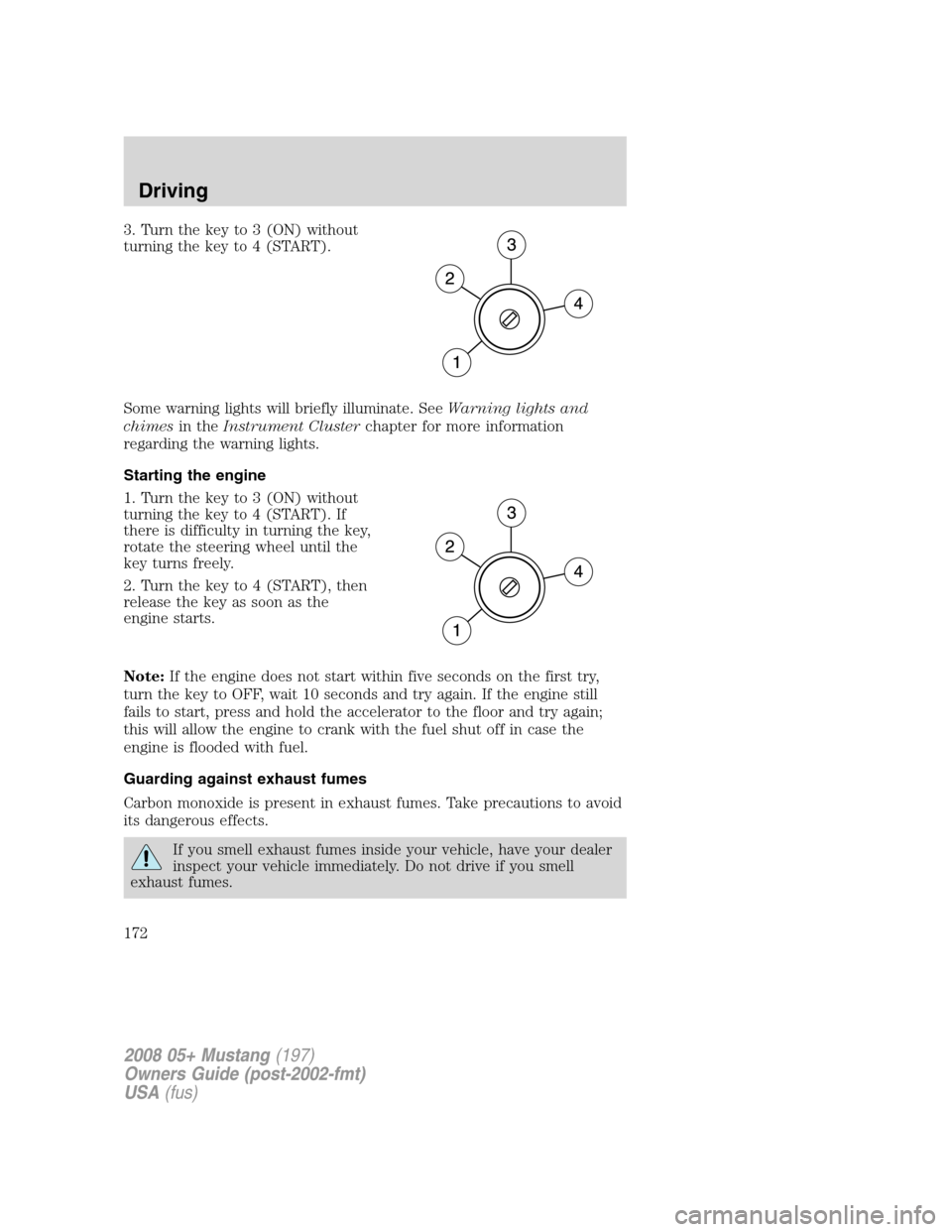
3. Turn the key to 3 (ON) without
turning the key to 4 (START).
Some warning lights will briefly illuminate. SeeWarning lights and
chimesin theInstrument Clusterchapter for more information
regarding the warning lights.
Starting the engine
1. Turn the key to 3 (ON) without
turning the key to 4 (START). If
there is difficulty in turning the key,
rotate the steering wheel until the
key turns freely.
2. Turn the key to 4 (START), then
release the key as soon as the
engine starts.
Note:If the engine does not start within five seconds on the first try,
turn the key to OFF, wait 10 seconds and try again. If the engine still
fails to start, press and hold the accelerator to the floor and try again;
this will allow the engine to crank with the fuel shut off in case the
engine is flooded with fuel.
Guarding against exhaust fumes
Carbon monoxide is present in exhaust fumes. Take precautions to avoid
its dangerous effects.
If you smell exhaust fumes inside your vehicle, have your dealer
inspect your vehicle immediately. Do not drive if you smell
exhaust fumes.
2008 05+ Mustang(197)
Owners Guide (post-2002-fmt)
USA(fus)
Driving
172
Page 175 of 280
BRAKES
Occasional brake noise is normal. If a metal-to-metal, continuous grinding
or continuous squeal sound is present, the brake linings may be worn-out
and should be inspected by an authorized dealer. If the vehicle has
continuous vibration or shudder in the steering wheel while braking, the
vehicle should be inspected by an authorized dealer.
Refer toBrake system warning
lightin theInstrument Cluster
chapter for information on the brake
system warning light.
Four-wheel anti-lock brake system (ABS) (if equipped)
Your vehicle may be equipped with an Anti-lock Braking System (ABS).
This system helps you maintain steering control during emergency stops
by keeping the brakes from locking. Noise from the ABS pump motor
and brake pedal pulsation may be observed during ABS braking; any
pulsation or mechanical noise you may feel or hear is normal.
ABS warning lamp
The ABS lamp in the instrument
cluster momentarily illuminates
when the ignition is turned on. If
the light does not illuminate during
start up, remains on or flashes, the
ABS may be disabled and may need to be serviced.
Even when the ABS is disabled,
normal braking is still effective. (If
your BRAKE warning lamp
illuminates with the parking brake
released, have your brake system
serviced immediately.)
Using ABS
When hard braking is required, apply continuous force on the brake
pedal; do not pump the brake pedal since this will reduce the
effectiveness of the ABS and will increase your vehicle’s stopping
distance. The ABS will be activated immediately, allowing you to retain
steering control during hard braking and on slippery surfaces. However,
the ABS does not decrease stopping distance.
P!
BRAKE
ABS
P!
BRAKE
2008 05+ Mustang(197)
Owners Guide (post-2002-fmt)
USA(fus)
Driving
175
Page 176 of 280
Parking brake
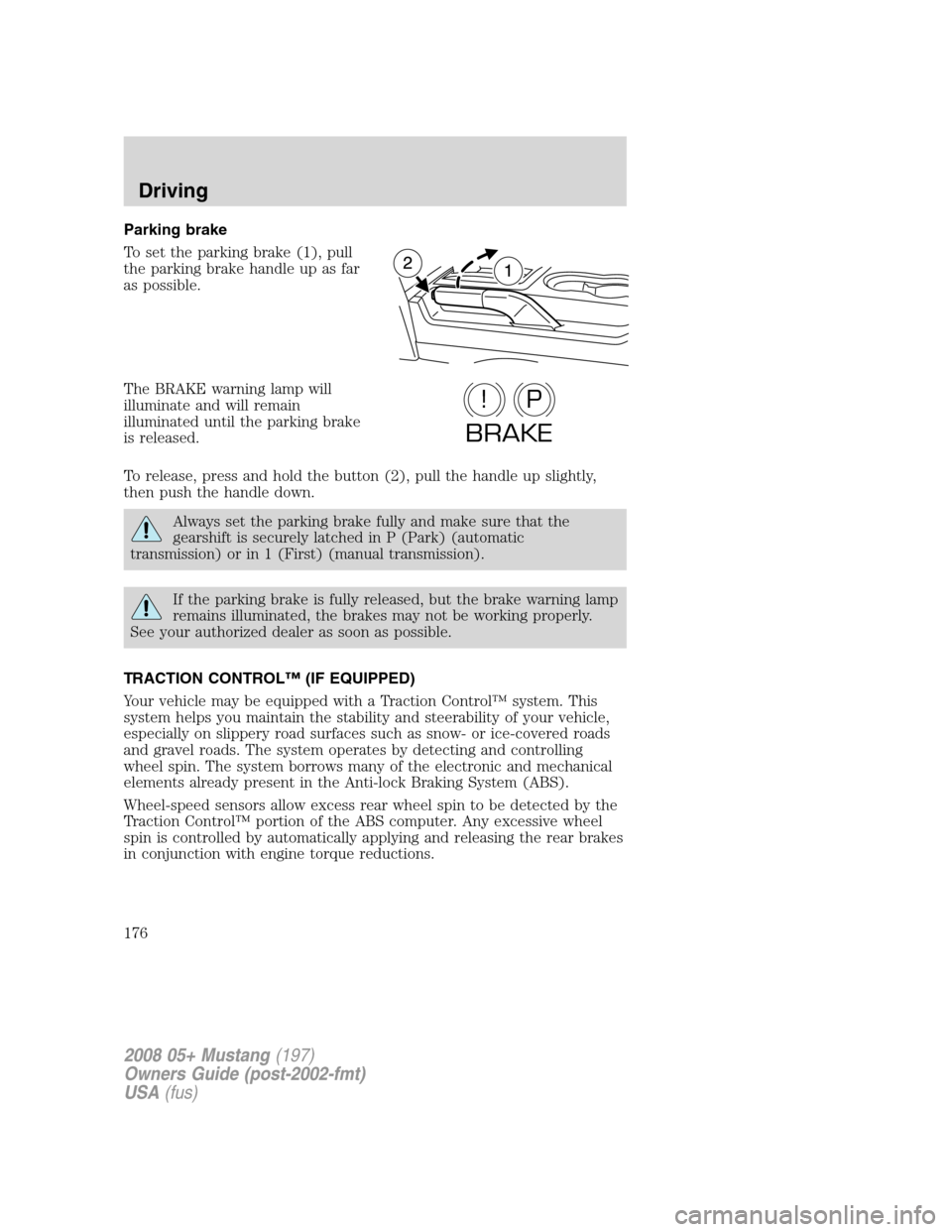
To set the parking brake (1), pull
the parking brake handle up as far
as possible.
The BRAKE warning lamp will
illuminate and will remain
illuminated until the parking brake
is released.
To release, press and hold the button (2), pull the handle up slightly,
then push the handle down.
Always set the parking brake fully and make sure that the
gearshift is securely latched in P (Park) (automatic
transmission) or in 1 (First) (manual transmission).
If the parking brake is fully released, but the brake warning lamp
remains illuminated, the brakes may not be working properly.
See your authorized dealer as soon as possible.
TRACTION CONTROL™ (IF EQUIPPED)
Your vehicle may be equipped with a Traction Control™ system. This
system helps you maintain the stability and steerability of your vehicle,
especially on slippery road surfaces such as snow- or ice-covered roads
and gravel roads. The system operates by detecting and controlling
wheel spin. The system borrows many of the electronic and mechanical
elements already present in the Anti-lock Braking System (ABS).
Wheel-speed sensors allow excess rear wheel spin to be detected by the
Traction Control™ portion of the ABS computer. Any excessive wheel
spin is controlled by automatically applying and releasing the rear brakes
in conjunction with engine torque reductions.
P!
BRAKE
2008 05+ Mustang(197)
Owners Guide (post-2002-fmt)
USA(fus)
Driving
176
Page 177 of 280
The Traction Control™ system will allow your vehicle to make better use
of available traction on slippery surfaces while you are trying to
accelerate or while your foot is on the accelerator pedal. The system is a
driver aid which makes your vehicle easier to handle primarily on snow
and ice covered roads.
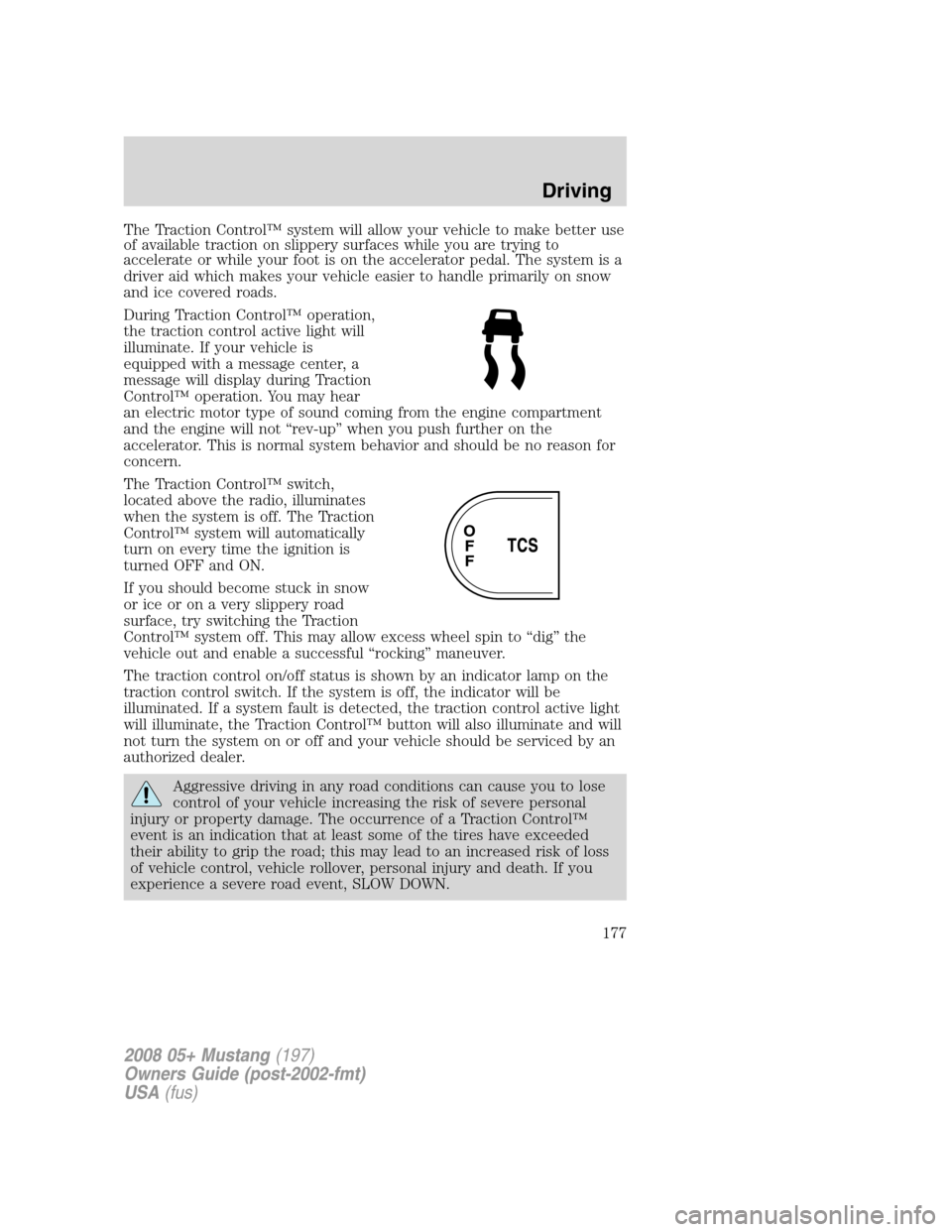
During Traction Control™ operation,
the traction control active light will
illuminate. If your vehicle is
equipped with a message center, a
message will display during Traction
Control™ operation. You may hear
an electric motor type of sound coming from the engine compartment
and the engine will not “rev-up” when you push further on the
accelerator. This is normal system behavior and should be no reason for
concern.
The Traction Control™ switch,
located above the radio, illuminates
when the system is off. The Traction
Control™ system will automatically
turn on every time the ignition is
turned OFF and ON.
If you should become stuck in snow
or ice or on a very slippery road
surface, try switching the Traction
Control™ system off. This may allow excess wheel spin to “dig” the
vehicle out and enable a successful “rocking” maneuver.
The traction control on/off status is shown by an indicator lamp on the
traction control switch. If the system is off, the indicator will be
illuminated. If a system fault is detected, the traction control active light
will illuminate, the Traction Control™ button will also illuminate and will
not turn the system on or off and your vehicle should be serviced by an
authorized dealer.
Aggressive driving in any road conditions can cause you to lose
control of your vehicle increasing the risk of severe personal
injury or property damage. The occurrence of a Traction Control™
event is an indication that at least some of the tires have exceeded
their ability to grip the road; this may lead to an increased risk of loss
of vehicle control, vehicle rollover, personal injury and death. If you
experience a severe road event, SLOW DOWN.
2008 05+ Mustang(197)
Owners Guide (post-2002-fmt)
USA(fus)
Driving
177
Page 180 of 280
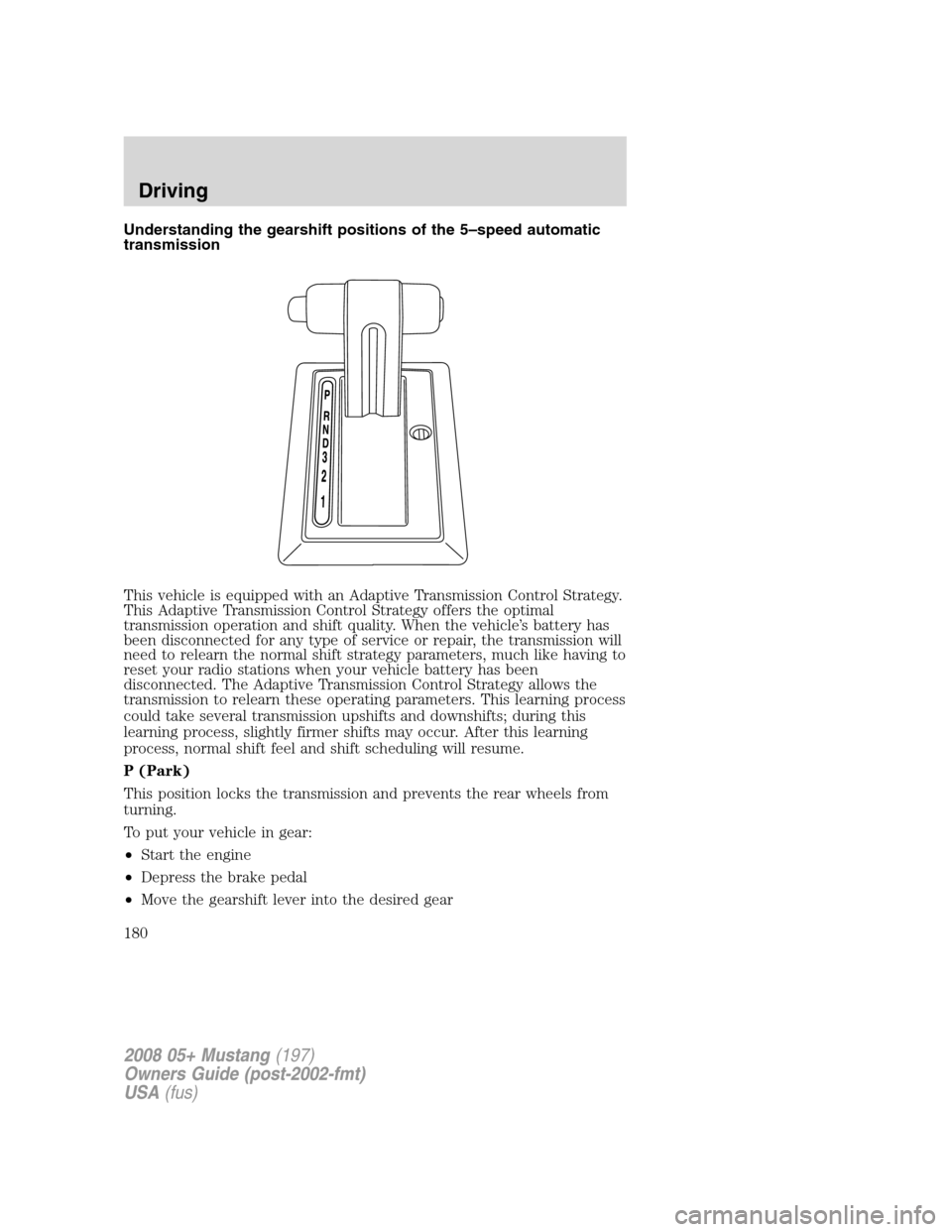
Understanding the gearshift positions of the 5–speed automatic
transmission
This vehicle is equipped with an Adaptive Transmission Control Strategy.
This Adaptive Transmission Control Strategy offers the optimal
transmission operation and shift quality. When the vehicle’s battery has
been disconnected for any type of service or repair, the transmission will
need to relearn the normal shift strategy parameters, much like having to
reset your radio stations when your vehicle battery has been
disconnected. The Adaptive Transmission Control Strategy allows the
transmission to relearn these operating parameters. This learning process
could take several transmission upshifts and downshifts; during this
learning process, slightly firmer shifts may occur. After this learning
process, normal shift feel and shift scheduling will resume.
P (Park)
This position locks the transmission and prevents the rear wheels from
turning.
To put your vehicle in gear:
•Start the engine
•Depress the brake pedal
•Move the gearshift lever into the desired gear
2008 05+ Mustang(197)
Owners Guide (post-2002-fmt)
USA(fus)
Driving
180
Page 182 of 280
•To return to Overdrive mode, press the transmission control switch.
The O/D OFF lamp will not be illuminated.
•Overdrive mode is automatically returned each time the key is turned
off.
3 (Third)
This position allows for third gear only.
•Provides engine braking.
•To return to D (Drive) without Overdrive, move the transmission shift
lever into the D (Drive) position.
•Selecting 3 (Third) at higher speeds will cause the transmission to
downshift to third gear at the appropriate vehicle speed.
2 (Second)
This position allows for second gear only.
•Provides engine braking.
•Use to start-up on slippery roads.
•To return to D (Drive) without Overdrive or 3 (Third), move the
transmission shift lever into the D (Drive) or 3 (Third) position.
•Selecting 2 (Second) at higher speeds will cause the transmission to
downshift to second gear at the appropriate vehicle speed.
1 (First)
This position allows for first gear only.
•Provides maximum engine braking.
•Will not downshift into first gear at high speeds; will cause the
transmission to downshift to a lower gear, then allows for first gear
when the vehicle reaches slower speeds.
Forced downshifts
•Allowed in Overdrive or Drive.
•Depress the accelerator to the floor.
•Allows transmission to select an appropriate gear.
If your vehicle gets stuck in mud or snow
If your vehicle gets stuck in mud or snow, it may be rocked out by
shifting between forward and reverse gears, stopping between shifts in a
steady pattern. Press lightly on the accelerator in each gear.
Do not rock the vehicle if the engine is not at normal operating
temperature or damage to the transmission may occur.
2008 05+ Mustang(197)
Owners Guide (post-2002-fmt)
USA(fus)
Driving
182
Page 185 of 280
DRIVING THROUGH WATER
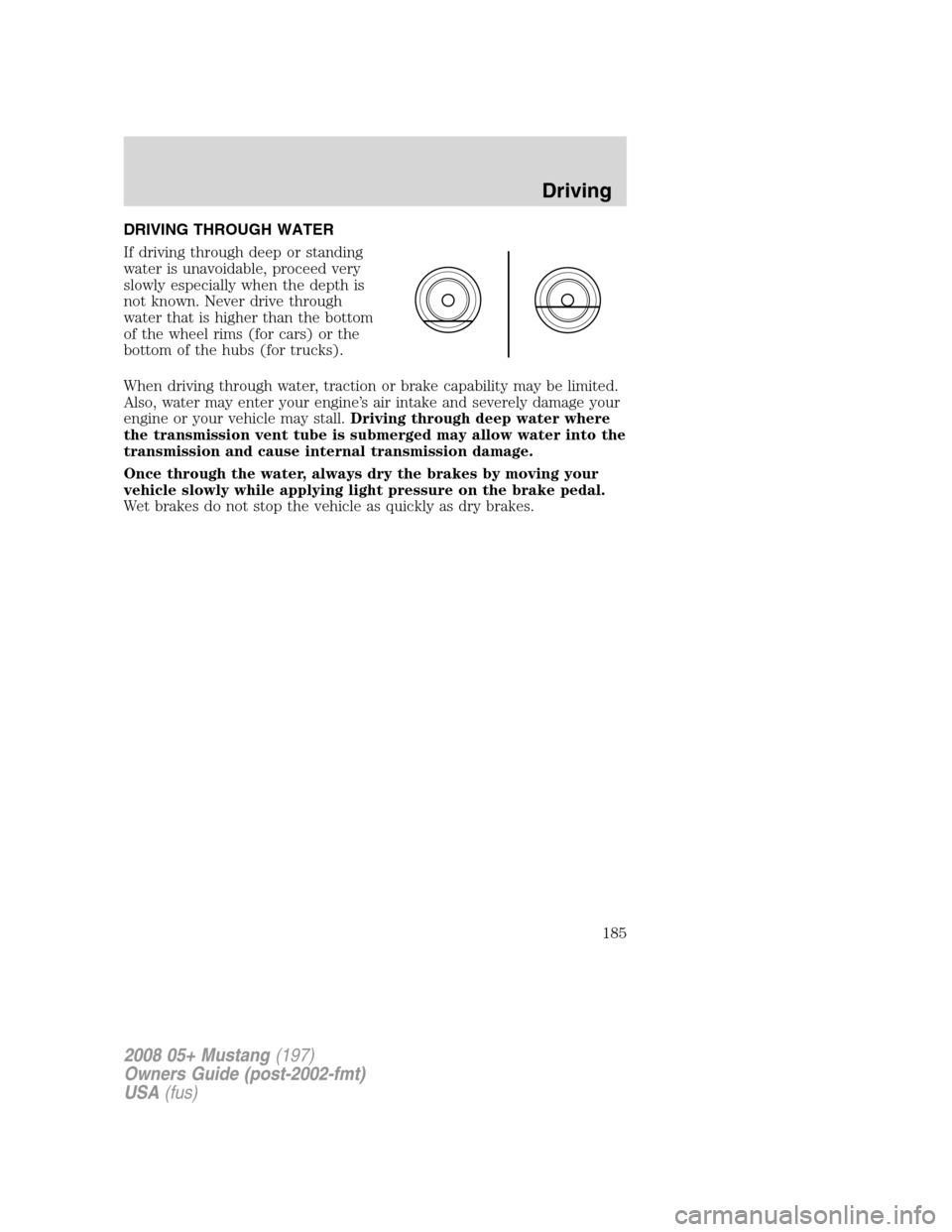
If driving through deep or standing
water is unavoidable, proceed very
slowly especially when the depth is
not known. Never drive through
water that is higher than the bottom
of the wheel rims (for cars) or the
bottom of the hubs (for trucks).
When driving through water, traction or brake capability may be limited.
Also, water may enter your engine’s air intake and severely damage your
engine or your vehicle may stall.Driving through deep water where
the transmission vent tube is submerged may allow water into the
transmission and cause internal transmission damage.
Once through the water, always dry the brakes by moving your
vehicle slowly while applying light pressure on the brake pedal.
Wet brakes do not stop the vehicle as quickly as dry brakes.
2008 05+ Mustang(197)
Owners Guide (post-2002-fmt)
USA(fus)
Driving
185
Page 190 of 280
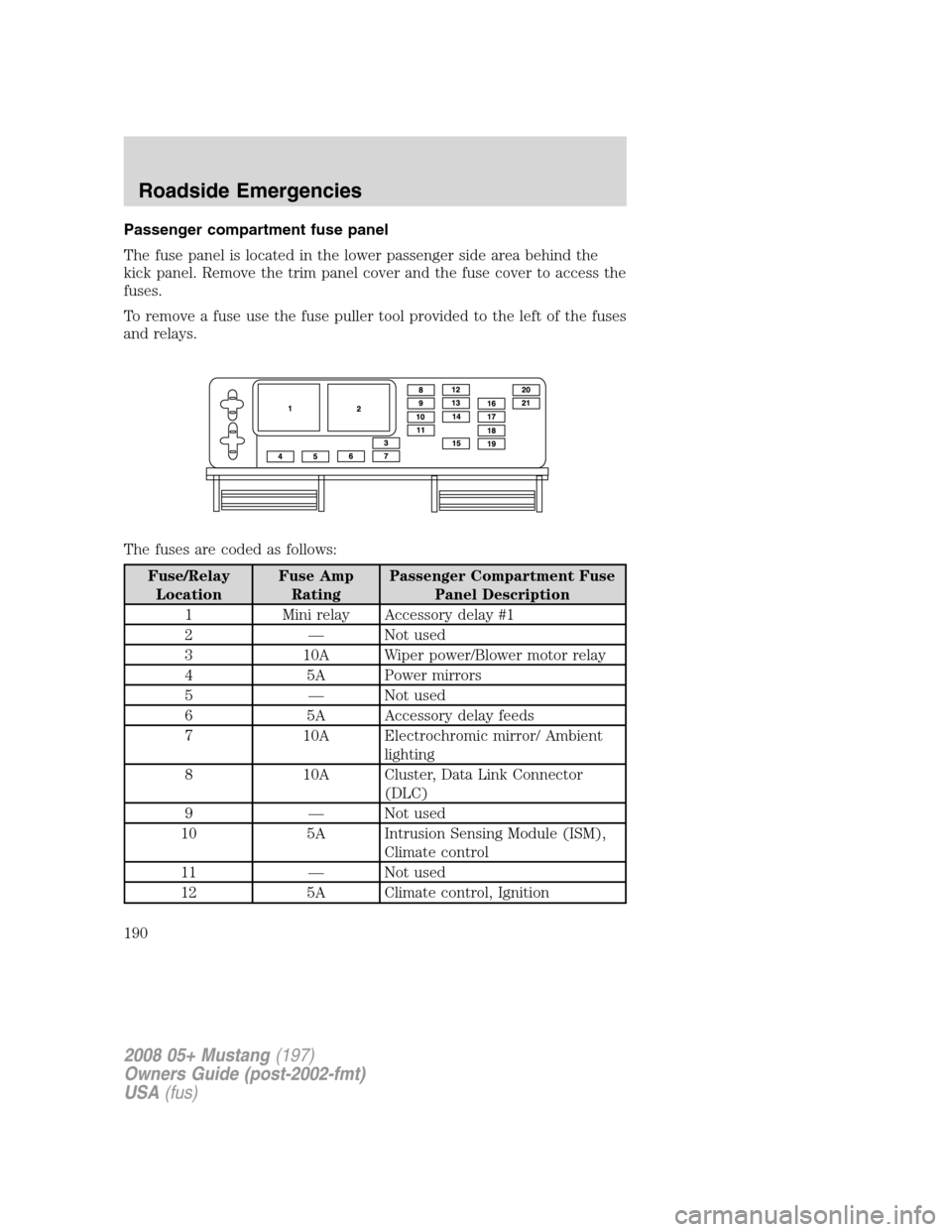
Passenger compartment fuse panel
The fuse panel is located in the lower passenger side area behind the
kick panel. Remove the trim panel cover and the fuse cover to access the
fuses.
To remove a fuse use the fuse puller tool provided to the left of the fuses
and relays.
The fuses are coded as follows:
Fuse/Relay
LocationFuse Amp
RatingPassenger Compartment Fuse
Panel Description
1 Mini relay Accessory delay #1
2 — Not used
3 10A Wiper power/Blower motor relay
4 5A Power mirrors
5 — Not used
6 5A Accessory delay feeds
7 10A Electrochromic mirror/ Ambient
lighting
8 10A Cluster, Data Link Connector
(DLC)
9 — Not used
10 5A Intrusion Sensing Module (ISM),
Climate control
11 — Not used
12 5A Climate control, Ignition
2008 05+ Mustang(197)
Owners Guide (post-2002-fmt)
USA(fus)
Roadside Emergencies
190
Page 196 of 280
Note:The tire pressure monitoring system (TPMS) indicator light will
illuminate when the spare is in use. To restore the full functionality of
the TPMS system, all road wheels equipped with the tire pressure
monitoring sensors must be mounted on the vehicle.
Have a flat tire serviced by an authorized dealer in order to prevent
damage to the TPMS sensor, refer toTire Pressure Monitoring System
(TPMS)in theTires, Wheels, and Loadingchapter. Replace the spare
tire with a road tire as soon as possible. During repairing or replacing of
the flat tire, have the authorized dealer inspect the TPMS sensor for
damage.
The use of tire sealants may damage your Tire Pressure
Monitoring System and should only be used if it is supplied with
your vehicle as part of the original temporary mobility kit.
Refer toTire Pressure Monitoring System (TPMS)in theTire,
Wheels and Loadingchapter for important information. If the
tire pressure monitor sensor becomes damaged, it will no longer
function.
Dissimilar spare tire/wheel information
Failure to follow these guidelines could result in an increased
risk of loss of vehicle control, injury or death.
If you have a dissimilar spare tire/wheel, then it is intended for
temporary use only. This means that if you need to use it, you should
replace it as soon as possible with a road tire/wheel that is the same size
and type as the road tires and wheels that were originally provided by
Ford. If the dissimilar spare tire or wheel is damaged, it should be
replaced rather than repaired.
A dissimilar spare tire/wheel is defined as a spare tire and/or wheel that
is different in brand, size or appearance from the road tires and wheels
and can be one of three types:
1.T-type mini-spare:This spare tire begins with the letter “T” for tire
size and may have “Temporary Use Only” molded in the sidewall
2.Full-size dissimilar spare with label on wheel:This spare tire has
a label on the wheel that states: “THIS TIRE AND WHEEL FOR
TEMPORARY USE ONLY”
2008 05+ Mustang(197)
Owners Guide (post-2002-fmt)
USA(fus)
Roadside Emergencies
196
Page 211 of 280
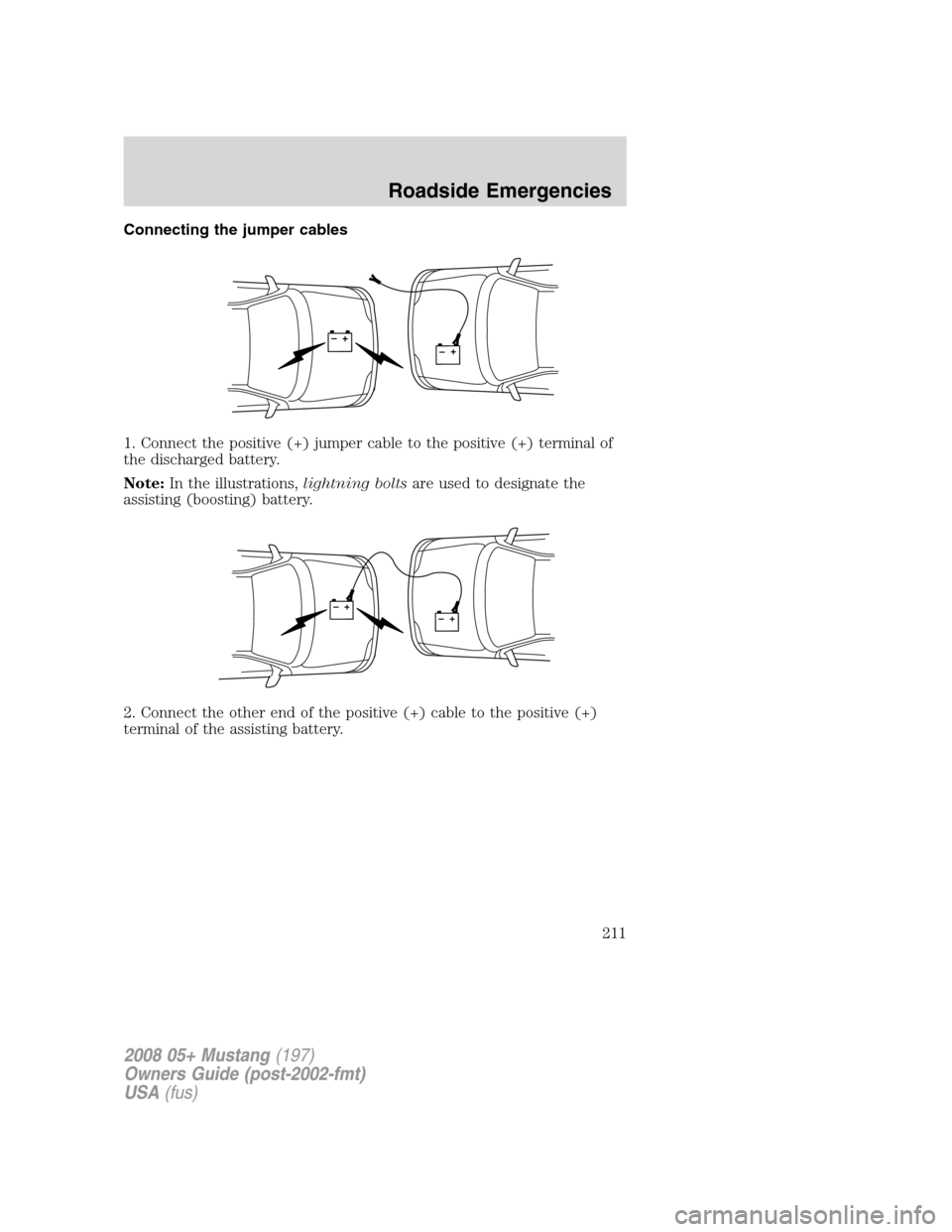
Connecting the jumper cables
1. Connect the positive (+) jumper cable to the positive (+) terminal of
the discharged battery.
Note:In the illustrations,lightning boltsare used to designate the
assisting (boosting) battery.
2. Connect the other end of the positive (+) cable to the positive (+)
terminal of the assisting battery.
+–+–
+–+–
2008 05+ Mustang(197)
Owners Guide (post-2002-fmt)
USA(fus)
Roadside Emergencies
211