clock FORD RANGER 2004 2.G User Guide
[x] Cancel search | Manufacturer: FORD, Model Year: 2004, Model line: RANGER, Model: FORD RANGER 2004 2.GPages: 248, PDF Size: 6.16 MB
Page 61 of 248
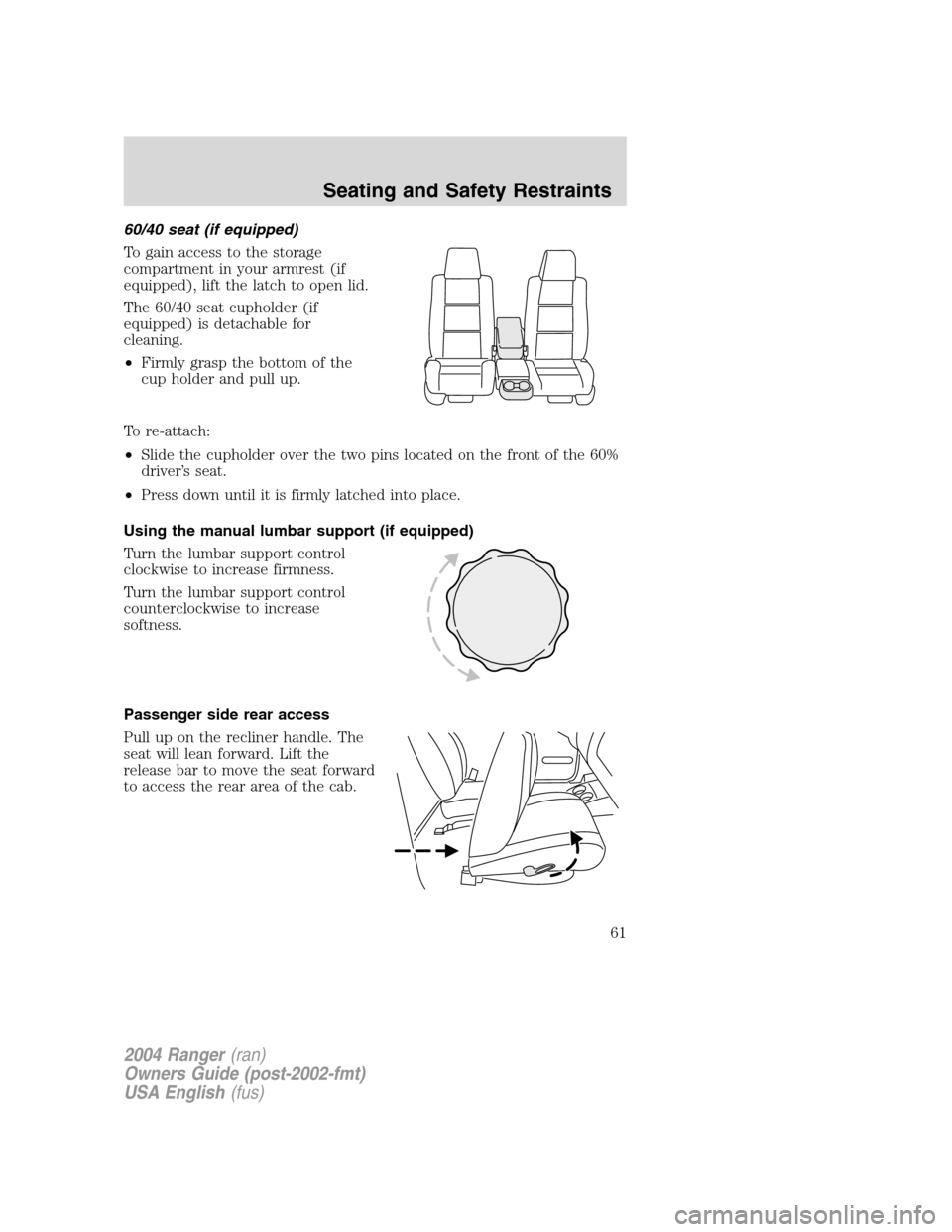
60/40 seat (if equipped)
To gain access to the storage
compartment in your armrest (if
equipped), lift the latch to open lid.
The 60/40 seat cupholder (if
equipped) is detachable for
cleaning.
•Firmly grasp the bottom of the
cup holder and pull up.
To re-attach:
• Slide the cupholder over the two pins located on the front of the 60%
driver ’s seat.
• Press down until it is firmly latched into place.
Using the manual lumbar support (if equipped)
Turn the lumbar support control
clockwise to increase firmness.
Turn the lumbar support control
counterclockwise to increase
softness.
Passenger side rear access
Pull up on the recliner handle. The
seat will lean forward. Lift the
release bar to move the seat forward
to access the rear area of the cab.
2004 Ranger (ran)
Owners Guide (post-2002-fmt)
USA English (fus)
Seating and Safety Restraints
61
Page 147 of 248
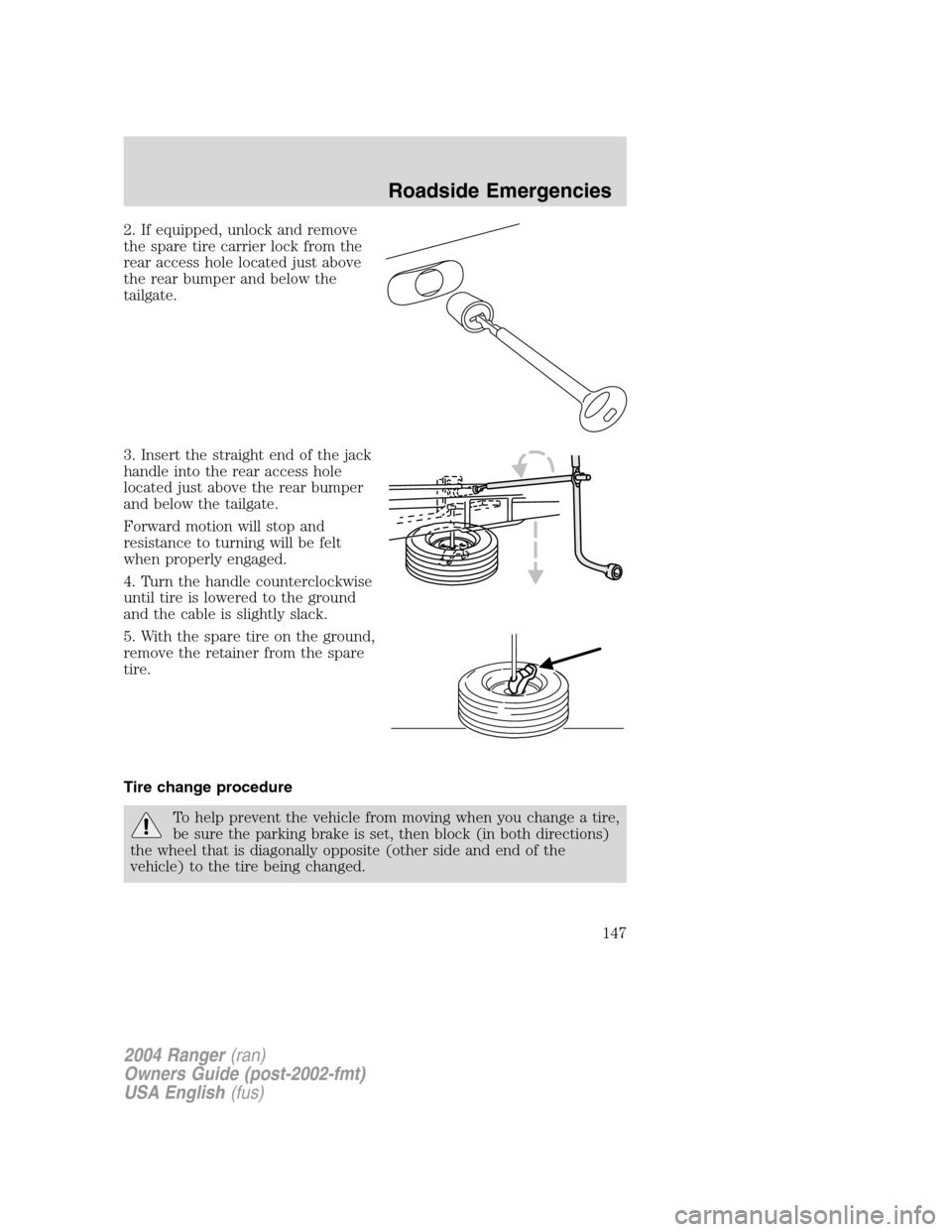
2. If equipped, unlock and remove
the spare tire carrier lock from the
rear access hole located just above
the rear bumper and below the
tailgate.
3. Insert the straight end of the jack
handle into the rear access hole
located just above the rear bumper
and below the tailgate.
Forward motion will stop and
resistance to turning will be felt
when properly engaged.
4. Turn the handle counterclockwise
until tire is lowered to the ground
and the cable is slightly slack.
5. With the spare tire on the ground,
remove the retainer from the spare
tire.
Tire change procedure
To help prevent the vehicle from moving when you change a tire,
be sure the parking brake is set, then block (in both directions)
the wheel that is diagonally opposite (other side and end of the
vehicle) to the tire being changed.
2004 Ranger (ran)
Owners Guide (post-2002-fmt)
USA English (fus)
Roadside Emergencies
147
Page 148 of 248
If the vehicle slips off the jack, you or someone else could be
seriously injured.
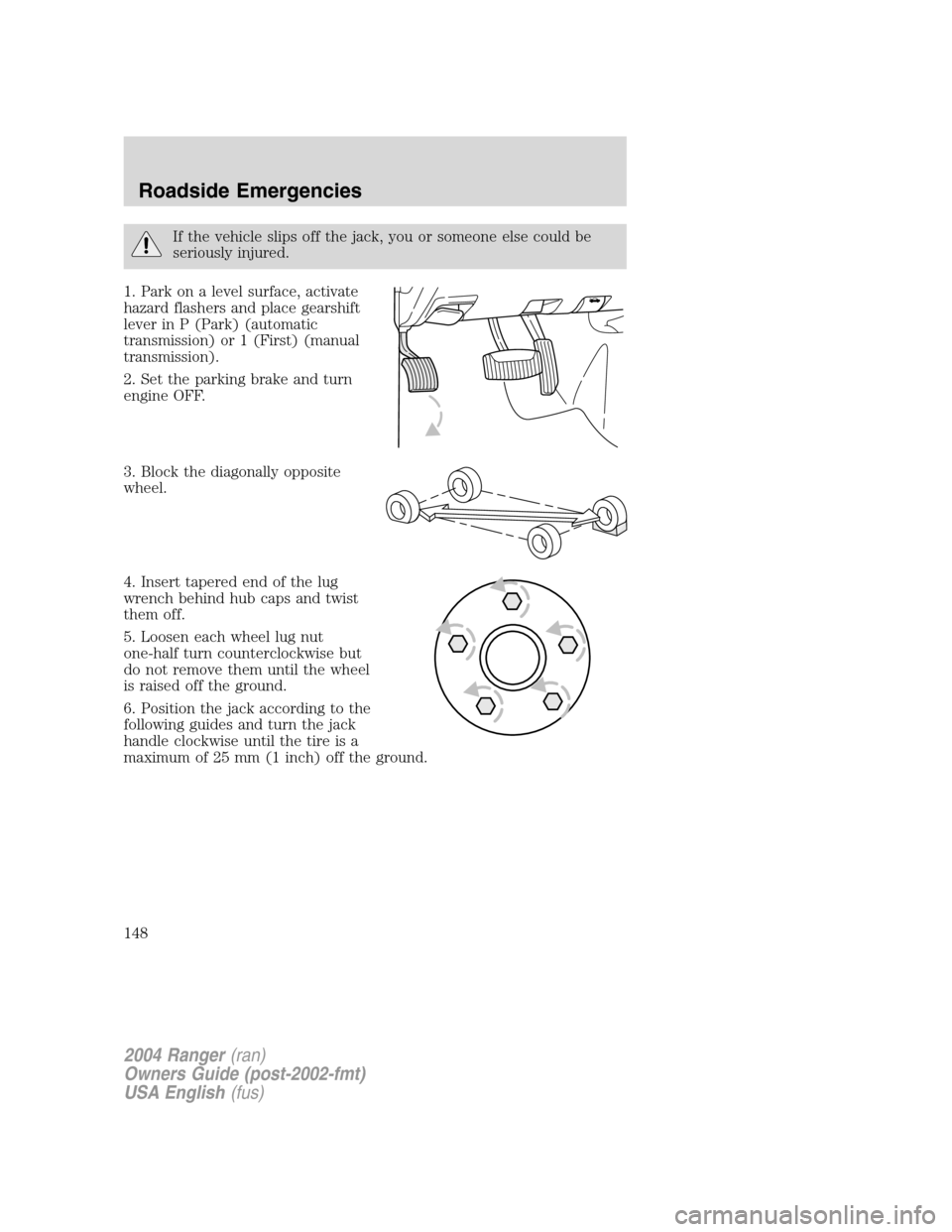
1. Park on a level surface, activate
hazard flashers and place gearshift
lever in P (Park) (automatic
transmission) or 1 (First) (manual
transmission).
2. Set the parking brake and turn
engine OFF.
3. Block the diagonally opposite
wheel.
4. Insert tapered end of the lug
wrench behind hub caps and twist
them off.
5. Loosen each wheel lug nut
one-half turn counterclockwise but
do not remove them until the wheel
is raised off the ground.
6. Position the jack according to the
following guides and turn the jack
handle clockwise until the tire is a
maximum of 25 mm (1 inch) off the ground.
2004 Ranger (ran)
Owners Guide (post-2002-fmt)
USA English (fus)
Roadside Emergencies
148
Page 149 of 248
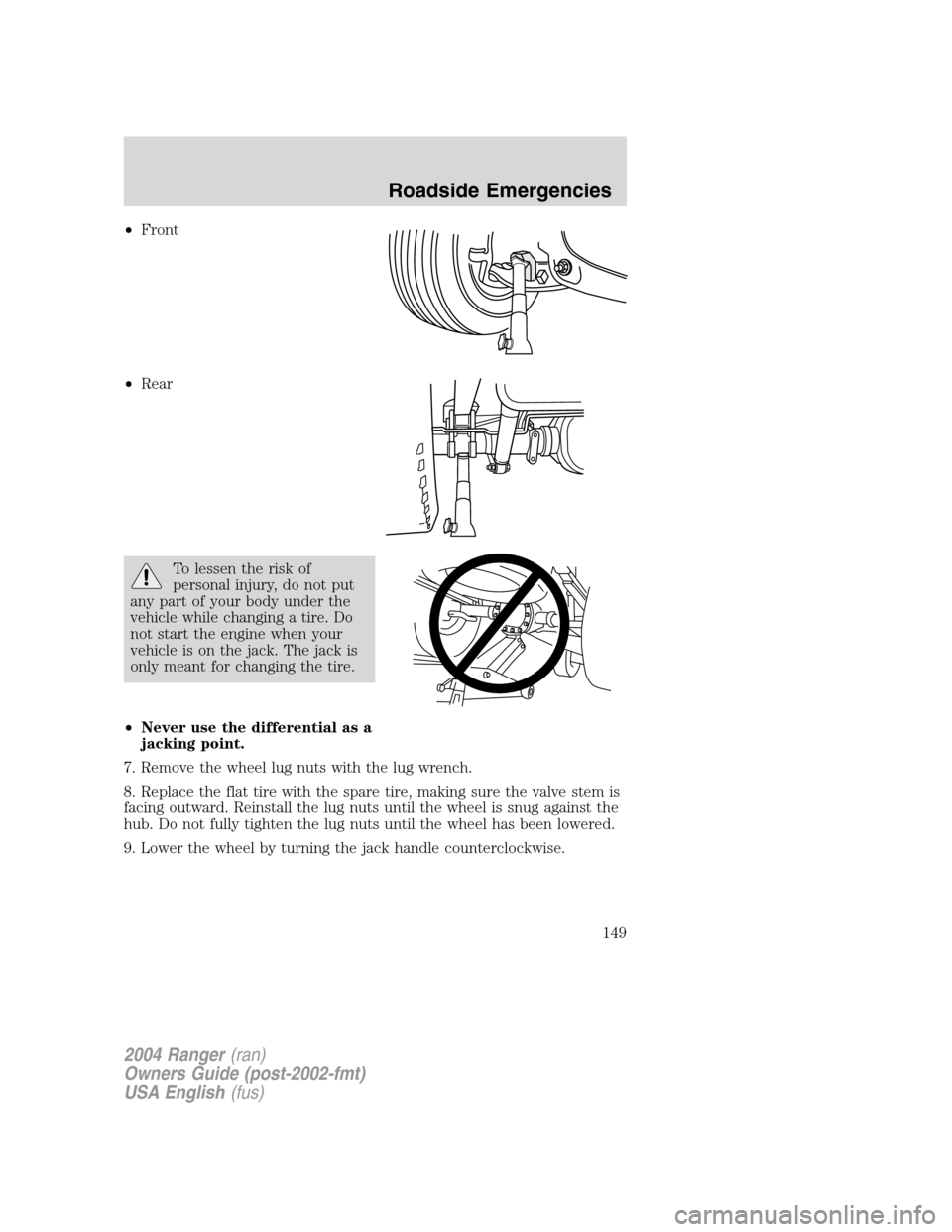
•Front
• Rear
To lessen the risk of
personal injury, do not put
any part of your body under the
vehicle while changing a tire. Do
not start the engine when your
vehicle is on the jack. The jack is
only meant for changing the tire.
• Never use the differential as a
jacking point.
7. Remove the wheel lug nuts with the lug wrench.
8. Replace the flat tire with the spare tire, making sure the valve stem is
facing outward. Reinstall the lug nuts until the wheel is snug against the
hub. Do not fully tighten the lug nuts until the wheel has been lowered.
9. Lower the wheel by turning the jack handle counterclockwise.
2004 Ranger (ran)
Owners Guide (post-2002-fmt)
USA English (fus)
Roadside Emergencies
149
Page 150 of 248
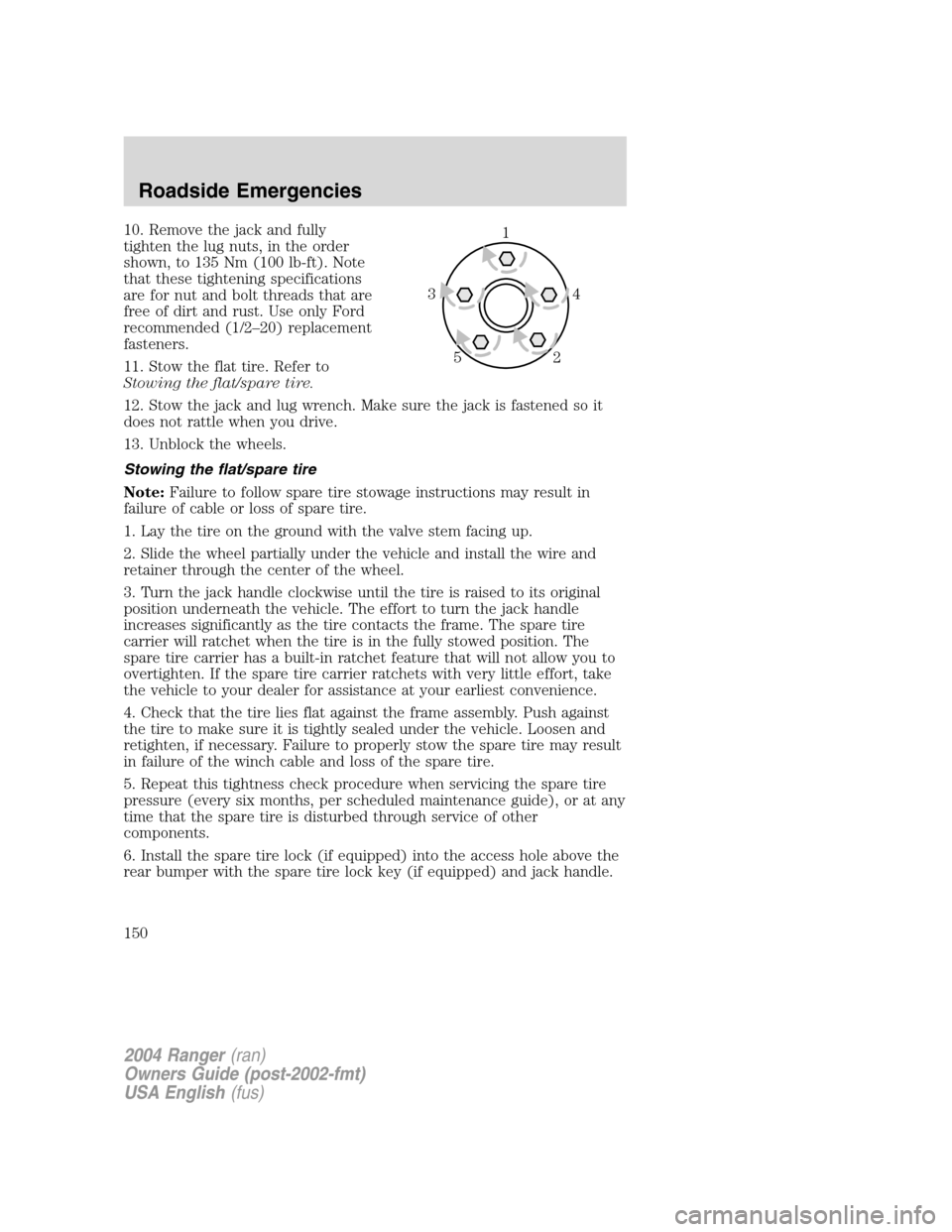
10. Remove the jack and fully
tighten the lug nuts, in the order
shown, to 135 Nm (100 lb-ft). Note
that these tightening specifications
are for nut and bolt threads that are
free of dirt and rust. Use only Ford
recommended (1/2–20) replacement
fasteners.
11. Stow the flat tire. Refer to
Stowing the flat/spare tire.
12. Stow the jack and lug wrench. Make sure the jack is fastened so it
does not rattle when you drive.
13. Unblock the wheels.
Stowing the flat/spare tire
Note: Failure to follow spare tire stowage instructions may result in
failure of cable or loss of spare tire.
1. Lay the tire on the ground with the valve stem facing up.
2. Slide the wheel partially under the vehicle and install the wire and
retainer through the center of the wheel.
3. Turn the jack handle clockwise until the tire is raised to its original
position underneath the vehicle. The effort to turn the jack handle
increases significantly as the tire contacts the frame. The spare tire
carrier will ratchet when the tire is in the fully stowed position. The
spare tire carrier has a built-in ratchet feature that will not allow you to
overtighten. If the spare tire carrier ratchets with very little effort, take
the vehicle to your dealer for assistance at your earliest convenience.
4. Check that the tire lies flat against the frame assembly. Push against
the tire to make sure it is tightly sealed under the vehicle. Loosen and
retighten, if necessary. Failure to properly stow the spare tire may result
in failure of the winch cable and loss of the spare tire.
5. Repeat this tightness check procedure when servicing the spare tire
pressure (every six months, per scheduled maintenance guide), or at any
time that the spare tire is disturbed through service of other
components.
6. Install the spare tire lock (if equipped) into the access hole above the
rear bumper with the spare tire lock key (if equipped) and jack handle.1
4
3
2
5
2004 Ranger (ran)
Owners Guide (post-2002-fmt)
USA English (fus)
Roadside Emergencies
150
Page 187 of 248
Because your vehicle’s engine is electronically controlled by a computer,
some control conditions are maintained by power from the battery. When
the battery is disconnected or a new battery is installed, the engine must
relearn its idle and fuel trim strategy for optimum driveability and
performance. To begin this process:
1. With the vehicle at a complete stop, set the parking brake.
2. Put the gearshift lever in P (Park), turn off all accessories and start
the engine.
3. Run the engine until it reaches normal operating temperature.
4. Allow the engine to idle for at least one minute.
5. Turn the A/C on and allow the engine to idle for at least one minute.
6. Drive the vehicle to complete the relearning process.
• The vehicle may need to be driven to relearn the idle and fuel trim
strategy.
• If you do not allow the engine to relearn its idle trim, the idle
quality of your vehicle may be adversely affected until the idle
trim is eventually relearned.
When the battery is disconnected or a new battery installed, the
transmission must relearn its adaptive strategy. As a result of this, the
transmission may shift firmly. This operation is considered normal and
will not affect function or durability of the transmission. Over time the
adaptive learning process will fully update transmission operation to its
optimum shift feel.
If the battery has been disconnected or a new battery has been installed,
the clock and the preset radio stations must be reset once the battery is
reconnected.
• Always dispose of automotive
batteries in a responsible manner.
Follow your local authorized
standards for disposal. Call your
local authorized recycling center
to find out more about recycling
automotive batteries.
LEAD
RETURN
RECYCLE
2004 Ranger (ran)
Owners Guide (post-2002-fmt)
USA English (fus)
Maintenance and Specifications
187
Page 191 of 248
with the factory-filled coolant.Mixing Motorcraft Speciality Orange
Engine Coolant or any orange-colored extended life product with your
factory filled coolant can result in degraded corrosion protection.
• A large amount of water without engine coolant may be added, in case
of emergency, to reach a vehicle service location. In this instance, the
cooling system must be drained and refilled with a 50/50 mixture of
engine coolant and distilled water as soon as possible. Water alone
(without engine coolant) can cause engine damage from corrosion,
overheating or freezing.
• Do not use alcohol, methanol, brine or any engine coolants
mixed with alcohol or methanol antifreeze (coolant). Alcohol
and other liquids can cause engine damage from overheating or
freezing.
• Do not add extra inhibitors or additives to the coolant. These
can be harmful and compromise the corrosion protection of the engine
coolant.
For vehicles with overflow coolant systems with a non-pressurized cap
on the coolant recovery system, add coolant to the coolant recovery
reservoir when the engine is cool. Add the proper mixture of coolant and
water to the “cold full ”level. For all other vehicles, which have a coolant
degas system with a pressurized cap, or if it is necessary to remove the
coolant pressure relief cap on the radiator of a vehicle with an overflow
system, follow these steps to add engine coolant.
To reduce the risk of personal injury, make sure the engine is
cool before unscrewing the coolant pressure relief cap. The
cooling system is under pressure; steam and hot liquid can come out
forcefully when the cap is loosened slightly.
1. Before you begin, turn the engine off and let it cool.
2. When the engine is cool, wrap a thick cloth around the coolant
pressure relief cap on the coolant reservoir (a translucent plastic bottle).
Slowly turn cap counterclockwise (left) until pressure begins to release.
3. Step back while the pressure releases.
4. When you are sure that all the pressure has been released, use the
cloth to turn it counterclockwise and remove the cap.
5. Fill the coolant reservoir slowly with the proper coolant mixture (see
above), to within the “cold fill range ”or the “cold full ”level on the
reservoir. If you removed the radiator cap in an overflow system, fill the
radiator until the coolant is visible and radiator is almost full.
2004 Ranger (ran)
Owners Guide (post-2002-fmt)
USA English (fus)
Maintenance and Specifications
191
Page 196 of 248
clothing and wash skin thoroughly with soap and water. Repeated or
prolonged skin contact with fuel liquid or vapor causes skin irritation.
• Be particularly careful if you are taking “Antabuse ”or other forms of
disulfiram for the treatment of alcoholism. Breathing gasoline vapors,
or skin contact could cause an adverse reaction. In sensitive
individuals, serious personal injury or sickness may result. If fuel is
splashed on the skin, promptly wash skin thoroughly with soap and
water. Consult a physician immediately if you experience an adverse
reaction.
When refueling always shut the engine off and never allow
sparks or open flames near the filler neck. Never smoke while
refueling. Fuel vapor is extremely hazardous under certain conditions.
Care should be taken to avoid inhaling excess fumes.
The flow of fuel through a fuel pump nozzle can produce static
electricity, which can cause a fire if fuel is pumped into an
ungrounded fuel container.
Use the following guidelines to avoid static build-up when filling an
ungrounded fuel container:
• Place approved fuel container on the ground.
• DO NOT fill a fuel container while it is in the vehicle (including the
cargo area).
• Keep the fuel pump nozzle in contact with the fuel container while
filling.
• DO NOT use a device that would hold the fuel pump handle in the fill
position.
Fuel Filler Cap
Your vehicle is equipped with a 1/4 turn fuel filler cap, which requires
the handle to be rotated 1/4 of a turn for removal or installation.
When fueling your vehicle:
1. Turn the engine off.
2. Carefully turn the fuel filler cap counterclockwise 1/4 of a turn until it
releases from the fuel filler pipe.
3. Carefully hang the cap from the tether.
4. To install the cap, place the cap into the filler pipe and rotate until
you hear at least 3 “clicks ”.
2004 Ranger (ran)
Owners Guide (post-2002-fmt)
USA English (fus)
Maintenance and Specifications
196
Page 240 of 248
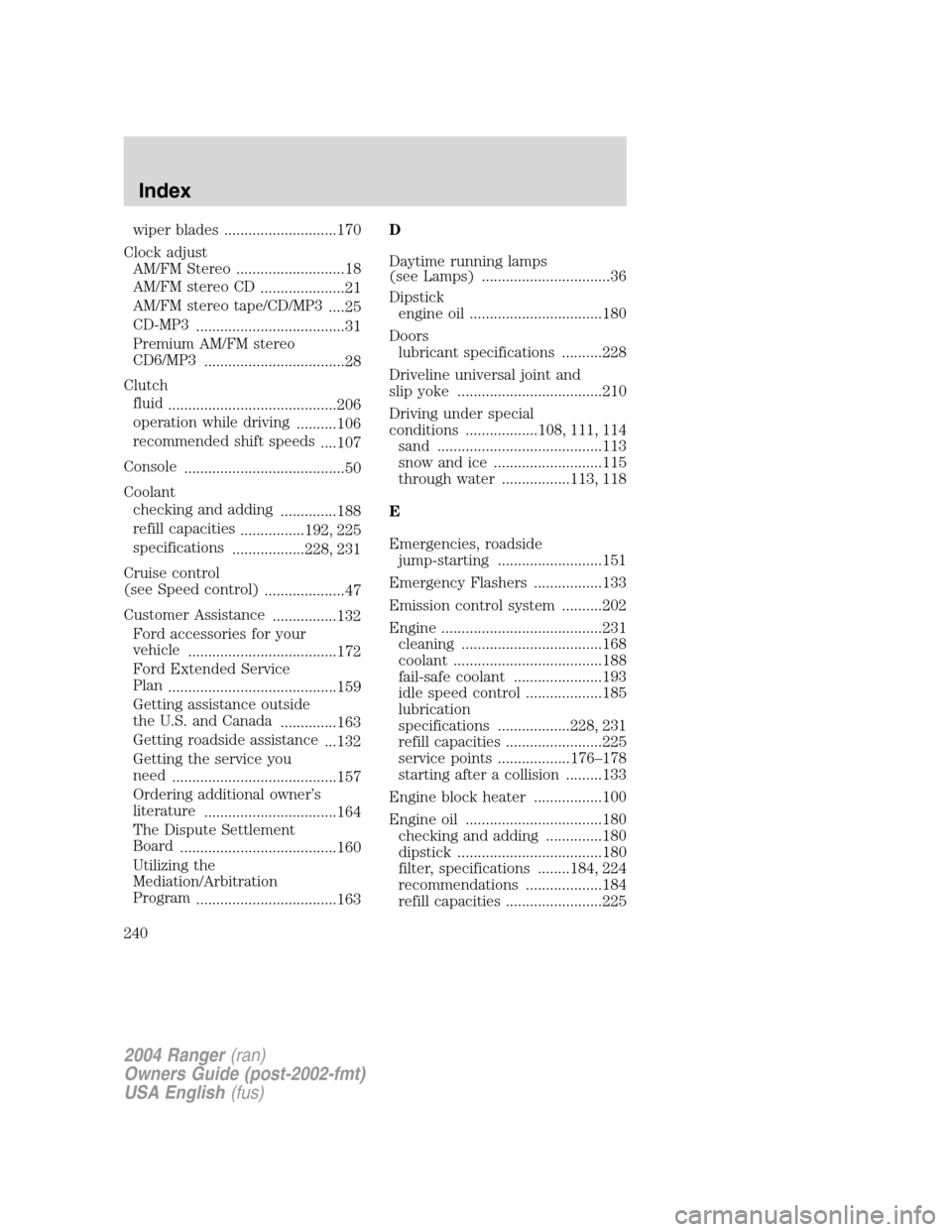
wiper blades ............................170
Clock adjust AM/FM Stereo ...........................18
AM/FM stereo CD .....................21
AM/FM stereo tape/CD/MP3 ....25
CD-MP3 .....................................31
Premium AM/FM stereo
CD6/MP3 ...................................28
Clutch fluid ..........................................206
operation while driving ..........106
recommended shift speeds ....107
Console ........................................50
Coolant checking and adding ..............188
refill capacities ................192, 225
specifications ..................228, 231
Cruise control
(see Speed control) ....................47
Customer Assistance ................132
Ford accessories for your
vehicle .....................................172
Ford Extended Service
Plan ..........................................159
Getting assistance outside
the U.S. and Canada ..............163
Getting roadside assistance ...132
Getting the service you
need .........................................157
Ordering additional owner ’s
literature .................................164
The Dispute Settlement
Board .......................................160
Utilizing the
Mediation/Arbitration
Program ...................................163 D
Daytime running lamps
(see Lamps) ................................36
Dipstick
engine oil .................................180
Doors lubricant specifications ..........228
Driveline universal joint and
slip yoke ....................................210
Driving under special
conditions ..................108, 111, 114 sand .........................................113
snow and ice ...........................115
through water .................113, 118
E
Emergencies, roadside jump-starting ..........................151
Emergency Flashers .................133
Emission control system ..........202
Engine ........................................231 cleaning ...................................168
coolant .....................................188
fail-safe coolant ......................193
idle speed control ...................185
lubrication
specifications ..................228, 231
refill capacities ........................225
service points ..................176 –178
starting after a collision .........133
Engine block heater .................100
Engine oil ..................................180 checking and adding ..............180
dipstick ....................................180
filter, specifications ........184, 224
recommendations ...................184
refill capacities ........................225
2004 Ranger (ran)
Owners Guide (post-2002-fmt)
USA English (fus)
Index
240
Page 243 of 248
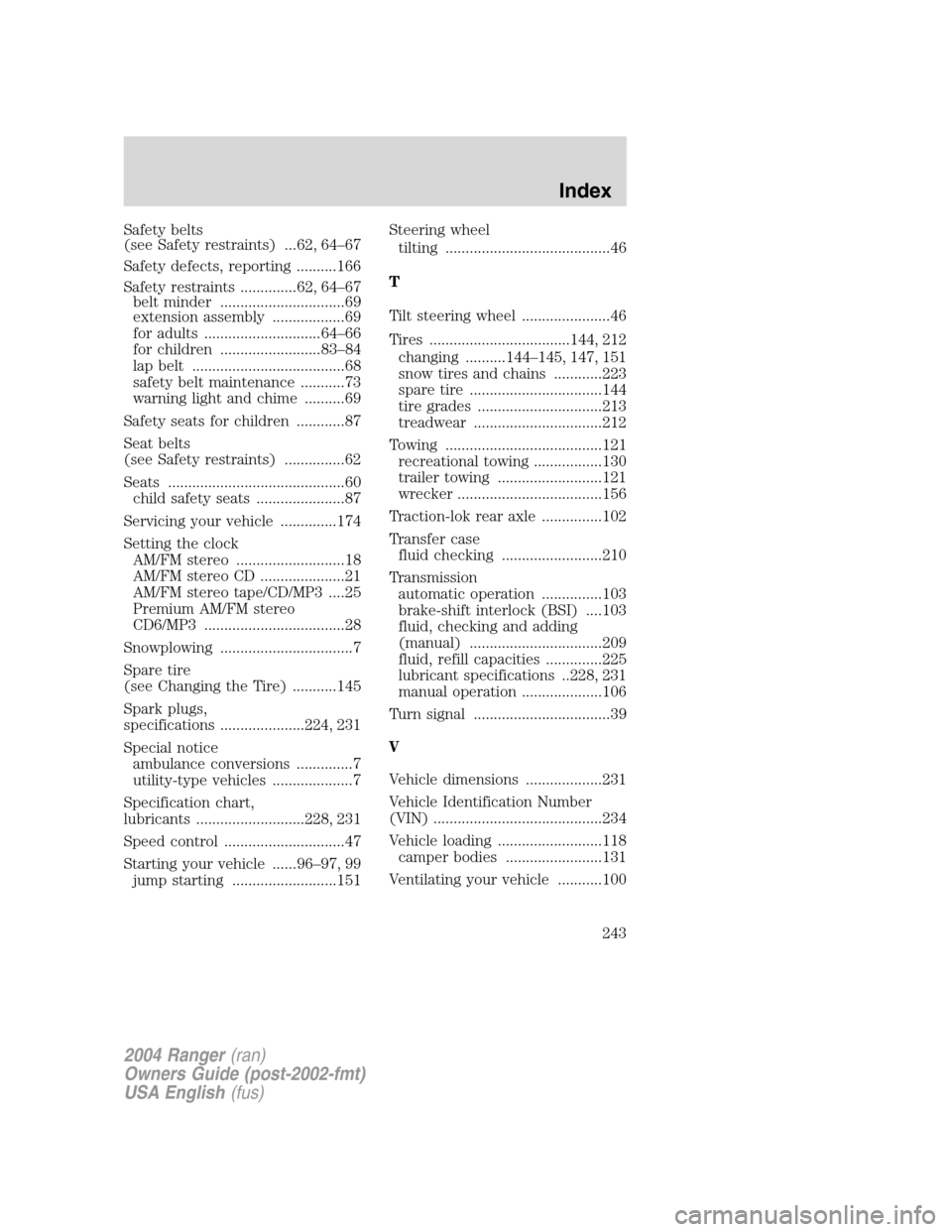
Safety belts
(see Safety restraints) ...62, 64–67
Safety defects, reporting ..........166
Safety restraints ..............62, 64 –67
belt minder ...............................69
extension assembly ..................69
for adults .............................64 –66
for children .........................83 –84
lap belt ......................................68
safety belt maintenance ...........73
warning light and chime ..........69
Safety seats for children ............87
Seat belts
(see Safety restraints) ...............62
Seats ............................................60 child safety seats ......................87
Servicing your vehicle ..............174
Setting the clock AM/FM stereo ...........................18
AM/FM stereo CD .....................21
AM/FM stereo tape/CD/MP3 ....25
Premium AM/FM stereo
CD6/MP3 ...................................28
Snowplowing .................................7
Spare tire
(see Changing the Tire) ...........145
Spark plugs,
specifications .....................224, 231
Special notice ambulance conversions ..............7
utility-type vehicles ....................7
Specification chart,
lubricants ...........................228, 231
Speed control ..............................47
Starting your vehicle ......96 –97, 99
jump starting ..........................151 Steering wheel
tilting .........................................46
T
Tilt steering wheel ......................46
Tires ...................................144, 212 changing ..........144 –145, 147, 151
snow tires and chains ............223
spare tire .................................144
tire grades ...............................213
treadwear ................................212
Towing .......................................121 recreational towing .................130
trailer towing ..........................121
wrecker ....................................156
Traction-lok rear axle ...............102
Transfer case fluid checking .........................210
Transmission automatic operation ...............103
brake-shift interlock (BSI) ....103
fluid, checking and adding
(manual) .................................209
fluid, refill capacities ..............225
lubricant specifications ..228, 231
manual operation ....................106
Turn signal ..................................39
V
Vehicle dimensions ...................231
Vehicle Identification Number
(VIN) ..........................................234
Vehicle loading ..........................118 camper bodies ........................131
Ventilating your vehicle ...........100
2004 Ranger (ran)
Owners Guide (post-2002-fmt)
USA English (fus)
Index
243