instrument panel FORD TRANSIT 2015 5.G User Guide
[x] Cancel search | Manufacturer: FORD, Model Year: 2015, Model line: TRANSIT, Model: FORD TRANSIT 2015 5.GPages: 461, PDF Size: 5.82 MB
Page 180 of 461
Canadian roadside coverage and benefits
may differ from the U.S. coverage. If you
require more information, please refer to
the coverage section of your warranty
guide, call us in Canada at
1-800-665-2006, or visit our website at
www.ford.ca.
Sykes Assistance Services Corporation
administers the Roadside Assistance
program. You must receive covered
services in Canada or the continental
United States. Coverage extends to
vehicles that use public, non-seasonal,
annually traveled roadways. Roadside
Assistance coverage does not extend to
vehicles involved in cross-country driving,
logging, autocross and any other form of
off-road use. Well maintained roads and
surfaces help ensure safe travel for the
supplier, and allow their representatives
to perform service as per the standard
operating procedures.
In Remote Locations
If our supplier cannot take your vehicle by
road to the nearest authorized dealership,
transportation by rail or water may be
necessary. The program covers a tow to
the dock or rail terminal and also to the
dealership at the end of the trip.
For rail or water transportation, however,
contact your authorized dealer to confirm
if you are eligible for additional coverage
before you authorize or pay for the service.
Call the Ford Roadside Assistance at
1-800-665-2006 for additional
information.
HAZARD WARNING FLASHERS The hazard warning button is located on
the instrument panel. Switch the hazard
warning flashers on when your vehicle is
creating a safety hazard.
Press the button to switch the hazard
warning flashers on. The front and rear
direction indicators will flash.
Press the button again to switch the
hazard warning flashers off.
Note:
Prolonged use of the hazard warning
flashers will cause the battery to run out of
charge. There may be insufficient power to
restart the engine.
FUEL SHUTOFF WARNING
Failure to inspect and, if necessary,
repair fuel leaks after a collision may
increase the risk of fire and serious
injury. Ford Motor Company recommends
that the fuel system be inspected by an
authorized dealer after any collision. In the event of a moderate to severe
collision, this vehicle includes a fuel pump
shutoff feature that stops the flow of fuel
to the engine. Not every impact will cause
a shutoff.
Should your vehicle shut off after a
collision, you may restart your vehicle. For
vehicles equipped with a key system:
1. Switch off the ignition.
2. Switch on the ignition.
3. Repeat Steps 1 and 2 to re-enable the
fuel pump.
Note: When you try to restart your vehicle
after a fuel shutoff, the vehicle makes sure
that various systems are safe to restart.
Once your vehicle determines that the
systems are safe, then the vehicle will allow
you to restart.
177 Transit (TTH) Canada/United States of America, enUSA, Edition date: 03/2014 Roadside EmergenciesE71943
Page 201 of 461
Circuits protected
Fuse rating
Fuse
Not used.
-
F8
Right-hand high beam.
10A
F9
Left-hand high beam.
10A
F10
Right-hand exterior lamps.
25A
F11
Left-hand position lamps.
Not used.
-
F12
On-board diagnostic.
15A
F13
Battery saver.
Turn signal indicator.
25A
F14 Power windows delayed accessory.
Lane departure sensor heated windshield pad.
Left-hand exterior lamps.
25A
F15 Right-hand position lamps.
High mounted stoplamp.
Audio unit.
20A
F16
Navigation unit.
Instrument panel cluster.
7.5A
F17
Heater control.
Headlamp switch module.
10A
F18 Steering wheel module.
Stoplamp switch supply.
Front control/display interface module.
5A
F19
Ignition passive anti-theft system.
5A
F20
Accessory relay, customer access feed.
3A
F21
CHANGING A FUSE WARNINGS
Do not modify the electrical system
of your vehicle in any way. Have
repairs to the electrical system and
the replacement of relays and high current
fuses carried out by an authorized dealer. WARNINGS
Switch the ignition and all electrical
equipment off before attempting to
change a fuse.
Always replace a fuse with one that
has the specified amperage rating.
Using a fuse with a higher amperage
rating can cause severe wire damage and
could start a fire. 198
Transit (TTH) Canada/United States of America, enUSA, Edition date: 03/2014 Fuses
Page 232 of 461
•
Never wash or rinse any ignition coil,
spark plug wire or spark plug well, or
the area in and around these locations.
• Cover the battery, power distribution
box, and air filter assembly to prevent
water damage when cleaning the
engine.
CLEANING THE WINDOWS AND
WIPER BLADES
Car wash chemicals and environmental
fallout can result in windshield and wiper
blade contamination. Dirty windshield and
wipers will result in poor windshield wiper
operation. Keep the windshield and wiper
blades clean to maintain windshield wiper
performance.
To clean the windshield and wiper blades:
• Clean the windshield with a
non-abrasive glass cleaner.
• For windshields contaminated with
tree sap, chemicals, wax or bugs, clean
the entire windshield using steel wool
(no greater than 0000 grade) in a
circular motion and rinse with water.
• Clean the wiper blades with isopropyl
rubbing alcohol or windshield washer
fluid.
Note: Do not use razor blades or other
sharp objects to clean or remove decals
from the inside of the heated rear window.
The vehicle warranty does not cover
damage caused to the heated rear window
grid lines.
CLEANING THE INTERIOR
Note: Do not allow air fresheners and hand
sanitizers to spill on interior surfaces. If a
spill occurs, wipe off immediately. Damage
may not be covered by your warranty. Safety Belts WARNINGS
Do not use abrasives, or chemical
solvents to clean them.
Do not allow moisture to penetrate
the safety belt retractor mechanism.
Clean them with interior cleaner or water
applied with a soft sponge. Let them dry
naturally, away from artificial heat.
Instrument Cluster Screens, LCD
Screens and Radio Screens
WARNING
Do not use abrasives, alcoholic
solvents or chemical solvents to
clean them.
Rear Windows
WARNING
Do not use any abrasive materials to
clean the interior of the rear
windows.
Note:
Do not install stickers or labels to the
interior of the rear windows.
CLEANING THE INSTRUMENT
PANEL AND INSTRUMENT
CLUSTER LENS WARNING
Do not use chemical solvents or
strong detergents when cleaning the
steering wheel or instrument panel
to avoid contamination of the airbag
system. 229
Transit (TTH) Canada/United States of America, enUSA, Edition date: 03/2014 Vehicle Care
Page 233 of 461
Clean the instrument panel and cluster
lens with a clean, damp, white cotton
cloth, then use a clean and dry white
cotton cloth to dry these areas.
•
Avoid cleaners or polishes that increase
the gloss of the upper portion of the
instrument panel. The dull finish in this
area helps protect you from
undesirable windshield reflection.
• Be certain to wash or wipe your hands
clean if you have been in contact with
certain products such as insect
repellent and suntan lotion in order to
avoid possible damage to the interior
painted surfaces.
• Do not use household or glass cleaners
as these may damage the finish of the
instrument panel, interior trim and
cluster lens.
• Do not allow air fresheners and hand
sanitizers to spill onto interior surfaces.
If a spill occurs, wipe off immediately.
Damage may not be covered by your
warranty.
If a staining liquid like coffee or juice has
been spilled on the instrument panel or on
interior trim surfaces, clean as follows:
1. Wipe up spilled liquid using a clean, white, cotton cloth.
2. Wipe the surface with a damp, clean, white cotton cloth. For more thorough
cleaning, use a mild soap and water
solution. If the spot cannot be
completely cleaned by this method,
the area may be cleaned using a
commercially available cleaning
product designed for automotive
interiors.
3. If necessary, apply more soap and water solution or cleaning product to
a clean, white, cotton cloth and press
the cloth onto the soiled area. Allow
this to set at room temperature for 30
minutes. 4.
Remove the soaked cloth and if it is not
soiled badly, use this cloth to clean the
area by using a rubbing motion for 60
seconds.
5. Following this, wipe area dry with a clean, white, cotton cloth.
REPAIRING MINOR PAINT
DAMAGE
You should repair paintwork damage
caused by stones from the road or minor
scratches as soon as possible. A choice of
products are available from an authorized
dealer.
Remove particles such as bird droppings,
tree sap, insect deposits, tar spots, road
salt and industrial fallout before repairing
paint chips.
Always read and follow the manufacturer ’s
instructions before using the products.
CLEANING THE ALLOY
WHEELS
Note: Do not apply a cleaning chemical to
warm or hot wheel rims and covers.
Note: Some automatic car washes may
cause damage to the finish on your wheel
rims and covers.
Note: Industrial-strength or heavy-duty
cleaners in combination with brush agitation
to remove brake dust and dirt, could wear
away the clear coat finish over a period time.
Note: Do not use hydrofluoric acid-based
or high caustic-based wheel cleaners, steel
wool, fuels or strong household detergents.
Note: If you intend parking your vehicle for
an extended period after cleaning the
wheels with a wheel cleaner, drive your
vehicle for a few minutes before doing so.
This will reduce the risk of increased
corrosion of the brake discs.
230 Transit (TTH) Canada/United States of America, enUSA, Edition date: 03/2014 Vehicle Care
Page 273 of 461
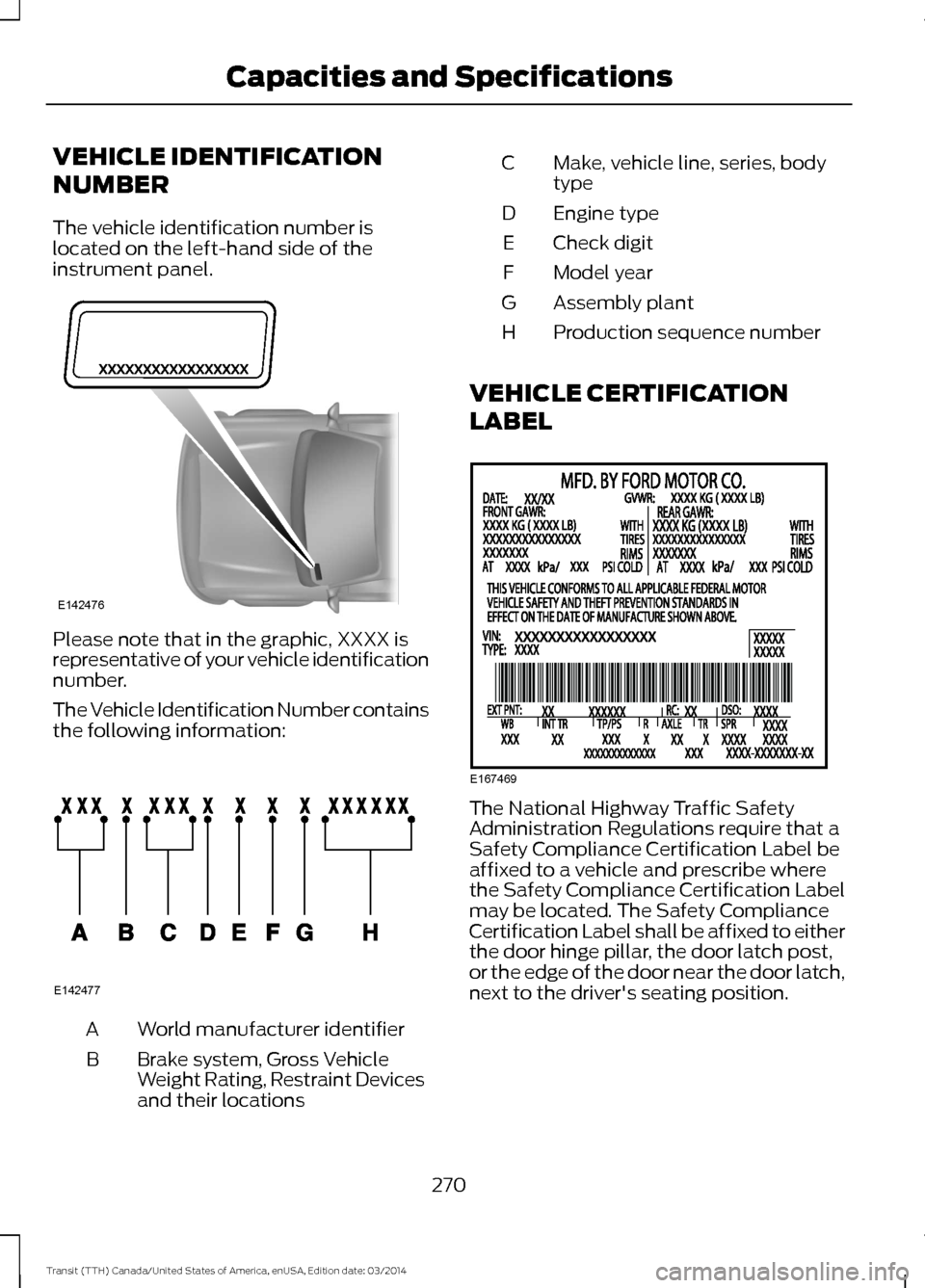
VEHICLE IDENTIFICATION
NUMBER
The vehicle identification number is
located on the left-hand side of the
instrument panel.
Please note that in the graphic, XXXX is
representative of your vehicle identification
number.
The Vehicle Identification Number contains
the following information:
World manufacturer identifier
A
Brake system, Gross Vehicle
Weight Rating, Restraint Devices
and their locations
B Make, vehicle line, series, body
type
C
Engine type
D
Check digit
E
Model year
F
Assembly plant
G
Production sequence number
H
VEHICLE CERTIFICATION
LABEL The National Highway Traffic Safety
Administration Regulations require that a
Safety Compliance Certification Label be
affixed to a vehicle and prescribe where
the Safety Compliance Certification Label
may be located. The Safety Compliance
Certification Label shall be affixed to either
the door hinge pillar, the door latch post,
or the edge of the door near the door latch,
next to the driver's seating position.
270 Transit (TTH) Canada/United States of America, enUSA, Edition date: 03/2014Capacities and SpecificationsE142476 E142477 E167469
Page 384 of 461
Sports Game
Voice command
Tune to the
Tune to the
Tune to the
game
Tune to the
Help
Tune Voice command
Preset <#>
SAT
SAT 1
SAT 1 preset <#>
SAT 2
SAT 2 preset <#>
SAT 3
SAT 3 preset <#>
Sirius <0-223>
Help
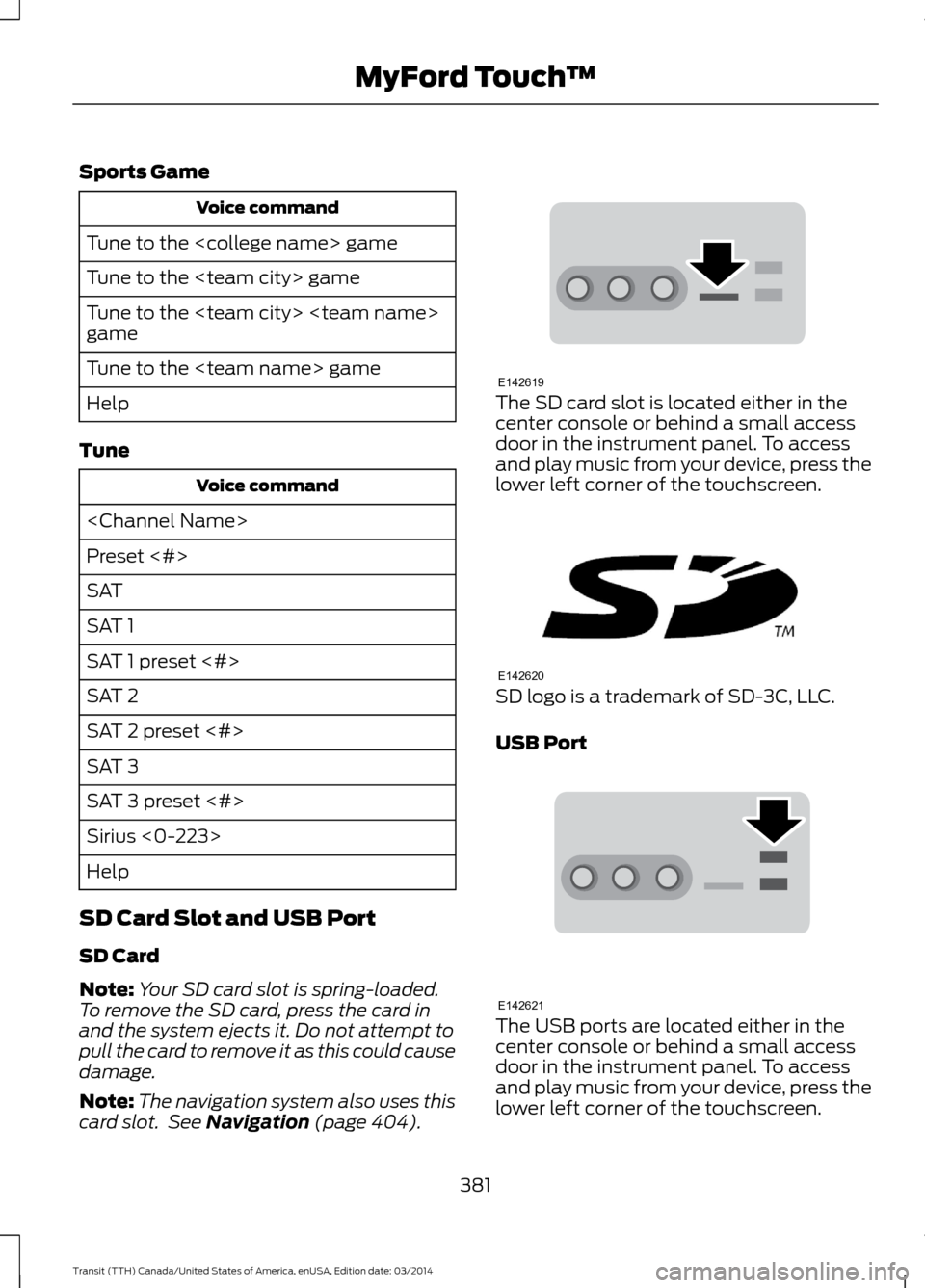
SD Card Slot and USB Port
SD Card
Note: Your SD card slot is spring-loaded.
To remove the SD card, press the card in
and the system ejects it. Do not attempt to
pull the card to remove it as this could cause
damage.
Note: The navigation system also uses this
card slot. See Navigation (page 404). The SD card slot is located either in the
center console or behind a small access
door in the instrument panel. To access
and play music from your device, press the
lower left corner of the touchscreen.
SD logo is a trademark of SD-3C, LLC.
USB Port
The USB ports are located either in the
center console or behind a small access
door in the instrument panel. To access
and play music from your device, press the
lower left corner of the touchscreen.
381 Transit (TTH) Canada/United States of America, enUSA, Edition date: 03/2014 MyFord Touch
™E142619 E142620 E142621
Page 389 of 461
![FORD TRANSIT 2015 5.G User Guide Press the voice button and when
prompted say:
Voice command
Next song
play
pause
[play] previous track
A/V Inputs WARNINGS
Driving while distracted can result in
loss of vehicle control, crash and
inj](/img/11/5392/w960_5392-388.png "FORD TRANSIT 2015 5.G User Guide Press the voice button and when
prompted say:
Voice command
Next song
play
pause
[play] previous track
A/V Inputs WARNINGS
Driving while distracted can result in
loss of vehicle control, crash and
inj")
Press the voice button and when
prompted say:
Voice command
Next song
play
pause
[play] previous track
A/V Inputs WARNINGS
Driving while distracted can result in
loss of vehicle control, crash and
injury. We strongly recommend that
you use extreme caution when using any
device that may take your focus off the
road. Your primary responsibility is the safe
operation of your vehicle. We recommend
against the use of any handheld device
while driving and encourage the use of
voice-operated systems when possible.
Make sure you are aware of all applicable
local laws that may affect the use of
electronic devices while driving. For safety reasons, do not connect
or adjust the settings on your
portable music player while your
vehicle is moving. Store the portable music player in a
secure location, for example the
center console or the glove box,
when your vehicle is moving. Hard objects
may become projectiles in a crash or
sudden stop, which may increase the risk
of serious injury. The audio extension cable
must be long enough to allow the portable
music player to be safely stored while your
vehicle is moving. The A/V inputs allow you to connect an
auxiliary audio/video source (for example
gaming systems or a personal camcorder)
by connecting RCA cords (not included)
to these input jacks. The jacks are yellow,
red and white and are located either
behind a small access door on the
instrument panel or in your center console.
You can also use the A/V inputs as an
auxiliary input jack to play music from your
portable music player over your vehicle's
speakers. Plug in your 1/8 inch (3.5
millimeter) RCA adapter into the two left
A/V input jacks (red and white).
Press the lower left corner of the
touchscreen, and then select A/V In.
To use the auxiliary input jack feature,
make sure that your portable music player
is designed for use with headphones and
that it is fully charged. You also need an
audio extension cable with stereo male
1/8-inch (3.5 millimeter) connectors at one
end and a RCA jack at the other.
1. Switch off the engine, radio and portable music player. Set the parking
brake and put the transmission in park
(P).
2. Attach one end of the audio extension
cable to the headphone output of your
player and the other end into the
adapter in one of the two left A/V input
jacks (white or red) inside the center
console.
386 Transit (TTH) Canada/United States of America, enUSA, Edition date: 03/2014 MyFord Touch
™E142622
Page 453 of 461
Brakes................................................................137
General Information........................................... 137
Breaking-In......................................................173
Bulb Specification Chart............................221
C
California Proposition 65.............................10
C
apacities and Specifications - 3.2L
Power Stroke Diesel.................................278
Capacities............................................................. 278
Specifications...................................................... 279
Capacities and Specifications - 3.5L..................................................................271
Capacities.............................................................. 271
Specifications...................................................... 272
Capacities and Specifications - 3.7L..................................................................274
Capacities............................................................. 274
Specifications...................................................... 276
Capacities and Specifications
................265
Car Wash See: Cleaning the Exterior............................... 227
Catalytic Converter
.......................................116
Driving with a Catalytic Converter.................116
Changing a Bulb............................................217 Central High Mounted Brake Lamp............220
Front Clearance Lamp...................................... 219
Headlamp.............................................................. 21
7
Interior Lamp....................................................... 220
License Plate Lamp.......................................... 220
Reading Lamps.................................................... 221
Rear Lamps........................................................... 219
Side Direction Indicator.................................... 219
Sun Visor Mirror Lamp....................................... 221
Changing a Fuse...........................................198
Changing a Road Wheel...........................256 Dissimilar Spare Wheel and Tire Assembly
Information..................................................... 256
Front Jacking Points........................................... 261
Installing a Road Wheel.................................. 262
Locking Lug Nuts................................................ 257
Rear Jacking Points............................................ 261
Removing a Road Wheel................................ 262
Stowing the Wheel and Vehicle Jack.........263
Vehicle Jack......................................................... 260
Vehicles With a Spare Wheel........................ 257Changing the 12V Battery
..........................213
Installing the Battery......................................... 214
Removing the Battery....................................... 213
Changing the Engine Air Filter - 3.2L Power Stroke Diesel.................................225
Changing the Engine Air Fil
ter -
3.5L.................................................................223
Changing the Engine Air Filter - 3.7L.................................................................224
Changing the Engine Oil and Oil Filter...............................................................205
Engine Lubrication for Severe Service Operation........................................................ 205
Resetting the Oil Life Monitoring System............................................................. 206
Changing the Wiper Blades......................
215
Changing the Windshield Wiper
Blades................................................................ 215
Checking MyKey System Status..............50
Checking the Wiper Blades.......................215
Child Restraint and Safety Belt Maintenance.................................................32
Child Safety.......................................................
13
General Information............................................. 13
Child Safety Locks
..........................................25
Left-Hand Side...................................................... 25
Right-Hand Side................................................... 26
Child Seat Positioning..................................24
Cigar Lighter
...................................................104
Cleaning Products........................................227
Cleaning the Alloy Wheels.......................230
Cl
eaning the Engine....................................228
Cleaning the Exterior...................................227 Body P
aintwork Preservation........................ 228
Cleaning the Chrome Trim.............................. 227
Cleaning the Headlamps................................. 227
Cleaning the Rear Window............................. 227
Cleaning the Instrument Panel and Instrument Cluster Lens.........................229
Cl
eaning the Interior...................................229
Instrument Cluster Screens, LCD Screens
and Radio Screens....................................... 229
Rear Windows..................................................... 229
Safety Belts.......................................................... 229
Cleaning the Windows and Wiper Blades...........................................................229
Clearing All MyKeys.......................................48
4
50 Transit (TTH) Canada/United States of America, enUSA, Edition date: 03/2014 Index
Page 456 of 461
Head Restraints..............................................95
Adjusting the Head Restraint.......................... 96
Installing the Head Restraint .......................... 96
Removing the Head Restraint......................... 96
Heated Windows and Mirrors....................93 He
ated Exterior Mirrors...................................... 93
Heated Rear Window......................................... 93
Heating See: Climate Control.......................................... 89
Hints on Controlling the Interior Climate.............................................................91
Cooling the Interior Quickly............................... 91
General Hints.......................................................... 91
Heating the Interior Quickly............................... 91
Maximum Cooling Performance in Instrument Panel or Instrument Panel
and Footwell Positions................................. 92
Recommended Settings for Cooling ...........92
Recommended Settings for Heating.............91
Side Window Defogging in Cold Weather.............................................................. 92
Vehicle Stationary for Extended Periods During Extreme High Ambient
Temperatures................................................... 92
Hints on Driving With Anti-Lock Brakes.............................................................137
Hood Lock See: Opening and Closing the Hood.........200
I
Ignition Switch..............................................106
In C
alifornia (U.S. Only).............................182
Information Display Control
.......................63
Information Displays.....................................79 General Information............................................ 79
Information....................................................395 911 Assist............................................................... 401
Alerts....................................................................... 401
Calendar................................................................ 401
Sirius Travel Link................................................ 398
SYNC Services (If Equipped, United States Only).................................................................. 395
Vehicle Health Report..................................... 403
Information Messages.................................84 Installing Child Seats.....................................14
Child Seats............................................................... 14
Using Lap and Shoulder Belts.......................... 15
Using Lower Anchors and Tethers for Children (LATCH).............................................. 17
Using Tether Straps.............................................. 19
Instrument Cluster.........................................73
Instrument Lighting Dimmer.....................68
Interior Lamps
.................................................69
Courtesy Lamp..................................................... 69
Reading Lamps..................................................... 69
Interior Mirror.....................................................71 Auto-Dimming Mirror........................................... 71
Introduction.........................................................7
J
Jump Starting the Vehicle
.........................178
Connecting the Jumper Cables..................... 179
Jump Starting....................................................... 179
Preparing Your Vehicle...................................... 178
Removing the Jumper Cables........................ 179
K
Keys and Remote Controls.........................44 Principle of Operation........................................ 44
L
Lane Keeping System.................................150 Lane Keeping Alert............................................ 150
Lighting Control..............................................66 Headlamp Flasher................................................ 67
High Beams............................................................ 66
Lighting Control Positions................................ 66
Parking Lamps....................................................... 67
Lighting..............................................................66 General Information........................................... 66
Load Carrying.................................................
153
Load Limit........................................................153
Vehicle Loading - with and without a
Trailer.................................................................. 153
Load Retaining Fixtures..............................
153
Securing Cargo.................................................... 153
453 Transit (TTH) Canada/United States of America, enUSA, Edition date: 03/2014 Index