brake GENESIS G80 2021 Owner's Manual
[x] Cancel search | Manufacturer: GENESIS, Model Year: 2021, Model line: G80, Model: GENESIS G80 2021Pages: 604, PDF Size: 11.47 MB
Page 11 of 604

01
1 -7
VEHICLE MODIFICATIONS
• This vehicle should not be modified. Modification of your vehicle could affect its
performance, safety or durability and may even violate governmental safety and
emissions regulations.
• In addition, damage or performance problems resulting from any modification may
not be covered under warranty.
• If you use unauthorized electronic devices, it may cause the vehicle to operate
abnormally, wire damage, battery discharge and fire. For your safety, do not use
unauthorized electronic devices.
NOTICE
All warning sounds (e.g. welcome/good-bye sound, virtual engine sound) are
generated from the interior amplifiers. If necessary, we recommend you to purchase
Genesis Part to replace an interior amplifier. Any unauthorized product may cause a
malfunction of the interior amplifiers.
VEHICLE BREAK-IN PROCESS
• Do not race the engine.
• While driving, keep your engine speed (rpm, or revolutions per minute) between
2,000 rpm and 4,000 rpm.
• Do not maintain a single speed for long periods of time, either fast or slow. Varying
engine speed is needed to properly break-in the engine.
• Avoid hard stops, except in emergencies, to allow the brakes to seat properly.
NOTICE
CALIFORNIA PROPOSITION 65 WARNING
Items contained in motor vehicles or emitted from them are known to the State of
California to cause cancer and birth defects or reproductive harm. These include:
• Gasoline and its vapors
• Engine exhaust
• Used engine oil
• Interior passenger compartment components and materials
• Component parts which are subject to heat and wear
In addition, battery posts, terminals and related accessories contain lead, lead
compounds and other chemicals known to the State of California to cause cancer
and reproductive harm.
Page 12 of 604

Introduction1-8
VEHICLE DATA COLLECTION AND EVENT DATA RECORDERS
This vehicle is equipped with an event data recorder (EDR). The main purpose of
an EDR is to record, in certain crash or near crash-like situations, such as an air bag
deployment or hitting a road obstacle, data that will assist in understanding how a
vehicle’s systems performed. The EDR is designed to record data related to vehicle
dynamics and safety systems for a short period of time, typically 30 seconds or less.
The EDR in this vehicle is designed to record such data as:
• How various systems in your vehicle were operating;
• Whether or not the driver and passenger safety belts were buckled/fastened;
• How far (if at all) the driver was depressing the accelerator and/or brake pedal; and,
• How fast the vehicle was traveling.
These data can help provide a better understanding of the circumstances in which
crashes and injuries occur. NOTE: EDR data are recorded by your vehicle only if a
non-trivial crash situation occurs; no data are recorded by the EDR under normal
driving conditions and no personal data (e.g., name, gender, age, and crash location)
are recorded. However, other parties, such as law enforcement, could combine the
EDR data with the type of personally identifying data routinely acquired during a crash
investigation.
To read data recorded by an EDR, special equipment is required, and access to the
vehicle or the EDR is needed. In addition to the vehicle manufacturer, other parties,
such as law enforcement, that have the special equipment, can read the information if
they have access to the vehicle or the EDR.
Page 16 of 604
2-4
Vehicle Information, Consumer Information and Reporting Safety Defects
The actual shape may differ from the illustration.
ORG3010003
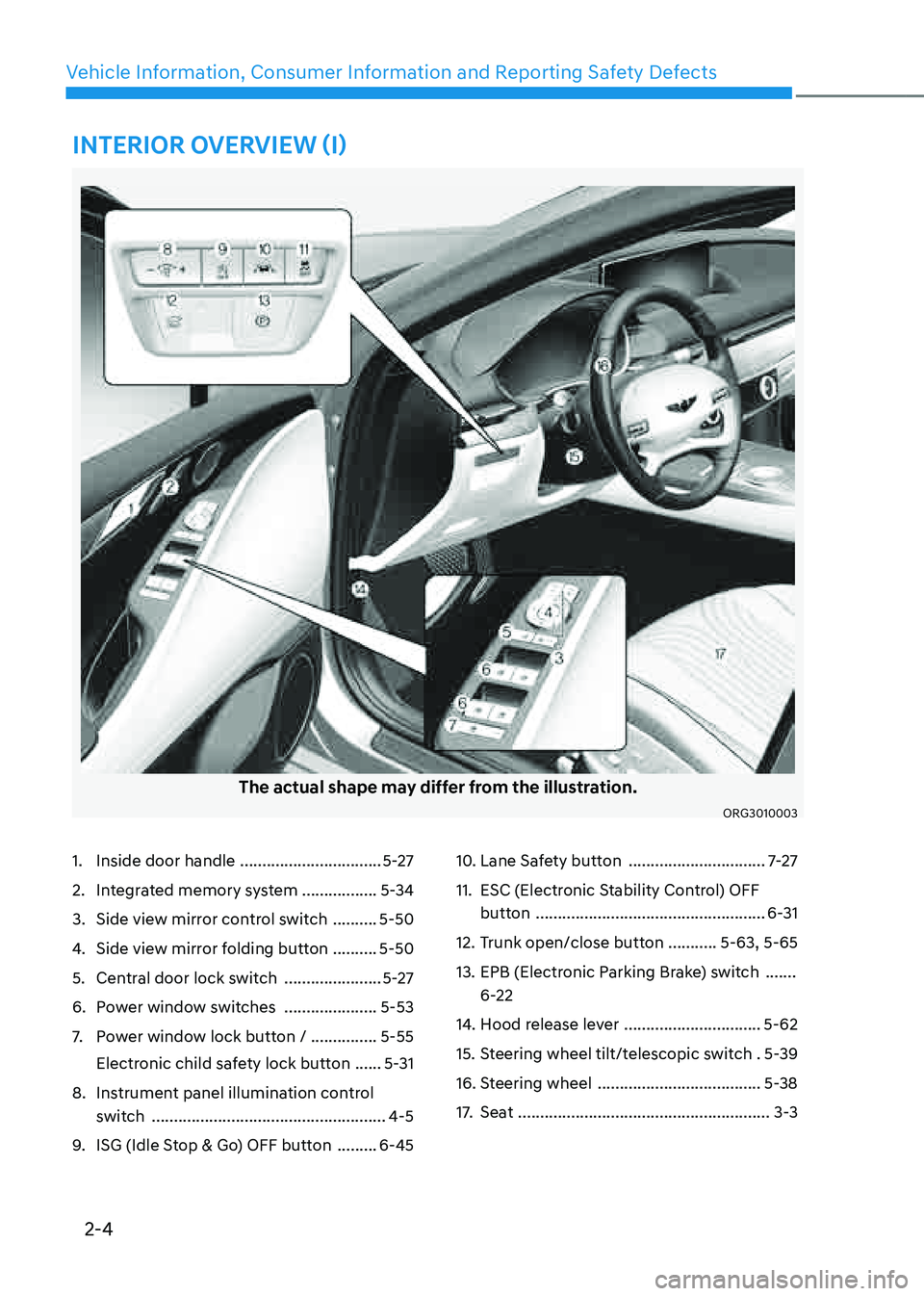
1. Inside door handle ................................5-27
2. Integrated memory system .................5-34
3. Side view mirror control switch ..........5-50
4. Side view mirror folding button ..........5-50
5. Central door lock switch ......................5-27
6. Power window switches .....................5-53
7. Power window lock button / ...............5-55
Electronic child safety lock button
......5-31
8. Instrument panel illumination control
switch
.....................................................4-5
9. ISG (Idle Stop & Go) OFF button .........6-45
10. Lane Safety button ...............................7-27
11. ESC (Electronic Stability Control) OFF
button
....................................................6-31
12. Trunk open/close button ...........5-63, 5-65
13. EPB (Electronic Parking Brake) switch .......
6-22
14. Hood release lever ...............................5-62
15. Steering wheel tilt/telescopic switch .5-39
16. Steering wheel .....................................5-38
17. Seat .........................................................3-3
INTERIOR OVERVIEW (I)
Page 19 of 604
2-7
02
The actual engine compartment in the vehicle may differ from the illustration.
ORG3090001
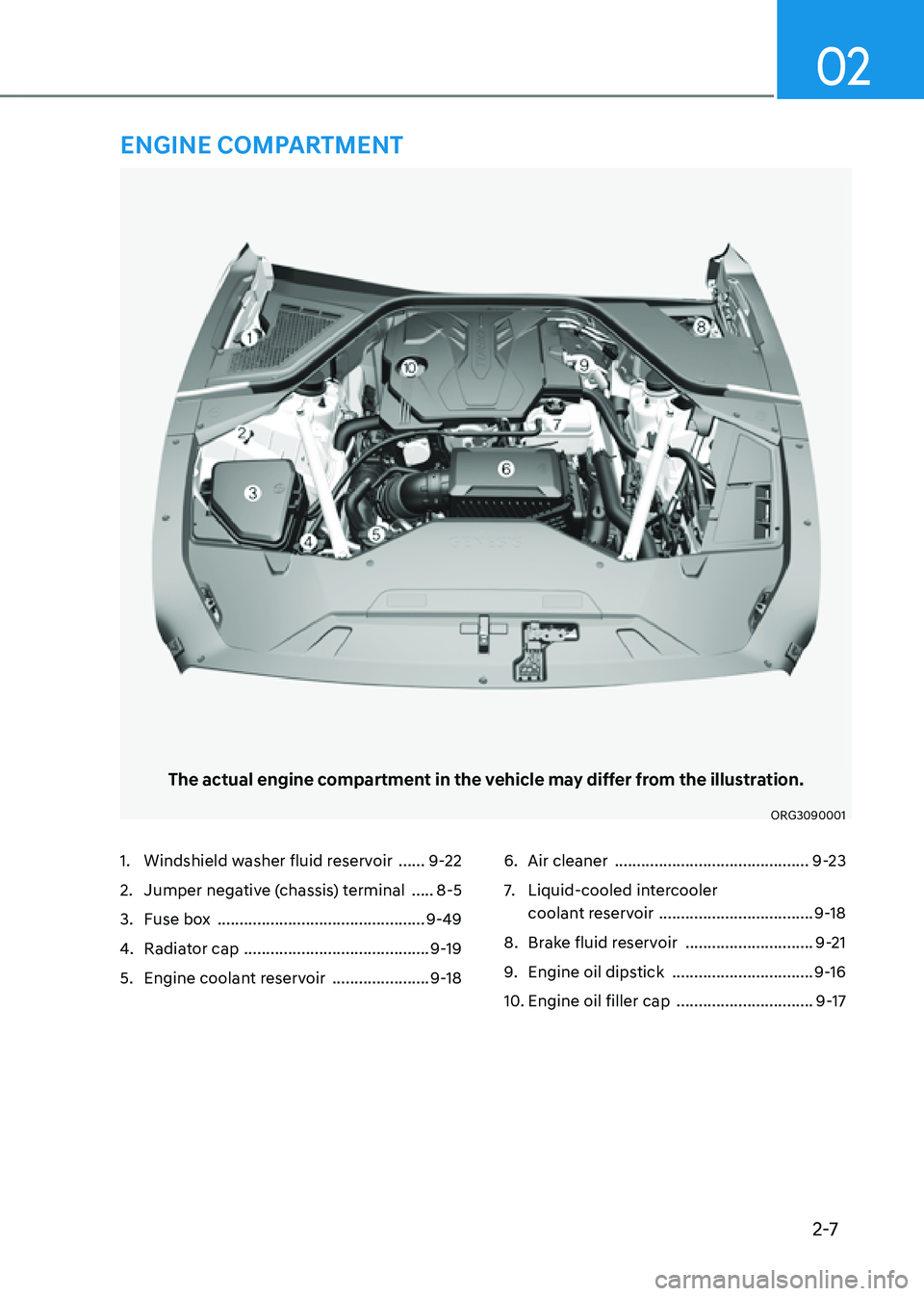
1. Windshield washer fluid reservoir ......9-22
2. Jumper negative (chassis) terminal .....8-5
3. Fuse box ...............................................9-49
4. Radiator cap ..........................................9-19
5. Engine coolant reservoir ......................9-18
6. Air cleaner ............................................9-23
7. Liquid-cooled intercooler
coolant reservoir
...................................9-18
8. Brake fluid reservoir .............................9-21
9. Engine oil dipstick ................................9-16
10. Engine oil filler cap ...............................9-17
ENGINE COMPARTMENT
Page 24 of 604
Vehicle Information, Consumer Information and Reporting Safety Defects
2-12
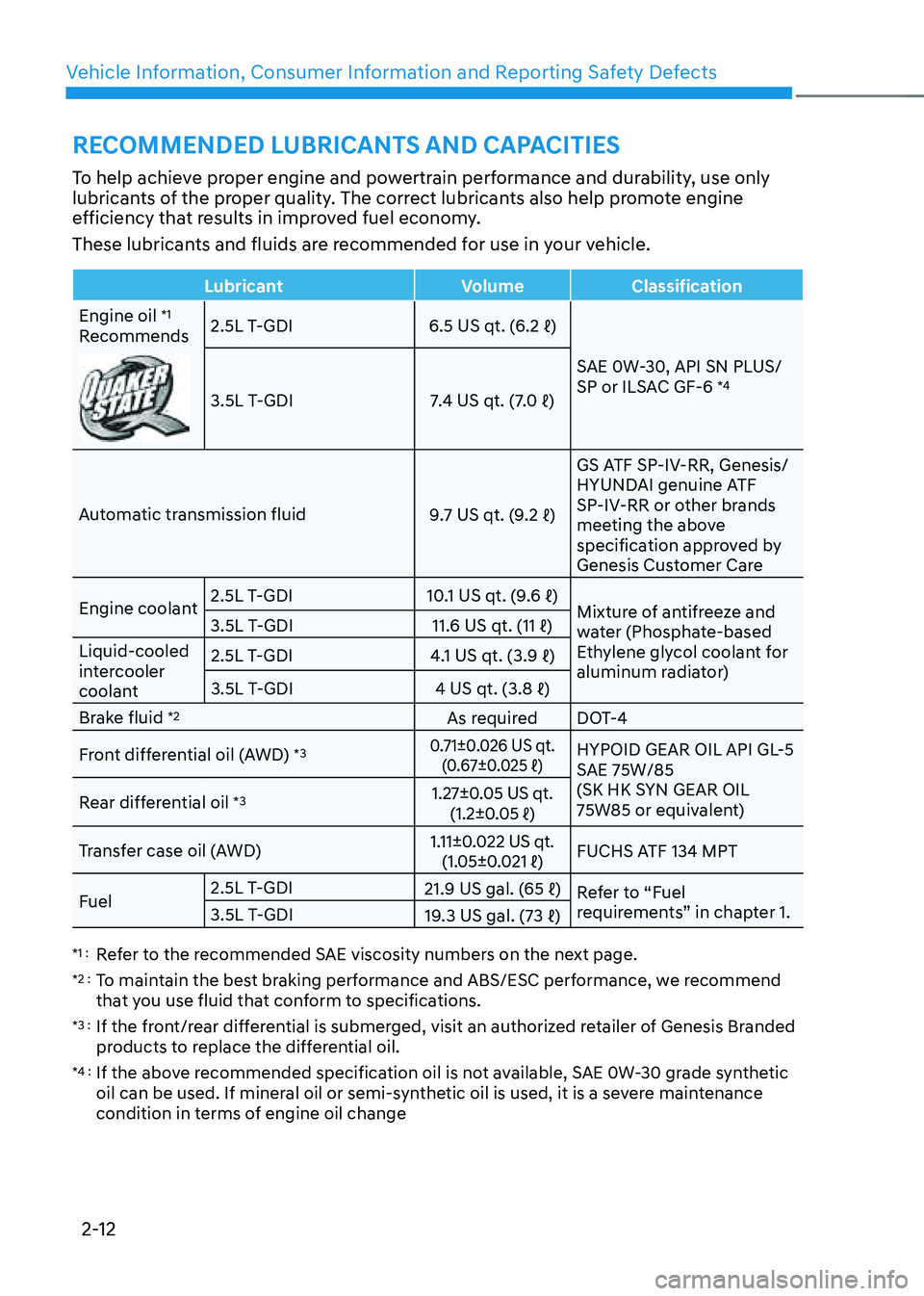
To help achieve proper engine and powertrain performance and durability, use only
lubricants of the proper quality. The correct lubricants also help promote engine
efficiency that results in improved fuel economy.
These lubricants and fluids are recommended for use in your vehicle.
LubricantVolumeClassification
Engine oil
*1
Recommends 2.5L T-GDI
6.5 US qt. (6.2 ℓ)
SAE 0W-30, API SN PLUS/
SP or ILSAC GF-6
*43.5L T-GDI 7.4 US qt. (7.0 ℓ)
Automatic transmission fluid 9.7 US qt. (9.2 ℓ)GS ATF SP-IV-RR, Genesis/
HYUNDAI genuine ATF
SP-IV-RR or other brands
meeting the above
specification approved by
Genesis Customer Care
Engine coolant 2.5L T-GDI
10.1 US qt. (9.6 ℓ)
Mixture of antifreeze and
water (Phosphate-based
Ethylene glycol coolant for
aluminum radiator)
3.5L T-GDI
11.6 US qt. (11 ℓ)
Liquid-cooled
intercooler
coolant 2.5L T-GDI
4.1 US qt. (3.9 ℓ)
3.5L T-GDI 4 US qt. (3.8 ℓ)
Brake fluid
*2As required DOT-4
Front differential oil (AWD)
*30.71±0.026 US qt. (0.67±0.025 ℓ)HYPOID GEAR OIL API GL-5
SAE 75W/85
(SK HK SYN GEAR OIL
75W85 or equivalent)
Rear differential oil
*31.27±0.05 US qt.
(1.2±0.05 ℓ)
Transfer case oil (AWD) 1.11±0.022 US qt.
(1.05±0.021 ℓ) FUCHS ATF 134 MPT
Fuel 2.5L T-GDI
21.9 US gal. (65 ℓ)
Refer to “Fuel
requirements” in chapter 1.
3.5L T-GDI 19.3 US gal. (73 ℓ)
*1 : Refer to the recommended SAE viscosity numbers on the next page.
*2 : To maintain the best braking performance and ABS/ESC performance, we recommend
that you use fluid that conform to specifications.
*3 : If the front/rear differential is submerged, visit an authorized retailer of Genesis Branded
products to replace the differential oil.
*4 : If the above recommended specification oil is not available, SAE 0W-30 grade synthetic
oil can be used. If mineral oil or semi-synthetic oil is used, it is a severe maintenance
condition in terms of engine oil change
RECOMMENDED LUBRICANTS AND CAPACITIES
Page 45 of 604

03
3-15
Carrying long/narrow cargo
ORG3030009N
Additional cargo space is provided to
accommodate long/narrow cargo (skis,
poles, etc.) not able to fit properly in the
trunk when closed.
1. Pull the armrest down.
2. Pull the cover down while pushing the
release lever down.
NOTICE
• Be careful when loading cargo
through the rear passenger seats
to prevent damage to the vehicle
interior.
• When both the armrest and the
panel, which is locates between
the rear seatback and the trunk, are
folded down, put back the panel first
before folding back the arm rest. If
not, the panel knobs and the armrest
knobs may interfere with each other
and get damaged.
CAUTION
• Make sure the engine is off, the
vehicle is shifted to P (Park) and the
parking brake is applied whenever
loading or unloading cargo. The
vehicle may move if the shift lever
is inadvertently moved to another
position.
• When cargo is loaded through the
rear passenger seats, ensure the
cargo is properly secured to prevent
it from moving while driving.
WARNING
Cargo should always be secured to
prevent it from being thrown about the
vehicle in a collision and causing injury
to the vehicle occupants. Do not place
objects in the rear seats, since they
cannot be properly secured and may hit
the front seat occupants in a collision.
Page 96 of 604

Safety System
3-66
ORG3030047
Just before impact, drivers often brake
heavily. Such heavy braking lowers the
front portion of the vehicle causing it
to “ride” under a vehicle with a higher
ground clearance. Air bags may not
inflate in this “underride” situation
because deceleration forces that are
detected by sensors may be significantly
reduced by such “underride” collisions.
ORG3030048
Front air bags may not inflate in
rollover accidents because front air bag
deployment would not provide additional
occupant protection.
Information
With rollover sensor
The side and curtain air bags and front
center air bag may inflate in a rollover
situation, when it is detected by the
rollover sensor.
ORG3030049
Air bags may not inflate if the vehicle
collides with objects such as utility poles
or trees, where the point of impact is
concentrated and the collision energy is
absorbed by the vehicle structure.
Page 102 of 604

Instrument Cluster
4
Instrument Cluster ........................................................................\
....................4-4Instrument Cluster Control ........................................................................\
..................4-5
Instrument panel illumination ........................................................................\
...........4-5
Gauges and Meters ........................................................................\
..............................4-5
Speedometer ........................................................................\
.....................................4-5
Tachometer ........................................................................\
.......................................4-6
Engine coolant temperature gauge (for 12.3-inch 3D cluster) ...............................4-6
Fuel gauge
........................................................................\
..........................................4 -7
Outside temperature gauge ........................................................................\
.............4-8
Odometer ........................................................................\
..........................................4-9
Distance to empty ........................................................................\
............................4-9
Fuel economy (for 12.3-inch 3D cluster) ................................................................4-10
Transmission Shift Indicator ........................................................................\
..............4-10
Automatic transmission shift indicator ..................................................................4-10
Warning and Indicator Lights ........................................................................\
.............4-11
Seat belt warning light ........................................................................\
.....................4-11
Air bag warning light ........................................................................\
........................4-11
Parking brake & Brake fluid warning light ...............................................................4-11
Anti-lock Brake System (ABS) warning light ..........................................................4-12
Electronic Brake Force Distribution (EBD) system warning light .........................4-12
Electric Power Steering (EPS) warning light ..........................................................4-13
Charging system warning light ........................................................................\
.......4-13
Engine oil pressure warning light ........................................................................\
...4-14
Engine coolant temperature warning light (for 8-inch cluster) ............................4-14
Low fuel level warning light ........................................................................\
............4-14
Malfunction Indicator Lamp (MIL) ........................................................................\
..4-15
Master warning light ........................................................................\
........................4-15
Electronic Parking Brake (EPB) warning light ........................................................4-16
Low tire pressure warning light ........................................................................\
......4-16
Forward Safety warning light ........................................................................\
..........4-17
Lane Safety indicator light ........................................................................\
..............4-17
All Wheel Drive (AWD) warning light ......................................................................4-17
LED headlight warning light ........................................................................\
............4-18
Icy road warning light ........................................................................\
.....................4-18
Electronic Stability Control (ESC) indicator light ...................................................4-19
Electronic Stability Control (ESC) OFF indicator light ...........................................4-19
4. Instrument Cluster
Page 103 of 604

Immobilizer indicator light ........................................................................\
..............4-19
AUTO STOP indicator light ........................................................................\
..............4-20
Turn signal indicator light ........................................................................\
................4-20
High beam indicator light ........................................................................\
...............4-20
Low beam indicator light ........................................................................\
.................4-21
Light ON indicator light ........................................................................\
....................4-21
High Beam Assist indicator light ........................................................................\
......4-21
AUTO HOLD indicator light ........................................................................\
..............4-21
LCD Display Messages ........................................................................\
.......................4-22
Vehicle is on ........................................................................\
.....................................4-22
Shift to P ........................................................................\
...........................................4-22
Vehicle is in N. Press START button and shift to P .................................................4-22
Low key battery ........................................................................\
...............................4-22
Press brake pedal to start engine ........................................................................\
..4-22
Key not in vehicle ........................................................................\
............................4-22
Key not detected ........................................................................\
..............................4-22
Press START button again ........................................................................\
..............4-22
Place the smart key in the emergency start slot and press the start button .......4-23
Check BRAKE SWITCH fuse ........................................................................\
...........4-23
Shift to P or N to start engine ........................................................................\
..........4-23
Battery discharging due to external electrical devices .........................................4-23
Door, Hood, trunk open indicator
........................................................................\
...4-23
Sunroof open indicator ........................................................................\
...................4-24
Low tire pressure ........................................................................\
.............................4-24
Lights ........................................................................\
................................................4-24
Wiper ........................................................................\
................................................4-25
Low washer fluid ........................................................................\
..............................4-25
Low fuel ........................................................................\
............................................4-25
Low engine oil ........................................................................\
.................................4-25
Engine overheated ........................................................................\
...........................4-26
Check haptic steering wheel system ......................................................................4-26
Check headlight ........................................................................\
..............................4-26
Check turn signal ........................................................................\
............................4-26
Check headlamp LED ........................................................................\
.....................4-26
4
Page 112 of 604
04
4-11
Warning and Indicator Lights
Information
Make sure that all warning lights are OFF
after starting the engine. If any light is still
ON, this indicates a situation that needs
attention.
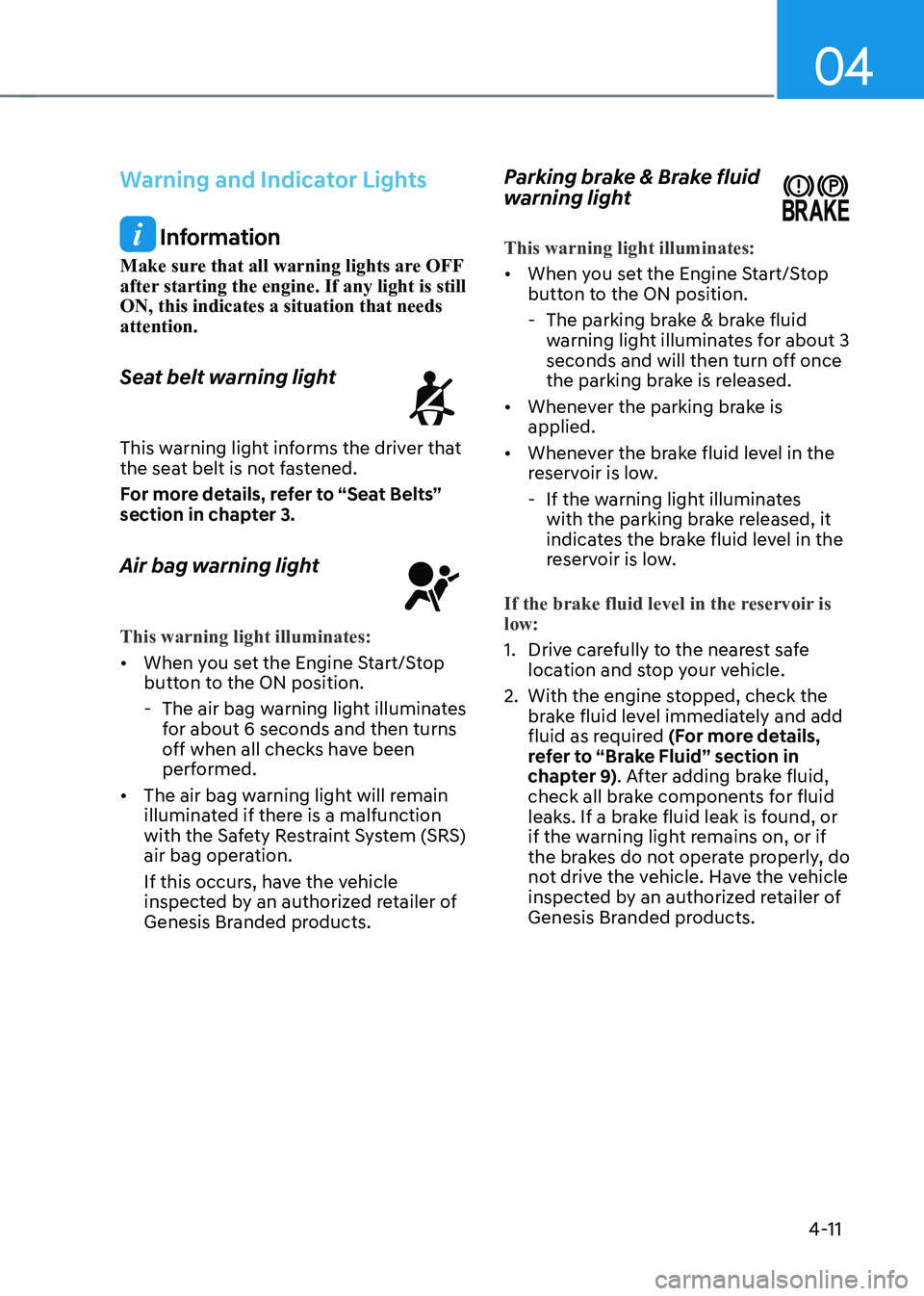
Seat belt warning light
This warning light informs the driver that the seat belt is not fastened.
For more details, refer to “Seat Belts”
section in chapter 3.
Air bag warning light
This warning light illuminates:
• When you set the Engine Start/Stop
button to the ON position.
-The air bag warning light illuminates
for about 6 seconds and then turns
off when all checks have been
performed.
• The air bag warning light will remain
illuminated if there is a malfunction
with the Safety Restraint System (SRS)
air bag operation.
If this occurs, have the vehicle
inspected by an authorized retailer of
Genesis Branded products.
Parking brake & Brake fluid
warning light
This warning light illuminates:
• When you set the Engine Start/Stop
button to the ON position.
-The parking brake & brake fluid
warning light illuminates for about 3
seconds and will then turn off once
the parking brake is released.
• Whenever the parking brake is
applied.
• Whenever the brake fluid level in the
reservoir is low.
-If the warning light illuminates
with the parking brake released, it
indicates the brake fluid level in the
reservoir is low.
If the brake fluid level in the reservoir is
low:
1. Drive carefully to the nearest safe
location and stop your vehicle.
2. With the engine stopped, check the
brake fluid level immediately and add
fluid as required (For more details,
refer to “Brake Fluid” section in
chapter 9). After adding brake fluid,
check all brake components for fluid
leaks. If a brake fluid leak is found, or
if the warning light remains on, or if
the brakes do not operate properly, do
not drive the vehicle. Have the vehicle
inspected by an authorized retailer of
Genesis Branded products.