FUEL GENESIS G90 2017 Owner's Guide
[x] Cancel search | Manufacturer: GENESIS, Model Year: 2017, Model line: G90, Model: GENESIS G90 2017Pages: 524, PDF Size: 19.3 MB
Page 374 of 524

5-113
05
Certification label
The certification label is located on
the driver's door sill at the center pil-
lar and shows the maximum allow-
able weight of the fully loaded vehi-
cle. This is called the GVWR (Gross
Vehicle Weight Rating). The GVWR
includes the weight of the vehicle, all
occupants, fuel and cargo.
This label also tells you the maxi-
mum weight that can be supported
by the front and rear axles, called
Gross Axle Weight Rating (GAWR).
The total weight of the vehicle,
including all occupants, accessories,
cargo, and trailer tongue load must
not exceed the Gross Vehicle Weight
Rating (GVWR) or the Gross Axle
Weight Rating (GAWR). To find out
the actual loads on your front and
rear axles, you need to go to a weigh
station and weigh your vehicle. Be
sure to spread out your load equally
on both sides of the centerline.Overloading your vehicle may
cause damage. Repairs would not
be covered by your warranty. Do
not overload your vehicle.
NOTICE
OBH059070
Overloading
Never exceed the GVWR for
your vehicle, the GAWR for
either the front or rear axle
and vehicle capacity weight.
Exceeding these ratings can
affect your vehicle's handling
and braking ability, and cause
an accident.
Do not overload your vehicle. Overloading your vehicle can
cause heat buildup in your
vehicle's tires and possible
tire failure, increased stop-
ping distances and poor vehi-
cle handling-all of which may
result in a crash.
WARNING
Page 379 of 524
If the Engine Doesn't Turn
Over or Turns Over Slowly
Be sure the shift lever is in N(Neutral) or P (Park). The engine
starts only when the shift lever is in
N (Neutral) or P (Park).
Turn on the interior light. If the light dims or goes out when you operate
the starter, the battery is drained.
Do not push or pull the vehicle to
start it. This could cause damage to
your vehicle. See instructions for
"Jump Starting" provided in this
chapter.
Push or pull starting the vehicle
may cause the catalytic converter
to overload which can lead to
damage to the emission control
system.
If the Engine Turns Over
Normally but Doesn't Start
Check the fuel level and add fuel if
necessary.
If the engine still does not start, have
your vehicle checked by an authorized
Dealer of Genesis Brand Products.
NOTICE
I I F
F
T
T H
H E
E
E
E N
N G
GI
IN
N E
E
W
W I
IL
L L
L
N
N O
O T
T
S
S T
T A
A R
RT
T
6-4
What to do in an emergency
Page 386 of 524
6-11
06
Tire Pressure Monitoring
System
Each tire, including the spare (if pro-
vided), should be checked monthly
when cold and inflated to the inflation
pressure recommended by the vehi-
cle manufacturer on the vehicle plac-
ard or tire inflation pressure label. (If
your vehicle has tires of a different
size than the size indicated on the
vehicle placard or tire inflation pres-
sure label, you should determine the
proper tire inflation pressure for
those tires.)
As an added safety feature, your
vehicle has been equipped with a tire
pressure monitoring system (TPMS)
that illuminates a low tire pressure
telltale when one or more of your
tires is significantly under-inflated.
Accordingly, when the low tire pres-
sure telltale illuminates, you should
stop and check your tires as soon as
possible, and inflate them to the
proper pressure. Driving on a signifi-
cantly under-inflated tire causes the
tire to overheat and can lead to tire
failure.
Under-inflation also reduces fuel effi-
ciency and tire tread life, and may
affect the vehicle’s handling and
stopping ability.Please note that the TPMS is not a
substitute for proper tire mainte-
nance, and it is the driver’s responsi-
bility to maintain correct tire pres-
sure, even if under-inflation has not
reached the level to trigger illumina-
tion of the TPMS low tire pressure
telltale.
Your vehicle has also been equipped
with a TPMS malfunction indicator to
indicate when the system is not oper-
ating properly. The TPMS malfunc-
tion indicator is combined with the
low tire pressure telltale. When the
system detects a malfunction, the
telltale will flash for approximately
one minute and then remain continu-
ously illuminated. This sequence will
continue upon subsequent vehicle
start-ups as long as the malfunction
exists.
When the malfunction indicator is
illuminated, the system may not be
able to detect or signal low tire pres-
sure as intended. TPMS malfunc-
tions may occur for a variety of rea-
sons, including the installation of
replacement or alternate tires or
wheels on the vehicle that prevent
the TPMS from functioning properly.
Always check the TPMS malfunction
telltale after replacing one or more
tires or wheels on your vehicle to
ensure that the replacement or alter-
nate tires and wheels allow the
TPMS to continue to function proper-
ly.
Over-inflation or under-inflation
can reduce tire life, adversely
affect vehicle handling, and
lead to sudden tire failure that
may cause loss of vehicle con-
trol resulting in an accident.
WARNING
Page 404 of 524
M
Ma
ai
in
n t
te
e n
n a
an
n c
ce
e
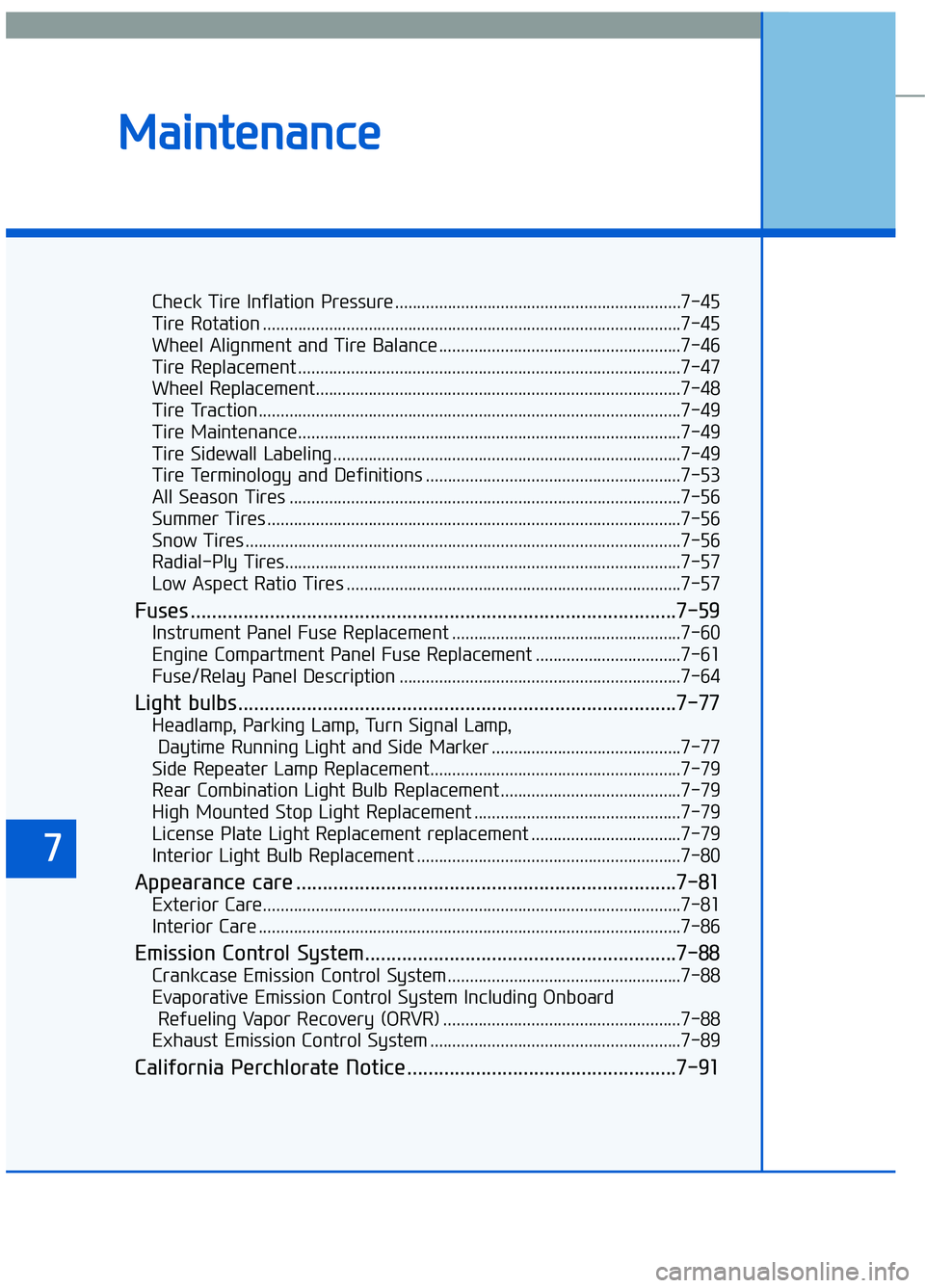
Check Tire Inflation Pressure .................................................................7-45
Tire Rotation ........................................................................\
.......................7-45
Wheel Alignment and Tire Balance .......................................................7-46
Tire Replacement ........................................................................\
...............7-47
Wheel Replacement........................................................................\
...........7-48
Tire Traction........................................................................\
........................7-49
Tire Maintenance........................................................................\
...............7-49
Tire Sidewall Labeling ........................................................................\
.......7-49
Tire Terminology and Definitions ..........................................................7-53
All Season Tires ........................................................................\
.................7-56
Summer Tires ........................................................................\
......................7-56
Snow Tires ........................................................................\
...........................7-56
Radial-Ply Tires........................................................................\
..................7-57
Low Aspect Ratio Tires ........................................................................\
....7-57
Fuses ........................................................................\
....................7-59
Instrument Panel Fuse Replacement ....................................................7-60
Engine Compartment Panel Fuse Replacement .................................7-61
Fuse/Relay Panel Description ................................................................7-64
Light bulbs........................................................................\
...........7-77
Headlamp, Parking Lamp, Turn Signal Lamp,
Daytime Running Light and Side Marker ...........................................7-77
Side Repeater Lamp Replacement.........................................................7-79
Rear Combination Light Bulb Replacement.........................................7-79
High Mounted Stop Light Replacement ...............................................7-79
License Plate Light Replacement replacement ..................................7-79
Interior Light Bulb Replacement ............................................................7-80
Appearance care ........................................................................\
7-81
Exterior Care........................................................................\
.......................7-81
Interior Care ........................................................................\
........................7-86
Emission Control System...........................................................7-88
Crankcase Emission Control System .....................................................7-88
Evaporative Emission Control System Including Onboard Refueling Vapor Recovery (ORVR) ......................................................7-88
Exhaust Emission Control System .........................................................7-89
California Perchlorate Notice ...................................................7-91
7
Page 408 of 524

7-6
MaintenanceThe following lists are vehicle checks
and inspections that should be per-
formed by the owner or an author-
ized Dealer of Genesis Brand
Products at the frequencies indicat-
ed to help ensure safe, dependable
operation of your vehicle.
Any adverse conditions should be
brought to the attention of your deal-
er as soon as possible.
These Owner Maintenance vehicle
checks are generally not covered by
warranties and you may be charged
for labor, parts and lubricants used.
O OW
W N
NE
ER
R
M
M A
AI
IN
N T
TE
EN
N A
AN
N C
CE
E
Performing maintenance work
on a vehicle can be dangerous.
If you lack sufficient knowledge
and experience or the proper
tools and equipment to do the
work, have it done by an author-
ized Dealer of Genesis Brand
Products.
ALWAYS follow these precau-
tions for performing mainte-
nance work:
• Park your vehicle on level
ground, move the shift lever
into the P (Park) position,
apply the parking brake, place
the Engine Start/Stop button
in the OFF position.
Block the tires (front and back) to prevent the vehicle
from moving.
Remove loose clothing or jew-
elry that can become entan-
gled in moving parts.
If you must run the engine during maintenance, do so
out doors or in an area with
plenty of ventilation.
Keep flames, sparks, or smok- ing materials away from the
battery and fuel-related parts.
WARNING
Touching metal parts
Do not touch metal parts
(including strut bars) while the
engine is operating or hot.
Doing so could result in serious
personal injury. Turn the engine
off and wait until the metal parts
cool down to perform mainte-
nance work on the vehicle.
WARNING
Page 409 of 524
7-7
07
Owner Maintenance Schedule
When you stop for fuel:
• Check the engine oil level.
Check coolant level in the enginecoolant reservoir.
Check the windshield washer fluid level.
Check for low or under-inflated tires.
While operating your vehicle:
Note any changes in the sound ofthe exhaust or any smell of exhaust
fumes in the vehicle.
Check for vibrations in the steering wheel. Notice if there is any
increased steering effort or loose-
ness in the steering wheel, or
change in its straight-ahead posi-
tion.
Notice if your vehicle constantly turns slightly or "pulls" to one side
when traveling on smooth, level
road.
When stopping, listen and check for unusual sounds, pulling to one
side, increased brake pedal travel
or "hard-to-push" brake pedal.
If any slipping or changes in the operation of your transmission
occurs, check the transmission
fluid level.
Check the automatic transmission P (Park) function.
Check the parking brake.
Check for fluid leaks under your vehicle (water dripping from the air
conditioning system during or after
use is normal).
At least monthly:
Check coolant level in the enginecoolant reservoir.
Check the operation of all exterior lights, including the brake lights,
turn signals and hazard warning
flashers.
Check the inflation pressures of all tires including the spare for tires
that are worn, show uneven wear,
or are damaged.
Check for loose wheel lug nuts.
Be careful when checking your
engine coolant level when the
engine is hot. This may result in
coolant being blown out of the
opening and cause serious
burns and other injuries.
WARNING
Page 411 of 524
7-9
07
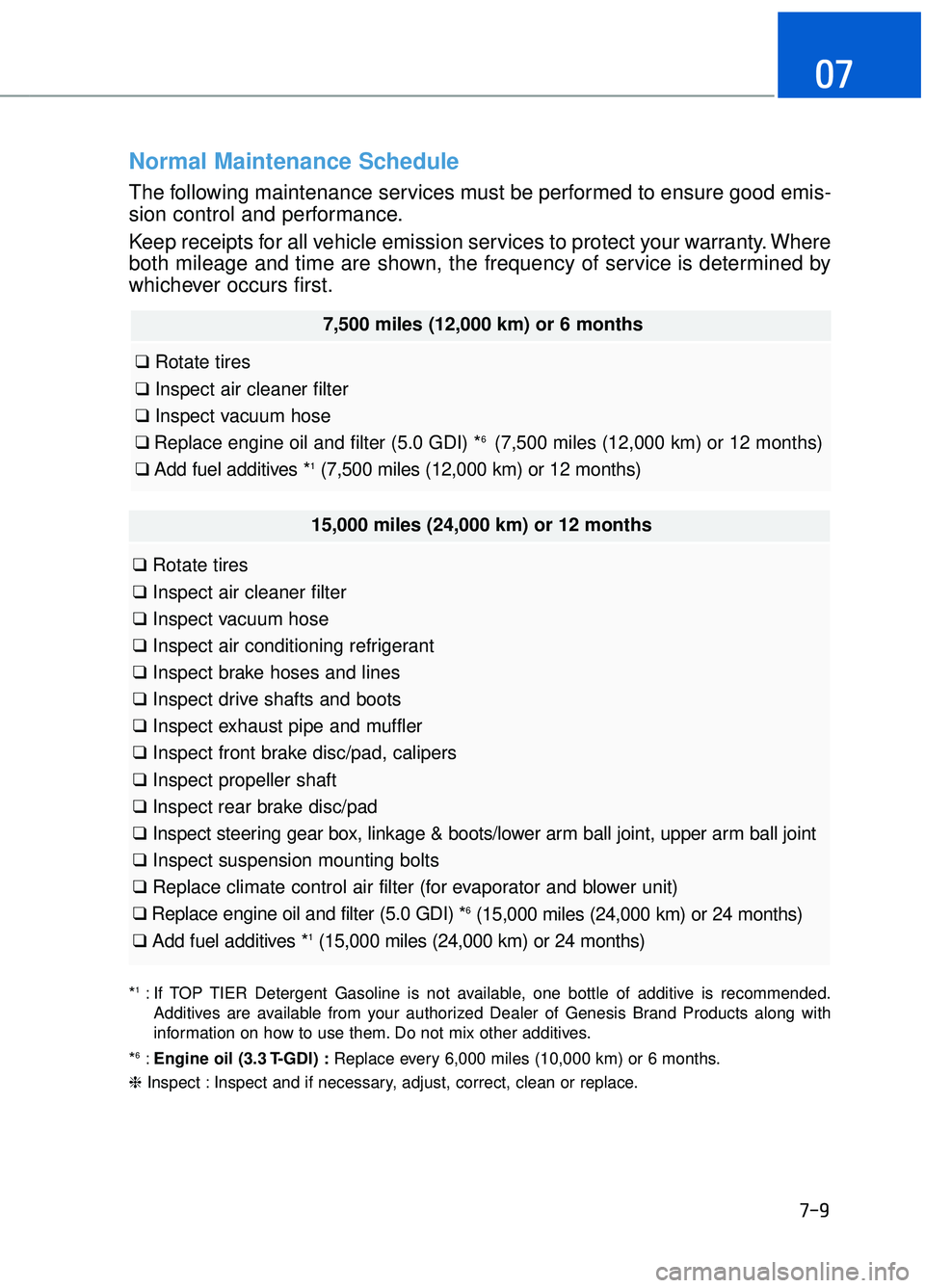
Normal Maintenance Schedule
The following maintenance services must be performed to ensure good emis-
sion control and performance.
Keep receipts for all vehicle emission services to protect your warranty. Where
both mileage and time are shown, the frequency of service is determined by
whichever occurs first.
7,500 miles (12,000 km) or 6 months
❑Rotate tires
❑ Inspect air cleaner filter
❑ Inspect vacuum hose
❑ Replace engine oil and filter (5.0 GDI) *
6 (7,500 miles (12,000 km) or 12 months)
❑ Add fuel additives *1(7,500 miles (12,000 km) or 12 months)
15,000 miles (24,000 km) or 12 months
❑ Rotate tires
❑ Inspect air cleaner filter
❑ Inspect vacuum hose
❑ Inspect air conditioning refrigerant
❑ Inspect brake hoses and lines
❑ Inspect drive shafts and boots
❑ Inspect exhaust pipe and muffler
❑ Inspect front brake disc/pad, calipers
❑ Inspect propeller shaft
❑ Inspect rear brake disc/pad
❑ Inspect steering gear box, linkage & boots/lower arm ball joint, upper arm ball joint
❑ Inspect suspension mounting bolts
❑ Replace climate control air filter (for evaporator and blower unit)
❑ Replace engine oil and filter (5.0 GDI) *
6(15,000 miles (24,000 km) or 24 months)
❑ Add fuel additives *1(15,000 miles (24,000 km) or 24 months)
*1: If TOP TIER Detergent Gasoline is not available, one bottle of additive is recommended.
Additives are available from your authorized Dealer of Genesis Brand Products along with
information on how to use them. Do not mix other additives.
*
6: Engine oil (3.3 T-GDI) : Replace every 6,000 miles (10,000 km) or 6 months.
❈ Inspect : Inspect and if necessary, adjust, correct, clean or replace.
Page 412 of 524
7-10
Maintenance
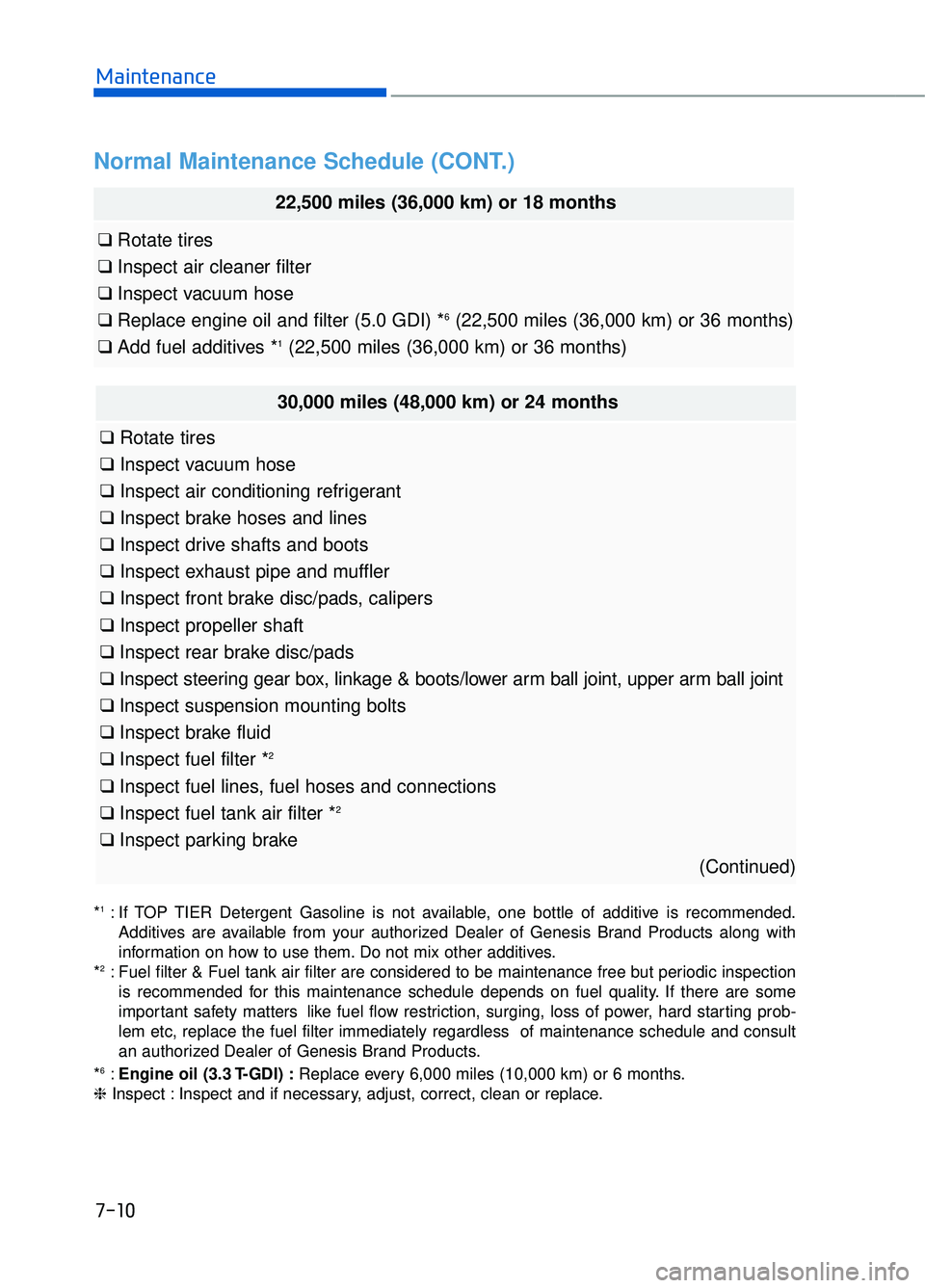
Normal Maintenance Schedule (CONT.)
22,500 miles (36,000 km) or 18 months
❑Rotate tires
❑ Inspect air cleaner filter
❑ Inspect vacuum hose
❑ Replace engine oil and filter (5.0 GDI) *
6(22,500 miles (36,000 km) or 36 months)
❑ Add fuel additives *1(22,500 miles (36,000 km) or 36 months)
*1: If TOP TIER Detergent Gasoline is not available, one bottle of additive is recommended.
Additives are available from your authorized Dealer of Genesis Brand Products along with
information on how to use them. Do not mix other additives.
*
2: Fuel filter & Fuel tank air filter are considered to be maintenance free\
but periodic inspection is recommended for this maintenance schedule depends on fuel quality. If there are some
important safety matters like fuel flow restriction, surging, loss of power, hard starting prob-
lem etc, replace the fuel filter immediately regardless of maintenance schedul\
e and consult
an authorized Dealer of Genesis Brand Products.
*
6: Engine oil (3.3 T-GDI) : Replace every 6,000 miles (10,000 km) or 6 months.
❈ Inspect : Inspect and if necessary, adjust, correct, clean or replace.
30,000 miles (48,000 km) or 24 months
❑Rotate tires
❑ Inspect vacuum hose
❑ Inspect air conditioning refrigerant
❑ Inspect brake hoses and lines
❑ Inspect drive shafts and boots
❑ Inspect exhaust pipe and muffler
❑ Inspect front brake disc/pads, calipers
❑ Inspect propeller shaft
❑ Inspect rear brake disc/pads
❑ Inspect steering gear box, linkage & boots/lower arm ball joint, upper arm ball joint
❑ Inspect suspension mounting bolts
❑ Inspect brake fluid
❑ Inspect fuel filter *
2
❑Inspect fuel lines, fuel hoses and connections
❑ Inspect fuel tank air filter *2
❑Inspect parking brake
(Continued)
Page 413 of 524
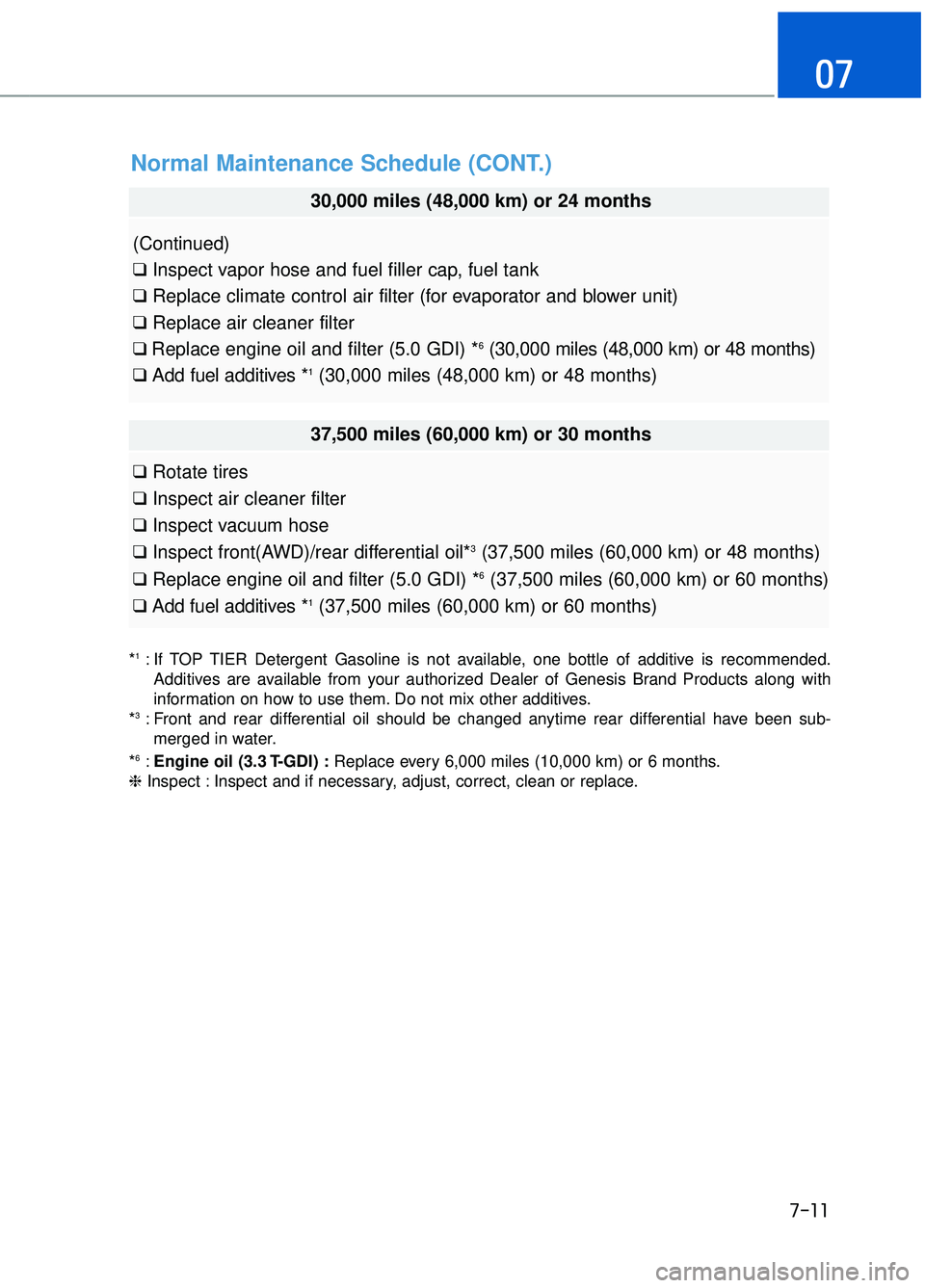
Normal Maintenance Schedule (CONT.)
7-11
07
*1: If TOP TIER Detergent Gasoline is not available, one bottle of additive is recommended.Additives are available from your authorized Dealer of Genesis Brand Products along with
information on how to use them. Do not mix other additives.
*
3: Front and rear differential oil should be changed anytime rear differential have been sub- merged in water.
*
6: Engine oil (3.3 T-GDI) : Replace every 6,000 miles (10,000 km) or 6 months.
❈ Inspect : Inspect and if necessary, adjust, correct, clean or replace.
30,000 miles (48,000 km) or 24 months
(Continued)
❑Inspect vapor hose and fuel filler cap, fuel tank
❑ Replace climate control air filter (for evaporator and blower unit)
❑ Replace air cleaner filter
❑ Replace engine oil and filter (5.0 GDI) *
6(30,000 miles (48,000 km) or 48 months)
❑ Add fuel additives *1(30,000 miles (48,000 km) or 48 months)
37,500 miles (60,000 km) or 30 months
❑ Rotate tires
❑ Inspect air cleaner filter
❑ Inspect vacuum hose
❑ Inspect front(AWD)/rear differential oil*
3(37,500 miles (60,000 km) or 48 months)
❑ Replace engine oil and filter (5.0 GDI) *6(37,500 miles (60,000 km) or 60 months)
❑ Add fuel additives *1(37,500 miles (60,000 km) or 60 months)
Page 414 of 524
7-12
Maintenance
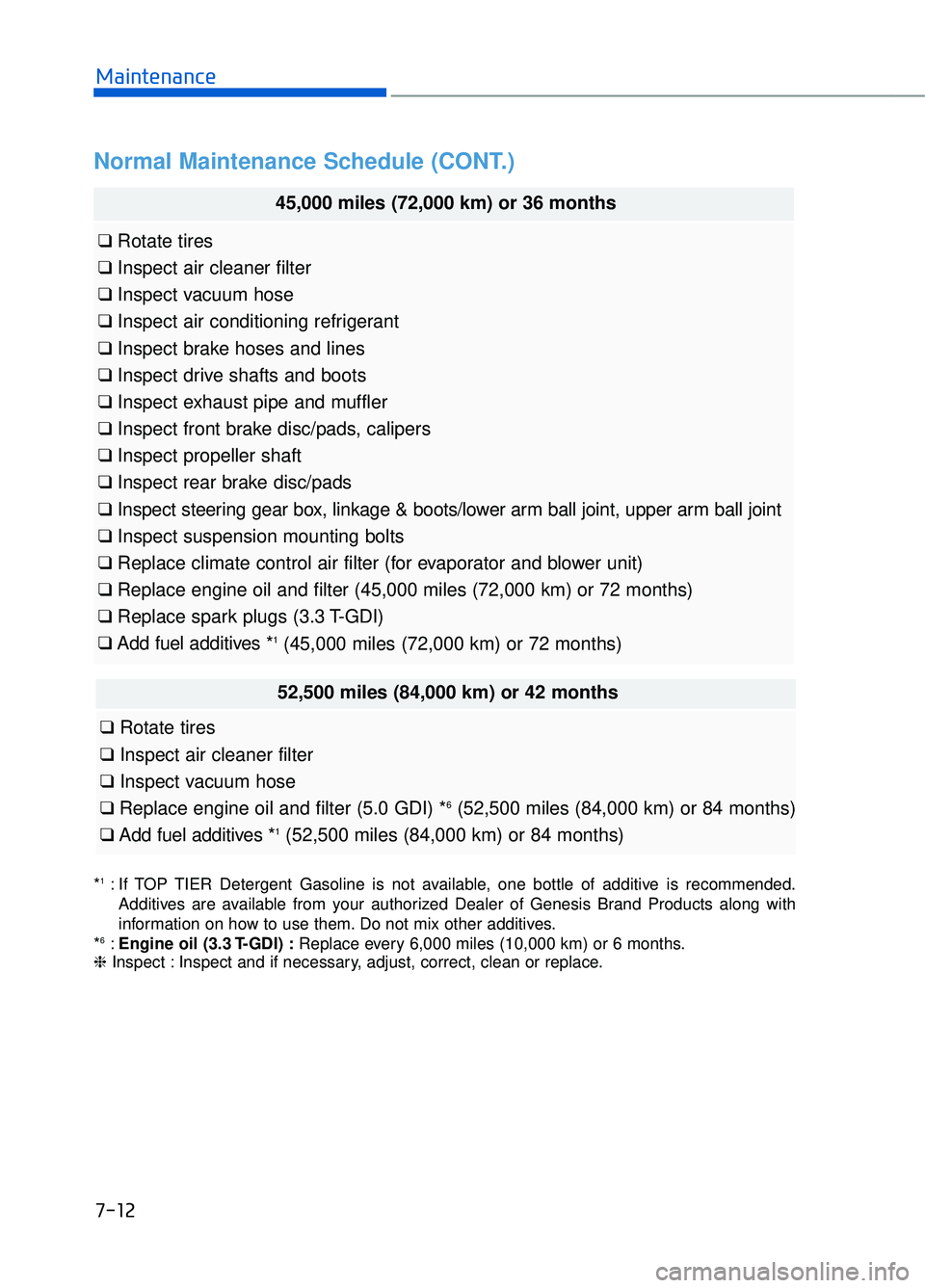
Normal Maintenance Schedule (CONT.)
45,000 miles (72,000 km) or 36 months
❑Rotate tires
❑ Inspect air cleaner filter
❑ Inspect vacuum hose
❑ Inspect air conditioning refrigerant
❑ Inspect brake hoses and lines
❑ Inspect drive shafts and boots
❑ Inspect exhaust pipe and muffler
❑ Inspect front brake disc/pads, calipers
❑ Inspect propeller shaft
❑ Inspect rear brake disc/pads
❑ Inspect steering gear box, linkage & boots/lower arm ball joint, upper arm ball joint
❑ Inspect suspension mounting bolts
❑ Replace climate control air filter (for evaporator and blower unit)
❑ Replace engine oil and filter (45,000 miles (72,000 km) or 72 months)\
❑ Replace spark plugs (3.3 T-GDI)
❑ Add fuel additives *
1(45,000 miles (72,000 km) or 72 months)
*1: If TOP TIER Detergent Gasoline is not available, one bottle of additive is recommended.
Additives are available from your authorized Dealer of Genesis Brand Products along with
information on how to use them. Do not mix other additives.
*
6: Engine oil (3.3 T-GDI) : Replace every 6,000 miles (10,000 km) or 6 months.
❈ Inspect : Inspect and if necessary, adjust, correct, clean or replace.
52,500 miles (84,000 km) or 42 months
❑Rotate tires
❑ Inspect air cleaner filter
❑ Inspect vacuum hose
❑ Replace engine oil and filter (5.0 GDI) *
6(52,500 miles (84,000 km) or 84 months)
❑ Add fuel additives *1(52,500 miles (84,000 km) or 84 months)