service GMC ENVOY 1998 Owner's Manual
[x] Cancel search | Manufacturer: GMC, Model Year: 1998, Model line: ENVOY, Model: GMC ENVOY 1998Pages: 386, PDF Size: 20.33 MB
Page 130 of 386
Have you recently changed brands of fuel?
If so, be sure to fuel your vehicle with quality fuel (see
"Fuel"
in the Index). Poor fuel quality will cause your
engine not to run as efficiently
as designed. You may
notice this as stalling after start-up, stalling when you
put the vehicle into gar, misfiring, hesitation on
acceleration or stumbling on acceleration. (These
conditions may go away once the engine
is warmed up.)
This will be detected by the system and cause the light
to turn on.
If you experience one or more of these conditions,
change the
fuel brand you use. It will require at least one
full tank of the proper fuel to turn the light off.
If none of the above steps have made the light turn off,
have your dealer or qualified service center check the
vehicle. Your dealer has the proper test equipment and
diagnostic tools to
fix any mechanical or electrical
problems that may have developed.
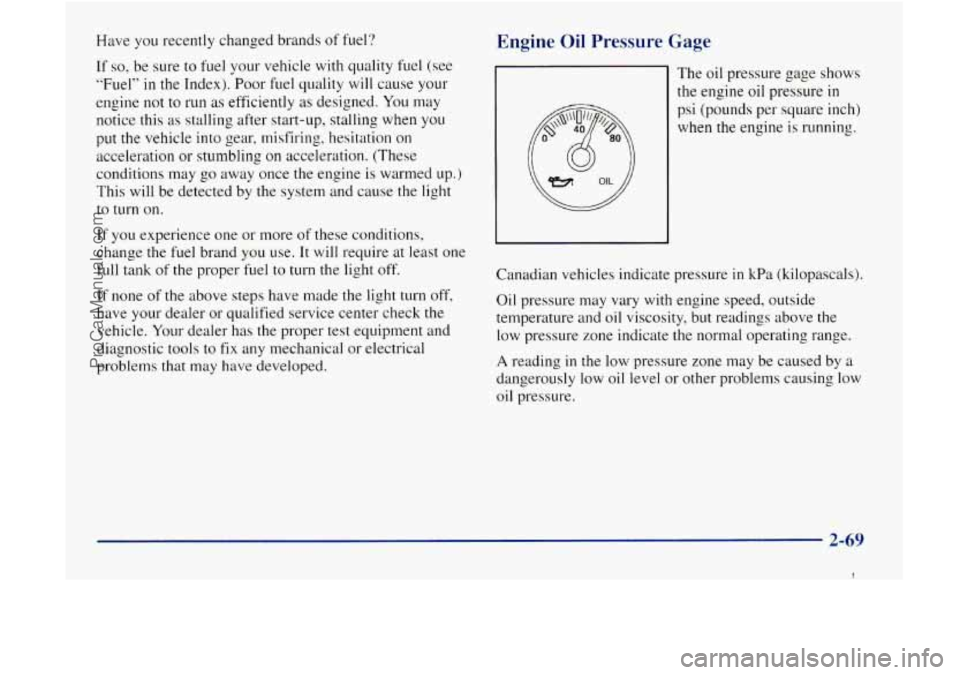
Engine Oil Pressure Gage
The oil pressure gage shows
the engine
oil pressure in
psi (pounds per square inch)
when the engine is running.
Canadian vehicles indicate pressure
in kPa (kilopascals).
Oil pressure may vary with engine speed, outside
temperature and oil viscosity, but readings above the
low pressure zone indicate the normal operating range.
A reading in the low pressure zone may be caused by a
dangerously low
oil level or other problems causing low
oil pressure.
2-69
I
ProCarManuals.com
Page 131 of 386

I A CAUTION:
Don’t keep driving if the oil pressure is low. If
you do, your engine can become so hot that it
catches fire. You or others could be burned.
Check your oil
as soon as possible and have your
vehicle serviced.
I
I NOTICE:
Damage to your engine from neglected oil
problems can be costly and
is not covered by
your warranty.
Security Warning Light
SECURITY
This light will come on
briefly when you turn the
key toward START. The
light will stay on until the
engine starts.
If the light flashes, the Passlock system has entered a
tamper mode.
If the vehicle fails to start, see “Passlock”
in the Index.
If the light comes on continuously while driving and
stays
on, there may be a problem with the Passlock
system. Your vehicle will not be protected by Passlock,
and you should see your dealer.
This light should also flash as you open
the door (if your
ignition is off).
This is a reminder to activate the
theft-deterrent system. See “Content Theft-Deterrent” in
the Index for more information.
2-70
ProCarManuals.com
Page 132 of 386

Service 4WD Light
SERVICE
4WD
This light should come on
briefly when you turn on the
ignition, as a check to show
you it is working.
The
SERVICE 4WD light comes on to indicate that
there may be a problem with the drive system and
service is required. Malfunctions can be indicated by the
system before any problem is apparent, which may
prevent serious damage
to the vehicle. This system is
also designed to assist your service technician in
correctly diagnosing a malfunction.
Check Gages Light
The CHECK GAGES light
CHECK
GAGES
will come on briefly when
you are starting the engine.
If the light comes on and stays on while you are driving,
check your coolant temperature and engine oil pressure
gages
to see if they are in the warning zones.
Gate Ajar Light
GATE
AJAR
This light will come on
briefly when
you are
starting the engine.
If it stays on, your liftgate
is ajar. Try closing the liftgate
again. Never drive with the liftgate even partially open.
2-71
ProCarManuals.com
Page 158 of 386

When using a scrubbing action, non-abrasive cleaning
cassette,
it is normal for the cassette to eject because
your unit is equipped with a cut tape detection feature
and
a cleaning cassette may appear as a broken tape. To
prevent the cleaning cassette from being ejected, use the
following steps.
1. Turn the ignition to RUN or ACCESSORY.
2. Turn the radio off.
3. Press and hold the TAPE AUX button for five
seconds. The tape symbol on the display
will flash
for two seconds.
4. Insert the scrubbing action cleaning cassette.
5. Eject the cleaning cassette after the manufacturer’s
recommended cleaning time.
When the cleaning cassette has been ejected, the cut tape
detection feature
is active again. You may
also choose a non-scrubbing action, wet-type
cleaner which uses a cassette
with a fabric belt to clean
the tape head. This type of cleaning cassette will not
eject on its own.
A non-scrubbing action cleaner may
not clean as thoroughly
as the scrubbing type cleaner.
The use of a non-scrubbing action, dry-type cleaning
cassette is not recommended.
After
you clean the player, press and hold EJECT for
five seconds to reset the
CLN indicator. The radio will
display
--- to show the indicator was reset.
Cassettes are subject to wear and the sound quality
may degrade over time. Always make sure the cassette
tape is
in good condition before you have your tape
player serviced.
3-25
I
ProCarManuals.com
Page 174 of 386
Off-Road Driving with Your GM
Four-Wheel-Drive Vehicle
Also, see "Anti-Lock Brakes" in the Index.
Off-road driving can be great fun. But
it does have some
definite hazards. The greatest of these is the
terrain itself.
"Off-roading" means you've left the great North
American road system behind. Traffic lanes aren't
marked. Curves aren't banked. There are no road signs.
Surfaces can be slippery, rough,
uphill or downhill. In
short, you've gone right back to nature.
Off-road driving involves some new skills. And that's
why it's very important that
you read this guide. You'll
find many driving tips and suggestions. These will help
make
your off-road driving safer and more enjoyable.
Before You Go Off-Roading
There are some things to do before you go out. For
example, be sure to have all necessary maintenance and
service work done. Check to make sure all underbody
shields
(if so equipped) are properly attached. Be sure
you read all the information about your
four-wheel-drive vehicle
in this manual. Is there enough
fuel? Is the spare tire fully inflated'? Are the fluid levels
up where they should be? What are the local
laws that
apply to off-roading where you'll be driving?
If you
don't know, you should check with
law enforcement
people
in the area. Will you be on someone's private
land'?
If so. be sure to get the necessary permission.
Loading Your Vehicle for Off-Road Driving
There are some important things to remember about
how to load your vehicle.
0 The heaviest things should be on the load floor and
forward of
your rear axle. Put heavier items as far
forward as you can.
Be sure the load is secured properly, so driving on
the off-road terrain doesn't toss things around.
4-15
I
ProCarManuals.com
Page 186 of 386

Your vehicle will require more frequent service due to
off-road use. Refer to the Maintenance Schedule for
additional information.
Drivin at Night
Night driving is more dangerous than day driving. One
reason is that some drivers are likely to be
impaired
-- by alcohol or drugs, with night vision
problems. or by fatigue. Here
are some tips on night driving.
0 Drive defensively.
0 Don't drink and drive.
0 Adjust your inside rearview mirror to reduce the
0 Since you can't see as well, you may need to slow
c2 "lare from headlamps behind you.
down and keep more space between
you and
other vehicles.
0 Slow down, especially on higher speed roads. Your
headlamps can light up only
so much road ahead.
In remote areas, watch for animals.
If you're tired. pull off the road in a safe place
and rest.
Night Vision
No one can see as well at night as in the daytime. But as
we get older these differences increase.
A 50-year-old
driver may require at least twice as much light to
see the
same thing
at night as a 20-year-old.
What you do
in the daytime can also affect your night
vision. For example,
if you spend the day in bright
sunshine
you are wise to wear sunglasses. Your eyes will
have
less trouble adjusting to night. But if you're
driving,
don't wear sunglasses at night. They may cut
down on glare from headlamps, but they also make a lot
of things invisible.
4-27
I
ProCarManuals.com
Page 192 of 386
The exit speed is usually posted.
Reduce your speed according to your speedometer’
not
to your sense of motion. After driving for any distance
at higher speeds,
you may tend to think you are going
slower than you actually are.
Before Leaving on a Long Trip
Make sure you’re ready. Try to be well rested. If you
must start when you’re not fresh
-- such as after a day’s
work
-- don’t plan to make too many miles that first part
of the journey. Wear comfortable clothing and shoes you
can easily drive
in.
Is your vehicle ready for a long trip? If you keep it
serviced and maintained, it‘s ready to go. If it needs
service, have
it done before starting out. Of course,
you’ll find experienced and able service experts
in GM
dealerships all across North America. They’ll be ready
and willing to help if you need it.
Here are some things you can check before a trip:
0
0
0
0
0
0
0
WincJsl~ield Wcrshc~r- Fluid: Is the reservoir full? Are
all windows clean inside and outside?
Wiper Blcrdes: Are they in good shape?
Fuel, Elzgirze Oil, Other Flr.ds: Have you checked
all levels‘?
Lcunps: Are they all working? Are the lenses clean?
Tires: They are vitally important to a safe,
trouble-free trip.
Is the tread good enough for
long-distance drivingi? Are the tires all inflated
to the
recommended pressure?
Wecrther Forec*cr.sts: What’s the weather outlook
along your route? Should
you delay your trip a short
time to avoid
a major storm system?
A4crp.s: Do you have up-to-date maps?
4-33
I
ProCarManuals.com
Page 193 of 386

Highway Hypnosis
Is there actually such a condition as “highway
hypnosis”? Or
is it just plain falling asleep at the wheel?
Call
it highway hypnosis, lack of awareness,
or whatever.
There is something about an easy stretch
of road with
the same scenery, along with the
hum of the tires on the
road, the drone
of the engine, and the rush of the wind
against the vehicle that can make you sleepy. Don‘t let it
happen to
you! If it does, your vehicle can leave the
road in
less than CI second, and you could crash and
be injured
.
What can you do about highway hypnosis? First, be
aware that it can happen.
Then here are some tips:
Make sure your vehicle is well ventilated, with a
comfortably cool interior.
Keep your eyes moving. Scan the road ahead and to
the sides. Check your mirrors and your
instruments frequently.
If you get sleepy, pull off the road into a rest. service
or parking area and take
a nap, get some exercise, or
both. For safety, treat drowsiness on
the highway as
an emergency.
aLL - - ountain Roads
Driving on steep hills or mountains is different from
driving
in flat or rolling terrain.
If you drive regularly in steep country, or if you’re
planning to visit there, here are some tips that can make
your trips safer
and more elljoyable. (See ”Off-Road
Driving“
in the Index for information about driving
off-road.)
4-34
ProCarManuals.com
Page 201 of 386
Payload
The payload capacity is shown on the CertificationRire
label. This is the maximum load capacity that your
vehicle can carry. Be sure to include the weight of the
occupants as part
of your load. If you added any
accessories or equipment after your vehicle left the
factory, remember to subtract the weight
of these things
from the payload.
Your dealer can help you with this.
Electronic Level Control
The rear of the vehicle is automatically kept level as you
load
or unload your vehicle. However, you should still
not exceed the
GVWR or the GAWR.
The ignition has to be on for the level control to work.
The system includes a small electric air compressor and
air-adjustable rear shock absorbers.
You may hear the compressor operating when you load
or unload your vehicle, and periodically
as the system
self-adjusts. This is normal. The compressor should operate for
brief periods
of time
If the sound continues for an extended period of time,
your vehicle needs service.
To keep your battery from
being drained. you may want to remove the
LD LEV
fuse in the fuse control panel until you can get your
vehicle serviced (see “Fuses and Circuit Breakers”
in
the Index).
Using heavier suspension components to get added
durability might not change your weight ratings.
Ask
your dealer to help you load your vehicle the right way.
NOTICE:
Your warranty does not cover parts or
components that fail because
of overloading.
ProCarManuals.com
Page 210 of 386

When You Are Ready to Leave After
Parking on a Hill
1. Apply your regular brakes and hold the pedal down
while you:
0 Start your engine;
Shift into a gear; and
0 Release the parking brake.
2. Let up on the brake pedal.
3. Drive slowly until the trailer is clear of the chocks.
4. Stop and have someone pick up and store the chocks.
Maintenance When Trailer Towing
Your vehicle will need service more often when you’re
pulling
a trailer. See the Maintenance Schedule for more
on this. Things that are especially important in trailer
operation are automatic transmission fluid (don’t
overfill), engine
oil, axle lubricant, belt, cooling system
and brake adjustment. Each of these is covered in this
manual, and the Index will help you find them quickly.
If you’re trailering, it’s
a good idea to review these
sections before you start your trip.
Check periodically to see that all hitch nuts and bolts
are tight.
ProCarManuals.com