service GMC ENVOY 1998 Service Manual
[x] Cancel search | Manufacturer: GMC, Model Year: 1998, Model line: ENVOY, Model: GMC ENVOY 1998Pages: 386, PDF Size: 20.33 MB
Page 261 of 386

Remote Oil Filter
The access door for the remote oil filter is in the steering
linkage shield assembly located under the radiator
support. Twist the screw to unlock or lock the door.
If
you open the door, make sure it is securely closed when
you are finished.
What to Do with Used Oil
Did you know that used engine oil contains certain
elements
that may be unhealthy for your skin and could
even cause cancer? Don’t let used oil stay on your skin
for very long. Clean your skin and nails with soap and
water, or
a good hand cleaner. Wash or properly throw
away clothing or rags containing used engine oil. (See
the manufacturer’s warnings about the use and disposal
of oil products.)
Used oil can be a real threat to the environment. If you
change your own oil, be sure to drain all free-flowing oil
from the filter before disposal. Don’t ever dispose of oil
by putting
it in the trash, pouring it on the ground, into
sewers, or into streams or bodies
of water. Instead,
recycle it by taking it to
a place that collects used oil. If
you have a problem properly disposing of your used oil,
ask your dealer, a service station or a local recycling
center for help.
To remove the air cleaner, remove the wing nuts that
hold the cover on. Remove the cover and lift
out the
air filter.
Insert
a new air filter, then replace the air cleaner cover.
Tighten the wing nuts
to hold the cover in place.
6-14
ProCarManuals.com
Page 262 of 386

A CAUTION:
Operating the engine with the air cleaner off can
cause you or others to be burned. The air cleaner
not only cleans the air, it stops flame
if the engine
backfires.
If it isn’t there, and the engine
backfires, you could be burned. Don’t drive with
it
off, and be careful working on the engine with
the
air cleaner off.
NOTICE:
If the air cleaner is off, a backfire can cause a
damaging engine fire. And, dirt can easily get
into your engine, which will damage it. Always
have the air cleaner in place when you’re driving.
Automatic Transmission Fluid
When to Check and Change
A good time to check your automatic transmission fluid
level
is when the engine oil is changed.
Change both the fluid and filter every
15,000 miles
(25 000 km) if the vehicle is mainly driven under one
or more of these conditions:
In heavy city traffic where the outside temperature
regularly reaches
90°F (32°C) or higher.
In hilly or mountainous terrain.
When doing frequent trailer towing.
Uses such as found in taxi, police or delivery service.
If you do not use your vehicle under any of these
conditions, change the fluid and filter every
50,000 miles (83 000 km).
See “Scheduled Maintenance Services’’ in the Index.
ProCarManuals.com
Page 263 of 386

How to Check
Because this operation can be a little difficult, you
may choose to have this done at your
GM dealership
Service Department.
If you do it yourself, be sure
to follow all the
instructions here, or you could get
a false reading on
the dipstick.
NOTICE:
Too much or too little fluid can damage your
transmission.
Too much can mean that some of
the fluid could come out and fall on hot engine
parts or exhaust system parts, starting a fire.
Be
sure to get an accurate reading if you check your
transmission fluid.
Wait at least 30 minutes before checking the
transmission fluid level
if you have been driving:
When outside temperatures are above 90°F (32°C).
0 At high speed for quite a while.
0 In heavy traffic -- especially in hot weather.
While pulling a trailer.
To get the right reading, the fluid should be at
normal operating temperature, which is 180°F to
200°F
(82°C to 93°C). See “Checking Transmission Fluid
Hot”
in the Index.
6-16
ProCarManuals.com
Page 266 of 386
Rear Axle
When to Check and Change Lubricant
Refer to the Maintenance Schedule to determine how
often to check the lubricant and when to change
it. See
“Scheduled Maintenance Services” in the Index.
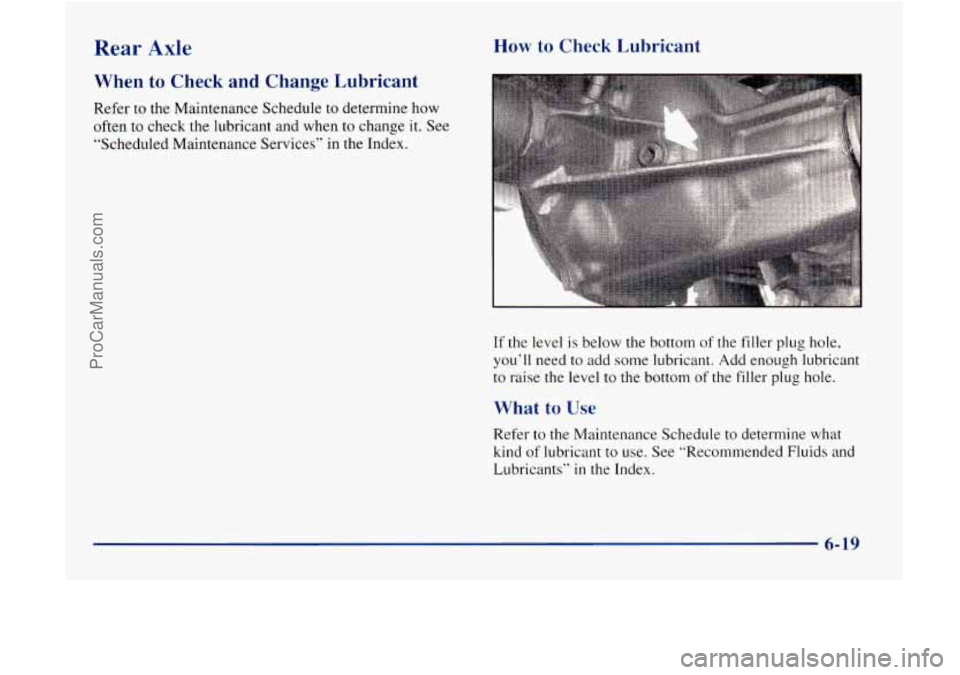
How to Check Lubricant
If the level is below the bottom of the filler plug hole,
you’ll need to add some lubricant. Add enough lubricant
to
raise the level to the bottom of the filler plug hole.
What to Use
Refer to the Maintenance Schedule to determine what
kind
of lubricant to use. See “Recommended Fluids and
Lubricants“
in the Index.
6-19
ProCarManuals.com
Page 268 of 386

Front Axle
When to Check and Change Lubricant
Refer to the Maintenance Schedule to determine how
often to check the lubricant and when to change
it. See
”Scheduled Maintenance Services”
in the Index.
How to Check Lubricant
If the level is below the bottom of the filler plug hole,
you may need to add some lubricant. When
the differential is cold, add enough lubricant to
raise the level to
1/2 inch (12 mm) below the filler
plug hole.
When the differential
is at operating temperature
(warm), add enough lubricant to raise the level
to the
bottom
of the filler plug hole.
What to use
Refer to the Maintenance Schedule to determine what
kind
of lubricant to use. See “Recommended Fluids and
Lubricants“
in the Index.
Engine Coolant
The cooling s stem in your vehicle is filled with
DEX-COOL J engine coolant. This coolant is designed
to remain in your vehicle for 5 years or 150,000 miles
(240 000 km) whichever occurs first, if you add only
DEX-COOL’ extended life coolant.
The following explains your cooling system and how
to add coolant when
it is low. If you have a problem
with engine overheating, see “Engine Overheating” in
the Index.
6-2 I
ProCarManuals.com
Page 276 of 386

NOTICE:
0 Using the wrong fluid can badly damage
brake system parts. For example, just
a few
drops of mineral-based oil, such as engine
oil, in your brake system can damage brake
system parts
so badly that they’ll have to be
replaced. Don’t let someone put in the
wrong kind of fluid.
If you spill brake fluid on your vehicle’s
painted surfaces, the paint finish can be
damaged. Be careful not to spill brake fluid
on your vehicle.
If you do, wash it off
immediately. See “Appearance Care” in
the Index.
Brake Wear
Your vehicle has four-wheel disc brakes.
Disc brake pads have built-in wear indicators that
make a high-pitched warning sound when the brake
pads are worn and new pads are needed. The sound
may come and
go or be heard all the time your vehicle
is moving (except when you are pushim on the brake
pedal firmly).
A CAU‘
The brake wear warning sound means that soon
your brakes won’t work well. That could lead to
an accident. When you hear the brake wear
warning sound, have your vehicle serviced.
NOTICE:
Continuing to drive with worn-out brake pads
could result
in costly brake repair.
6-29
ProCarManuals.com
Page 278 of 386

If you’re not going to drive your vehicle for 25 days
or more, remove the black, negative
(-) cable from
the battery. This will help keep your battery from
running down.
A CAUTION:
Bulb Replacement
Before you replace any bulbs, be sure that all the lamps
are off and the engine isn’t running. See “Replacement
Bulbs”
in the Index.
For any bulb changing procedure not listed
in this
section, contact your GM dealer’s service department.
High Intensity Discharge (HID) Lighting
Batteries have acid that can burn you and gas
that can explode. You can be badly hurt if you
aren’t careful. See “Jump Starting” in the Index
for tips on working around
a battery without
getting hurt.
Contact your dealer to learn how to prepare your vehicle
for longer storage periods.
Also, for your audio system, see “Theft-Deterrent
Feature”
in the Index.
I A CAUTION: I
The low beam High Intensity Discharge lighting
system operates at a very high voltage.
If you try
to service
any of the system components, you
could be injured. Have your dealer or
a qualified
technician service them.
6-31
ProCarManuals.com
Page 283 of 386
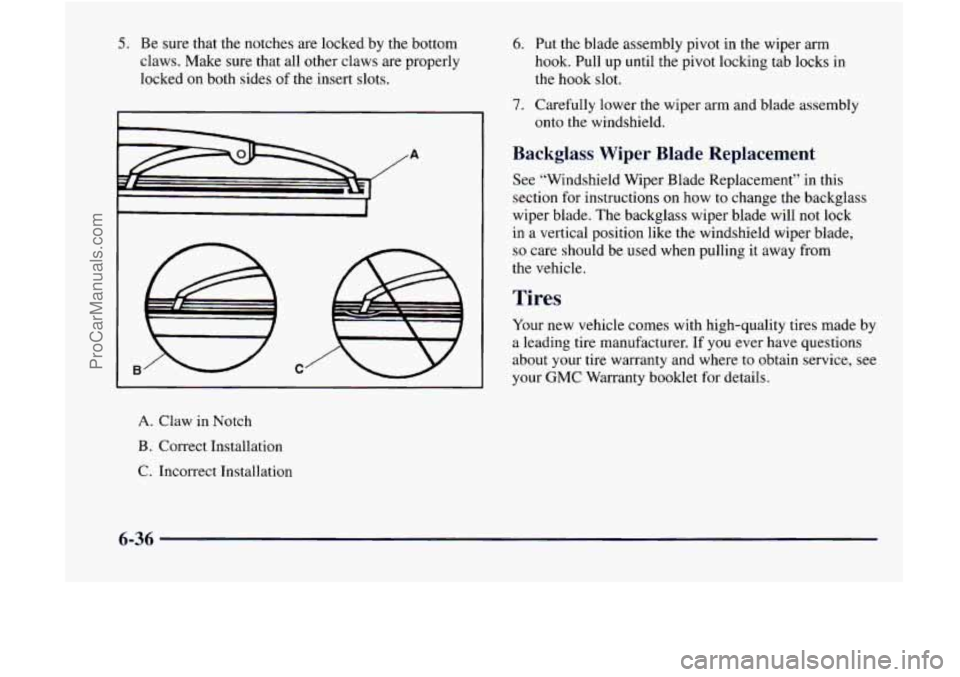
5. Be sure that the notches are locked by the bottom
claws. Make sure that all other claws are properly
locked on both sides
of the insert slots.
A
t------
A. Claw in Notch
B. Correct Installation
C. Incorrect Installation
6. Put the blade assembly pivot in the wiper arm
hook. Pull up until the pivot locking tab locks in
the hook
slot.
7. Carefully lower the wiper arm and blade assembly
onto the windshield.
Backglass Wiper Blade Rep --ment
See “Windshield Wiper Blade Replacement” in this
section
for instructions on how to change the backglass
wiper blade. The backglass wiper blade will not lock
in a vertical position like the windshield wiper blade,
so care should be used when pulling it away from
the vehicle.
Tires
Your new vehicle comes with high-quality tires made by
a leading tire manufacturer. If you ever have questions
about your tire warranty and where to obtain service, see
your
GMC Warranty booklet for details.
6-36
ProCarManuals.com
Page 285 of 386
NOTICE: (Continued)
If your tires have too much air (overinflation),
you can get the following:
0 Unusual wear
Bad handling
Rough ride
Needless damage from road hazards.
When to Check
Check your tires once a month or more. Also, check the
tire pressure
of the spare tire.
How to Check
Use a good quality pocket-type gage to check tire
pressure. You can’t
tell if your tires are properly inflated
simply by looking at them. Radial tires may look
properly inflated even when they’re underinflated.
Be sure to put the valve caps back on the valve stems.
They help prevent leaks by keeping out dirt and moisture.
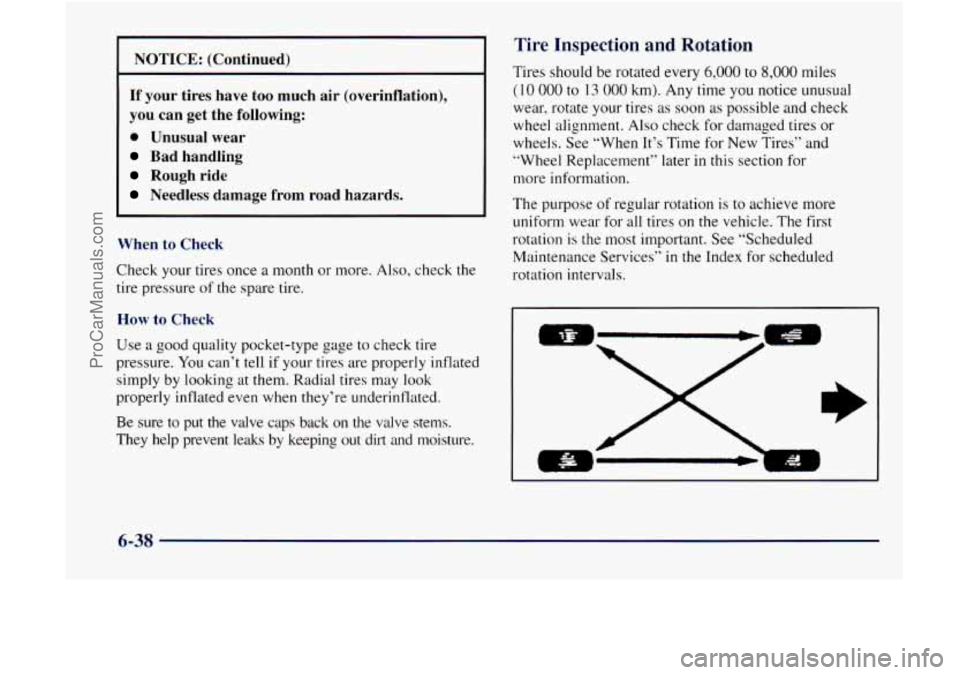
Tire Inspection and Rotation
Tires should be rotated every 6,000 to 8,000 miles
( 10 000 to 13 000 km). Any time you notice unusual
wear, rotate your tires
as soon as possible and check
wheel alignment.
Also check for damaged tires or
wheels. See “When It’s Time for New Tires” and
“Wheel Replacement” later in
this section for
more information.
The purpose of regular rotation is to achieve more
uniform wear for all tires on the vehicle. The first
rotation is the most important. See “Scheduled
Maintenance Services”
in the Index for scheduled
rotation intervals.
6-38
ProCarManuals.com
Page 287 of 386

When It’s Time for New Tires
One way to tell when it’s
time for new tires is to
check the treadwear
indicators, which will
appear when your tires have
only 1/16 inch (1.6 mm) or
less
of tread remaining.
You need a new tire if any of the following statements
are true:
0 You can see the indicators at three or more places
around the tire.
You can see cord or fabric showing through the
tire’s rubber.
The tread or sidewall is cracked, cut or snagged deep
enough to show cord or fabric.
0 The tire has a bump, bulge or split.
The tire has a puncture, cut or other damage that
can’t be repaired well because of the size or location
of the damage.
Buying New Tires
To find out what kind and size of tires you need, look at
the Certificationmire label.
The tires installed
on your vehicle when it was new had
a Tire Performance Criteria Specification (TPC Spec)
number on each tire’s sidewall. When
you get new tires,
get ones with that same TPC Spec number. That way
your vehicle will continue to have tires that are designed
to give proper endurance, handling, speed rating,
traction, ride and other things during normal service
on
your vehicle. If your tires have an all-season tread
design, the TPC number will be followed by an
“MS”
(for mud and snow).
If you ever replace your tires with those not having a
TPC Spec number, make sure they are the same size,
load range, speed rating and construction type (bias,
bias-belted or radial)
as your original tires.
6-40
ProCarManuals.com