light GMC JIMMY 1997 Service Manual
[x] Cancel search | Manufacturer: GMC, Model Year: 1997, Model line: JIMMY, Model: GMC JIMMY 1997Pages: 410, PDF Size: 20.03 MB
Page 172 of 410
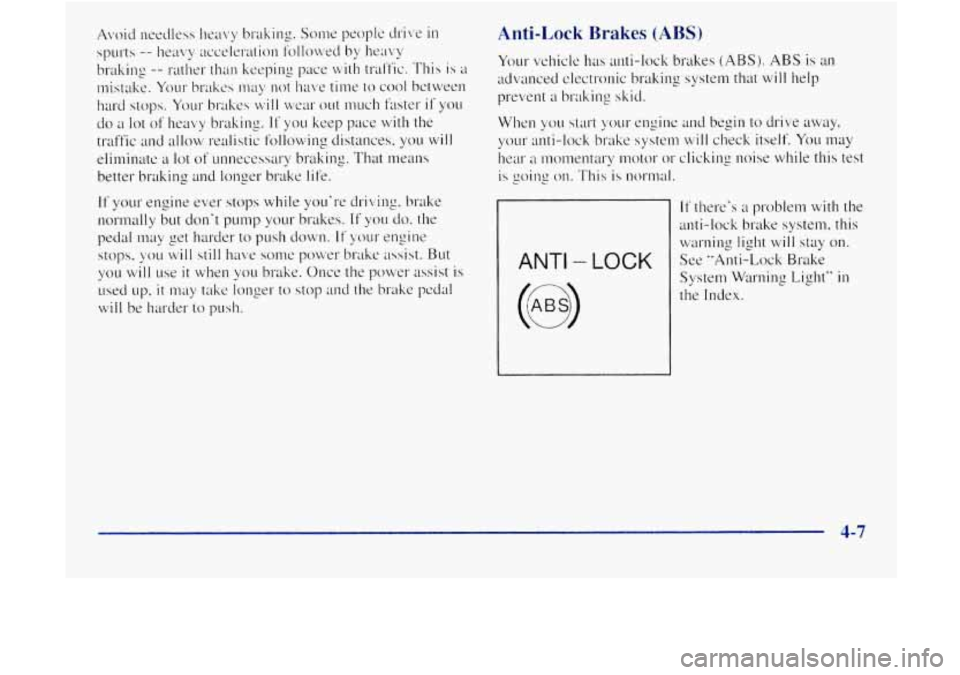
Anti-Lock Brakes (ABS)
If there’s ;1 problem with the
anti-lock
brake system. this
warning light
will stay on.
See “Anti-Lock Brake
System Warning Light”
in
the Index.
4-7
Page 176 of 410

An emergency like this requires close attention and a
quick decision. If yo^^ are holding the steering wheel at
the recommended 9 and 3 o'clock positions. you can
turn
it a full 180 degrees very quickly without removing
either hand.
But you have to act fast, steer quickly, and
just
as quickly straighten the wheel once you have
avoided the object.
The fact that
SLICII emergency situations are always
possible is
a good rwson to practice defensive driving at
all times and wear safety belts properly.
Off-Road Recovery
I OFF- ROAD RECOVERY / ,+
-/// edge of paved surface
If the level of the shoulder is only slightly below the
pwement, recovery should
be fairly easy. Ease off the
accelerator and then,
if there is nothing in the way, steer so
that your vehicle straddles the edge of the pavement. YOLI
can turn the steering wheel up to one-quarter turn until the
right front
tire contacts the pavement edge. Then turn your
steering wheel
to go straight down the roadway.
4-11
Page 183 of 410

Scanning the Terrain
Off-road driving can take you over many different kinds
of terrain. You need to be fimilix with the terrain and its
many different features. Here are some things
to consider.
Surfcm Corzc1i~io11.s. Off-roading can take you over
hard-packed dirt, gravel, rocks, grass, sand, rrrud. snow
or ice. Each
of these surfaces affects the steering.
acceleration and braking
of your vehicle in different
ways. Depending upon the kind of surface you are on.
you may experience slipping. sliding, wheel spinning,
delayed acceleration, poor traction and longer
braking distances.
Su@ce Ohstclcles. Unseen or hidden obstacles can be
hazardous. A rock, log, hole, rut or bump can startle you if
you're not prepared for them. Often these obstacles are.
hidden by grass, bushes, snow or even the rise and fall of
the
0
0
0
0
terrain itself. Here are some things to consider:
Is the path ahead clear?
Will the surface texture change abruptly up ahead?
Does
the travel take you uphill or downhill? (There's
more discussion of these subjects later.)
Will
you have to stop suddenly or change
direction quickly? When you
drive over obstacles or rough terrain. keep
a
firm grip on the steering wheel. Ruts. troughs or other
surface features can jerk
the wheel out of your hands if
you're not prepared.
When
you drive over bumps, rocks, or other obstacles,
your wheels can leave the ground. If this happens, even
with one or two wheels. you can't control the vehicle
as
well or at all.
Because you will be on an unpaved surface., it's
especially important to avoid sudden acceleration,
sudden
tl1rnC ot- suclden braking.
In a way. off-road driving requires a different kind of
alertness from driving
on paved roads and highways.
There are
no road signs. posted speed limits or signal
lights.
You have to use your own good judgment about
what is
safe and what isn't.
Drinking
and driving can be very dangerous on any
1-oad. And this is certainly true for off-nmi driving. At
the very tirne you need special alertness and driving
skills, your reflexes. perceptions and judgment can be
affected by
wen a small amount of alcohol. You could
have
:I serious -- or even fital -- accident if you drink
and drivc or ride with a drivel- who has been drinking.
See "Drunken Driving" in the Index.
4-18
Page 188 of 410

Driving Downhill
/I CAUTION:
Heavy braking when going down a hill can cause
your brakes to overheat and
fade. This could
cause
loss of control and a serious accident.
Apply the brakes lightly when descending a hill
and use a
low gear to keep vehicle speed
under control.
4-23
Page 191 of 410
Driving in Mud, Sand, Snow or Ice
When you drive in mud, snow or sand, your wl~ecls
won't get
good traction. You ca11.t accelerate ;IS quickly,
turning
is nm-e difficult, and you'll need longer
braking distances.
It's best to use
a low gear when you're in mud -- the
deeper the mud, the lower the gear.
In really deep mud.
the idea is to keep your vehicle moving
so ~OLI don't
get stuck.
When
you drive on sand, you'll sense a change in wheel
traction. But it will depend upon how loosely p~~ked the
sand is. On loosely prncked sand (as on beaches or sand
dunes) your tires will tend
to sink into the sand. This has
a11 effect on steering. accelerating and braking. You may
want
to reduce the air pressure in your tires slightly
when driving on sand. This will ilnprove traction.
Hard packed snow and
ice offer the worst tire traction.
On these surfaces, it's very easy to lose control. On wet
ice, for example, the traction is
so poor that you will
have difficulty accelerating. And if you do get moving.
poor steering and difficult braking
can C~LIS~ you to slide
out
of colltl*ol.
Driving on frozen lakes, ponds or ws can be
dangerous. Underwat.er springs, currents under
the ice, or sudden thaws can weaken the ice. Your
vehicle could
fall through the ice and you and
your passengers could drown. Drive your vehicle
on safe surfaces
only.
Driving in Water
4-26
Page 195 of 410
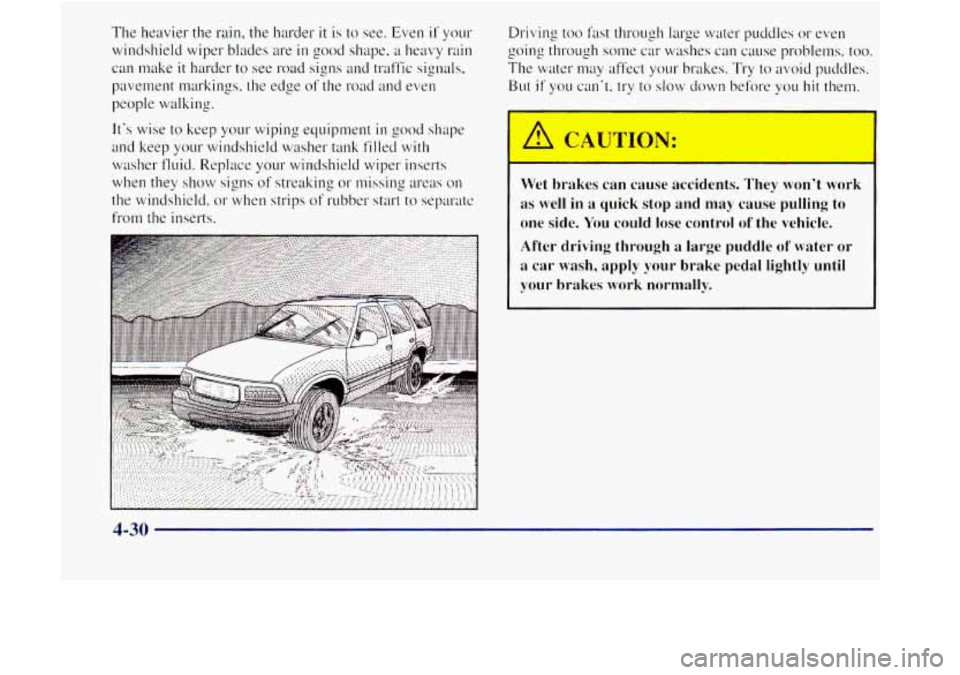
The heavier the rain. the harder it is to see. Even il'yo~~r
windshield wiper blades are
in good sl~ape. a heavy rain
can make it harder to see road signs and traffic signals.
pavement markings, the edge
of the road and even
people walking.
It's wise
to keep your wiping equipment in good shape
and keep your windshield washer tank filled with
washer fluid. Replace your windshield wiper inserts
when they show signs
of streaking or missing areas on Wet brakes can cause accidents. They won't work
the windshield. or when strips of rubber start to separatc as well in a quick stop and may cause pulling to
from the inserts. one side. You could lose control of the vehicle.
After driving through a large puddle
of water or
a car wash, apply your brake pedal lightly until
your brakes work nornlally.
4-30
Page 196 of 410

Hydroplaning Driving Through Deep Standing Water
If you drive too quickly through deep puddles or
standing water, water can come in through your
engine's air intake and badly damage your
engine. Never drive through water that
is slightly
lower than the underbody
of your vehicle. If you
can't avoid deep puddles or standing water, drive
through them very
s1ow;ly.
Some Other Rainy Weather Tips
4-31
Page 199 of 410
Once you are moving on the freeway, make certain you
allow a reasonable following distance. Expect to IIIOVC
slightly slower at night.
When you want to leave the freeway, move
to the proper
lane well
in advance. If you miss your exit, do not.
under any circumstances, stop and back up. Drive
on to
the next exit.
The exit ramp can be curved, sometimes quite sharply.
The exit speed is usually posted.
Reduce your speed according to your speedometer, not
to your sense of motion. After driving for any distance
at higher speeds, you may tend to
think you are going
slower than you actually are.
Before Leaving on a Long Trip
Make sure you're ready. Try to be well rested. If you
must start when you're not fresh
-- such as after a day's
work
-- don't plan to make too many miles that first part
of the journey. Wear comfortable clothing and shoes you
can easily drive in.
Is your vehicle ready for a long trip'! If you keep it
serviced and maintained, it's ready to go. If it needs
service, have
it done before starting out. Of course,
you'll find experienced and able service experts
in GM
dealerships all across North America. They'll be ready
and willing to help
if you need it.
Here are some things you can check before a trip:
0
0
0
0
0
0
0
Windshield Wldwr Fluid: Is the reservoir full? Are
all windows clean inside and outside?
Wiper. Blcrd~s: Are they in good shape?
F~lel, EI1girw Oil, Other Fluids: Have you checked
all levels?
LUIII~S: Are they all working'? Are the lenses clean?
Tires: They are vitally important to a safe,
trouble-free trip.
Is the tread good enough for
long-distance driving? Are the tires all inflated to the
recommended pressure?
Wecrtlwr For-cxmts: What's the weather outlook
along your route? Should you delay your trip a short
time to avoid a major storm system?
Mclps: Do you have up-to-date maps'?
4-34
Page 202 of 410
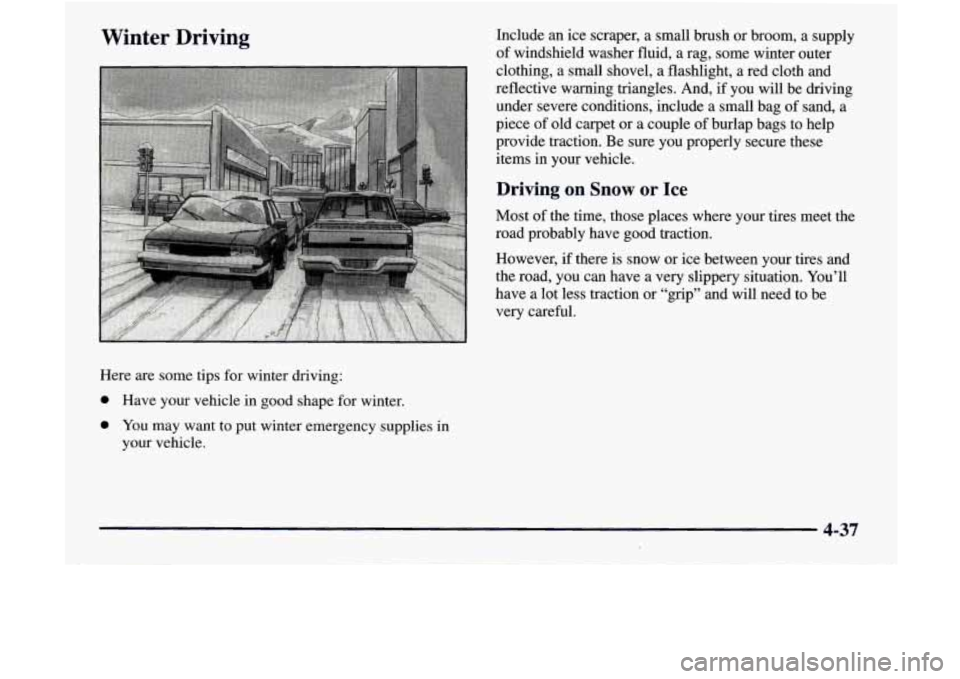
Winter Driving
Here are some tips for winter driving:
0 Have your vehicle in good shape for winter.
0 You may want to put winter emergency supplies in
your vehicle. Include an ice scraper, a small brush or broom, a supply
of windshield washer fluid,
a rag, some winter outer
clothing, a small shovel, a flashlight, a red cloth and
reflective warning triangles. And, if you will be driving
under severe conditions, include a small bag
of sand, a
piece
of old carpet or a couple of burlap bags to help
provide traction. Be sure you properly secure these
items in your vehicle.
Driving on Snow or Ice
Most of the time, those places where your tires meet the
road probably have good traction.
However, if there is snow or ice between your tires and
the road, you can have a very slippery situation. You’ll
have a lot less traction or “grip” and will need to be
very careful.
4-37
Page 205 of 410

Snow can trap exhaust gases under your vehicle.
This can cause deadly
CO (carbon monoxide) gas
to get inside.
CO could overcome you and kill
you. You can’t see it or smell it,
so you might not
know it is in your vehicle. Clear away snow from
around the base of your vehicle, especially any
that is blocking your exhaust pipe. And check
around again from time to time to be sure snow
doesn’t collect there.
Open a window just a little on the side of the
vehicle that’s away from the wind. This will help
keep
CO out.
Run your engine only as long as you must. This saves
fuel. When
you run the engine, make it go a little faster
than just idle. That is, push the accelerator slightly.
This
uses less fuel for the heat that you get and it keeps the
battery charged.
You will need a well-charged battery to
restart the vehicle. and possibly for signaling later on
with your headlamps. Let the heater run for a while.
Then, shut the engine
off and close the window almost
all the way
to preserve the heat. Start the engine again
and repeat this only when you feel really uncomfortable
from the cold.
But do it as little as possible. Preserve the
fuel as long
as you can. To help keep warm, you can get
out of the vehicle and
do some hirly vigorous exercises
every half
hour or so until help comes.
4-40