port GMC SAVANA 1998 Owner's Guide
[x] Cancel search | Manufacturer: GMC, Model Year: 1998, Model line: SAVANA, Model: GMC SAVANA 1998Pages: 388, PDF Size: 20.04 MB
Page 195 of 388
Maximum trailer weight is calculated assuming the
driver and one passenger are in the towing vehicle and it
has all
the required trailering equipment. The weight of
additional equipment, passengers and cargo in the
towing vehicle must be subtracted from
the above
maximum trailer weights.
You can ask your dealer for our trailering information or
advice, or
you can write us at the address listed in your
Warranty and Owner Assistance Information Booklet.
In Canada, write
to:
General Motors of Canada Limited
Customer Communication Centre
1908 Colonel Sam Drive
Oshawa, Ontario
L 1 H 8P7
Weight of the Trailer Tongue
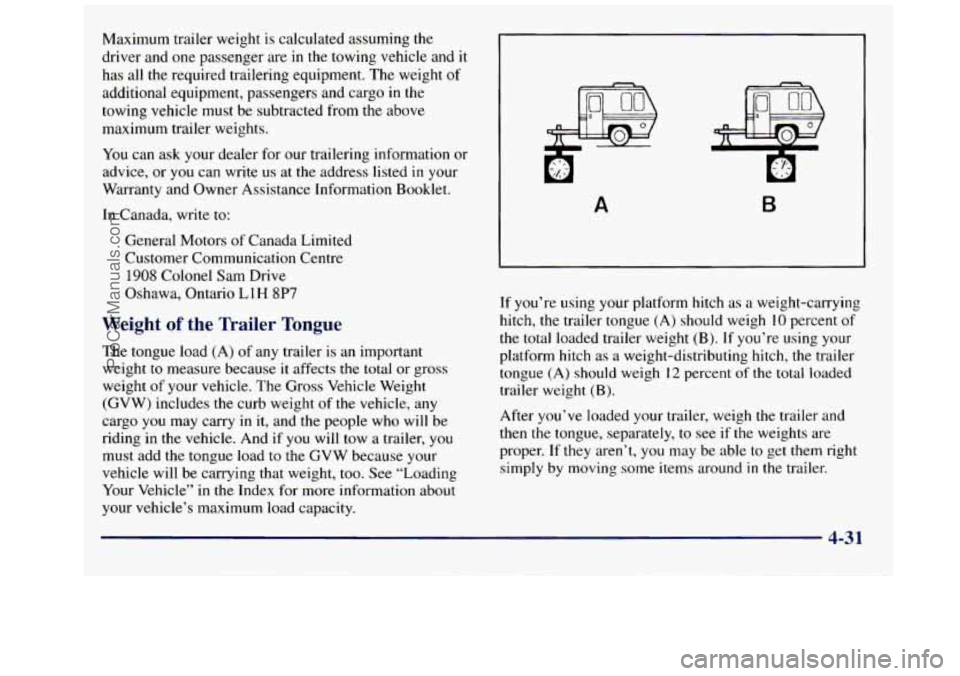
The tongue load (A) of any trailer is an important
weight to measure because it affects the total or gross
weight of your vehicle. The Gross Vehicle Weight
(GVW) includes the curb weight of the vehicle, any
cargo
you may carry in it, and the people who will be
riding in
the vehicle. And if you will tow a trailer, you
must add the tongue load to the GVW because your
vehicle will be carrying that weight, too. See “Loading
Your Vehicle” in the Index for more information about
your vehicle’s maximum load capacity.
A B
If you’re using your platform hitch as a weight-carrying
hitch, the trailer tongue
(A) should weigh 10 percent of
the total loaded trailer weight
(B). If you’re using your
platform hitch
as a weight-distributing hitch, the trailer
tongue
(A) should weigh 12 percent of the total loaded
trailer weight
(B).
After you’ve loaded your trailer, weigh the trailer and
then
the tongue, separately, to see if the weights are
proper.
If they aren’t, you may be able to get them right
simply by moving some items around
in the trailer.
4-31
ProCarManuals.com
Page 196 of 388
Total Weight on Your Vehicle’s Tires
Be sure your vehicle’s tires are inflated to the upper
limit for cold tires. You’ll find these numbers on the
Certification label at the rear edge of the driver’s door or
see “Tire Loading” in
the Index. Then be sure you don’t
go over the
GVW limit for your vehicle, including the
weight of the trailer tongue.
Hitches
It’s important to have the correct hitch equipment.
Crosswinds, large trucks going by and rough roads are
a
few reasons why you’ll need the right hitch. Here are
some rules to follow:
The bumpers on your vehicle are not intended for
hitches.
Do not attach rental hitches or other
bumper-type hitches to them. Use only
a
frame-mounted hitch that does not attach to the
bumper. Do not use a ball hitch, because it could pull
the bumper loose.
If you’ll be pulling a trailer that, when loaded, will
weigh more than
4,000 lbs. (1 800 kg), be sure to use
a properly mounted, weight-distributing hitch and
sway control
of the proper size. This equipment is
very important for proper vehicle loading and good
handling when you’re driving.
Will you have to make any holes in the body of your
vehicle when you install a trailer hitch?
If you’re using the wiring provided by the
factory-installed hitch, you should not need to make
any holes in the body
of your vehicle. However, if
you have an aftermarket hitch installed, you may
need to make holes in
the body.
If you do, then be sure to seal the holes later when
you remove the hitch. If you don’t seal them, deadly
carbon monoxide
(CO) from your exhaust can get
into your vehicle (see “Carbon Monoxide”
in the
Index). Dirt and water can, too.
4-32
ProCarManuals.com
Page 199 of 388
Making Turns
NOTICE:
Making very sharp turns while trailering could cause the trailer to come in contact with the vehicle. Your vehicle could be damaged. Avoid
making very sharp turns while trailering.
When you’re turning with a trailer, make wider turns than
normal.
Do this so your trailer won’t strike soft shoulders,
curbs, road signs, trees or other objects. Avoid jerky or
sudden maneuvers. Signal well
in advance.
Turn Signals When Towing a Trailer
When you tow a trailer, your vehicle has to have extra
wiring and a heavy-duty turn signal flasher (included in
the optional trailering package).
The arrows on your instrument panel will flash
whenever you signal
a turn or lane change. Properly
hooked up, the trailer lamps will also flash, telling other
drivers you’re about
to turn, change lanes or stop. When towing
a trailer,
the arrows on your instrument
panel
will flash for turns even if the bulbs on the trailer
are burned out. Thus, you may think drivers behind
you are seeing your signal when they are not. It’s
important to check occasionally
to be sure the trailer
bulbs are still working.
Driving On Grades
Reduce speed and shift to a lower gear before you start
down a long or steep downgrade. If you don’t shift
down, you might have
to use your brakes so much that
they would get hot and
no longer work well.
On a long uphill grade, shift down and reduce your
speed to around
45 mph (70 km/h) to reduce the
possibility of engine and transmission overheating.
When towing at high altitude on steep uphill grades,
consider the following: Engine coolant will boil at a lower
temperature than at normal altitudes. If you turn your
engine
off immediately after towing at high altitude on
steep uphill grades, your vehicle may show signs similar to
engine overheating.
To avoid this, let the engine run while
parked (preferably
on level ground) with the automatic
transmission
in PARK (P) for a few minutes before turning
the engine off. If you do get
the overheat warning, see
“Engine Overheating” in
the Index.
4-35
ProCarManuals.com
Page 200 of 388
Parking on Hills
You really should not park your vehicle, with a trailer
attached, on a hill. If something goes wrong, your rig
could start to move. People can be injured, and both
your vehicle and the trailer can be damaged.
But if you ever have to park your rig on a hill, here’s
how to do it:
1. Apply your regular brakes, but don’t shift into
PARK
(P) yet. Then turn your wheels into the curb if
facing downhill or into traffic if facing uphill.
2. Have someone place chocks under the trailer wheels.
3. When the wheel chocks are in place, release the
regular brakes until the chocks absorb the load.
4. Reapply the regular brakes. Then apply your parking
brake and then shift to
PARK (P).
5. Release the regular brakes.
When You Are Ready to Leave After
Parking
on a Hill
1. Apply your regular brakes and hold the pedal down
while you:
Start your engine;
Shift into a gear; and
Release the parking brake.
2. Let up on the brake pedal.
3. Drive slowly until the trailer is clear of the chocks.
4. Stop and have someone pick up and store the chocks.
Maintenance When Trailer Towing
Your vehicle will need service more often when you’re
pulling a trailer. See the Maintenance Schedule for more
on this. Things that are especially important in trailer
operation are automatic transmission fluid (don’t
overfill), engine oil, axle lubricant, belt, cooling system
and brake adjustment. Each of these
is covered in this
manual, and the Index will help you find them quickly.
If you’re trailering, it’s a good idea to review these
sections before you start your trip.
Check periodically to see that all hitch nuts and bolts
are tight.
4-36
ProCarManuals.com
Page 211 of 388
A I
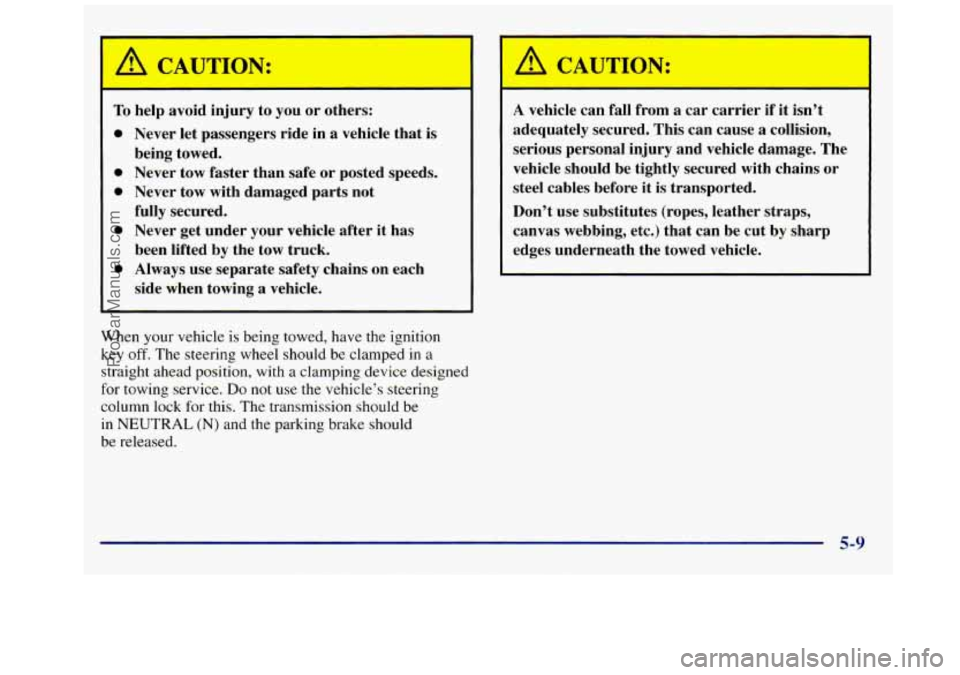
I /! CAUTION:
To
0
0
0
0 0
help avoid injury
to you or others:
Never let passengers ride in a vehicle that is
being towed.
Never tow faster than safe or posted speeds.
Never tow with damaged parts not
fully secured. Never get under your vehicle after it has
been lifted by the tow truck.
Always use separate safety chains on each
side when towing a vehicle.
When your vehicle is being towed, have the ignition
key off. The steering wheel should be clamped in a
straight ahead position, with a clamping device designed
for towing service.
Do not use the vehicle’s steering
column lock for this. The transmission should be
in NEUTRAL (N) and the parking brake should
be released.
A CAUTION:
A vehicle can fall from a car carrier if it isn’t
adequately secured. This can cause a collision,
serious personal injury and vehicle damage. The
vehicle should be tightly secured with chains or
steel cables before it is transported.
Don’t use substitutes (ropes, leather straps,
canvas webbing, etc.) that can be cut by sharp
edges underneath the towed vehicle.
5-9
ProCarManuals.com
Page 225 of 388
Removing the Spare Tire and Tools
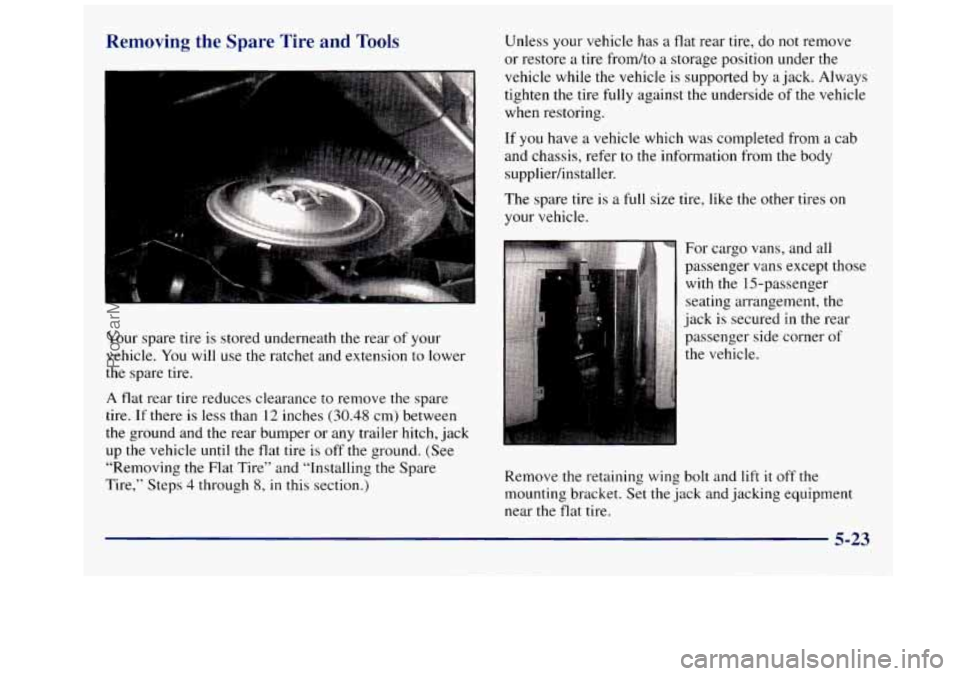
Your spare tire is stored underneath the rear of your
vehicle.
You will use the ratchet and extension to lower
the spare tire.
A flat rear tire reduces clearance to remove the spare
tire.
If there is less than 12 inches (30.48 cm) between
the ground and the rear bumper or any trailer hitch, jack
up the vehicle until the flat tire is off the ground. (See
“Removing the Flat Tire” and “Installing the Spare
Tire,” Steps
4 through 8, in this section.) Unless your vehicle has
a flat rear tire, do not remove
or restore a tire fromho
a storage position under the
vehicle while the vehicle is supported by a jack. Always
tighten
the tire fully against the underside of the vehicle
when restoring.
If you have a vehicle which was completed from a cab
and chassis, refer to the information from the body
supplierhnstaller.
The spare tire is a
full size tire, like the other tires on
your vehicle.
Remove the retaining wing bolt and lift it off the
mounting bracket. Set the jack and jacking equipment
near the flat tire.
5-23
ProCarManuals.com
Page 232 of 388
.- - I
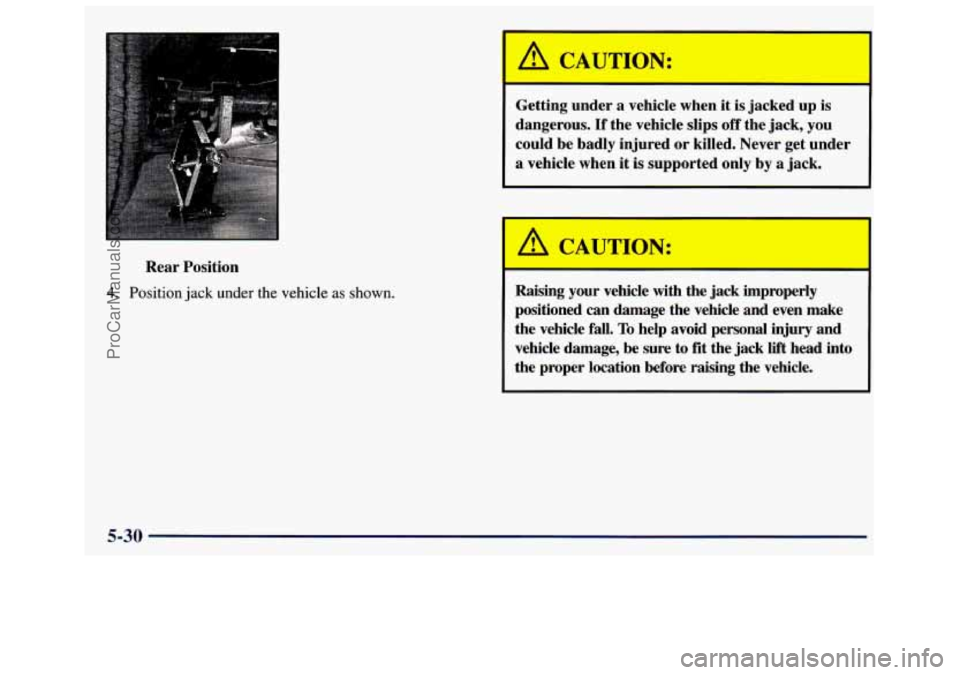
Rear Position
4. Position jack under the vehicle as shown.
I
---
Getting under a vehicle when it is jacked up is
dangerous.
If the vehicle slips off the jack, you
could be badly injured or killed. Never get under
a vehicle when it is supported only by a jack.
I A CAUTION:
Raising your vehicle with the jack improperly
positioned can damage the vehicle and even make
the vehicle fall.
To help avoid personal injury and
vehicle damage, be sure to fit the jack lift head
into
the proper location before raising the vehicle.
5-30
ProCarManuals.com
Page 241 of 388
Section 6 Service and Appearance Care
Here you will find information about the care of your vehicle. This section begins with service and fuel information,
and then it shows how to check important fluid and lubricant levels. There is also technical information about your
6-2
6-3
6-5
6-5
6-7
6-8
6- 11
6- 12
6- 16
6-
17
6-2 1
6-2 1
6-24
6-25
6-25
6-26
6-27
6-3
1
vehicle, and a part devoted to its appearance care.
Service
Fuel (Gasoline Engine)
Fuels in Foreign Countries (Gasoline Engines)
Filling Your Tank (Gasoline Engine)
Filling a Portable Fuel Container
Checking Things Under the Hood
Noise Control System Engine Oil (Gasoline Engine)
Air Cleaner (Gasoline Engines)
Automatic Transmission Fluid
Rear Axle
Engine Coolant
Radiator Pressure Cap
Thermostat
Power Steering Fluid
Windshield Washer Fluid
Brakes
Battery
6-32
6-32
6-40
6-4
1
6-5 1
6-5 1
6-55
6-56
6-57
6-57
6-57
6-59
6-60
6-6
1
6-66
6-67
6-69 Bulb
Replacement
Halogen Bulbs
Windshield Wiper Blade Replacement
Tires Appearance Care
Cleaning the Inside
of Your Vehicle
Cleaning the Outside of Your Vehicle
Cleaning Aluminum Wheels (If Equipped)
Cleaning Tires
Sheet Metal Damage
Finish Damage
Appearance Care Materials Chart
Vehicle Identification Number (VJN)
Electrical System
Replacement Bulbs
Capacities and Specifications
Normal Maintenance Replacement Parts
6-1
ProCarManuals.com
Page 242 of 388
Service
Your dealer knows your vehicle best and wants you to
be happy with it. We hope you’ll go to your dealer for
all your service needs. You’ll get genuine GM parts and
GM-trained and supported service people.
We hope you’ll want to keep your GM vehicle all GM.
Genuine GM parts have one of these marks:
Genuine
Doing Your Own Service Work
If you want to do some of your own service work, you’ll
want
to use the proper GM Service Manual. It tells you
much more about how to service your vehicle than this
manual can.
To order the proper service manual, see
“Service and Owner Publications” in the Index.
Your vehicle may have an air bag system. If it does,
see “Servicing Your Air Bag-Equipped Vehicle’’ in the
Index before attempting to do your own service work.
You should keep
a record with all parts receipts and list
the mileage and the date of any service work you
perform. See “Maintenance Record” in the Index.
6-2
ProCarManuals.com
Page 247 of 388
When you put the cap back on, turn it to the right
(clockwise) until you hear a clicking sound. Make
sure you fully install the cap. The diagnostic system
can determine
if the fuel cap has been left off or
improperly installed. This would allow fuel to
evaporate into the atmosphere. See “Malfunction
Indicator Lamp” in the Index.
NOTICE:
If you need a new cap, be sure to get the right
type. Your dealer can get one for you.
If you get
the wrong type, it may not
fit properly. This may
cause your malfunction indicator lamp to light
and your fuel tank and emissions system may be
damaged. See “Malfunction Indicator Lamp” in
the Index.
Filling a Portable Fuel Container
I
Never fill a portable fuel container while it is in
your vehicle. Static electricity discharge from the
container can ignite the gasoline vapor. You can
be badly burned and your vehicle damaged
if this
occurs.
To help avoid injury to you and others:
0 Dispense gasoline only into approved
containers.
0 Do not fill a container while it is inside a
vehicle, in a vehicle’s trunk, pickup bed or
on any surface other than the ground.
inside of the fill opening before operating
the nozzle. Contact should be maintained
until the filling
is complete.
0 Bring the fill nozzle in contact with the
0 Don’t smoke while pumping gasoline.
6-7
ProCarManuals.com