port GMC SAVANA 1998 User Guide
[x] Cancel search | Manufacturer: GMC, Model Year: 1998, Model line: SAVANA, Model: GMC SAVANA 1998Pages: 388, PDF Size: 20.04 MB
Page 58 of 388
w nen cnoosing a child restraint, be sure the child
restraint is designed to be used in a vehicle.
If it is, it
will have a label saying that it meets Federal Motor
Vehicle Safety Standards.
Then follow the instructions for the restraint.
You may
find these instructions on the restraint itself or in a
booklet, or both. These restraints use the belt system in
your vehicle, but the child also has to
be secured within
the restraint to help reduce the chance of personal injury.
The instructions that come with the infant or child
restraint will show you how to
do that. Both the owner’s
manual and the child restraint instructions are important,
so if either one of these is not available, obtain a
replacement copy from
the manufacturer.
Where to Put the Restraint (Except Cargo
Vans and Cab and Chassis Models)
Accident statistics show that children are safer if they
are restrained
in the rear rather than the front seat. We at
General Motors therefore recommend that you put your
child restraint in
a rear seat. If your vehicle has a front
passenger air bag,
never put a rear-facing child restraint
in the front passenger seat. Here’s why:
A child in a rear-facing child restraint can be
seriously injured or killed
if the right front
passenger’s air bag inflates, even if your vehicle
has reduced-force frontal air bags. This
is
because the back of the rear-facing child
restraint would be very close to the inflating
air
bag. If your vehicle has a right front passenger’s
air bag, always secure a rear-facing child
restraint in a rear seat.
You may secure
a forward-facing child restraint
in the right front seat, but before
you do, always
move the front passenger seat
as far back as it
will
go. It’s better to secure the child restraint in
a rear seat.
Wherever
you install it, be sure to secure the child
restraint properly.
Keep in mind that an unsecured child restraint can move
around
in a collision or sudden stop and injure people in
the vehicle. Be sure to properly secure any child
restraint
in your vehicle -- even when no child is in it.
1-50
ProCarManuals.com
Page 60 of 388
Securing a Child Restraint in a Rear
Outside Seat Position around the restraint. The child restraint instructions
will show
you how.
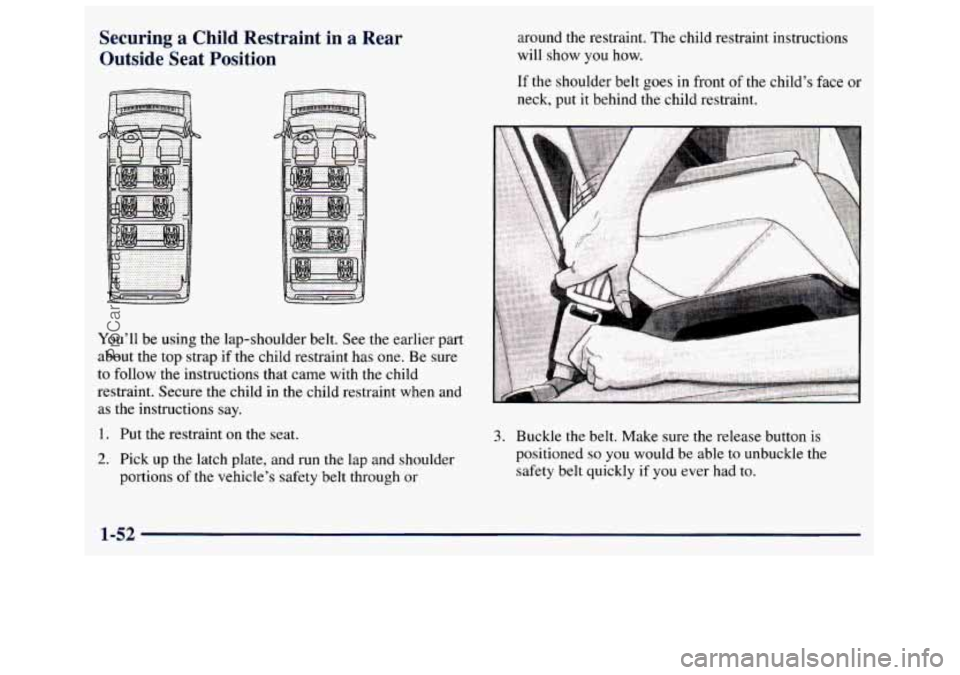
You’ll be using the lap-shoulder belt. See the earlier part
about the top strap if the child restraint has one. Be sure
to
follow the instructions that came with the child
restraint. Secure the child
in the child restraint when and
as the instructions
say.
1. Put the restraint on the seat.
2. Pick up the latch plate, and run the lap and shoulder
portions of the vehicle’s safety belt through or
If the shoulder belt goes in front of the child’s face or
neck, put
it behind the child restraint.
I
3. Buckle the belt. Make sure the release button is
positioned
so you would be able to unbuckle the
safety belt quickly if
you ever had to.
1-52
ProCarManuals.com
Page 64 of 388
If your vehicle has a front passenger air bag, never put a
rear-facing child restraint
in this seat. Here’s why:
-
A child in a rearfacing child restraint can be
seriously injured or killed if the front passenger’s
air bag inflates, even if your vehicle has
reduced-force frontal air bags. This is because
the back
of the rearfacing child restraint would
be very close to the inflating air bag.
If your
vehicle is a passenger van, always secure a
rearfacing child restraint in a rear seat.
If your vehicle is a cargo van with a right front
passenger air bag, do not use a rearfacing child
restraint in this vehicle.
If a forward-facing child
restraint is suitable for your child, always move
the passenger seat as far back as it
will go.
You’ll be using the lap-shoulder belt. See the earlier part
about the top strap if the child restraint has one. Be sure
to follow the instructions that came with the child
restraint. Secure the child in the child restraint when and
as the instructions say.
1. If your vehicle has a front passenger air bag, always
move the seat as far back as it will
go before
securing a forward-facing child restraint. (See
“Seats” in the Index.)
2. Put the restraint on the seat.
3. Pick up the latch plate, and run the lap and shoulder
portions of the vehicle’s safety belt through or
around the restraint. The child restraint instructions
will show
you how.
If the shoulder belt goes in front of the child’s face or
neck, put
it behind the child restraint.
‘ 1-56 i
ProCarManuals.com
Page 69 of 388
I
Never do this. Here a child is sitting in a seat that has a
lap-shoulder belt, but the shoulder part is behind
the child.
If the child wears the belt in this way, in
a crash the child might slide under the belt. The
belt’s force would then be applied right on the
child’s abdomen. That could cause serious or
fatal injuries.
Wherever the child sits, the lap portion of the belt
should be worn low and snug on the hips, just touching
the child’s thighs. This applies belt force to the child’s
pelvic bones in a crash.
Safety Belt Extender
If the vehicle’s safety belt will fasten around you, you
should use it. But
if
a safety belt isn’t long enough to fasten, your
dealer will order you an extender. It’s free. When you go
in to order it, take the heaviest coat you
will wear, so the
extender will be long enough for you. The extender will
be just for you, and just
for the seat in your vehicle that
you choose. Don’t let someone else use it, and use it
only for
the seat it is made to fit. To wear it, just attach it
to the regular safety belt.
Checking Your Restraint Systems
Now and then, make sure the safety belt reminder light
and all your belts, buckles, latch plates, retractors and
anchorages are working properly. Look for any other
loose or damaged safety belt system parts.
If you see
anything that might keep a safety belt system from
doing its job, have it repaired.
Torn or frayed safety belts may not protect you in a
crash. They can rip apart under impact forces.
If a belt is
torn or frayed, get a new one right away.
Also look for any opened or broken air bag covers, and
have them repaired or replaced. (The air bag system
does not need regular maintenance.)
1-61
ProCarManuals.com
Page 77 of 388
Power Door Locks (Option)
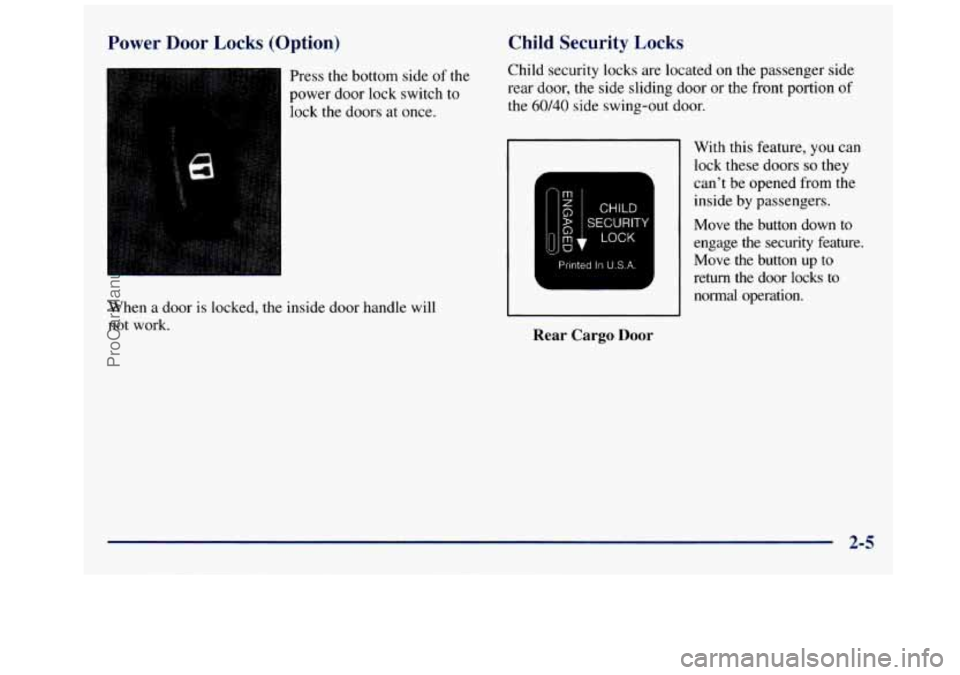
Press the bottom side of the
power door lock switch
to
lock the doors at once.
When a door is locked, the inside door handle will
not work.
Child Security Locks
Child security locks are located on the passenger side
rear door, the side sliding door or
the front portion of
the 60/40 side swing-out door.
With this feature, you can
lock these doors
so they
can’t be opened
from the
inside by passengers. 1
CHILD
LOCK
Printed In U.S.A.
1
Move the button down to
engage the security feature.
Move the button up to
return
the door locks to
normal operation.
Rear Cargo Door
2-5
ProCarManuals.com
Page 82 of 388
60140 Swing-Out Side Door
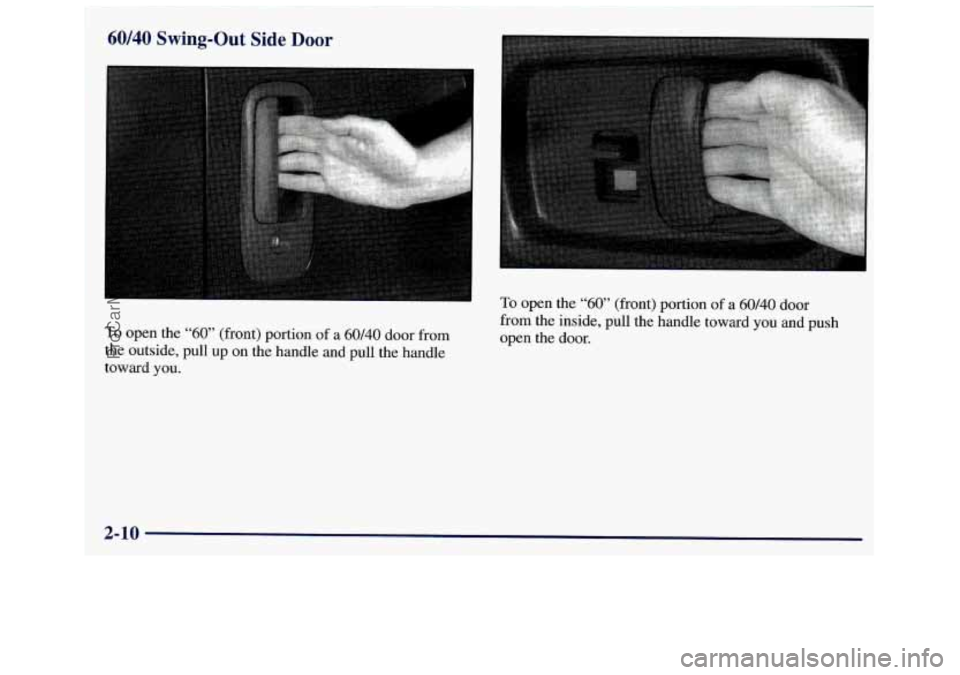
To open the “60” (front) portion of a 60/40 door from
the outside, pull up on the handle and pull the handle
toward you.
2-10
To open the “60” (front) portion of a 60/40 door
from the inside, pull the handle toward you and push
open the door.
ProCarManuals.com
Page 83 of 388
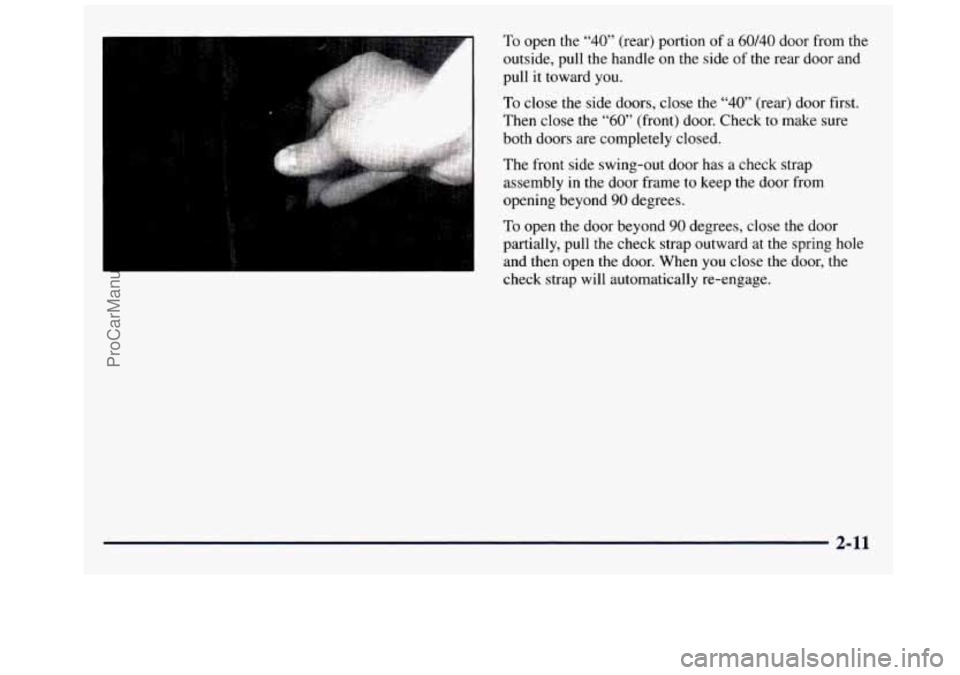
To open the “40” (rear) portion of a 60/40 door from the
outside, pull the handle
on the side of the rear door and
pull it toward you.
To close the side doors, close the “40” (rear) door first.
Then close the
“60” (front) door. Check to make sure
both doors are completely closed.
The front side swing-out door
has a check strap
assembly
in the door frame to keep the door from
opening beyond
90 degrees.
To open the door beyond 90 degrees, close the door
partially, pull the check strap outward at the spring hole
and then open the door. When you
close the door, the
check strap will automatically re-engage.
2-11
ProCarManuals.com
Page 120 of 388
Storage Compartments
I
Cigarette LightedAshtray
The front ashtray is located in the instrument panel
extension, at the center of the instrument panel. Lift up
on the ashtray door to open it.
I NOTICE:
If you store paper and other things that burn in
your ashtrays, they could be set on fire by
cigarettes or other smoking materials. That could
cause a fire and possibly damage your vehicle.
Do
not store papers and other things that burn in
your ashtrays.
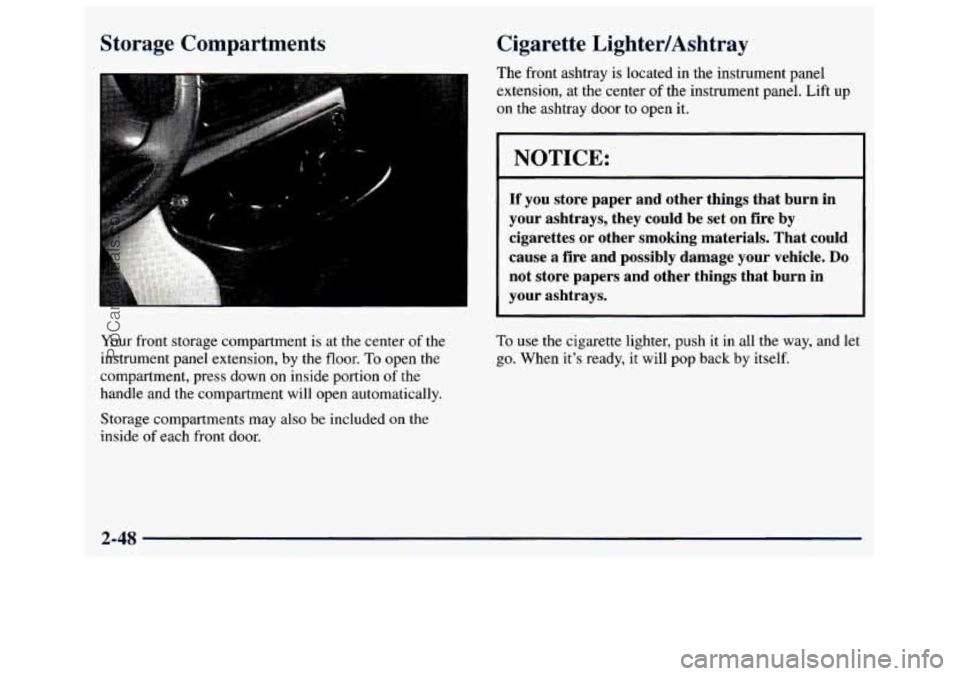
Your front storage compartment is at the center of the
instrument panel extension,
by the floor. To open the
compartment, press down
on inside portion of the
handle and the compartment will open automatically.
Storage compartments may also be included
on the
inside of each front door.
To use the cigarette lighter, push it in all the way, and let
go. When it’s ready, it will pop back
by itself.
2-48
ProCarManuals.com
Page 160 of 388
Tips About Your Audio System
Hearing damage from loud noise is almost undetectable
until it
is too late. Your hearing can adapt to higher
volumes
of sound. Sound that seems normal can be loud
and harmful to your hearing. Take precautions by
adjusting
the volume control on your radio to a safe
sound level before
your hearing adapts to it.
To help avoid hearing loss or damage:
Adjust the volume control to the lowest setting.
Increase volume slowly until you hear comfortably
and clearly.
NOTICE:
Before you add any sound equipment to your
vehicle
-- like a tape player, CB radio, mobile
telephone or two-way radio
-- be sure you can
add what you want.
If you can, it’s very
important to do it properly. Added sound
equipment may interfere with the operation
of
your vehicle’s engine, Delco Electronics radio or
other systems, and even damage them. Your
vehicle’s systems may interfere with the
operation
of sound equipment that has been
added improperly.
So, before adding sound equipment, check with
your dealer and be sure to check Federal rules
covering mobile radio and telephone units.
3-24
ProCarManuals.com
Page 163 of 388
Power Antenna Mast Care
Your power antenna will look its best and work
well
if it’s cleaned from time to time. To clean the
antenna mast:
1.
2.
3.
4.
5.
6.
Turn on the ignition and radio to raise the antenna.
Dampen a clean cloth with mineral
spirits or
equivalent solvent.
Wipe the cloth over the mast sections, removing
any dirt.
Wipe dry with a clean cloth.
Make the antenna go up and down by turning the
radio or ignition off and
on.
Repeat if necessary.
I NOTICE:
Don’t lubricate the power antenna. Lubrication
could damage it.
1 NOTICE:
Before entering an automatic car wash, turn off
your radio to make the power antenna
go down.
This will prevent the mast from possibly getting
damaged. If the antenna does not
go down when
you turn the radio off,
it may be damaged or
need to be cleaned. In either case, lower the
antenna
by hand by carefully pressing the
antenna down.
If the mast portion of your antenna is damaged, you can
easily replace
it. See your dealer for a replacement kit
and follow the instructions in the kit.
3-27
ProCarManuals.com