port GMC SAVANA 1998 Service Manual
[x] Cancel search | Manufacturer: GMC, Model Year: 1998, Model line: SAVANA, Model: GMC SAVANA 1998Pages: 388, PDF Size: 20.04 MB
Page 255 of 388
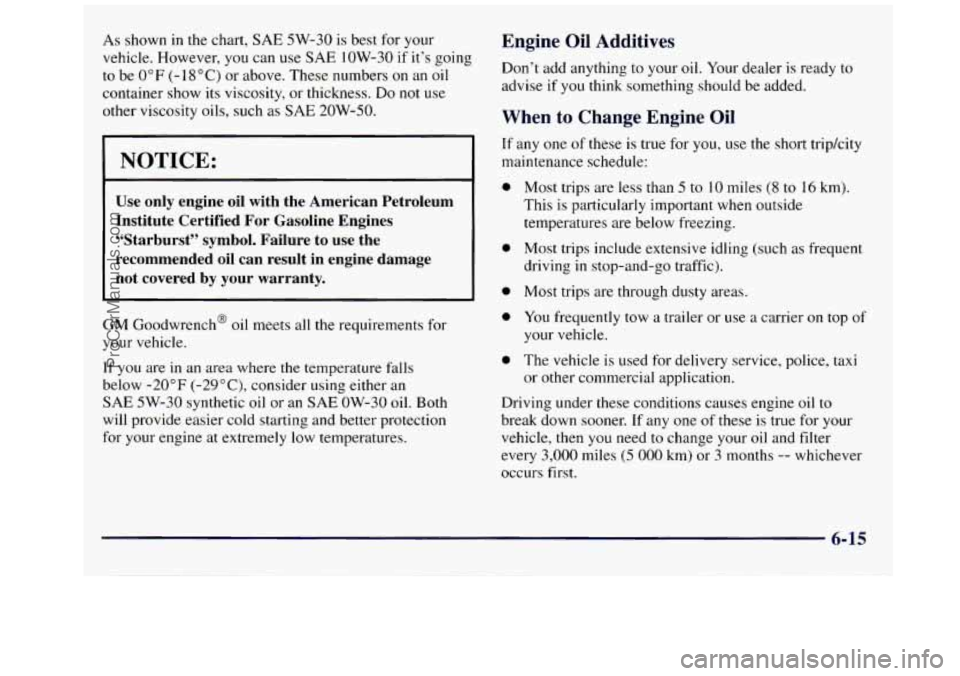
As shown in the chart, SAE 5W-30 is best for your
vehicle. However, you can use
SAE 1OW-30 if it’s going
to be 0” F (- 18°C) or above. These numbers on an oil
container show its viscosity, or thickness. Do
not use
other viscosity oils, such
as SAE 20W-50.
1 NOTICE:
Use only engine oil with the American Petroleum
Institute Certified For Gasoline Engines
“Starburst” symbol. Failure to use the
recommended oil can result in engine damage
not covered by your warranty.
GM Goodwrench@ oil meets all the requirements for
your vehicle.
If you are in an area where
the temperature falls
below
-20°F (-29”C), consider using either an
SAE 5W-30 synthetic oil or an SAE OW-30 oil. Both
will provide easier cold starting and better protection
for your engine at extremely low temperatures.
Engine Oil Additives
Don’t add anything to your oil. Your dealer is ready to
advise if
you think something should be added.
When to Change Engine Oil
If any one of these is true for you, use the short tripkity
maintenance schedule:
0
0
0
0
0
Most trips are less than 5 to 10 miles (8 to 16 km).
This is particularly important when outside
temperatures are below freezing.
Most trips include extensive idling (such as frequent
driving in stop-and-go traffic).
Most trips are through dusty areas.
You frequently tow a trailer or use a carrier on top of
your vehicle.
The vehicle
is used for delivery service, police, taxi
or other commercial application.
Driving under these conditions causes engine oil to
break down sooner. If any one of these is true for your
vehicle, then you need to change your oil and filter
every
3,000 miles (5 000 km) or 3 months -- whichever
occurs first.
6-15
ProCarManuals.com
Page 262 of 388
NOTICE:
When adding coolant, it is important that you
use only
DEX-COOL@ (silicate-free) coolant.
If coolant other than DEX-COOL is added to
the system, premature engine, heater core or
radiator corrosion may result. In addition, the
engine coolant will require change sooner
-- at
30,000 miles (50 000 km) or 24 months,
whichever occurs
first. Damage caused by the
use of coolant other than DEX-COOL@ is not
covered by your new vehicle warranty.
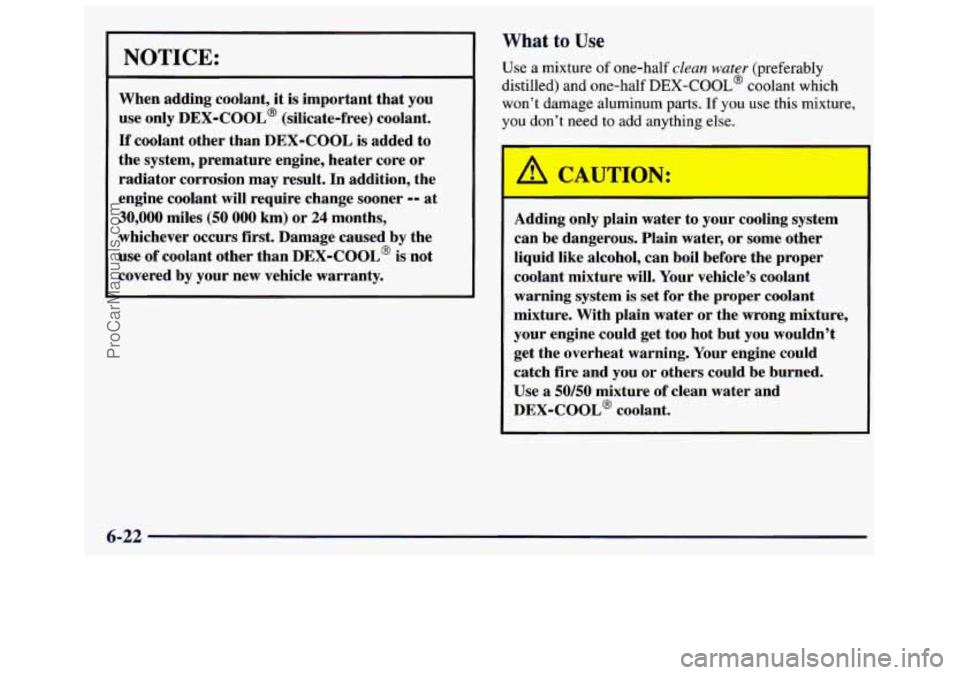
What to Use
Use a mixture of one-half clean water (preferably
distilled) and one-half
DEX-COOL@ coolant which
won’t damage aluminum parts. If you
use this mixture,
you don’t need
to add anything else.
I
A CAC LILA:
Adding only plain water to your cooling system
can be dangerous. Plain water, or some other
liquid like alcohol, can boil before the proper
coolant mixture will. Your vehicle’s coolant
warning system
is set for the proper coolant
mixture. With plain water or the wrong mixture,
your engine could get too hot but you wouldn’t
get the overheat warning. Your engine could
catch fire and you or others could be burned.
Use
a 50/50 mixture of clean water and
DEX-COOL@ coolant.
6-22
ProCarManuals.com
Page 283 of 388
How to Check
Use a good quality pocket-type gage to check tire
pressure. You can’t tell if your tires are properly inflated
simply by looking at them. Radial tires may look
properly inflated even when they’re underinflated.
Be sure to put the valve caps back on
the valve
stems. They help prevent leaks by keeping out dirt
and moisture.
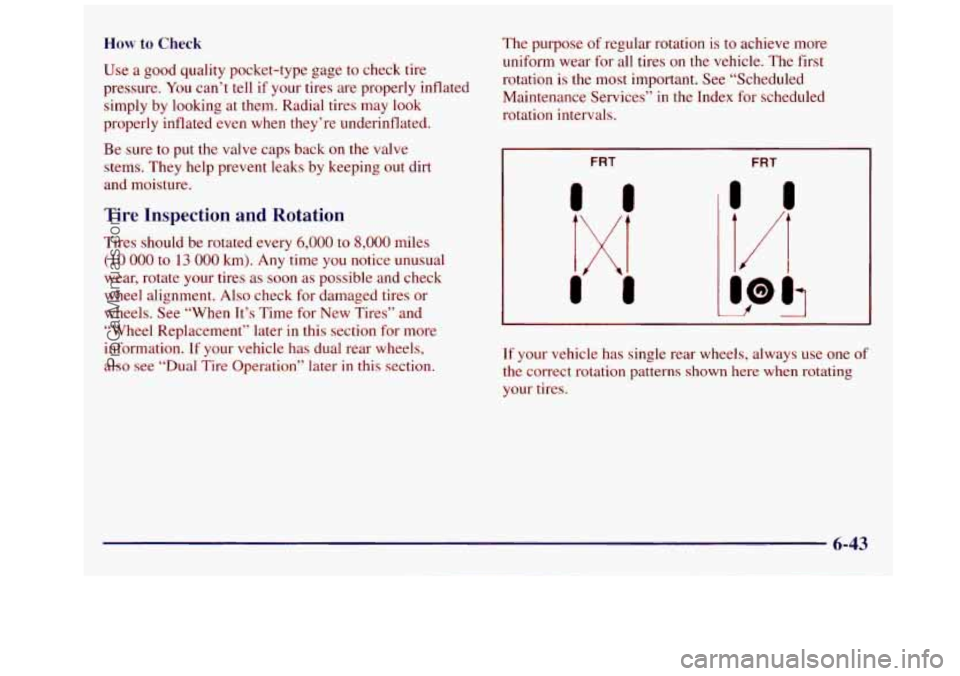
Tire Inspection and Rotation
Tires should be rotated every 6,000 to 8,000 miles
(10 000 to 13 000 km). Any time you notice unusual
wear, rotate your tires as soon as possible and check
wheel alignment. Also check for damaged tires or
wheels. See “When It’s Time for New Tires” and
“Wheel Replacement” later in this section for more
information. If your vehicle has dual rear wheels,
also see “Dual Tire Operation” later
in this section. The purpose
of regular rotation is to achieve more
uniform wear for all tires
on the vehicle. The first
rotation is the most important. See “Scheduled
Maintenance Services” in the Index for scheduled
rotation intervals.
If
your vehicle has single rear wheels, always use one of
the correct rotation patterns shown
here when rotating
your tires.
6-43
ProCarManuals.com
Page 305 of 388
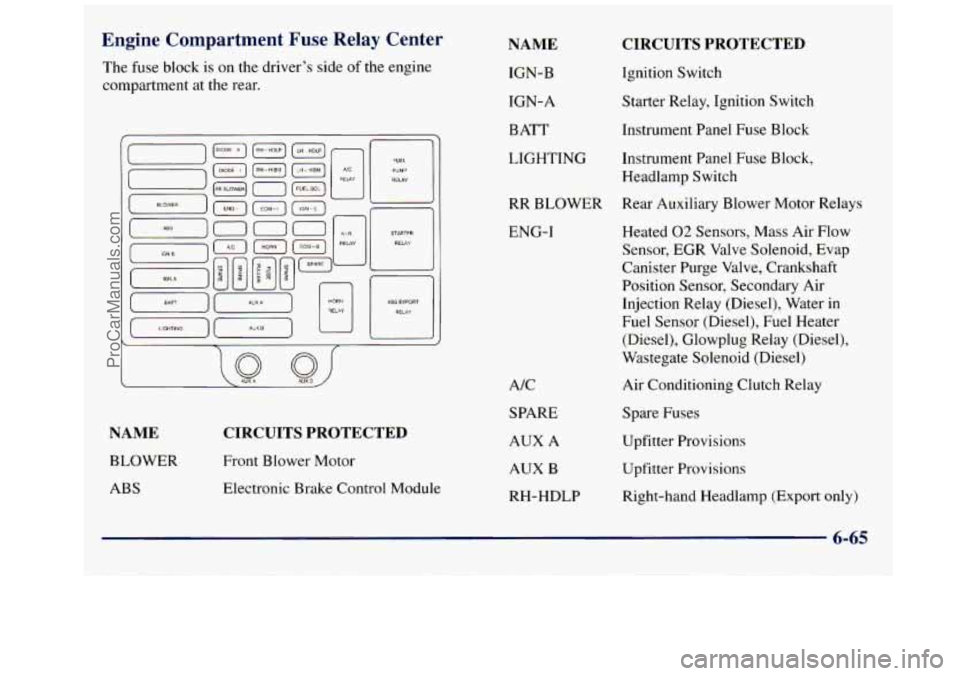
Engine Compartment Fuse Relay Center
The fuse block is on the driver’s side of the engine
compartment at the rear.
NAME
BLOWER
ABS
CIRCUITS PROTECTED
Front Blower Motor
Electronic Brake Control Module
NAME
IGN-B
IGN-A
BATT
LIGHTING
CIRCUITS PROTECTED
Ignition Switch
Starter Relay, Ignition Switch
Instrument Panel Fuse Block
Instrument Panel Fuse Block,
Headlamp Switch
RR BLOWER Rear Auxiliary Blower Motor Relays
ENG-I
AIC
SPARE
AUX A
AUX B
RH-HDLP
Heated 02 Sensors, Mass Air Flow
Sensor, EGR Valve Solenoid, Evap
Canister Purge Valve, Crankshaft
Position Sensor, Secondary Air
Injection Relay (Diesel), Water in
Fuel Sensor (Diesel), Fuel Heater
(Diesel), Glowplug Relay (Diesel),
Wastegate Solenoid (Diesel)
Air Conditioning Clutch Relay
Spare Fuses
Upfitter Provisions
Upfitter Provisions Right-hand Headlamp (Export only)
6-65
ProCarManuals.com
Page 306 of 388
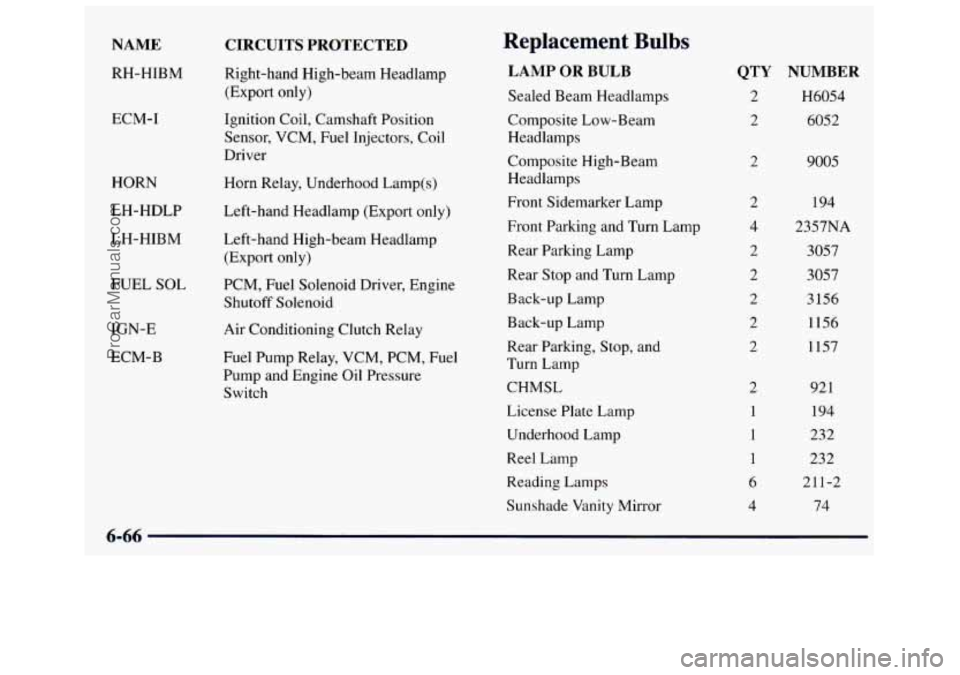
NAME
RH-HIBM
ECM-I
HORN
LH-HDLP
LH-HIBM
FUEL SOL
IGN-E
ECM-B
CIRCUITS PROTECTED
Right-hand High-beam Headlamp
(Export only)
Ignition Coil, Camshaft Position
Sensor,
VCM, Fuel Injectors, Coil
Driver
Horn Relay, Underhood Lamp( s)
Left-hand Headlamp (Export
only)
Left-hand High-beam Headlamp
(Export only)
PCM,
Fuel Solenoid Driver, Engine
Shutoff Solenoid
Air Conditioning Clutch Relay
Fuel Pump Relay, VCM, PCM, Fuel
Pump and Engine Oil Pressure
Switch
Replacement Bulbs
LAMP OR BULB
Sealed Beam Headlamps
Composite Low-Beam
Headlamps
Composite High-Beam
Headlamps
Front Sidemarker Lamp
Front Parking and Turn Lamp
Rear Parking Lamp
Rear Stop and Turn Lamp
Back- up Lamp
Back-up Lamp
Rear Parking, Stop, and
Turn Lamp
CHMSL
License Plate Lamp
Underhood Lamp
Reel Lamp
Reading Lamps
Sunshade Vanity Mirror
QTY NUMBER
2 H6054
2 6052
2
2
4
2
1
1
1
6
4
9005
194
2357NA
3057
3057
3156
1156 1157
92
1
194
232
232
211-2
74
6-66
ProCarManuals.com
Page 314 of 388
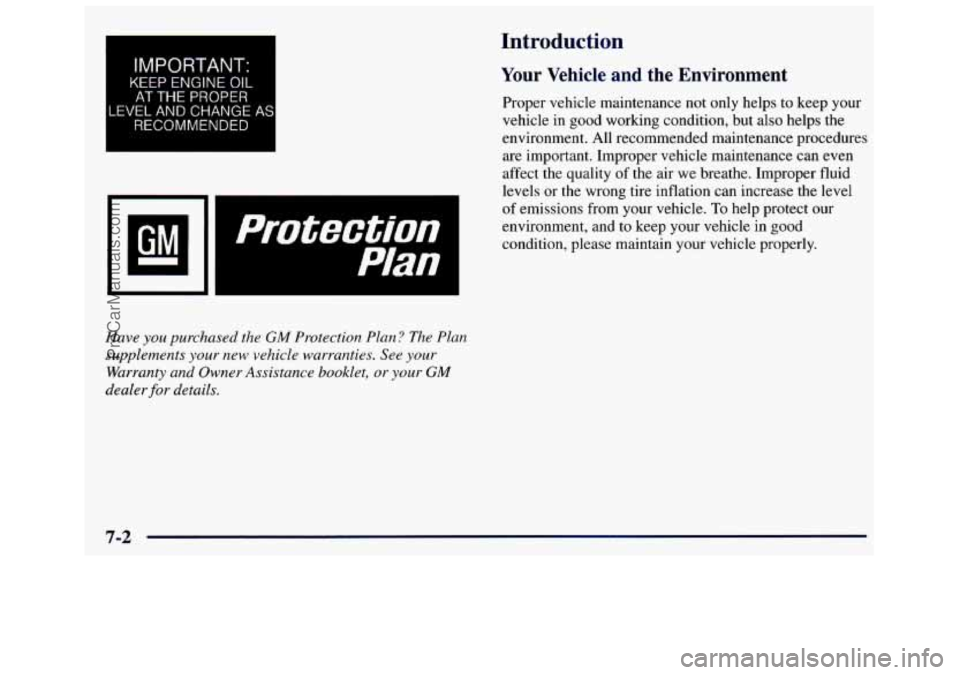
I IMPORTANT: I
KEEP ENGINE OIL
AT THE PROPER
LEVEL AND CHANGE
AS
RECOMMENDED
Introduction
Your Vehicle and the Environment
Proper vehicle maintenance not only helps to keep your
vehicle in good working condition, but also helps the
environment. All recommended maintenance procedures
are important. Improper vehicle maintenance can even
affect the quality
of the air we breathe. Improper fluid
levels or
the wrong tire inflation can increase the level
of emissions from your vehicle. To help protect our
environment, and to keep your vehicle in good
condition, please maintain your vehicle properly.
Have you purchused the GM Protection Plan? The Plan
supplements
your new vehicle warranties. See your
Warranty and Owner Assistance booklet,
or your GM
dealer for detuils.
7-2
ProCarManuals.com
Page 315 of 388
How This Section is Organized
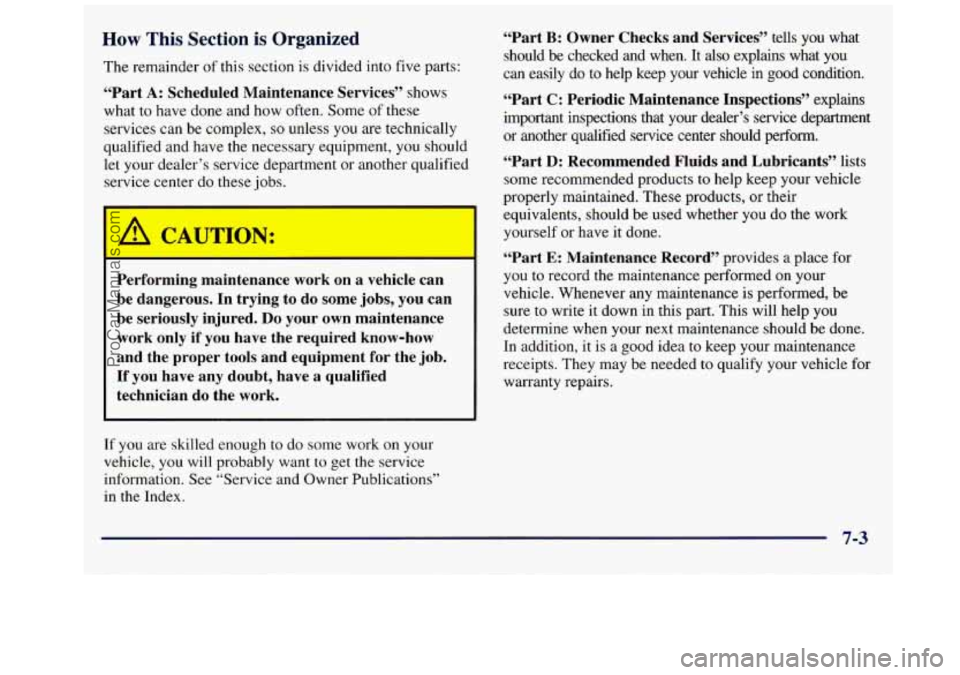
The remainder of this section is divided into five parts:
“Part A: Scheduled Maintenance Services” shows
what to have done and how often. Some
of these
services can be complex,
so unless you are technically
qualified and have the necessary equipment, you should
let your dealer’s service department or another qualified
service center do these
jobs.
.
Performing maintenance work on a vehicle can
be dangerous. In trying to do some jobs, you can
be seriously injured.
Do your own maintenance
work only if you have the required know-how
and the proper tools and equipment
for the job.
If you have any doubt, have a qualified
technician
do the work.
If you are skilled enough to do some work on your
vehicle, you
will probably want to get the service
information. See “Service
and Owner Publications”
in the Index.
“Part B: Owner Checks and Services” tells you what
should be checked and when. It
also explains what you
can easily do to help keep your vehicle in
good condition.
“Part C : Periodic Maintenance Inspections” explains
important inspections that your dealer’s service department or another qualified service center should perfom.
“Part D: Recommended Fluids and Lubricants” lists
some recommended products to help keep your vehicle
properly maintained. These products, or their
equivalents, should be used whether you do the work
yourself or have it done.
“Part E: Maintenance Record” provides a place for
you to record the maintenance performed on your
vehicle. Whenever any maintenance is performed, be
sure to write it down in this part. This will help
you
determine when your next maintenance should be done.
In addition, it is a good idea to keep your maintenance
receipts. They may be needed to qualify your vehicle for
warranty repairs.
7-3
ProCarManuals.com
Page 316 of 388
Part A: Scheduled Maintenance
Servk - s
Using Your Maintenance Schedule
We at General Motors want to help you keep your vehicle
in good working condition. But we don’t know exactly
how you’ll drive it. You may drive very short distances
only a few times a week.
Or you may drive long distances
all the time in very hot, dusty weather. You may use your
vehicle
in making deliveries. Or you may drive it to work,
to do errands or
in many other ways.
Because of all the different
ways people use their
vehicles, maintenance needs
vary. You may even need
more frequent checks and replacements than you’ll find
in the schedules in this section.
So please read this
section and note how you drive. If you have any
questions
on how to keep your vehicle in good
condition, see your
GM dealer.
This part tells you the maintenance services you should
have done and when you should schedule them. If you
go to your dealer for your service needs, you’ll know
that GM-trained and supported service people will
perform the work using genuine GM
parts.
The proper fluids and lubricants to use are listed in Part D.
Make sure whoever services your vehicle uses these. All
parts should be replaced
and all necessary repairs done
before you or anyone else
drives the vehicle.
These schedules are for vehicles that:
carry passengers and cargo within recommended
limits. You will find these limits on your vehicle’s
Certificationflire label. See “Loading Your Vehicle’’
in the Index.
are driven on reasonable road surfaces within legal
driving limits.
use the recommended fuel. See “Fuel” in the Index.
Selecting the Right Schedule
First you’ll need to decide which of the two schedules is
right for your vehicle. Here’s how
to decide which
schedule to follow:
Gasoline engine vehicles
and diesel engine vehicles
have different maintenance requirements. If you have
a
diesel engine, follow a schedule designated for diesel
engine vehicles only.
See the Diesel Engine Supplement for diesel engine
maintenance schedules.
7-4
ProCarManuals.com
Page 317 of 388
Maintenance Schedule
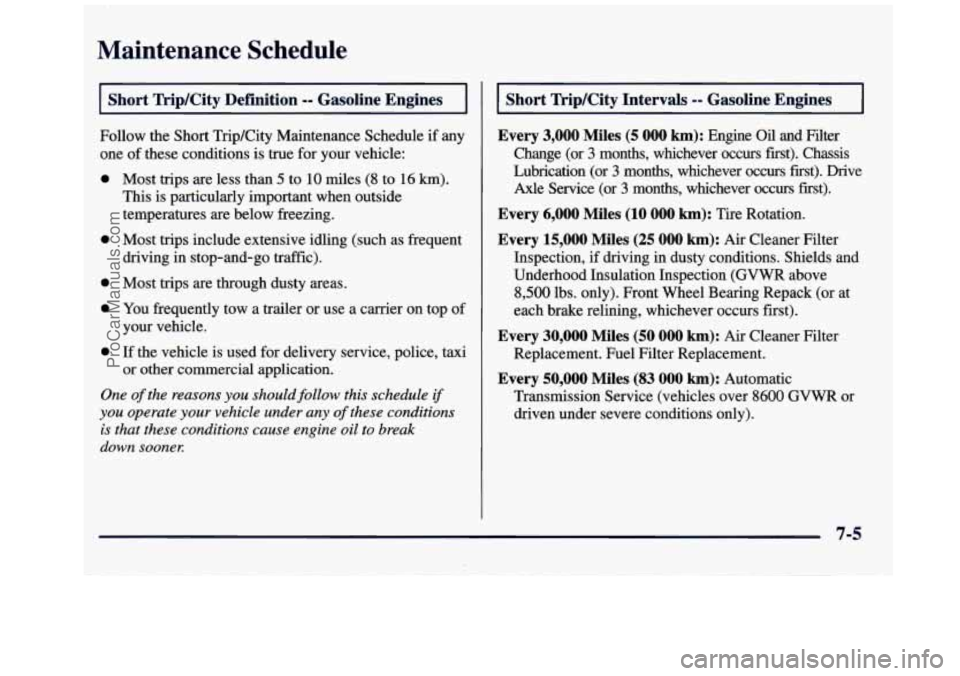
I Short TripKity Definition -- Gasoline Engines I
Follow the Short TripKity Maintenance Schedule if any
one of these conditions is true for your vehicle:
0
0
0
0
0
Most trips are less than 5 to 10 miles (8 to 16 km).
This is particularly important when outside
temperatures are below freezing.
Most trips include extensive idling (such as frequent
driving in stop-and-go traffic).
Most trips are through dusty areas.
You frequently tow a hailer or use a carrier on top of
your vehicle.
If the vehicle is used for delivery service, police, taxi
or other commercial application.
One of the reasons you should follow this schedule if
you operate your vehicle under any of these conditions
is that these conditions cause engine oil to break
down soonex
Short TriplCity Intervals -- Gasoline Engines
Every
3,000 Miles (5 000 km): Engine Oil and Filter
Change (or
3 months, whichever occurs fist). Chassis
Lubrication (or
3 months, whichever occurs first). Drive
Axle Service (or 3 months, whichever occurs first).
Every 6,000 Miles (10 000 km): Tire Rotation.
Every 15,000 Miles (25 000 km): Air Cleaner Filter
Inspection, if driving in dusty conditions. Shields and
Underhood Insulation Inspection
(GVWR above
8,500 lbs. only). Front Wheel Bearing Repack (or at
each brake relining, whichever occurs first).
Every 30,000 Miles (50 000 km): Air Cleaner Filter
Replacement. Fuel Filter Replacement.
Every 50,000 Miles (83 000 km): Automatic
Transmission Service (vehicles over 8600
GVWR or
driven under severe conditions only).
7-5
ProCarManuals.com
Page 350 of 388
Part B: Owner Checks and Services
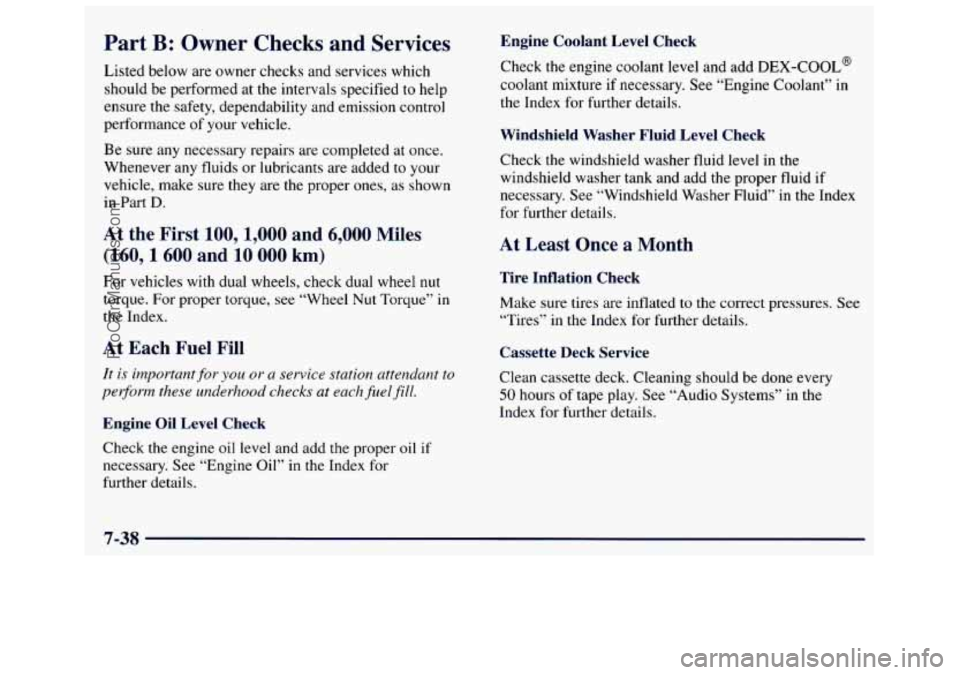
Listed below are owner checks and services which
should be performed at
the intervals specified to help
ensure the safety, dependability and emission control
performance
of your vehicle.
Be sure any necessary repairs are completed at once.
Whenever any fluids or lubricants are added to your
vehicle, make sure they are the proper ones, as shown
in Part
D.
At the First 100, 1,000 and 6,000 Miles
(160,1600 and 10 000 km)
For vehicles with dual wheels, check dual wheel nut
torque. For proper torque, see “Wheel Nut Torque” in
the Index.
At Each Fuel Fi”
It is important for you or a service station attendant to
per$orrn these underhood checks
at each fitelfill.
Engine Oil Level Check
Check the engine oil level and add the proper oil if
necessary. See “Engine Oil” in the Index for
further details.
Engine Coolant Level Check
Check the engine coolant level and add DEX-COOL@
coolant mixture if necessary. See “Engine Coolant” in
the Index for further details.
Windshield Washer Fluid Level Check
Check the windshield washer fluid level in the
windshield washer tank and add the proper fluid if
necessary. See “Windshield Wdsher Fluid” in the Index
for further details.
At Least Once a Month
Tire Inflation Check
Make sure tires are inflated to the correct pressures. See
“Tires” in the Index for further details.
Cassette Deck Service
Clean cassette deck. Cleaning should be done every
50 hours of tape play. See “Audio Systems” in the
Index for further details.
7-38
ProCarManuals.com