engine GMC SIERRA 1994 Owners Manual
[x] Cancel search | Manufacturer: GMC, Model Year: 1994, Model line: SIERRA, Model: GMC SIERRA 1994Pages: 404, PDF Size: 20.91 MB
Page 289 of 404
I NOTICE:
If you use an improper coolant mix, your engine could overheat
and be badly damaged.
The repair cost wouldn’t be covered by
your warranty.
Too much water in the mix can freeze and crack
the engine, radiator, heater core and other parts.
Some conditions, such as air trapped in the cooling system, can affect the
coolant level
in the radiator. Check the coolant level when the engine is cold
and follow the steps under “Adding Coolant” for the proper way to add
coolant.
If you have to add coolant more than four times a year, have your dealer
check your cooling system.
If you use the proper coolant, you don’t have to add extra
inhibitors or additives which claim to improve the system. These
can be harmful.
Adding Coolant -Gas Engines
To Check Coolant
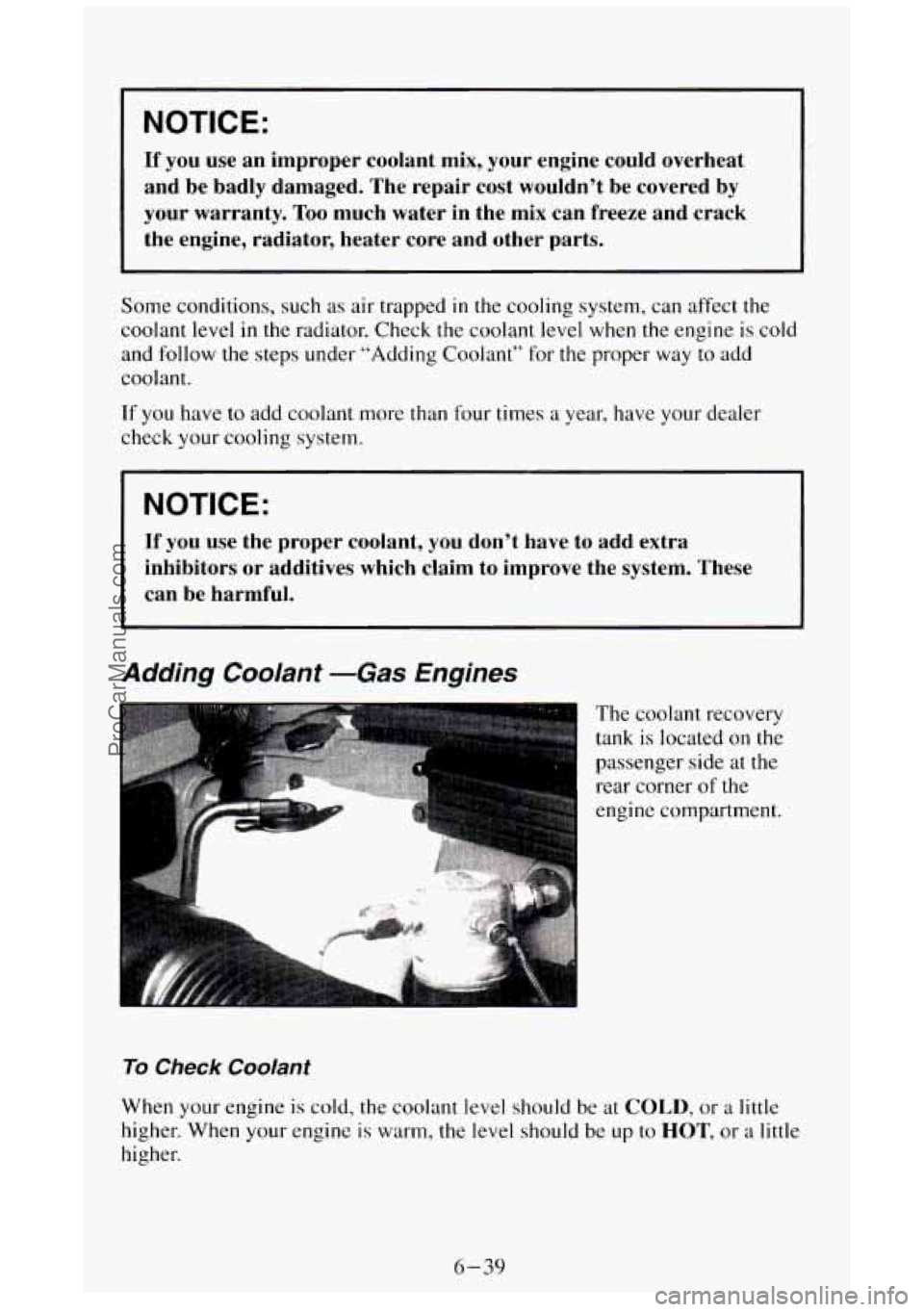
The coolant recovery
tank
is located on the
passenger side at the
rear corner
of the
engine compartment.
When your engine
is cold, the coolant level should be at COLD, or a little
higher. When
your engine is warm, the level should be up to HOT, or a little
higher.
6-39
ProCarManuals.com
Page 290 of 404
To Add Coolant
If you need more coolant, add the proper mix at the coolant recovery tunk.
A CAUTION:
Turning the radiator pressure cap when the engine and radiator
are hot can allow steam and scalding liquids to blow out and
burn you badly. With the coolant recovery tank, you will almost
never have to add coolant at the radiator. Never turn the
radiator pressure cap
- even a little - when the engine and
radiator are hot.
Add coolant mix at the recovery tank, but be careful not to spill it.
A CAUTION:
You can be burned if you spill coolant on hot engine parts.
Coolant contains ethylene glycol, and it will burn
if the engine
parts are hot enough. Don’t spill coolant on a hot engine.
Adding Coolant -Diesel Engines
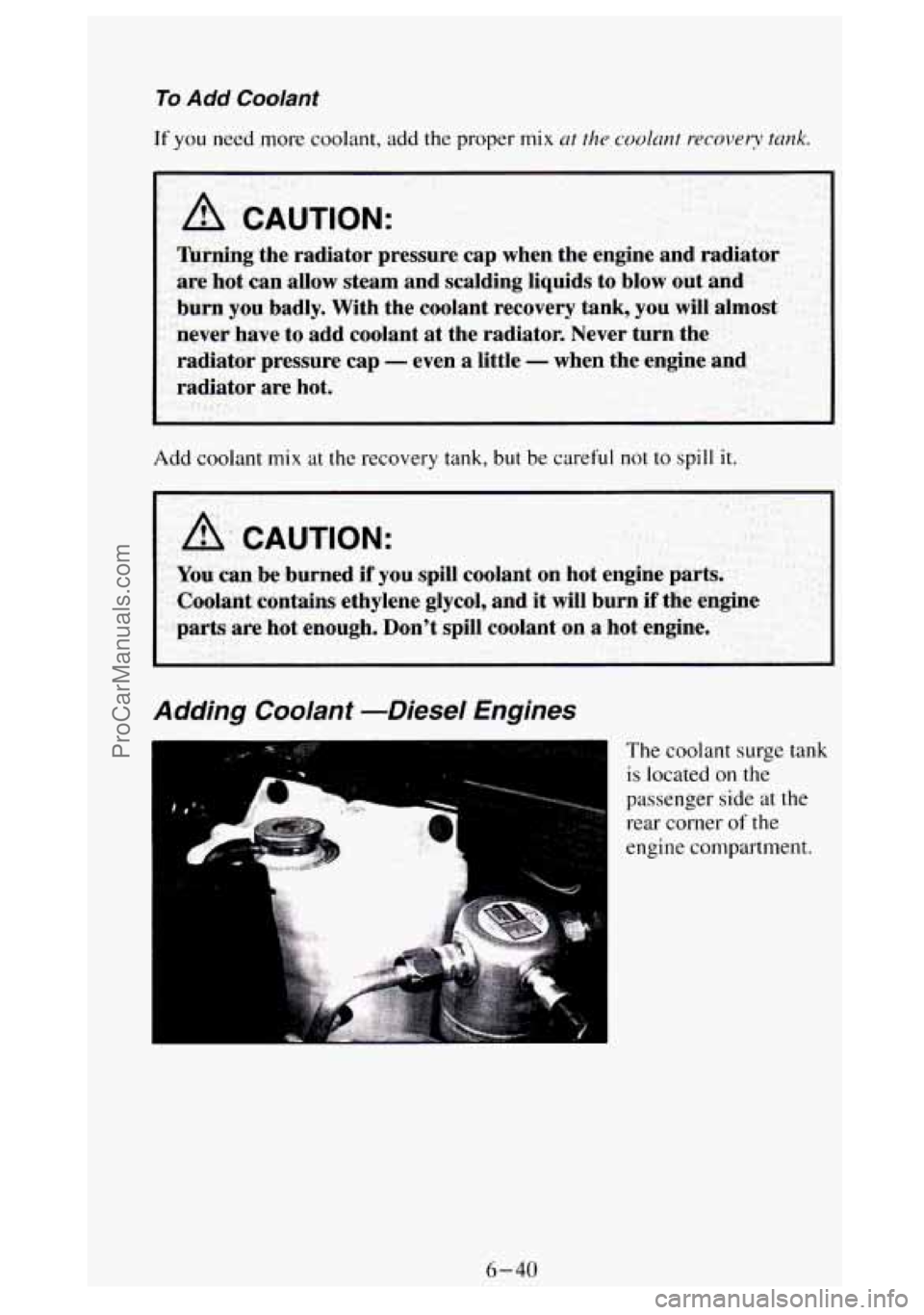
The coolant surge tank
is located on the
passenger side at the
rear corner
of the
engine compartment.
6-40
ProCarManuals.com
Page 291 of 404
To Check Coolant
When your engine is cold, the coolant level should be at the COLD mark,
or a little higher. When your engine is warm, the level should be above the
COLD mark.
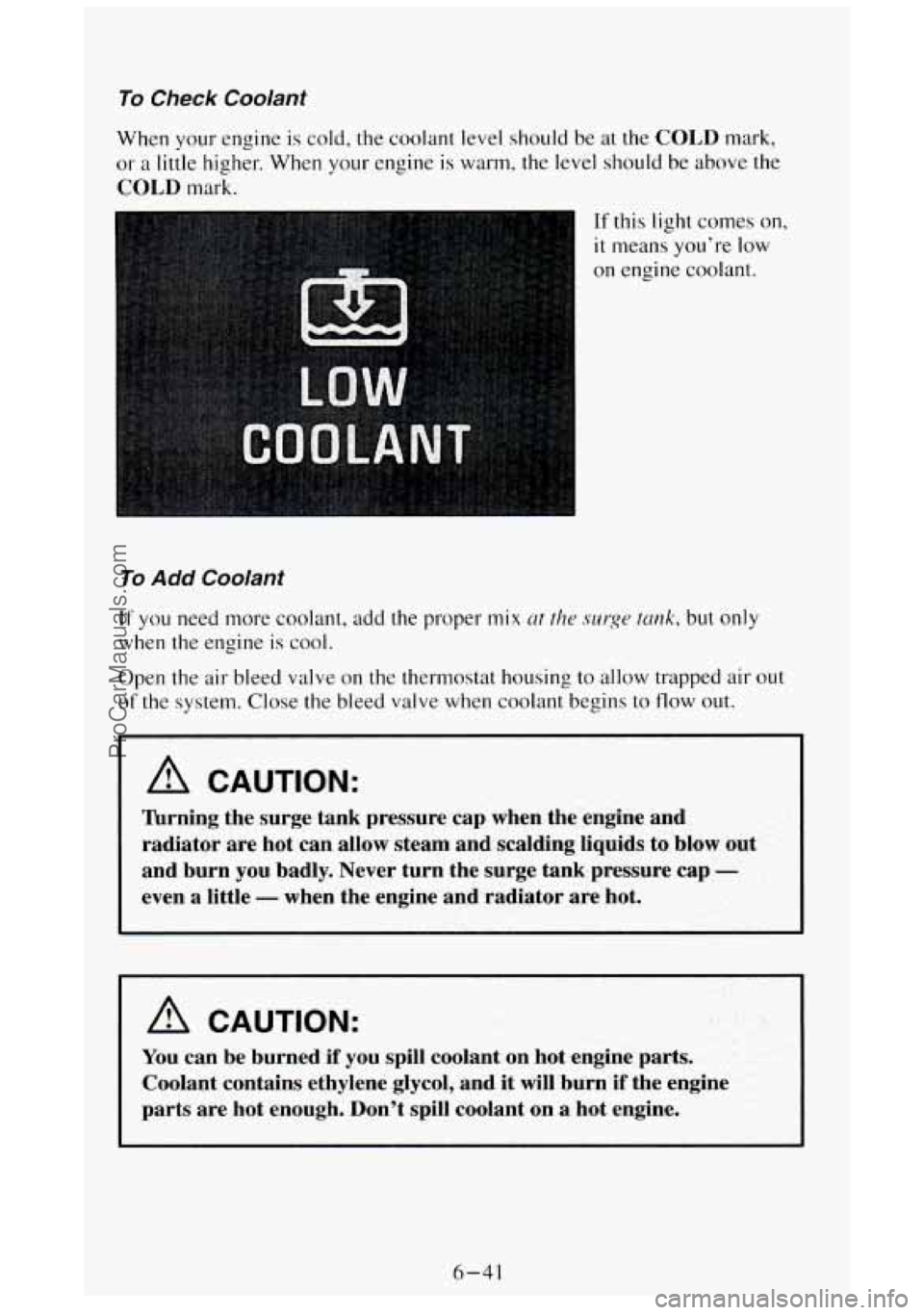
If this light comes on,
it means you’re low
on engine coolant.
To Add Coolant
If you need more coolant, add the proper mix at the surge tnnk, but only
when the engine is cool.
Open the air bleed valve on the thermostat housing to allow trapped air
out
of the system. Close the bleed valve when coolant begins to flow out.
I A CAUTION:
nrning the surge tank pressure cap when the engine and
radiator are hot can allow steam and scalding liquids to blow
out:
and burn you badly. Never turn the surge tank pressure cap -
even a little - when the engine and radiator are hot.
A CAUTION:
You can be burned if you spill coolant on hot engine parts.
Coolant contains ethylene glycol, and it will burn if the engine
parts are hot enough. Don’t spill coolant on
a hot engine.
6-41
ProCarManuals.com
Page 292 of 404
Radiator Pressure Cap-Gas Engines
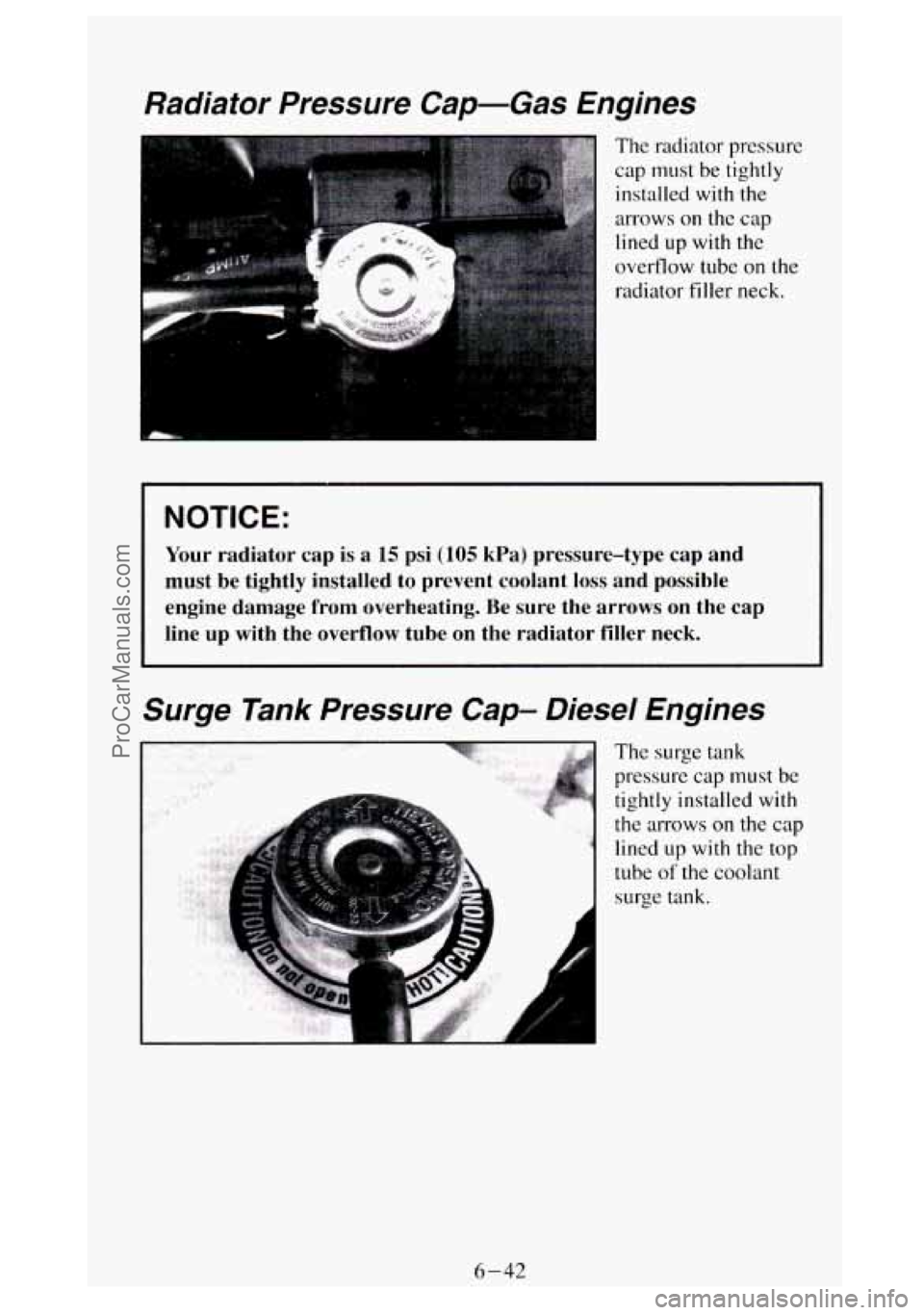
The radiator pressure
cap must be tightly
installed with the
arrows
on the cap
lined
up with the
overflow tube
on the
radiator filler neck.
NOTICE:
Your radiator cap is a 15 psi (105 kPa) pressure-type cap and
must be tightly installed to prevent coolant
loss and possible
engine damage from overheating. Be sure the arrows
on the cap
line
up with the overflow tube on the radiator filler neck.
Surge Tank Pressure Cap- Diesel Engines
6-42
ProCarManuals.com
Page 293 of 404
NOTICE:
Your surge tank pressure cap is a unique 15 psi (105 kPa)
pressure-type cap for use with surge tank cooling systems only.
It must be tightly installed to prevent coolant
loss and possible
engine damage from overheating. Be sure the arrows on the cap
line up with the top tube
of the coolant surge tank.
Thermostat
Engine coolant temperature is controlled by a thermostat in the engine
coolant system. The thermostat stops
the flow of coolant through the
radiator
until the coolant reaches a preset temperature.
When
you replace your thermostat, an AC" thermostat is recommended.
Power Steering Fluid
NOTICE:
Always turn the engine off before checking or adding power
steering fluid. The power steering pump cap is close to the fan
and other moving parts.
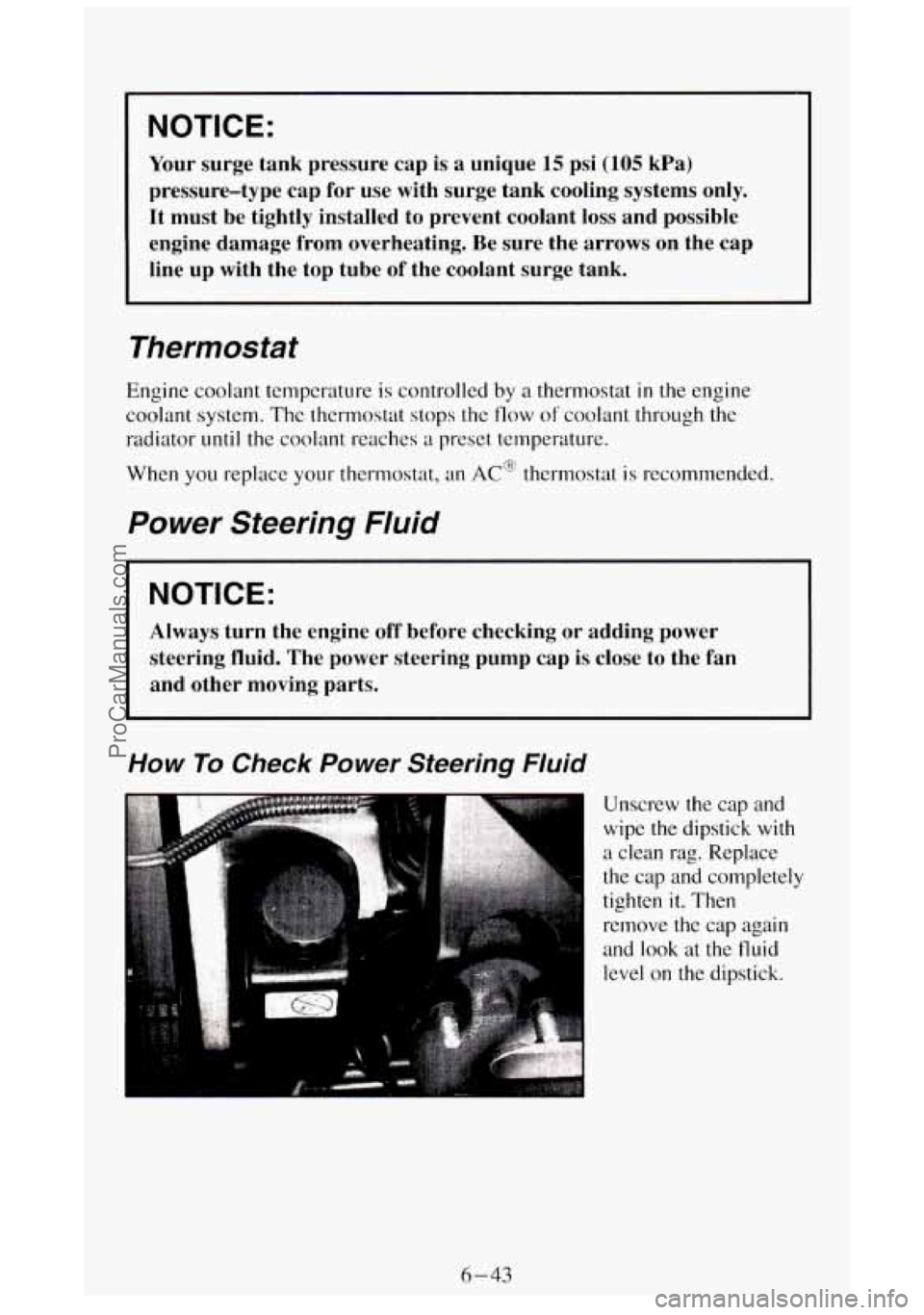
How To Check Power Steering Fluid
Unscrew the cap and
wipe the dipstick
with
a clean rag. Replace
the cap and completely
tighten it. Then
remove the cap again
and
look at the fluid
level on the dipstick.
6-43
ProCarManuals.com
Page 294 of 404
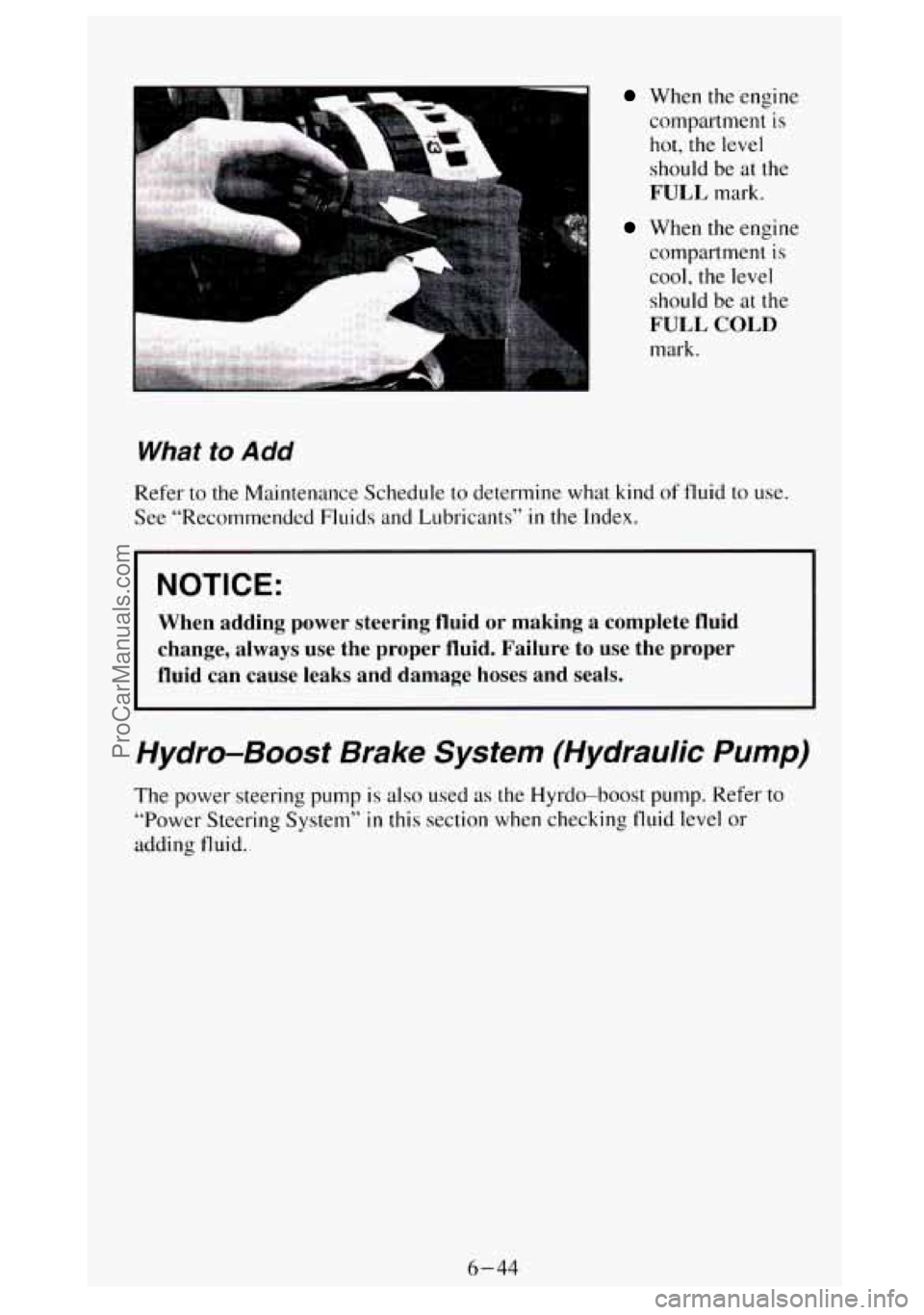
When the engine
compartment is
hot, the level
should be at the
FULL mark.
When the engine
compartment
is
cool, the level
should be at the
FULL COLD
mark.
What to Add
Refer to the Maintenance Schedule to determine what kind of fluid to use.
See “Recommended Fluids and Lubricants”
in the Index.
NOTICE:
When adding power steering fluid or making a complete fluid
change, always use the proper fluid. Failure
to use the proper
fluid can cause leaks and damage hoses and seals.
Hydro-Boost Brake System (Hydraulic Pump)
The power steering pump is also used as the Hyrdo-boost pump. Refer to
“Power Steering System”
in this section when checking fluid level or
adding tluid.
6-44
ProCarManuals.com
Page 297 of 404
To Check Brake Fluid
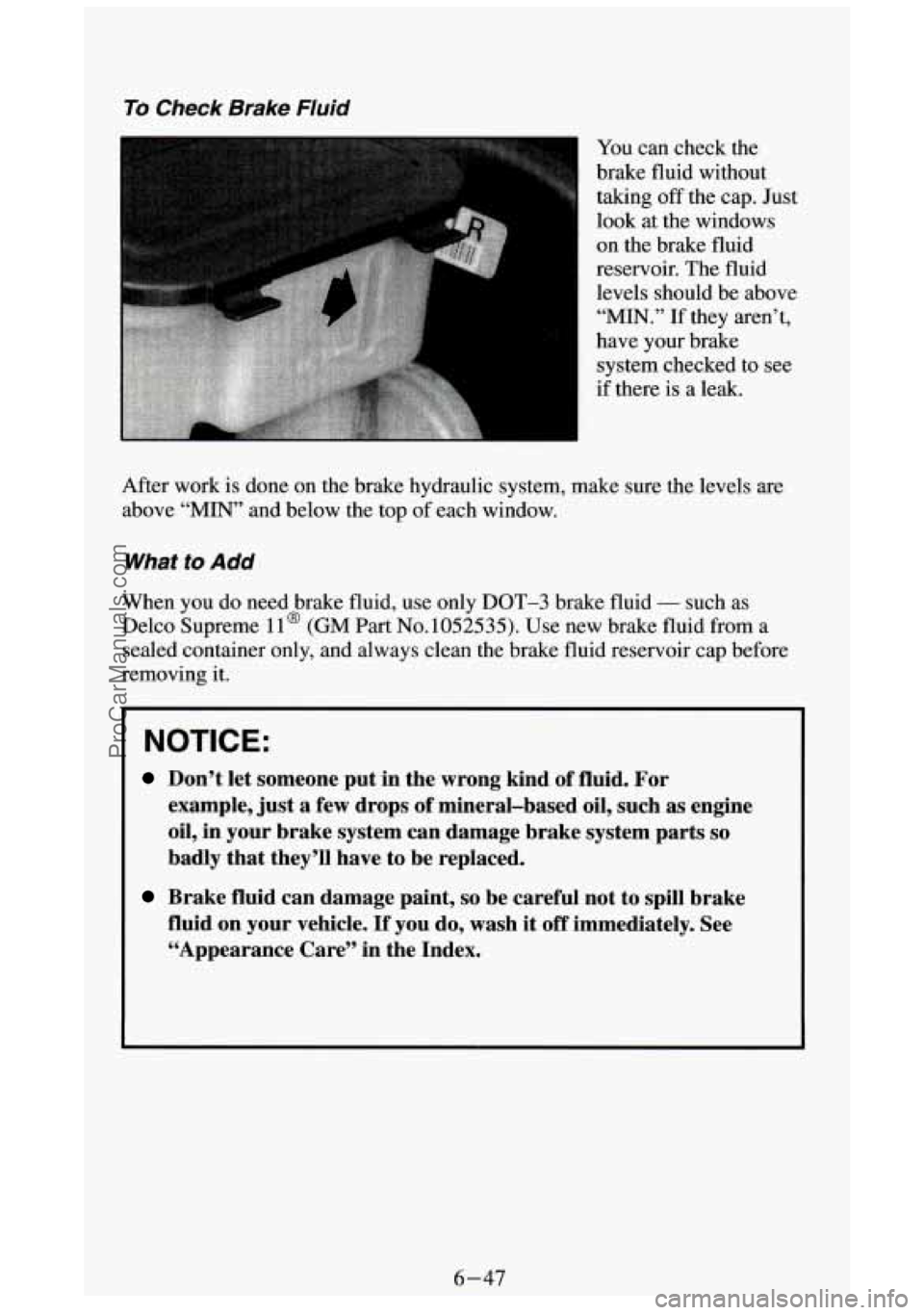
You can check the
brake fluid without
taking off the cap. Just
look at the windows
on the brake fluid
reservoir. The fluid
levels should be above
“MIN.” If they aren’t,
have your brake system checked to see
if there is a leak.
After work
is done on the brake hydraulic system, make sure the levels are
above
“MIN” and below the top of each window.
What to Add
When you do need brake fluid, use only DOT-3 brake fluid - such as
Delco Supreme
ll@ (GM Part No.1052535). Use new brake fluid from a
sealed container only, and always clean the brake fluid reservo\
ir cap before
removing it.
NOTICE:
Don’t let someone put in the wrong kind of fluid. For
example, just
a few drops of mineral-based oil, such as engine
oil, in your brake system can damage brake system parts so
badly that they’ll have to be replaced.
Brake fluid can damage paint, so be careful not to spill brake
fluid
on your vehicle. If you do, wash it off immediately. See
“Appearance Care” in the Index.
6-47
ProCarManuals.com
Page 300 of 404
Wheel Nut Torque
For vehicle with dual wheels, wnen the vehicle, wheel or Tasteners are new,
have the torque set at
the first 100, 1,000 and 6,000 miles (1 60, 1600 and
9600 km). Use the torque specified
in the appropriate Specification Chart
later
in this section.
Single Belt Accessory Drive
If your new vehicle uses a serpentine belt, it is lighter and more durable than
systems with several belts.
The belt runs over or around the pulleys on the engine.
A tensioner may be
used
to keep the belt tight at all times. The tensioner also makes replacing
the belt easier.
If you need to replace the belt, be sure to get the correct
replacement belt. Your dealership or parts supplier can help you with this.
The Accessory Drive belt Routing label on your vehicle will show
you how
to route
the belt your vehicle uses.
Windshield Wiper Blade Inserts
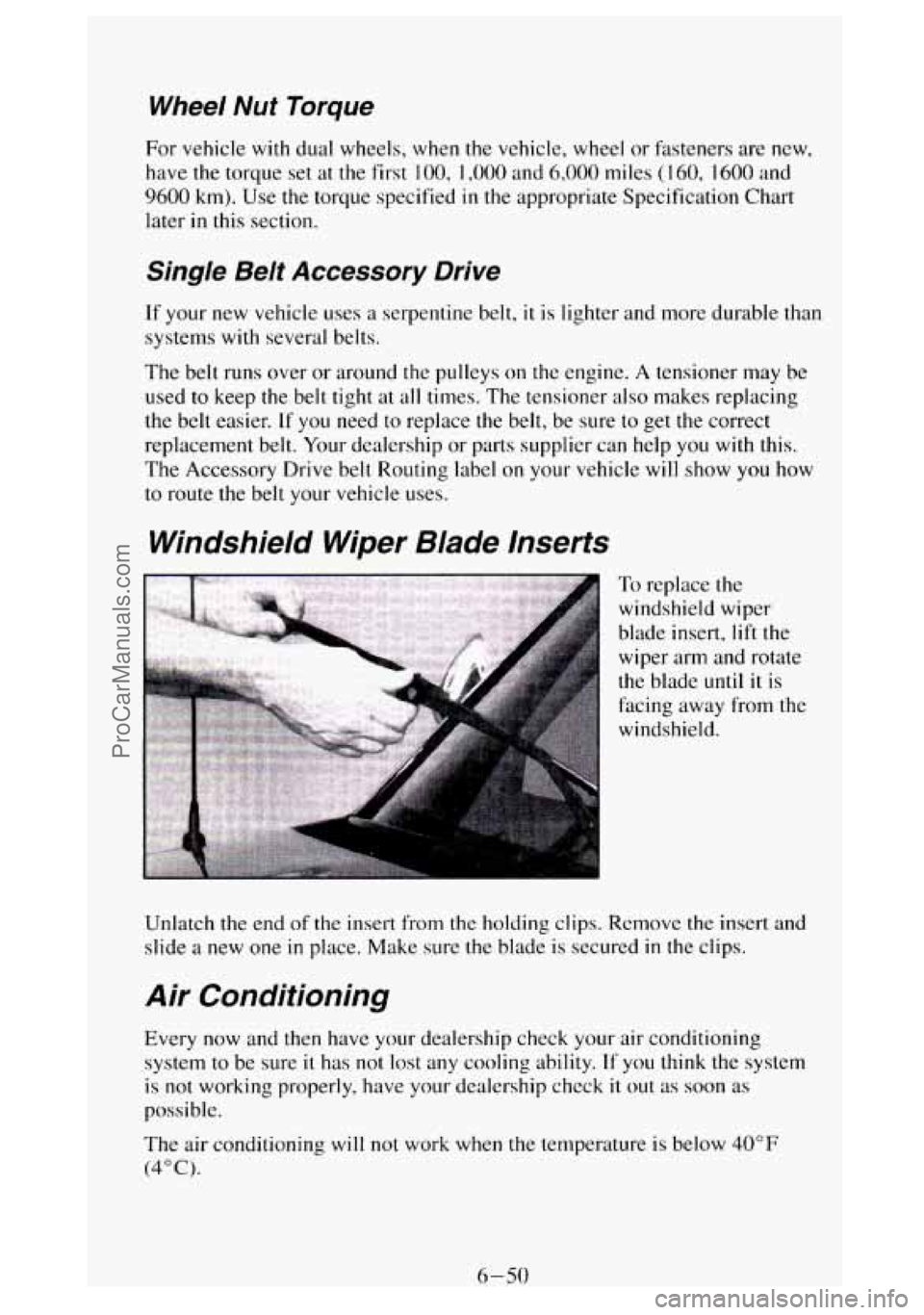
To replace the
windshield wiper
blade insert, lift the
wiper arm and rotate
the blade until
it is
facing away from the
windshield.
Unlatch
the end of the insert from the holding clips. Remove the insert and
slide a new
one in place. Make sure the blade is secured in the clips.
Air Conditioning
Every now and then have your dealership check your air conditioning
system
to be sure it has not lost any cooling ability. If you think the system
is not working properly, have your dealership check it out as soon as
possible.
The air conditioning
will not work when the temperature is below 40°F
(4°C).
6-50
ProCarManuals.com
Page 301 of 404
Fluid Leak Check
After the vehicle has been parked for a while, inspect the surface under the
vehicle for water, oil, fuel or other fluids. Water dripping from the air
conditioning
system after it has been used is normal. If you notice fuel leaks
or fumes, the causes should be found and corrected at once.
Lubrication
Accelerator Control System
Your maintenance schedule will tell you how often the accelerator linkage
pivot points must be lubricated. See “Recommended
Fluids and Lubricants”
in the Tndex for the proper lubricant to use.
Accelerator cables and cruise control cables should not be lubricated.
Any
cab1e.s that are worn or are hard to pull should be replaced.
Hood Latches and Hood Hinge
Your maintenance schedule will tell you how often to lubricate the hood
latch and hood hinge assembly. See “Recommended Fluids and Lubricants”
in the Index for the proper lubricant to use.
Propeller Shaft Slip Splines
See your maintenance schedule to find out how often the. slip splines must
be lubricated. See “Recommended Fluids and Lubricants”
in the Index for
the proper lubricant to use.
Constant Velocity Joints
See your mamtenance schedule to find out how often the constant velocity
joints must be lubricated. See “Recommended Flui-ds and Lubricants”
in the
Index for the proper lubricant to use.
Body
Normal use of your vehicle will cause metal to metal wear at some points on
the cab and body if they are not lubricated.
For exposed surfaces, such as door checks, door lock bolts, lock striker
plates, dovetail bumper wedges, etc., a
thin film of engine oil should be
applied.
The seat adjusters and seat track should be lubricated
with chassis grease.
Door weather strips and rubber hood bumpers should be wiped clean with
a
rubber lubricant.
6-51
ProCarManuals.com
Page 303 of 404

Contact your dealer to learn how to prepare your vehicle for longer storage
periods.
Bulb Replacement
Before you replace any bulbs, be sure that all the lights are\
off and the
engine isn’t running.
Sealed Beam Headlights
I
1. Remove the four
screws from the
headlight retainer.
2. Pull the headlight
out and remove
the retainer.
3.
4.
5.
Unplug and
remove the
headlight.
Plug in the new
headlight and put
it in place.
Install the
retainer
to the
headlight and
tighten the
screws.
6-53
ProCarManuals.com