tow GMC SIERRA 1994 Service Manual
[x] Cancel search | Manufacturer: GMC, Model Year: 1994, Model line: SIERRA, Model: GMC SIERRA 1994Pages: 404, PDF Size: 20.91 MB
Page 235 of 404
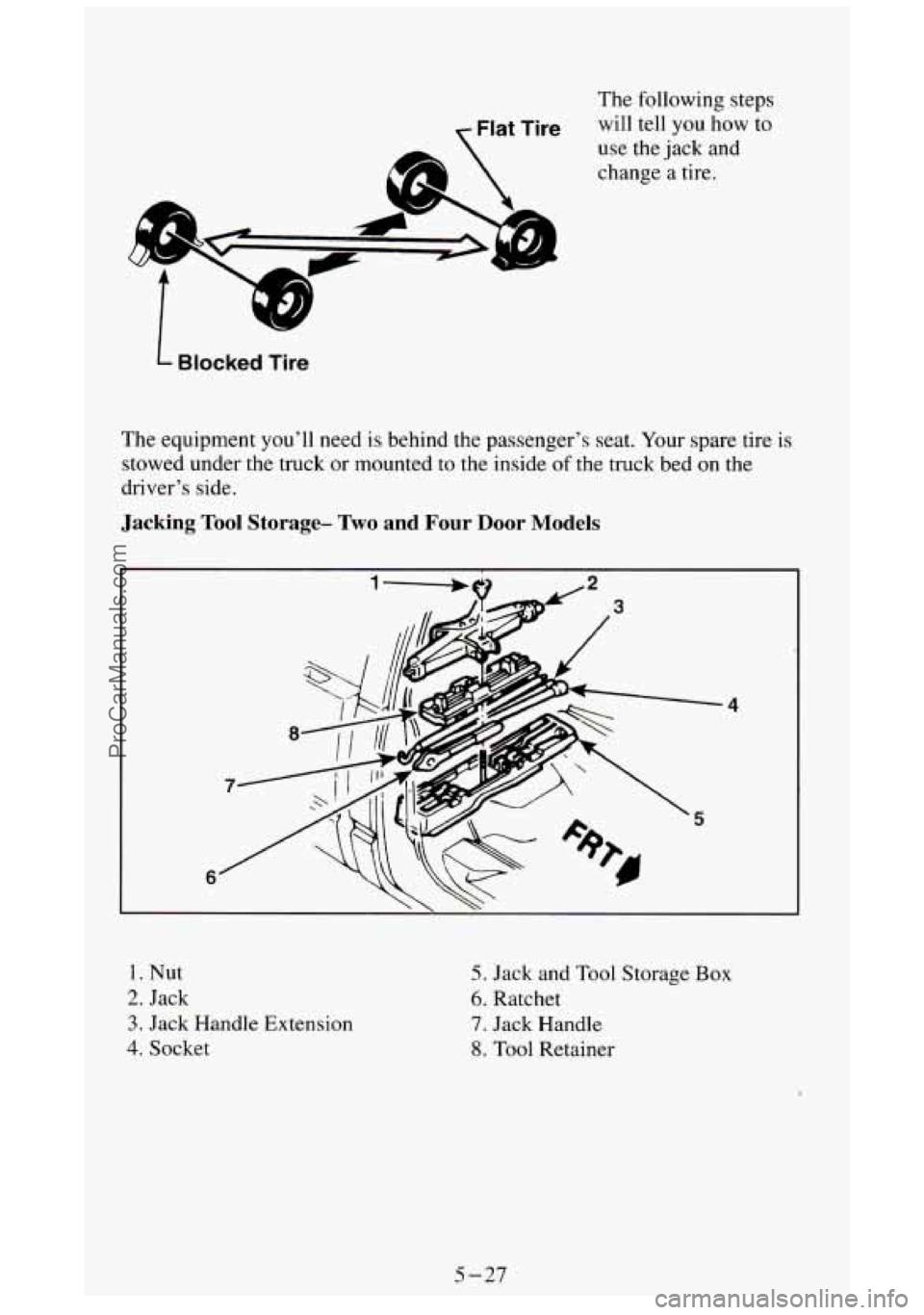
use the jack and
change a tire.
L Blocked Tire
1 ne equipment you’ll need is behind the passenger’s seat. Your spare tire is
stowed under the truck or mounted to the inside of the truck bed on the
driver’s side.
Jacking Tool Storage- Two and Four Door Models
1. Nut
2. Jack
3. Jack Handle Extension
4. Socket
5. Jack and Tool Storage Box
6. Ratchet
7. Jack Handle
8. Tool Retainer
5-27
ProCarManuals.com
Page 237 of 404
Jack Storage
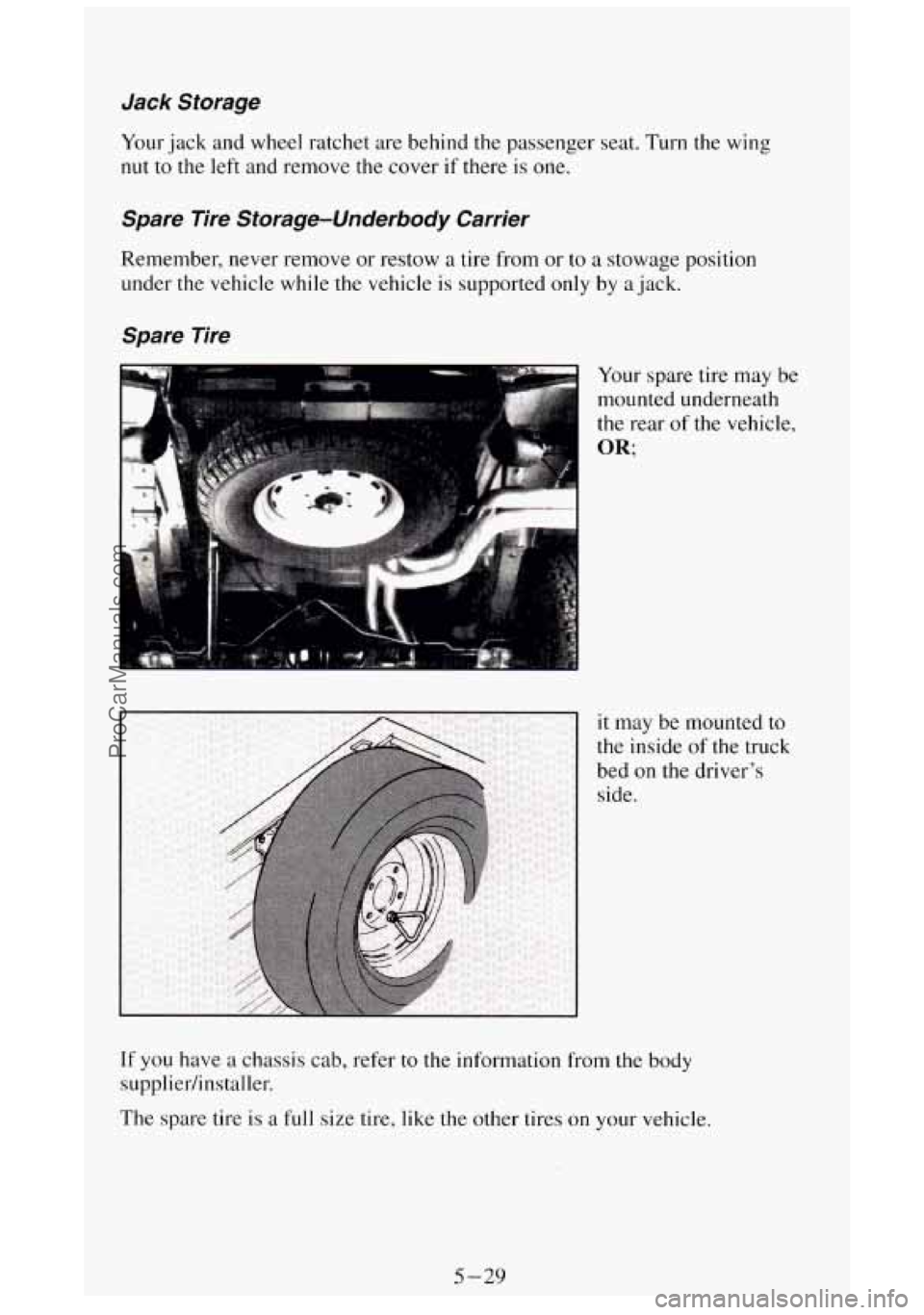
Your jack and wheel ratchet are behind the passenger seat. Turn the wing
nut to the left and remove the cover if there is one.
Spare Tire Storage-Underbody Carrier
Remember, never remove or restow a tire from or to a stowage position
under the vehicle while the vehicle is supported only by a
jack.
Spare Tire
Your spare tire may be
mounted underneath
the rear
of the vehicle,
OR;
it may be mounted to
the inside
of the truck
bed on the driver’s
side.
If you have a chassis cab, refer to the information from the body
supplier/installer.
The spare tire is
a full size tire, like the other tires on your vehicle.
5-29
ProCarManuals.com
Page 245 of 404
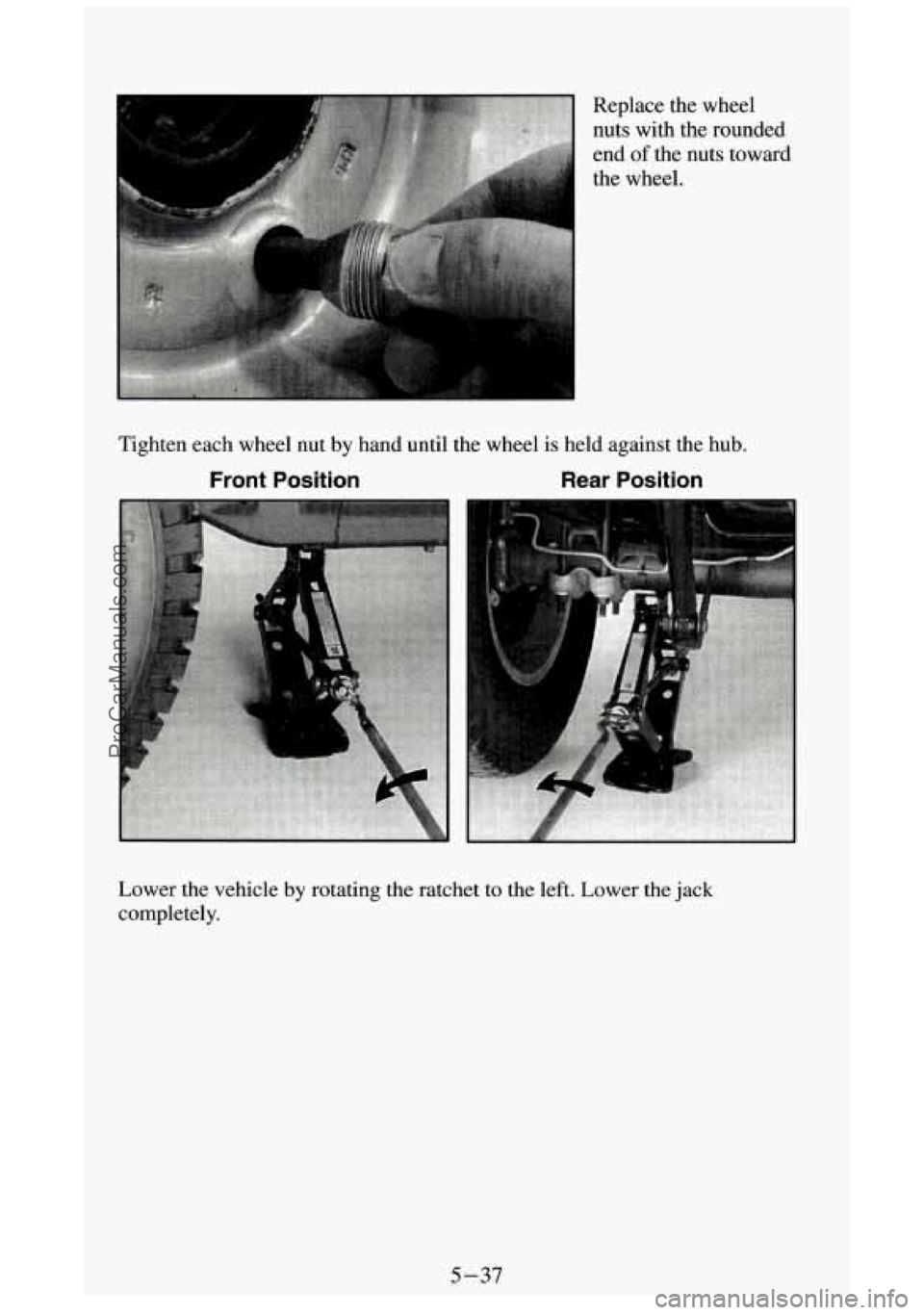
Replace the wheel
nuts with the rounded
end of the nuts toward
the wheel.
Lower the vehicle by rotating the ratchet to the left. Lower the jack
completely.
5-37
ProCarManuals.com
Page 249 of 404

NOTICE:
~ ~ ~~ ~~
Spinning your wheels can destroy parts of your vehicle as well\
as
the tires. If you spin the wheels too fast while shifting your back
and forth, you can destroy your
.
Rocking your vehicle to get it out:
First, turn your steering wheel left and right. That will clear the area around
your front wheels. Then shift back and forth between
“R’ (Reverse) and a
forward gear (or with a manual
, between First or Second gear and Reverse),
spinning the wheels as little as possible. Release the accelerator pedal while
you shift, and press lightly on the accelerator pedal when the\
is in gear. If
that doesn’t get you out after a few tries, you may need to be towed out. Or,
you can use your recovery hooks,
if your vehicle has them. If you do need
to be towed out, see “Towing Your Vehicle” in the Index.
Using the Recovery Hooks
If you ever get stuck in sand, mud, ice or snow, your vehicle may be
equipped with recovery hooks. The recovery hooks are provided at the front
of your vehicle. You may need to use them
if you’re stuck off-road and
need to be pulled to some place where you can continue drivin\
g.
5-41
ProCarManuals.com
Page 250 of 404

NOTICE:
I
Never use the recovery hooks to tow the vehicle. Your vehicle \
could be damaged and it would not be covered by warranty.
5-42
ProCarManuals.com
Page 268 of 404
I
I
I
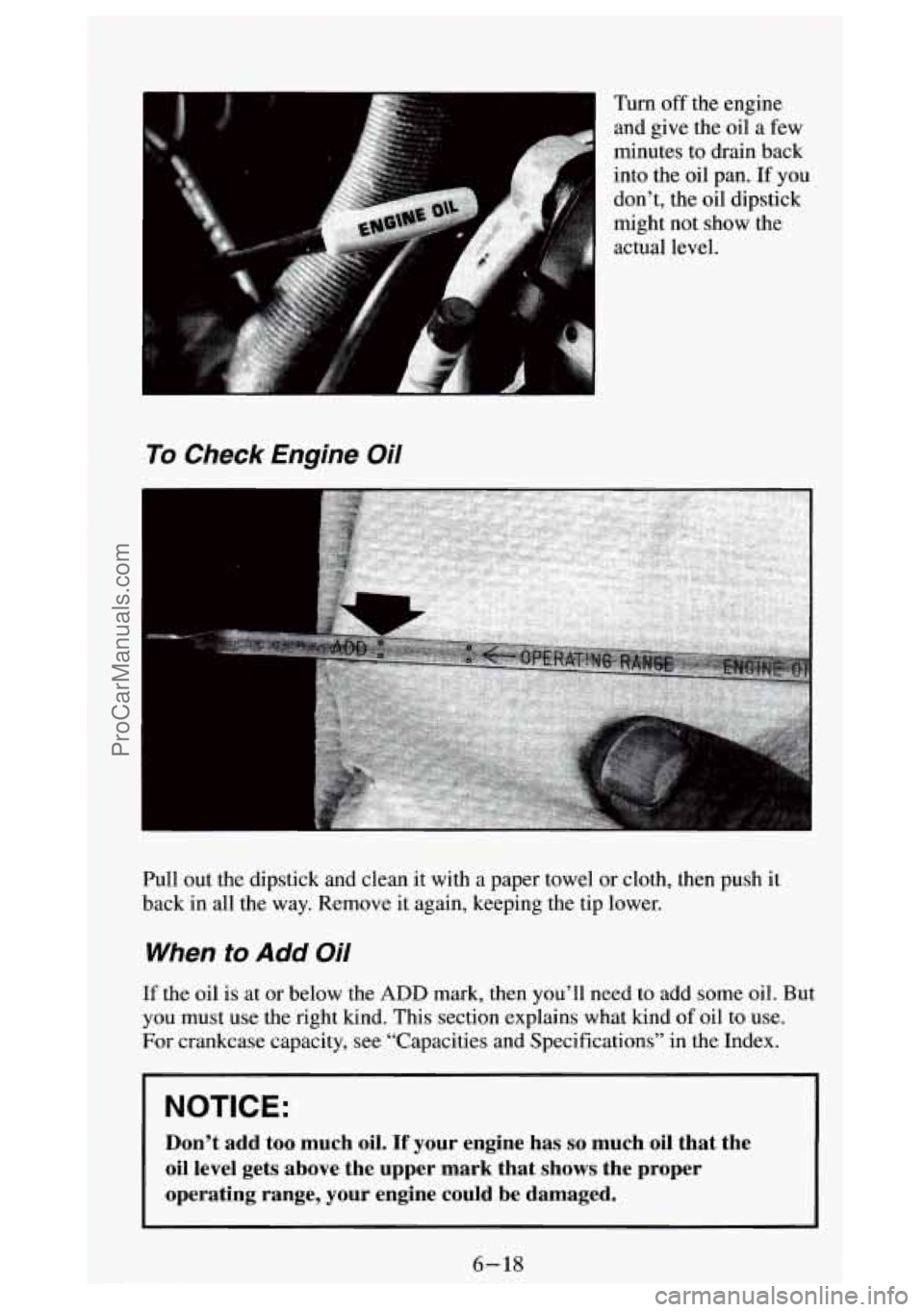
To Check Engine Oil
Turn off the engine
and give the oil a few
minutes to drain back
into the
oil pan. If you
don’t, the oil dipstick
might
not show the
actual level.
Pull out the dipstick and clean it with
a paper towel or cloth, then push it
back in all the way. Remove it again, keeping the tip lower.
When to Add Oil
If the oil is at or below the ADD mark, then you’ll need to add some oil. But
you must use the right kind. This section explains what kind of oil
to use.
For crankcase capacity, see “Capacities and Specifications”
in the Index.
NOTICE:
Don’t add too much oil. If your engine has so much oil that the
oil level gets above the upper mark that shows the proper
operating range, your engine could be damaged.
6-18
t I- ProCarManuals.com
Page 273 of 404
Engine Oil Additives
Don’t add anything to your oil. Your GM dealer is ready to advise if you
think something should be added.
When to Change Engine Oil
See if any one of these is true for you:
Most trips are less than 4 miles (6 km).
It’s below freezing outside and most trips are less than 10 miles
(16 km).
The engine is at low speed most of the time (as in door-to-door
delivery, or
in stop-and-go traffic).
You tow a trailer often.
Most trips are through dusty places.
The vehicle is frequently operated off-road.
If any one
of these is true for your vehicle, then you need to change your oil
and-filter every 3,000 miles (5 000 km) or 3 months - whichever comes
first.
Light Duty Emissions:
If none of them is true, change the oil every 7,500 miles (12 500 km) or
12 months
- whichever comes first. Change the filter at the first oil change
and at every other oil change after that.
Heavy Duty Emissions:
If none of them is true, change the oil every 6,000 miles (10 000 km) or
12 months - whichever comes first. Change the filter at the first oil change
and at every other oil change after that if mileage determines when you
change
your oil. If time determines when you change your oil, change the
filter each time you change your oil.
Engine Coolant Heater (Engine Block Heater)
An engine coolant heater can be a big help if you have to park outside in
very cold weather, 0°F (- 18°C) or colder. If your vehicle has this option,
see “Engine Coolant Heater
” in the Index.
6-23
ProCarManuals.com
Page 275 of 404
To Check Engine Oil
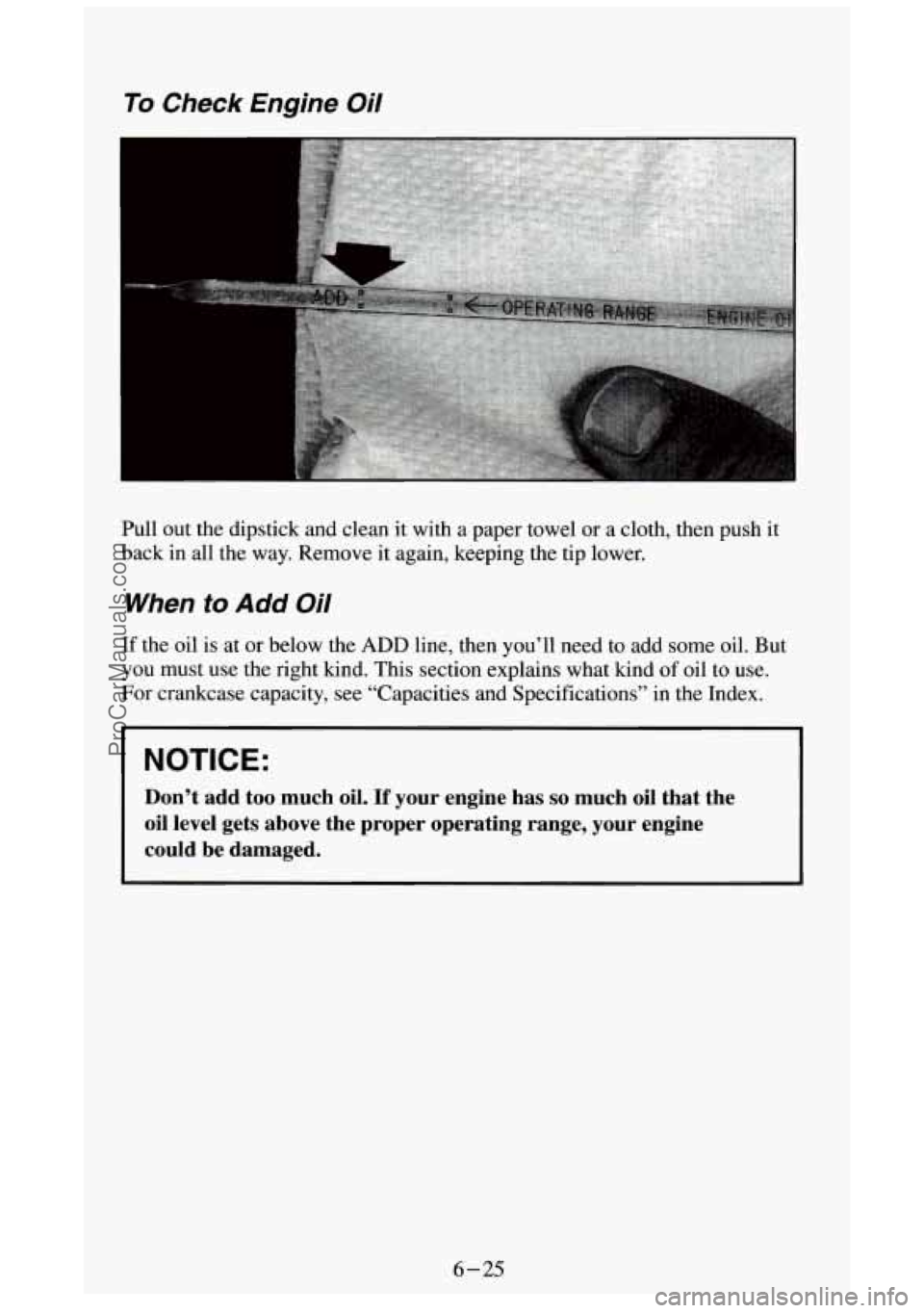
Pull out the dipstick and clean it with a paper towel or a cloth, then push it
back in all the way. Remove it again, keeping the tip lower.
When to Add Oil
If the oil is at or below the ADD line, then you’ll need to add some oil. But
you must use the right kind. This section explains what kind
of oil to use.
For crankcase capacity, see “Capacities and Specifications” in
the Index.
NOTICE:
Don’t add too much oil. If your engine has so much oil that the
oil level gets above the proper operating range, your engine
could be damaged.
6-25
ProCarManuals.com
Page 278 of 404
This doughnut-shaped logo (symbol) is used on most oil containers to help
you select the correct oil.
You should look for this on
the oil container, and use only those oils that
display
the logo.
GM Goodwrench@ oil
(in Canada, GM Engine Oil) meets all the
requirements for your vehicle.
Engine Oil Additives
Don’t add anything to your oil. Your GM dealer is ready to advise if you
think something should be added.
When to Change Engine Oil
See if any one of these is true for you:
0 Most trips are less than 4 miles (6 km).
0 It’s below freezing outside and most trips are less than 10 miles
(16 km).
0 The engine is at low speed most of the time (as in door-to-door
delivery, or in stop-and-go traffic).
0 You tow a trailer often.
0 Most trips are through dusty places.
The vehicle is frequently operated off-road.
If any
of these is true for your vehicle, then you need to change your oil and
filter
every 2,500 miles (4 000 km) or 3 months - whichever comes first.
If
none of them is true, change the oil and filter every 5,000 miles
(8 000 km) or 12 months - whichever comes first.
What to Do with Used Oil
Did you know that used engine oil contains certain elements that may be
unhealthy for
your skin and could even cause cancer‘? Don’t let used oil stay
on your
skin for very long. Clean your skin and nails with soap and water,
or a good hand cleaner. Wash or properly throw away clothing or rags
containing used engine oil. (See the manufacturer’s warnings about the use
and disposal
of oil products.)
Used
oil can be a real threat to the environment. If you change your own oil,
be sure
to drain all free-flowing oil from the filter before disposal. Don’t
ever dispose
of oil by putting it in the trash, pouring it on the ground, into
sewers, or into streams or bodies
of water. Instead, recycle it by taking it to
a place that collects used oil. If you have
a problem properly disposing of
your used
oil, ask your dealer, a service station or a local recycling center
for help.
6-28
ProCarManuals.com
Page 280 of 404
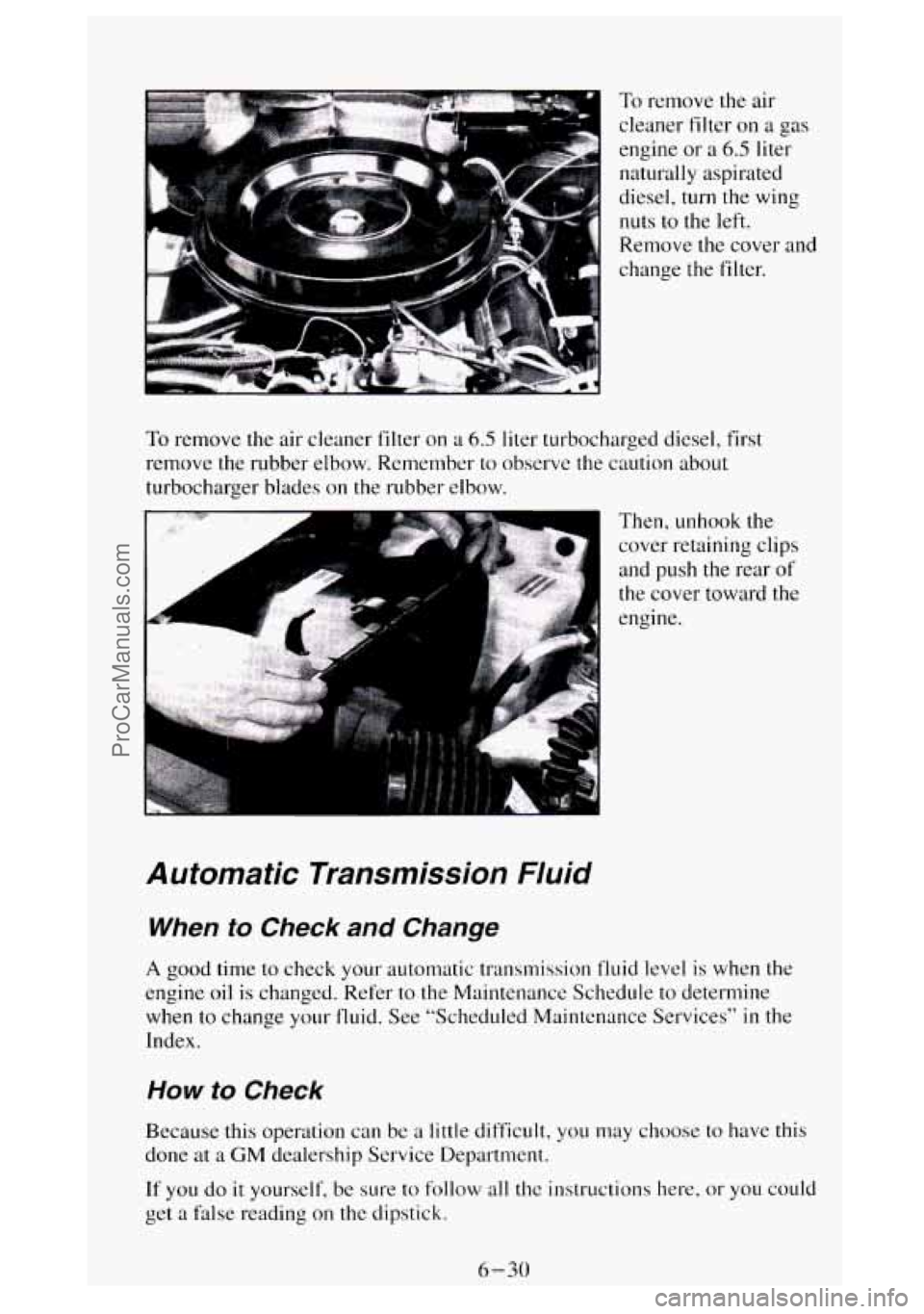
.-. -1 To remove the air
cleaner filter on
a gas
engine or a 6.5 liter
naturally aspirated
diesel,
turn the wing
nuts to the left.
Remove the cover and
change the filter.
Then, unhook the
cover retaining clips
and push the rear
of
the cover toward the
engine.
Automatic Transmission Nuid
When to Check and Change
A good time to check your automatic transmission fluid level is when the
engine oil is changed. Refer
to the Maintenance Schedule to determine
when to change your fluid. See “Scheduled Maintenance Services”
in the
Index.
How to Check
Because this operation can be a little difficult, you may choose to have this
done at
a GM dealership Service Department.
If you do it yourself, be SLIK to follow all the instructions here, or you could
get a false reading on the dipstick.
6 - 30
ProCarManuals.com