tow GMC SIERRA 1994 Workshop Manual
[x] Cancel search | Manufacturer: GMC, Model Year: 1994, Model line: SIERRA, Model: GMC SIERRA 1994Pages: 404, PDF Size: 20.91 MB
Page 282 of 404
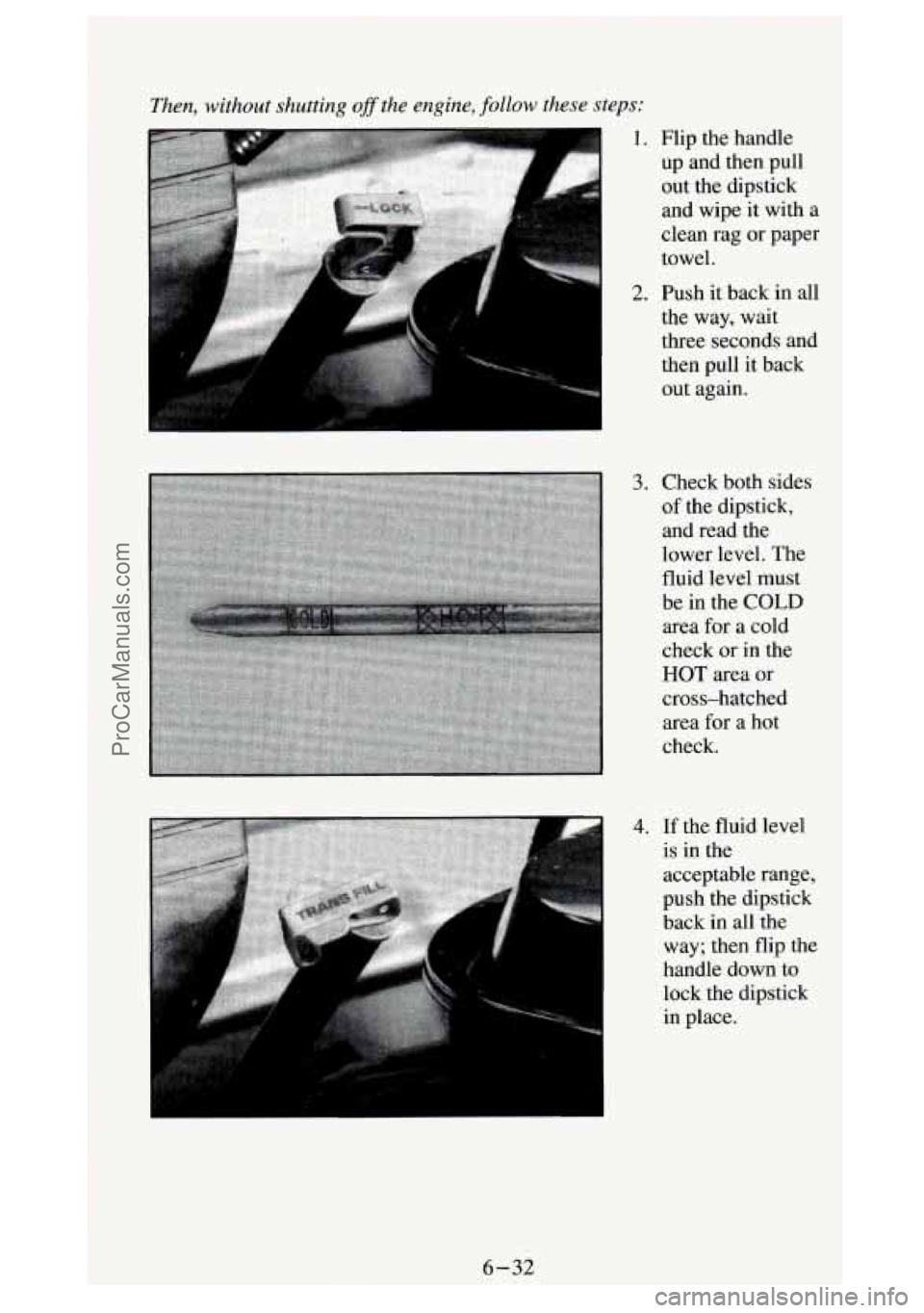
Then, .without shutting ofithe engine, follow these steps:
1. Flip the handle
up and then pull
out the dipstick
and wipe it with a
clean rag
or paper
towel.
2. Push it back in all
the way, wait
three seconds and
then pull it back
out again.
3. Check both sides
of the dipstick,
and read the
lower level. The
fluid level must
be in the COLD area for a cold
check or in the
HOT area or
cross-hatched
area for a hot
check.
4. If the fluid level
is in the
acceptable range,
push the dipstick back in all the
way; then flip the
handle down to
lock the dipstick in place.
ProCarManuals.com
Page 317 of 404
Trailering Package
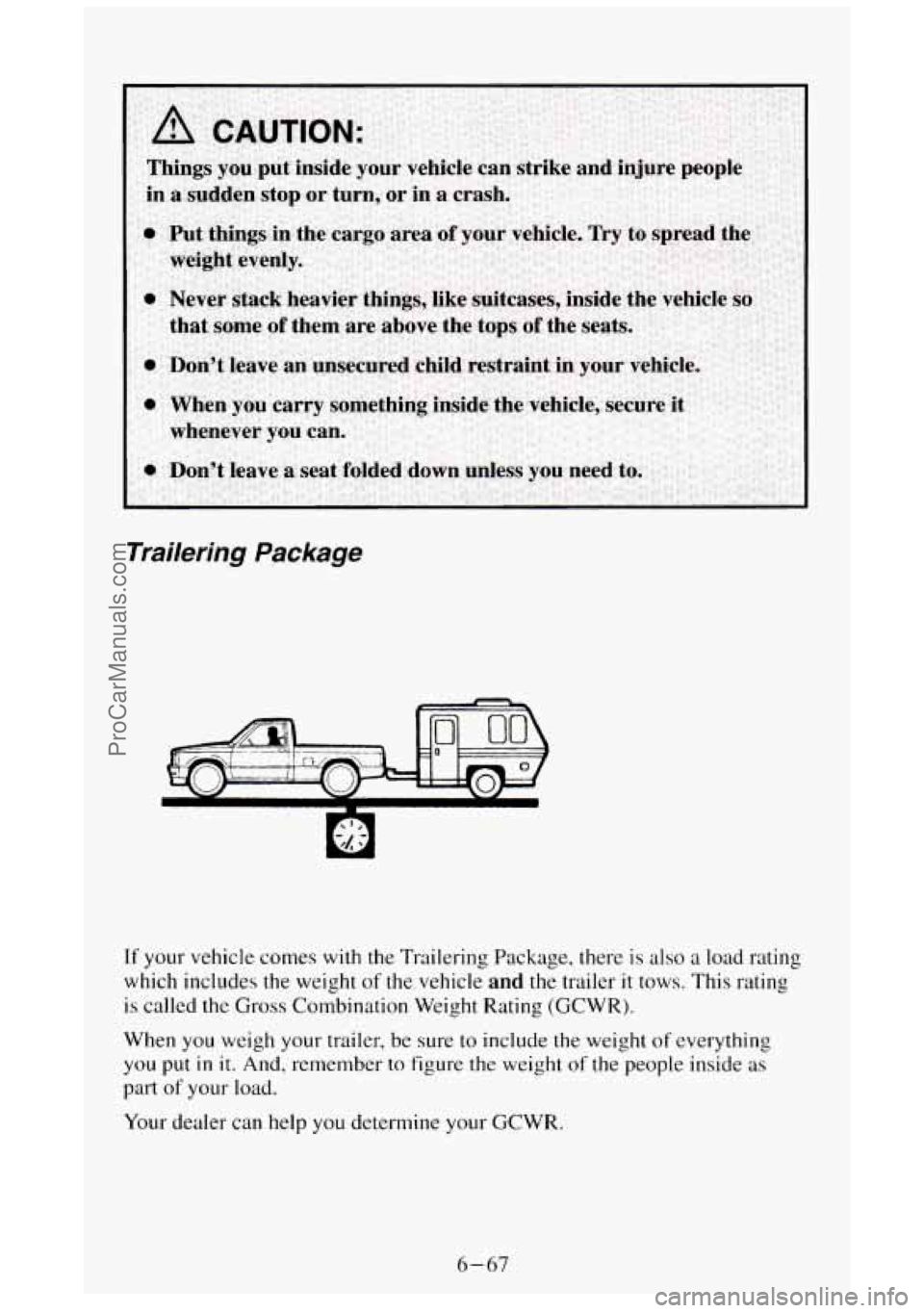
If your vehicle comes with the Trailering Package, there is also a load rating
which includes the weight
of the vehicle and the trailer it tows. This rating
is called the Gross Combination Weight Rating (GCWR).
When you weigh your trailer, be sure
to include the weight of everything
you put
in it. And, remember to figure the weight of the people inside as
part of your load.
Your dealer can help you determine your GCWR.
6-67
ProCarManuals.com
Page 320 of 404
After you’ve loaded your vehicle and camper, drive to a weigh station and
weigh
on the front and rear wheels separately. This will tell you the loads on
your axles. The loads
on the front and rear axles shouldn’t be more than
either of the GAWRs. The total
of the axle loads should not be more than
the GVWR.
Open your driver’s door and look at
the CertificatiodTire label to find out
your CWAR and GVWR.
If
you’ve gone over your weight ratings, move or take out some things until
all the weights fall below the ratings. Of course, you should always tie down
any loose items when you load your vehicle or camper.
When you install and load your slide-in camper, check the manufacturer’s
instructions.
If
you want more information on curb weights, cargo weights, cargo weight
rating and the correct center of gravity zone for your vehicle, your dealer
can help
you. Just ask for a copy of “Consumer Information, Truck-Camper
Loading.”
Trailer Recommendations
You must subtract your hitch loads from the CWR for your vehicle. Weigh
your vehicle with
the trailer hitch attached, so that you won’t go over the
GVWR or the GAWR.
You’ll get the best performance if you spread out the weight of your load
the right way, and if‘ you choose the correct hitch and trailer brakes.
For more information, see “Trailer Towing’’
in the Index.
Pickup Conversion To Chassis Cab
General Motors is aware that some vehicle owners may consider having the
pickup box removed and
a commercial or recreational body installed.
Before
you do so, first contact the GM Zone Office for your area for
information on such conversions. (See the “Warranty and Owner
Assistance” booklet for Zone Office.) Owners should be aware that, as
manufactured, there are differences between a chassis cab and a pickup with
the box removed which may affect vehicle safety. The components
necessary to adapt
the pickup to permit its safe use with a specialized body
should be installed by a body builder
in accordance with the information
available from
the Zone Office.
6-70
ProCarManuals.com
Page 331 of 404
Cleaning the Inside of Your Vehicle
Use a vacuum cleaner often to get rid of dust and loose dirt. Wipe vinyl or
leather with
a clean, damp cloth.
Your GM dealer has two
GM cleaners, a solvent-type spot lifter and a
foam-type powdered cleaner. They will clean normal spots and stains very
well.
Do not use them on vinyl or leather.
Here are some cleaning tips:
Always read the instructions on the cleaner label.
0 Clean up stains as soon as you can - before they set.
Use a clean cloth or sponge, and change to a clean area often. A soft
brush may be used if stains are stubborn.
Use solvent-type cleaners in a well-ventilated area only. If you use
them, don’t saturate the stained area.
0 If a ring forms after spot cleaning, clean the entire area immediately or
it will
set.
Using Foam-Type CIeaner on Fabric
0 Vacuum and brush the area to remove any loose dirt.
Always clean a whole trim panel or section. Mask surrounding trim
Mix Multi-Purpose Powdered Cleaner following the directions on the
along
stitch or welt
lines.
container label.
Use suds only and apply with a clean sponge.
Don’t saturate the material.
Don’t rub it roughly.
As soon as you’ve cleaned the section, use a sponge to remove the
suds.
Rinse the section with a clean, wet sponge.
Wipe off what’s left with a slightly damp paper towel or cloth.
Then dry it immediately with a blow dryer or a heat lamp.
I NOTICE:
I Be careful with a hair dryer or heat lamp. You could scorch the I
fabric.
Wipe with a clean cloth.
6-81
ProCarManuals.com
Page 332 of 404
Using Solvent-Type Cleaner on Fabric
First, see if you have to use solvent-type cleaner at all. Some spots and
stains will clean off better
with just water and mild soap.
If you need to use a solvent:
0 Gently scrape excess soil from the trim material with a clean, dull knife
or scraper. Use very little cleaner, light pressure and clean cloths
(preferably cheesecloth). Cleaning should start at the outside
of the
stain, “feathering” toward the center. Keep changing to
a clean section
of the cloth.
0 When you clean a stain from fabric, immediately dry the area with an
air hose, hair dryer, or heat lamp
to help prevent a cleaning ring. (See
the previous NOTICE.)
Fabric Protection
Your vehicle has upholstery and trim carpet that has been treated with
Scotchgard
TM Fabric Protector, a 3M product. Scotchgard TM protects fabrics
by repelling oil and water, which are the carriers of most stains. Even with
this protection, you still need to clean your upholstery and trim carpet often
to keep
it looking new.
Further information on cleaning is available by calling 1-800-433-3296
(in Minnesota, 1-800-642-6 167).
Special Cleaning Problems
Greasy or Oily Stains
Such as grease, oil, butter, margarine, shoe polish, coffee with cream,
chewing gum, cosmetic creams, vegetable oils, wax crayon, tar and asphalt.
0 Carefully scrape off excess stain.
Follow the solvent-type instructions described earlier.
0 Shoe polish, wax crayon, tar and asphalt will stain if left on a vehicle
seat fabric. They should be removed as soon as possible. Be careful,
because
the cleaner will dissolve them and may cause them to spread.
Non-Greasy Stains
Such as catsup, coffee (black), egg, fruit, fruit juice, milk, soft drinks, wine,
vomit, urine and blood.
Carefully scrape off excess stain, then sponge the soiled area with cool
water.
0 If a stain remains, follow the foam-type instructions described earlier.
6-82
ProCarManuals.com
Page 335 of 404
Washing Your Vehicle
The best way to preserve your vehicle’s finish is to keep it clean by washing
it often with lukewarm or cold water.
Don’t wash your vehicle in the direct rays of the sun. Don’t use strong soaps
or chemical detergents. Use liquid hand, dish or car washing (mild
detergent) soaps. Don’t use cleaning agents that contain aci\
d or abrasives.
All cleaning agents should be flushed promptly and not allowed \
to dry on
the surface, or they could stain. Dry the finish with a soft, clean chamois o\
r
a
100% cotton towel to avoid surface scratches and water spotting.
High pressure vehicle washes may cause water to enter your veh\
icle.
Finish Care
Occasional waxing or mild polishing of your vehicle may be necessary to
remove residue from the paint finish. You can get GM approved cleaning
products from your dealer. (See “Appearance Care and Materials” in the
Index.)
Your GM manufactured vehicle may have
a “basecoatklearcoat” paint
finish. The clearcoat gives more depth and gloss to the colored basecoat.
Always use waxes and polishes that
are non-abrasive and made for a
basecoatlclearcoat paint finish.
I NOTICE:
Machine compounding or aggressive polishing on a
basecoatklearcoat paint finish may dull the finish or leave swi\
rl
marks.
Protecting Exterior Bright Metal Parts
Bright metal parts should be cleaned regularly to keep their l\
uster. Washing with water is all that is usually needed. However, you may use
GM Chrome
Polish on chrome or stainless steel trim, if necessary.
Use special care with aluminum trim. To avoid damaging protective trim,
never use auto or chrome polish, steam or caustic soap to clean aluminum.
A coating of
wax, rubbed to high polish, is recommended for all bright
metal parts.
6-85
ProCarManuals.com
Page 353 of 404
Selecting the Proper Maintenance Schedule
Here is how to tell which schedule to follow once you find the proper
maintenance chart
to use.
MAINTENANCE SCHEDULE I
Is any one of these true for your vehicle?
Most trips are less than 4 miles (6 kilometers.)
Most trips are less than 10 miles ( 16 kilometers), and the outside
temperatures are below freezing.
The engine is at low speed most of the time (as in door-to-door
delivery, stop-and-go traffic, or commercial use).
You operate in dusty areas or off-road frequently.
You tow a trailer.
If any one (or more) of these is true for your driving, follow Schedule I.
Schedule I is shown by a plus sign (+) on the chart.
MAINTENANCE SCHEDULE I1
Follow Schedule I1 ONLY if none of the above conditions are true.
Schedule
TI is shown by a dot (0) on the chart.
7-5
ProCarManuals.com
Page 370 of 404
24. DRIVE AXLE SERVICE? - Check readfront axle fluid level and
add
as needed. Check constant velocity joints and axle seals for
leaking.
0
0
0
0
Locking differential - Drain fluid at first oil change and refill.
Check fluid level and add
as needed at subsequent oil changes. In
dusty areas, or trailer towing applications drain fluid at every
15,000 miles (24 135 kilometers) and refill.
Standard differential - Check fluid level and add as needed at
every
oil change. In dusty areas, or trailer towing applications,
drain fluid every
15,000 miles (24 I35 kilometers) and refill.
More frequent lubrication may be required on heavy-duty or
off-road use.
3500 HD Models - 3500 HD Models with applications requiring
extreme overload/trdiler tow conditions
and high speed conditions
(above 45 mph (72
kdh)) for extended periods of time must
change drive axle fluid every
3,000 miles (4828 kilometers) or 3
months, whichever comes first, OR must use 75W-140 synthetic
fluid meeting
GM specifications. See “Recommended Fluids and
Lubricants” at the end of this section for the proper fluid to use.
25.
BRAKE SYSTEM INSPECTION-f - When the engine oil is
changed, inspect the lines and hoses for proper hookup, binding, leaks,
cracks, chafing, etc. Check the parking brake adjust, and the fluid level
in the master cylinder. A low fluid level can indicate worn disc brake
pads which may need
to be serviced.
When the wheels are removed for rotation, inspect disc brake pads for
wear and rotors for surfxe condition. Also inspect drum brake linings
for wear and cracks. Inspect other brake parts, including drums, wheel
cylinders, parking brake, etc., at the same time. Remove any
rust or dirt
from the wheel and mounting surfaces before mounting the wheel.
Inspect brakes more often if driving habits or conditions result in
frequent braking.
?A fluid loss in these systems may indicate a problem. Have them
inspected and repaired at once.
7-22
ProCarManuals.com
Page 386 of 404
Roadside Assistance
GMC Truck’s Roadside Assistance provides stranded owners with
over-the-phone roadside repairs or towing service for disabled vehicles.
This service combines the efforts of technically trained telephone
representatives with a network
of GMC Truck’s dealer services.
Just dial GMC Truck Roadside Assistance at 1-800-GMC TRUCK
(1-800-462-8782, Roadside Assistance prompt) to reach a qualified
representative who can assist you
in repair or arrange a tow. Other
recommended services can also be arranged for situations such as retrieving
locked-in keys, changing a tire, or delivering gasoline, at
a charge to the
owner. We also provide dealer information at no charge such as location
of
the nearest GMC Truck dealer and their hours of operation.
Roadside Assistance is available 24 hours a day, seven days a week,
365
days a year, including weekends and holidays. Should you have any
questions about roadside assistance, call the GMC Truck Roadside
Assistance Center or contact your dealer.
Courtesy Transportation
The GMC Truck Commitment Plus Program offers courtesy
transportation for customers when obtaining warranty service. The
Courtesy Transportation Program is available to retail purchasers
of
Commitment Plus eligible 1994 GMC light duty trucks. This program
is offered in conjunction with the
36 month/36,000 mile BUMPER TO
BUMPER New Vehicle Limited Warranty.
0 In Canada, please consult your GM Dealer for information on
courtesy transportation.
COURTESY TRANSPORTATION INCLUDES
0 One way SHUTTLE RIDE from the dealership (up to 10 miles) for
same-day warranty repairs.
0 A loaner vehicle will be made available for overnight warranty repairs
up
to a 5 day maximum, or a $30 allowance for a rental vehicle, cab,
bus or other transportation in lieu
of a loaner. (Bringing vehicles in late
in the day, for service on the next day,
does not constitute overnight
repairs
.)
0 GAS allowance of $10 a day for rides provided by another person (i.e.,
friend, neighbor, etc.)
in lieu of rental for overnight warranty repair up
to 5 day maximum.
Note: All Courtesy Transportation arrangements will be administered
by
your GMC Truck dealership service management. All requests
should reflect actual costs up to and not to exceed the maxim\
um
allowable dollar limits.
8-6
ProCarManuals.com
Page 399 of 404
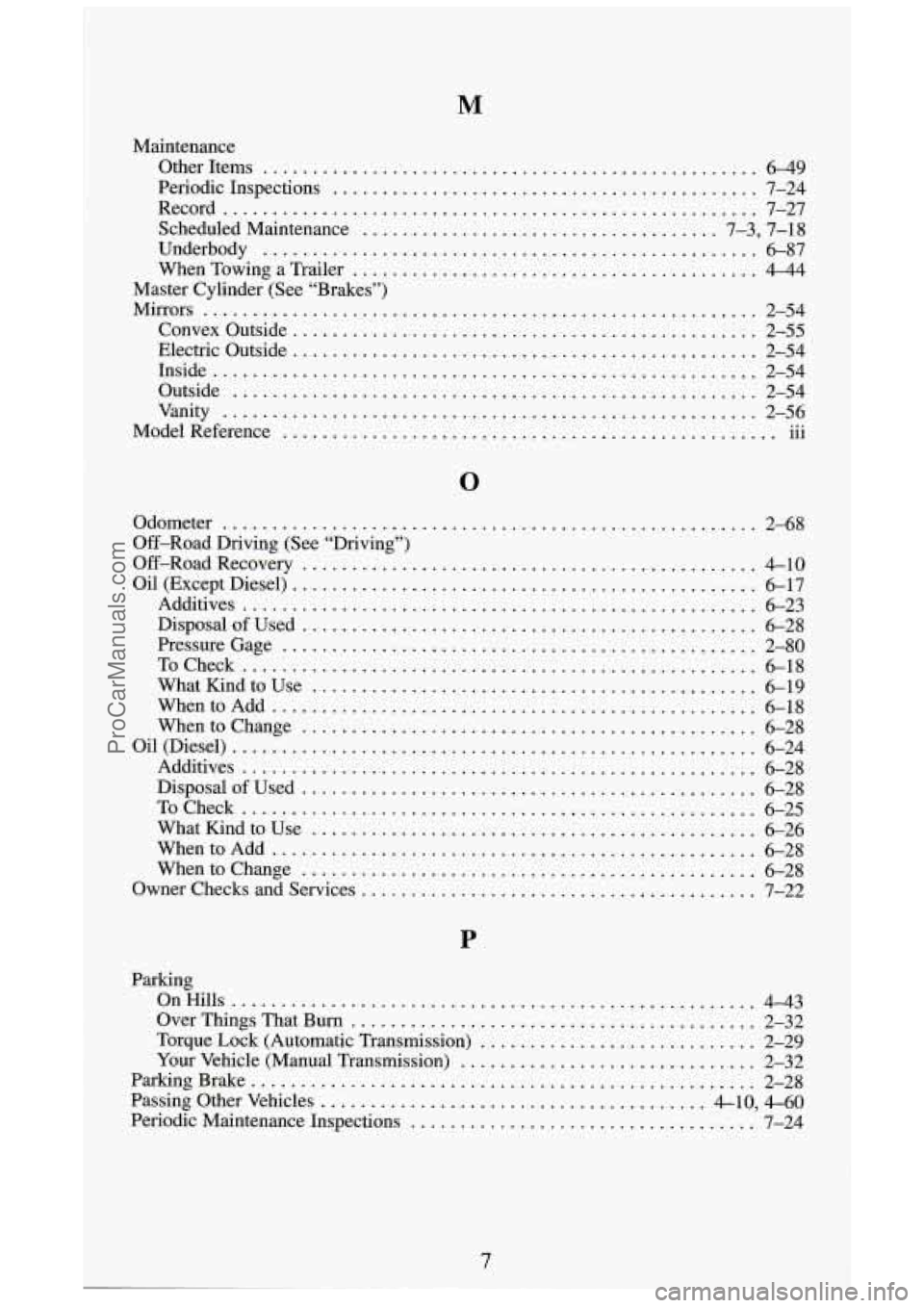
M
Maintenance OtherItems
.................................................. 6-49
Periodic Inspections
........................................... 7-24
Record
...................................................... 7-27
Scheduled Maintenance
.................................... 7.3. 7.18
When Towing
a Trailer ......................................... 4-44
Convexoutside ............................................... 2-55
Electric Outside
............................................... 2-54
Inside
....................................................... 2-54
Outside
..................................................... 2-54
Vanity
...................................................... 2-56
ModelReference
.................................................. 111
Underbody .................................................. 6-87
Master Cylinder (See “Brakes”) Mirrors
........................................................ 2-54
...
0
Odometer ...................................................... 2-68
Off-Road Driving (See “Driving”)
Off-RoadRecovery
.............................................. 4-10
Oil (Except Diesel) ............................................... 6-17
Additives
.................................................... 6-23
DisposalofUsed
.............................................. 6-28
Pressure Gage
................................................ 2-80
To(3lheck
.................................................... 6-18
WhatKindtoUse
............................................. 6-19
WhentoAdd
................................................. 6-18
Whentochange
.............................................. 6-28
Oil(Diese1)
..................................................... 6-24
Additives
.................................................... 6-28
DisposalofUsed
.............................................. 6-28
ToCheck
.................................................... 6-25
WhatKindtoUse
............................................. 6-26
WhentoAdd
................................................. 6-28
Whentochange
.............................................. 6-28
Owner Checks and Services ........................................ 7-22
Parking OnHills
..................................................... 4-43
Over Things That
Burn ......................................... 2-32
Torque Lock (Automatic Transmission)
............................ 2-29
Your Vehicle (Manual Transmission)
.............................. 2-32
Passing Other Vehicles
....................................... 4-10. 4-60
Periodic Maintenance Inspections
................................... 7-24
ParkingBrake
................................................... 2-28
7
ProCarManuals.com