lock GMC SIERRA 1995 Repair Manual
[x] Cancel search | Manufacturer: GMC, Model Year: 1995, Model line: SIERRA, Model: GMC SIERRA 1995Pages: 488, PDF Size: 26.01 MB
Page 191 of 488
A CAUTION:
Driving to the top (crest) of a hill at full speed can cause an
accident. There could be a drop-off, embankment, cliff, or even
another vehicle. You could be seriously injured
or killed. As you
near the top
of a hill, slow down and stay alert.
Q: What should I do if my vehicle stalls, or is about to stall, and I
A: If this happens, there are some things you should do, and there are
some things you must not do. First, here’s what you
shoclld do:
can’t make it up the hill?
0 Push the brake pedal to stop the vehicle and keep it from rolling
backwards. Also, apply the parking brake.
If your engine is still running, shift the transmission into reverse,
release the parking brake, and slowly back down the
hill in reverse.
If your engine has stopped running, you’ll need to restart it. With the
brake pedal depressed and the parking brake still applied, shift the
transmission to PARK (P) (or, shift to NEUTRAL
(N) if your vehicle
has a manual transmission) and restart the engine. Then, shift
to
reverse, release the parking brake, and slowly back down the hill as
straight
as possible in reverse.
0 As you are backing down the hill, put your left hand on the steering
wheel at the
12 o’clock position. This way, you’ll be able to tell if your
wheels are straight and maneuver
as you back down. It’s best that you
back down the hill with your wheels straight rather than in the left or
right direction. Turning the
wheel too far to the left or right will
increase the possibility
of a rollover.
Here are some things you
must mt do if you stall, or are about to stall,
when going
up a hill.
0 Never attempt to prevent a stall by shifting into NEUTRAL (N) (or
depressing the clutch,
if you have a manual transmission) to ”rev-up”
the engine and regain forward momentum. This won’t work. Your
vehicle will roll backwards very quickly and
you could go out of
control.
4-’17
ProCarManuals.com
Page 206 of 488
be
What’s
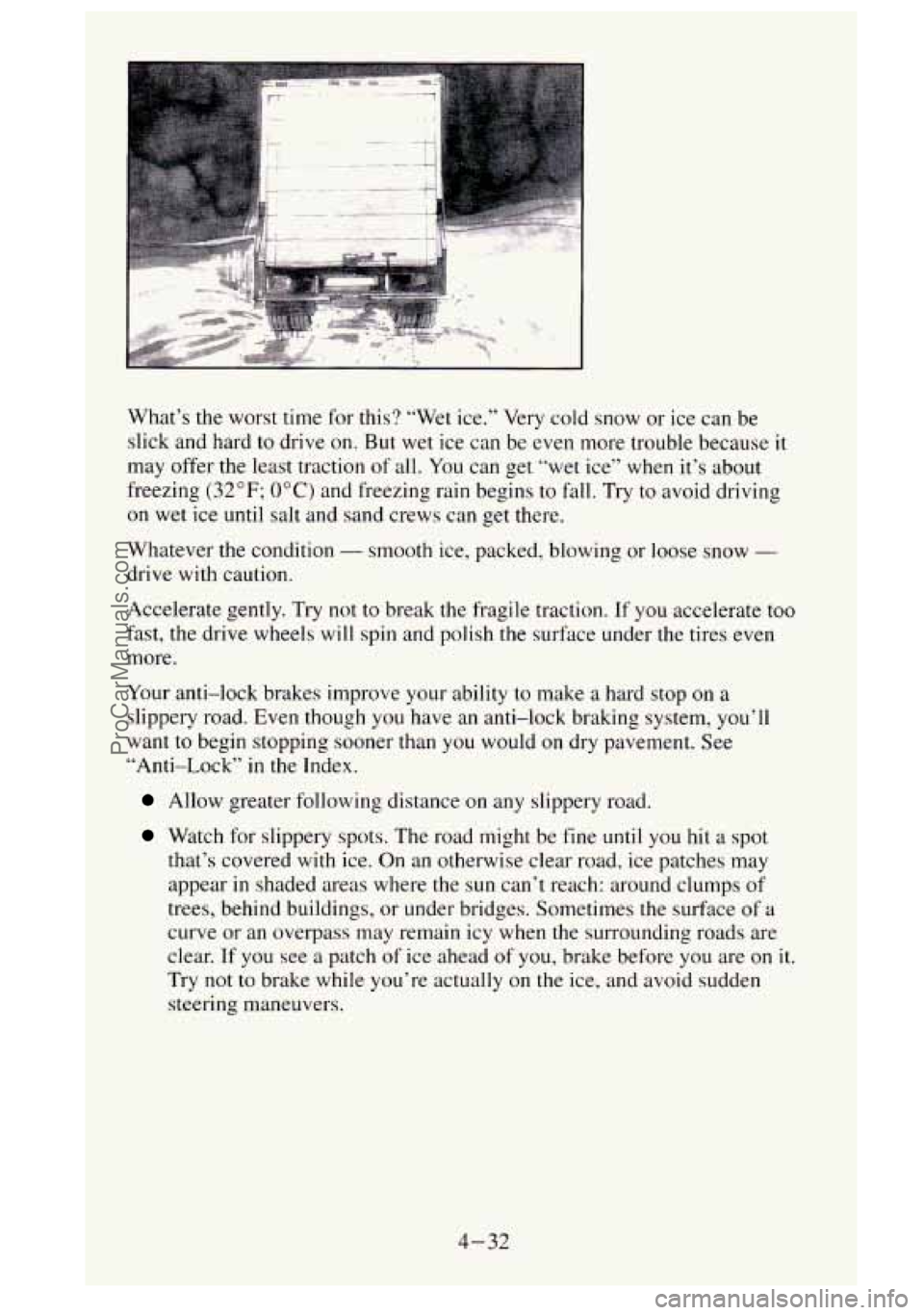
the worst time for this? “Wet ice.” Very cold snow or ice can
slick and hard to drive
on. But wet ice can be even more trouble because it
may offer the least traction of all. You can get “wet ice” when it’s about
freezing
(32°F; OOC) and freezing rain begins to fall. Try to avoid driving
on wet ice until salt and sand crews can get there.
Whatever the condition
- smooth ice, packed, blowing or loose snow -
drive with caution.
Accelerate gently. Try not to break the fragile traction.
If you accelerate too
fast, the drive wheels will spin and polish the surface under the tires even
more.
Your anti-lock brakes improve your ability
to make a hard stop on a
slippery road. Even though you have an anti-lock braking system, you’ll
want to begin stopping sooner than you would on dry pavement. See
“Anti-Lock”
in the Index.
Allow greater following distance on any slippery road.
Watch for slippery spots. The road might be fine until you hit a spot
that’s covered with ice.
On an otherwise clear road, ice patches may
appear in shaded areas where the sun can’t reach: around clumps of
trees, behind buildings, or under bridges. Sometimes the surface
of a
curve or an overpass may remain icy when the surrounding roads are
clear. If
you see a patch of ice ahe.ad of you, brake before you are on it.
Try not to brake while you’re actually on the ice, and avoid sudden
steering maneuvers.
4-32
ProCarManuals.com
Page 207 of 488
If You’re Caught in a Blizzard
k
I ....- -’
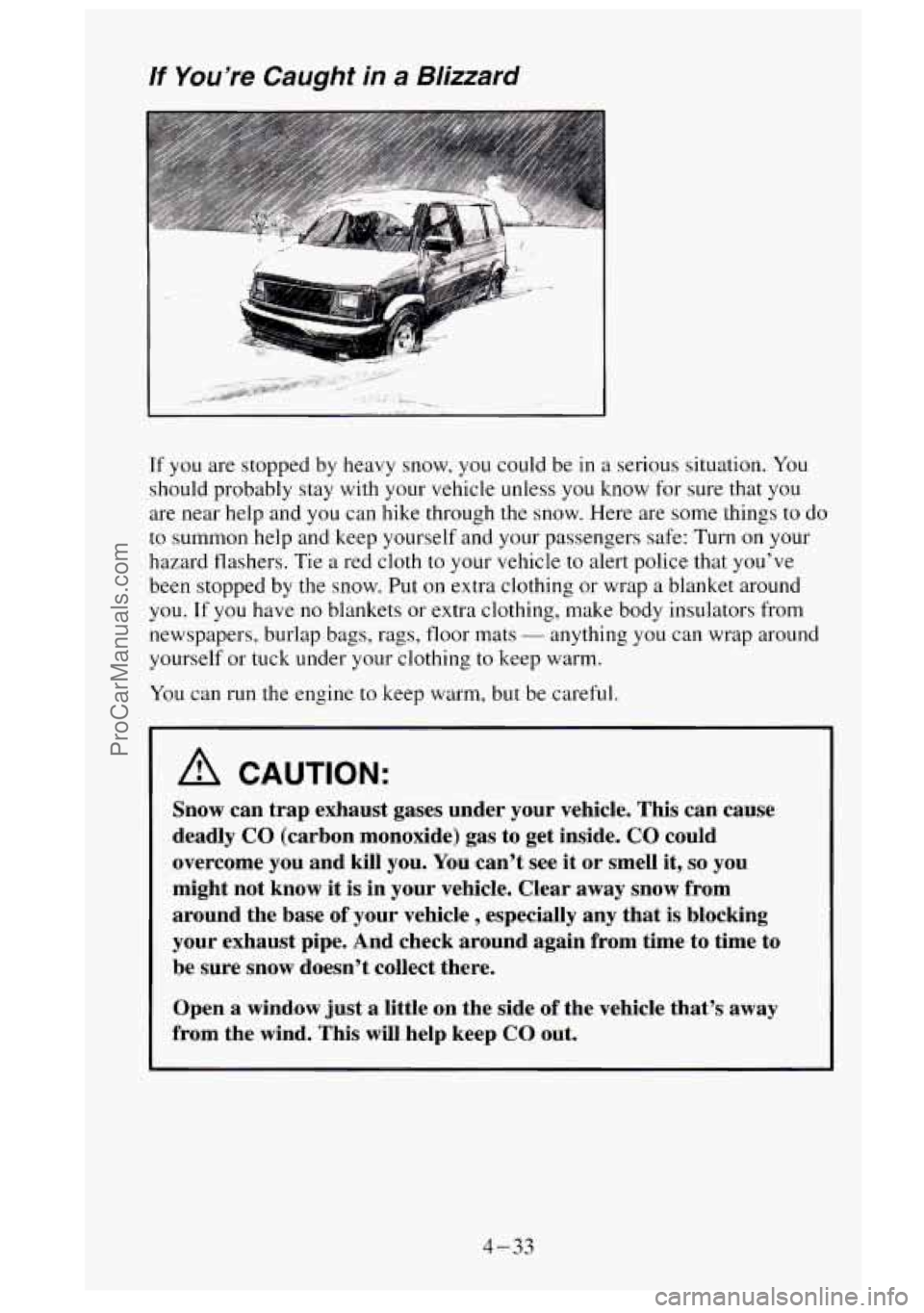
If you are stopped by heavy snow, you could be in a serious situation. You
should probably stay with your vehicle unless you know for sure that you
are near help and
you can hike through the snow. Here are some things to do
to summon help and keep yourself and your passengers safe: Turn on your
hazard flashers. Tie
a red cloth to your vehicle to alert police that you’ve
been stopped by the snow.
Put on extra clothing or wrap a blanket around
you.
If you have no blankets or extra clothing, make body insulators from
newspapers, burlap bags, rags, floor mats
- anything you can wrap around
yourself
or tuck under your clothing to keep warm.
You can run the engine to keep warm, but be careful.
-
A CAUTION:
Snow can trap exhaust gases under your vehicle. This can cause
deadly
CO (carbon monoxide) gas to get inside. CO could
overcome you and kill you.
You can’t see it or smell it, so you
might not know it is in your vehicle. Clear away snow from
around the base of your vehicle
, especially any that is blocking
your exhaust pipe.
And check around again from time to time to
be sure snow doesn’t collect there.
Open a window just
a little on the side of the vehicle that’s away
from the wind. This
will help keep CO out.
4-33
ProCarManuals.com
Page 208 of 488
c
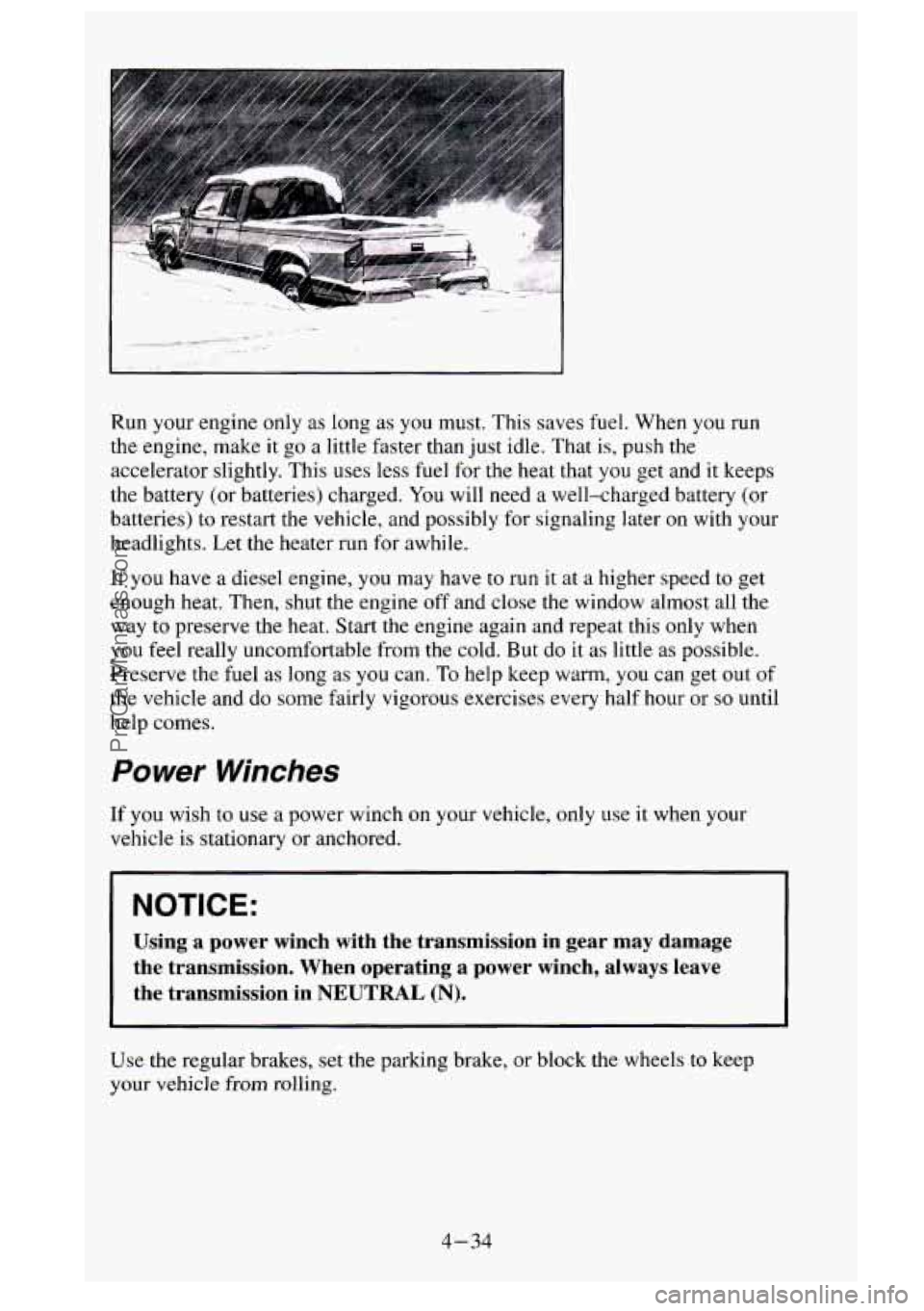
Run your engine only as long as you must. This saves fuel. When you run
the engine, make
it go a little faster than just idle. That is, push the
accelerator slightly. This uses less fuel for the heat that
you get and it keeps
the battery (or batteries) charged. You will need a well-charged battery (or
batteries) to restart the vehicle, and possibly for signaling later on with your
headlights. Let the heater run for awhile.
If you have a diesel engine, you may have to run it at a higher speed to get
enough heat. Then, shut the engine off and close the window almost all the
way
to preserve the heat. Start the engine again and repeat this only when
you feel really uncomfortable from the cold. But do it as little as possible.
Preserve the fuel as long
as you can. To help keep warm, you can get out of
the vehicle and do some fairly vigorous exercises every half hour or so until
help comes.
Power Winches
If you wish to use a power winch on your vehicle, only use it when your
vehicle
is stationary or anchored.
NOTICE:
Using a power winch with the transmission in gear may damage
the transmission. When operating a power winch, always leave
the transmission in NEUTRAL
(N).
Use the regular brakes, set the parking brake, or block the wheels to keep
your vehicle
from rolling.
4-34
ProCarManuals.com
Page 231 of 488
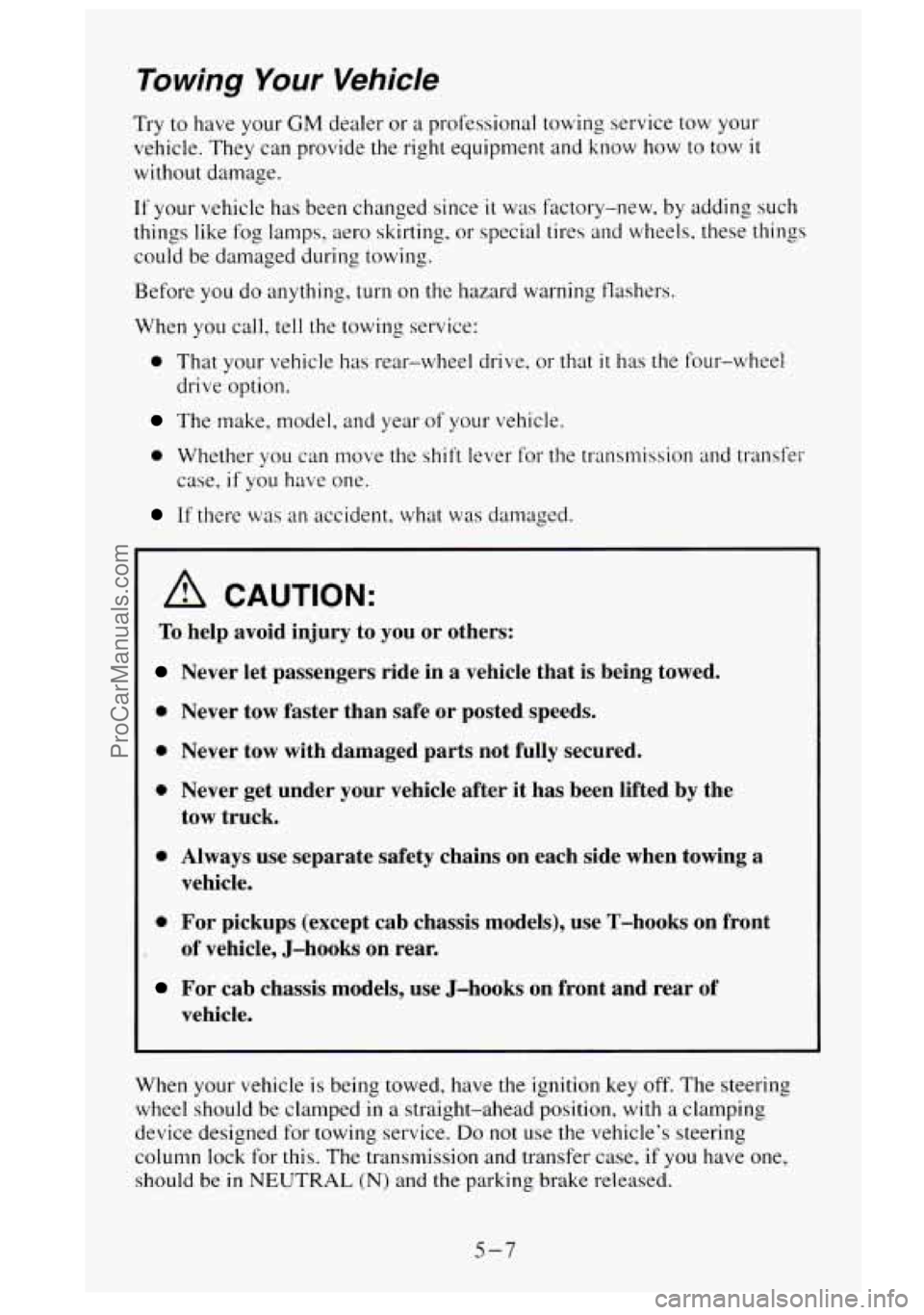
To wing Your Vehicle
Try to have your GM dealer or a professional towing service tow your
vehicle. They can provide the right equipment and know how to tow
it
without damage.
If your vehicle has been changed since
it was factory-new. by adding such
things like fog lamps, aero skirting,
or special tires and wheels, these things
could be damaged during towing.
Before you do anything,
turn on the hazard warning flashers.
When you call, tell the towing service:
0 That your vehicle has rear-wheel drive, or that it has the four-wheel
drive option.
The make, model, and year of your vehicle.
0 Whether you can move the shift lever for the transmission and transfer
case,
if you have one.
If there was an accident. what was damaged.
A CAUTION:
To help avoid injury to you or others:
Never let passengers ride in a vehicle that is being towed.
0 Never tow faster than safe or posted speeds.
0 Never tow with damaged parts not fuIly secured.
0 Never get under your vehicle after it has been lifted by the
tow truck.
0 Always use separate safety chains on each side when towing a
vehicle.
0 For pickups (except cab chassis models), use T-hooks on front
. of vehicle, J-hooks on rear.
For cab chassis models, use J-hooks on front and rear of
vehicle.
When your vehicle is being towed, have the ignition key off. The steering
wheel should be clamped
in a straight-ahead position, with a clamping
device designed for towing, service.
Do not use the vehicle’s steering
column lock for this. The transmission and transfer case, if
you have one,
should be
in NEUTRAL (N) and the parking brake released.
5-7
ProCarManuals.com
Page 250 of 488
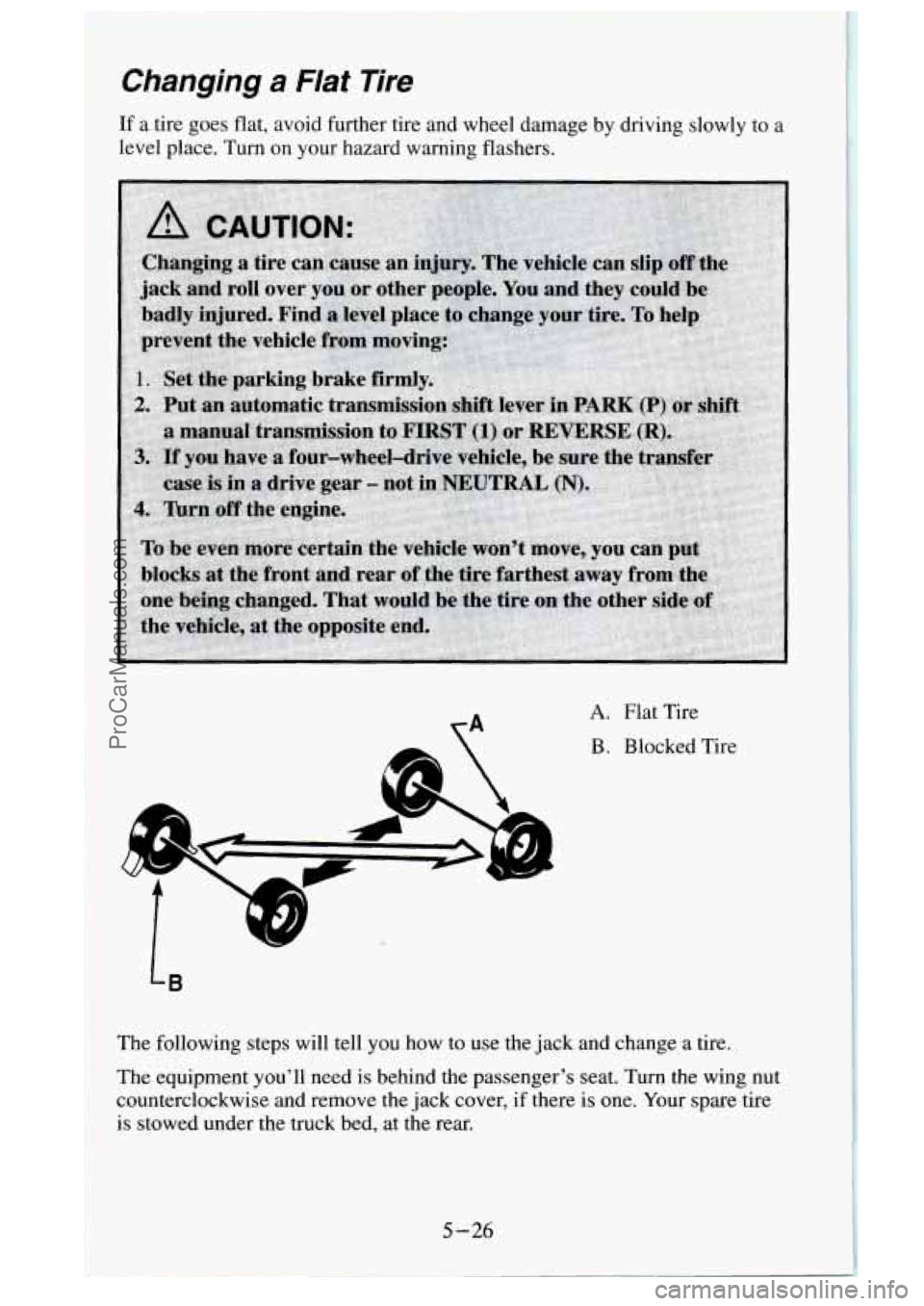
Changing a Flat Tire
If a tire goes flat, avoid further tire and wheel damage by driving slowly to a
level place. Turn on your hazard warning flashers.
A. Flat Tire
B. Blocked Tire
The following steps will tell
you how to use the jack and change a tire.
The equipment you’ll need
is behind the passenger’s seat. Turn the wing nut
counterclockwise and remove the jack cover, if there is one.
Your spare tire
is stowed under the truck bed, at the
rear.
5-26
ProCarManuals.com
Page 255 of 488
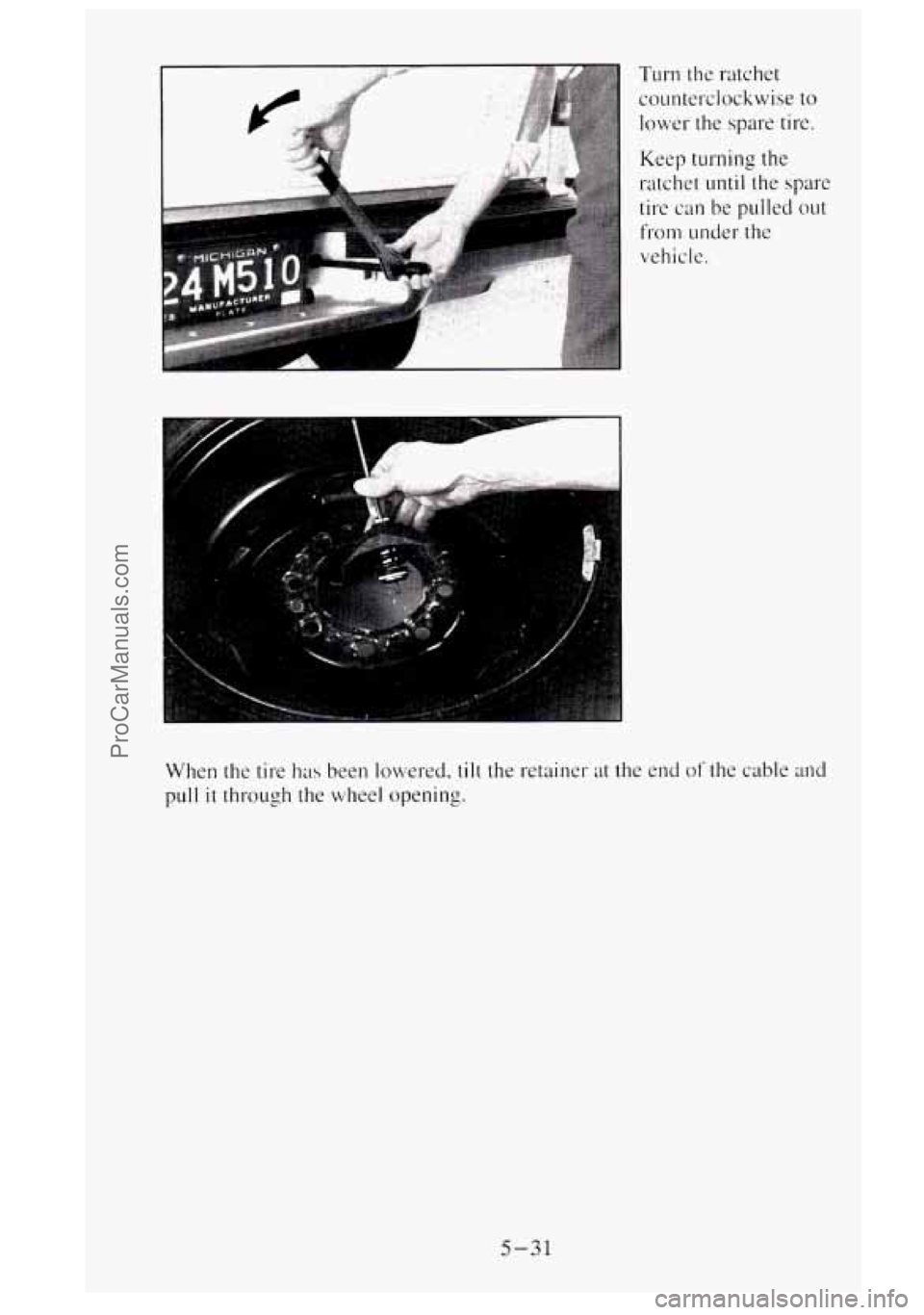
Turn the ratchet
counterclockwise to
lower- the spare tire.
Keep turning the
ratchet
until the spare
tire
can be pulled out
from under the
vehicle.
When the tire
has been lowered. till the retainer at the end of the cable and
pull it through the wheel opening.
5-31
ProCarManuals.com
Page 256 of 488
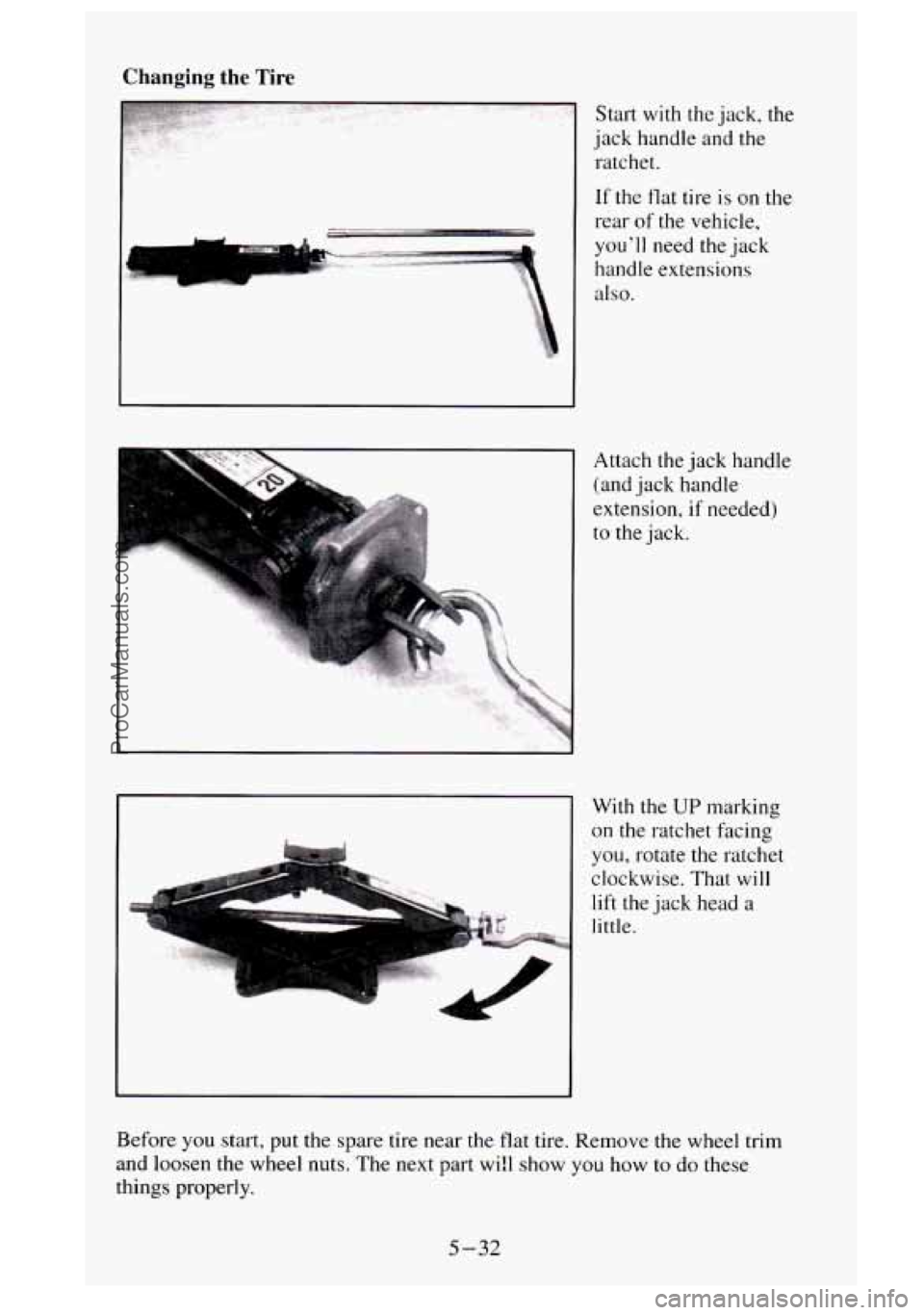
Changing the Tire
.
Start with the jack, the
jack handle and the
ratchet.
If
the flat tire is on the
rear of
the vehicle,
you’ll need the jack
handle extensions
also.
Attach the jack handle
(and jack handle
extension, if needed)
to the jack.
With the
Up marking
on the ratchet facing
you, rotate the ratchet
clockwise. That will
lift the jack head a
little.
Before
you start, put the spare tire near the flat tire. Remove the wheel trim
and loosen
the wheel nuts. The next part wi!l show you how to do these
things properly.
5-32
ProCarManuals.com
Page 257 of 488
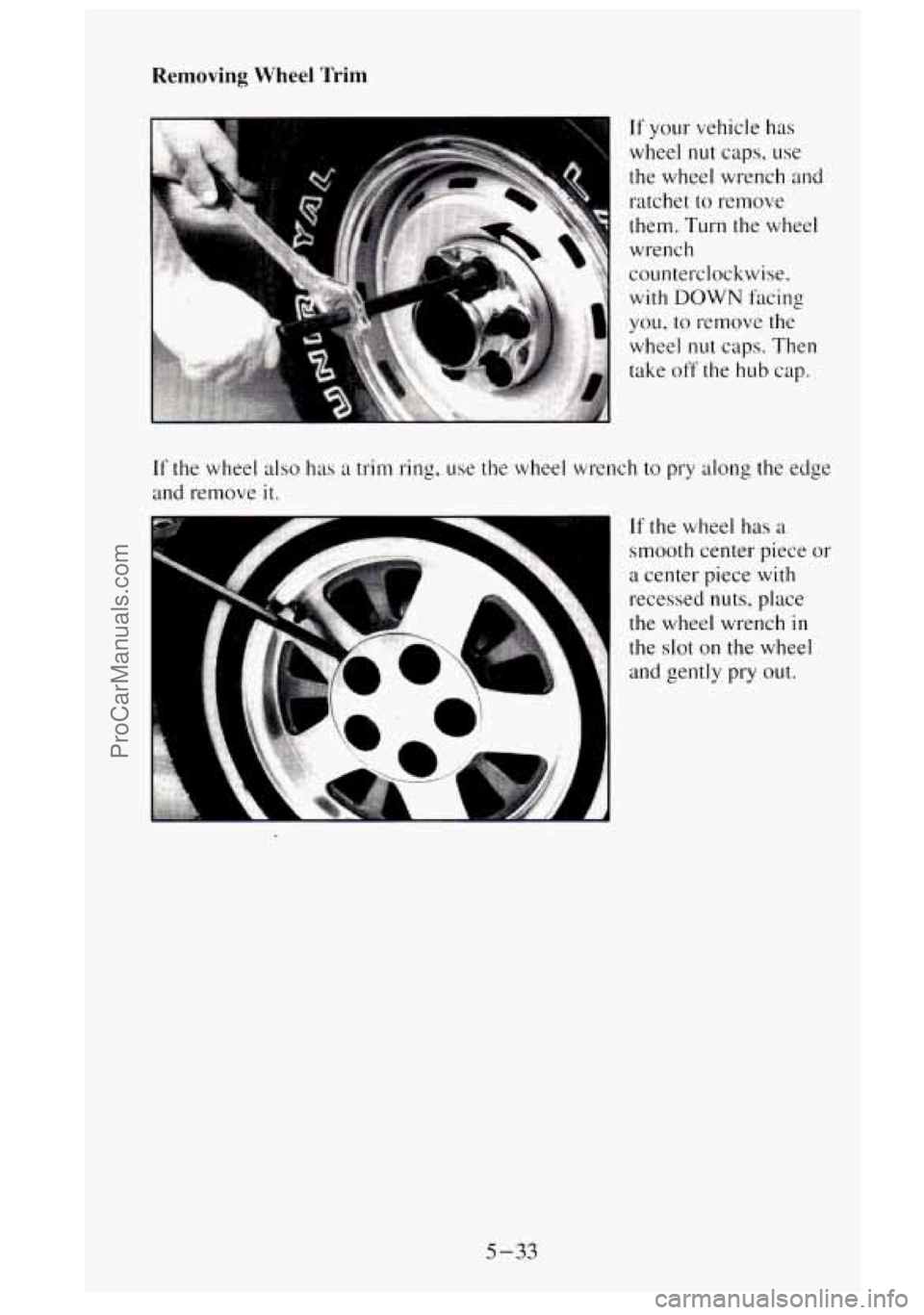
Kemoving Wheel Trim
If your vehicle has
wheel
nut caps, use
the wheel wrench and
ratchet
to remove
them. Turn the wheel
wrench
counterclockwise.
with DOWN facing
you, to remove the
wheel
nut caps. Then
take off the hub cap.
If the wheel also has a trim ring. use the wheel wrench to pry along the edge
and remove
it.
If the wheel has a
smooth center piece or
a center piece with
recessed nuts, place
the wheel wrench
in
the slot on the wheel
and gently
pry out.
5-33
ProCarManuals.com
Page 258 of 488
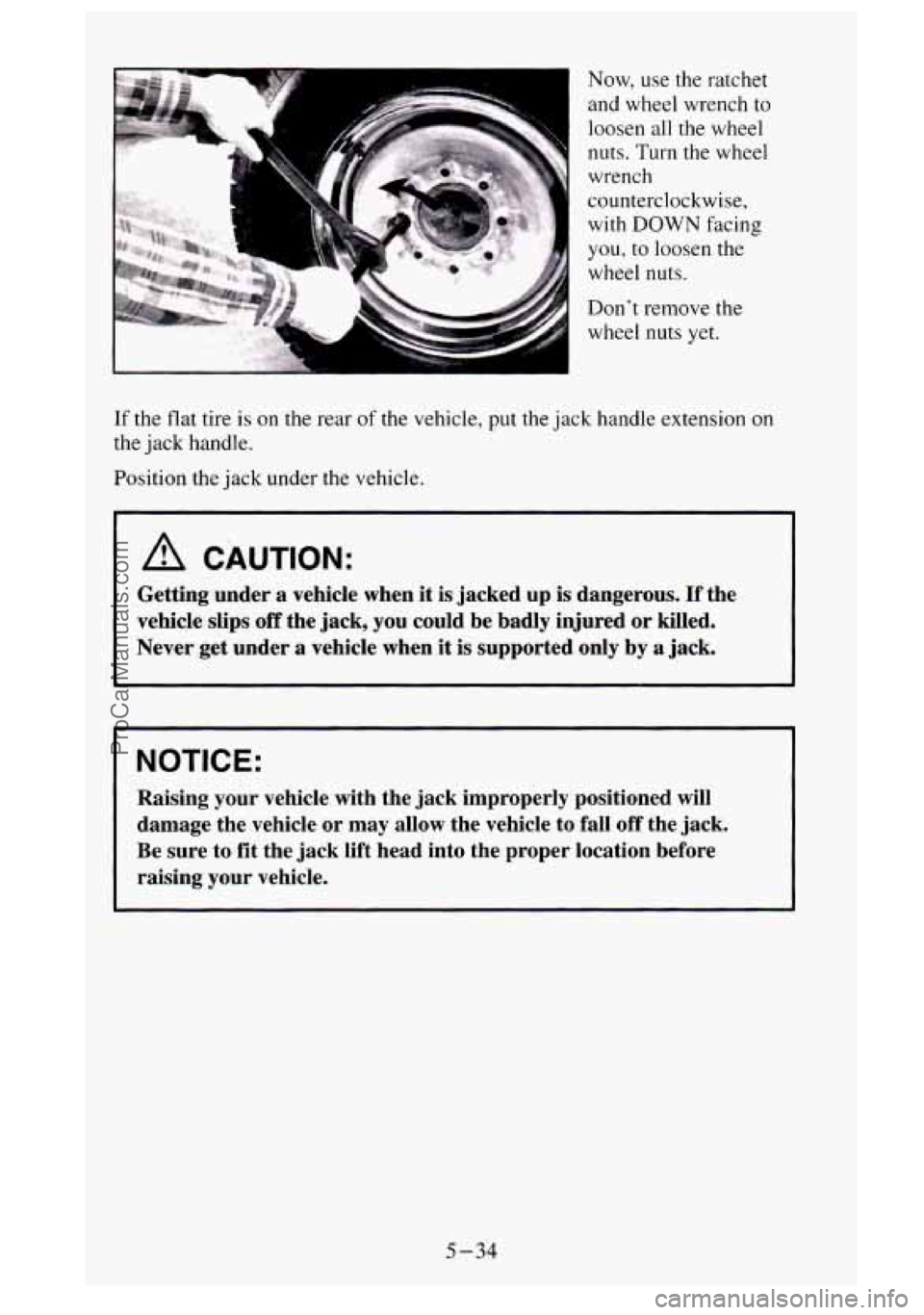
Now, use the ratchet
and wheel wrench to loosen all the wheel
nuts.
Turn the wheel
wrench
counterclockwise,
with DOWN facing
you, to loosen the
wheel nuts.
Don’t remove the
wheel nuts yet.
If the flat tire is on the rear of the vehicle, put the jack handle extension on
the jack handle.
Position the jack under the vehicle.
1 A CAUTION:
Getting under a vehicle when it is jacked up is dangerous. If the
vehicle slips
off the jack, you could be badly injured or killed.
Never get under a vehicle when
it is supported only by a jack.
NOTICE:
Raising your vehicle with the jack improperly positioned will
damage the vehicle or may allow the vehicle to fall
off the jack.
Be sure to
fit the jack lift head into the proper location before
raising your vehicle.
5-34
ProCarManuals.com