lock GMC SIERRA 1995 Manual PDF
[x] Cancel search | Manufacturer: GMC, Model Year: 1995, Model line: SIERRA, Model: GMC SIERRA 1995Pages: 488, PDF Size: 26.01 MB
Page 259 of 488
Front rosluon Rear Position
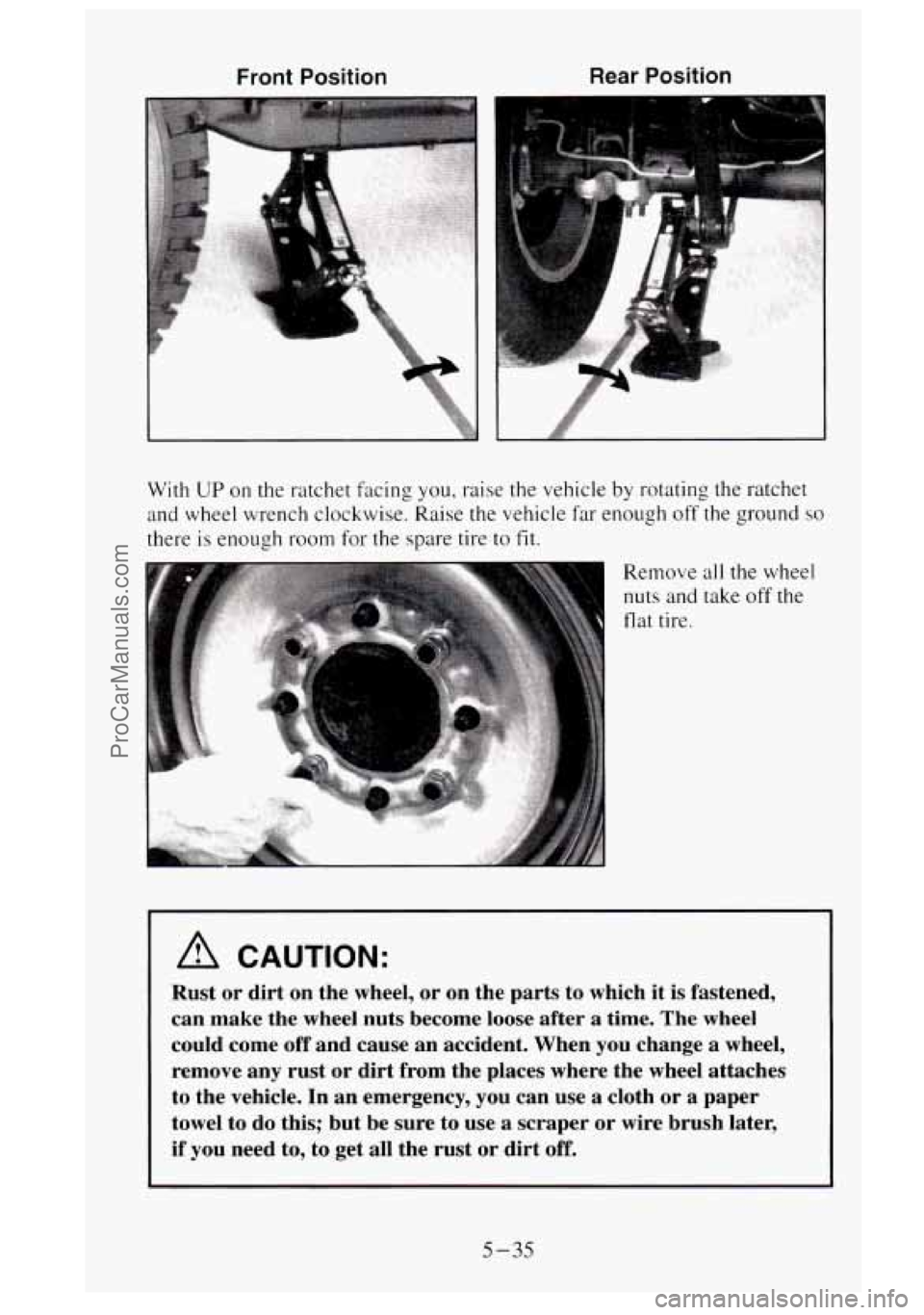
With UP on the ratchet facing you, raise the vehicle by rotating the ratchet
and wheel wrench clockwise. Raise the vehicle
far enough off the ground so
there is enough room for the spare tire to fit.
Remove
all the wheel
nuts and take
off the
flat tire,
A CAUTION:
Rust or dirt on the wheel, or on the parts to which it is fastened,
can make the wheel nuts become loose after a time. The wheel
could come
off and cause an accident. When you change a wheel,
remove any rust or dirt from the places where the wheel attaches
to the vehicle. In an emergency, you can use a cloth or a paper
towel
to do this; but be sure to use a scraper or wire brush later,
if you need to, to get all the rust or dirt off.
5-35
ProCarManuals.com
Page 260 of 488
Remove any rust or dirt from the wheel bolts, mounting surfaces and spare
wheel. Place the spare
on the wheel mounting surface.
A CAUTION:
Never use oil or grease on studs or nuts. If you do, the nuts
might come loose. Your wheel could fall
off, causing a serious
accident.
Replace the wheel
nuts with the rounded
end
of the nuts toward
the wheel.
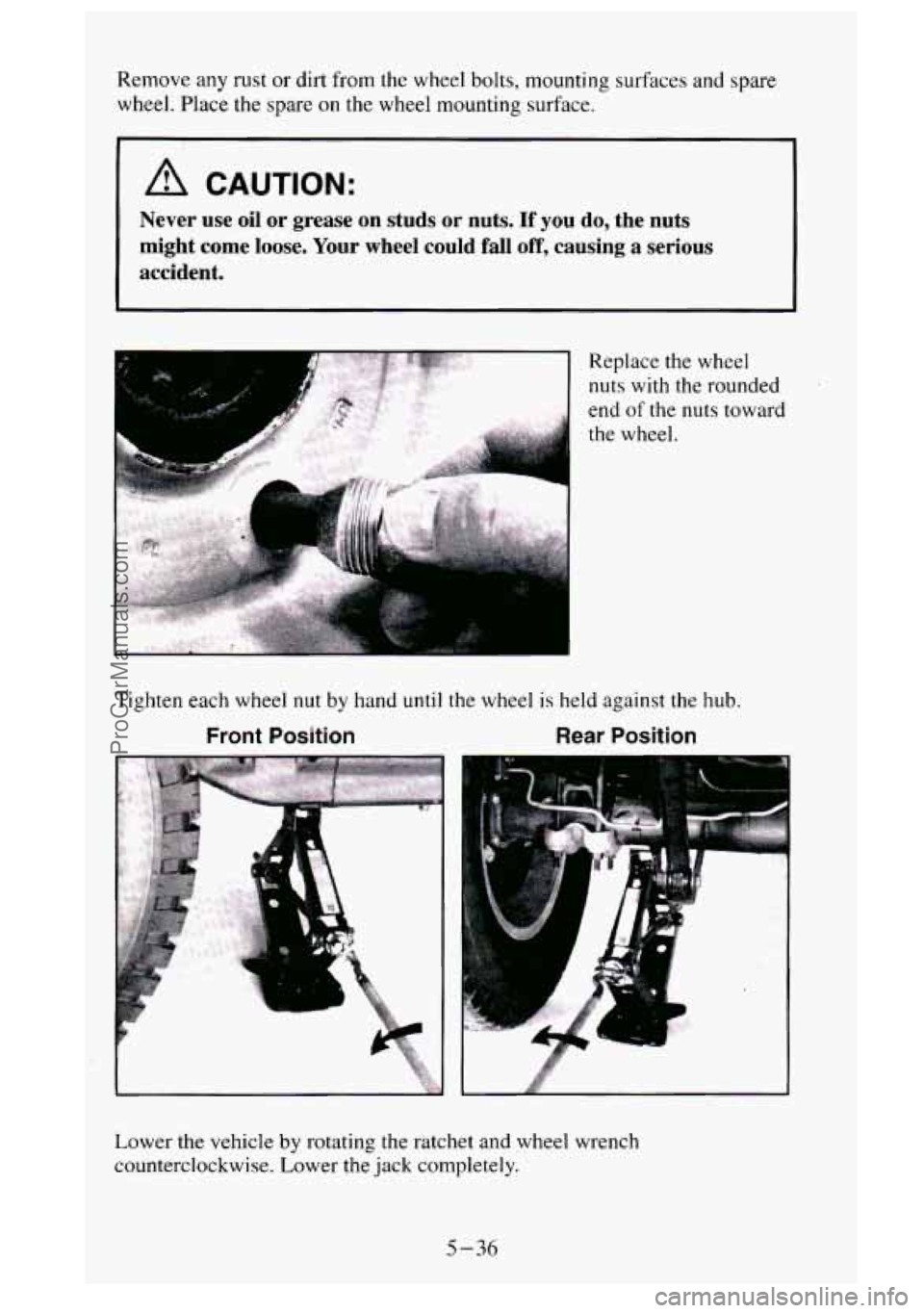
Tighten each wheel
nut by hand until the wheel is held against the hub.
Front Position Rear Position
Lower the vehicle by rotating the ratchet and wheel wrench
counterclockwise. Lower the jack completely.
5-36
ProCarManuals.com
Page 261 of 488
Tighten Clockwise Tightening Sequence
t
40
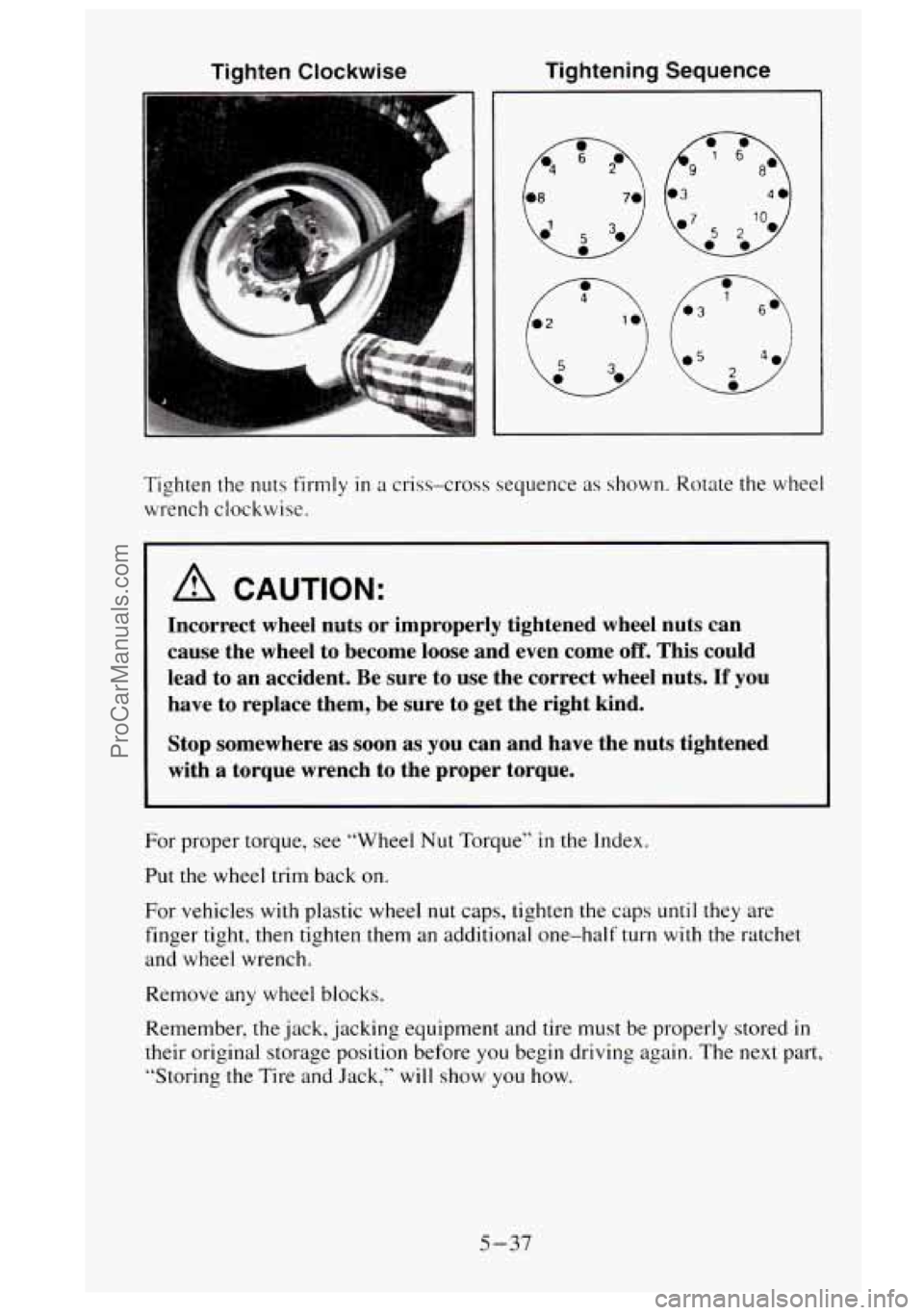
Tighten the
nuts firmly in a criss-cross sequence as shown. Rotate the wheel
wrench clockwise.
A CAUTION:
Incorrect wheel nuts or improperly tightened wheel nuts can
cause the wheel to become loose and even come
off. This could
lead to an accident. Be sure to use the correct wheel nuts.
If you
have to replace them, be sure to get the right kind.
Stop somewhere
as soon as you can and have the nuts tightened
with
a torque wrench to the proper torque.
For proper torque, see “Wheel Nut Torque” in the Index.
Put the wheel trim back on.
For vehicles with plastic wheel
nut caps, tighten the caps until they are
finger tight, then tighten them an additional one-half turn
with the ratchet
and wheel wrench.
Remove any wheel blocks.
Remember, the jack, jacking equipment and tire must be properly stored
in
their original storage position before you begin driving again. The next part,
“Storing the Tire and Jack,”
will show you how.
5-37
ProCarManuals.com
Page 262 of 488
I
A ,CAUTION:
Storing a jack, a tire or other equipment in the passenger
compartment
of the vehicle could cause injury. In a sudden stop
or collision, loose equipment could strike someone. Store all
these
in the proper place.
Stowing the
Tire - Under-Body Carrier
Stow the flat tire under the rwr of the vehicle in spare tire carrier. To stow
the flat tire:
1.
AI 3
3.
4.
5.
Put the tire on the ground at the rear of the vehicle with the valve stern
pointed down.
Pull the wheel retainer through thc wheel opening.
Attach the ratchet
to the urheel n'rench with the UP marking Facing
you.
Put the other end of the whcel wrench through the rcar bumper access
hole, located at the passenger side edge
of the license plate. Be sure the
wheel wrench connects into the hoist
shaft.
Turn the ratchet clockwise to raise the tire. Keep turning the ratchet
until the tire is all the way up. You will hear two "clicks" when the tire
is secure. Pull on the tire to nuke sure it is tightly secured.
Stowing the Jack and Jacking Tools
Return the jack, ratchet, wheel wrench and jack extensions to their location
behind the passenger's
seat. Stow thc jack and jacking tools as shown in the
illustrations earlier
in this part. Secure the items and replace the jack cover,
if there is one.
5-38
ProCarManuals.com
Page 278 of 488
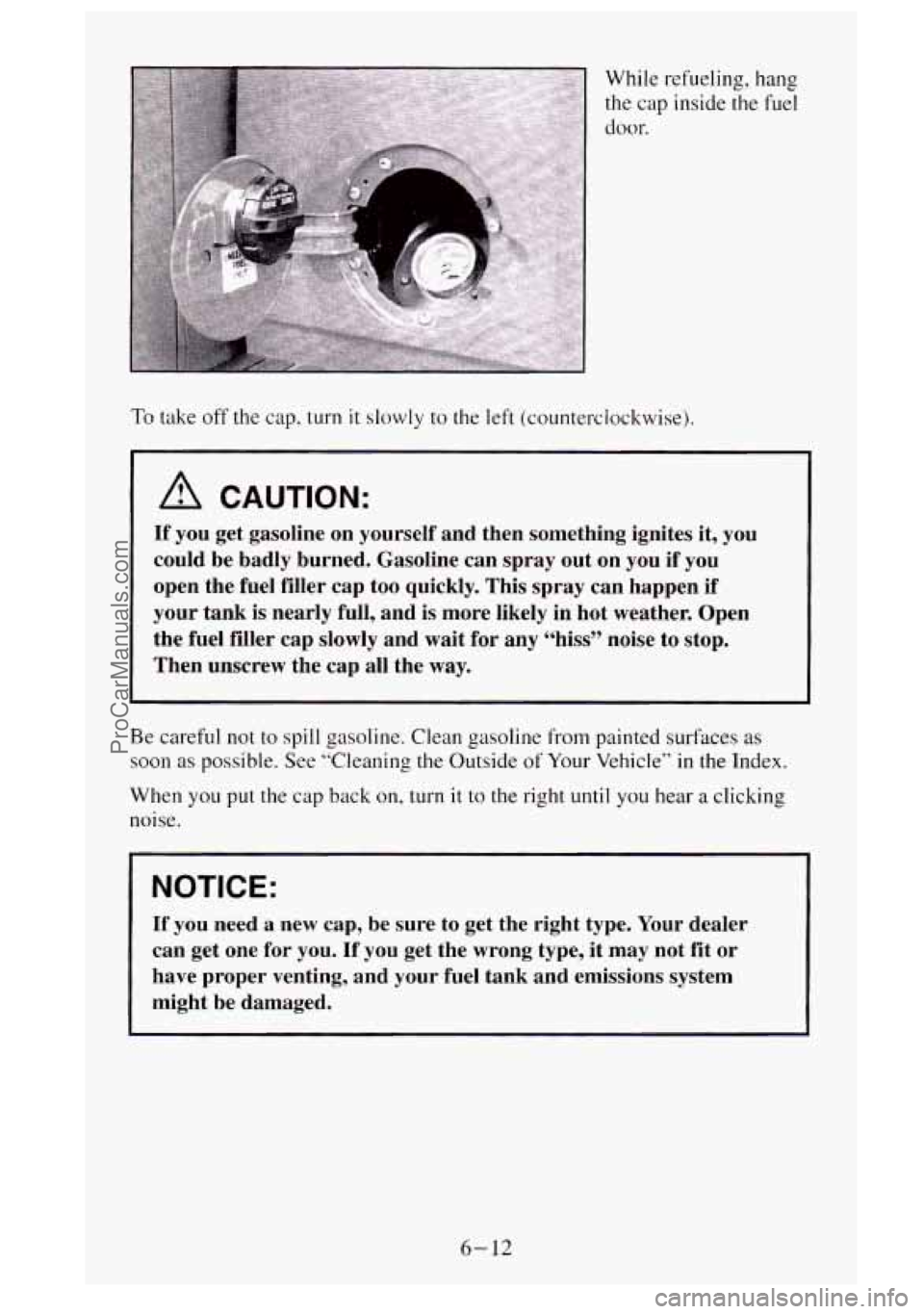
While refueling, hang
the cap inside the fuel
door.
To take off the cap, turn it slowly to the left (counterclockwise).
-~
A CAUTION:
If you get gasoline on yourself and then something ignites it, you
could be badly burned. Gasoline can spray out on you if you
1 open the fuel filler cap too quickly. This spray can happen if
your tank is nearly full, and
is more likely in hot weather. Open
the
fuel filler cap slowly and wait for any “hiss” noise to stop.
Then unscrew the cap all the way.
Be careful not to spill gasoline. Clean gasoline from painted surfaces as
soon as possible. See “Cleaning the Outside of Your Vehicle” in the Index.
When
you put the cap back on, turn it to the right until you hear a clicking
noise.
1 NOTICE:
If you need a new cap, be sure t.0 get the right type. Your dealer
can get one for you.
If you get the wrong type, it may not fit or
have proper venting, and your fuel tank and emissions system
might be damaged.
6- 12
ProCarManuals.com
Page 295 of 488
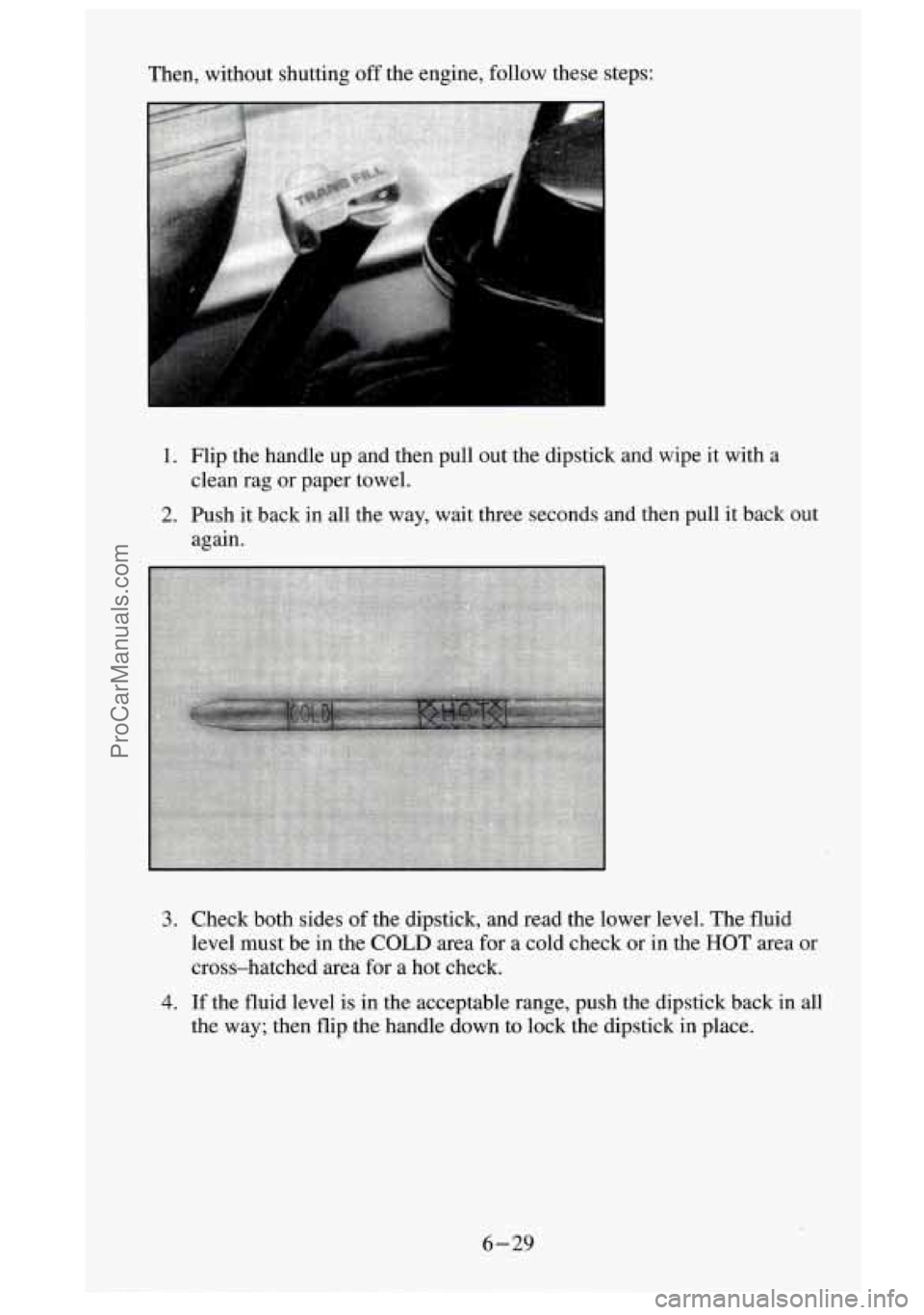
Then, without shutting off the engine, follow these steps:
,
1. Flip the handle up and then pull out the dipstick and wipe it with a
2. Push it back in all the way, wait three seconds and then pull it back out
clean rag
or paper towel.
again.
3. Check both sides of the dipstick, and read the lower level. The fluid
level must be in the
COLD area for a cold check or in the HOT area or
cross-hatched area for a hot check.
4. If the fluid level is in the acceptable range, push the dipstick back in all
the way; then
flip the handle down to lock the dipstick in place.
6-29
ProCarManuals.com
Page 296 of 488
How to Add Fluid
Refer to the Maintenance Schedule to determine what kind of transmission
fluid
to use. See “Recommended Fluids and Lubricants” in the Index.
Add fluid only after checking the transmission fluid
HOT. (A COLD check
is used
only as a reference.) If the fluid level is low, add only enough of the
proper fluid to bring the level up
to the HOT area for a hot check. It doesn’t
take much fluid, generally less than a
int. Don ’t overfill. We recommend
you use only fluid labeled DEXRON
-111, because fluid with that label is
made especially for your automatic transmission. Damage caused by fluid
other than DEXRON@-I11 is not covered by your
new vehicle warranty.
8
0 After adding fluid, recheck the fluid level as described under “How to
Check.”
0 When the correct fluid level is obtained, push the dipstick back in all
the way; then flip the handle down
to lock the dipstick in place.
Manual Transmission Fluid
When to Check
A good time to have it checked is when the engine oil is changed. However,
the fluid
in your manual transmission doesn’t require changing.
How to Check
Because this operation can be a little difficult, you may choose to have this.
done at your
GM dealer Service Department.
If you do it yourself, be sure to follow all the instructions here, or you could
get a false reading.
NOTICE:
Too much or too little fluid can damage your transmission. Too
much can mean that some of the fluid could come out and fall on
hot engine parts or exhaust system parts, starting a fire.
Be sure
to get an accurate reading if you check your transmission fluid.
Check the fluid level only when your engine is off, the vehicle is parked on
a level place and the transmission is cool enough for you to rest your fingers
on the transmission case.
6-30
ProCarManuals.com
Page 312 of 488
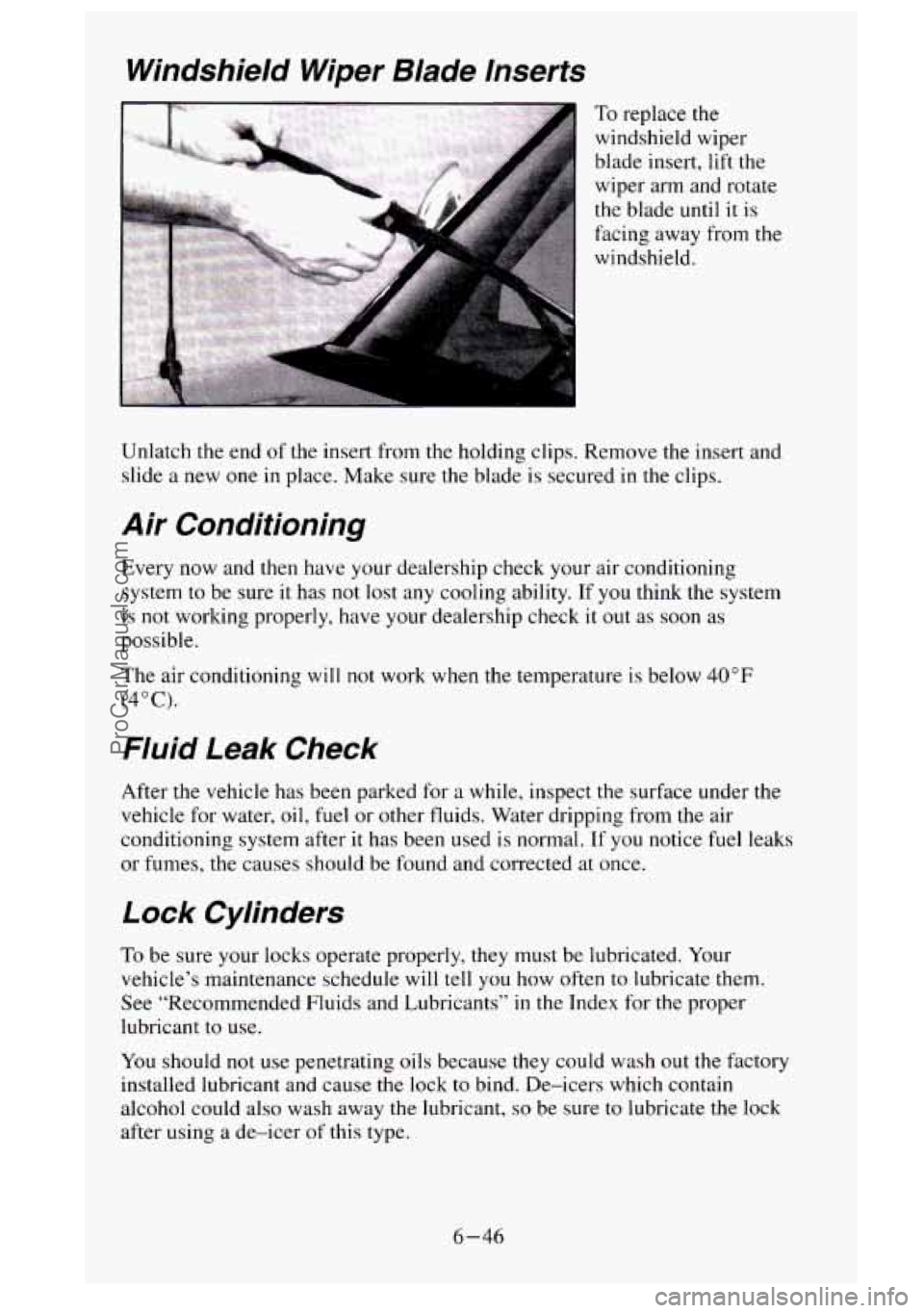
Windshield Wiper Blade Inserts
To replace the
windshield wiper
blade insert, lift
the
wiper arm and rotate
the blade until
it is
facing away from the
windshield.
Unlatch the end
of the insert from the holding clips. Remove the insert and
slide
a new one in place. Make sure the blade is secured in the clips.
Air Conditioning
Every now and then have your dealership check your air conditioning
system to be sure it
has not lost any cooling ability. If you think the system
is not working properly, have your dealership check it out as soon as
possi bleb
The air conditioning will
not work when the temperature is below 40°F
(4°C).
Fluid Leak Check
After the vehicle has been parked for a while, inspect the surface under the
vehicle for water, oil, fuel
or other fluids. Water dripping from the air
conditioning system after it has been used is normal.
If you notice fuel leaks
or fumes, the causes should be found and corrected at once.
Lock Cylinders
To be sure your locks operate properly, they must be lubricated. Your
vehicle’s maintenance schedule will tell you how often to lubricate them.
See “Recommended Fluids and Lubricants” in the Index for
the proper
lubricant to use.
You should
not use penetrating oils because they could wash out the factory
installed lubricant and cause
the lock to bind. De-icers which contain
alcohol could also
wash away the lubricant, so be sure to lubricate the lock
after using
a de-icer of this type.
6-46
ProCarManuals.com
Page 316 of 488
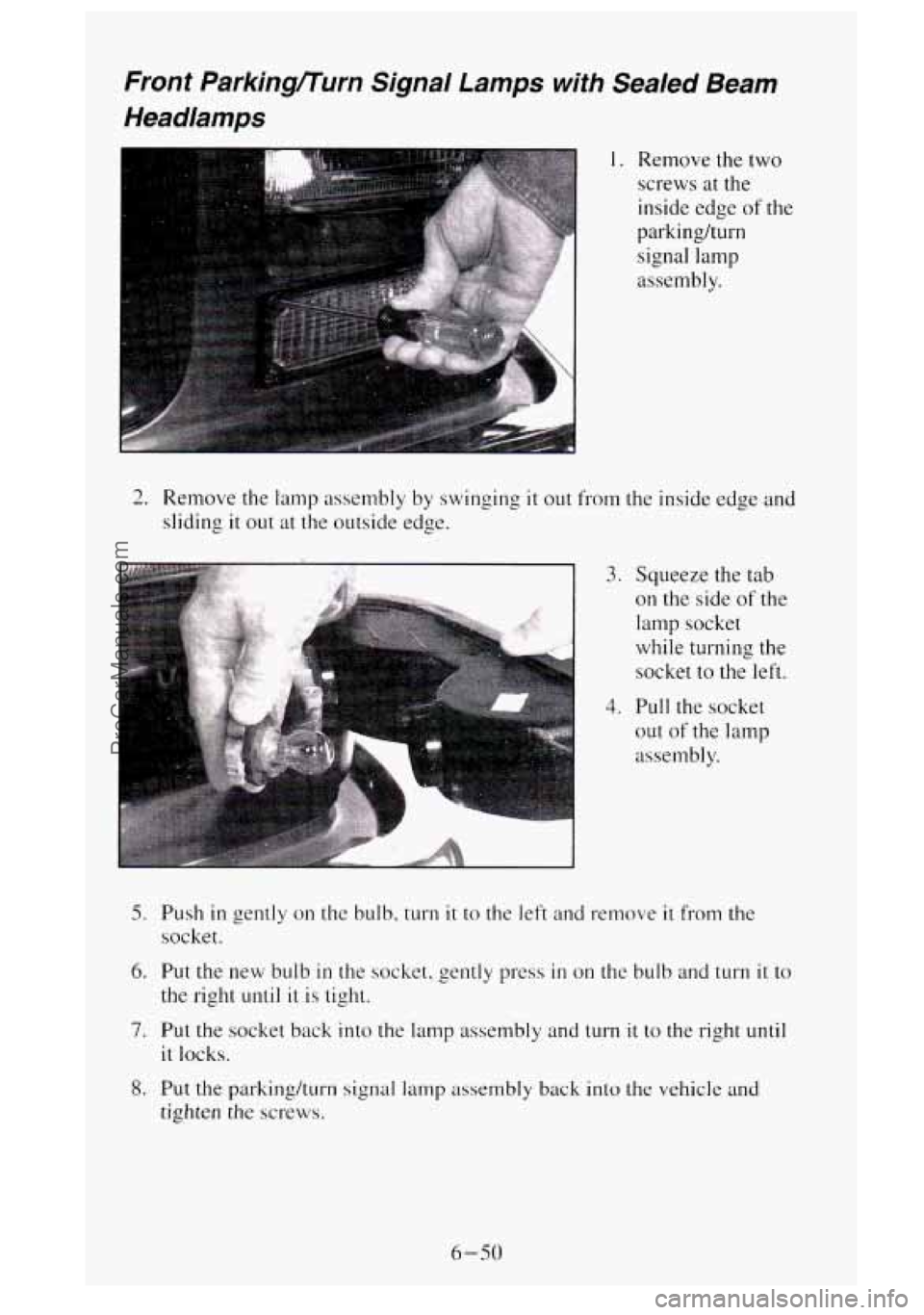
Front Parkingnurn Signal Lamps with Sealed Beam
Headiamps
1. Remove the two
screws at the
inside edge
of the
parkinghrn
signal lamp
assembly.
2. Remove the lamp assembly by swinging it out from the inside edge and
sliding
it out at the outside edge.
3. Squeeze the tab
on the side
of the
lamp socket
while turning the
socket
to the left.
4. Pull the socket
out
of the lamp
assembly.
5. Push in gently on the bulb, turn it to the left and remove it from the
socket.
6. Put the new bulb in the socket, gently press in on the bulb and turn it to
the right until it is tight.
7. Put the socket back into the lamp assembly and turn it to the right until
it locks.
8. Put the parking/turn signal lamp assembly back inlo the vehicle and
tighten the screws.
4-50
ProCarManuals.com
Page 317 of 488
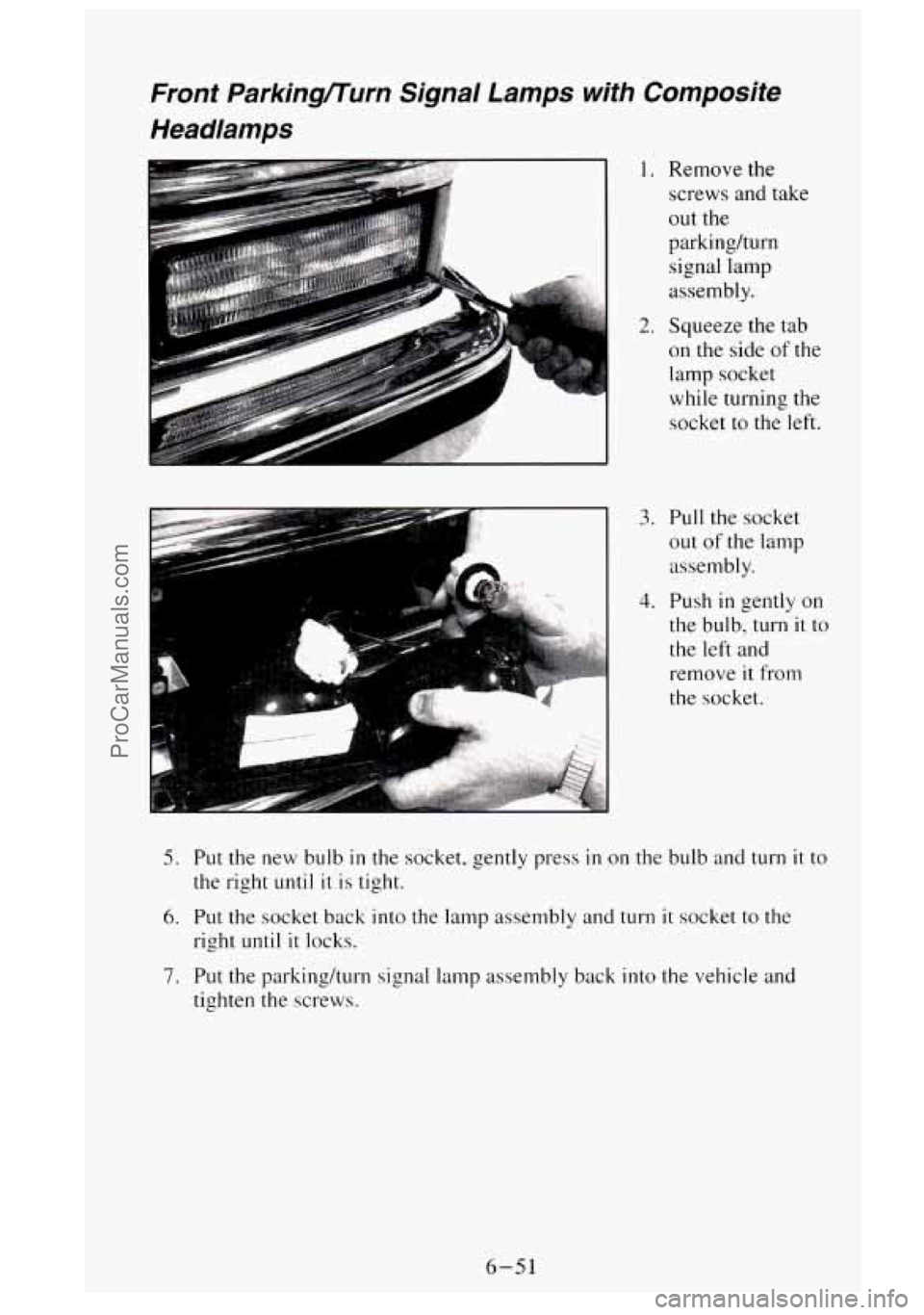
Front Parkingflurn Signal Lamps with Composite
Headlamps
1. Remove the
screws and take
out the
parkinghum
signal lamp
assembly.
2. Squeeze the tab
on the side of the
lamp socket
while turning the
socket to the left.
3. Pull the socket
out: of the lamp
assembly.
4. Push in gently on
the bulb, turn
it to
the left and
remove
it from
the socket.
5. Put the new bulb in the socket, gently press in on the bulb and turn it to
the right until it is tight.
6. Put the socket back into the lamp assembly and turn it socket to the
right
until it locks.
7. Put the parkinghurn signal lamp assembly back into the vehicle and
tighten the screws.
6-51
ProCarManuals.com