light GMC YUKON DENALI 2003 User Guide
[x] Cancel search | Manufacturer: GMC, Model Year: 2003, Model line: YUKON DENALI, Model: GMC YUKON DENALI 2003Pages: 447, PDF Size: 21.97 MB
Page 81 of 447
An,,ne who is up against, or very close to,
any air bag when
it inflates can be seriously
injured or killed. Air bags plus lap-shoulder
belts offer the best protection for adults, but
not for young children and infants. Neither the
vehicle’s safety belt system nor its air bag system is designed for them. Young children
and infants need the protection that a child
restraint system can provide. Always secure
children properly
in your vehicle. To read how,
see the part of this manual called “Older
Children” or
“Infants and Young Children”.
There is a air bag readiness light on the
instrument panel cluster,
which shows the air
bag symbol. The
system checks the air bag electrical system for
malfunctions. The light tells you
if there is an electrical
problem. See
Air Bag Readiness Light on page 3-31
for more information.
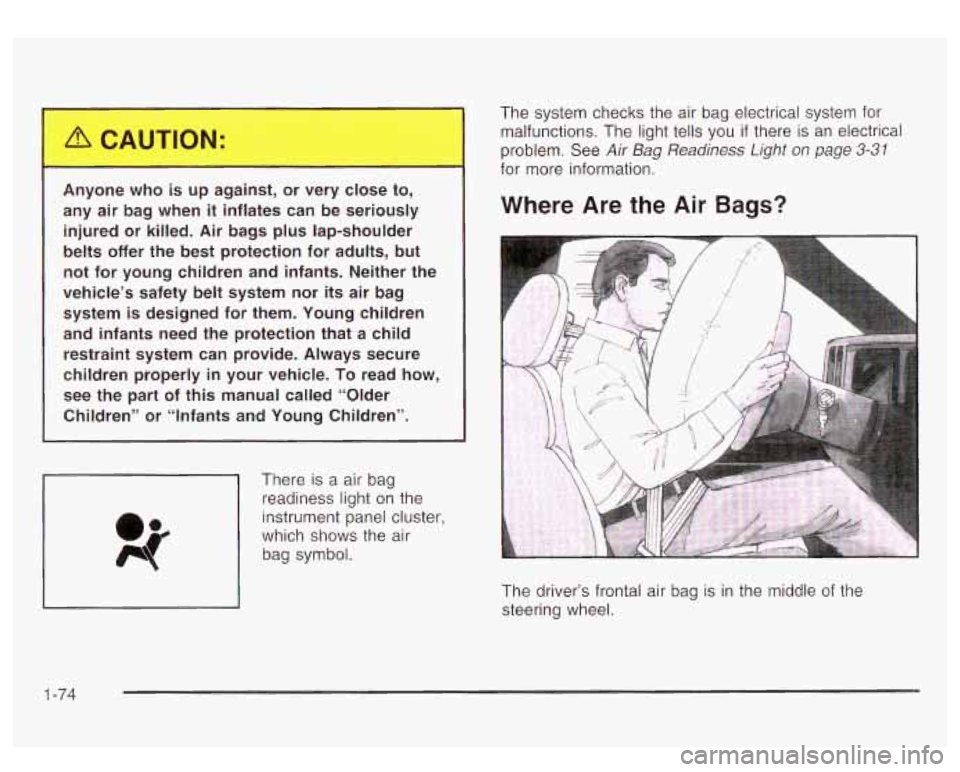
Where Are the Air Bags?
The driver’s frontal air bag is in the middle of the
steering wheel.
1-74
Page 90 of 447
When the passenger sensing system has turned off the
passenger’s frontal air bag, the
off indicator will light
and stay lit to remind you that the air bag is
off.
The passenger sensing system is designed to turn off
the passenger’s frontal air bag when a rear facing infant
seat, a forward-facing child restraint or a booster seat
is detected. If the child restraint has been installed
and the on indicator is lit, turn the vehicle
off, remove
the child restraint from the vehicle and reinstall the
restraint following the child restraint manufacturer’s
directions and refer to Securing
a Child Restraint in the
Right Front Seat Position
on page 7-68 of this manual.
If after reinstalling the child restraint and restarting
the vehicle, the on indicator is still lit, secure the child in
the child restraint in a rear seat position in the vehicle
and check with your dealer.
The passenger sensing system is designed to enable
(may inflate) the right front passenger’s frontal air
bag anytime the system senses that a person of adult
size is sitting properly in the right front passenger’s seat.
When the passenger sensing system has allowed the
air bag to be enabled, the on indicator will light and stay
lit to remind you that the air bag is active. For
some children who have outgrown child restraints
and for very small adults, the passenger sensing system
may or may not turn
off the right front passenger’s
frontal air bag, depending upon the person’s seating
posture and body build. Everyone in your vehicle
who has outgrown child restraints should wear a safety
belt properly
- - whether or not there is an air bag
for that person.
If a person of adult-size is sitting in the right front
passenger’s seat, but the
off indicator is lit, it could be
because that person isn’t sitting properly in the seat. If
this happens, turn the vehicle
off and ask the person to
place the seatback in the full upright position, then sit
upright in the seat, centered on the seat cushion, with the
person’s legs comfortably extended. Restart the vehicle
and have the person remain in this position for about two
minutes. This will allow the system to detect that person
and then enable the passenger’s air bag.
1-83
Page 91 of 447
/r CAUTION:
If the air bag readiness light in the instrument
panel cluster ever comes on and stays on,
it
means that something may be wrong with the
air bag system. If this ever happens, have the
CAUTION: (Continued)
CAUTION:
u icle servicc- prom. y, because an
adult-size person sitting in the right front passenger’s seat may not have the protection
of the frontal air bag. See “Air Bag Readiness
Light”
in the Index for more on this, including
important safety information.
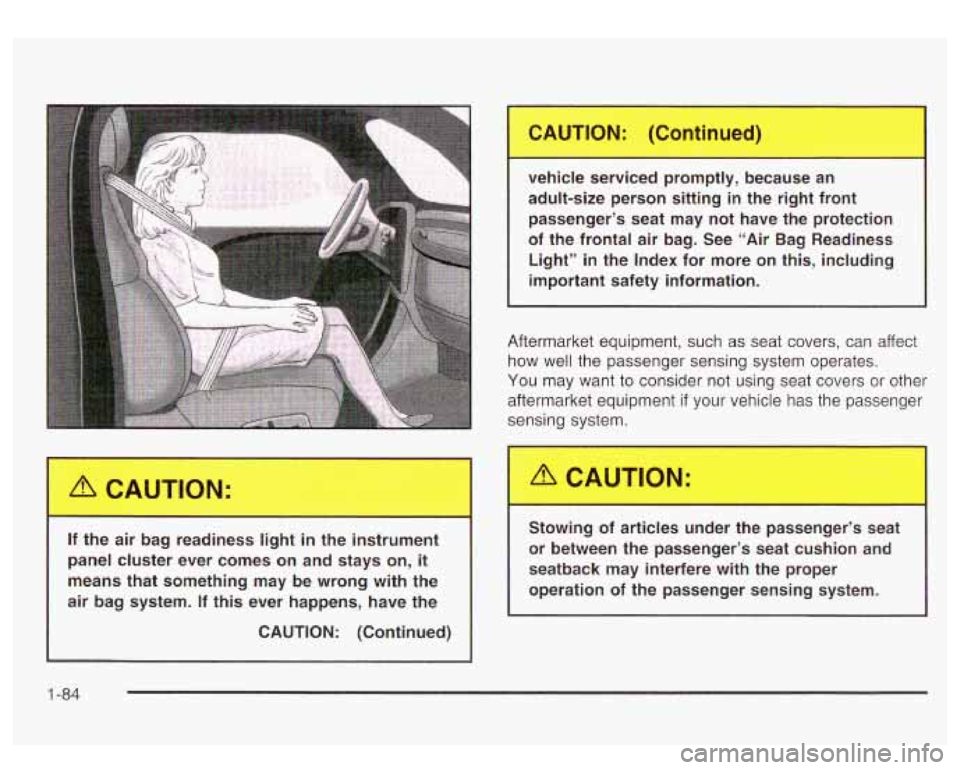
Aftermarket equipment, such as seat covers, can affect
how well the passenger sensing system operates.
You may want to consider not using seat covers or other
aftermarket equipment
if your vehicle has the passenger
sensing system.
Stowing of articles under
th -3assenger’s seat
or between the passenger’s seat cushion and
seatback may interfere with the proper
operation of the passenger sensing system.
1 -84
Page 93 of 447
Restraint System Check
Checking Your Restraint Systems
Now and then, make sure the safety belt reminder light
and all your belts, buckles, latch plates, retractors
and anchorages are working properly. Look for any other
loose or damaged safety belt system parts. If you see
anything that might keep a safety belt system from doing
its job, have it repaired. Torn
or frayed safety belts may not protect you in a
crash. They can rip apart under impact forces. If a belt
is torn or frayed, get a new one right away.
Also look for any opened or broken air bag covers, and
have them repaired or replaced. (The air bag system
does not need regular maintenance.)
1 -86
Page 110 of 447
Power Windows
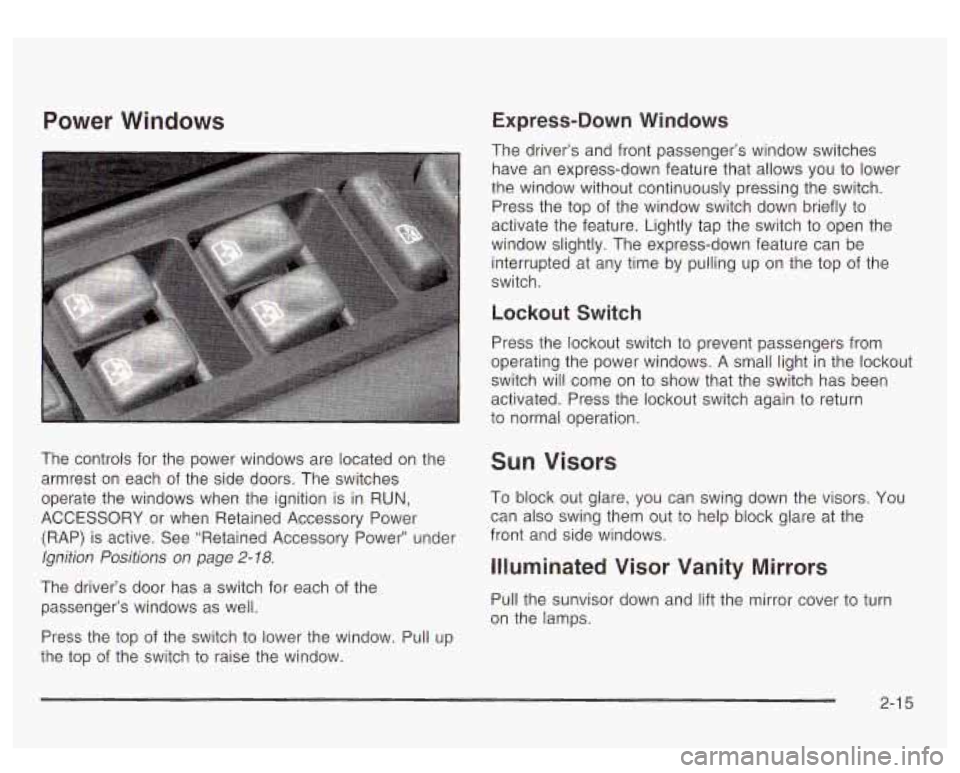
The controls for the power windows are located on the
armrest on each of the side doors. The switches
operate the windows when the ignition is in
RUN,
ACCESSORY or when Retained Accessory Power
(RAP) is active. See “Retained Accessory Power” under
Ignition Positions
on page 2- 18.
The driver’s door has a switch for each of the
passenger’s windows as well.
Press the top of the switch to lower the window. Pull up
the top of the switch to raise the window.
Express-Down Windows
The driver’s and front passenger’s window switches
have an express-down feature that allows you to lower
the window without continuously pressing the switch.
Press the top of the window switch down briefly to
activate the feature. Lightly tap the switch to open the
window slightly. The express-down feature can be
interrupted at any time by pulling up on the top of the
switch.
Lockout Switch
Press the lockout switch to prevent passengers from
operating the power windows. A small light in the lockout
switch will come on to show that the switch has been
activated. Press the lockout switch again to return
to normal operation.
Sun Visors
To block out glare, you can swing down the visors. You
can also swing them out to help block glare at the
front and side windows.
Illuminated Visor Vanity Mirrors
Pull the sunvisor down and lift the mirror cover to turn
on the lamps.
2-1 5
Page 111 of 447
Theft-Deterrent Systems
Vehicle theft is big business, especially in some cities.
Although your vehicle has a number of theft-deterrent
features, we know that nothing we put on it can make it
impossible
to steal.
Content Theft-Deterrent
Your vehicle is equipped with a content theft-deterrent
alarm system.
With this system, the
security light in the instrument panel cluster
will flash as you open
the door
if your ignition
is
off.
This light reminds you to activate the theft-deterrent
system. Here’s how
to do it:
1. Open the door.
2. Lock the door with the power door lock switch or
the remote keyless entry transmitter. The security
light should come
on and stay on.
3. Close all doors. The security light should go off
after about 30 seconds. The alarm is not armed
until the security light goes
off.
If a locked door is opened without the key or the remote
keyless entry transmitter, the alarm will
go off. The
headlamps and parking lamps will flash for
two minutes,
and the horn will sound for
30 seconds, then will turn
off to save the battery power. You can choose different
feedback options for the alarm. See Driver lnformation
Center
(DIC) on page 3-43.
Remember, the theft-deterrent system won’t activate if
you lock the doors with a key or use the manual
door lock.
It activates only if you use a power door lock
switch with the door open, or with the remote keyless
entry transmitter. You should also remember that
you can start your vehicle with the correct ignition key
if
the alarm has been set off.
Here’s how to avoid setting off the alarm by accident:
If you don’t want to activate the theft-deterrent
system, the vehicle should be locked with the door
key after the doors are closed.
Always unlock a door with a key, or use the remote
keyless entry transmitter. Unlocking a door any
other way will set
off the alarm.
If you set
off the alarm by accident, unlock any door with
the key. You can also turn
off the alarm by pressing
unlock on the remote keyless entry transmitter. The alarm
won’t stop
if you try to unlock a door any other way.
2-1 6
Page 112 of 447
Testing the Alarm Passlock@’
The alarm can be tested by following these steps:
1. From inside the vehicle, lower the driver’s window
and open the driver’s door.
2. Activate the system by locking the doors with the
power door lock switch while the door is open, or
with the remote keyless entry transmitter.
3. Get out of the vehicle, close the door and wait for
the security light
to go out.
4. Then reach in through the window, unlock the door
with the manual door lock and open the door. This
should set
off the alarm.
While the alarm is set, the power door unlock switch is
not operational.
If the alarm does not sound when it should but the
headlamps flash, check
to see if the horn works. The
horn fuse may be blown. To replace the fuse, see Fuses
and Circuit Breakers on page
5-87.
If the alarm does not sound or the headlamps do not
flash, the vehicle should be serviced by your dealer. Your
vehicle is equipped with the Passlock@
theft-deterrent system.
Passlock@ is a passive theft-deterrent system. Passlock@
enables fuel
if the ignition lock cylinder is turned with
a valid key. If a correct key is not used or the ignition
lock cylinder is tampered with, the fuel system is
disabled and the vehicle will not start.
During normal operation, the security light will turn
off
approximately five seconds after the key is turned
to RUN.
If the engine stalls and the security light flashes, wait
about
10 minutes until the light stops flashing before
trying
to restart the engine. Remember to release
the key from START as soon as the engine starts.
If the engine does not start after three tries, the vehicle
needs service.
If the engine is running and the security light comes on,
you will be able to restart the engine
if you turn the engine
off. However, your Passlock@system is not working
properly and must be serviced by your dealer. Your
vehicle is not protected by Passlock@at this time. You
may also want
to check the fuse. See Fuses and Circuit
Breakers
on page 5-87. See your dealer for service.
In an emergency, call the Roadside Assistance Center.
See Roadside Assistance Program
on page 7-5.
3-1 7
Page 120 of 447
Parking Brake
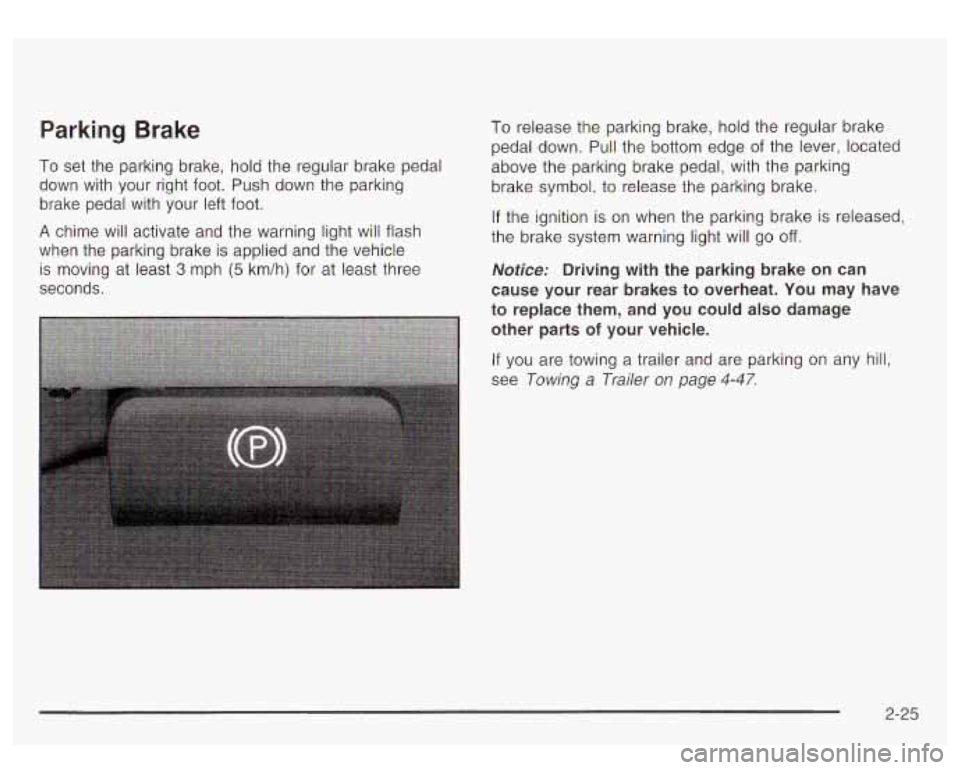
To set the parking brake, hold the regular brake pedal
down with your right foot. Push down the parking
brake pedal with your left foot.
A chime will activate and the warning light will flash
when the parking brake is applied and the vehicle
is moving at
least 3 mph (5 km/h) for at least three
seconds.
To release the parking brake, hold the regular brake
pedal down.
Pull the bottom edge of the lever, located
above the parking brake pedal, with the parking
brake symbol,
to release the parking brake.
If the ignition is on when the parking brake is releasea,
the brake system warning light will go
off.
Notice: Driving with the parking brake on can
cause your rear brakes to overheat. You may have
to replace them, and you could also damage
other parts
of your vehicle.
If you are towing a trailer and are parking on any hill,
see Towing a Trailer on page
4-47.
2-25
Page 126 of 447
Mirrors
Automatic Dimming Rearview Mirror
with Onstar@, Compass
and
Temperature Display
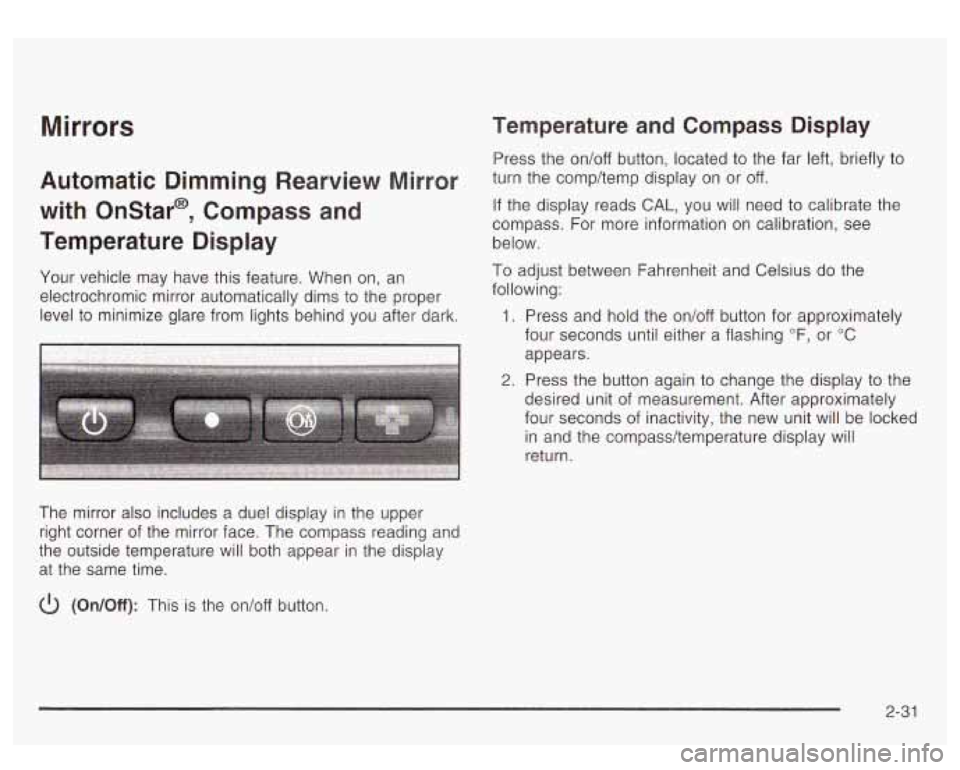
Your vehicle may have this feature. When on, an
electrochromic mirror automatically dims to the proper
level to minimize glare from lights behind you after dark.
The mirror also includes a duel display in the upper
right corner of the mirror face. The compass reading and
the outside temperature will both appear in the display
at the same time.
Temperature and Compass Display
Press the on/off button, located to the far left, briefly to
turn the comp/temp display on or
off.
If the display reads CAL, you will need to calibrate the
compass. For more information on calibration, see
below.
To adjust between Fahrenheit and Celsius do the
following:
1.
2. Press and hold the
on/off button for approximately
four seconds until either a flashing OF, or "C
appears.
Press the button again to change the display to the
desired unit
of measurement. After approximately
four seconds of inactivity, the new unit will be locked
in and the compass/temperature display will
return.
6 (On/Off): This is the on/off button.
2-31
Page 127 of 447
Electrochromic Mirror Operation
The electrochromic (self dimming) mirror function is
turned on automatically each time the ignition is started.
To operate the electrochromic mirror do the following:
1.
2.
Make sure the green indicator light, located to
the left of the on/off button, is lit. If it’s not, press
and hold the on/off button for approximately
six seconds until the green light comes on,
indicating that the mirror is in electrochromic
(self dimming) mode.
Turn off the electrochromic mirror function by
pressing and holding the on/off button for
approximately six seconds until the green indicator
light turns off.
Compass Variance
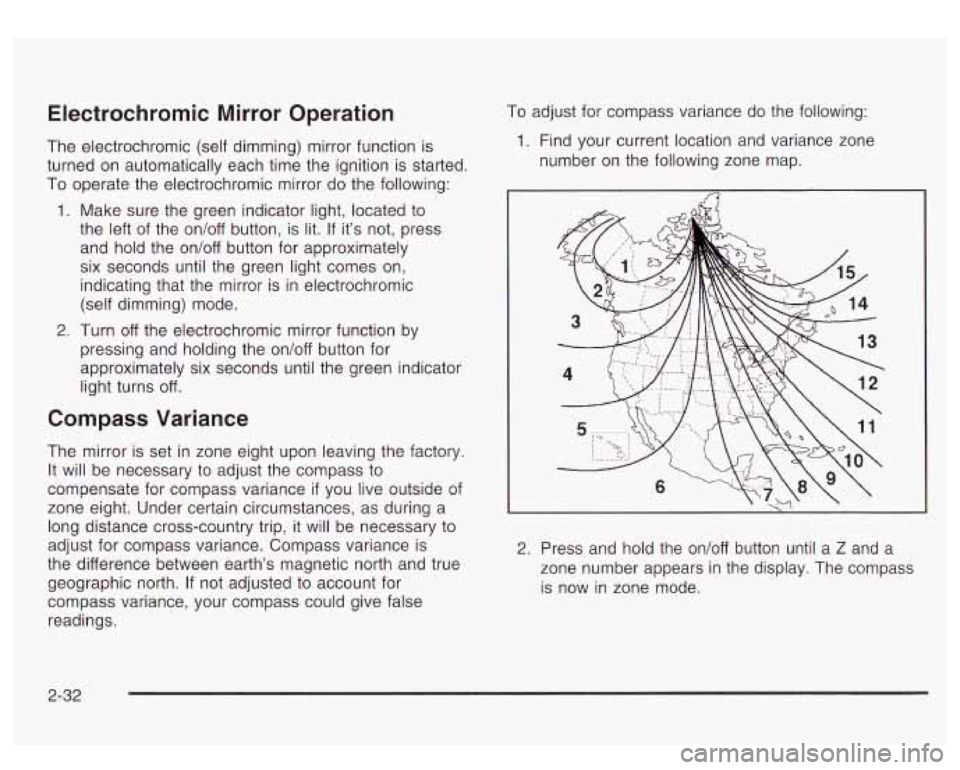
The mirror is set in zone eight upon leaving the factory.
It will be necessary to adjust the compass to
compensate for compass variance if you live outside of
zone eight. Under certain circumstances, as during a
long distance cross-country trip, it will be necessary
to
adjust for compass variance. Compass variance is
the difference between earth’s magnetic north and true
geographic north. If not adjusted to account for
compass variance, your compass could give false
readings.
l-0 adjust for compass variance do the following:
1. Find your current location and variance zone
number on the following zone map.
2. Press and hold the on/off button until a Z and a
zone number appears in the display. The compass
is now in zone mode.
2-32