torque GREAT WALL FLORID 2008 Workshop Manual
[x] Cancel search | Manufacturer: GREAT WALL, Model Year: 2008, Model line: FLORID, Model: GREAT WALL FLORID 2008Pages: 281, PDF Size: 43.97 MB
Page 142 of 281
Downloaded from www.Manualslib.com manuals search engine 135Steering System
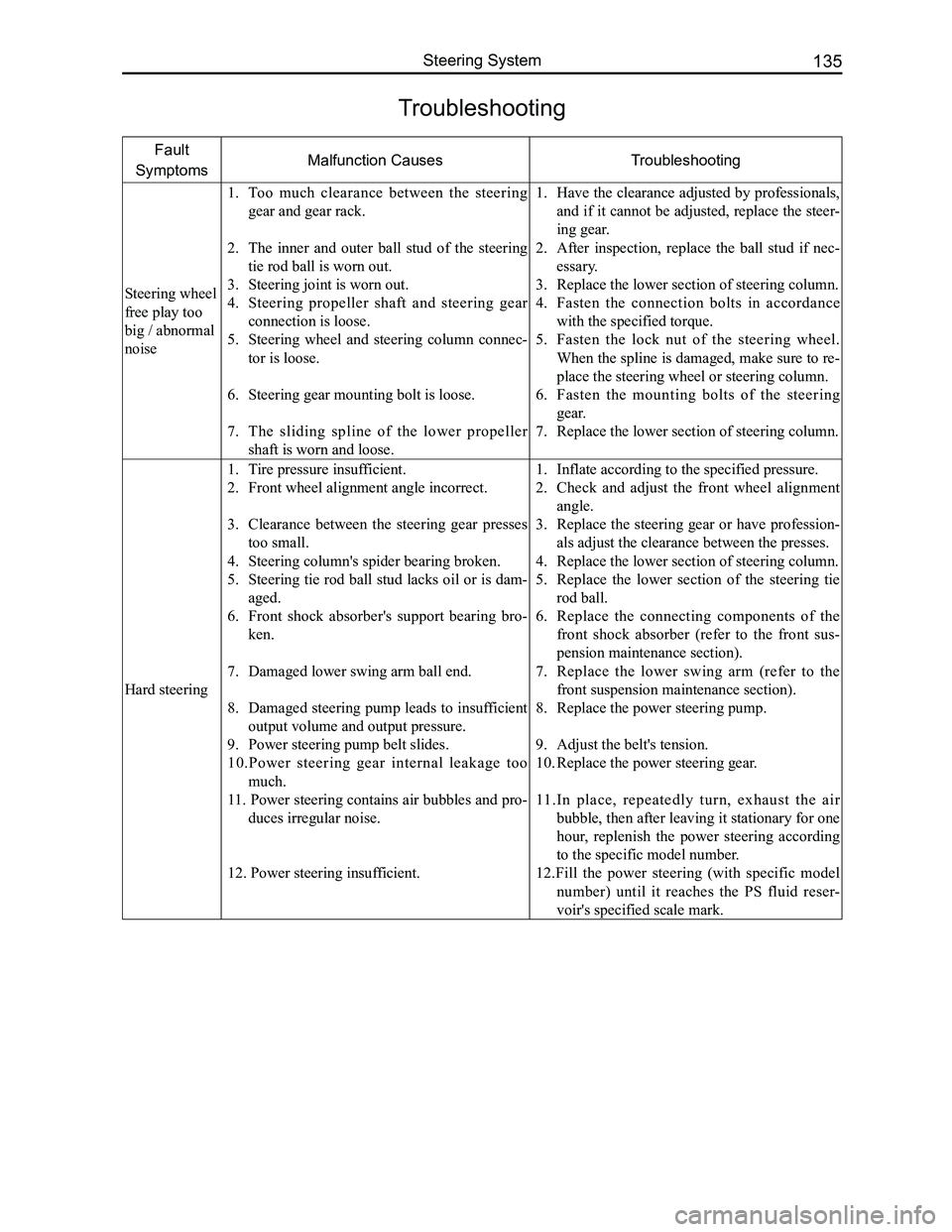
Troubleshooting
Fault
SymptomsMalfunction CausesTroubleshooting
Steering wheel
free play too
big / abnormal
noise
1. Too much clearance between the steering
gear and gear rack.
2. The inner and outer ball stud of the steering
tie rod ball is worn out.
3. Steering joint is worn out.
4. Steering propeller shaft and steering gear
connection is loose.
5. Steering wheel and steering column connec-
tor is loose.
6. Steering gear mounting bolt is loose.
7. The sliding spline of the lower propeller
shaft is worn and loose.
1. Have the clearance adjusted by professionals,
and if it cannot be adjusted, replace the steer-
ing gear.
2. After inspection, replace the ball stud if nec-
essary.
3. Replace the lower section of steering column.
4. Fasten the connection bolts in accordance
with the specified torque.
5. Fasten the lock nut of the steering wheel.
When the spline is damaged, make sure to re-
place the steering wheel or steering column.
6. Fasten the mounting bolts of the steering
gear.
7. Replace the lower section of steering column.
Hard steering
1. Tire pressure insufficient.
2. Front wheel alignment angle incorrect.
3. Clearance between the steering gear presses
too small.
4. Steering column's spider bearing broken.
5. Steering tie rod ball stud lacks oil or is dam-
aged.
6. Front shock absorber's support bearing bro-
ken.
7. Damaged lower swing arm ball end.
8. Damaged steering pump leads to insufficient
output volume and output pressure.
9. Power steering pump belt slides.
10.Power steering gear internal leakage too
much.
11. Power steering contains air bubbles and pro-
duces irregular noise.
12. Power steering insufficient.
1. Inflate according to the specified pressure.
2. Check and adjust the front wheel alignment
angle.
3. Replace the steering gear or have profession-
als adjust the clearance between the presses.
4. Replace the lower section of steering column.
5. Replace the lower section of the steering tie
rod ball.
6. Replace the connecting components of the
front shock absorber (refer to the front sus-
pension maintenance section).
7. Replace the lower swing arm (refer to the
front suspension maintenance section).
8. Replace the power steering pump.
9. Adjust the belt's tension.
10. Replace the power steering gear.
11.In place, repeatedly turn, exhaust the air
bubble, then after leaving it stationary for one
hour, replenish the power steering according
to the specific model number.
12.Fill the power steering (with specific model
number) until it reaches the PS fluid reser-
voir's specified scale mark.
Page 146 of 281
Downloaded from www.Manualslib.com manuals search engine 139Steering System
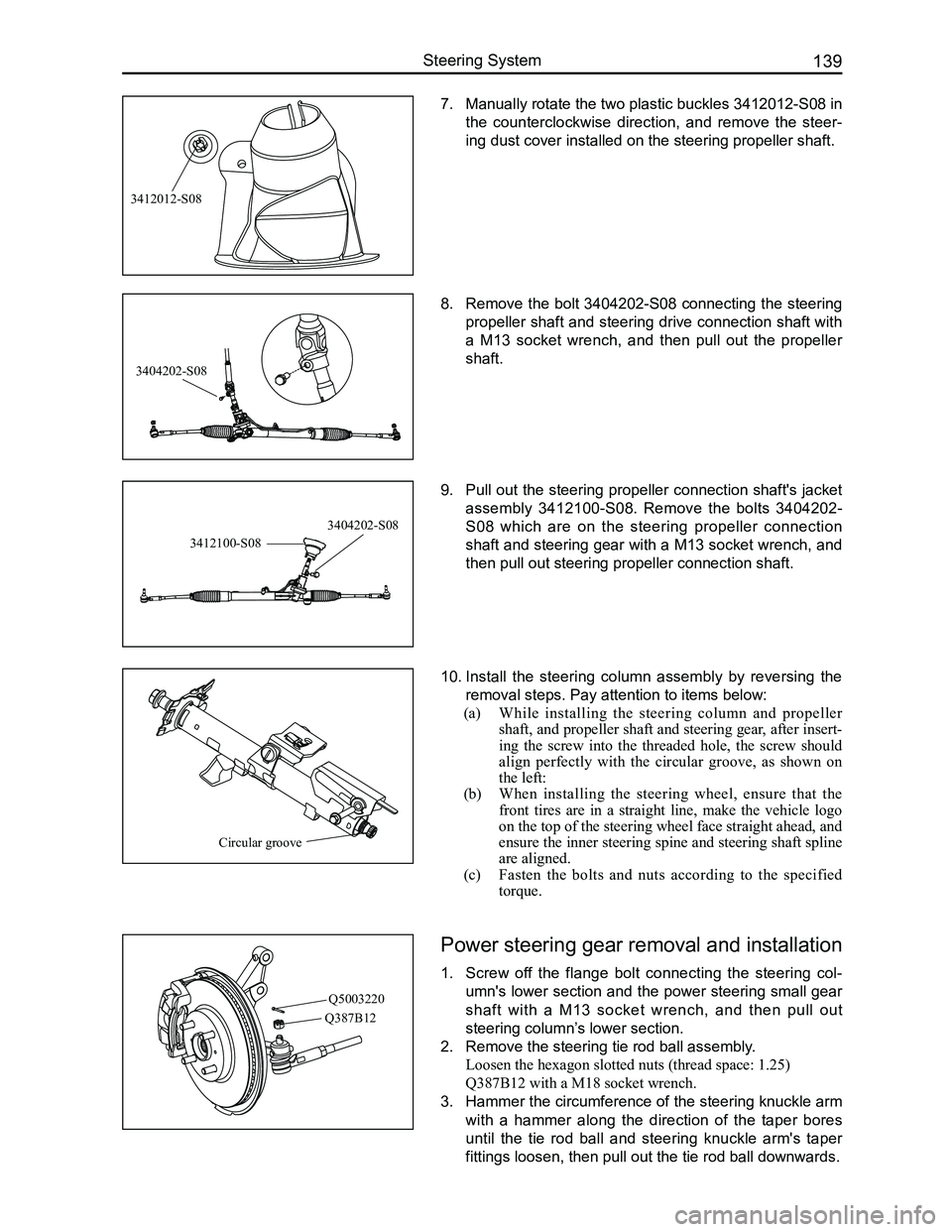
7. Manually rotate the two plastic buckles 3412012-S08 in
the counterclockwise direction, and remove the steer-
ing dust cover installed on the steering propeller shaft.
8. Remove the bolt 3404202-S08 connecting the steering
propeller shaft and steering drive connection shaft with
a M13 socket wrench, and then pull out the propeller
shaft.
9. Pull out the steering propeller connection shaft's jacket
assembly 3412100-S08. Remove the bolts 3404202-
S08 which are on the steering propeller connection
shaft and steering gear with a M13 socket wrench, and
then pull out steering propeller connection shaft.
10. Install the steering column assembly by reversing the
removal steps. Pay attention to items below:
(a) While installing the steering column and propeller
shaft, and propeller shaft and steering gear, after insert-
ing the screw into the threaded hole, the screw should
align perfectly with the circular groove, as shown on
the left:
(b) When installing the steering wheel, ensure that the
front tires are in a straight line, make the vehicle logo
on the top of the steering wheel face straight ahead, and
ensure the inner steering spine and steering shaft spline
are aligned.
(c) Fasten the bolts and nuts according to the specified
torque.
3412012-S08
Circular groove
3412100-S08
3404202-S08
Power steering gear removal and installation
1. Screw off the flange bolt connecting the steering col-
umn's lower section and the power steering small gear
shaft with a M13 socket wrench, and then pull out
steering column’s lower section.
2. Remove the steering tie rod ball assembly.
Loosen the hexagon slotted nuts (thread space: 1.25)
Q387B12 with a M18 socket wrench.
3. Hammer the circumference of the steering knuckle arm
with a hammer along the direction of the taper bores
until the tie rod ball and steering knuckle arm's taper
fittings loosen, then pull out the tie rod ball downwards.
Q5003220
Q387B12
3404202-S08
Page 147 of 281
Downloaded from www.Manualslib.com manuals search engine GWFLORID Maintenance Manual140
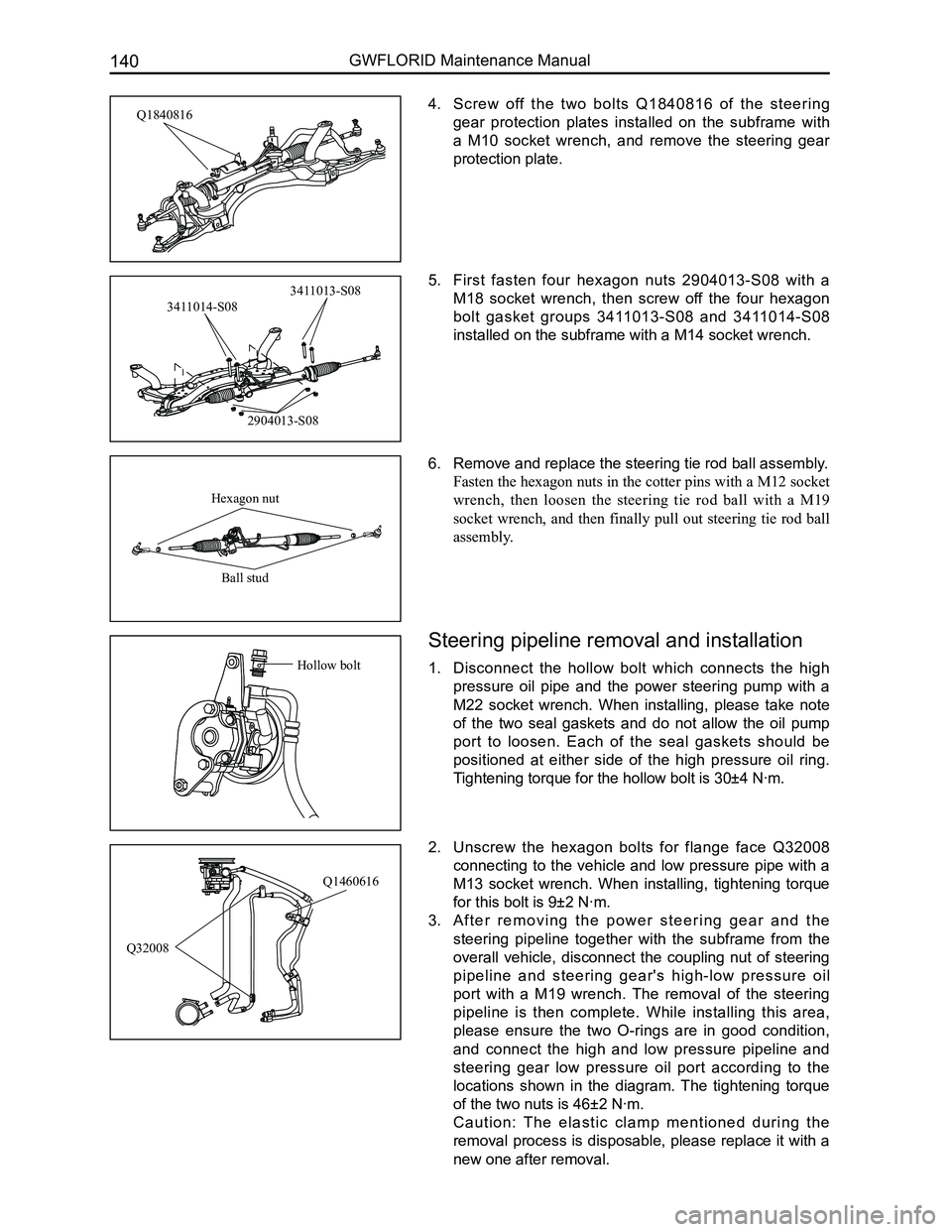
4. Screw off the two bolts Q1840816 of the steering
gear protection plates installed on the subframe with
a M10 socket wrench, and remove the steering gear
protection plate.
5. First fasten four hexagon nuts 2904013-S08 with a
M18 socket wrench, then screw off the four hexagon
bolt gasket groups 3411013-S08 and 3411014-S08
installed on the subframe with a M14 socket wrench.
6. Remove and replace the steering tie rod ball assembly.
Fasten the hexagon nuts in the cotter pins with a M12 socket
wrench, then loosen the steering tie rod ball with a M19
socket wrench, and then finally pull out steering tie rod ball
assembly.
2. Unscrew the hexagon bolts for flange face Q32008
connecting to the vehicle and low pressure pipe with a
M13 socket wrench. When installing, tightening torque
for this bolt is 9±2 N·m.
3. A f t e r r e m o v i n g t h e p o w e r s t e e r i n g g e a r a n d t h e
steering pipeline together with the subframe from the
overall vehicle, disconnect the coupling nut of steering
pipeline and steering gear's high-low pressure oil
port with a M19 wrench. The removal of the steering
pipeline is then complete. While installing this area,
please ensure the two O-rings are in good condition,
and connect the high and low pressure pipeline and
steering gear low pressure oil port according to the
locations shown in the diagram. The tightening torque
of the two nuts is 46±2 N·m.
C a u t i o n : T h e e l a s t i c c l a m p m e n t i o n e d d u r i n g t h e
removal process is disposable, please replace it with a
new one after removal.
Q1460616
Q32008
Q1840816
2904013-S08
3411014-S08
3411013-S08
Hexagon nut
Ball stud
Steering pipeline removal and installation
1. Disconnect the hollow bolt which connects the high
pressure oil pipe and the power steering pump with a
M22 socket wrench. When installing, please take note
of the two seal gaskets and do not allow the oil pump
port to loosen. Each of the seal gaskets should be
positioned at either side of the high pressure oil ring.
Tightening torque for the hollow bolt is 30±4 N·m.
Hollow bolt
Page 148 of 281
Downloaded from www.Manualslib.com manuals search engine 141Steering System
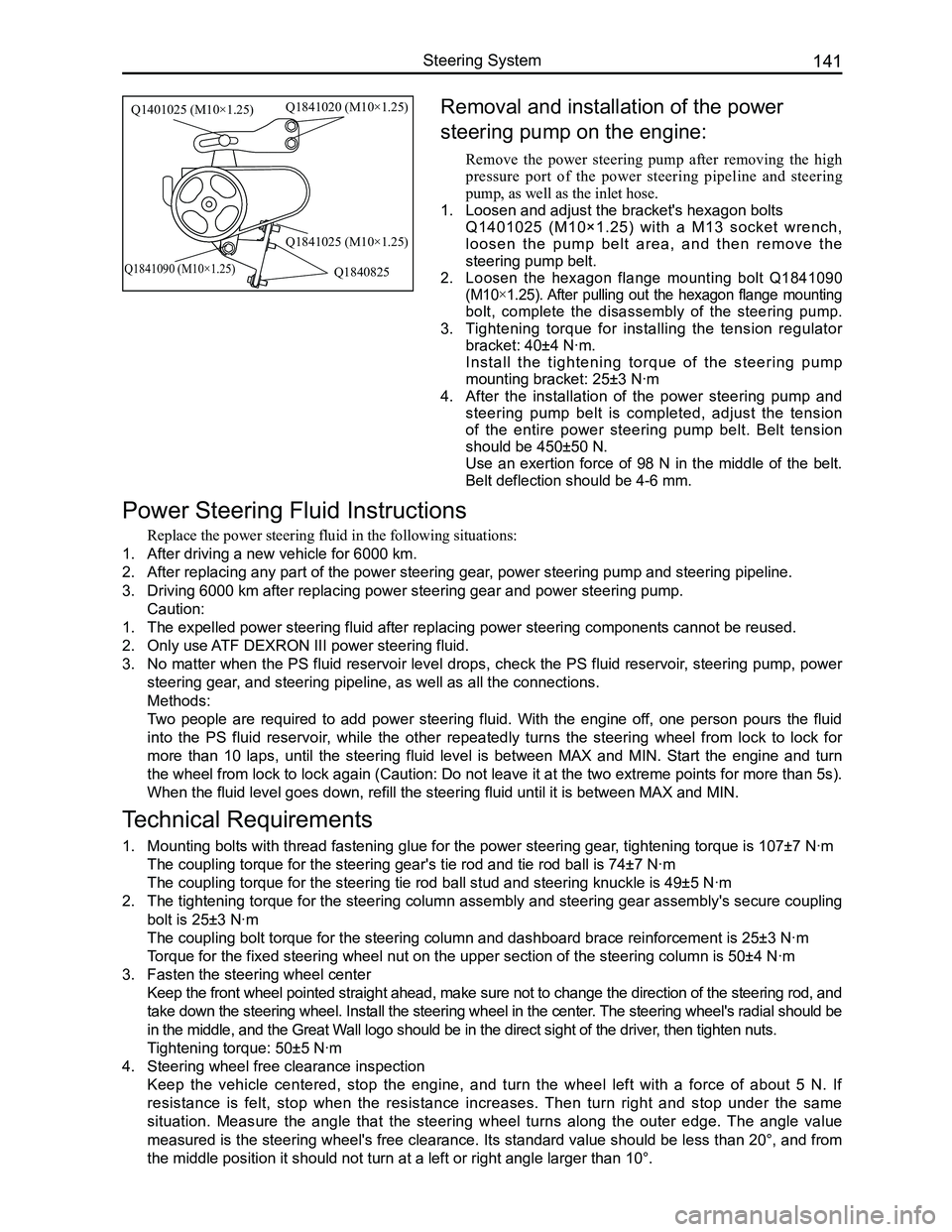
Removal and installation of the power
steering pump on the engine:
Remove the power steering pump after removing the high
pressure port of the power steering pipeline and steering
pump, as well as the inlet hose.
1. Loosen and adjust the bracket's hexagon bolts
Q1401025 (M10×1.25) with a M13 socket wrench,
l o o s e n t h e p u m p b e l t a r e a , a n d t h e n r e m o v e t h e
steering pump belt.
2. Loosen the hexagon flange mounting bolt Q1841090
(M10×1.25). After pulling out the hexagon flange mounting
bolt, complete the disassembly of the steering pump.
3. Tightening torque for installing the tension regulator
bracket: 40±4 N·m.
Install the tightening torque of the steering pump
mounting bracket: 25±3 N·m
4. After the installation of the power steering pump and
steering pump belt is completed, adjust the tension
of the entire power steering pump belt. Belt tension
should be 450±50 N.
Use an exertion force of 98 N in the middle of the belt.
Belt deflection should be 4-6 mm.
Power Steering Fluid Instructions
Replace the power steering fluid in the following situations:
1. After driving a new vehicle for 6000 km.
2. After replacing any part of the power steering gear, power steering pump and steering pipeline.
3. Driving 6000 km after replacing power steering gear and power steering p\
ump.
Caution:
1. The expelled power steering fluid after replacing power steering compone\
nts cannot be reused.
2. Only use ATF DEXRON III power steering fluid.
3. No matter when the PS fluid reservoir level drops, check the PS fluid reservoir, steering pump, power
steering gear, and steering pipeline, as well as all the connections.
Methods:
Two people are required to add power steering fluid. With the engine off, one person pours the fluid
into the PS fluid reservoir, while the other repeatedly turns the steering wheel from lock to lock for
more than 10 laps, until the steering fluid level is between MAX and MIN. Start the engine and turn
the wheel from lock to lock again (Caution: Do not leave it at the two extreme points for more than 5s).
When the fluid level goes down, refill the steering fluid until it is be\
tween MAX and MIN.
Technical Requirements
1. Mounting bolts with thread fastening glue for the power steering gear, tightening torque is 107±7 N·m
The coupling torque for the steering gear's tie rod and tie rod ball is \
74±7 N·m
The coupling torque for the steering tie rod ball stud and steering knuc\
kle is 49±5 N·m
2. The tightening torque for the steering column assembly and steering gear assembly's secure coupling
bolt is 25±3 N·m
The coupling bolt torque for the steering column and dashboard brace rei\
nforcement is 25±3 N·m
Torque for the fixed steering wheel nut on the upper section of the steer\
ing column is 50±4 N·m
3. Fasten the steering wheel center
Keep the front wheel pointed straight ahead, make sure not to change the direction of the steering rod, and
take down the steering wheel. Install the steering wheel in the center. The steering wheel's radial should be
in the middle, and the Great Wall logo should be in the direct sight of the driver, then tighten nuts.
Tightening torque: 50±5 N·m
4. Steering wheel free clearance inspection
Keep the vehicle centered, stop the engine, and turn the wheel left with a force of about 5 N. If
resistance is felt, stop when the resistance increases. Then turn right and stop under the same
situation. Measure the angle that the steering wheel turns along the outer edge. The angle value
measured is the steering wheel's free clearance. Its standard value should be less than 20°, and from
the middle position it should not turn at a left or right angle larger t\
han 10°.
Q1401025 (M10×1.25)Q1841020 (M10×1.25)
Q1841025 (M10×1.25)
Q1840825Q1841090 (M10×1.25)
Page 210 of 281
Downloaded from www.Manualslib.com manuals search engine 203Air Conditioning System
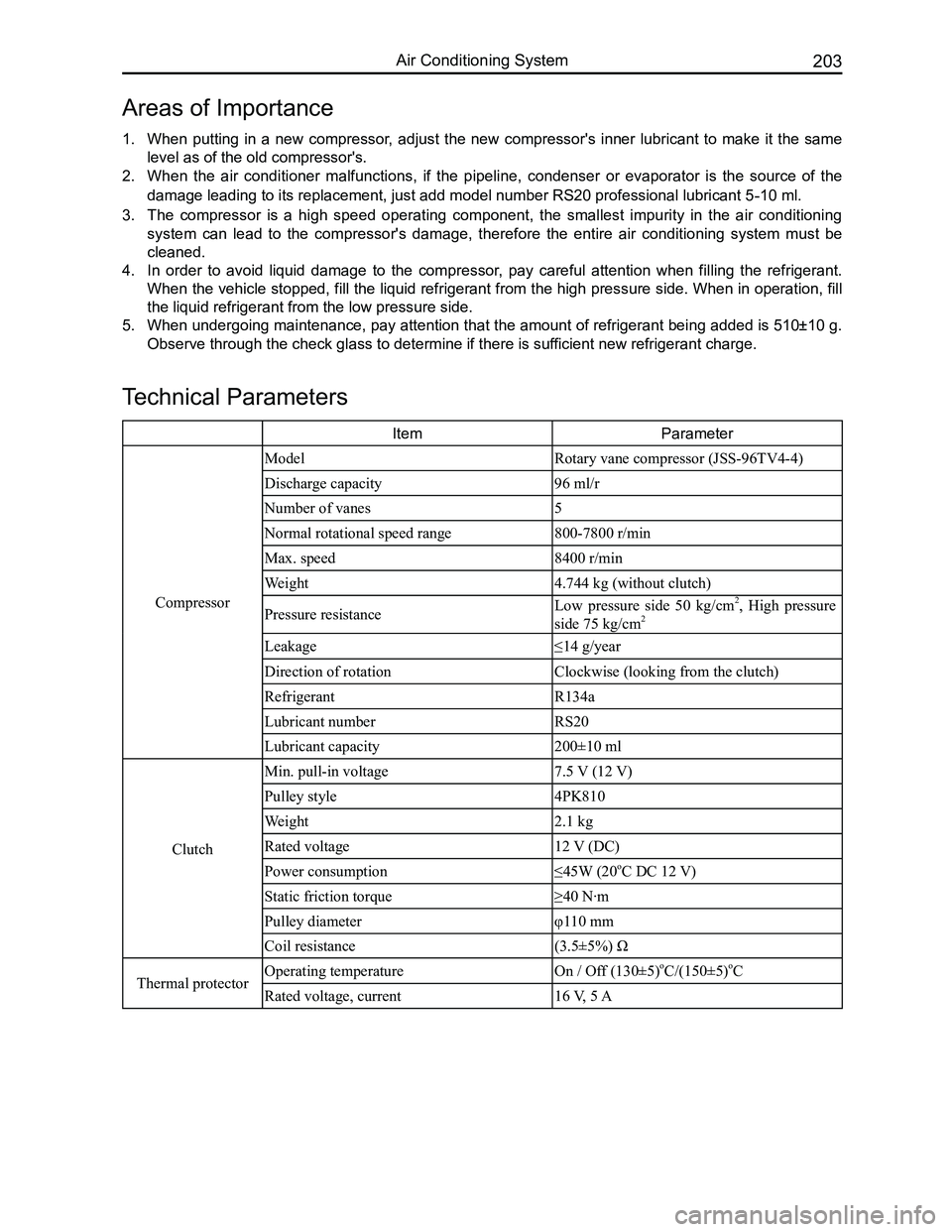
Areas of Importance
1. When putting in a new compressor, adjust the new compressor's inner lubricant to make it the same
level as of the old compressor's.
2. When the air conditioner malfunctions, if the pipeline, condenser or evaporator is the source of the
damage leading to its replacement, just add model number RS20 profession\
al lubricant 5-10 ml.
3. The compressor is a high speed operating component, the smallest impurity in the air conditioning
system can lead to the compressor's damage, therefore the entire air conditioning system must be
cleaned.
4. In order to avoid liquid damage to the compressor, pay careful attention when filling the refrigerant.
When the vehicle stopped, fill the liquid refrigerant from the high pressure side. When in operation, fill
the liquid refrigerant from the low pressure side.
5. When undergoing maintenance, pay attention that the amount of refrigerant being added is 510±10 g.
Observe through the check glass to determine if there is sufficient new refrigerant charge.
ItemParameter
Compressor
ModelRotary vane compressor (JSS-96TV4-4)
Discharge capacity96 ml/r
Number of vanes5
Normal rotational speed range800-7800 r/min
Max. speed8400 r/min
Weight4.744 kg (without clutch)
Pressure resistanceLow pressure side 50 kg/cm2, High pressure
side 75 kg/cm2
Leakage≤14 g/year
Direction of rotationClockwise (looking from the clutch)
RefrigerantR134a
Lubricant numberRS20
Lubricant capacity 200±10 ml
Clutch
Min. pull-in voltage7.5 V (12 V)
Pulley style 4PK810
Weight2.1 kg
Rated voltage12 V (DC)
Power consumption≤45W (20oC DC 12 V)
Static friction torque≥40 N·m
Pulley diameterφ110 mm
Coil resistance(3.5±5%) Ω
Thermal protectorOperating temperatureOn / Off (130±5)oC/(150±5)oC
Rated voltage, current16 V, 5 A
Technical Parameters
Page 216 of 281
Downloaded from www.Manualslib.com manuals search engine 209Air Conditioning System
Compressor Removal
1. Hoist the vehicle with a jack.
2. Remove the bottom mudguard.
3. Remove the compressor.
Compressor Installation
Before installing, manually rotate the compressor several
circles, allowing each component in the relative motion to be
covered with lubricant.
Clearance between the compressor's auricular branch and
bracket should be less than 0.1 mm. If the clearance is too
big, fill the clearance with a washer.
1. Loosen the engine's adjusting bolt firstly, take down the
engine belt, and then change the compressor belt.
2. Fix the compressor bracket onto the engine body with
the bolts. The bracket must be fastened tightly with suf-
ficient intensity. Fix the compressor bracket onto the
engine with four M10 ×1.25 (Q1461030 FD) bolts and
a tightening torque of 45±5 N·m, and then install the
compressor onto the bracket with a tightening torque of
22±3 N·m.
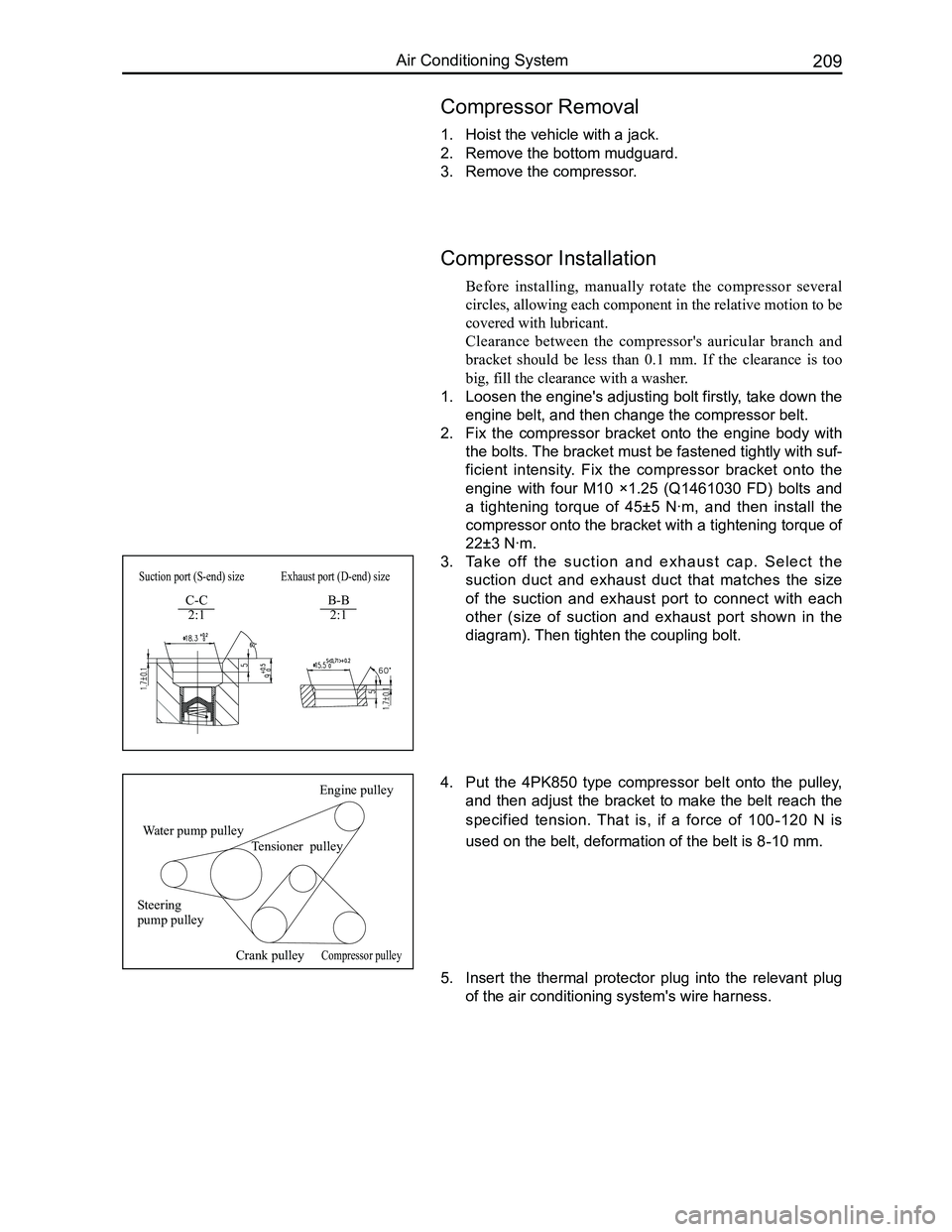
3. Ta k e o ff t h e s u c t i o n a n d e x h a u s t c a p . S e l e c t t h e
suction duct and exhaust duct that matches the size
of the suction and exhaust port to connect with each
other (size of suction and exhaust port shown in the
diagram). Then tighten the coupling bolt.
Water pump pulley
Engine pulley
Tensioner pulley
Steering pump pulley
Crank pulleyCompressor pulley
Suction port (S-end) sizeExhaust port (D-end) size
C-C 2:1B-B 2:1
4. Put the 4PK850 type compressor belt onto the pulley,
and then adjust the bracket to make the belt reach the
specified tension. That is, if a force of 100-120 N is
used on the belt, deformation of the belt is 8-10 mm.
5. Insert the thermal protector plug into the relevant plug
of the air conditioning system's wire harness.
Page 218 of 281
Downloaded from www.Manualslib.com manuals search engine 211Air Conditioning System
Clutch Installation
1. Install the solenoid coil at the place pressing up against the head cover's end surface and pay atten-
tion to insert the dowel pin of the solenoid coil into the bottom hole of the head cover. Put the retaining
ring into the groove with circlip pliers, and press the solenoid coil's connecting wire onto the pressing
line plate on the head cover with a SST.
2. Put the compressor on a specially designed fixture or platform, with its head cover facing upwards.
Press the pulley into the head cover shaft, and put the pulley bearing's retaining ring into the groove
with circlip pliers.
3. Install the armature onto the main shaft's spline and seize the clutch's triangular piece with a clamp.
Then tighten the inner hexagon lock screws and washers with a torque wrench. Screw torque should
be between 150-180 N·m. After installation is done, make sure to check if the clutch's pulley and
armature are able to operate freely, and also check the clearance between the pulley and armature,
which should be 0.3-0.6 mm.
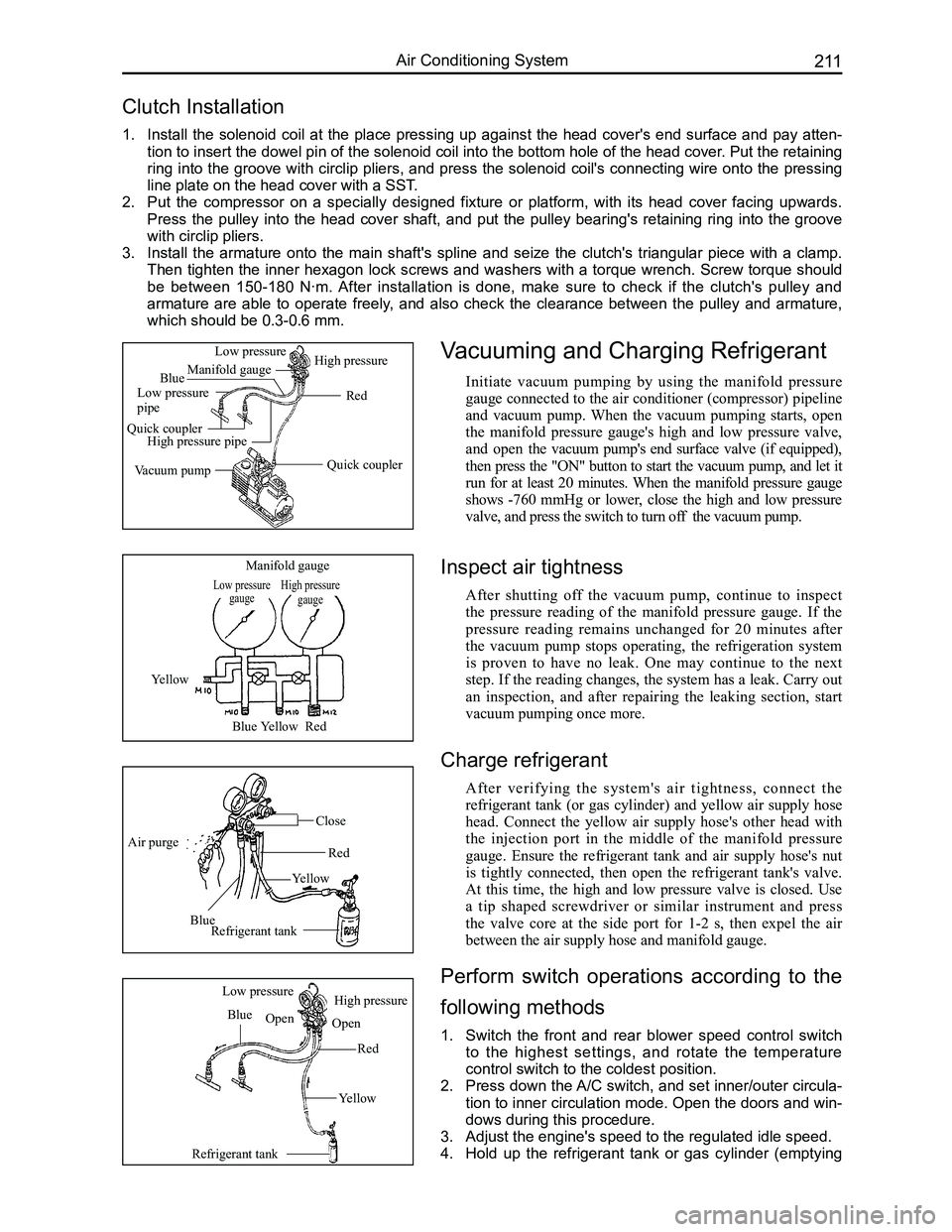
Vacuuming and Charging Refrigerant
Initiate vacuum pumping by using the manifold pressure
gauge connected to the air conditioner (compressor) pipeline
and vacuum pump. When the vacuum pumping starts, open
the manifold pressure gauge's high and low pressure valve,
and open the vacuum pump's end surface valve (if equipped),
then press the "ON" button to start the vacuum pump, and let it
run for at least 20 minutes. When the manifold pressure gauge
shows -760 mmHg or lower, close the high and low pressure
valve, and press the switch to turn off the vacuum pump.
Low pressure gaugeHigh pressure gauge
Manifold gauge
Yellow
BlueYellowRed
Air purge
Blue
Yellow
Red
Close
Refrigerant tank
Refrigerant tank
Blue
Red
Yellow
Low pressureHigh pressure
OpenOpen
Quick coupler
Red
Manifold gauge
Low pressure pipe
Quick couplerHigh pressure pipe
Vacuum pump
Low pressureHigh pressure
Blue
Inspect air tightness
After shutting off the vacuum pump, continue to inspect
the pressure reading of the manifold pressure gauge. If the
pressure reading remains unchanged for 20 minutes after
the vacuum pump stops operating, the refrigeration system
is proven to have no leak. One may continue to the next
step. If the reading changes, the system has a leak. Carry out
an inspection, and after repairing the leaking section, start
vacuum pumping once more.
Charge refrigerant
After verifying the system's air tightness, connect the
refrigerant tank (or gas cylinder) and yellow air supply hose
head. Connect the yellow air supply hose's other head with
the injection port in the middle of the manifold pressure
gauge. Ensure the refrigerant tank and air supply hose's nut
is tightly connected, then open the refrigerant tank's valve.
At this time, the high and low pressure valve is closed. Use
a tip shaped screwdriver or similar instrument and press
the valve core at the side port for 1-2 s, then expel the air
between the air supply hose and manifold gauge.
Perform switch operations according to the
following methods
1. Switch the front and rear blower speed control switch
to the highest settings, and rotate the temperature
control switch to the coldest position.
2. Press down the A/C switch, and set inner/outer circula-
tion to inner circulation mode. Open the doors and win-
dows during this procedure.
3. Adjust the engine's speed to the regulated idle speed.
4. Hold up the refrigerant tank or gas cylinder (emptying
Page 269 of 281
Downloaded from www.Manualslib.com manuals search engine GWFLORID Maintenance Manual262
Seat Belt
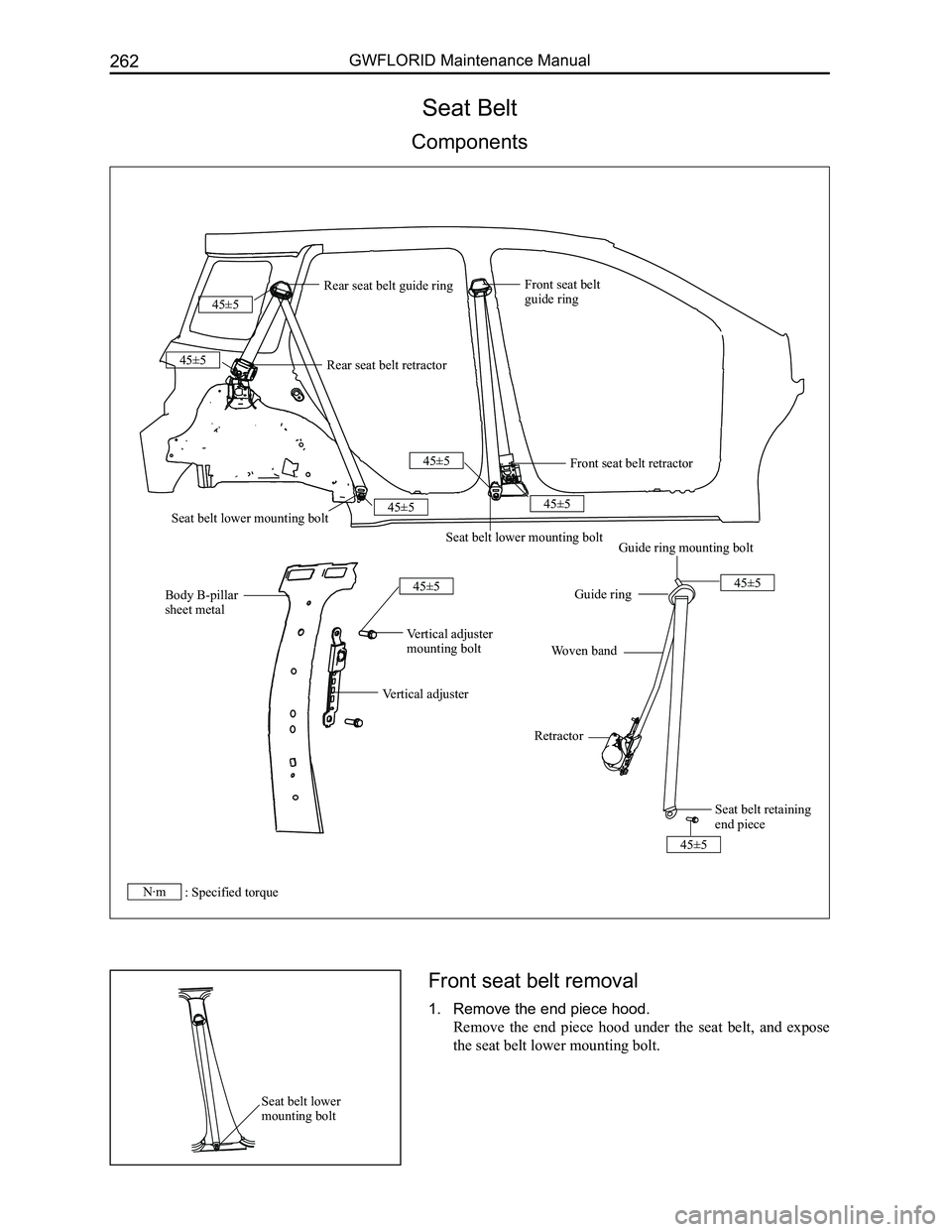
Components
Front seat belt removal
1. Remove the end piece hood.
Remove the end piece hood under the seat belt, and expose
the seat belt lower mounting bolt.
Rear seat belt guide ring
Rear seat belt retractor
Seat belt lower mounting bolt
Front seat belt retractor
Front seat belt guide ring
Seat belt lower mounting bolt
Vertical adjuster mounting bolt
Body B-pillar sheet metal
Vertical adjuster
Guide ring mounting bolt
Guide ring
Woven band
Retractor
Seat belt retaining end piece
45±5
Seat belt lower mounting bolt
N·m
45±5
45±5
45±5
45±5
45±5
45±5
: Specified torque
45±5
Page 270 of 281
Downloaded from www.Manualslib.com manuals search engine 263Vehicle Body
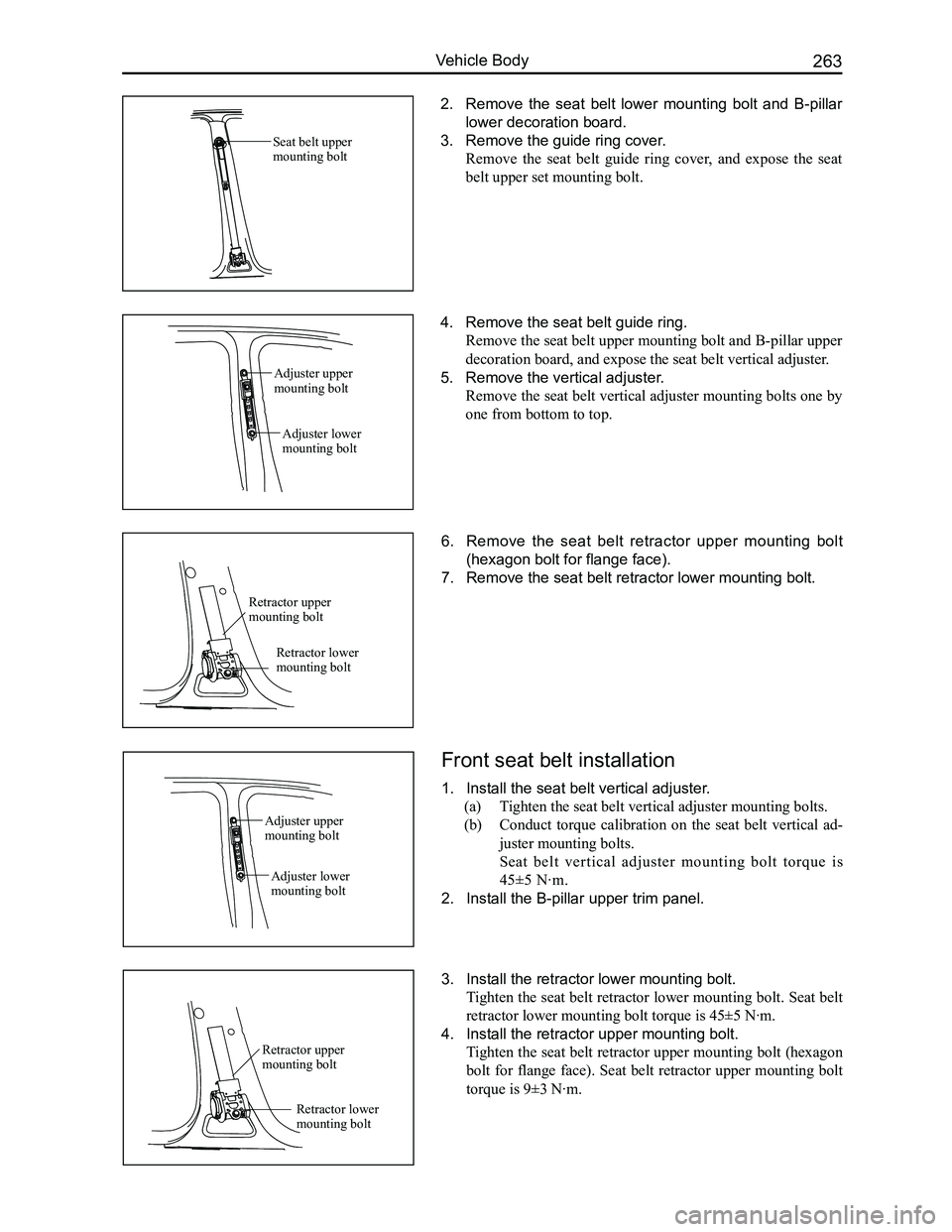
6. Remove the seat belt retractor upper mounting bolt
(hexagon bolt for flange face).
7. Remove the seat belt retractor lower mounting bolt.
Front seat belt installation
1. Install the seat belt vertical adjuster.
(a) Tighten the seat belt vertical adjuster mounting bolts.
(b) Conduct torque calibration on the seat belt vertical ad-
juster mounting bolts.
Seat belt vertical adjuster mounting bolt torque is
45±5 N·m.
2. Install the B-pillar upper trim panel.
3. Install the retractor lower mounting bolt.
Tighten the seat belt retractor lower mounting bolt. Seat belt
retractor lower mounting bolt torque is 45±5 N·m.
4. Install the retractor upper mounting bolt.
Tighten the seat belt retractor upper mounting bolt (hexagon
bolt for flange face). Seat belt retractor upper mounting bolt
torque is 9±3 N·m.
2. Remove the seat belt lower mounting bolt and B-pillar
lower decoration board.
3. Remove the guide ring cover.
Remove the seat belt guide ring cover, and expose the seat
belt upper set mounting bolt.
4. Remove the seat belt guide ring.
Remove the seat belt upper mounting bolt and B-pillar upper
decoration board, and expose the seat belt vertical adjuster.
5. Remove the vertical adjuster.
Remove the seat belt vertical adjuster mounting bolts one by
one from bottom to top.
Retractor upper mounting bolt
Retractor lower mounting bolt
Adjuster upper mounting bolt
Adjuster lower mounting bolt
Retractor upper mounting bolt
Retractor lower mounting bolt
Seat belt upper mounting bolt
Adjuster upper
mounting bolt
Adjuster lower mounting bolt
Page 271 of 281
Downloaded from www.Manualslib.com manuals search engine GWFLORID Maintenance Manual264
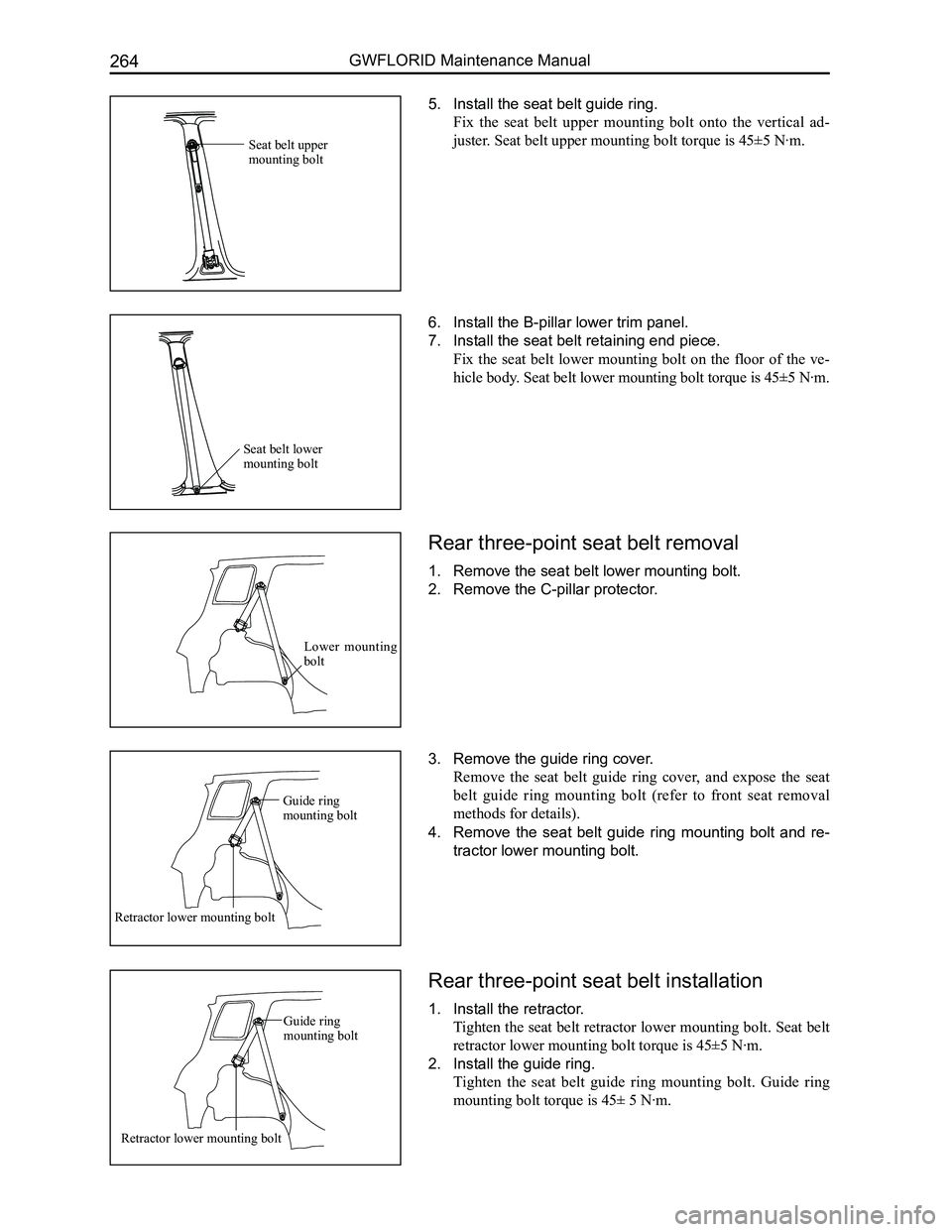
Rear three-point seat belt removal
1. Remove the seat belt lower mounting bolt.
2. Remove the C-pillar protector.
3. Remove the guide ring cover.
Remove the seat belt guide ring cover, and expose the seat
belt guide ring mounting bolt (refer to front seat removal
methods for details).
4. Remove the seat belt guide ring mounting bolt and re-
tractor lower mounting bolt.
Rear three-point seat belt installation
1. Install the retractor.
Tighten the seat belt retractor lower mounting bolt. Seat belt
retractor lower mounting bolt torque is 45±5 N·m.
2. Install the guide ring.
Tighten the seat belt guide ring mounting bolt. Guide ring
mounting bolt torque is 45± 5 N·m.
6. Install the B-pillar lower trim panel.
7. Install the seat belt retaining end piece.
Fix the seat belt lower mounting bolt on the floor of the ve-
hicle body. Seat belt lower mounting bolt torque is 45±5 N·m.
5. Install the seat belt guide ring.
Fix the seat belt upper mounting bolt onto the vertical ad-
juster. Seat belt upper mounting bolt torque is 45±5 N·m.Seat belt upper mounting bolt
Seat belt lower mounting bolt
Lower mounting bolt
Guide ring mounting bolt
Retractor lower mounting bolt
Guide ring mounting bolt
Retractor lower mounting bolt