tow HONDA CR-Z 2012 1.G User Guide
[x] Cancel search | Manufacturer: HONDA, Model Year: 2012, Model line: CR-Z, Model: HONDA CR-Z 2012 1.GPages: 333, PDF Size: 10.43 MB
Page 198 of 333
197
Driving
Towing a Trailer
Your vehicle is not designed to tow a trailer. Attempting to do so can void your warranties.
Towing Your Vehicle
Your vehicle is not designed to be towed behind a motor home. If your vehicle needs
to be towed in an emergency, refer to the emergency towing information.2 Emergency Towing P. 308
Page 202 of 333
201
uuWhen DrivinguPrecautions While Driving
Driving
Precautions While Driving
Avoid driving in deep water and on flooded roads. This can damage the engine or
cause electrical component failure.
If there is a strong impact with something under the vehicle, stop in a safe location.
Check the underside of the vehicle for damage or any fluid leaks.
■In Rain
■Other Precautions
1Precautions While Driving
NOTICE
Do not operate the shift lever while pressing the
accelerator pedal. You could damage the
transmission.
If the ignition switch is turned to ACCESSORY
(q or
LOCK
(0 while driving, the engine will shut down
and all steering and brake power assist functions will
stop, making it difficult to control the vehicle.
Do not put the shift lever in
(N , as you will lose
engine braking (and acceleration) performance.
During the first 600 miles (1,000 km) of operation,
avoid sudden acceleration or full throttle operation so
as to not damage the engine or powertrain.
Avoid hard braking for the first 200 miles (300 km).
You should also follow this when the brake pads are replaced.
NOTICE
Following can damage the under spoiler: • Parking the vehicle by a parking block
• Parallel parking along the road shoulder
• Driving towards the bottom of a hill
• Driving up or down to a different surface level
(such as a road shoulder)
• Driving on a rutted or bumpy road
• Driving on a road with potholes
Page 247 of 333
246
uuMaintenance Under the HooduOpening the Hood
Maintenance
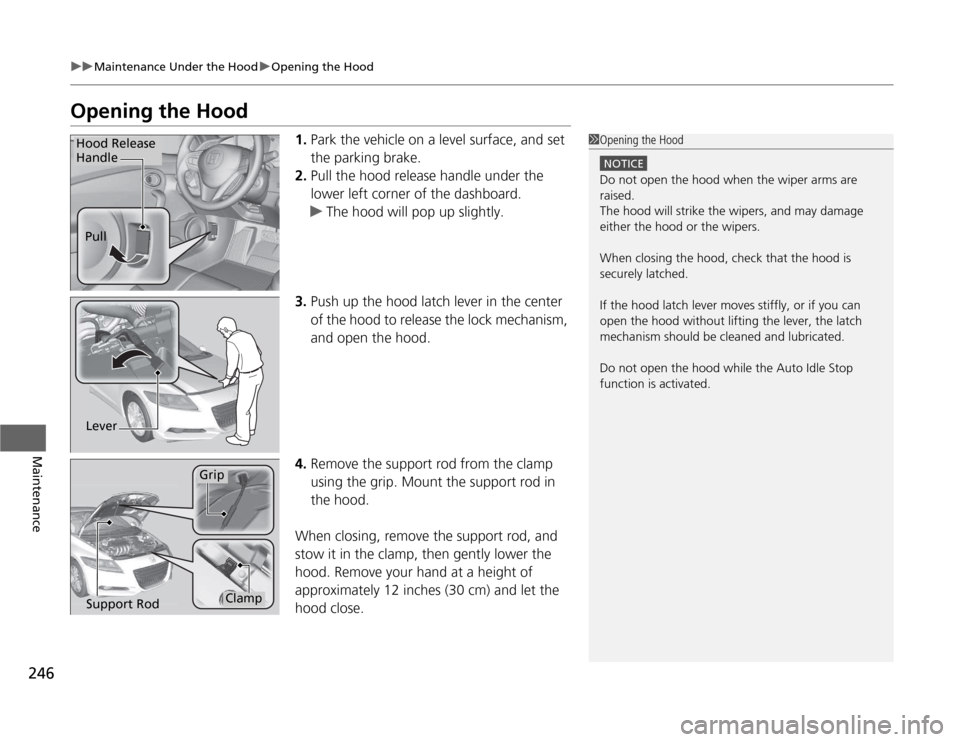
Opening the Hood1.Park the vehicle on a level surface, and set
the parking brake.
2. Pull the hood release handle under the
lower left corner of the dashboard.
uThe hood will pop up slightly.
3. Push up the hood latch lever in the center
of the hood to release the lock mechanism,
and open the hood.
4. Remove the support rod from the clamp
using the grip. Mount the support rod in
the hood.
When closing, remove the support rod, and
stow it in the clamp, then gently lower the
hood. Remove your hand at a height of
approximately 12 inches (30 cm) and let the
hood close.
1Opening the Hood
NOTICE
Do not open the hood when the wiper arms are raised.
The hood will strike the wipers, and may damage
either the hood or the wipers.
When closing the hood, check that the hood is
securely latched.
If the hood latch lever moves stiffly, or if you can
open the hood without lifting the lever, the latch
mechanism should be cleaned and lubricated.
Do not open the hood while the Auto Idle Stop
function is activated.
Hood Release
Handle
Pull
Lever
Support Rod
Grip
Clamp
Page 249 of 333
248
uuMaintenance Under the HooduOil Check
Maintenance
Oil Check
We recommend that you check the engine oil level every time you refuel.
Park the vehicle on level ground.
Wait approximately three minutes after turning the engine off before you check the
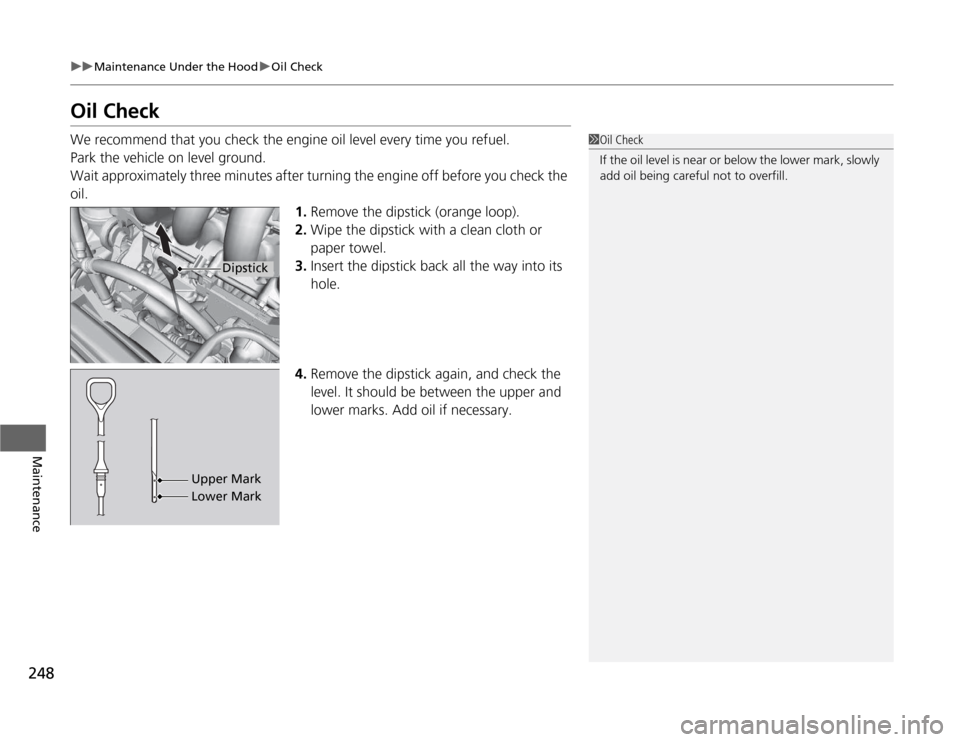
oil.1.Remove the dipstick (orange loop).
2. Wipe the dipstick with a clean cloth or
paper towel.
3. Insert the dipstick back all the way into its
hole.
4. Remove the dipstick again, and check the
level. It should be between the upper and
lower marks. Add oil if necessary.
1Oil Check
If the oil level is near or below the lower mark, slowly
add oil being careful not to overfill.
Dipstick
Upper Mark
Lower Mark
Page 279 of 333
278
Maintenance
12 Volt Battery
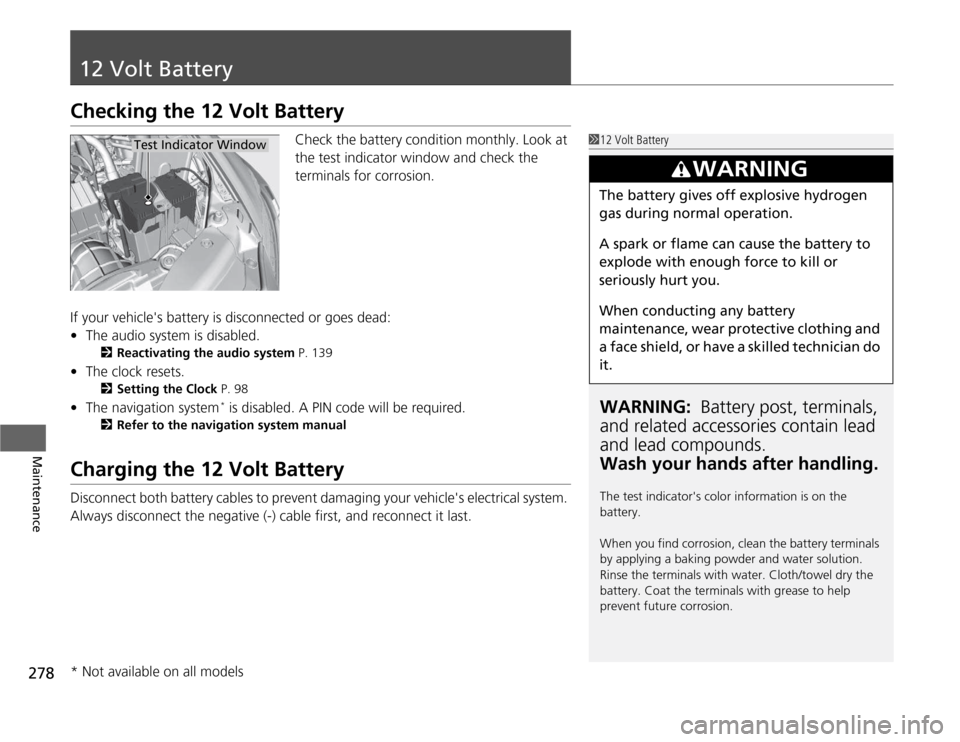
Checking the 12 Volt BatteryCheck the battery condition monthly. Look at
the test indicator window and check the
terminals for corrosion.
If your vehicle's battery is disconnected or goes dead: • The audio system is disabled.
2 Reactivating the audio system P. 139
• The clock resets.
2 Setting the Clock P. 98
• The navigation system *
is disabled. A PIN code will be required.
2 Refer to the navigation system manual
Charging the 12 Volt Battery
Disconnect both battery cables to prevent damaging your vehicle's electrical system.
Always disconnect the negative (-) cable first, and reconnect it last.
112 Volt Battery
WARNING: Battery post, terminals,
and related accessori es contain lead
and lead compounds. Wash your hands after handling.
The test indicator's color information is on the
battery.
When you find corrosion, clean the battery terminals
by applying a baking powder and water solution.
Rinse the terminals with water. Cloth/towel dry the
battery. Coat the terminals with grease to help
prevent future corrosion.
3WARNING
The battery gives off explosive hydrogen
gas during normal operation.
A spark or flame can cause the battery to
explode with enough force to kill or seriously hurt you.
When conducting any battery
maintenance, wear protective clothing and
a face shield, or have a skilled technician do
it.
Test Indicator Window
* Not available on all models
Page 286 of 333

285
Handling the UnexpectedThis chapter explains how to handle unexpected troubles.
Tools
Types of Tools .................................. 286
If a Tire Goes Flat
Changing a Flat Tire ......................... 287
Engine Does Not Start
Checking the Engine ........................ 293
Jump Starting .................................... 294
Shift Lever Does Not Move .............. 296
Overheating
How to Handle Overheating ............. 297 Indicator, Coming On/Blinking
If the Low Oil Pressure Indicator Comes On ............................................. 299
If the Charging System Indicator Comes On ................................................. 300
If the Malfunction Indicator Lamp Comes
On or Blinks ................................... 301
If the Brake System Indicator Comes On... 302
If the EPS Indicator Comes On.......... 302
If the IMA Indicator Comes On......... 303
If the Low Tire Pressure/TPMS Indicator
Comes On or Blinks........................ 303 Fuses
Fuse Locations ................................. 304
Inspecting and Changing Fuses ........ 307
Emergency Towing ........................... 308
When You Cannot Open the Hatch ..... 310
Page 287 of 333
286
Handling the Unexpected
Tools
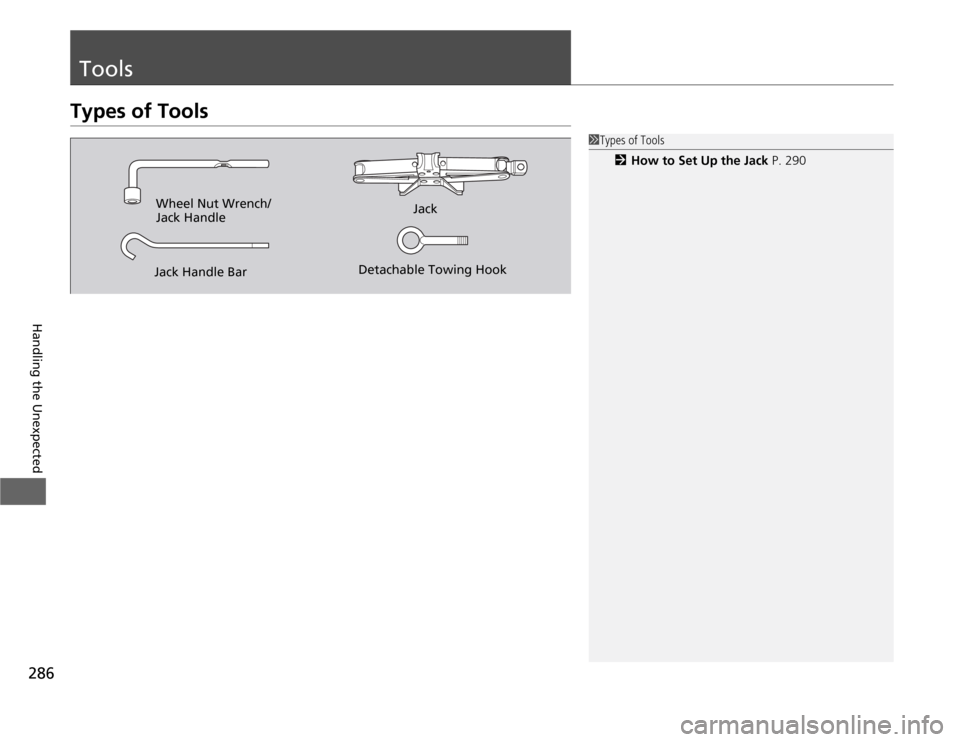
Types of Tools
1Types of Tools2 How to Set Up the Jack P. 290
Wheel Nut Wrench/
Jack Handle Jack
Jack Handle Bar Detachable Towing Hook
Page 294 of 333
293
Handling the Unexpected
Engine Does Not Start
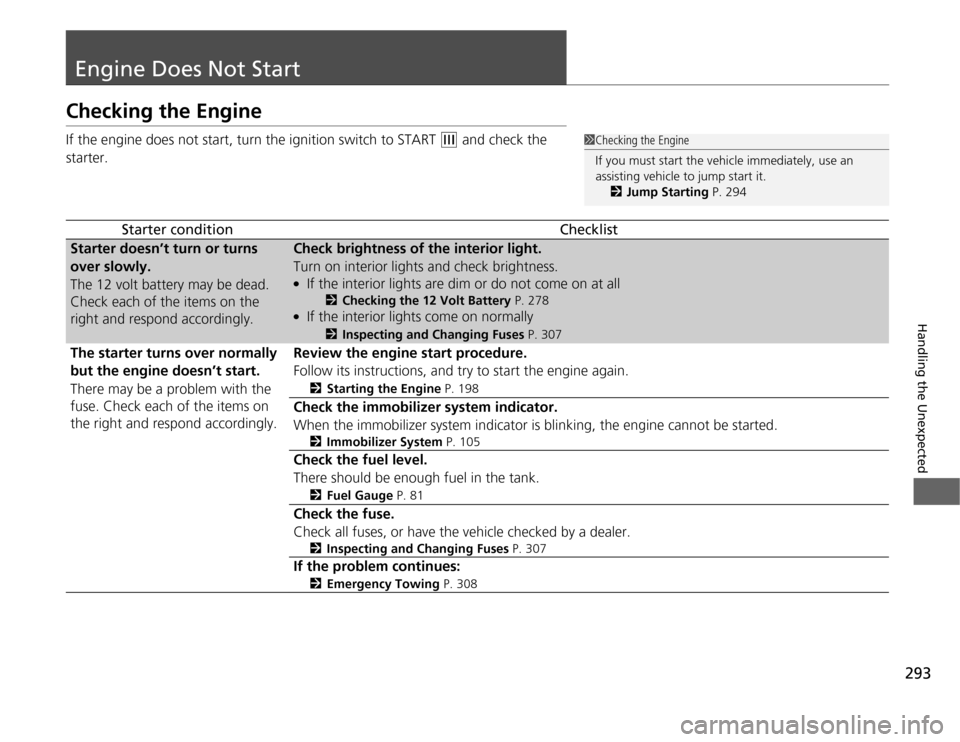
Checking the Engine
If the engine does not start, turn the ignition switch to START
(e and check the
starter.
Starter conditionChecklist
Starter doesn’t turn or turns
over slowly.
The 12 volt battery may be dead.
Check each of the items on the
right and respond accordingly.Check brightness of the interior light.
Turn on interior lights and check brightness. ● If the interior lights are dim or do not come on at all
2Checking the 12 Volt Battery P. 278
● If the interior lights come on normally 2
Inspecting and Changing Fuses P. 307
The starter turns over normally
but the engine doesn’t start.
There may be a problem with the
fuse. Check each of the items on the right and respond accordingly.Review the engine start procedure.
Follow its instructions, and try to start the engine again. 2Starting the Engine P. 198
Check the immobilizer system indicator.
When the immobilizer system indicator is blinking, the engine cannot be started.
2Immobilizer System P. 105
Check the fuel level.
There should be enough fuel in the tank. 2Fuel Gauge P. 81
Check the fuse.
Check all fuses, or have the vehicle checked by a dealer.
2Inspecting and Changing Fuses P. 307
If the problem continues:
2Emergency Towing P. 308
1Checking the Engine
If you must start the vehicle immediately, use an assisting vehicle to jump start it.
2 Jump Starting P. 294
Page 309 of 333
308
Handling the Unexpected
Emergency Towing
Call a professional towing service if you need to tow your vehicle. ■Flat bed equipment
The operator loads your vehicle on the back of a truck.
This is the best way to transport your vehicle. ■ Wheel lift equipment
The tow truck uses two pivoting arms that go under the front tires and lift them off
the ground. The rear tires remain on the ground. This is an acceptable way to
tow your vehicle.1Emergency Towing
NOTICE
Trying to lift or tow your vehicle by the bumpers will
cause serious damage. The bumpers are not designed
to support the vehicle's weight.
NOTICE
Improper towing such as towing behind a
motorhome or other motor vehicle can damage the
transmission.
Never tow your vehicle with just a rope or chain.
It is very dangerous, since ropes or chains may shift from side to side or break.
Page 310 of 333
309
uuEmergency Towingu
Handling the Unexpected
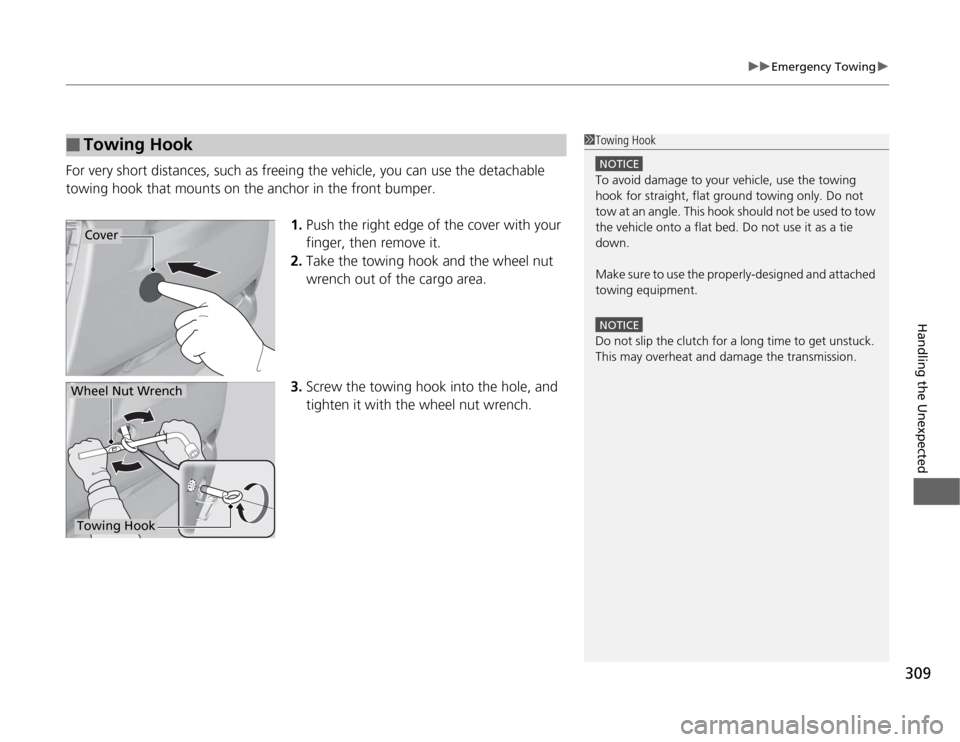
For very short distances, such as freeing the vehicle, you can use the detachable
towing hook that mounts on the anchor in the front bumper.1.Push the right edge of the cover with your
finger, then remove it.
2. Take the towing hook and the wheel nut
wrench out of the cargo area.
3. Screw the towing hook into the hole, and
tighten it with the wheel nut wrench.
■Towing Hook1Towing Hook
NOTICE
To avoid damage to your vehicle, use the towing hook for straight, flat ground towing only. Do not
tow at an angle. This hook should not be used to tow
the vehicle onto a flat bed. Do not use it as a tie down.
Make sure to use the properly-designed and attached
towing equipment.
NOTICE
Do not slip the clutch for a long time to get unstuck.
This may overheat and damage the transmission.
Cover
Wheel Nut Wrench
Towing Hook