brake HONDA CR-Z 2013 1.G Owner's Guide
[x] Cancel search | Manufacturer: HONDA, Model Year: 2013, Model line: CR-Z, Model: HONDA CR-Z 2013 1.GPages: 325, PDF Size: 11.73 MB
Page 191 of 325
190
uuWhen DrivinguShifting
Driving
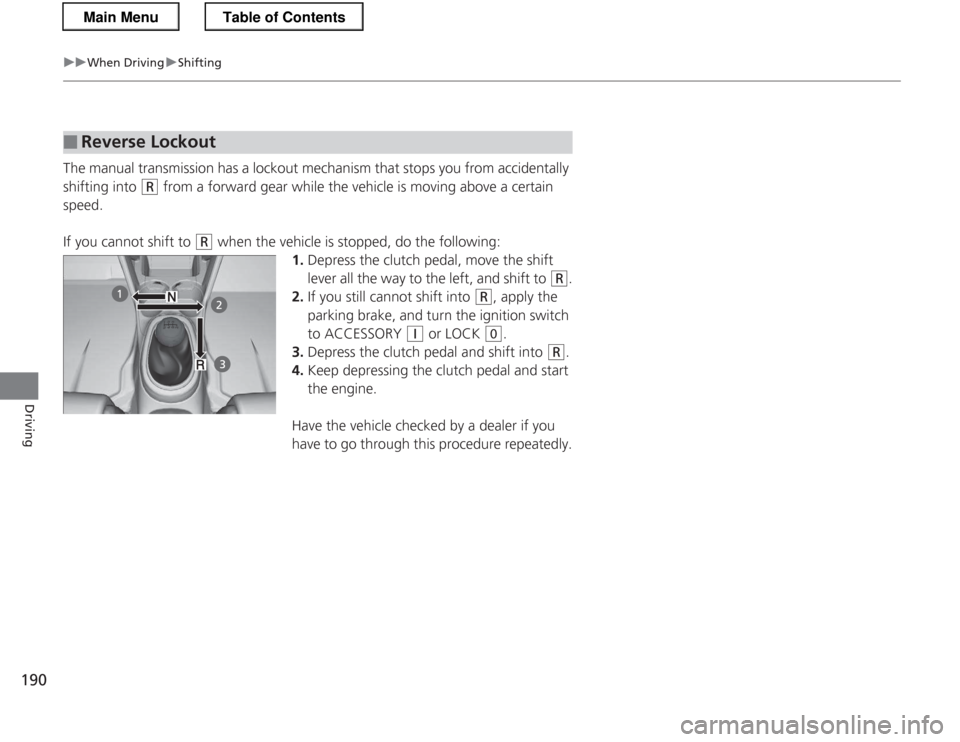
The manual transmission has a lockout mechanism that stops you from accidentally
shifting into
(R from a forward gear while the vehicle is moving above a certain
speed.
If you cannot shift to
(R when the vehicle is stopped, do the following:
1.Depress the clutch pedal, move the shift
lever all the way to the left, and shift to
(R .
2. If you still cannot shift into
(R , apply the
parking brake, and turn the ignition switch
to ACCESSORY
(q or LOCK (0 .
3. Depress the clutch pedal and shift into
(R .
4. Keep depressing the clutch pedal and start
the engine.
Have the vehicle checked by a dealer if you
have to go through this procedure repeatedly.
■Reverse Lockout
Main MenuTable of Contents
Page 193 of 325
uuWhen DrivinguAuto Idle Stop
192
Driving
The vehicle stops with the shift lever in (D and the brake pedal depressed.
■ Auto Idle Stop does not activate when:
• The low temperature indicator is on.
• The IMA battery charge is low.
• The bars of the ASST/CHRG indicators do not move when accelerating or
decelerating.
• The transmission fluid temperature is low.
• The vehicle comes to a stop again before the vehicle speed reaches 9 mph
(15 km/h) after the engine starts.
• Stopped on a steep incline.
• The shift lever is in a position other than
(D or (N .
• Airflow from the climate control system increases. (Except when in ECON mode)
uIf you have selected the fan speed manually:
The display shows more than five vertical bars.
• Shift mode is in the L mode.
• is on (the indicator is on).
■ Auto Idle Stop may not activate when:
• The climate control system is in use, and there is a significant difference between
the set temperature and the actual interior temperature. (Except when in ECON mode).
• When humidity in the interior is high.
• The vehicle is stopped by braking suddenly.
■Auto Idle Stop Activates When:1Auto Idle Stop Activates When:
The Auto Idle Stop may also activate when the brake
pedal is depressed, and the vehicle slows down to a
speed below 6 mph (10 km/h).
Main MenuTable of Contents
Page 194 of 325
193
uuWhen DrivinguAuto Idle Stop
Driving
The brake pedal is released. ■The engine restarts even if the brake pedal is depressed when:
• The shift position is changed to
(R .
• Shift mode set in the L mode.
• The accelerator pedal is depressed.
• The pressure to the brake pedal is reduced and the vehicle starts moving while
stopped on an incline.
• The IMA battery charge becomes low.
• The low temperature indicator comes on.
• The climate control system is in use, and the difference between the set
temperature and actual interior temperature becomes significant.
• The climate control system is being used to dehumidify the interior.
• The pressure on the brake pedal is repeatedly applied and released slightly.
• The (windshield defogger) button is pressed.
■The Engine Automatically Restarts When:
Main MenuTable of Contents
Page 196 of 325
Continued195
uuWhen DrivinguAuto Idle Stop
Driving
Stopping with the brake, the clutch pedal is fully depressed, and the shift lever is in
(N.
uTo restart the engine automatically, depress the clutch pedal.
■ Auto Idle Stop does not activate when:
• The low temperature indicator is on.
• The IMA battery charge is low.
• The bars of the ASST/CHRG indicators do not move when accelerating or
decelerating.
• The vehicle comes to a stop again before the vehicle speed reaches 9 mph
(15 km/h) after the engine starts.
• The shift lever is in
(R .
• Airflow from the climate control system increases. (Except when in ECON mode)
uIf you have selected the fan speed manually:
The display shows more than five vertical bars.
• is on (the indicator is on).
■ Auto Idle Stop may not activate when:
• The climate control system is in use, and there is a significant difference between
the set temperature and the actual interior temperature. (Except when in ECON
mode).
• When humidity in the interior is high.
• The vehicle is stopped by braking suddenly.
■Auto Idle Stop Activates When:1Auto Idle Stop Activates When:
The brake pedal is depressed, the vehicle slows down
to a speed below 19 mph (30 km/h), and the clutch
pedal is fully pressed.
The engine may not stop or restart automatically if
you fail to fully depress the clutch pedal.
Keeping the proper driving positions makes it easier
for you to depress the clutch pedal fully.
2 Adjusting the Seats P. 121
Main MenuTable of Contents
Page 197 of 325
uuWhen DrivinguAuto Idle Stop
196
Driving
The clutch pedal is fully depressed, and the shift lever is moved to a position other
than
(N .
■ The engine automatically resta rts when the clutch pedal is fully depressed
even if the shift lever is in
(N when:
• The low temperature indicator comes on.
• The accelerator pedal is pressed.
• The IMA battery charge becomes low.
• The climate control system is in use, and the difference between the set
temperature and actual interior temperature becomes significant.
• The climate control system is being used to dehumidify the interior.
The engine automatically restarts when the pressure on the brake pedal is
repeatedly applied and released slightly during a stop. This applies even if the clutch
pedal is not fully depressed.
Fully depress the clutch pedal.
uThe engine automatically restarts.
■The Engine Automatically Restarts When:
■When the Auto Idle Stop Indicator Starts Blinking Rapidly1When the Auto Idle Stop Indicator Starts Blinking Rapidly
The indicator starts blinking rapidly under the
following conditions: • The (windshield defogger) button is pressed.
• When the climate control system is in use and
moisture builds up inside the vehicle.
• When the climate control system is in use and the
difference between the set temperature and the
actual temperature inside the vehicle becomes
significant.
Main MenuTable of Contents
Page 200 of 325
199
uuWhen DrivinguPlus Sport System
Driving
■To cancel the Plus Sport System:
To cancel the ready-to-be activated system: • Do not depress the accelerator pedal for more than five seconds while the Plus
Sport indicator is blinking.
• Press the button again.
• Depress the brake or clutch pedal.
uThe Plus Sport indicator stops blinking.
To stop the system in operation, do any of the following: • Release the accelerator pedal.
• Press the button again.
uThe Plus Sport indica tor stops blinking, then stays on, and the Plus Sport
READY indicator comes on.
1To cancel the Plus Sport System:
The Plus Sport System automatically shuts itself off
with the system ready to be activated, or cancels if
the system is in operation when: • You are making a sharp turn while driving.
• The wheel speed between the front and rear, or
left and right tires becomes significantly different
due to an icy or wet, and slippery road.
The ambient meter changes color to red in NORMAL
and ECON mode while the system is in operation.
The Plus Sport System can momentarily accelerate
your vehicle. However, it is still your responsibility to
decide when to use the system. Drive safely at speeds
appropriate for the conditions.
Main MenuTable of Contents
Page 203 of 325
uuWhen DrivinguCruise Control
202
Driving
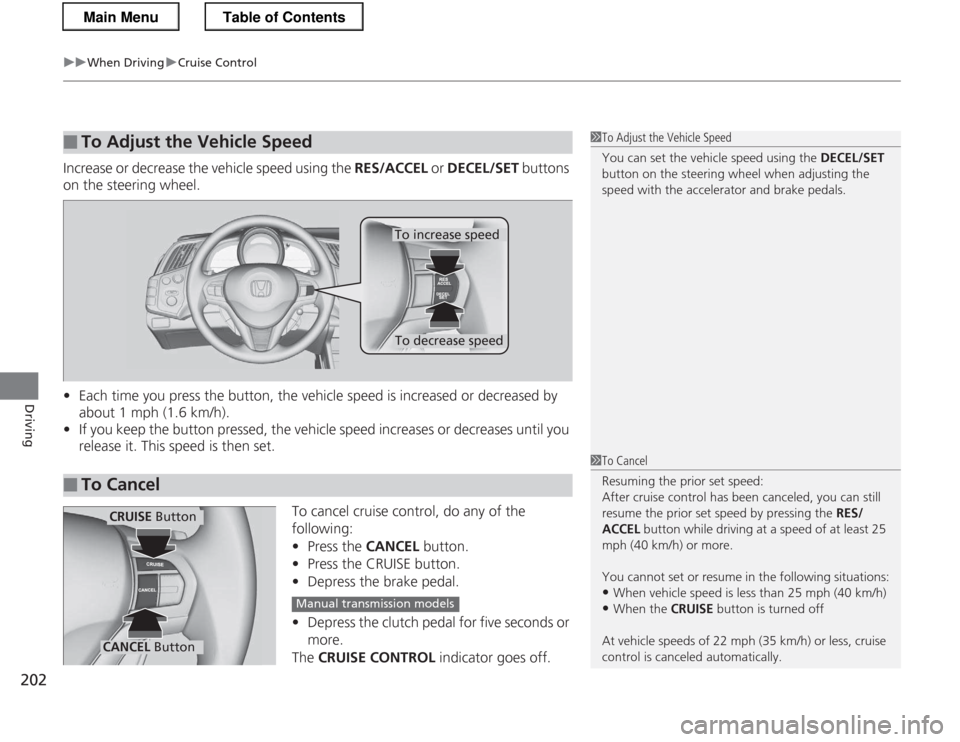
Increase or decrease the vehicle speed using the RES/ACCEL or DECEL/SET buttons
on the steering wheel. • Each time you press the button, the vehicle speed is increased or decreased by
about 1 mph (1.6 km/h).
• If you keep the button pressed, the vehicle speed increases or decreases until you
release it. This speed is then set.
To cancel cruise control, do any of the
following: • Press the CANCEL button.
• Press the CRUISE button.
• Depress the brake pedal.
• Depress the clutch pedal for five seconds or more.
The CRUISE CONTROL indicator goes off.
■To Adjust the Vehicle Speed1To Adjust the Vehicle Speed
You can set the vehicle speed using the DECEL/SET
button on the steering wheel when adjusting the
speed with the accelerator and brake pedals.
■To Cancel
To decrease speed
To increase speed
1To Cancel
Resuming the prior set speed:
After cruise control has been canceled, you can still
resume the prior set speed by pressing the RES/
ACCEL button while driving at a speed of at least 25
mph (40 km/h) or more.
You cannot set or resume in the following situations: • When vehicle speed is less than 25 mph (40 km/h)
• When the CRUISE button is turned off
At vehicle speeds of 22 mph (35 km/h) or less, cruise control is canceled automatically.
CRUISE Button
CANCEL Button
Manual transmission models
Main MenuTable of Contents
Page 204 of 325
203
uuWhen DrivinguVSA® (Vehicle Stability Assist), aka ESC (Electronic Stability Control), System
Continued
Driving
VSA ® (Vehicle Stability Assist), aka ESC (Electronic
Stability Control), System VSA ® helps to stabilize the vehicle during cornering if the vehicle turns more or less
than what was intended. It also assists in maintaining traction on slippery surfaces. It does so by regulating engine output and selectively applying the brakes.
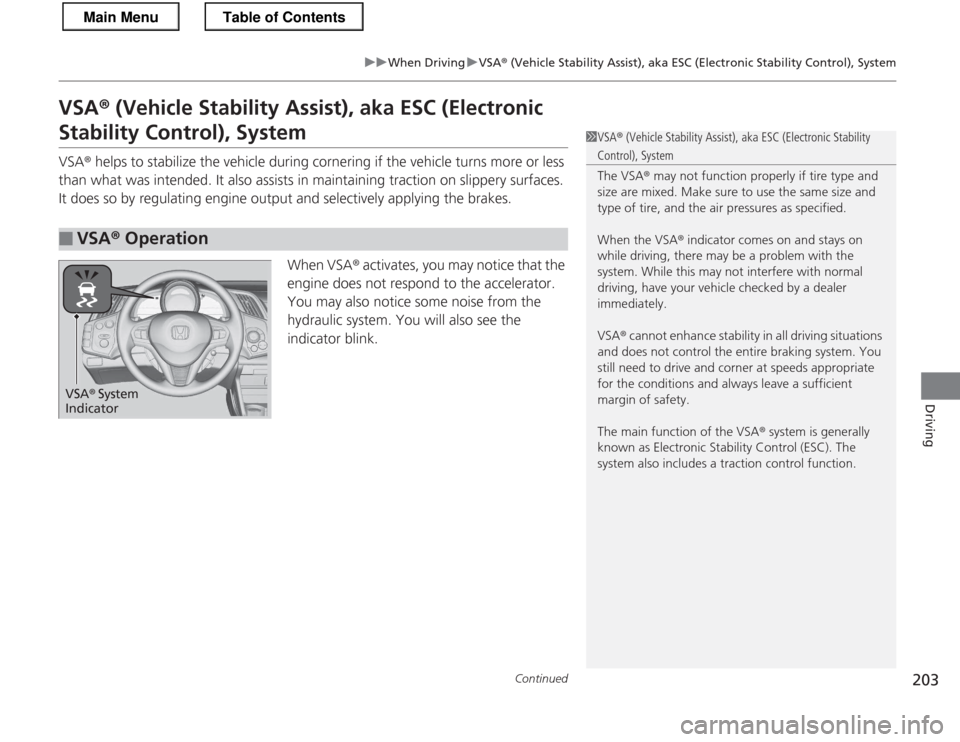
When VSA® activates, you may notice that the
engine does not respond to the accelerator.
You may also notice some noise from the
hydraulic system. You will also see the
indicator blink.
■VSA ® Operation
1VSA ® (Vehicle Stability Assist), aka ESC (Electronic Stability
Control), System
The VSA ® may not function properly if tire type and
size are mixed. Make sure to use the same size and
type of tire, and the ai r pressures as specified.
When the VSA ® indicator comes on and stays on
while driving, there may be a problem with the
system. While this may not interfere with normal
driving, have your vehicle checked by a dealer
immediately.
VSA ® cannot enhance stability in all driving situations
and does not control the entire braking system. You
still need to drive and cor ner at speeds appropriate
for the conditions and always leave a sufficient margin of safety.
The main function of the VSA ® system is generally
known as Electronic Stability Control (ESC). The
system also includes a traction control function.
VSA ® System
Indicator
Main MenuTable of Contents
Page 209 of 325
208
Driving
Braking
Brake System
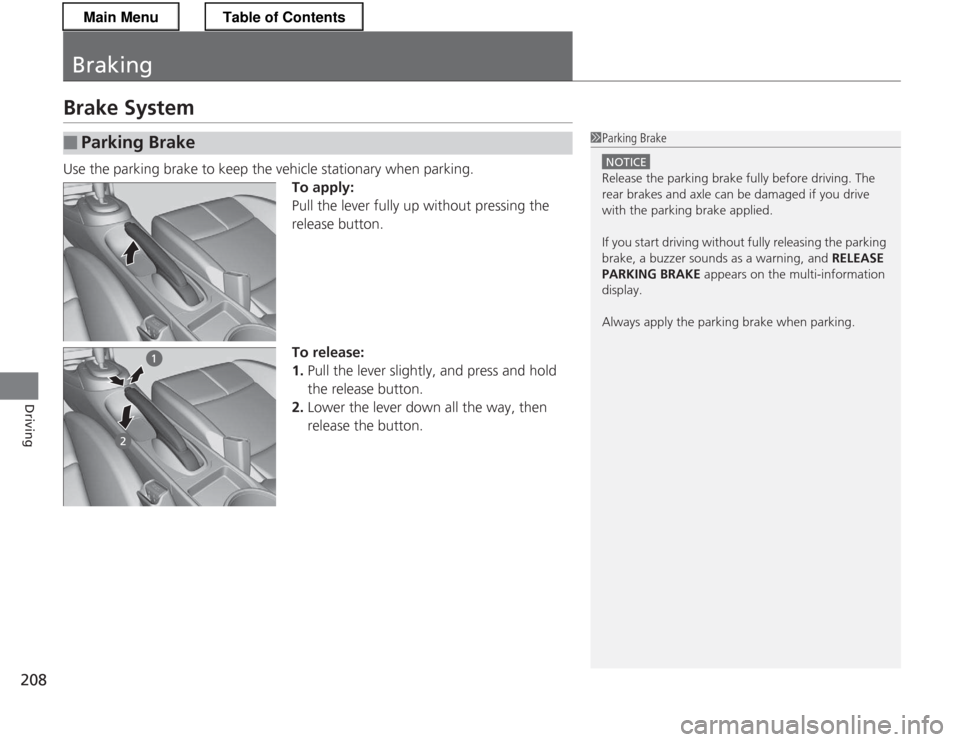
Use the parking brake to keep the vehicle stationary when parking.To apply:
Pull the lever fully up without pressing the release button.
To release: 1.Pull the lever slightly, and press and hold the release button.
2. Lower the lever down all the way, then release the button.
■Parking Brake1Parking Brake
NOTICE
Release the parking brake fully before driving. The
rear brakes and axle can be damaged if you drive
with the parking brake applied.
If you start driving without fully releasing the parking
brake, a buzzer sounds as a warning, and RELEASE
PARKING BRAKE appears on the multi-information
display.
Always apply the parking brake when parking.
Main MenuTable of Contents
Page 210 of 325
209
uuBrakinguBrake System
Driving
Your vehicle is equipped with disc brakes at all four wheels. A vacuum power assist
helps reduce the effort needed on the brake pedal. The brake assist system increases
the stopping force when you depress the brake pedal hard in an emergency
situation. The anti-lock brake system (ABS) helps you retain steering control when braking very hard. 2 Brake Assist System P. 211
2 ABS (Anti-lock Brake System) P. 210
■Foot Brake1Foot Brake
Check the brakes after driving through deep water,
or if there is a buildup of road surface water. If
necessary, dry the brakes by lightly depressing the
pedal several times.
If you hear a continuous metallic friction sound when
applying the brakes, the brake pads need to be
replaced. Have the vehicle checked by a dealer.
Constantly using the brake pedal while going down a
long hill builds up heat, which reduces the brake
effectiveness. Apply engine braking by taking your
foot off the accelerator pedal and downshifting to a
lower gear. With manual transmission use a lower
gear for greater engine braking.
Do not rest your foot on the brake pedal while
driving, as it will lightly apply the brakes and cause
them to lose effectiveness over time and reduce pad
life. It will also confuse drivers behind you.
Main MenuTable of Contents