type r HONDA INTEGRA 1994 4.G User Guide
[x] Cancel search | Manufacturer: HONDA, Model Year: 1994, Model line: INTEGRA, Model: HONDA INTEGRA 1994 4.GPages: 1413, PDF Size: 37.94 MB
Page 364 of 1413
Mainshaft Assembly
Clearance Inspection
NOTE: lf replacement is required. always replace the
synchro sleeve and the synchro hub as a set.
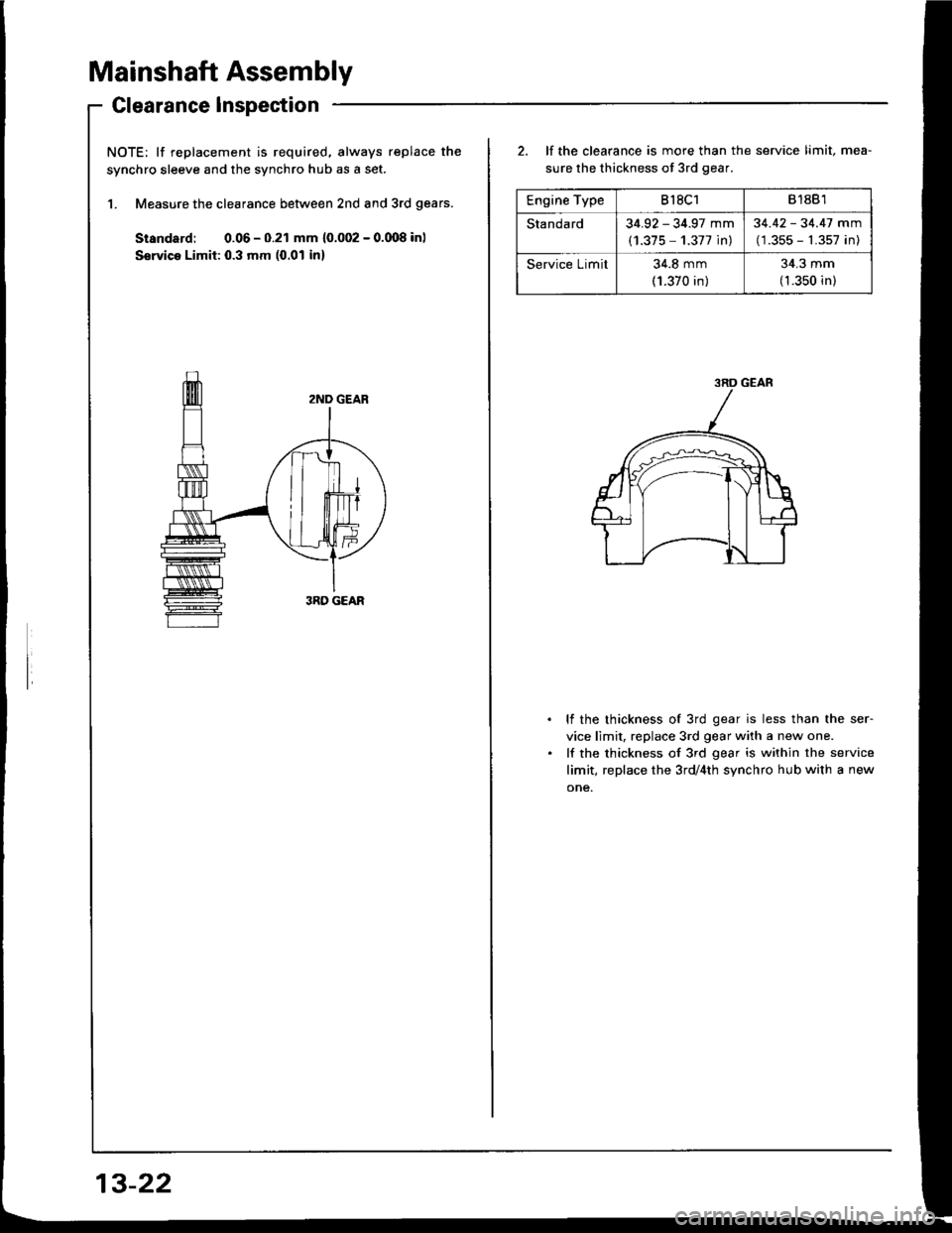
1. Measure the clearance between 2nd and 3rd gears.
Standard: 0.06 - 0.21 mm {0.002 - 0.008 inl
Ssrvica Limit: 0.3 mm (0.01 in)
13-22
Engine Type818C181881
Standard34.92 - 34.97 mm
(1.375 - 1.377 in)
34.42 - 34.47 mm
(1.355 - 1.357 in)
Service Limit34.8 mm
(1.370 in)
34.3 mm(1.350 in)
2. lf the clearance is more than the service limit, mea-
sure the thickness of 3rd gear.
lf the thickness of 3rd gear is less than the ser-
vice limit, replace 3rd gear with a new one.
lf the thickness of 3rd gear is within the service
limit, replace the 3rd/4th synchro hub with a new
one.
3RD GEAR
Page 365 of 1413
1.
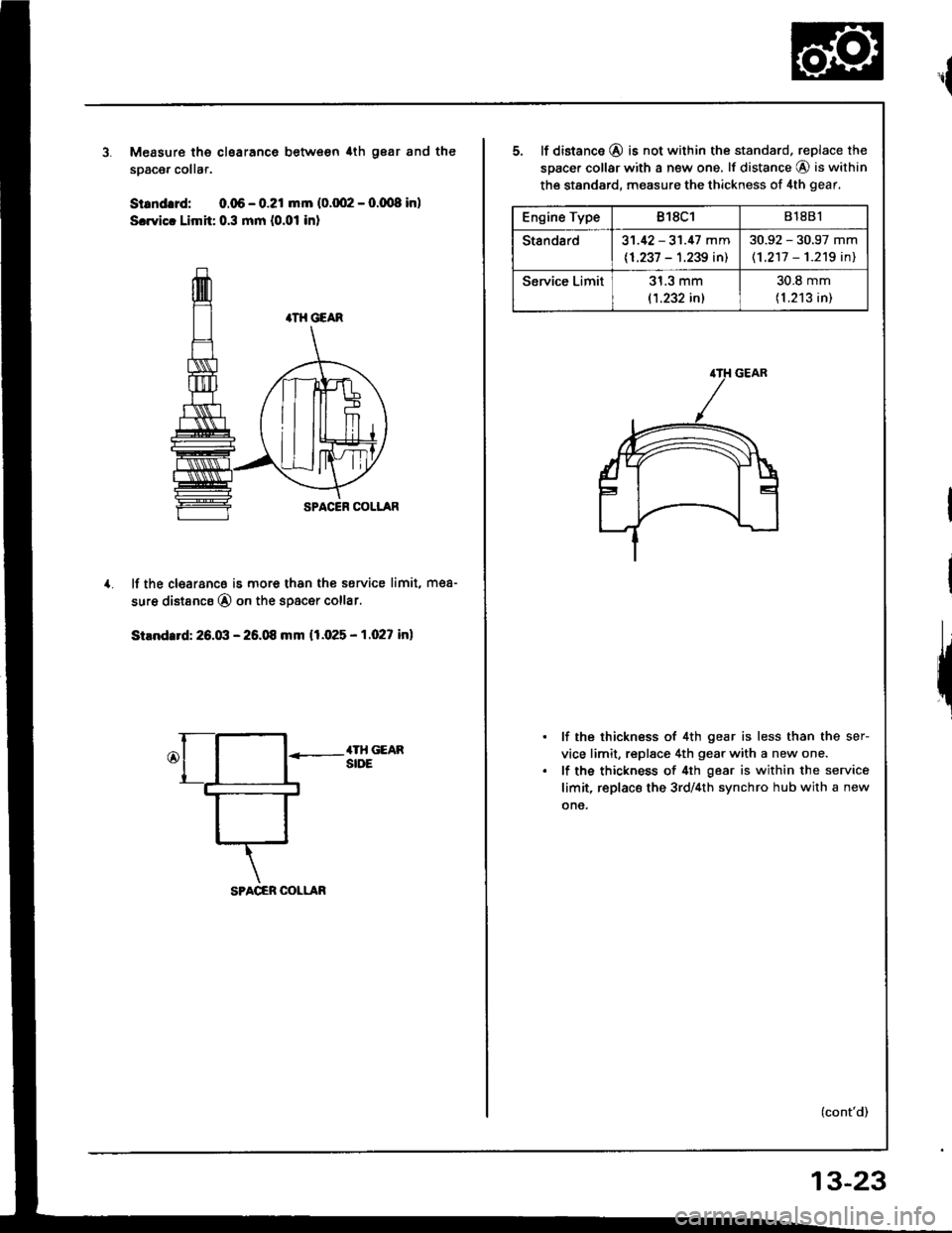
Measure the clsarance betw€en,lth gear and the
soacer collar.
St.ndffd: 0.06 - 0.21 mm (0.002 - 0.(xt8 in)
Scwicr Limh: 0.3 mm (0.01 in)
lf the clearanc8 is more than the service limit, mea-
sure distance @ on the spacer collar
Stlnd.rd: 26.03 - 26.m mm 11.025 - 1.027 in)
SPACER GOLLAR
,,1
5. lf distance O is not within the standard, replace the
spacer collar with a n€w one. lf distance @ is within
th€ standard, measure the thickness of 4th gear.
lf the thickness of 4th gear is less than the ser-
vice limit, replace 4th gear with a new one.
lf the thickness of 4th gear is within the service
limit, replaco the 3rdl4th synchro hub with a new
one.
(cont'd)
Engine Type818C181881
Standard31.42 - 31.47 mm
(1.237 - 1.239 in)
30.92 - 30.97 mm
\1.211 - '1.2'19 inl
Service Limit31.3 mm
l'1.232 inl
30.8 mm
(1.213 in)
13-23
Page 367 of 1413
- Disassembly
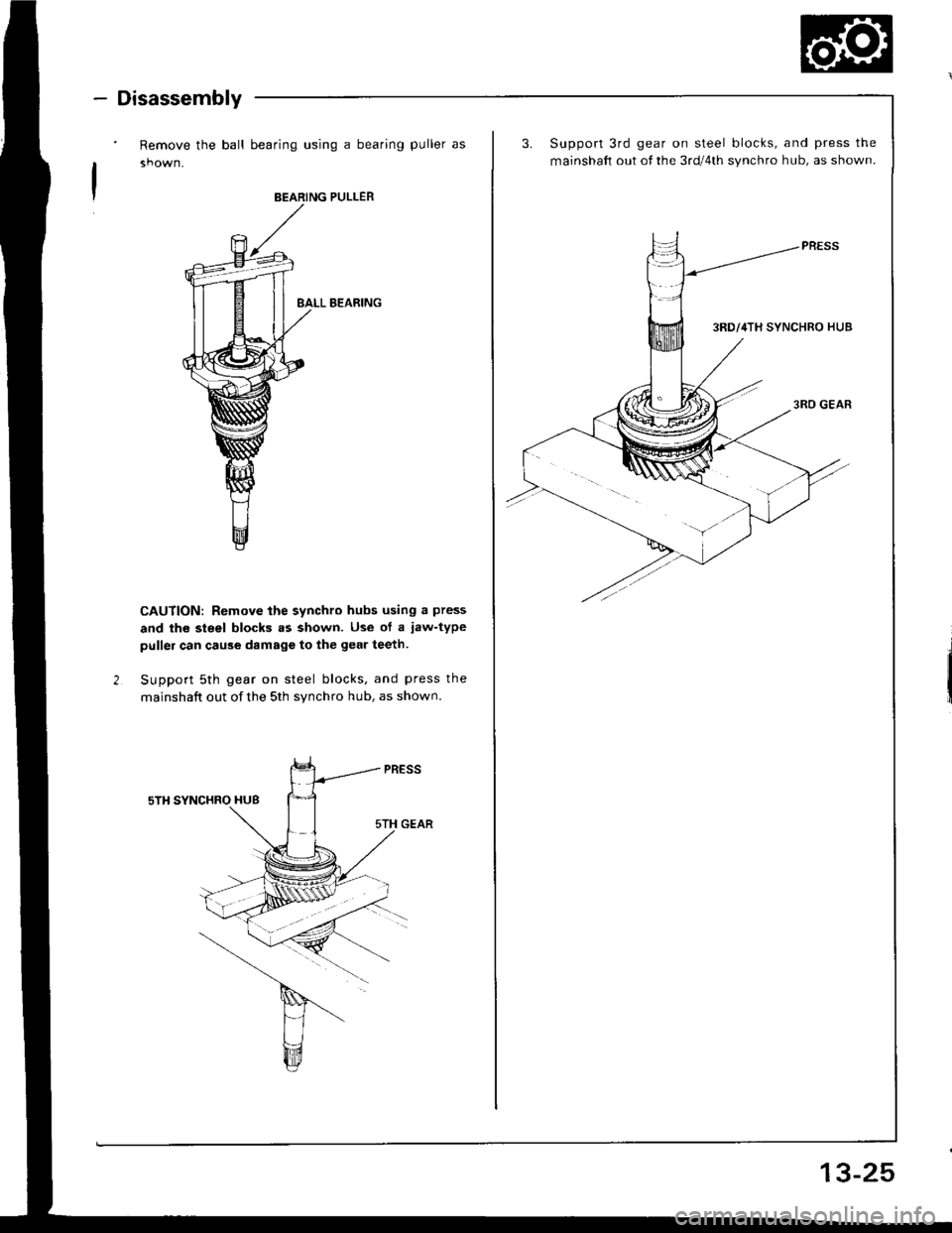
Remove the ball bearing using a bearing puller as
BEARING PULLER
BALL B€ARING
CAUTION: Remove the synchro hubs using a press
and the steel blocks .s shown. Use of a jaw-type
puller can cau3e damags to the gear teeth.
Support 5th gear on steel blocks, and press the
mainshaft out of the 5th synchro hub, as shown.
3.Support 3rd gear on steel blocks, and press the
mainshaft out of the 3rd/4th synchro hub, as shown.
13-25
Page 396 of 1413
![HONDA INTEGRA 1994 4.G User Guide Description
(contd)
Gear Selection
The selector lever has seven posirions; E PARK, E REVERSE, N NEUTRAL, @ 1st through 4th positions. E 1st
through 3rd positions, Ql2nd gear and [] 1st gear.
Starting](/img/13/6067/w960_6067-395.png "HONDA INTEGRA 1994 4.G User Guide Description
(contd)
Gear Selection
The selector lever has seven posirions; E PARK, E REVERSE, N NEUTRAL, @ 1st through 4th positions. E 1st
through 3rd positions, Ql2nd gear and [] 1st gear.
Starting")
Description
(cont'd)
Gear Selection
The selector lever has seven posirions; E PARK, E REVERSE, N NEUTRAL, @ 1st through 4th positions. E 1st
through 3rd positions, Ql2nd gear and [] 1st gear.
Starting is possible only in @ and I Oosition through use ot a slide-type, neutral-safety switch.
Automatic Tlansaxle {A/T) Gear Position Indicatol
A/T gear pos;tion indicator in the instrumenl panel shows what gear has been selected without having look down at
the console.
Position Description
l3?]] PARK Front wheels locked; parking pawl engaged with parking gear on countershatt. All clutches
reteaseo,
[R] REVERSE Reverse; reverse selector engaged with countershalt reverse gear and 4th clutch locked.
N NEUTRAL All clurches released.
D+l DRIVE General driving; starts off in 'lst, shifts automatically to 2nd, 3rd, then 4th, depending on vehicle
('lst through 4th) speed and throttle position. Do'vnshifts through 3rd, 2nd and 1st on deceleration to stop.
The lock-up mechanism comes into operation in 2nd, 3rd and 4th when the transmission in lDtposrtron.
Dgi DRIVE For rapid acceleration at highway speeds and general driving; starts off in 1st. shifts automatical-(1st through 3rd) ly to 2nd then 3rd, depending on vehicle speed and throttle position. Downshifts through lower
gears on deceleration to stop. The lock-up mechanism comes into operation in 3rd.
El SECOND Driving in 2nd geari stays in 2nd gear, does not shift up and down.
For engine braking or better traction starting off on loose or slippery surfece.
L]l FIRST Driving in 1st gear; stays in lst gear, does not shilt up.
For engine braking.
14-4
Page 479 of 1413
PROBABLE CAUSE
1Shitt cable broken/out of adiustment.
Throttle cable too short.
Throttle cable too long.
Wrong type ATF.
ldle rpm too low/high.
o.Oil pump worn or binding.
7.Pressure regulator stuck.
8.l st clutch detective.
9.2nd clutch detective.
10.3rd clutch defective.
114th clutch defective.
12.1 st'hold clutch defective.
13.Mainshatt worn/damaged.
14.Modulator valve stuck.
Throttle valve B stuck.
lo.ATF strainer clogged.
Toroue converter def ective.
18.Torque converter check valve stuck.'I 9.1-2 shift valve stuck.
2-3 shift valve stuck.
213-4 shift valve stuck.
Servo control valve stuck.
23.Clutch Dressure control (CPC) valve stuck.
2-3 orifice control valve stuck.
Orifice control valve stuck.
26.3-2 kick-down valve stuck.
27.4-3 kick-down valve stuck.
24.4th exhaust valve stuck.
29.1st accumulator detective.
30.2nd accumulator detective.
313rd accumulator defective.
4th accumulator defective.
1 st-hold accumulator defective.
Servo valve stuck.
35.Lock-up timing B valve stuck.
36.Lock-up shift valve stuck.
37.Lock-uo control valve stuck.
38.Shift fork benr.
39.Reverse gears worn/damaged (3 gears).
40.Reverse selectot worn.
413rd gears worn/damaged (2 gears).
Final qears worn/damaged (2 gearsl.
43.Differential Dinion shatt worn.
44.Feedpipe O-ring broken.
45.4th qears worn/damaged (2 gearsl
Gear clearance incorrect.
47.Clutch clearance incorrect.
48.One-way (sprag) clutch defective.
49.Sealinq rings/quide worn.
50.Axle-inboard joint clip missing.
Page 596 of 1413
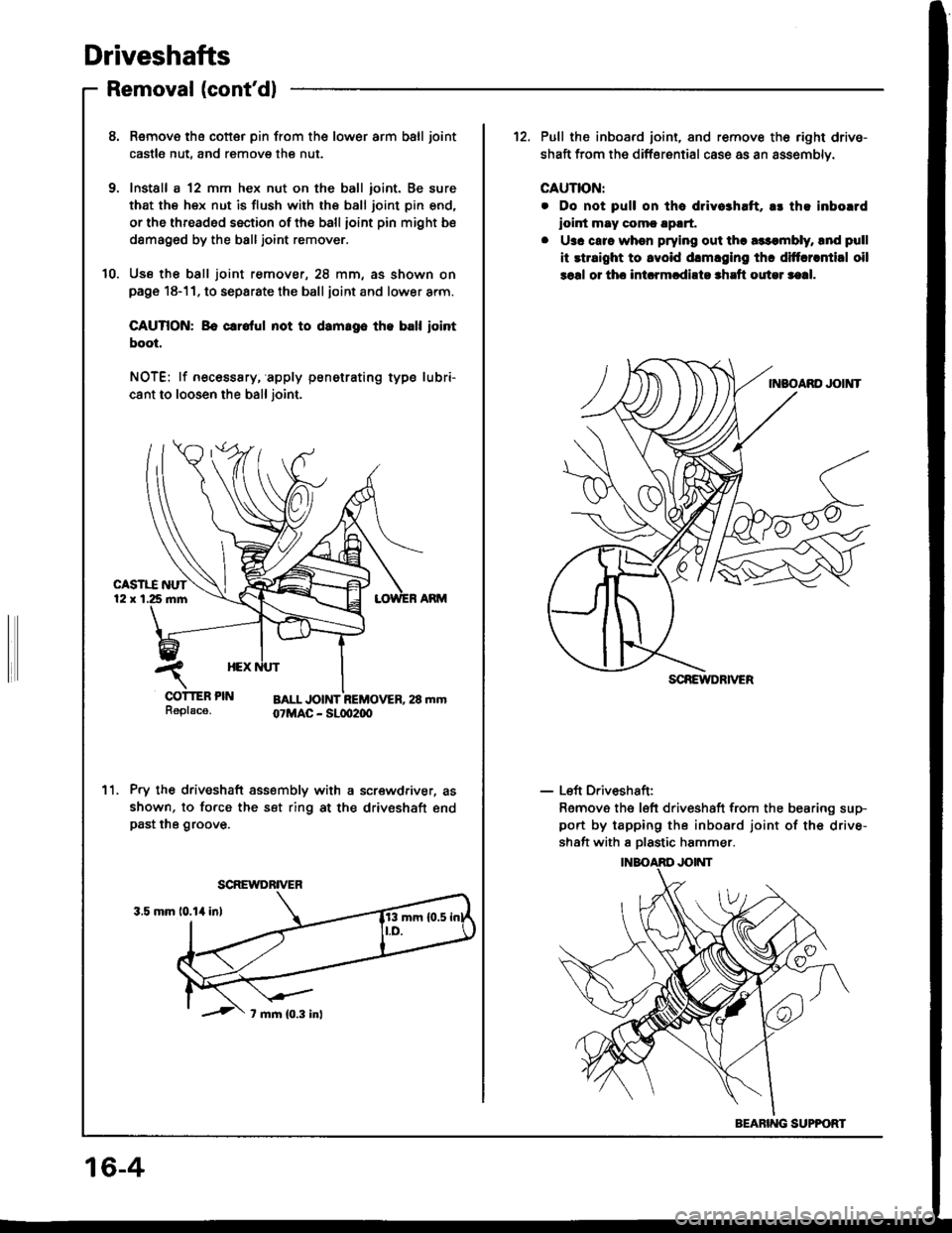
Driveshafts
Removal (cont'dl
8. Remove tha cotter pin from the lower arm ball joint
castle nut, and remove the nut.
9. Install a 12 mm hex nut on the ball ioint. Be sure
that the hex nut is flush with the ball joint pin end,
or the threaded section of the ball ioint pin might be
damag6d by the balljoint remover.
10. Use th€ ball joint remover, 28 mm, as shown onpage 18-11. to separate the ball joint and lower arm.
CAUTION: Bo crrolul not to damrgo th. ball iointboot.
NOTE: lf necesssry, apply penetrating type lubri-
cant to loosen the ball joint.
Pry the driveshaft assembly with a screwdriver, as
shown, to force the set ring at the driveshaft endpast the groove.
11.
SCREWDRIVER
12. Pull the inboard joint, and remove th6 right drive-
shaft from the differential case as an assemblv.
CAUTION:
. Do not pull on tha dlivo3haft, a! th! inborrd
ioint may comc !p!rt,
. U3c carc when prying out tha a$qnbly, lnd pull
it rtraight to lvoid drmlging thc diftcrrntial oil
soal or thc int.rmcdirto shrft outel saal.
- Left Driveshaft:
Remove the left driveshaft from the bearing sup-
port by tapping the inboard joint of the drive-
shaft with I Dlastic hammer.
SCREIYDRIVER
BEARING SUPPOFT
16-4
Page 597 of 1413
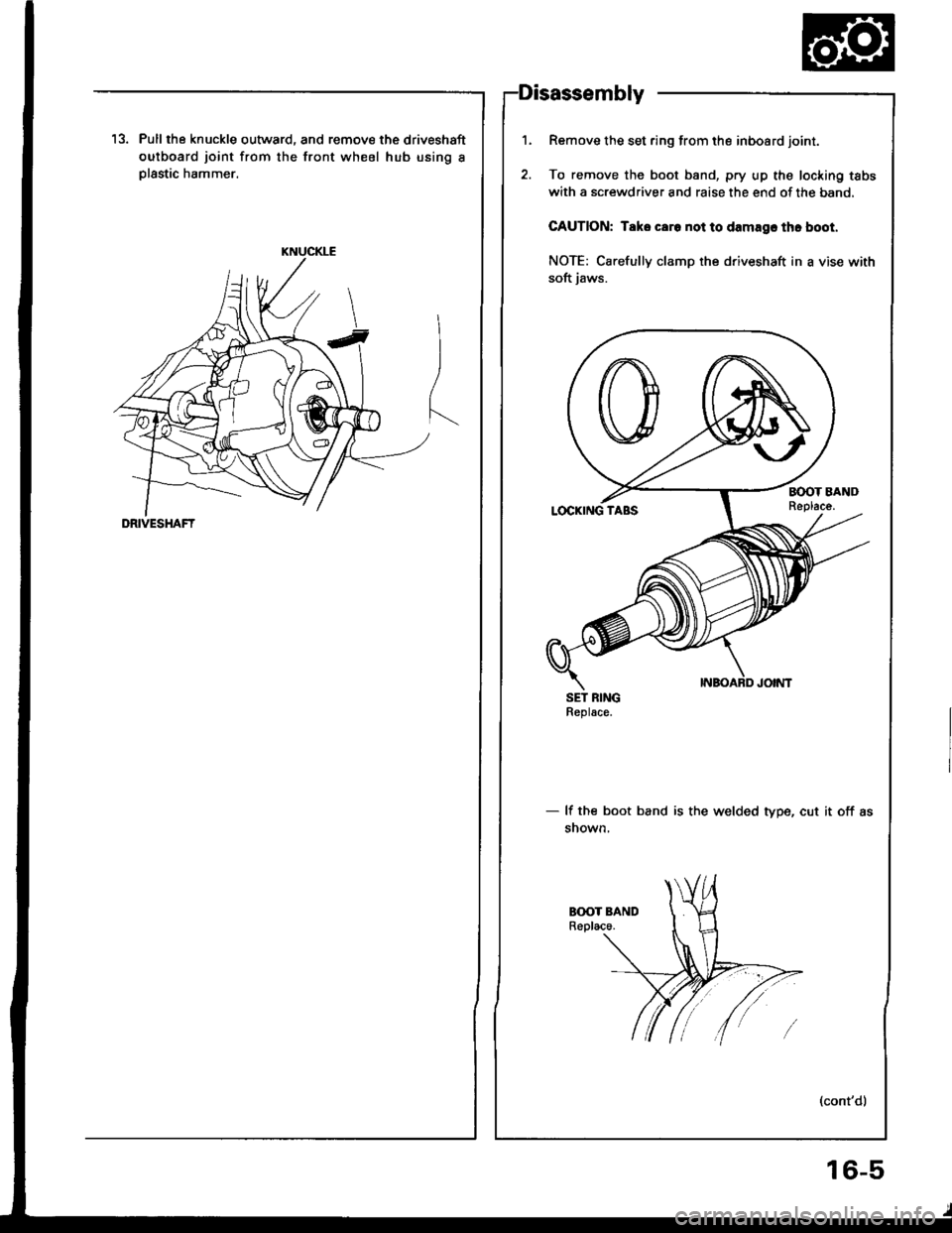
KNUCKLE
DRIVESHAFT
13. Pull the knuckle outward, and remove the driveshaft
outboard joint from the front wheel hub using I
Dlastic hammer.
Remove the set ring from the inboard joint.
To remove the boot band, pry up the locking tabs
with a screwdriver and raise the end of the band,
CAUTION: Taks caro not to damagc thc boot.
NOTE: Carefully clamp the driveshaft in a vise with
soft iaws.
SET RINGReplace.
- lf the boot band is the welded type, cut it off as
snown,
1.
16-5
Page 611 of 1413
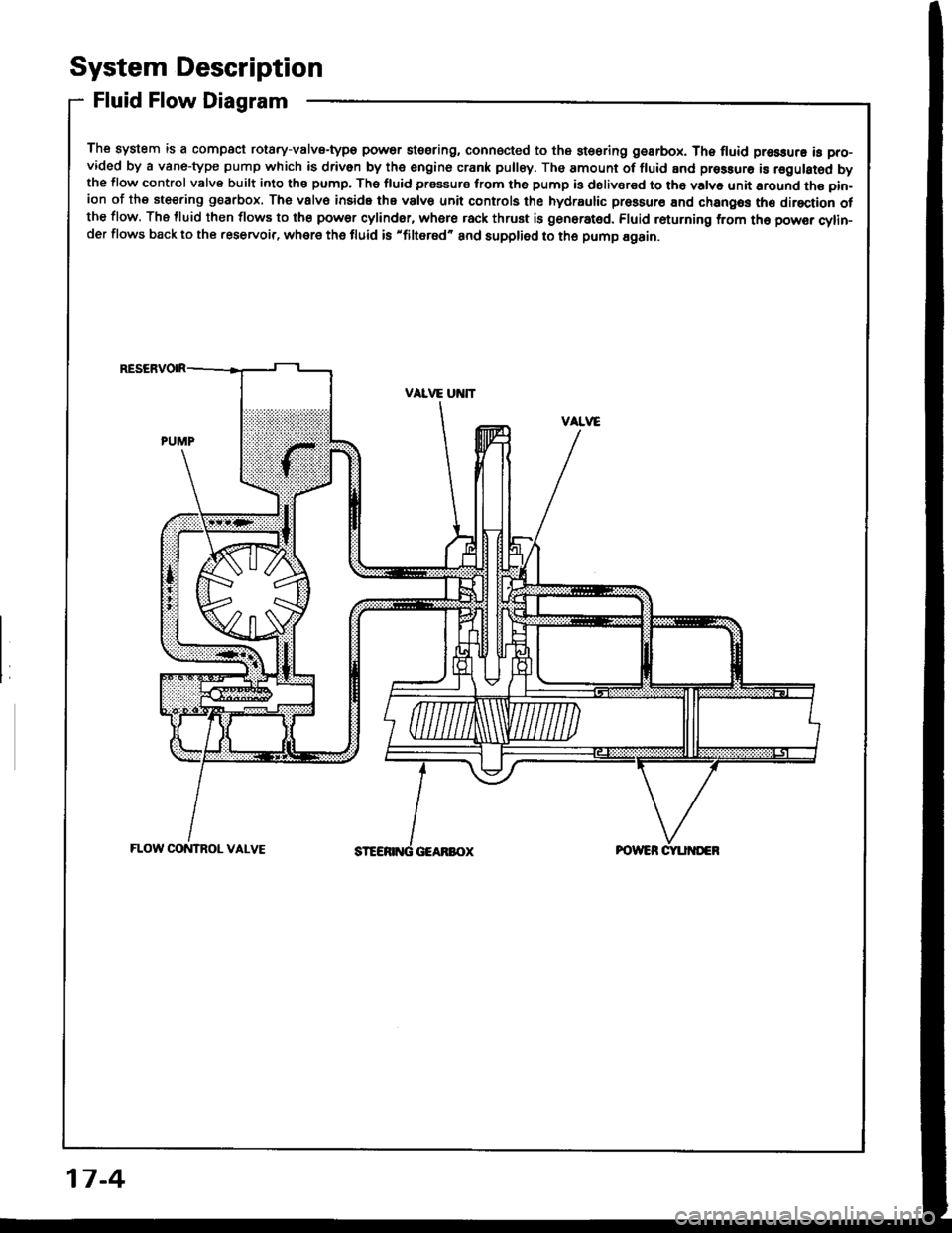
System Description
Fluid Flow Diagram
The system is a compact rotary-valvs-type power stssring, connocted to the st€oring gearbox. Th6 fluid pressure is pro-vided by a vane-type pump which is driven by the engine crank pulley. The amount of fluid and pressurs is regulsted bythe flow control valve built into ths pump, The fluid prssaurs from th6 pump is dolivsred to tho valve unit sround the pin-ion of the steering g€arbox. The vslv€ inside the valvs unit controls the hydraulic prossur€ End changos the direction otthe flow. The fluid then flows to the power cylinder, where rack thrust is gen6rat6d. Fluid returning from th6 powsr cylin-der flows back to the .eservoir, where the fluid is 'filtered" and supplied to the pump Egain.
17-4
Page 612 of 1413
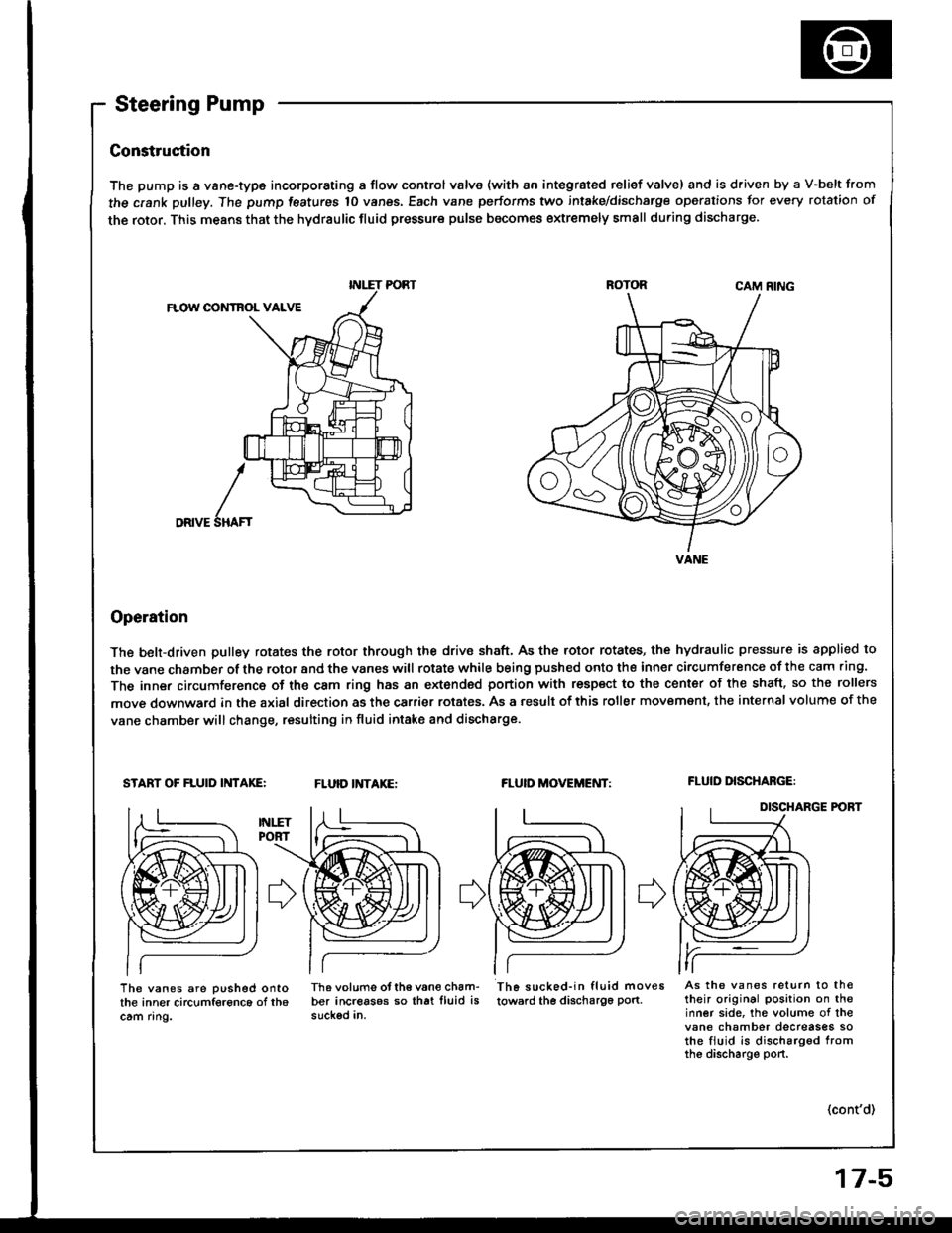
Construetion
The pump is a vane-type incorporating a flow control valve (with an integrated relief valve) and is driven by a V-belt from
the crank pulley. The pump features 10 vanes, Each vane performs two intake/dischsrge operations for every rotation of
the rotor. This means that the hydraulic fluid pressure pulse becomes extremely small during discharge.
CAM RING
FLOW CONTBOL VALVE
DRIVE
Operation
The belt-driven pulley rotates the rotor through the drive shaft, As the rotor rotates, the hydraulic pressure is applied to
the vane chamber of the rotor and the vanes witl rotate while being pushed onto the inner circumference of the cam .ing.
The inner circumference of the cam ring has an extonded portion with respect to the center of the shaft. so the rollers
move downward in the axial direction as the carrier rotates. As a result of this roller movemsnt, the internal volume of the
vane chamber will change, resulting in fluid intake and discharge.
START OF FLUID INTAKE:FLUID INTAKE:FLUID MOVEMENT:FLUID DISCHABGE:
DISCHARGE P('BT
I
SHAF'
The vanes are pushed ontothe inner circumference of th6cam ring.
Th6 volums otth€ van€ cham-ber increasos so that lluid issuckod in.
Th6 sucked-in fluid moves
towsrd the discha196 pon.As the vanes return to th€their original position on theinner side, the volume of thevane chamber decreases sothe fiuid is discharg6d fromthe discharge port.
(cont'd)
INLET PORT
VANE
Page 615 of 1413
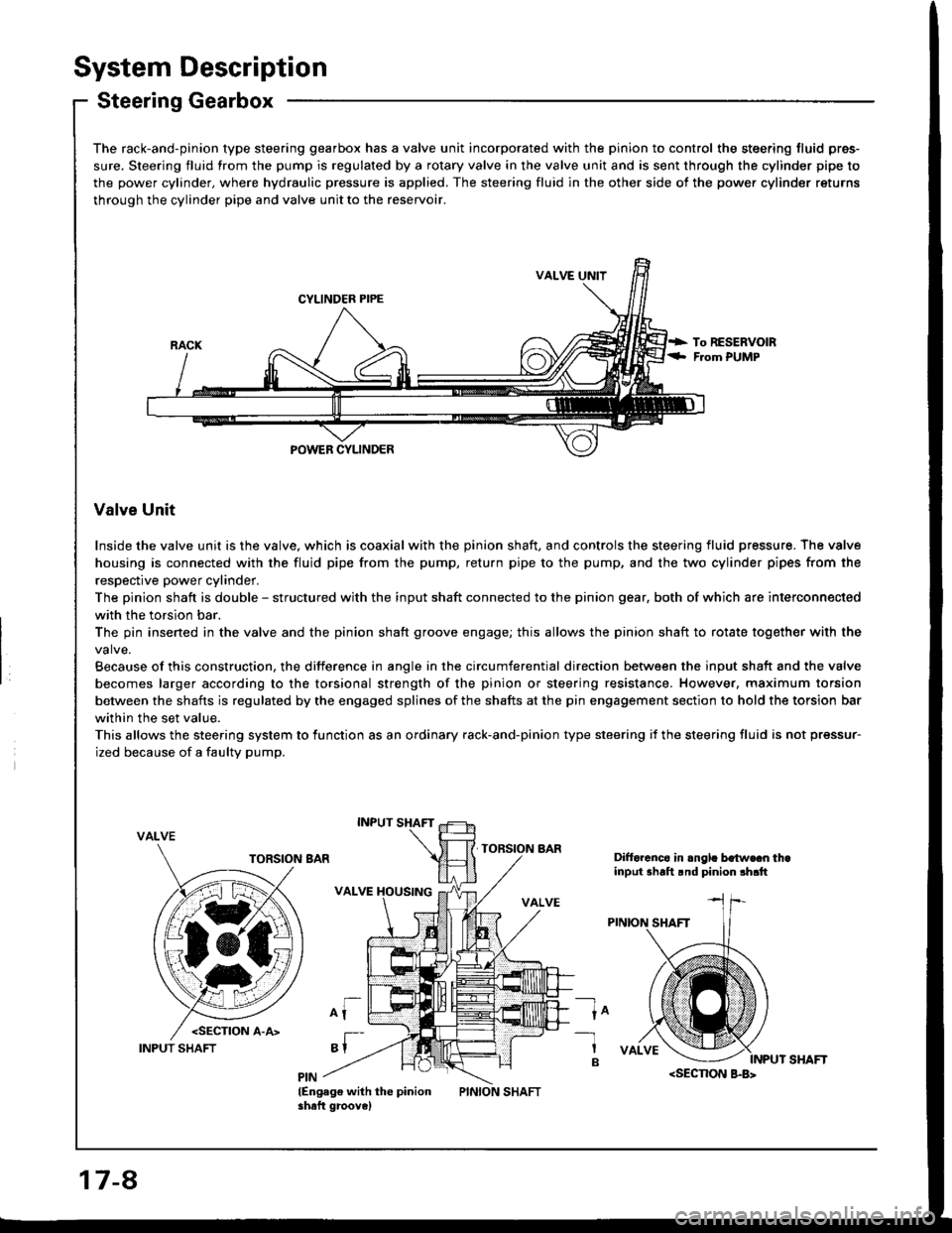
System Description
Steering Gearbox
The rack-and-pinion type steering gearbox has a valve unit incorporated with the pinion to control the steering fluid pres-
sure. Steering fluid from the pump is regulated by a rotary valve in the valve unit and is sent through the cylinder pipe to
the power cylinder, where hydraulic pressure is applied. The steering fluid in the other side of the power cylinder returns
through the cylinder pipe and valve unit to the reservoir.
VALVE UNIT
CYLINDER PIPE
POWEB CYLINDER
Valve Unit
Inside the valve unit is the valve, which is coaxial with the pinion shaft, and controls the steering fluid pressure. The valve
housing is connected with the fluid pipe from the pump, return pipe to the pump, and the two cylinder pipes from the
respective power cylinder.
The pinion shaft is double - structured with the input shaft connected to the pinion gear, both of which are interconnected
with the torsion bar.
The pin insened in the valve and the pinion shaft groove engage; this allows the pinion shaft to rotate together with the
Because of this construction, the difference in angle in the circumferential direction between the input shaft and the valve
becomes larger according to the torsional strength of the pinion or steering resistance. However, maximum torsion
between the shafts is regulated by the engaged splines of the shafts at the pin engagement section to hold the torsion bar
within the set value.
This allows the steering system to lunction as an ordinary rack-and-pinion type steering if the steering fluid is not pressur-
ized because of a faulty pump.
VALVE
Difforcnco in .ngl. bo{w€cn thainput shalt rnd pinion !h.tt
ln-1
B
lEngag€ with the pinionshaft groove)
17-8
INPUT SHAFT