brake HONDA INTEGRA 1998 4.G Manual PDF
[x] Cancel search | Manufacturer: HONDA, Model Year: 1998, Model line: INTEGRA, Model: HONDA INTEGRA 1998 4.GPages: 1681, PDF Size: 54.22 MB
Page 770 of 1681
Inspection
rrii tlmm {0.4 inl10
l.
Rear Brake Disc
Disc Runout Inspection
Loosen the rear wheel nuts slightly, then raise the
vehicle and support it on safety stands. Remove the
rear wneers.
Remove the brake pads (see page 19-16).
Inspect the disc surface for damage or cracks. Clean
the disc thoroughly and remove all rust.
Use wheel nuts and suitable plain washers to hold
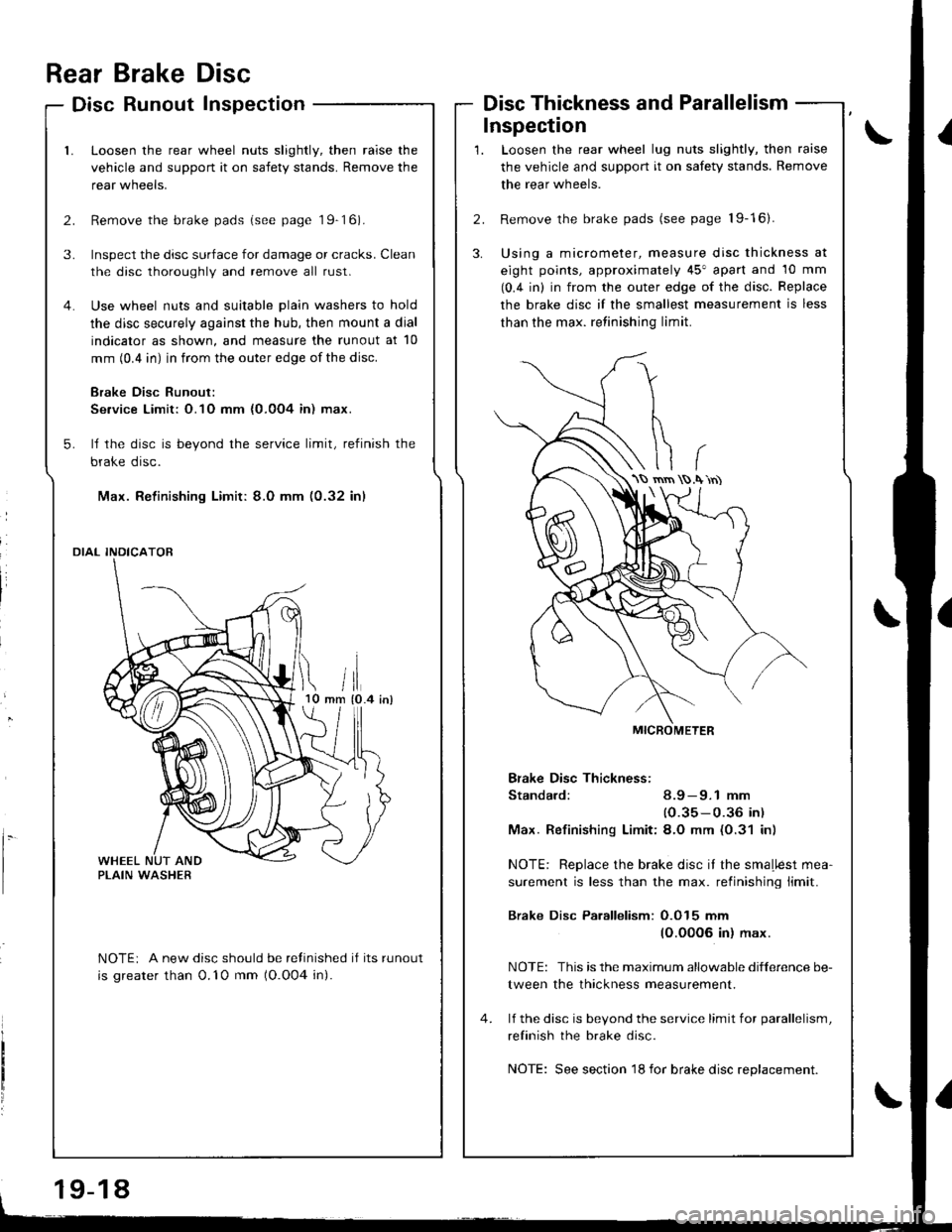
the disc securely against the hub, then mount a dial
indicator as shown, and measure the runout at 10
mm (0.4 in) in from the outer edge of the disc.
Brake Disc Runout:
Se.vice Limit: O.1O mm {0.0O4 in) max.
ll the disc is beyond the service limit, refinish the
brake disc.
Max. Refinishing Limit: 8.0 mm (0.32 in)
DIAL INDICATOR
NOTEi A new disc should be refinished if its runout
is greater than 0.'10 mm (O.O04 in).
Disc Thickness and Parallelism
Loosen the rear wheel lug nuts slightly, then raise
the vehicle and support it on safety stands. Remove
the rear wheels.
Remove the brake pads (see page 19-16).
Using a micrometer, measure disc thickness at
eight points, approximately 45" apart and 10 mm
(0.4 in) in from the outer edge of the disc. Replace
the brake disc if the smallest measurement is less
than the max. retinishing limit.
Bfake Disc Thickness:
Standard: 8.9 - 9.1 mm
(0.35-0.36 in)
Max. Refinishinq Limit:8.O mm (0.31 in)
NOTE: Replace the brake disc it the smaLlest mea-
surement is less than the max. retinishing limit.
Brake Disc Parallelism: O.O15 mm
(O.00O6 in) max.
NOTE: This is the maximum allowable difference be-
tween the thickness measurement.
lf the disc is bevond the service limit for parallelism,
refinish the brake disc.
NOTE: See section 18 for brake disc replacement.
\S rnrn .\'rn)
19-18
Page 771 of 1681
Rear Brake Caliper
Disassembly/Reassembly
o Never use an air hose or dry brush to clean brake assemblies.o Use an OSHA-approv€d vacuum cleaner to avoid breathing brake dust.. Conlaminated brake discs or pads reduce stopping ability.. When reusing the pads, always reinstall the brake pads in their original positions to prevent loss of braking efficiency,
CAUTION: Do not spill brake fluid on the vehicle; it may damags the paint; it brake fluid does contast the paint, wash itoff immediately with water,
NOTE:
. Coat the piston. piston seal, and caliper bore with clean brake fluid.. Beplace all rubber parts with new ones whenever disassembled.o Clean all parts in brake fluid and air dry; blow out all passages with compressed air.a Before reassembling, check that all parts are free of dust and other foreign particles.
. Replace parts with new ones whenever specified to do so.. Make sure no dirt or other foreign matter is allowed to contaminate the brake fluid.. Always use Genuine Honda DOT3 Brake Fluid. Using a non-Honda brake fluid can cause corrosion and decrease the lifeof the svstem.
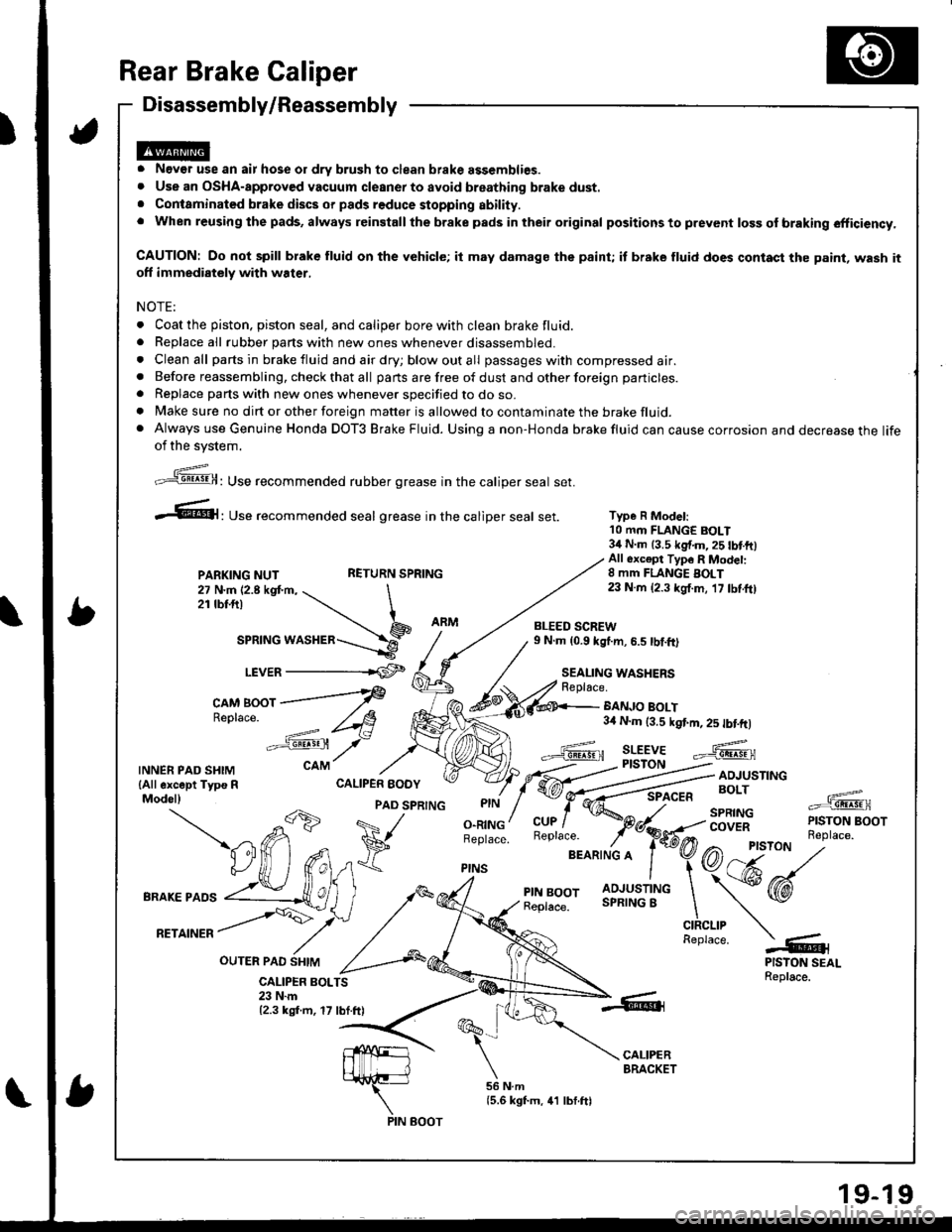
Type R Model:10 mm FLANGE BOLT34 N.m 13.5 kg{.m,25 tbtftlAll 6xc€pt Typ6 R Modet:8 mm FLANGE BOLT23 N.m {2.3 kgf.m, 17 tbf.ft)
BANJO BOLT3,0 N.m (3.5 kgt m, 2s tbtftl
Replace.
;,'"]@: Use recommended rubber grease in the caliper seal set.
.61, Use recommended seal grease in the catiper seal set.
PARKING NUTRETURN SPRING
27 N.m 12.8 kgt m, \2rtbt.frl \
ar"t"o *or"a"=-\9_r.r,e=
LEVER -------rCF
c^M Boor ---f
Re'lace
-==': /t8
"':sst /-
CALIPER BOLTS23 N.m12.3 kgf.m, 17 lbf.ft)
TNNERPADSHTM cAM
lAll except Typs R CALIPER EODYModel)
OUTER PAO SHIM
-db
PAD SPRTNG
a71 ^ V
BRAKEPA''
vUffifi*
,*,
^rrorr /Y'
,/ ^,
O.RINGBeplace.
PINS
BLEED SCREW9 N.m (0.9 kg{.m, 6.5 tbf.ft)
SEALING WASHERSReplace.
PIN BOOT
Page 772 of 1681
Brake Hoses/Lines
Inspection/Torque Specif icationsInspecuon/ | orque Dpecl carlon
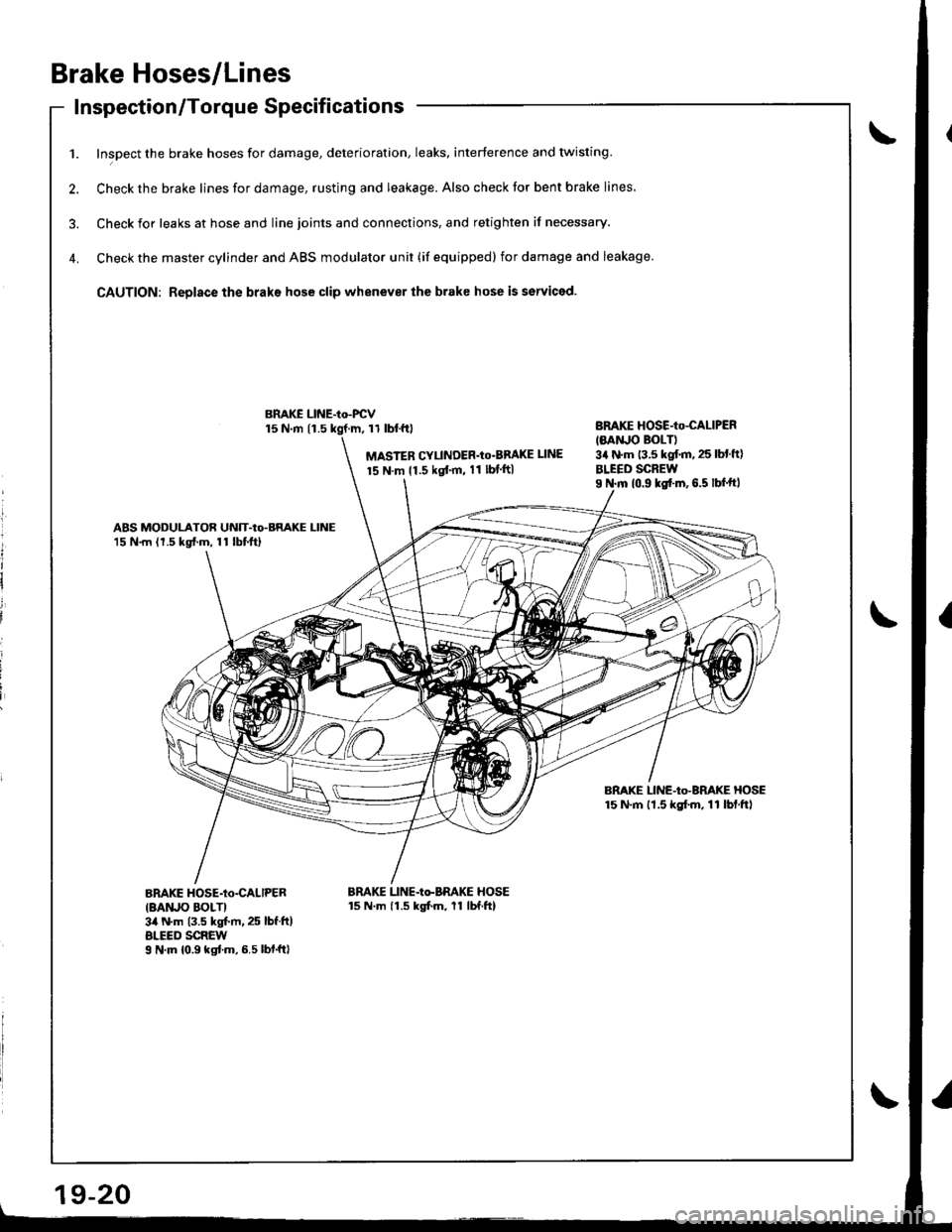
1. Inspect the brake hoses for damage, deterioration, leaks, interference and twisting
2. Check the brake lines for damage, rusting and leakage. Also check tor bent brake lines.
3. Check ior leaks at hose and line joints and connections, and retighten if necessary.
4. Check the master cylinder and ABS modulator unit (if equipped) for damage and leakage.
CAUTION: Replace the braks hose clip whenever the brake hose is serviced.
15 N.m 11.511 tbl.f0
MASTER CYLINDER'Io'BBAKE UNE
15 N.m {1.5 kgt'm, 11 lbf ft}
BnAKE HOSE-Io-CALIPER
IMNJO BOLTI3a N'm 13.5 kgf.m. 25 lbl ft)
BLEED SCREWI N.m 10.9 ks{.m,6.5 lbf.ftl
ABS MODULATOR UNIT-Io-BRAKE LINE15 N.m (1.5 kg{.m, 11 lbtftl
BRAKE LINE-Io-BRAKE HOSE15 N'm lt.5 kgf.m, 11 lbf.ftl
BnAKE HOSE-Io-CALIPER
IBAruO BOLTI3il N.m (3.5 kgt m, 25 lbf.ft)ALEED SCREWI N'm 10.9 kgtm,6.5lbf.ftl
BRAKE LINE-Io-BRAKE HOSE15 N.m 11.5 kgfm, 11 lbf.ftl
BMKE LINE-Io-FCV
l
It
I
i
i
i
Page 773 of 1681
Hose Replacement
CAUTION:
a Betore reassembling, check thal all parts are free of
dust and othet foreign particles.
a Replace parts with new ones whenever specilied tooo so.
a Do not spill brake tluid on the car; it may damage thepaint; if biake fluid does contact the paint, wash it
off immediatelv with water.
1. Replace the brake hose if the hose is twisted,
cracked, or il ir leaks.
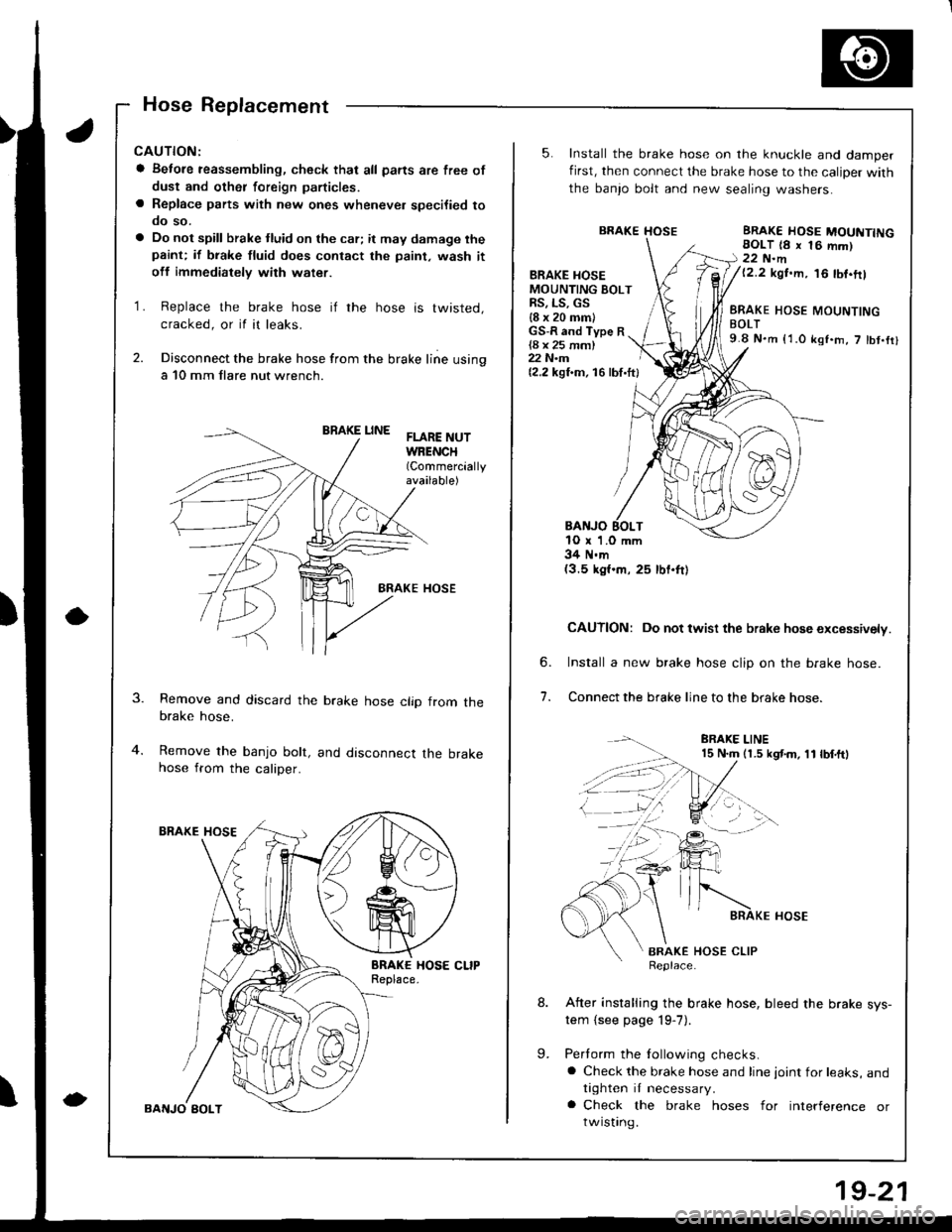
2. Disconnect the brake hose from the brake line using
a 10 mm llare nut wrench.
BRAKE LINEFLARE NUTWRENCH(Commercially
available)
BRAKE HOSE
Remove and discard the brake hose clip from thebrake hose.
Remove the banjo bolt, and disconnect the brakehose from the caliper.
5.
BRAKE HOSEMOUNTING BOLTRS, LS, GS{8 x 20 mm)
Install the brake hose on the knuckle and damper
first, then connect the brake hose to the caliDer with
the banjo bolt and new sealing washers.
BRAKE HOSEERAKE HOSE MOUNTINGEOLT 18 x 16 mm)22 N.m{2.2 kgt.m, 16 tbf.ftl
GS-R and Type R{8 x 25 mm)22 N.m(2,2 kgf.m, 16lbf.ftl
BANJO EOLTtO r 1.0 mm34 N.m(3.5 kgf.m, 25 lbf.ft)
CAUTION: Do not twist the brake hose excessively.
Install a new brake hose clip on the brake hose.
Connect the brake line to the brake hose.
6.
7.
BRAKE HOSE MOUNTINGBOLT9.8 N.m {'1.0 kst.m, 7 tbt.fi}
BRAKE LINE15 N.m (1.5 kgt m, 11 lbf.ftl
BRA(E HOSE CLIPReplace.
After installing the brake hose, bleed the brake sys-tem (see page 19-7).
Perlorm the following checks.a Check the brake hose and line joint for leaks, andtighten it necessary.
a Check the brake hoses for interference orrwrslrng.
.:2-.--l
L
19-21
Page 774 of 1681
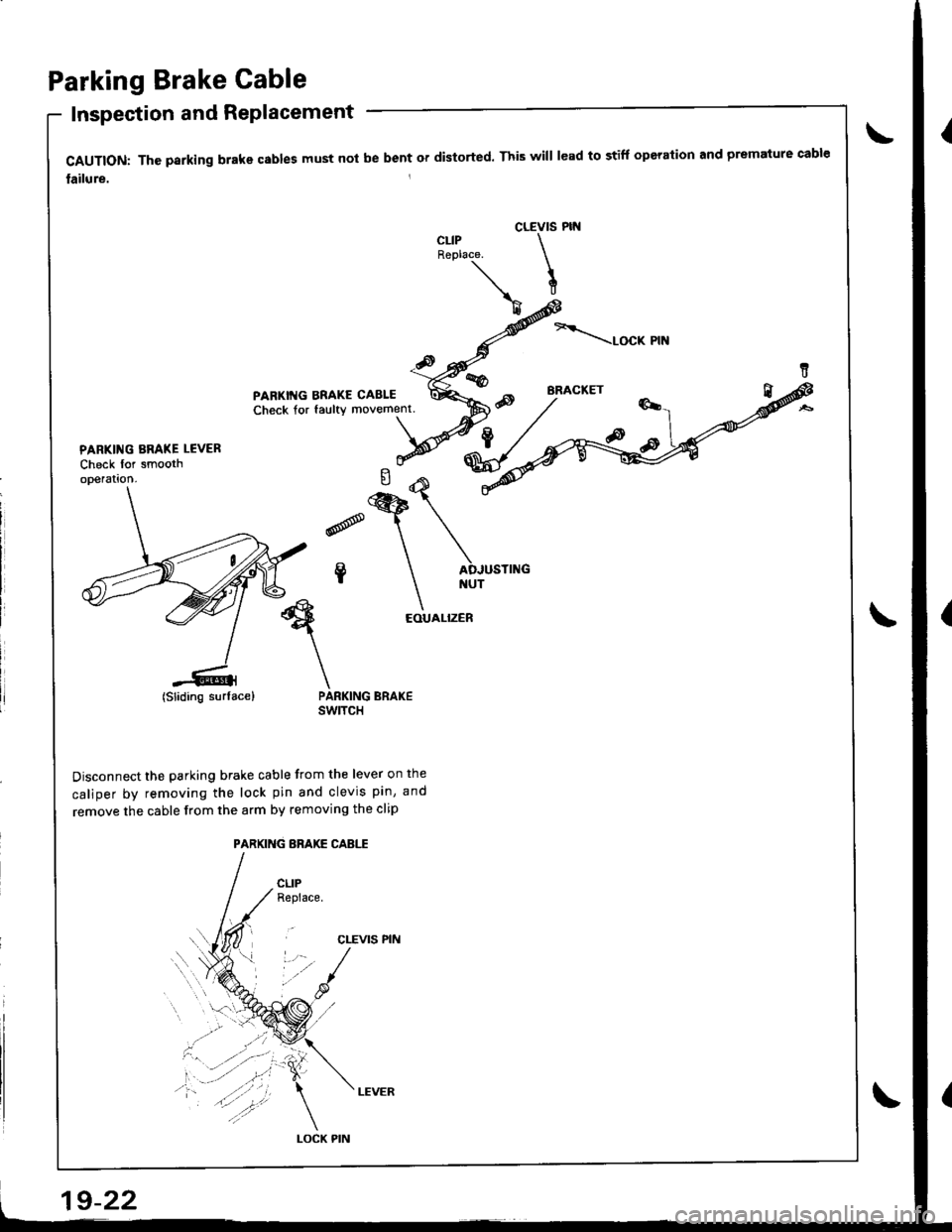
Parking Brake Cable
Inspection and Replacement
CAUTION: Thc psrking brake cables must not be bent or distorted. This will lead to stiff operation and premature cable
lailure.
CLEVIS PIN
LOCK PIN
PARKING ERAKE LCVER
Check for smooth
EOUALIZER
(Sliding surface) PARKING BRAKEswtTcH
Disconnect the parking brake cable from the lever on the
caliper by removing the lock pin and clevis pin, and
remove the cable from the arm by removing the clip
PARKING BRAKE CABLE
CLEVIS PIN
CLIPReplace.
lSliding surlace)
19-22
Page 775 of 1681
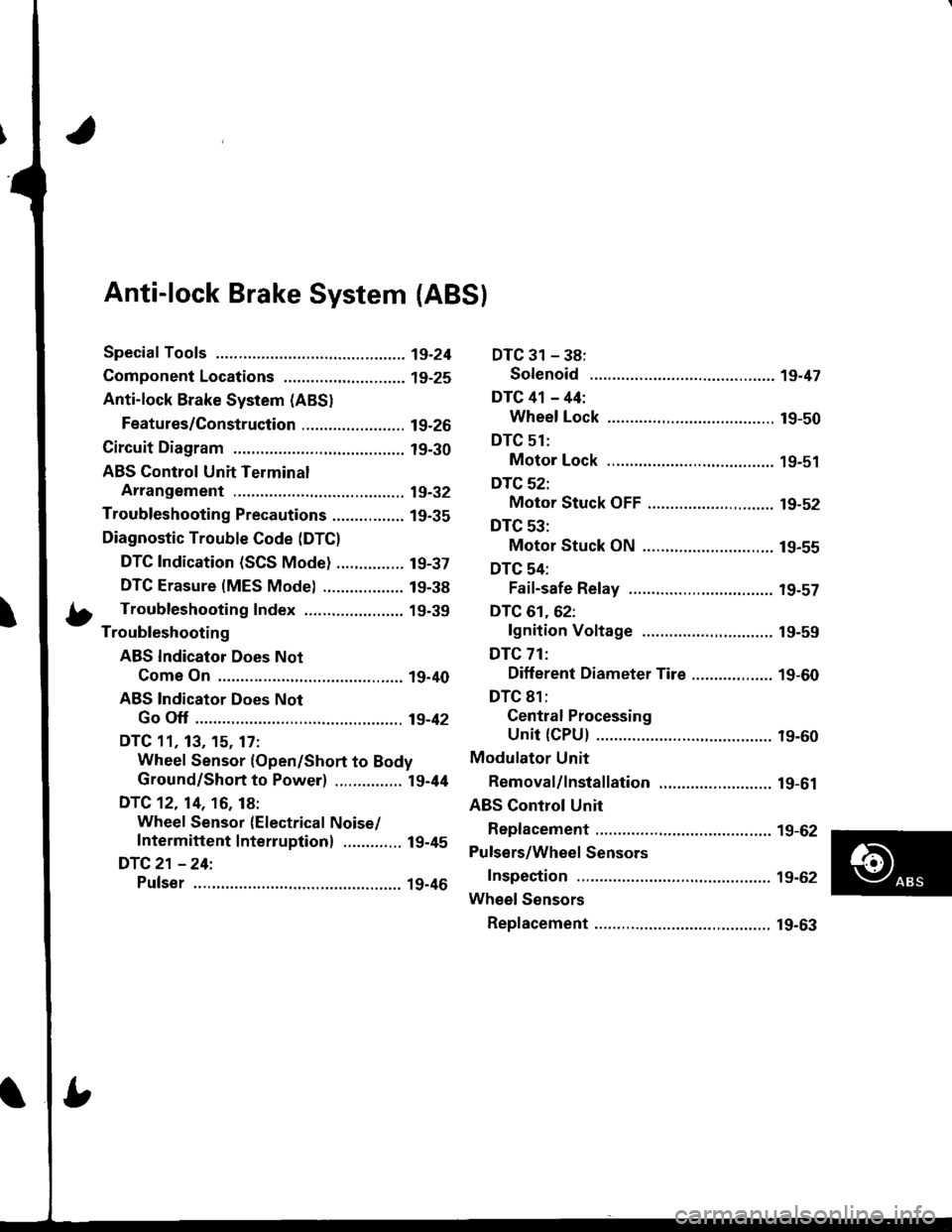
Anti-lock Brake System {ABS}
Speciaf Tools ............... 19-24
Component Locations,...........,..,........... 19-25
Anti-lock Brake System (ABSI
Features/Construction ....................... 19-2G
Circuit Diagram ........... 19-30
ABS Control Unit Terminal
Arrangement ........... 19-32
Troubleshooting Precautions ................ 1g-35
Diagnostic Trouble Code (DTC)
DTC Indication (SCS Mode) ............... t9-37
DTC Erasure {MES Mode) .................. 19-38
b Troubleshooting Index ...................... 19-39- Troubleshooting
ABS Indicator Does Not
Come On .............. 19-40
ABS Indicator Does Not
Go Off .............. ..... 19-42
DTC 11, 13, 15. 17:
Wheel Sensor (Open/Short to Body
Ground/Short to Power) ............... l9-44
DTC 12. 14, 16, 18:
Wheel Sensor (Electrical Noise/
Intermittent Interruption) ..........,.. 19-45
DTC21 -24:
Pulser ...,.......... ..... 19-46
DTC 31 - 38:
Solenoid .............. 19-47
DTC 41 - 44:
Wheel Lock .......... 19-50
DTC 51:
Motor Lock .......... 19-51
DTC 52:
Motor Stuck OFF ...................,........ 19-52
DTC 53:
Motor Stuck ON ............................. 19-55
DTC 54:
Fail-safe Relay ................................ t9-57
DTC 61.62:
lgnition Voltage ............................. 19-59
DTC 71:
Different Diameter Tire .................. 1 9-60
DTC 81:
Gentral Processing
Unit {CPU} ............ 19-60
Modulator Unit
Bemoval/lnstallation ......................... 19-61
ABS Control Unit
Replacement ............ 19-62
Pulsers/Wheel Sensors
Inspection ................ 19-62
Wheel Sensors
Replacement .,.......... 19-63
Page 778 of 1681
.,i
,I
Anti-lock Brake SYstem (ABS)
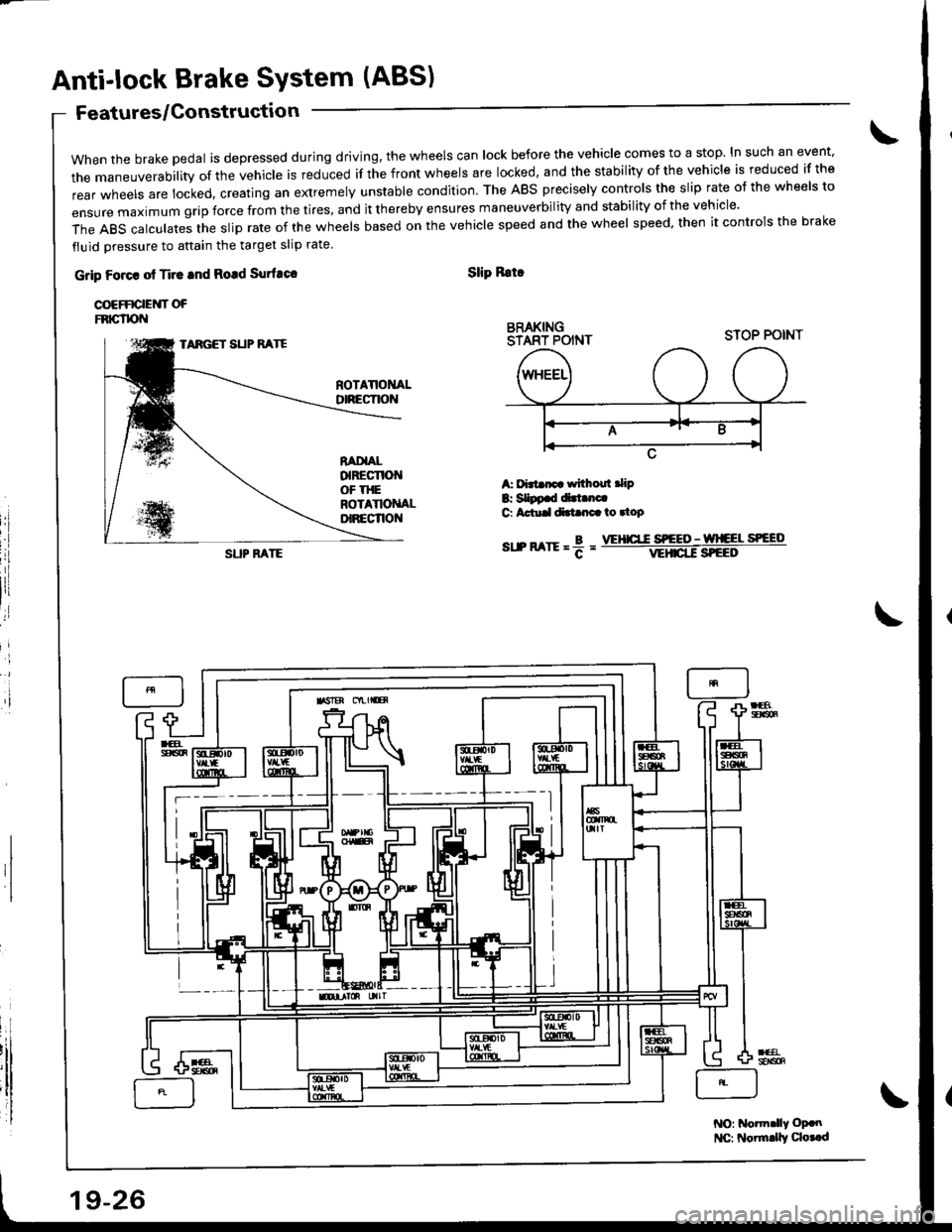
when the brake pedal is depressed during driving, the wheels can lock before the vehicle comes to a stop. In such an event.
the maneuverability of the vehicle is reduced if the front wheels are locked, and the stability of the vehicle is reduced if the
rear wheels are locked, creating an extremely unstable condition. The ABS precisely controls the slip rate o{ the wheels to
ensUre maximum grip force from the tires, and it thereby ensures maneuverbiIity and stabiIity of the vehicIe.
The ABS calculates the slip rate of the wheels based on the vehicle speed and the wheel speed. then it controls the brake
fluid oressure to attain the target slip rate
Features/Gonstructio n
Grip Foact ot Ti.c tnd Rotd Surfuco
COEFFICIEUT OFFNIG"TPN
Slip Rrtr
BRAKINGSTART POINT
i'l
A: f'3t rp withoul .lip
B: SIDp.d dirt.nc.G Actu.ldtt nc.io.top
sr.n arrr = f =
STOP POINTTARGET SUP RATE
SUP FATEVEHICT.C S'EEO - wlCEL SPEED
NO: Notm.lly oP.n
l{C: Noirnrly qo..d
19-26
Page 780 of 1681
Anti-lock Brake System (ABS)
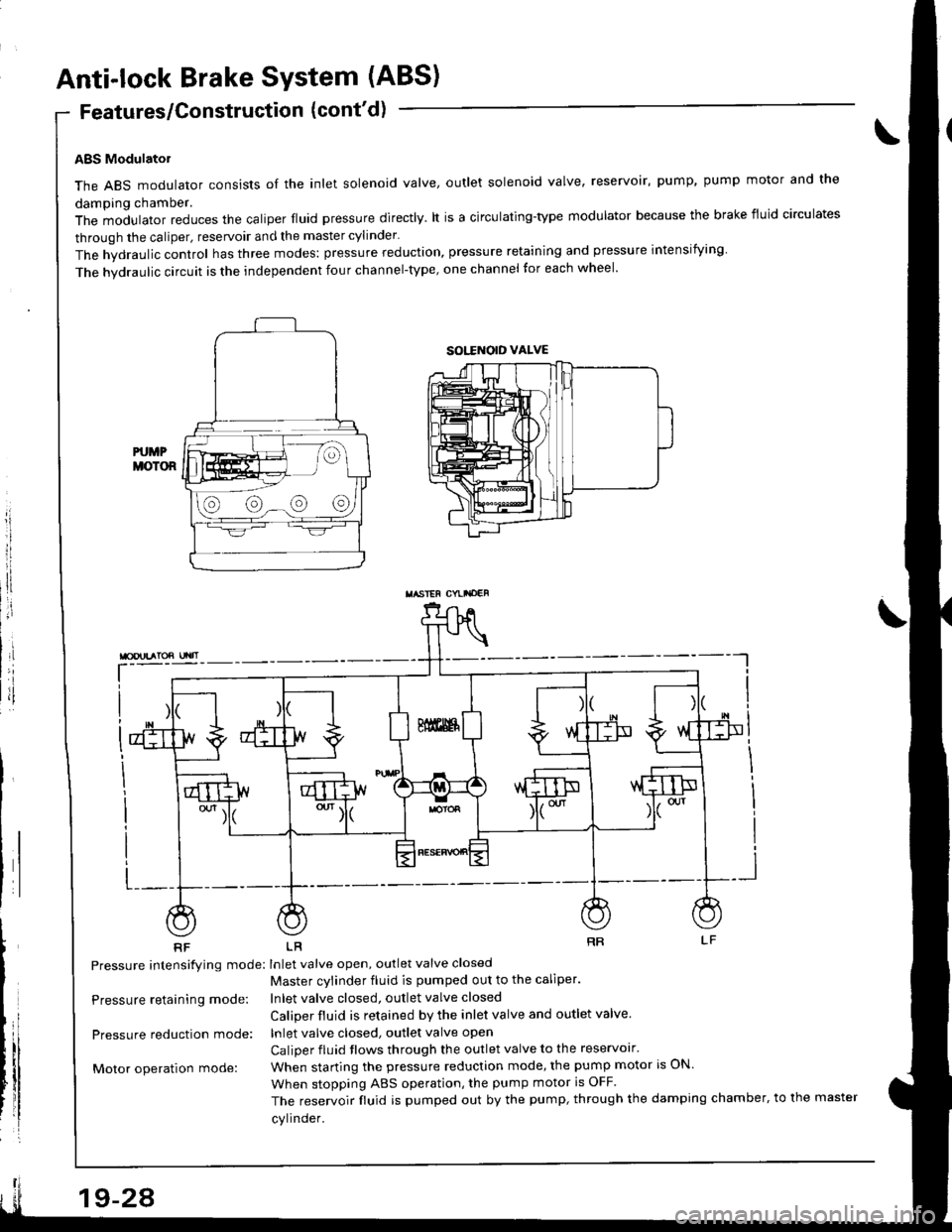
Features/Construction (cont'd)
ABS Modulatol
The ABS modulator consists of the inlet solenoid valve, outlet solenoid valve, reservoir, pump, pump motor and the
damping chamber.
The modulator reduces the caliper fluid pressure directly. lt is a circulating-type modulator because the brake fiuid circulates
through the caliper, reservoir and the master cylinder.
The hydraulic control has three modes: pressure reduction, pressure retaining and pressure intensiiying
The hvdraulic circuit is the independent four channel-type, one channel tor each wheel'
L-__
RF LR
Pressure intensifying mode: Inlet valve open, outlet valve closed
Master cvlinder fluid is pumped out to the caliper.
Inlet valve closed, outlet valve closed
Caliper fluid is retained by the inlet valve and outlet valve.
lnlet valve closed, outlet valve open
Caliper fluid flows through the outlet valve to the reservolr'
When starting the pressure reduction mode, the pump motor is ON.
When stopping ABS operation, the pump motor is OFF.
The reservoir fluid is pumped out by the pump, through the damping chamber, to the master
cylinder.
\
Pressure retaining mode:
Pressure reduction mode:
Motor operation mode:
sott orD vALvE
@@-@@
TASIEF CYLI'OEF
19-24
Page 784 of 1681
![HONDA INTEGRA 1998 4.G Manual PDF ABS Gontrol Unit Terminal Arrangement
ABS CONTROL UN]T 22P CONNECTOR
Wire side oI female t6rminals
Terminal
numbel
Wire
Golor
Terminsl sign
{Terminal
namet
Description
Measurgmgnt
TerminalConditions
{](/img/13/6069/w960_6069-783.png "HONDA INTEGRA 1998 4.G Manual PDF ABS Gontrol Unit Terminal Arrangement
ABS CONTROL UN]T 22P CONNECTOR
Wire side oI female t6rminals
Terminal
numbel
Wire
Golor
Terminsl sign
{Terminal
namet
Description
Measurgmgnt
TerminalConditions
{")
ABS Gontrol Unit Terminal Arrangement
ABS CONTROL UN]T 22P CONNECTOR
Wire side oI female t6rminals
Terminal
numbel
Wire
Golor
Terminsl sign
{Terminal
namet
Description
Measurgmgnt
TerminalConditions
{lgnition swhch ON {ll}}Voltage
1BLK/WHTGND3(Ground 3)
Ground1.GNDBelow 0.3 V
4GRN/REDPARK
{Parking)
Detects parking brake
switch signal4-GNDParking
brake
PulledBelow 0.3 V
Battery voltage
LT GRN/
BLK
FLW (-)
{FronLleft
wheel negative)
Detects left-front wheel
sensor srgnal
0.053 V or
above
0sci\oscope:
0.15 Vp-p or
above
7GBN/ORN
FLW (+)
(Front-left
wheel positive)- | Turn wheel at
E
1 turntsecona
l'GRN
FRW (-)
(Front-right
wheel negative)
Detects right-f ront wheel
sensor slgnal
8-9
1 FR\N (+)
I \GRN/BLK (Front-right
I I wheelpositiveStops0.25 - 1.15 V
10GRN/WHTSTOPDetects brake switch signal1O.GNDBrake pedalDepressedBaftery voltage
ReleasedBelow 0.3 V
11BLK/TELtG2
(lgnition 2)
Power source for activating
the system11-GNDlgnition
switch
oN {I)Battery voltage
Start (lll)Below 0.3 V
19-32
Page 788 of 1681
Troubleshooting Precautions
Kickback
L The motor operates when the ABS is functioning, and the fluid in the reservoir is forced out to the master cylinder,
causing kickback at the brake pedal.
Pump Motol
1. The pump motor operates when the ABS is functioning.
2. The ABS control unit checks the pump motor operation during initial diagnosis and when the vehicle is started. You
mav hear the motor operate at this time, but it is normal
Brake Fluid Replacement/Air Bleeding'1. Brake fluid replacement and air bleeding procedures are the same as vehicles without ABS. To ease bleeding, start
with the front wheels.
Troubleshooting
1. The troubleshooting flowcharts procedures assume that the cause of the problem is still present and the ABS indica-
tor is still on. Following the flowchart when the ABS indicator does not come on can result in incorrect diagnosis.
2. Ouestion the customer about the conditions when the problem occurred, and try to reproduce the same conditions
for troubleshooting.
Find out when the ABS indjcator came on. such as during initial diagnosis. during ABS control, after ABS control,
when vehicle speed was at a certain speed, etc.
3, When the ABS indicator does not come on during the test-drive, but troubleshooting is performed based on the DTC,
check for loose connectors, poor contact at the terminals, etc. before you start troubleshooting'
4. After troubleshooting, erase the DTC and test-drive the vehicle. Be sure the ABS indicator does not come on.
5. The connector illustrations show the female terminals with a single outline and the male terminals with a double outline.