lock HONDA ODYSSEY 1998 Repair Manual
[x] Cancel search | Manufacturer: HONDA, Model Year: 1998, Model line: ODYSSEY, Model: HONDA ODYSSEY 1998Pages: 272, PDF Size: 2.67 MB
Page 205 of 272
Lights
Replacing a Headlight Bulb
Your vehicle has halogen headlight
bulbs, one on each side. When replacing a bulb, handle it by its steel
base and protect the glass from contact with your skin or hard
objects. If you touch the glass, clean
it with denatured alcohol and a clean
cloth.
Halogen headlight bulbs get very hot when lit. Oil, perspiration, or a scratch
on the glass can cause the bulb to
overheat and shatter.
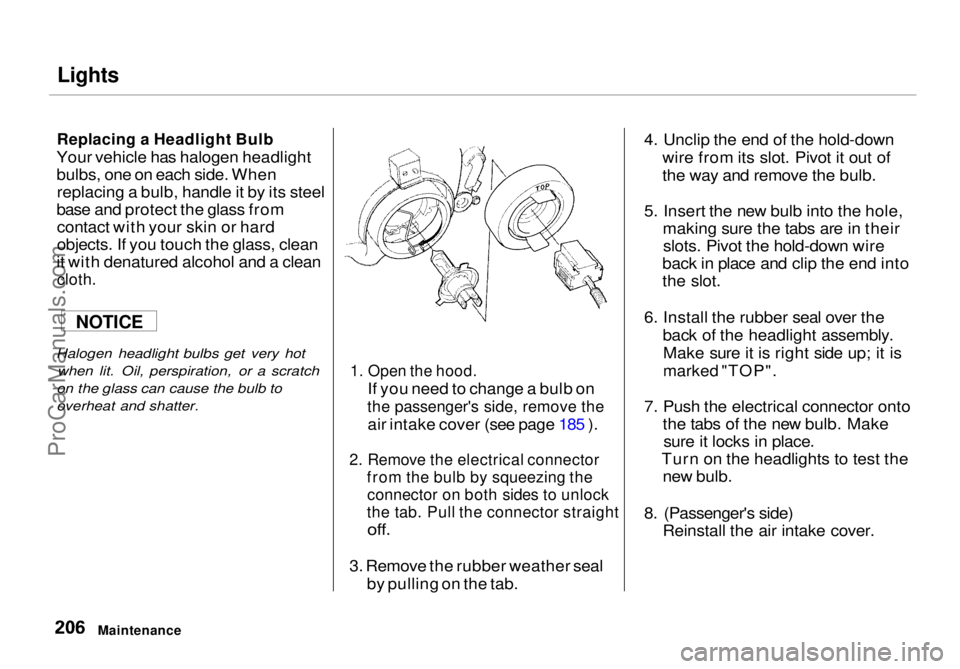
1. Open the hood.
If you need to change a bulb on
the passenger's side, remove the
air intake cover (see page 185 ).
2. Remove the electrical connector from the bulb by squeezing the
connector on both sides to unlock
the tab. Pull the connector straight
off.
3. Remove the rubber weather seal by pulling on the tab. 4. Unclip the end of the hold-down
wire from its slot. Pivot it out of
the way and remove the bulb.
5. Insert the new bulb into the hole, making sure the tabs are in theirslots. Pivot the hold-down wire
back in place and clip the end into
the slot.
6. Install the rubber seal over the back of the headlight assembly.Make sure it is right side up; it is
marked "TOP".
7. Push the electrical connector onto the tabs of the new bulb. Makesure it locks in place.
Turn on the headlights to test the new bulb.
8. (Passenger's side) Reinstall the air intake cover.
Maintenance
NOTICEProCarManuals.comMain Menu Table of Contents s t
Page 206 of 272
Lights
Replacing the Front Side Marker/
Turn Signal and Parking Light Bulb
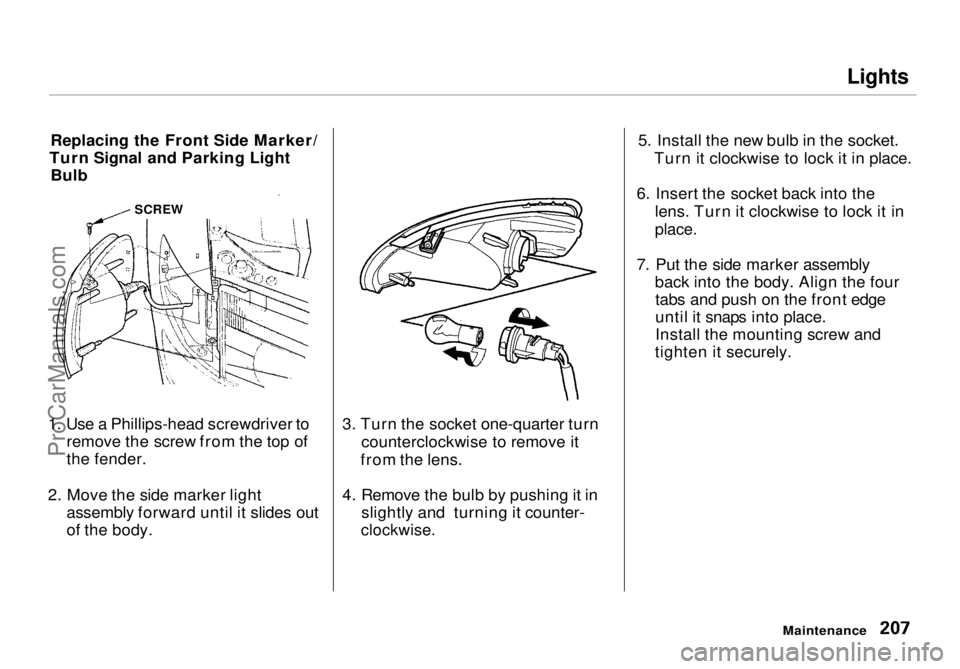
1. Use a Phillips-head screwdriver to remove the screw from the top of
the fender.
2. Move the side marker light assembly forward until it slides out
of the body. 3. Turn the socket one-quarter turn
counterclockwise to remove it
from the lens.
4. Remove the bulb by pushing it in slightly and turning it counter-
clockwise.
5. Install the new bulb in the socket.
Turn it clockwise to lock it in place.
6. Insert the socket back into the lens. Turn it clockwise to lock it in
place.
7. Put the side marker assembly back into the body. Align the fourtabs and push on the front edge
until it snaps into place.
Install the mounting screw and
tighten it securely.
Maintenance
SCREWProCarManuals.comMain Menu Table of Contents s t
Page 207 of 272
Lights
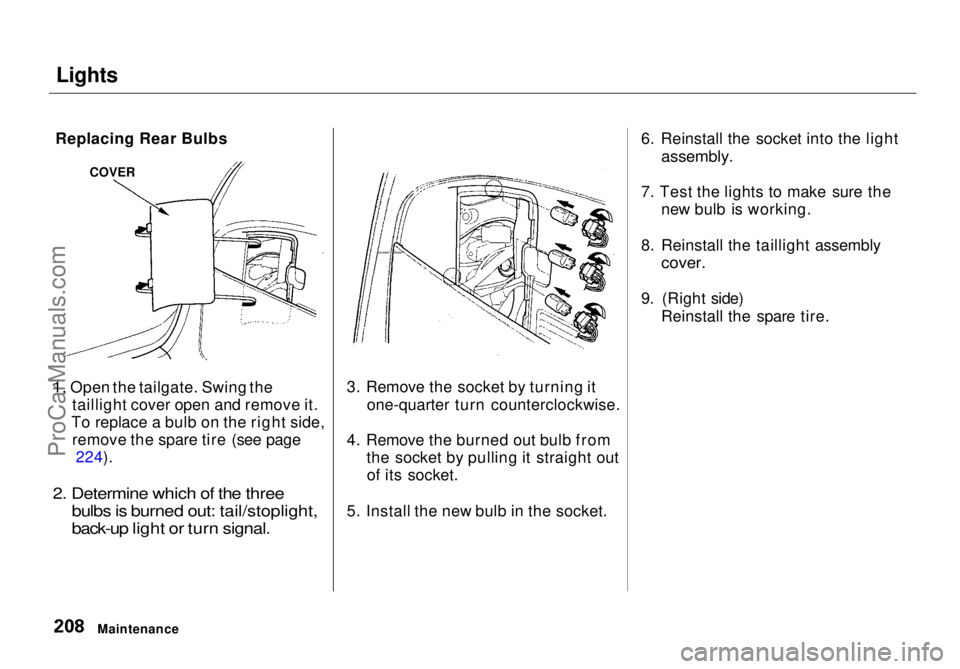
1. Open the tailgate. Swing the taillight cover open and remove it.
To replace a bulb on the right side, remove the spare tire (see page 224).
2. Determine which of the three bulbs is burned out: tail/stoplight,
back-up light or turn signal.
3. Remove the socket by turning it
one-quarter turn counterclockwise.
4. Remove the burned out bulb from the socket by pulling it straight outof its socket.
5. Install the new bulb in the socket. 6. Reinstall the socket into the light
assembly.
7. Test the lights to make sure the new bulb is working.
8. Reinstall the taillight assembly
cover.
9. (Right side) Reinstall the spare tire.
Maintenance
COVER
Replacing Rear BulbsProCarManuals.comMain Menu Table of Contents s t
Page 210 of 272
Storing Your Vehicle
If you need to park your vehicle for
an extended period (more than one
month), there are several things you
should do to prepare it for storage.
Proper preparation helps prevent
deterioration and makes it easier to
get your vehicle back on the road. If
possible, store your vehicle indoors.
Fill the fuel tank.
Change the engine oil and filter(see page 175 ). Wash and dry the exterior
completely.
Clean the interior. Make sure the
carpeting, floor mats, etc. are
completely dry. Leave the parking brake off. Put
the transmission in Park. Block the rear wheels. If the vehicle is to be stored for a
longer period, it should be supported on jackstands so the
tires are off the ground.
Leave one window open slightly (if
the vehicle is being stored
indoors).
Disconnect the battery.
Support the front and rear wiper
blade arms with a folded towel or rag so they do not touch the
windshield.
To minimize sticking, apply a
silicone spray lubricant to all door
and trunk seals. Also, apply a body
wax to the painted surfaces that mate with the door and trunk seals. Cover the vehicle with a
"breathable" vehicle cover, one
made from a porous material such as cotton. Nonporous materials,
such as plastic sheeting, trap
moisture, which can damage the
paint. If possible, run the engine for a
while periodically (preferably once a month).
If you store your vehicle for 12
months or longer, have your Honda dealer perform the inspections called
for in the 24 months/30,000 miles (48,000 km) maintenance schedule
(Normal Conditions) as soon as you
take it out of storage (see page 164 ).
The replacements called for in the maintenance schedule are not
needed unless the vehicle has
actually reached that time or mileage.
MaintenanceProCarManuals.comMain Menu Table of Contents s t
Page 220 of 272
Changing a Flat Tire
If you have a flat tire while driving,
stop in a safe place to change it.
Stopping in traffic or on the shoulder of a busy road is dangerous. Drive
slowly along the shoulder until you
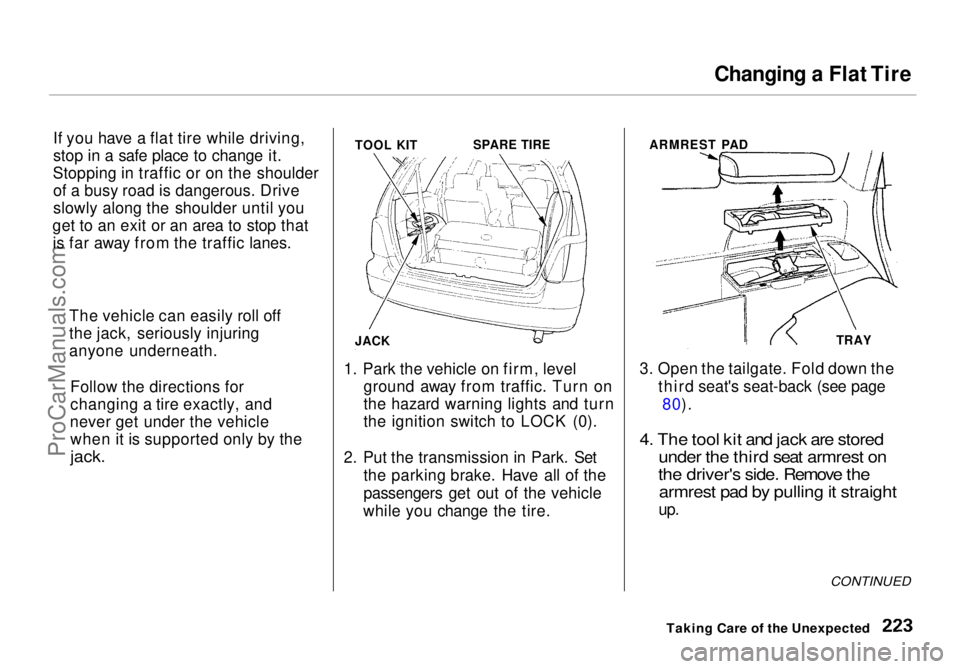
get to an exit or an area to stop that is far away from the traffic lanes. TOOL KIT
SPARE TIRE
JACK
1. Park the vehicle on firm, level ground away from traffic. Turn on
the hazard warning lights and turn
the ignition
switch to LOCK (0).
2. Put the transmission in Park. Set the parking brake. Have all of the
passengers get out of the vehicle
while you change the tire. ARMREST PAD
TRAY
3. Open the tailgate. Fold down the third seat's seat-back (see page80).
4. The tool kit and jack are stored under the third seat armrest on
the driver's side. Remove the armrest pad by pulling it straight
up.
CONTINUED
Taking Care of the Unexpected
The vehicle can easily roll off
the jack, seriously injuring
anyone underneath.
Follow the directions for
changing a tire exactly, and
never get under the vehicle when it is supported only by the
jack.ProCarManuals.comMain Menu Table of Contents s t
Page 221 of 272
Changing a Flat Tire
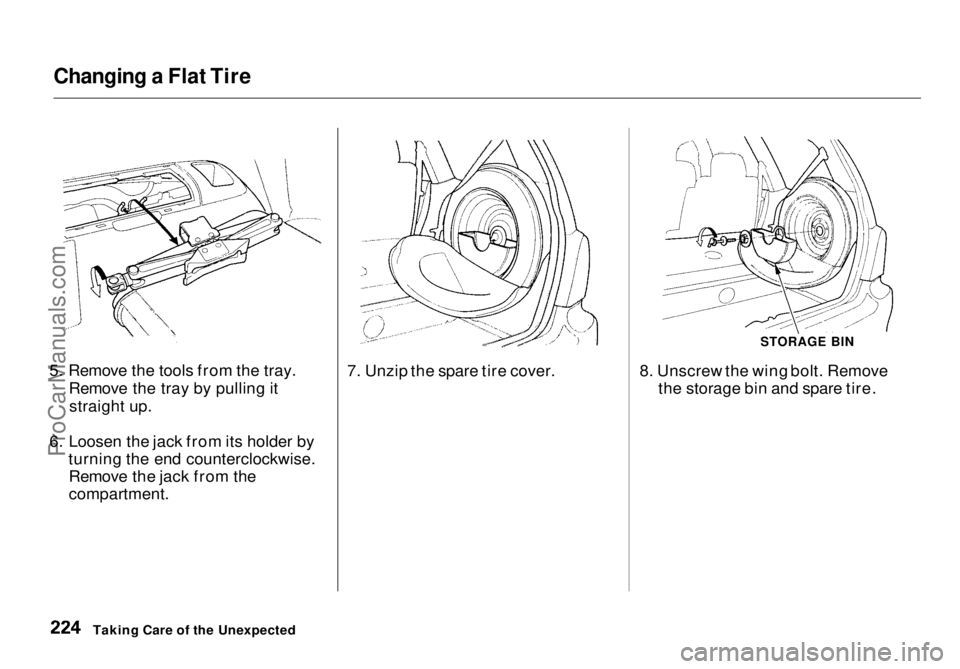
5. Remove the tools from the tray. Remove the tray by pulling itstraight up.
6. Loosen the jack from its holder by turning the end counterclockwise.Remove the jack from the
compartment. 7. Unzip the spare tire cover.
STORAGE BIN
8. Unscrew the wing bolt. Remove the storage bin and spare tire.
Taking Care of the UnexpectedProCarManuals.comMain Menu Table of Contents s t
Page 222 of 272
Changing a Flat Tire
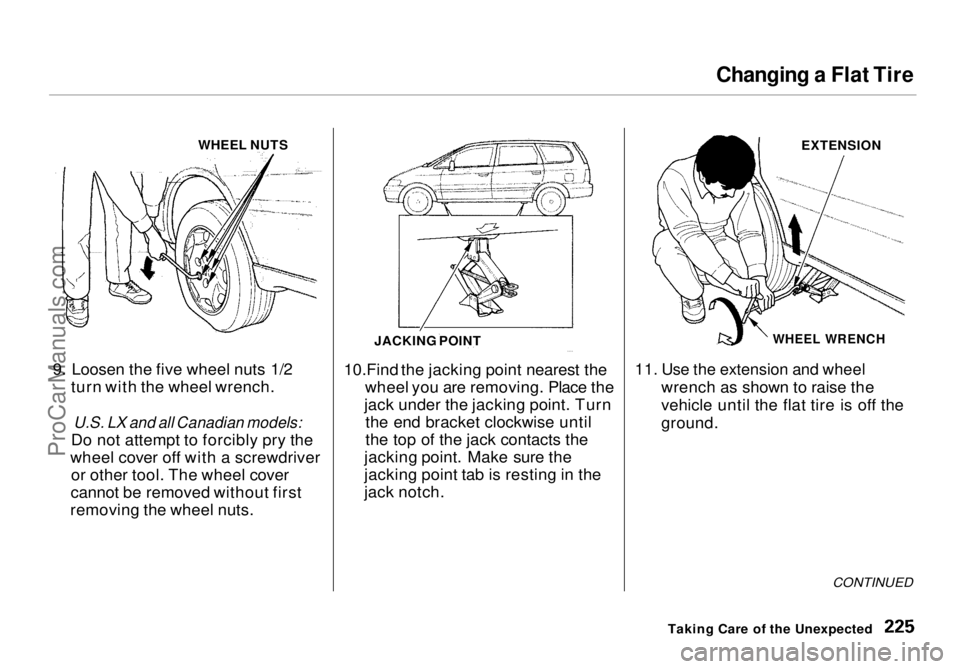
WHEEL NUTS
9. Loosen the five wheel nuts 1/2 turn with the wheel wrench.
U.S. LX and all Canadian models:
Do not attempt to forcibly pry the
wheel cover off with a screwdriver or other tool. The wheel cover
cannot be removed without first
removing the wheel nuts. 10.Find the jacking point nearest the
wheel you are removing. Place the
jack under the jacking point. Turn the end bracket clockwise until
the top of the jack contacts the
jacking point. Make sure the
jacking point tab is resting in the
jack notch. EXTENSION
WHEEL WRENCH
11. Use the extension and wheel
wrench as shown to raise the
vehicle until the flat tire is off the
ground.
CONTINUED
Taking Care of the Unexpected
JACKING POINTProCarManuals.comMain Menu Table of Contents s t
Page 225 of 272
Changing a Flat Tire
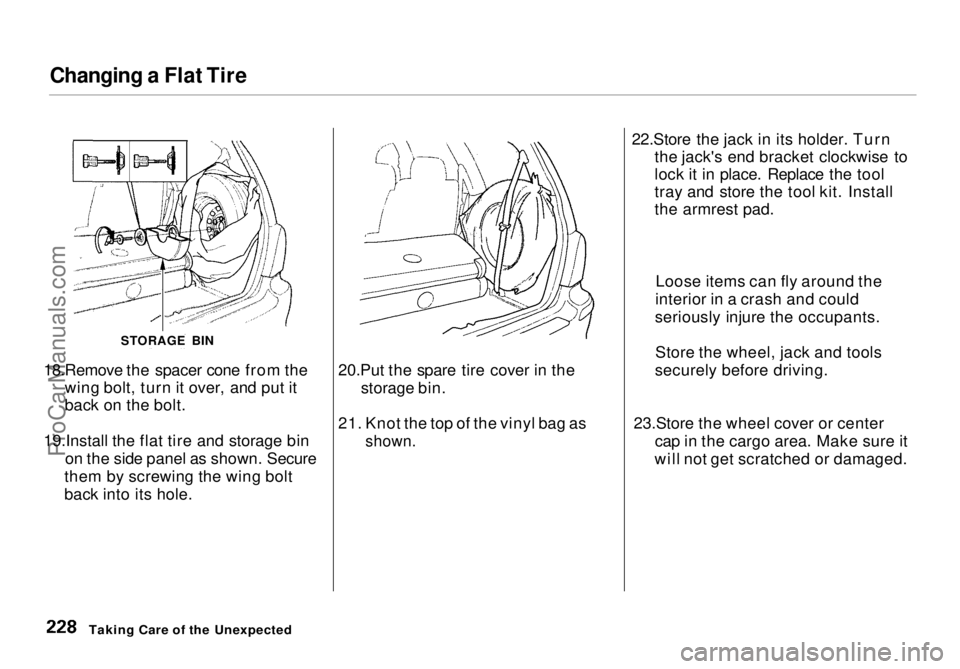
18.Remove the spacer cone from the wing bolt, turn it over, and put it
back on the bolt.
19.Install the flat tire and storage bin on the side panel as shown. Secure
them by screwing the wing bolt
back into its hole. 20.Put the spare tire cover in the
storage bin.
21. Knot the top of the vinyl bag as
shown.
22.Store the jack in its holder. Turn
the jack's end bracket clockwise to
lock it in place. Replace the tool
tray and store the tool kit. Install
the armrest pad.
23.Store the wheel cover or center cap in the cargo area. Make sure it
will not get scratched or damaged.
Taking Care of the Unexpected
STORAGE BIN
Loose items can fly around the
interior in a crash and could
seriously injure the occupants.
Store the wheel, jack and tools
securely before driving.ProCarManuals.comMain Menu Table of Contents s t
Page 226 of 272
If Your Engine Won't Start
Diagnosing why your engine won't start falls into two areas, depending
on what you hear when you turn the
key to START (III):
You hear nothing, or almostnothing. The engine's starter
motor does not operate at all, or
operates very slowly.
You can hear the starter motor operating normally, or the starter
motor sounds like it is spinning
faster than normal, but the engine does not start up and run.
Nothing Happens or the Starter
Motor Operates Very Slowly
When you turn the ignition switch to START (III), you do not hear the
normal noise of the engine trying tostart. You may hear a clicking sound
or series of clicks, or nothing at all.
Check these things: Your vehicle has the Immobilizer
System. You should use a
properly-coded master or valet key
to start the engine (see page 67).
A key that is not properly coded will cause the immobilizer systemindicator in the dash panel to blink
rapidly.
Check the transmission interlock.
The transmission must be in Park or Neutral or the starter will not
operate.
Turn the ignition switch to ON (II).
Turn on the headlights and check their brightness. If the headlightsare very dim or don't light at all,
the battery is discharged. See
Jump Starting on page 230.
Turn the ignition switch to START
(III). If the headlights do not dim,
check the condition of the fuses. If
the fuses are OK, there is proba-
bly something wrong with the electrical circuit for the ignitionswitch or starter motor. You will
need a qualified technician to determine the problem. (See
Towing on page 244.)
If the headlights dim noticeably or
go out when you try to start theengine, either the battery is dis-
charged or the connections are
corroded. Check the condition of
the battery and terminal connec-
tions (see page 189). You can
then try jump starting the vehicle
from a booster battery (see page
231).
Taking Care of the UnexpectedProCarManuals.comMain Menu Table of Contents s t
Page 230 of 272
If Your Engine Overheats
4. If the temperature gauge stays at the red mark, turn off the engine.
5. Wait until you see no more signs of steam or spray, then open the
hood.
6. Look for any obvious coolant leaks, such as a split radiator hose.
Everything is still extremely hot,
so use caution. If you find a leak, it
must be repaired before you
continue driving (see Towing on
page 244).
7. If you don't find an obvious leak, check the coolant level in the
radiator reserve tank (see page 132). If the level is below the
MIN mark, add coolant to halfway
between the MIN and MAX marks.
8. If there was no coolant in the reserve tank, you may also have to
add coolant to the radiator. Let the
engine cool down until the pointer reaches the middle of the tempera-
ture gauge, or lower, before check- ing the radiator.
9. Using gloves or a large heavy cloth, turn the radiator cap
counterclockwise, without pushingdown, to the first stop. This
releases any remaining pressure in
the cooling system. After the
pressure releases, push down on
the cap and turn it until it comes
off.
10.Start the engine and set the
temperature control lever tomaximum. Add coolant to the
radiator up to the base of the filler
neck. If you do not have the
proper coolant mixture available,
you can add plain water. Remember to have the cooling
system drained and refilled with
the proper mixture as soon as you
can.
11. Put the radiator cap back on tightly. Run the engine and watch
the temperature gauge. If it goes
back to the red mark, the engine
needs repair. (See Towing on
page 244.)
12.If the temperature stays normal, check the coolant level in the
radiator reserve tank. If it has
gone down, add coolant to the MAX mark. Put the cap back on
tightly.
Taking Care of the Unexpected
Removing the radiator cap
while the engine is hot can
cause the coolant to spray out,
seriously scalding you.
Always let the engine and radiator cool down before
removing the radiator cap.ProCarManuals.comMain Menu Table of Contents s t