wheel HONDA PILOT 2014 2.G Workshop Manual
[x] Cancel search | Manufacturer: HONDA, Model Year: 2014, Model line: PILOT, Model: HONDA PILOT 2014 2.GPages: 488, PDF Size: 12.11 MB
Page 435 of 488
434
Handling the Unexpected
Tools
Types of Tools
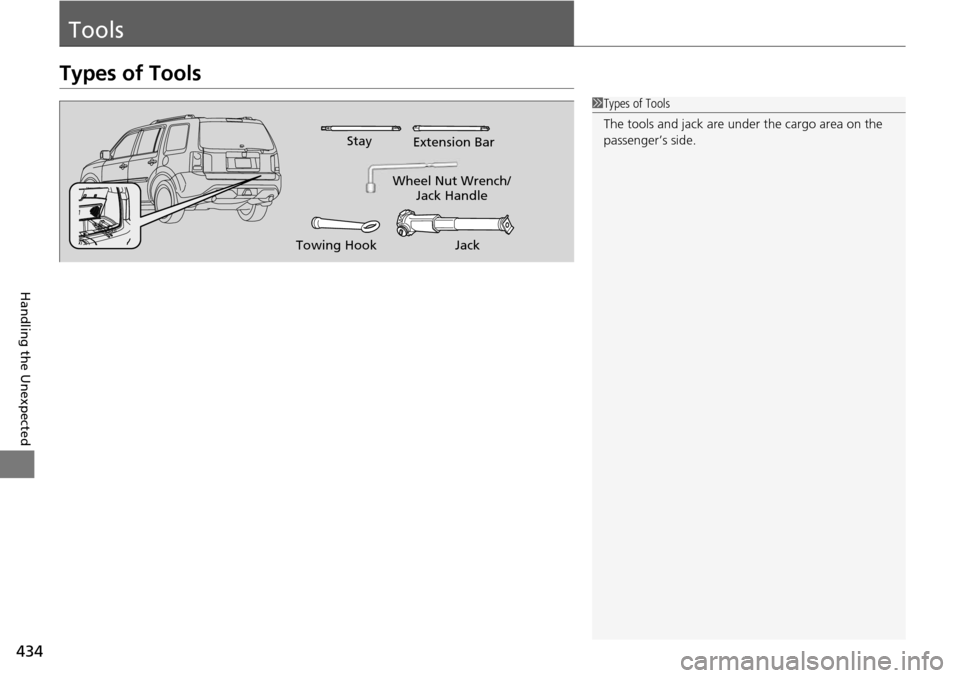
1Types of Tools
The tools and jack are unde r the cargo area on the
passenger’s side.
Wheel Nut Wrench/ Jack Handle
Jack
Towing Hook Stay
Extension Bar
Page 436 of 488
435Continued
Handling the Unexpected
If a Tire Goes Flat
Changing a Flat Tire
If a tire goes flat while driving, grasp the steering wheel firmly, and brake gradually
to reduce speed. Then, stop in a safe plac e. Replace the flat tire with a compact
spare tire. Go to a dealer as soon as possib le to have the full-size tire repaired or
replaced.
1. Park
the vehicle on firm, level, and non-slippery surface an d apply the parking
brake.
2. Move t
he shift lever to (P
.
3. Turn
on the hazard warning lights an d turn the ignition switch to LOCK (0
.
1Changing a Flat Tire
Periodically check the tire pressure of the compact
spare. It should be set to the specified pressure.
Specified Pressure: 60 psi (420 kPa, 4.2 kgf/cm
2)
When driving with the compact spare tire, keep the
vehicle speed under 50 mph (80 km/h). Replace with
a full-size tire as soon as possible.
The compact spare tire and wheel in your vehicle are
specifically for this model.
Do not use them with another vehicle.
Do not use another type of compact spare tire or
wheel with your vehicle.
Do not mount tire chains on a compact spare tire.
If a chain-mounted front tire goes flat, remove one of
the full-size rear tires and replace it with the compact
spare tire. Remove the flat front tire and replace it
with the full-size tire that was removed from the rear.
Mount the tire chains on the front tire.
Do not use a puncture-repairi ng agent on a flat tire,
as it can damage the tire pressure sensor.
Page 437 of 488
436
uu If a Tire Goes Flat u Changing a Flat Tire
Handling the Unexpected
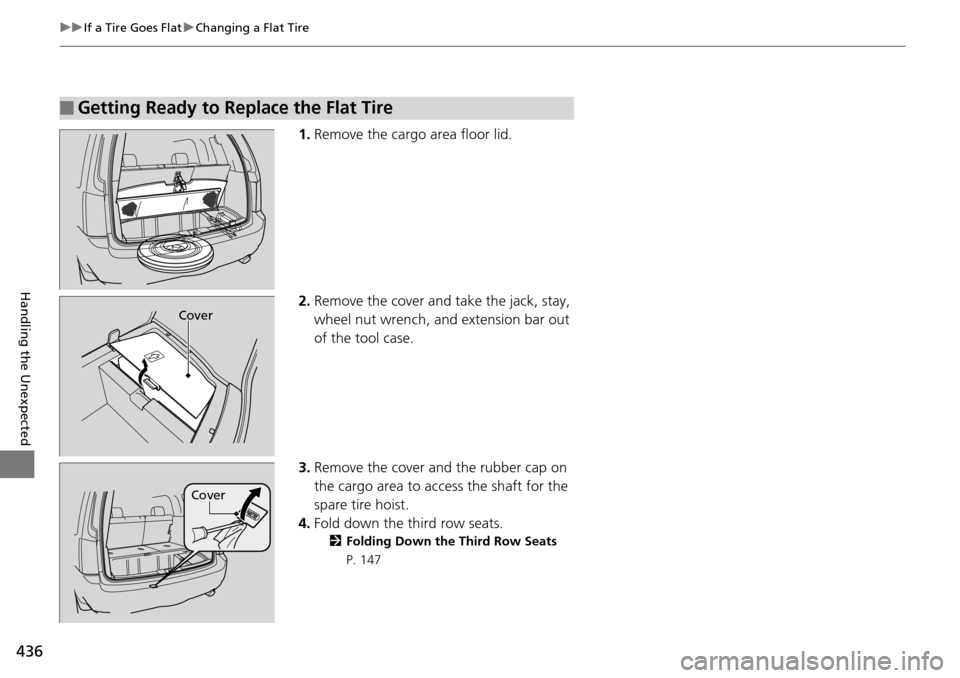
1. Remove the cargo area floor lid.
2.Remove the cover and take the jack, stay,
wheel nut wrench, and extension bar out
of the tool case.
3. Remove the cover
and the rubber cap on
the cargo area to access the shaft for the
spare tire hoist.
4. Fol
d down the third row seats.
2 Folding Down the Third Row Seats
P. 147
■Getting Ready to Replace the Flat Tire
Cover
Cover
Page 438 of 488
437
uu If a Tire Goes Flat u Changing a Flat Tire
Continued
Handling the Unexpected
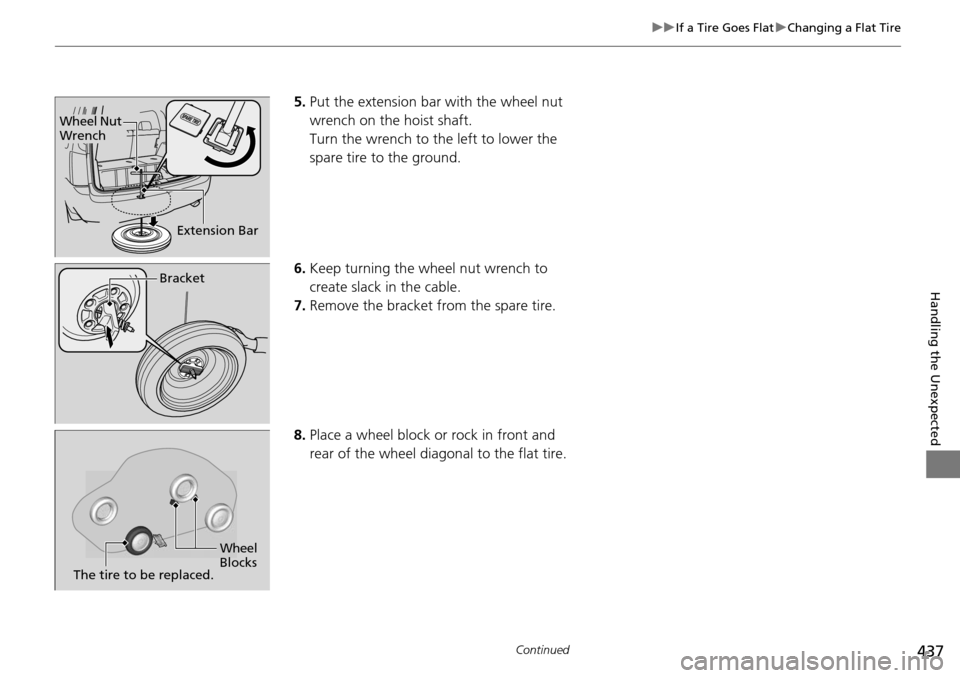
5. Put the extension bar with the wheel nut
wrench on the hoist shaft.
Turn the wrench to the left to lower the
spare tire to the ground.
6. Keep t
urning the wh eel nut wrench to
create slack in the cable.
7. Re
move the bracket from the spare tire.
8.Place a
wheel block or rock in front and
rear of the wheel diagonal to the flat tire.
Wheel Nut
Wrench
Extension Bar
Bracket
Wheel
Blocks
The tire to be replaced.
Page 439 of 488
438
uu If a Tire Goes Flat u Changing a Flat Tire
Handling the Unexpected
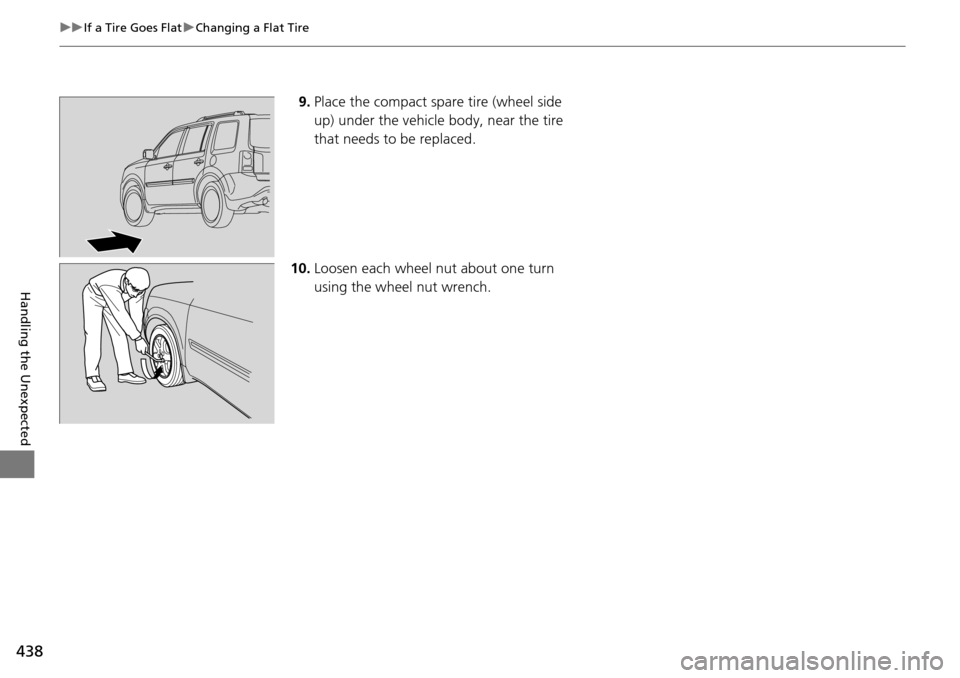
9. Place the compact spare tire (wheel side
up) under the vehicle body, near the tire
that needs to be replaced.
10. Loosen each wheel nut about one turn
using the wheel nut wrench.
Page 441 of 488
440
uu If a Tire Goes Flat u Changing a Flat Tire
Handling the Unexpected
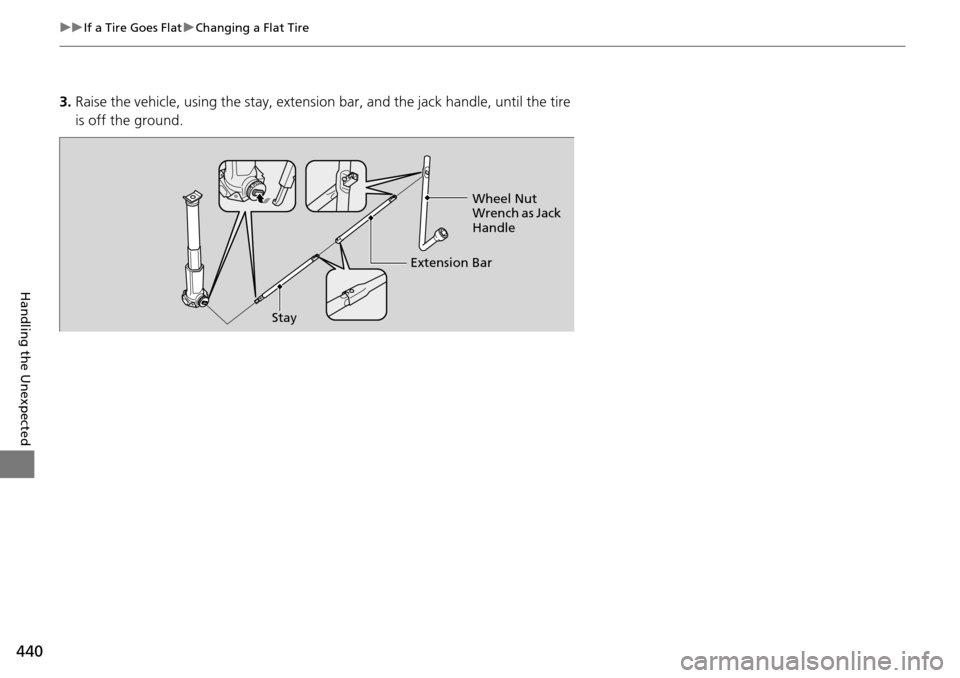
3. Raise the vehicle, using the stay, extension bar, and the jack handle, until the tire
is off the ground.
Stay Extension BarWheel Nut
Wrench as Jack
Handle
Page 442 of 488
Continued441
uu If a Tire Goes Flat u Changing a Flat Tire
Handling the Unexpected
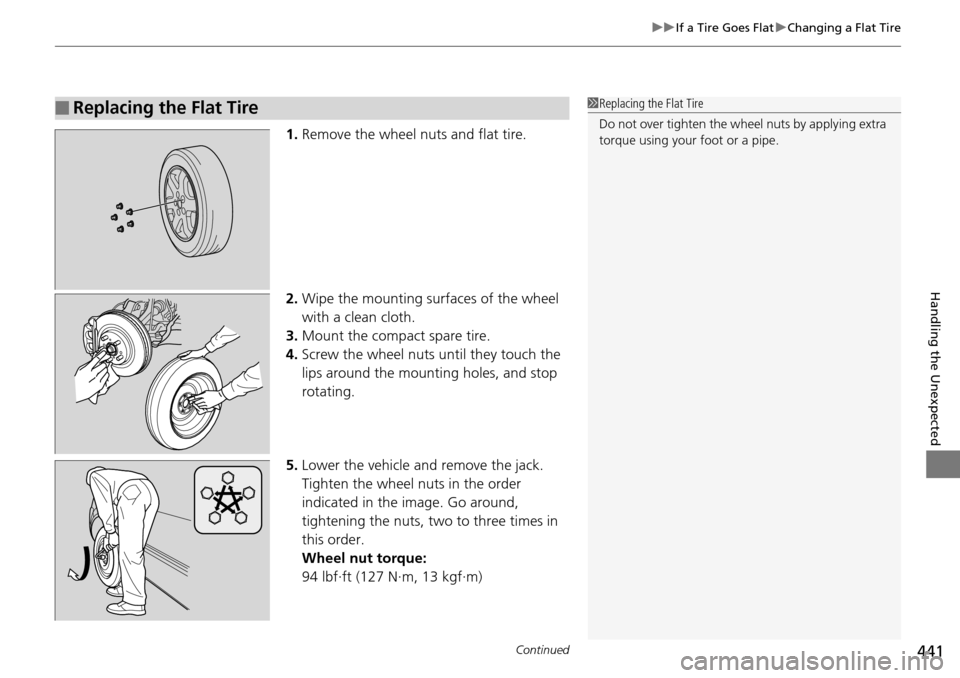
1. Remove the wheel nuts and flat tire.
2.Wipe the mounting surfaces of the wheel
with a clean cloth.
3. Mount t
he compact spare tire.
4.Screw
the wheel nuts until they touch the
lips around the mounting holes, and stop
rotating.
5. Lower the
vehicle and remove the jack.
Tighten the wheel nuts in the order
indicated in the image. Go around,
tightening the nuts, two to three times in
this order.
Wheel nut torque:
94 lbf∙ft (127 N∙m, 13 kgf∙m)
■Replacing the Flat Tire1 Replacing the Flat Tire
Do not over tighten the wheel nuts by applying extra
torque using your foot or a pipe.
Page 443 of 488
uu If a Tire Goes Flat u Changing a Flat Tire
442
Handling the Unexpected
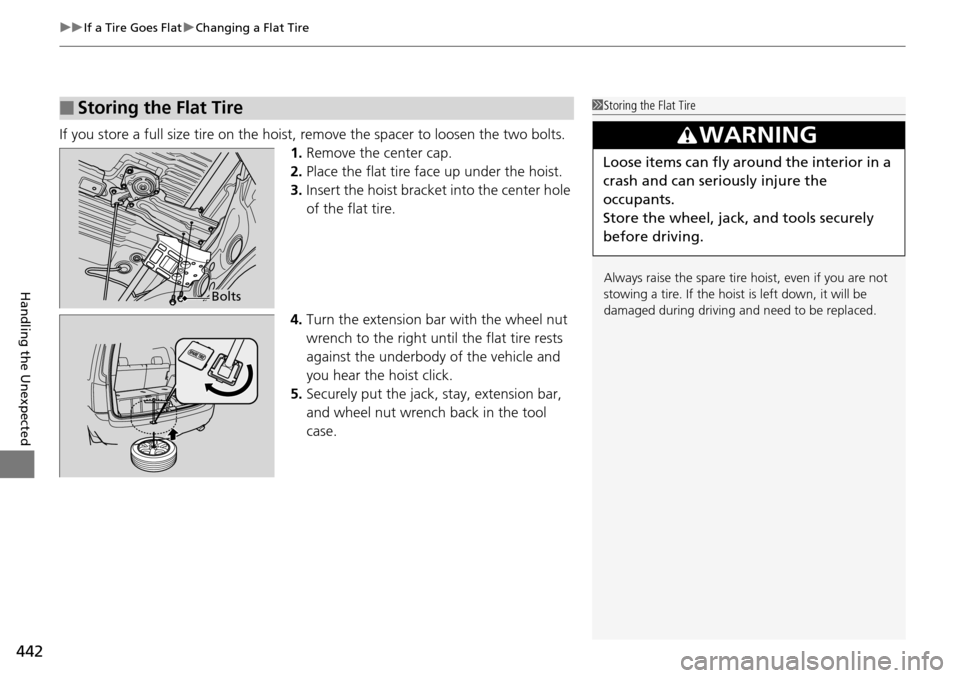
If you store a full size tire on the hoist, remove the spacer to loosen the two bolts.
1.Remove the center cap.
2. Place
the flat tire fa ce up under the hoist.
3. Insert the
hoist bracket into the center hole
of the flat tire.
4. Turn the
extension ba r with the wheel nut
wrench to the right until the flat tire rests
against the underbody of the vehicle and
you hear the hoist click.
5. Sec
urely put the jack, stay, extension bar,
and wheel nut wrench back in the tool
case.
■Storing the Flat Tire1Storing the Flat Tire
Always raise the spare tire hoist, even if you are not
stowing a tire. If the hoist is left down, it will be
damaged during driving and need to be replaced.
3 WARNING
Loose items can fly around the interior in a
crash and can seriously injure the
occupants.
Store the wheel, jack, and tools securely
before driving.
Bolts
Page 444 of 488
443
uu If a Tire Goes Flat u Changing a Flat Tire
Handling the Unexpected
If you replace a flat tire with the spare ti re, the low tire pressure indicator comes on
while you are driving. After driving for a fe w miles (kilometers), the indicator will go
off and the TPMS indicator co mes on, but this is normal.
If you replace the tire with a specified re gular tire, the low tire pressure or TPMS
indicator will go off after a few miles (kilometers).
If you replace a flat tire with the spare tire, t
he low tire pressure/TPMS indicator
comes on while you are driving. After dr iving for a few miles (kilometers), the
indicator will start blinking for a short time and then stay on. CHECK TPMS
SYSTEM appears on the multi-information display, but this is normal.
If you replace the tire with a specified regular
tire, the warning message on the
multi-information display and the low tire pressure/TPMS indicator will go off after
a few miles (kilometers).
■TPMS and the Spare Tire1 TPMS and the Spare Tire
The system cannot monitor th e pressure of the spare
tire. Manually check the spare tire pressure to be sure
that it is correct.
Use TPMS specific wheels. Each is equipped with a
tire pressure sensor mounted inside the tire behind
the valve stem.
Models with info rmation display
Models with multi- information display
Page 460 of 488
459
Handling the Unexpected
Emergency Towing
Call a professional towing service if you need to tow your vehicle.
■Flat bed equipment
The operator loads your vehicle on the back of a truck.
This is the best way to tra
nsport your vehicle.
■Wheel lift equipment
The tow truck uses two pivoti ng a
rms that go under the front tires and lift them off
the ground. The rear tires remain on the ground. This is an acceptable way to
tow your vehicle.
1 Emergency Towing
NOTICE
Trying to lift or tow your vehicle by the bumpers will
cause serious damage. The bumpers are not designed
to support the vehicle's weight.
Never tow your vehicle with just a rope or chain.
It is very dangerous, since ropes or chains may shift
from side to side or break.All models
2WD models