instrument panel HUMMER H3 2010 User Guide
[x] Cancel search | Manufacturer: HUMMER, Model Year: 2010, Model line: H3, Model: HUMMER H3 2010Pages: 410, PDF Size: 2.24 MB
Page 57 of 410

Seats and Restraints 3-13
The person keeps going until
stopped by something. In a real
vehicle, it could be the windshield...or the instrument panel...or the safety belts!
With safety belts, you slow down
as the vehicle does. You get more
time to stop. You stop over more
distance, and your strongest bones
take the forces. That is why safety
belts make such good sense.
Page 71 of 410

Seats and Restraints 3-27
Replacing Safety Belt
System Parts After a
Crash
{WARNING
A crash can damage the safety
belt system in the vehicle.
A damaged safety belt system
may not properly protect the
person using it, resulting in
serious injury or even death in a
crash. To help make sure the
safety belt systems are working
properly after a crash, have them
inspected and any necessary
replacements made as soon as
possible.After a minor crash, replacement of
safety belts may not be necessary.
But the safety belt assemblies that
were used during any crash may
have been stressed or damaged.
See your dealer to have the safety
belt assemblies inspected or
replaced.
New parts and repairs may be
necessary even if the safety belt
system was not being used at the
time of the crash.
Have the safety belt pretensioners
checked if the vehicle has been in a
crash, or if the airbag readiness light
stays on after you start the vehicle
or while you are driving. See
Airbag
Readiness Light on page 5‑10.
Airbag System
The vehicle has the following
airbags:
.A frontal airbag for the driver.
.A frontal airbag for the right front
passenger.
.A roof-rail airbag for the driver
and the passenger seated
directly behind the driver.
.A roof-rail airbag for the right
front passenger and the
passenger seated directly
behind the right front passenger.
All of the airbags in the vehicle will
have the word AIRBAG embossed
in the trim or on an attached label
near the deployment opening.
For frontal airbags, the word
AIRBAG will appear on the middle
part of the steering wheel for the
driver and on the instrument panel
for the right front passenger.
With roof-rail airbags, the word
AIRBAG will appear along the
headliner or trim.
Page 73 of 410

Seats and Restraints 3-29
{WARNING
Children who are up against,
or very close to, any airbag
when it inflates can be seriously
injured or killed. Airbags plus
lap-shoulder belts offer protection
for adults and older children, but
not for young children and infants.
Neither the vehicle's safety belt
system nor its airbag system
is designed for them. Young
children and infants need the
protection that a child restraint
system can provide. Always
secure children properly in your
vehicle. To read how, seeOlder
Children
on page 3‑42or Infants
and Young Children
on
page 3‑44
.
There is an airbag readiness light
on the instrument panel cluster,
which shows the airbag symbol.
The system checks the airbag
electrical system for malfunctions.
The light tells you if there is an
electrical problem. See Airbag
Readiness Light
on page 5‑10for
more information.
Where Are the Airbags?
The driver frontal airbag is in the
middle of the steering wheel.
Page 74 of 410

3-30 Seats and Restraints
The right front passenger frontal
airbag is in the instrument panel on
the passenger's side.Driver Side shown, PassengerSide similar
The roof-rail airbags for the
driver, right front passenger, and
second row outboard passengers
are in the ceiling above the side
windows.
{WARNING
If something is between an
occupant and an airbag, the
airbag might not inflate properly
or it might force the object into
that person causing severe injury
or even death. The path of an
inflating airbag must be kept
clear. Do not put anything
between an occupant and an
airbag, and do not attach or put
anything on the steering wheel
hub or on or near any other
airbag covering.
Never secure anything to the roof
of a vehicle with roof-rail airbags
by routing a rope or tie down
through any door or window
opening. If you do, the path of an
inflating roof-rail airbag will be
blocked.
Page 76 of 410

3-32 Seats and Restraints
Roof-rail airbags are not intended to
inflate in rear impacts. Both roof-rail
airbags will deploy when either side
of the vehicle is struck, or if the
sensing system predicts that the
vehicle is about to roll over.
In any particular crash, no one
can say whether an airbag should
have inflated simply because of
the damage to a vehicle or because
of what the repair costs were.
For frontal airbags, inflation is
determined by what the vehicle hits,
the angle of the impact, and how
quickly the vehicle slows down.
For roof-rail airbags, deployment
is determined by the location and
severity of the side impact. In a
rollover event, roof-rail airbag
deployment is determined by the
direction of the roll.What Makes an Airbag
Inflate?
In a deployment event, the sensing
system sends an electrical signal
triggering a release of gas from the
inflator. Gas from the inflator fills the
airbag causing the bag to break out
of the cover and deploy. The inflator,
the airbag, and related hardware are
all part of the airbag module.
Frontal airbag modules are located
inside the steering wheel and
instrument panel. For vehicles with
roof-rail airbags, there are airbag
modules in the ceiling of the vehicle,
near the side windows that have
occupant seating positions.
How Does an Airbag
Restrain?
In moderate to severe frontal or
near frontal collisions, even belted
occupants can contact the steering
wheel or the instrument panel. In
moderate to severe side collisions,
even belted occupants can contact
the inside of the vehicle.
Airbags supplement the protection
provided by safety belts. Frontal
airbags distribute the force of
the impact more evenly over the
occupant's upper body, stopping the
occupant more gradually. Roof-rail
airbags distribute the force of the
impact more evenly over the
occupant's upper body.
Page 79 of 410

Seats and Restraints 3-35
Passenger Sensing
System
The vehicle has a passenger
sensing system for the right front
passenger position. The passenger
airbag status indicator will be visible
on the instrument panel when the
vehicle is started.
United States
Canada
The words ON and OFF, or the
symbol for on and off, are visible
during the system check. When the
system check is complete, the word ON or OFF, or the symbol for on or
off, will be visible. See
Passenger
Airbag Status Indicator
on
page 5‑11.
The passenger sensing system will
turn off the right front passenger
frontal airbag under certain
conditions. The driver airbags and
the roof-rail airbags are not affected
by the passenger sensing system.
The passenger sensing system
works with sensors that are part
of the right front passenger seat
and safety belt. The sensors are
designed to detect the presence
of a properly-seated occupant
and determine if the right front
passenger frontal airbag should
be enabled (may inflate) or not. According to accident statistics,
children are safer when properly
secured in a rear seat in the correct
child restraint for their weight
and size.
We recommend that children be
secured in a rear seat, including:
an infant or a child riding in a
rear-facing child restraint; a child
riding in a forward-facing child seat;
an older child riding in a booster
seat; and children, who are large
enough, using safety belts.
Page 84 of 410
3-40 Seats and Restraints
Servicing the
Airbag-Equipped Vehicle
Airbags affect how the vehicle
should be serviced. There are
parts of the airbag system in
several places around the vehicle.
Your dealer and the service manual
have information about servicing
the vehicle and the airbag system.
To purchase a service manual, see
Service Publications Ordering
Information on page 13‑12.
{WARNING
For up to 10 seconds after the
ignition is turned off and the
battery is disconnected, an airbag
can still inflate during improper
service. You can be injured if you
are close to an airbag when it
inflates. Avoid yellow connectors.(Continued)
WARNING (Continued)
They are probably part of the
airbag system. Be sure to follow
proper service procedures, and
make sure the person performing
work for you is qualified to do so.
Adding Equipment to the
Airbag-Equipped Vehicle
Q: Is there anything I might addto or change about the vehicle
that could keep the airbags
from working properly?
A: Yes. If you add things that
change the vehicle's frame,
bumper system, height, front
end or side sheet metal, they
may keep the airbag system
from working properly. Changing
or moving any parts of the front
seats, safety belts, the airbag
sensing and diagnostic module, steering wheel, instrument
panel, roof-rail airbag modules,
ceiling headliner or pillar garnish
trim, overhead console, front
sensors, side impact sensors,
rollover sensor module, or airbag
wiring can affect the operation of
the airbag system.
In addition, the vehicle has a
passenger sensing system
for the right front passenger
position, which includes sensors
that are part of the passenger
seat. The passenger sensing
system may not operate properly
if the original seat trim is
replaced with non-Hummer
covers, upholstery or trim,
or with Hummer covers,
upholstery or trim designed for
a different vehicle. Any object,
such as an aftermarket seat
heater or a comfort enhancing
pad or device, installed under or
Page 117 of 410
Instruments and Controls 5-3
Windshield Washer
L(Washer Fluid): To spray
washer fluid on the windshield, push
the paddle marked with
Lat the
top of the turn signal/lane change
lever. The wipers will clear the
window and then either stop or
return to the preset speed.
{WARNING
In freezing weather, do not use
your washer until the windshield
is warmed. Otherwise the
washer fluid can form ice on the
windshield, blocking your vision.
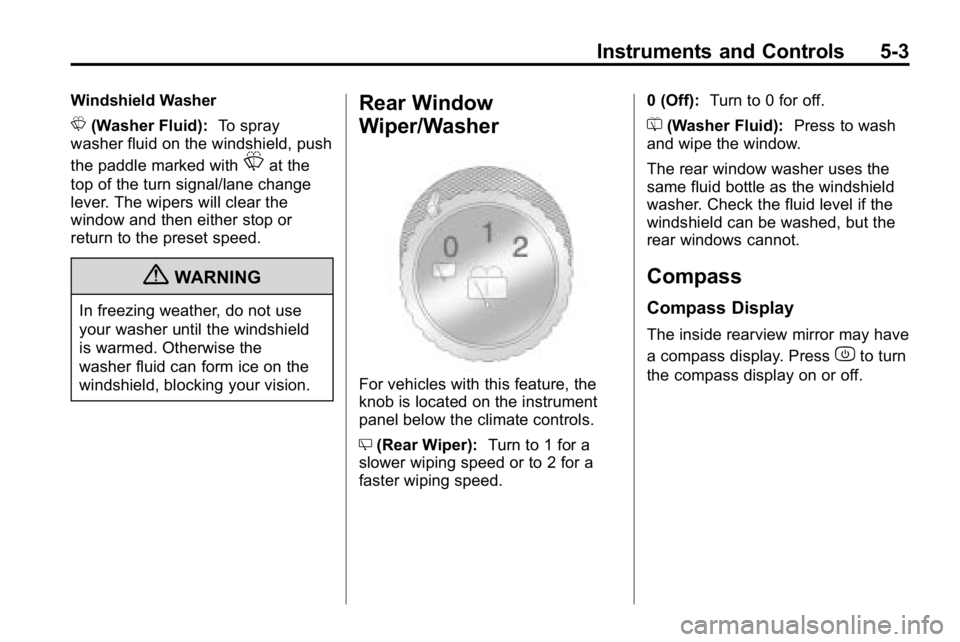
Rear Window
Wiper/Washer
For vehicles with this feature, the
knob is located on the instrument
panel below the climate controls.
Z (Rear Wiper): Turn to 1 for a
slower wiping speed or to 2 for a
faster wiping speed. 0 (Off):
Turn to 0 for off.
= (Washer Fluid): Press to wash
and wipe the window.
The rear window washer uses the
same fluid bottle as the windshield
washer. Check the fluid level if the
windshield can be washed, but the
rear windows cannot.
Compass
Compass Display
The inside rearview mirror may have
a compass display. Press
zto turn
the compass display on or off.
Page 123 of 410
Instruments and Controls 5-9
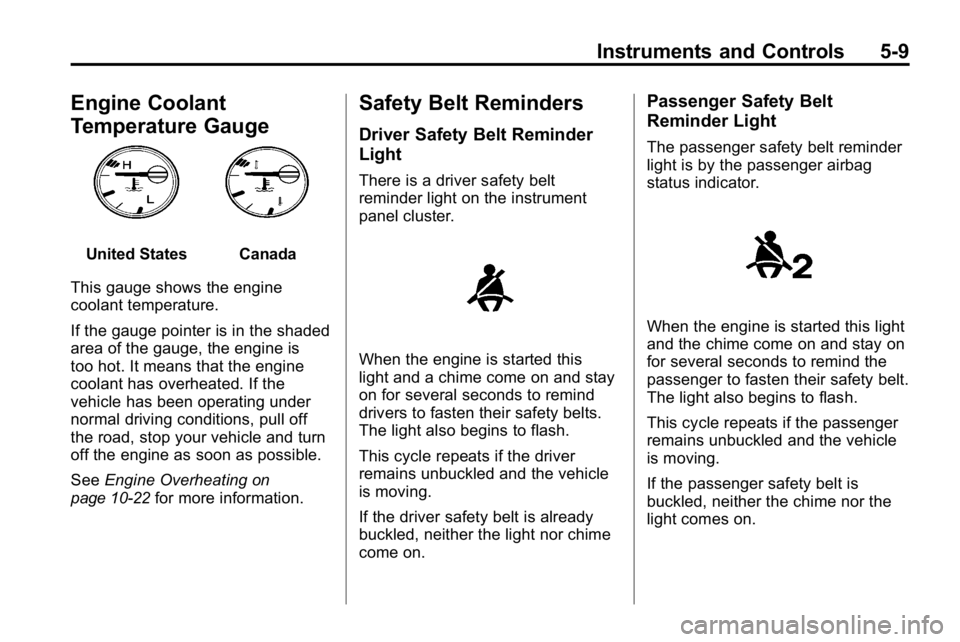
Engine Coolant
Temperature Gauge
United StatesCanada
This gauge shows the engine
coolant temperature.
If the gauge pointer is in the shaded
area of the gauge, the engine is
too hot. It means that the engine
coolant has overheated. If the
vehicle has been operating under
normal driving conditions, pull off
the road, stop your vehicle and turn
off the engine as soon as possible.
See Engine Overheating
on
page 10‑22for more information.
Safety Belt Reminders
Driver Safety Belt Reminder
Light
There is a driver safety belt
reminder light on the instrument
panel cluster.
When the engine is started this
light and a chime come on and stay
on for several seconds to remind
drivers to fasten their safety belts.
The light also begins to flash.
This cycle repeats if the driver
remains unbuckled and the vehicle
is moving.
If the driver safety belt is already
buckled, neither the light nor chime
come on.
Passenger Safety Belt
Reminder Light
The passenger safety belt reminder
light is by the passenger airbag
status indicator.
When the engine is started this light
and the chime come on and stay on
for several seconds to remind the
passenger to fasten their safety belt.
The light also begins to flash.
This cycle repeats if the passenger
remains unbuckled and the vehicle
is moving.
If the passenger safety belt is
buckled, neither the chime nor the
light comes on.
Page 124 of 410

5-10 Instruments and Controls
The front passenger safety belt
warning light and chime may turn on
if an object is put on the seat such
as a briefcase, handbag, grocery
bag, laptop or other electronic
device. To turn off the warning light
and or chime, remove the object
from the seat or buckle the
safety belt.
Airbag Readiness Light
There is an airbag readiness light
on the instrument panel cluster,
which shows the airbag symbol.
The system checks the airbag's
electrical system for malfunctions.
The light indicates if there is an
electrical problem. The system
check includes the airbag sensor,
the pretensioners, the airbagmodules, the wiring and the crash
sensing and diagnostic module.
For more information on the airbag
system, see
Airbag System
on
page 3‑27.
This light comes on when the
vehicle is started, and flashes for a
few seconds. The light goes out
when the system is ready.
If the airbag readiness light stays on
after the vehicle is started or comes
on while driving, the airbag system
may not work properly. Have the
vehicle serviced right away.
{WARNING
If the airbag readiness light
stays on after the vehicle is
started or comes on while driving,
it means the airbag system
might not be working properly.
The airbags in the vehicle might
not inflate in a crash, or they
could even inflate without a crash.
To help avoid injury, have the
vehicle serviced right away.
The airbag readiness light should
flash for a few seconds when the
engine is started. If the light does
not come on then, have it fixed
immediately.