lock Hyundai Accent 2006 Repair Manual
[x] Cancel search | Manufacturer: HYUNDAI, Model Year: 2006, Model line: Accent, Model: Hyundai Accent 2006Pages: 599, PDF Size: 17.59 MB
Page 197 of 599
3 WHAT TO DO IN AN EMERGENCY
10
!
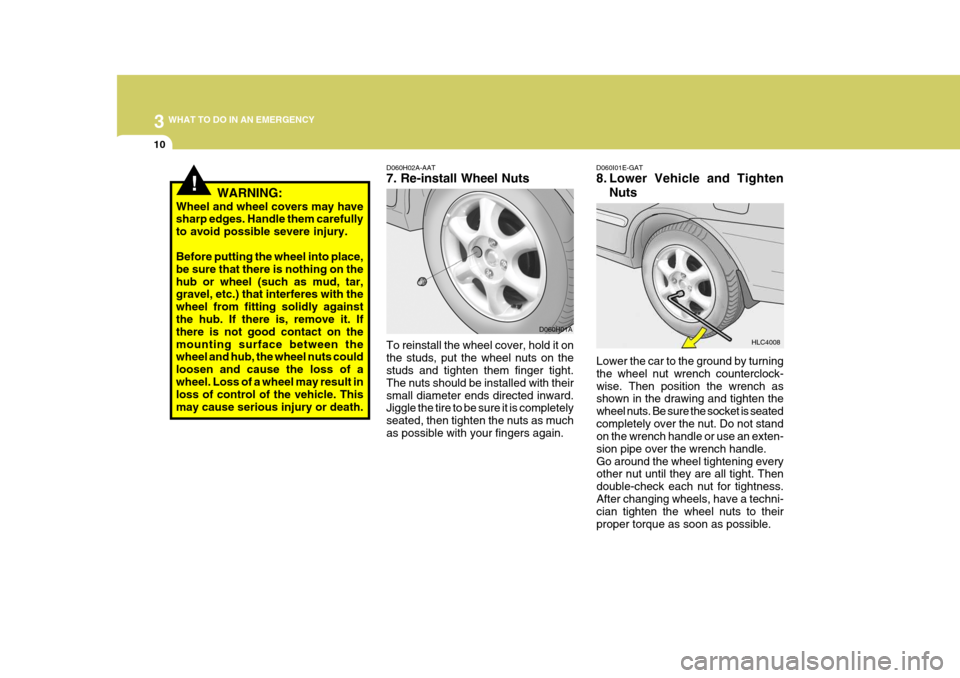
D060H02A-AAT 7. Re-install Wheel Nuts
Lower the car to the ground by turning the wheel nut wrench counterclock-wise. Then position the wrench as shown in the drawing and tighten the wheel nuts. Be sure the socket is seatedcompletely over the nut. Do not stand on the wrench handle or use an exten- sion pipe over the wrench handle.Go around the wheel tightening every other nut until they are all tight. Then double-check each nut for tightness.After changing wheels, have a techni- cian tighten the wheel nuts to their proper torque as soon as possible.
D060I01E-GAT
8. Lower Vehicle and Tighten
Nuts
To reinstall the wheel cover, hold it on the studs, put the wheel nuts on the studs and tighten them finger tight. The nuts should be installed with theirsmall diameter ends directed inward. Jiggle the tire to be sure it is completely seated, then tighten the nuts as muchas possible with your fingers again. D060H01A
HLC4008
WARNING:
Wheel and wheel covers may have sharp edges. Handle them carefully to avoid possible severe injury. Before putting the wheel into place, be sure that there is nothing on thehub or wheel (such as mud, tar, gravel, etc.) that interferes with the wheel from fitting solidly againstthe hub. If there is, remove it. If there is not good contact on the mounting surface between the wheel and hub, the wheel nuts could loosen and cause the loss of awheel. Loss of a wheel may result in loss of control of the vehicle. This may cause serious injury or death.
Page 199 of 599
3 WHAT TO DO IN AN EMERGENCY
12
D080C02A
CAUTION:
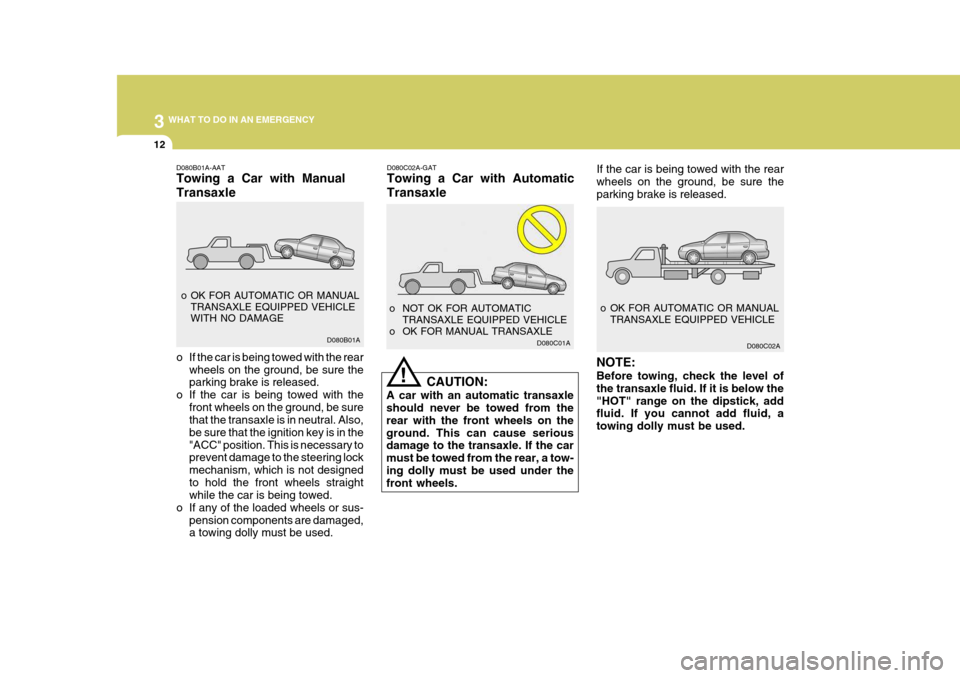
A car with an automatic transaxle should never be towed from the rear with the front wheels on theground. This can cause serious damage to the transaxle. If the car must be towed from the rear, a tow-ing dolly must be used under the front wheels.
! o OK FOR AUTOMATIC OR MANUAL
TRANSAXLE EQUIPPED VEHICLE
If the car is being towed with the rear wheels on the ground, be sure theparking brake is released.
NOTE: Before towing, check the level of the transaxle fluid. If it is below the"HOT" range on the dipstick, add fluid. If you cannot add fluid, a towing dolly must be used.
D080B01A-AAT Towing a Car with Manual Transaxle
o If the car is being towed with the rear wheels on the ground, be sure the parking brake is released.
o If the car is being towed with the front wheels on the ground, be surethat the transaxle is in neutral. Also, be sure that the ignition key is in the"ACC" position. This is necessary to prevent damage to the steering lock mechanism, which is not designedto hold the front wheels straight while the car is being towed.
o If any of the loaded wheels or sus- pension components are damaged,a towing dolly must be used.
o OK FOR AUTOMATIC OR MANUAL
TRANSAXLE EQUIPPED VEHICLE WITH NO DAMAGE
D080B01A D080C02A-GAT Towing a Car with Automatic Transaxle
o NOT OK FOR AUTOMATIC TRANSAXLE EQUIPPED VEHICLE
o OK FOR MANUAL TRANSAXLE D080C01A
Page 200 of 599
3
WHAT TO DO IN AN EMERGENCY
13EMERGENCY TOWINGIF YOU LOSE YOUR KEYS
D120A01A-GAT If you lose your keys, many Hyundai dealers can make you a new key if you have your key number. If you lock the keys inside your car andyou cannot obtain a new key, many Hyundai dealers can use special tools to open the door for you. Information about the key of immobi- lizer system (If Installed) will be foundon page 1-5.
D080D03A-AAT
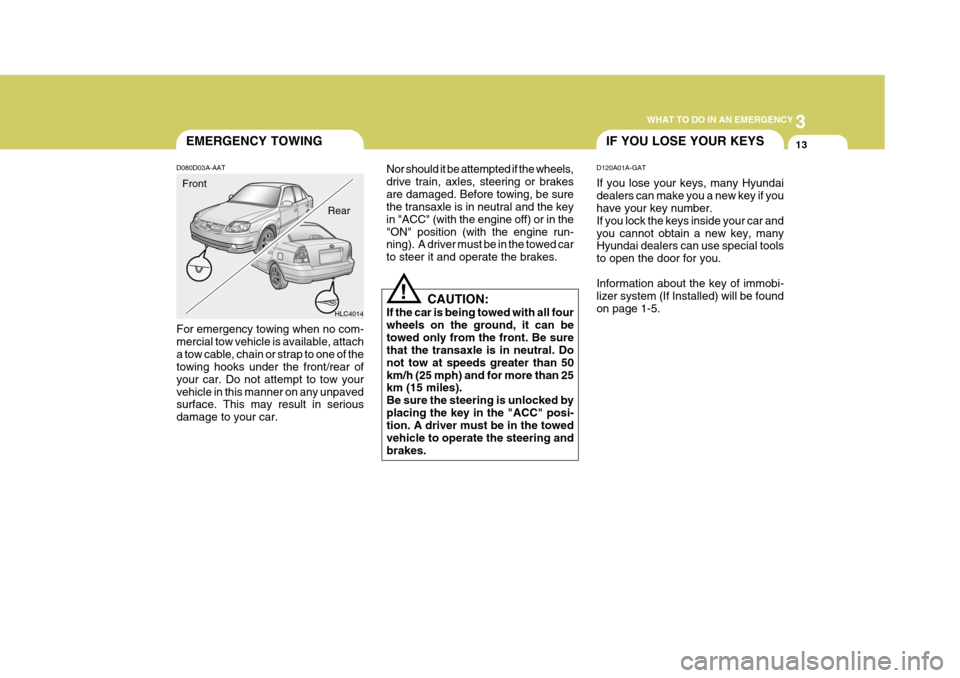
For emergency towing when no com-mercial tow vehicle is available, attacha tow cable, chain or strap to one of the towing hooks under the front/rear of your car. Do not attempt to tow yourvehicle in this manner on any unpaved surface. This may result in serious damage to your car. HLC4014
CAUTION:
If the car is being towed with all fourwheels on the ground, it can betowed only from the front. Be sure that the transaxle is in neutral. Do not tow at speeds greater than 50km/h (25 mph) and for more than 25 km (15 miles). Be sure the steering is unlocked byplacing the key in the "ACC" posi- tion. A driver must be in the towed vehicle to operate the steering andbrakes.
!
Front
RearNor should it be attempted if the wheels, drive train, axles, steering or brakesare damaged. Before towing, be sure the transaxle is in neutral and the key in "ACC" (with the engine off) or in the"ON" position (with the engine run- ning). A driver must be in the towed car to steer it and operate the brakes.
Page 224 of 599

6 DO-IT-YOURSELF MAINTENANCE
6
G020A01A-AAT Engine Compartment The following should be checked regu- larly:
o Engine oil level and condition
o Transaxle fluid level and condition
o Brake fluid level
o Clutch fluid level
o Engine coolant level
o Windshield washer fluid level
o Accessory drive belt condition
o Engine coolant hose condition
o Fluid leaks (on or below compo-
nents)
o Power steering fluid level
o Battery condition
o Air filter condition G020C01A-AAT Vehicle Interior The following should be checked each time when the vehicle is driven:
o Lights operation
o Windshield wiper operation
o Horn operation
o Defroster, heater system operation
(and air conditioning, if installed)
o Steering operation and condition
o Mirror condition and operation
o Turn signal operation
o Accelerator pedal operation
o Brake operation, including parking
brake
o Manual transaxle operation, includ- ing clutch operation
o Automatic transaxle operation, in- cluding "Park" mechanism opera-tion
o Seat control condition and opera- tion
o Seat belt condition and operation
o Sunvisor operation If you notice anything that does not operate correctly or appears to befunctioning incorrectly, inspect it care- fully and seek assistance from your Hyundai dealer if service is needed.
G020B01A-AAT Vehicle Exterior The following should be checked monthly:
o Overall appearance and condition
o Wheel condition and wheel nut torque
o Exhaust system condition
o Light condition and operation
o Windshield glass condition
o Wiper blade condition
o Paint condition and body corrosion
o Fluid leaks
o Door and hood lock condition
o Tire pressure and condition
(including spare tire)
GENERAL CHECKS
Page 227 of 599
6
DO-IT-YOURSELF MAINTENANCE
9
!
CHANGING THE OIL AND FILTER
G350A01A-GAT ENGINE OIL CONSUMPTION Function of Engine Oil Engine oil has the primary function of lubricating and cooling the inside of theengine. Engine oil consumption It is normal that an engine should consume some engine oil while nor-mal driving. The cause of oil consump- tion in a normal engine are as follows;
o Engine oil is used to lubricate pis-
tons, piston rings and cylinders. A thin film of oil is left on the cylinderwall when a piston moves down- wards in the cylinder. High negative pressure generated during engineoperation sucks some of the oil into the combustion chamber. This oil with some oil of the cylinderwall is burned by the high tempera-
ture combustion gases during the combustion process.
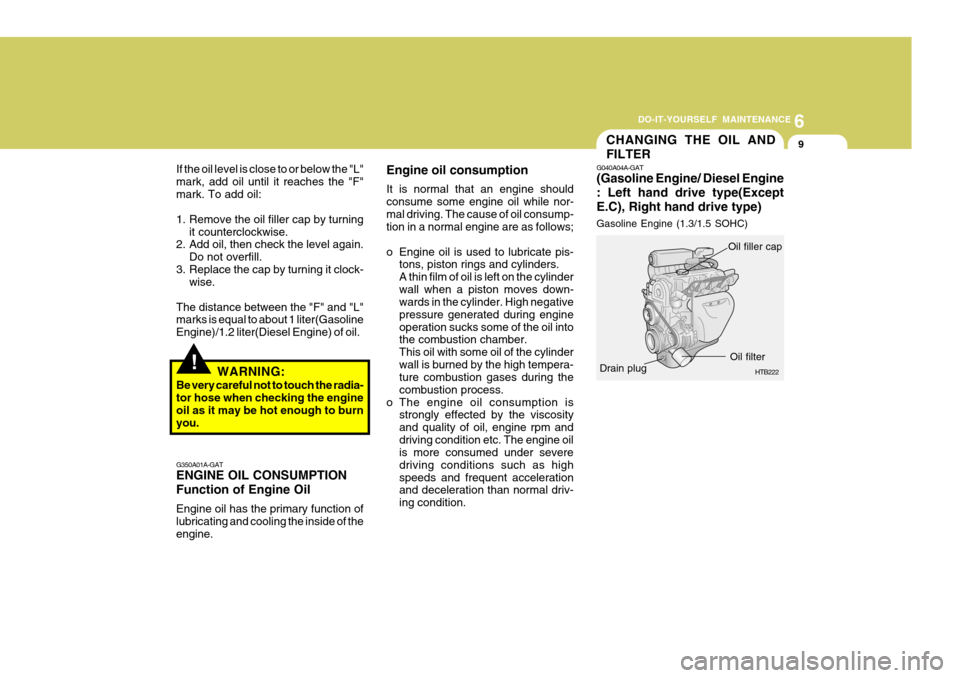
o The engine oil consumption is strongly effected by the viscosityand quality of oil, engine rpm anddriving condition etc. The engine oil is more consumed under severe driving conditions such as highspeeds and frequent acceleration and deceleration than normal driv- ing condition. G040A04A-GAT (Gasoline Engine/ Diesel Engine : Left hand drive type(ExceptE.C), Right hand drive type) Gasoline Engine (1.3/1.5 SOHC)
HTB222
Oil filler cap
Drain plug Oil filter
If the oil level is close to or below the "L" mark, add oil until it reaches the "F"mark. To add oil:
1. Remove the oil filler cap by turning
it counterclockwise.
2. Add oil, then check the level again.
Do not overfill.
3. Replace the cap by turning it clock- wise.
The distance between the "F" and "L" marks is equal to about 1 liter(Gasoline Engine)/1.2 liter(Diesel Engine) of oil.
WARNING:
Be very careful not to touch the radia-tor hose when checking the engine oil as it may be hot enough to burn you.
Page 228 of 599
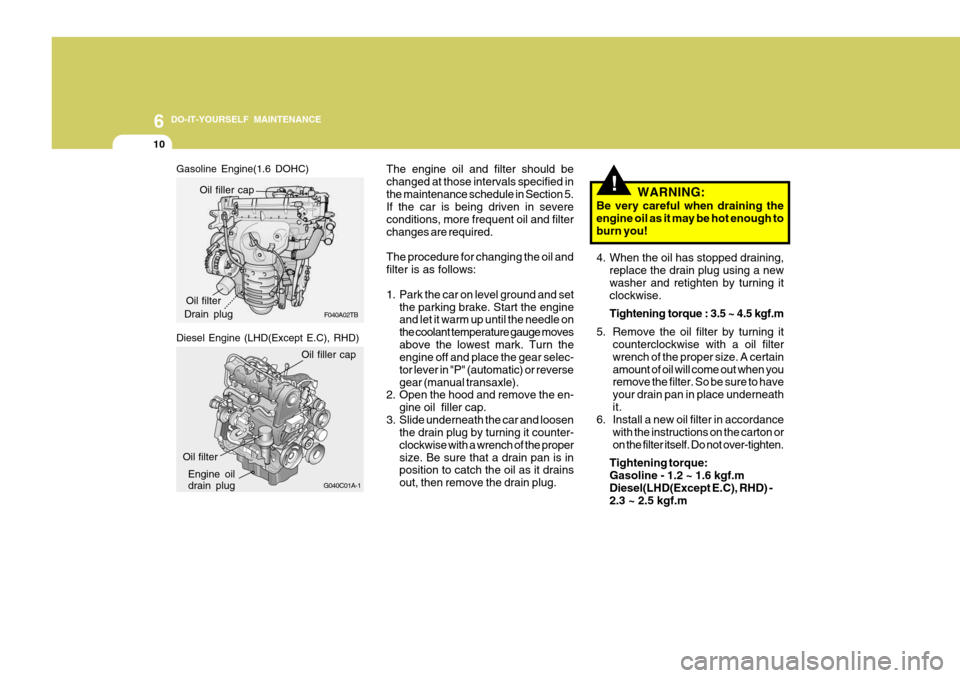
6 DO-IT-YOURSELF MAINTENANCE
10
!
The engine oil and filter should be changed at those intervals specified inthe maintenance schedule in Section 5. If the car is being driven in severe conditions, more frequent oil and filterchanges are required. The procedure for changing the oil and filter is as follows:
1. Park the car on level ground and set
the parking brake. Start the engine and let it warm up until the needle on the coolant temperature gauge movesabove the lowest mark. Turn the engine off and place the gear selec- tor lever in "P" (automatic) or reversegear (manual transaxle).
2. Open the hood and remove the en-
gine oil filler cap.
3. Slide underneath the car and loosen the drain plug by turning it counter-clockwise with a wrench of the propersize. Be sure that a drain pan is in position to catch the oil as it drains out, then remove the drain plug. WARNING:
Be very careful when draining the engine oil as it may be hot enough to burn you!
4. When the oil has stopped draining, replace the drain plug using a new washer and retighten by turning it clockwise.
Tightening torque : 3.5 ~ 4.5 kgf.m
5. Remove the oil filter by turning it counterclockwise with a oil filter wrench of the proper size. A certainamount of oil will come out when you remove the filter. So be sure to have your drain pan in place underneathit.
6. Install a new oil filter in accordance
with the instructions on the carton oron the filter itself. Do not over-tighten.
Tightening torque:Gasoline - 1.2 ~ 1.6 kgf.m Diesel(LHD(Except E.C), RHD) - 2.3 ~ 2.5 kgf.m
Diesel Engine (LHD(Except E.C), RHD)
G040C01A-1
Engine oil drain plug
Oil filter
Oil filler cap
Gasoline Engine(1.6 DOHC)
F040A02TB
Oil filler cap
Drain plug Oil filter
.........
Page 229 of 599
6
DO-IT-YOURSELF MAINTENANCE
11
!
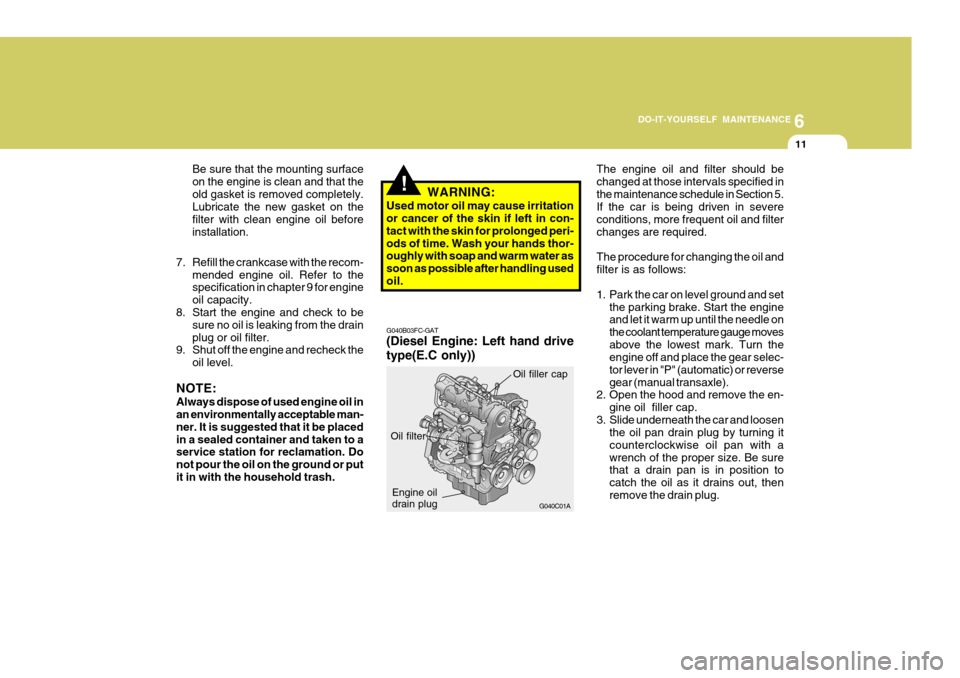
G040B03FC-GAT
(Diesel Engine: Left hand drive type(E.C only)) The engine oil and filter should be changed at those intervals specified inthe maintenance schedule in Section 5. If the car is being driven in severe conditions, more frequent oil and filterchanges are required. The procedure for changing the oil and filter is as follows:
1. Park the car on level ground and set
the parking brake. Start the engine and let it warm up until the needle on the coolant temperature gauge movesabove the lowest mark. Turn the engine off and place the gear selec- tor lever in "P" (automatic) or reversegear (manual transaxle).
2. Open the hood and remove the en-
gine oil filler cap.
3. Slide underneath the car and loosen the oil pan drain plug by turning itcounterclockwise oil pan with awrench of the proper size. Be sure that a drain pan is in position to catch the oil as it drains out, thenremove the drain plug.
Engine oil drain plug
Oil filter
G040C01A
7. Refill the crankcase with the recom-mended engine oil. Refer to the specification in chapter 9 for engine oil capacity.
8. Start the engine and check to be sure no oil is leaking from the drainplug or oil filter.
9. Shut off the engine and recheck the
oil level.
NOTE: Always dispose of used engine oil in an environmentally acceptable man- ner. It is suggested that it be placedin a sealed container and taken to a service station for reclamation. Do not pour the oil on the ground or putit in with the household trash. WARNING:
Used motor oil may cause irritation or cancer of the skin if left in con- tact with the skin for prolonged peri-ods of time. Wash your hands thor- oughly with soap and warm water as soon as possible after handling usedoil.
Oil filler cap
Be sure that the mounting surface on the engine is clean and that theold gasket is removed completely. Lubricate the new gasket on the filter with clean engine oil beforeinstallation.
Page 230 of 599
6 DO-IT-YOURSELF MAINTENANCE
12
Oil filter drain plug
!
!
that a drain pan is in position to catch the oil.
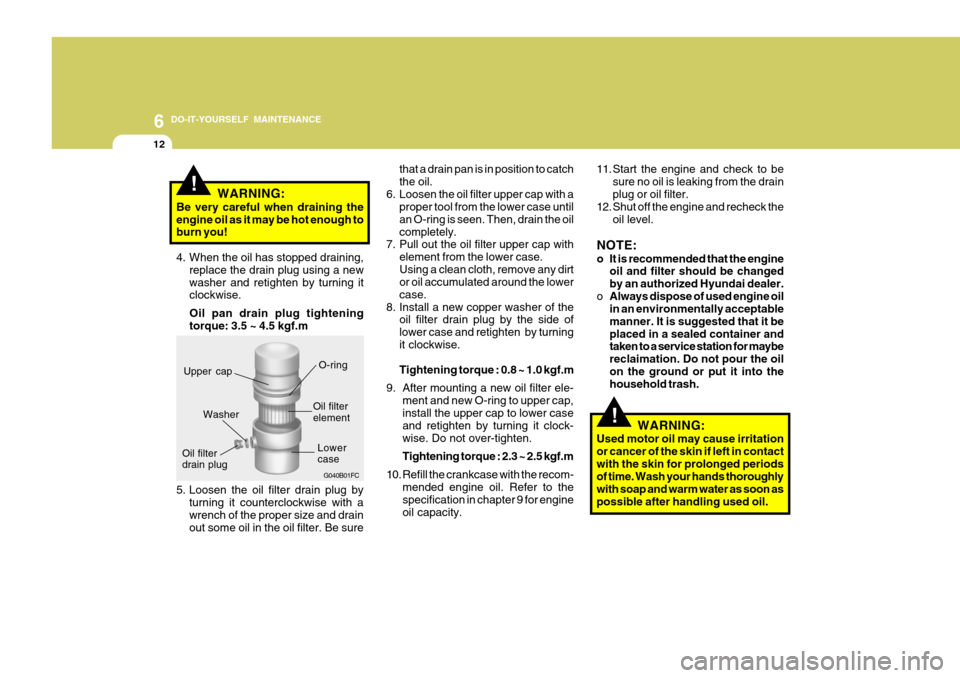
6. Loosen the oil filter upper cap with a proper tool from the lower case untilan O-ring is seen. Then, drain the oilcompletely.
7. Pull out the oil filter upper cap with
element from the lower case.Using a clean cloth, remove any dirt or oil accumulated around the lower case.
8. Install a new copper washer of the oil filter drain plug by the side oflower case and retighten by turningit clockwise. Tightening torque : 0.8 ~ 1.0 kgf.m
9. After mounting a new oil filter ele- ment and new O-ring to upper cap, install the upper cap to lower case and retighten by turning it clock- wise. Do not over-tighten. Tightening torque : 2.3 ~ 2.5 kgf.m
10. Refill the crankcase with the recom- mended engine oil. Refer to the specification in chapter 9 for engineoil capacity. 11. Start the engine and check to be
sure no oil is leaking from the drainplug or oil filter.
12. Shut off the engine and recheck the
oil level.
NOTE:
o It is recommended that the engine oil and filter should be changed by an authorized Hyundai dealer.
o Always dispose of used engine oil in an environmentally acceptable manner. It is suggested that it beplaced in a sealed container and taken to a service station for maybe reclaimation. Do not pour the oilon the ground or put it into the household trash.
G040B01FC
O-ring
Oil filter element
Washer
Upper cap
Lowercase
WARNING:
Be very careful when draining the engine oil as it may be hot enough to burn you!
4. When the oil has stopped draining, replace the drain plug using a new washer and retighten by turning it clockwise. Oil pan drain plug tightening torque: 3.5 ~ 4.5 kgf.m
5. Loosen the oil filter drain plug by turning it counterclockwise with a wrench of the proper size and drainout some oil in the oil filter. Be sure WARNING:
Used motor oil may cause irritationor cancer of the skin if left in contactwith the skin for prolonged periods of time. Wash your hands thoroughly with soap and warm water as soon aspossible after handling used oil.
Page 232 of 599
6 DO-IT-YOURSELF MAINTENANCE
14
G050D01A
G050D02A-AAT To Change the Coolant The coolant should be changed at those intervals specified in the vehiclemaintenance schedule in Section 5.
CAUTION:
Engine coolant can damage the fin-ish of your car. If you spill engine coolant on the car, wash it off thor- oughly with clean water.
!
1. Park the car on level ground, set the parking brake and remove the ra- diator cap when cool.
2. Be sure your drain receptacle is in place. Open the drain cock on theradiator. Allow all the engine coolantto drain from the cooling system, then securely close the drain cock.
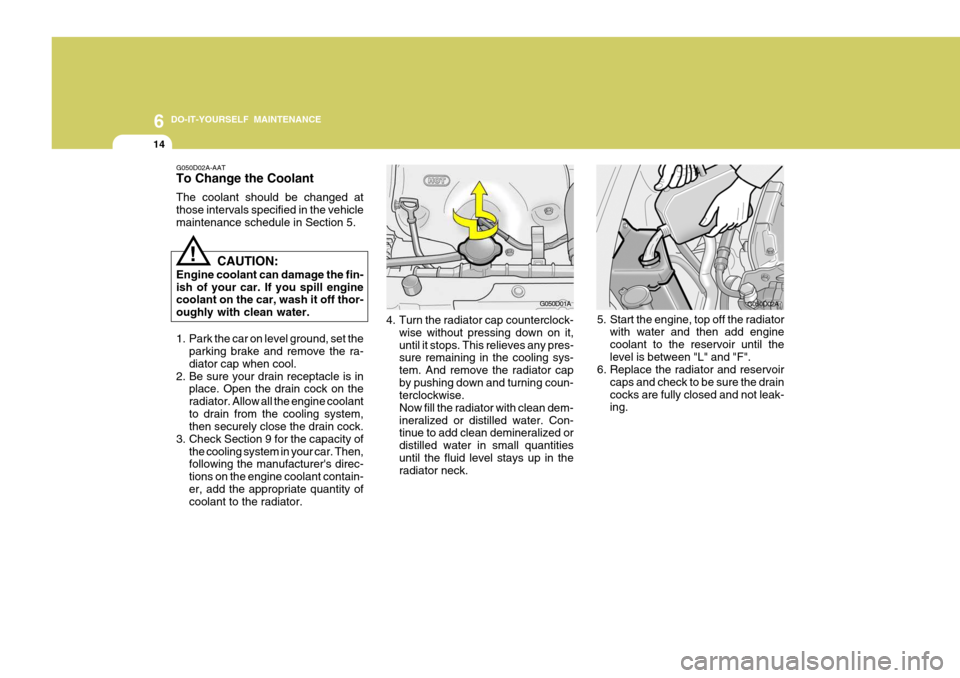
3. Check Section 9 for the capacity of the cooling system in your car. Then,following the manufacturer's direc- tions on the engine coolant contain-er, add the appropriate quantity of coolant to the radiator. 4. Turn the radiator cap counterclock-
wise without pressing down on it, until it stops. This relieves any pres- sure remaining in the cooling sys- tem. And remove the radiator capby pushing down and turning coun- terclockwise. Now fill the radiator with clean dem-ineralized or distilled water. Con- tinue to add clean demineralized or distilled water in small quantitiesuntil the fluid level stays up in the radiator neck. G050D02A
5. Start the engine, top off the radiator with water and then add engine coolant to the reservoir until thelevel is between "L" and "F".
6. Replace the radiator and reservoir
caps and check to be sure the draincocks are fully closed and not leak- ing.
Page 234 of 599

6 DO-IT-YOURSELF MAINTENANCE
16
!WARNING:
It is recommended that the engine be cool or cold when changing the spark plugs. If the engine is hot,you could burn yourself on the in- sulated connector, the spark plug or the engine itself. G060C03A
6. To install the new spark plug, guide
the socket down over the sparkplug, being careful not to damage the ceramic insulator.
NOTE: Spark plugs should be tightened firmly. Over-tightening can damagethe threads in the aluminum cylin- der head. Also, leaving them too loose can cause the spark plug toget very hot and possibly result in damage to the engine.
7. Replace the cable by pushing the insulated connector directly down onto the electrode. Check to be sure it has snapped into place and can'tfall off.
HLC5023
G060C01S-GAT Changing the Spark Plugs You will find it easier to change spark plugs if the engine is cold. Alwayschange one spark plug at a time. This helps avoid getting the wires mixed up.
1. Remove the center cover on the en-
gine rocker cover (DOHC engine only.)
2. Using a clean cloth, remove any dirt
that has accumulated around the base of the spark plug so it cannot fall into the cylinder when the spark plug is removed.
3. To remove the spark plug cable, pull straight up on the insulated connec-tor, not the cable. Pulling on thecable may damage the carbon core conductor. G060C01A
4. When preparing to remove the oldspark plug, guide the socket downover the spark plug, being careful not to damage the ceramic insula-tor.
5. To remove the old spark plug, turn
the wrench handle in a counter-clockwise direction.