wheel Hyundai Accent 2006 Repair Manual
[x] Cancel search | Manufacturer: HYUNDAI, Model Year: 2006, Model line: Accent, Model: Hyundai Accent 2006Pages: 599, PDF Size: 17.59 MB
Page 509 of 599
2
DRIVING YOUR HYUNDAI
19
o The formation of snow or ice built up inside the wheel arches may inter- fere with the road wheels or steering mechanism. In such instances, un- usual noises or an increase in steer-ing effort may result. Therefore, ensure that the wheel arches are checked periodically and any accu-mulated snow or ice removed.
o It is advisable to carry emergency
equipment including, torch, shovel,tow rope, blankets etc., if a journey is to be undertaken into areas of severe road conditions.TRAILER AND CARAVAN TOWING
!
C195F01A-EAT TOWING ATTACHMENTS It is strongly recommended that only an Hyundai Approved towing attach-ment is used to ensure that the loads placed upon the body structure are correctly distributed. The use of a nonapproved attachment will result in the invalidation of the vehicle warranty. Hyundai towing attachments are de-signed and constructed to ensure maximum towing performance and ease of fitment. A range of accesso-ries including electrical kits are avail- able through the Hyundai dealer net- work. It is of the utmost importance that those areas of the vehicle which aresubjected to greater stress during tow- ing are maintained in accordance with the recommendations given at the endof this book. In addition, the daily oper- ating checks relating to engine oil, transmission oil and tyres must beperformed at each refuelling to ensure maximum reliability and safety.
C190E02A-EAT
WARNING:
It is not recommended that the ve- hicle be used for towing until thefirst 1,000 miles of Running In has been completed. All Hyundai AC- CENT models are suited to towingtrailers and caravans up to the lim- its indicated on page 2-21. This models fitted with automatictransaxle have a transaxle oil cooler and further transaxle cooling should not be required. C190E01L
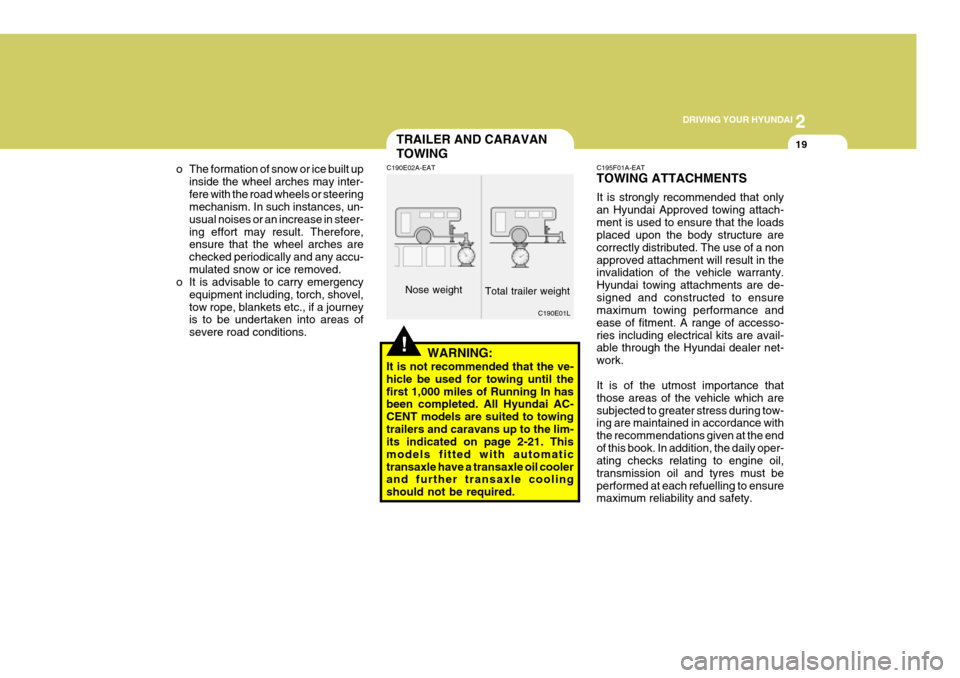
Nose weight
Total trailer weight
Page 510 of 599
2DRIVING YOUR HYUNDAI
20
vehicle towing attachment each and every time the trailer is hitched to thevehicle. Whilst towing, the performance of the vehicle will be reduced in terms of acceleration, braking and handling due to the increased loads placed upon thevehicle. The driver should anticipate the change in characteristics and ad- just the driving style in keeping withthese changes. Care should be exer- cised when cornering and braking to prevent the outfit becoming uncontrol-lable by reducing cornering speeds and allowing increased braking dis- tances. The driver should exercise care to ensure that when pulling away fromrest particularly on uphill gradients the clutch unit is not subjected to exces- sive slippage which will reduce theuseful life of this component. Use of the "Overdrive Off", "2" and "L" posi- tions when driving vehicles with auto-matic transmission will assist with brak- ing performance when long down hill gradients are encountered. Improved acceleration performance will be avail-able by selecting "Overdrive Off","2",or "1" depending upon road speed if it is found that the transmission unit makes an undesirable upshift whilsthill climbing or overtaking. The trans- mission unit should be operated in "D" with the Overdrive "On" under normalcircumstances to enhance fuel economy and reduce noise and en- gine wear.
C190E02L
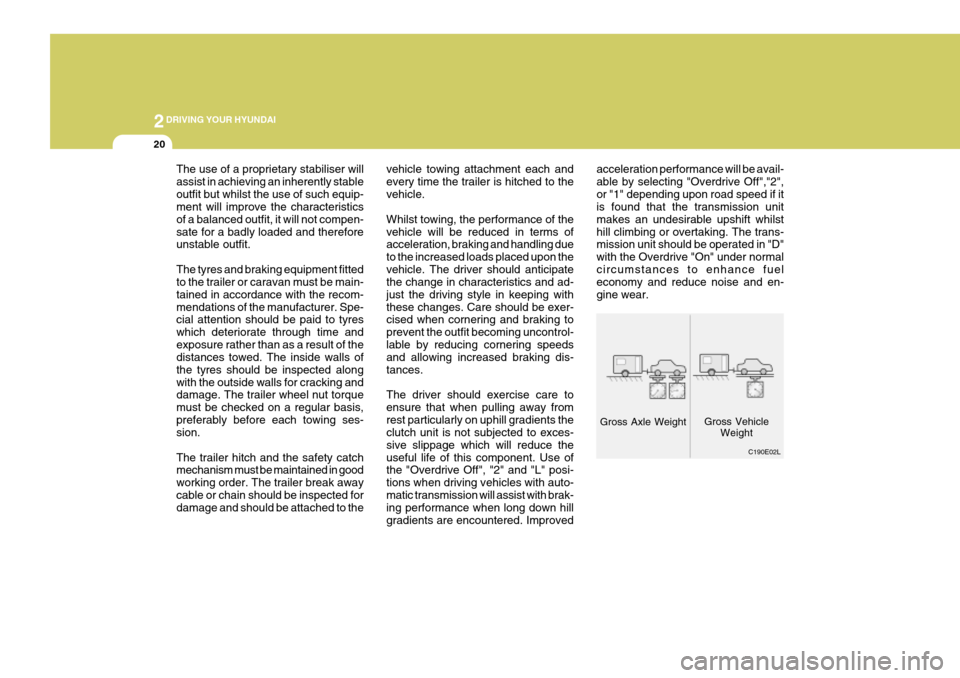
Gross Axle Weight
Gross Vehicle
Weight
The use of a proprietary stabiliser willassist in achieving an inherently stableoutfit but whilst the use of such equip- ment will improve the characteristics of a balanced outfit, it will not compen-sate for a badly loaded and therefore unstable outfit. The tyres and braking equipment fitted to the trailer or caravan must be main- tained in accordance with the recom-mendations of the manufacturer. Spe- cial attention should be paid to tyres which deteriorate through time andexposure rather than as a result of the distances towed. The inside walls of the tyres should be inspected alongwith the outside walls for cracking and damage. The trailer wheel nut torque must be checked on a regular basis,preferably before each towing ses- sion. The trailer hitch and the safety catch mechanism must be maintained in good working order. The trailer break awaycable or chain should be inspected for damage and should be attached to the
Page 512 of 599

2DRIVING YOUR HYUNDAI
22
7. The vehicle/trailer combination ismore affected by crosswind and buffeting. When being passed by a large vehicle, keep a constant speedand steer straight ahead. If there is too much wind buffeting slow down to get out of the other vehicle's airturbulence.
8. When parking your car and trailer,
especially on a hill, be sure tofollow all the normal precautions. Turn your front wheel into the curb, set the parking brake firmly, andput the transaxle in 1st or Reverse (manual) or Park (automatic). In addition, place wheel chocks ateach of the trailer's tyres.
9. If the trailer has electric brakes,
start your vehicle and trailer mov-ing, and then apply the trailer brake controller by hand to be sure the brakes are working. This lets youcheck your electrical connection at the same time.
10. During your trip, check occasion- ally to be sure that the load issecure, and that the lights and any trailer brakes are still working.
C190F02A-EAT Trailer or Vehicle Towing Tips
1. Before towing, check towbar hitch
and safety cable connections as well as proper operation of the trailer running lights, brake lights, and turn signals.
2. Always drive your vehicle at a mod- erate speed (Less than 60 MPH)
3. Trailer towing requires more fuel than normal conditions.
4. To maintain engine braking effi-
ciency and electrical charging per-formance, do not use fifth gear (manual transaxle) or overdrive (automatic transaxle).
5. Always secure items in the trailer to prevent load shift whilst driving.
6. Check the condition and air pres- sure of all tyres on the trailer and your car. Low tyre pressure can seriously affect the handling. Alsocheck the spare tyre.
C190G01A-EAT Important Trailer Weight Infor- mation The Maximum Towable Weight of your Hyundai Accent will be reduced if thevehicle is load. The Maximum Towable Weight for a fully load is vehicle is calculated asfollows:
1. Find the Vehicle Identification Num-
ber (VIN) plate (see section 8).
2. Note the top 2 weights (in kg) of the
4 lines of weight information on the VIN plate.
3. Subtract the weight on line 1 from
line 2. This result (in kg) is themaximum towable weight of a fully loaded vehicle. For more information, contact yourlocal Hyundai Dealer.
Page 514 of 599
3
If the Engine Will Not Start .......................................... 3-2
Jump Starting .............................................................. 3-3
If the Engine Overheats .............................................. 3-5
Spare Wheel ................................................................ 3-6
In the Event of a Puncture .......................................... 3-7
Vehicle Towing or Recovery .....................................3-12
If You Lose Your Keys .............................................. 3-14
IN CASE OF EMERGENCY
3
Page 519 of 599
3 IN CASE OF EMERGENCY
6SPARE WHEEL
!
CAUTION:
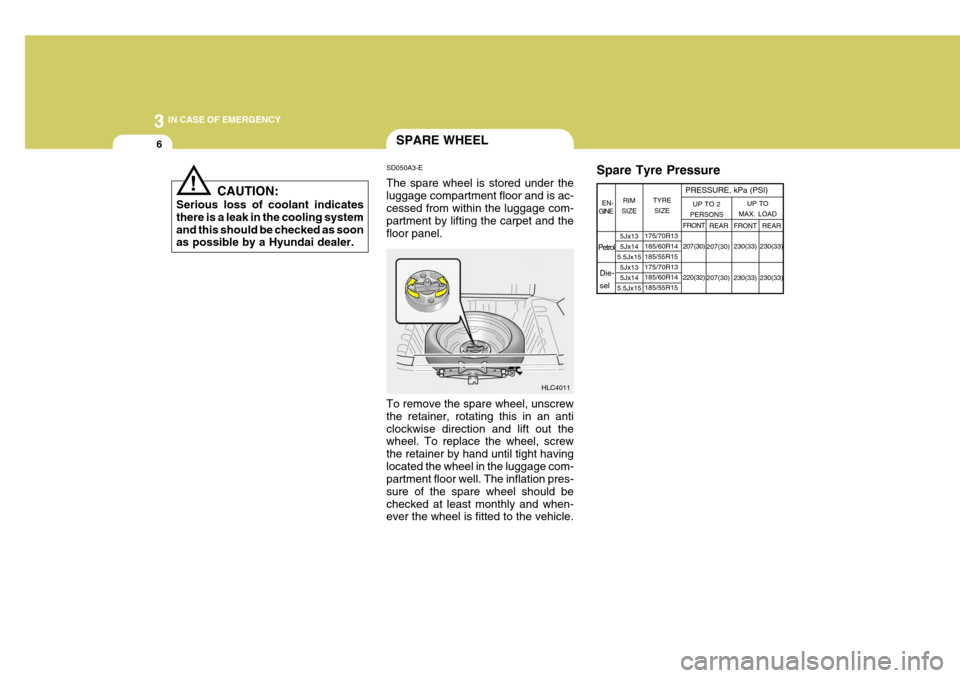
Serious loss of coolant indicates there is a leak in the cooling systemand this should be checked as soon as possible by a Hyundai dealer. SD050A3-E The spare wheel is stored under the luggage compartment floor and is ac- cessed from within the luggage com- partment by lifting the carpet and thefloor panel. To remove the spare wheel, unscrew the retainer, rotating this in an anticlockwise direction and lift out the wheel. To replace the wheel, screw the retainer by hand until tight havinglocated the wheel in the luggage com- partment floor well. The inflation pres- sure of the spare wheel should bechecked at least monthly and when- ever the wheel is fitted to the vehicle. Spare Tyre Pressure
5Jx13 5Jx14
5.5Jx15
5Jx13 5Jx14
5.5Jx15 TYRE
SIZE
RIM
SIZE PRESSURE, kPa (PSI)
175/70R13 185/60R14185/55R15175/70R13 185/60R14 185/55R15 REAR
207(30) 207(30) FRONT
230(33)230(33)
UP TO 2
PERSONS UP TO
MAX. LOAD
REAR
230(33)230(33)
FRONT 207(30) 220(32)
EN-
GINE
Die- sel
Petrol
HLC4011
Page 520 of 599
3
IN CASE OF EMERGENCY
7CHANGING A FLAT TYREIN THE EVENT OF A PUNCTURE
SD070A1-E It is of the utmost importance that care is exercised when changing roadwheels. Ensure that the parking brake is set and that the gear shift lever is in reverse (P, if the vehicle has automatictransaxle).
SD060A1-E If a puncture occurs whilst driving the vehicle:
1. Bring the car to rest as soon as it is
safe to do so and with the minimum amount of braking required which will assist in maintaining the maxi-mum amount of control. The vehicle should be parked wherever pos- sible upon firm level ground to facili-tate wheel changing.
2. If the vehicle is creating a hazard
and the road conditions do not per-mit the wheel to be changed safely, assistance should be sought.
3. Passengers must not be allowed to remain inside the vehicle duringwheel changing. If a puncture oc- curs whilst the vehicle is on amotorway, the passengers should take refuge on the motorway em- bankment to avoid the possibility ofinjury occurring should the vehicle be struck by other motorway traffic.
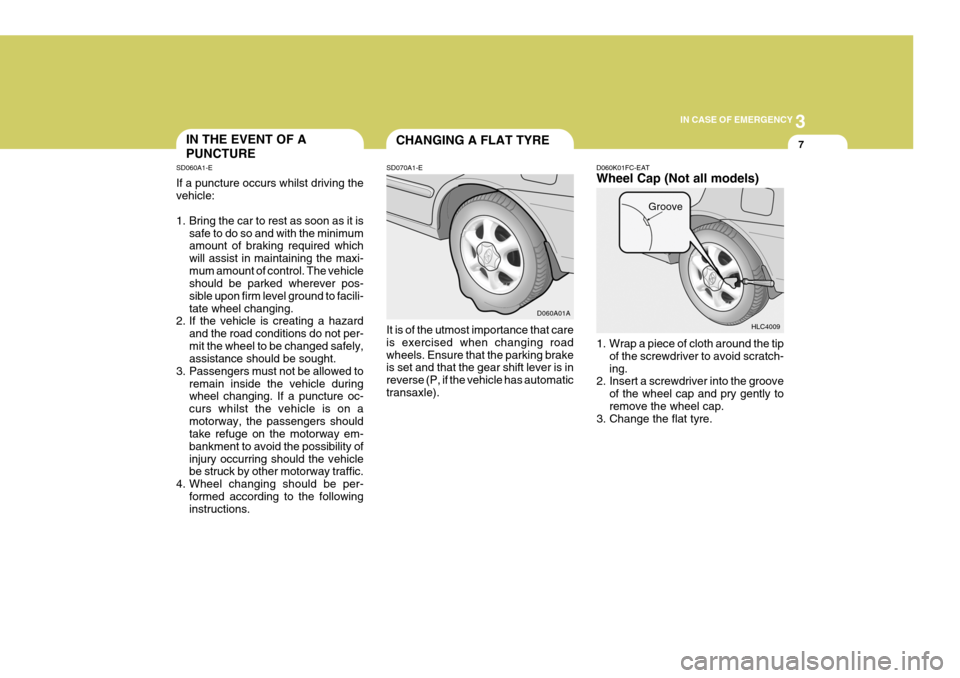
4. Wheel changing should be per- formed according to the followinginstructions. D060K01FC-EAT Wheel Cap (Not all models)
1. Wrap a piece of cloth around the tip of the screwdriver to avoid scratch- ing.
2. Insert a screwdriver into the groove
of the wheel cap and pry gently toremove the wheel cap.
3. Change the flat tyre.
HLC4009
Groove
D060A01A
Page 521 of 599
3 IN CASE OF EMERGENCY
8
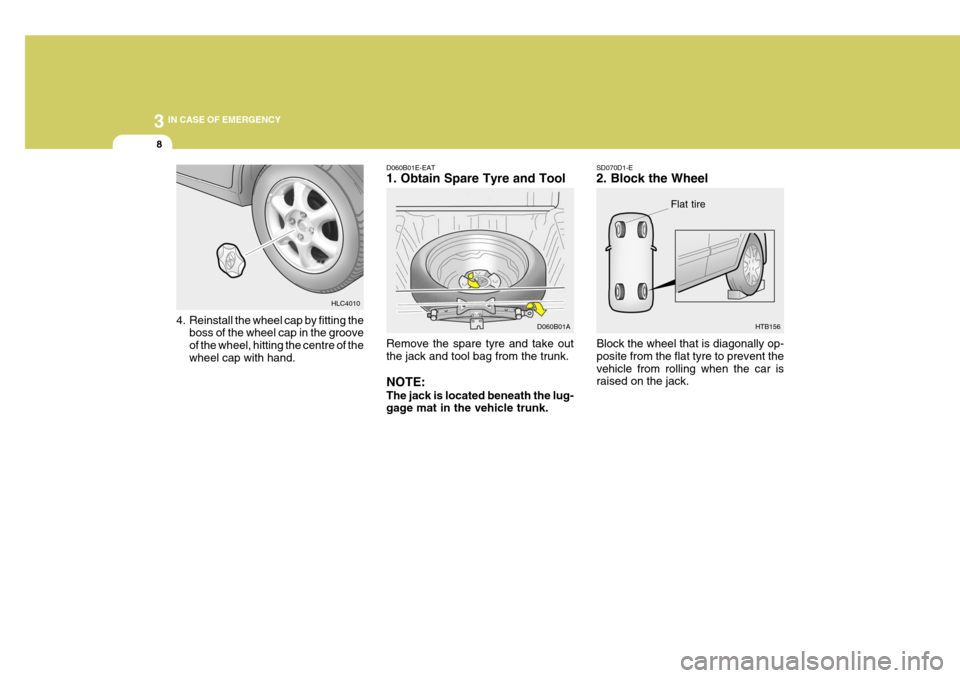
4. Reinstall the wheel cap by fitting theboss of the wheel cap in the groove of the wheel, hitting the centre of thewheel cap with hand. SD070D1-E 2. Block the Wheel
Block the wheel that is diagonally op- posite from the flat tyre to prevent thevehicle from rolling when the car is raised on the jack.
Remove the spare tyre and take out the jack and tool bag from the trunk. NOTE: The jack is located beneath the lug- gage mat in the vehicle trunk.
D060B01E-EAT 1. Obtain Spare Tyre and Tool
HLC4010
HTB156
Flat tireD060B01A
Page 522 of 599
3
IN CASE OF EMERGENCY
9
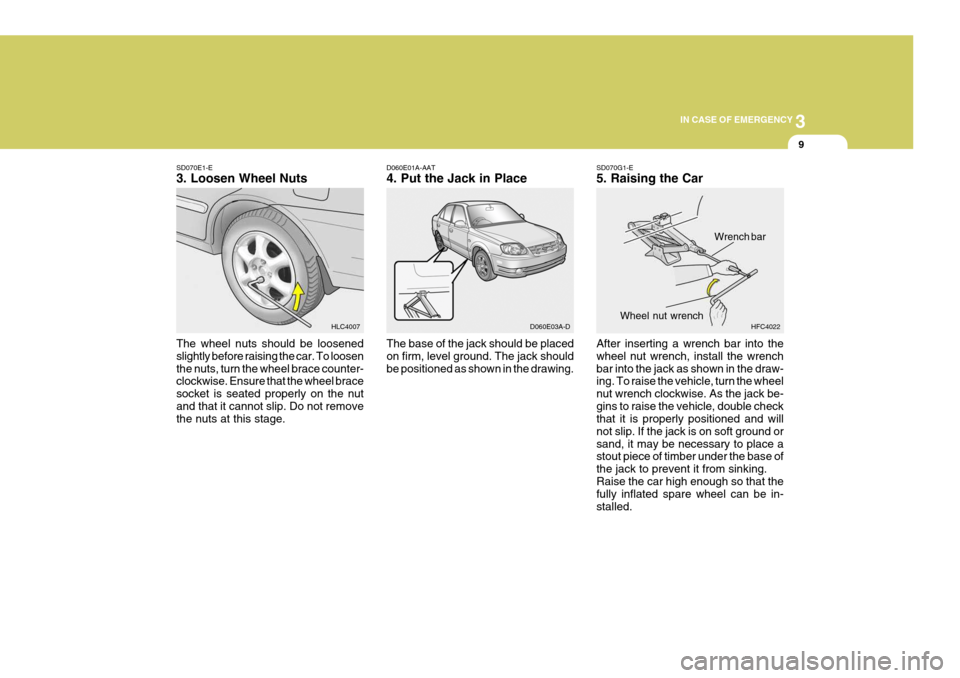
SD070E1-E 3. Loosen Wheel Nuts The wheel nuts should be loosened slightly before raising the car. To loosenthe nuts, turn the wheel brace counter- clockwise. Ensure that the wheel brace socket is seated properly on the nutand that it cannot slip. Do not remove the nuts at this stage. SD070G1-E 5. Raising the Car After inserting a wrench bar into the wheel nut wrench, install the wrenchbar into the jack as shown in the draw- ing. To raise the vehicle, turn the wheel nut wrench clockwise. As the jack be-gins to raise the vehicle, double check that it is properly positioned and will not slip. If the jack is on soft ground orsand, it may be necessary to place a stout piece of timber under the base of the jack to prevent it from sinking.Raise the car high enough so that the fully inflated spare wheel can be in- stalled.
D060E01A-AAT 4. Put the Jack in Place The base of the jack should be placed on firm, level ground. The jack shouldbe positioned as shown in the drawing.
Wrench bar
Wheel nut wrench
D060E03A-D HFC4022
HLC4007
Page 523 of 599
3 IN CASE OF EMERGENCY
10
!
!
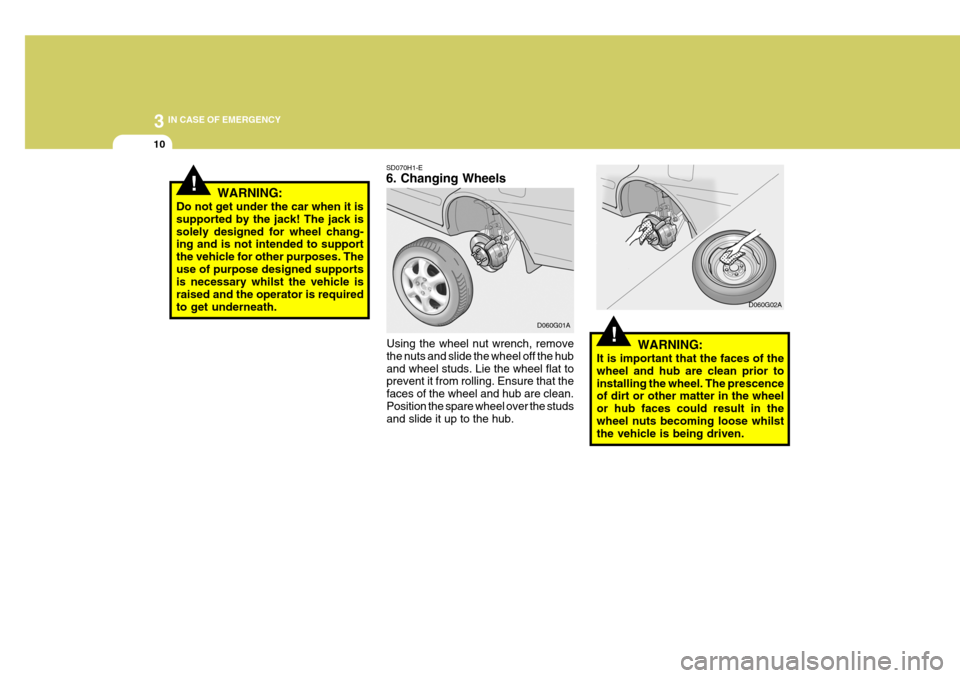
SD070H1-E 6. Changing Wheels
WARNING:
Do not get under the car when it is supported by the jack! The jack issolely designed for wheel chang- ing and is not intended to support the vehicle for other purposes. Theuse of purpose designed supports is necessary whilst the vehicle is raised and the operator is requiredto get underneath.
Using the wheel nut wrench, removethe nuts and slide the wheel off the huband wheel studs. Lie the wheel flat to prevent it from rolling. Ensure that the faces of the wheel and hub are clean.Position the spare wheel over the studs and slide it up to the hub. WARNING:
It is important that the faces of the wheel and hub are clean prior toinstalling the wheel. The prescence of dirt or other matter in the wheel or hub faces could result in thewheel nuts becoming loose whilst the vehicle is being driven.
D060G01A D060G02A
Page 524 of 599
3
IN CASE OF EMERGENCY
11
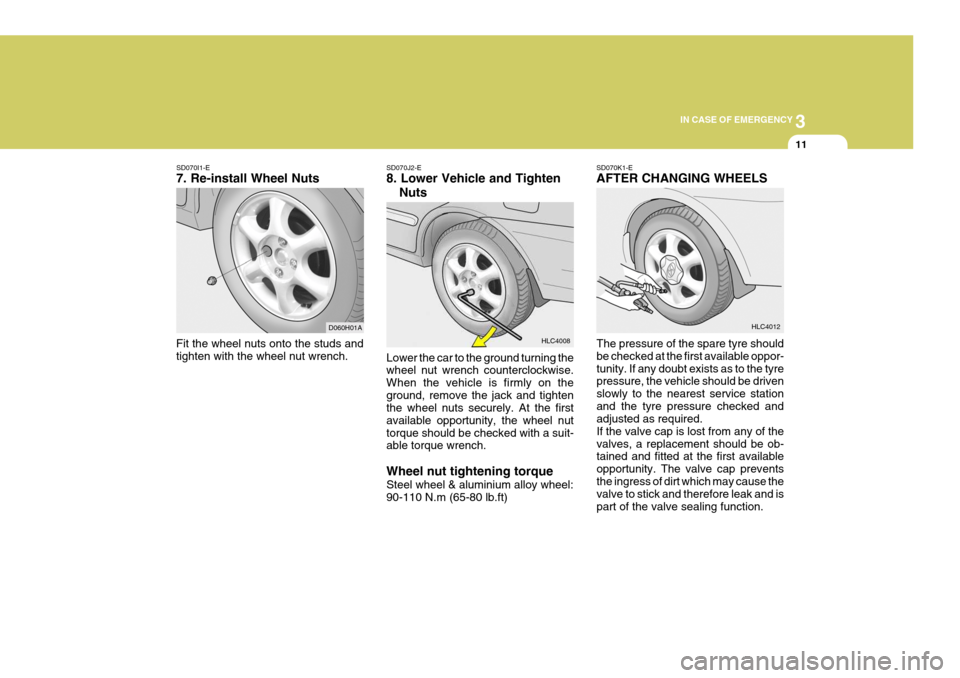
SD070I1-E 7. Re-install Wheel Nuts
Fit the wheel nuts onto the studs and tighten with the wheel nut wrench. D060H01ASD070J2-E 8. Lower Vehicle and Tighten
Nuts
Lower the car to the ground turning the wheel nut wrench counterclockwise. When the vehicle is firmly on theground, remove the jack and tighten the wheel nuts securely. At the first available opportunity, the wheel nuttorque should be checked with a suit- able torque wrench. Wheel nut tightening torque Steel wheel & aluminium alloy wheel: 90-110 N.m (65-80 lb.ft) SD070K1-E AFTER CHANGING WHEELS
The pressure of the spare tyre should be checked at the first available oppor-tunity. If any doubt exists as to the tyre pressure, the vehicle should be driven slowly to the nearest service stationand the tyre pressure checked and adjusted as required. If the valve cap is lost from any of thevalves, a replacement should be ob- tained and fitted at the first available opportunity. The valve cap preventsthe ingress of dirt which may cause the valve to stick and therefore leak and is part of the valve sealing function.
HLC4008 HLC4012