fuel Hyundai Coupe 2006 Service Manual
[x] Cancel search | Manufacturer: HYUNDAI, Model Year: 2006, Model line: Coupe, Model: Hyundai Coupe 2006Pages: 483, PDF Size: 12.73 MB
Page 314 of 483
1
CONTROLS AND EQUIPMENT
47
!
INSTRUMENT CLUSTER
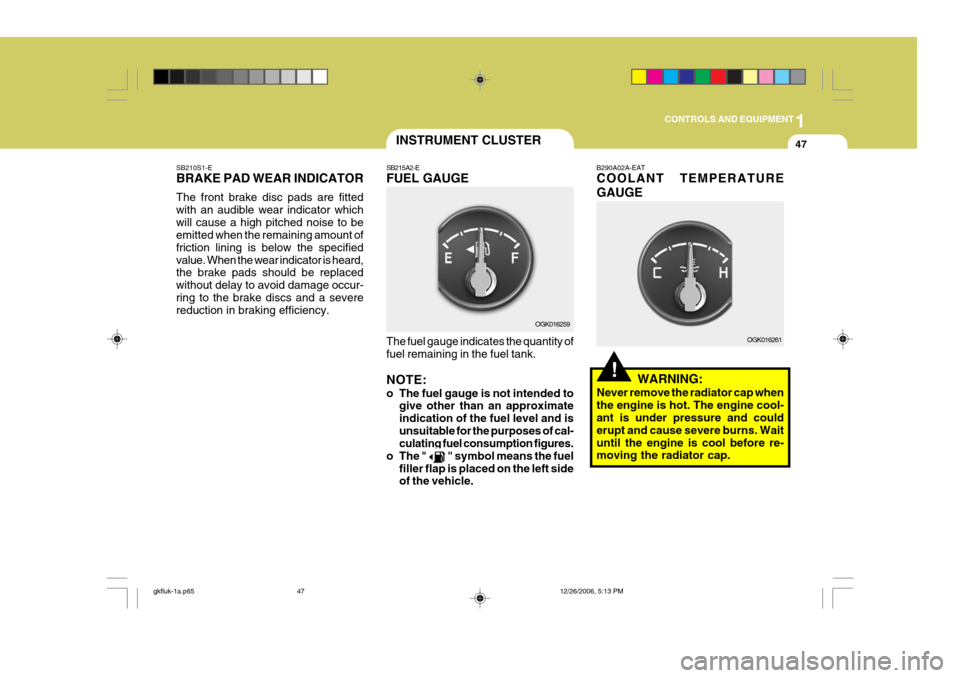
SB210S1-E BRAKE PAD WEAR INDICATOR The front brake disc pads are fitted with an audible wear indicator whichwill cause a high pitched noise to be emitted when the remaining amount of friction lining is below the specifiedvalue. When the wear indicator is heard, the brake pads should be replaced without delay to avoid damage occur-ring to the brake discs and a severe reduction in braking efficiency. SB215A2-E FUEL GAUGE The fuel gauge indicates the quantity of fuel remaining in the fuel tank. NOTE:
o The fuel gauge is not intended to
give other than an approximate indication of the fuel level and isunsuitable for the purposes of cal- culating fuel consumption figures.
o The "
" symbol means the fuel
filler flap is placed on the left side of the vehicle. B290A02A-EAT COOLANT TEMPERATURE GAUGE
WARNING:
Never remove the radiator cap when the engine is hot. The engine cool- ant is under pressure and could erupt and cause severe burns. Waituntil the engine is cool before re- moving the radiator cap.
OGK016259
OGK016261
gkfluk-1a.p65 12/26/2006, 5:13 PM
47
Page 317 of 483
1CONTROLS AND EQUIPMENT
50TRIP COMPUTER
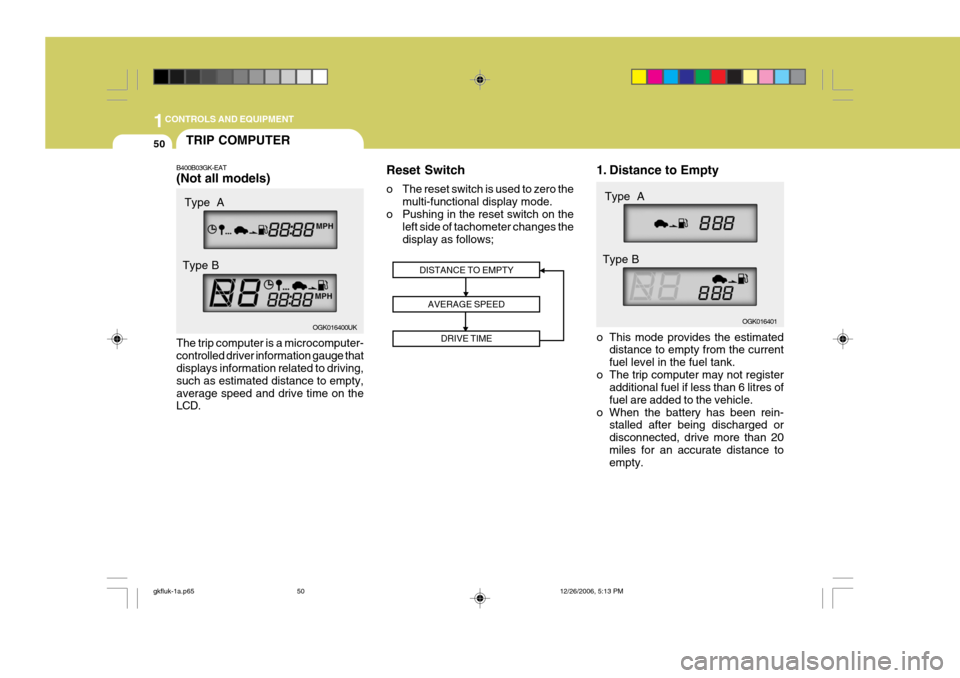
B400B03GK-EAT (Not all models) The trip computer is a microcomputer- controlled driver information gauge that displays information related to driving, such as estimated distance to empty,average speed and drive time on the LCD. Reset Switch
o The reset switch is used to zero the
multi-functional display mode.
o Pushing in the reset switch on the left side of tachometer changes the display as follows; 1. Distance to Empty
o This mode provides the estimated
distance to empty from the current fuel level in the fuel tank.
o The trip computer may not register additional fuel if less than 6 litres offuel are added to the vehicle.
o When the battery has been rein- stalled after being discharged ordisconnected, drive more than 20miles for an accurate distance to empty.
DISTANCE TO EMPTY
AVERAGE SPEED DRIVE TIME
OGK016400UK OGK016401
Type A
Type B Type A
Type B
gkfluk-1a.p65 12/26/2006, 5:13 PM
50
Page 318 of 483
1
CONTROLS AND EQUIPMENT
51
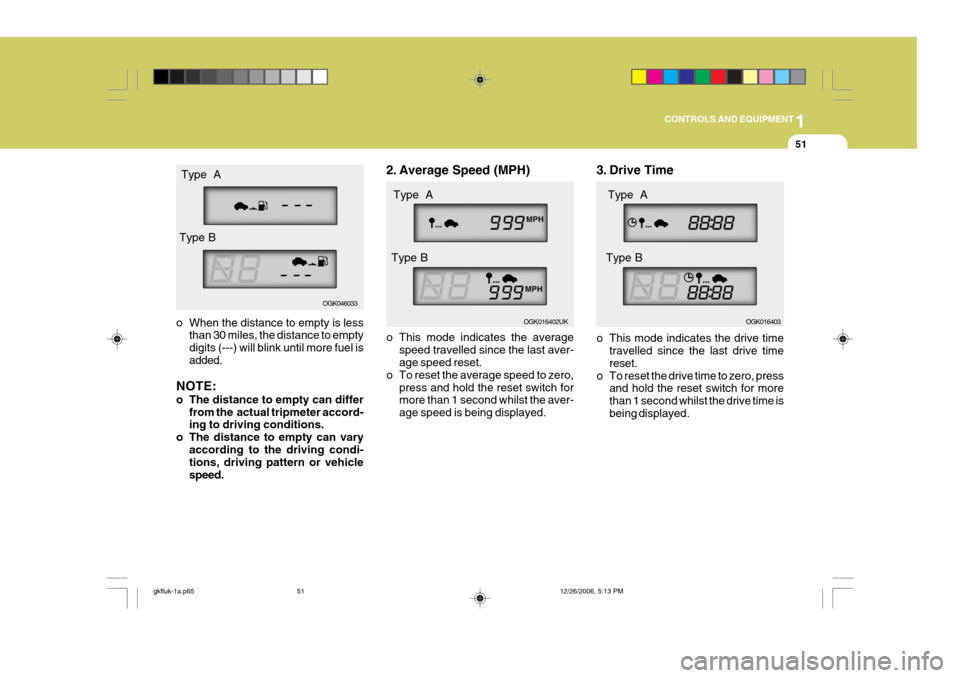
o When the distance to empty is less
than 30 miles, the distance to empty digits (---) will blink until more fuel is added.
NOTE:
o The distance to empty can differ from the actual tripmeter accord- ing to driving conditions.
o The distance to empty can vary according to the driving condi-tions, driving pattern or vehicle speed. 2. Average Speed (MPH)
o This mode indicates the average
speed travelled since the last aver- age speed reset.
o To reset the average speed to zero, press and hold the reset switch formore than 1 second whilst the aver- age speed is being displayed. 3. Drive Time
o This mode indicates the drive time
travelled since the last drive time reset.
o To reset the drive time to zero, press and hold the reset switch for morethan 1 second whilst the drive time isbeing displayed.
OGK016402UKOGK016403
Type A
Type B Type A
Type B
OGK046033
Type A
Type B
gkfluk-1a.p65 12/26/2006, 5:13 PM
51
Page 319 of 483
1CONTROLS AND EQUIPMENT
52MULTI GAUGE
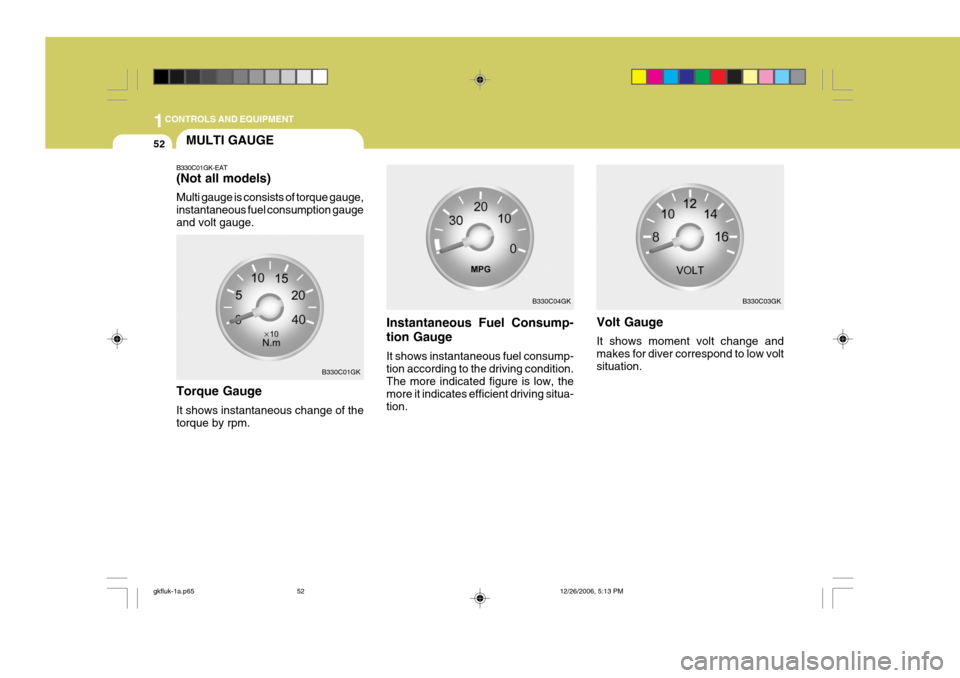
B330C01GK-EAT (Not all models) Multi gauge is consists of torque gauge, instantaneous fuel consumption gaugeand volt gauge.
Instantaneous Fuel Consump- tion Gauge It shows instantaneous fuel consump- tion according to the driving condition. The more indicated figure is low, the more it indicates efficient driving situa-tion.
Torque Gauge It shows instantaneous change of the torque by rpm. Volt Gauge It shows moment volt change and makes for diver correspond to low voltsituation.
B330C01GK B330C04GK
B330C03GK
gkfluk-1a.p65
12/26/2006, 5:13 PM
52
Page 338 of 483
1
CONTROLS AND EQUIPMENT
71
!WARNING:
o Always double check to be sure that the bonnet is firmly latched before driving away. If it is not latched, the bonnet could fly openwhilst the vehicle is being driven, causing a total loss of visibility, which might result in an acci-dent.
o Do not move the vehicle with the
bonnet in the raised position, asvision is obstructed and the bon- net could fall or be damaged.
When closing the bonnet, slowly close the bonnet and make sure it locks intoplace.
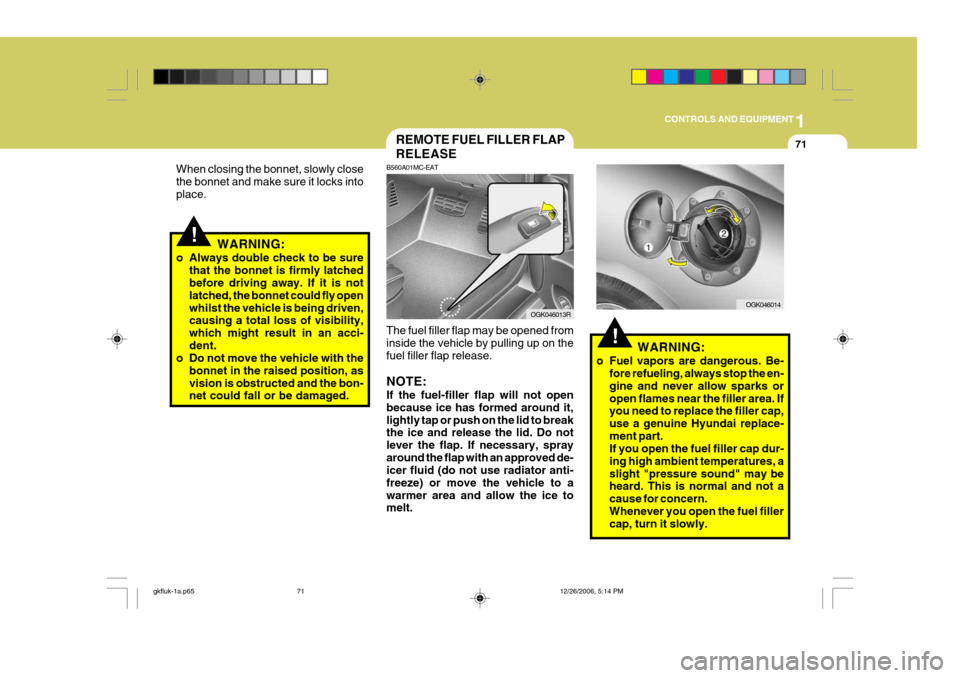
REMOTE FUEL FILLER FLAP RELEASE
B560A01MC-EAT The fuel filler flap may be opened from inside the vehicle by pulling up on thefuel filler flap release. NOTE: If the fuel-filler flap will not open because ice has formed around it,lightly tap or push on the lid to break the ice and release the lid. Do not lever the flap. If necessary, sprayaround the flap with an approved de- icer fluid (do not use radiator anti- freeze) or move the vehicle to awarmer area and allow the ice to melt.
OGK046013R
!WARNING:
o Fuel vapors are dangerous. Be- fore refueling, always stop the en- gine and never allow sparks oropen flames near the filler area. If you need to replace the filler cap, use a genuine Hyundai replace-ment part. If you open the fuel filler cap dur- ing high ambient temperatures, aslight "pressure sound" may be heard. This is normal and not a cause for concern.Whenever you open the fuel filler cap, turn it slowly.
OGK046014
gkfluk-1a.p65 12/26/2006, 5:14 PM
71
Page 339 of 483
1CONTROLS AND EQUIPMENT
72
o Automotive fuels are flammable/
explosive materials. When refuel- ing, please note the following guidelines carefully. Failure tofollow these guidelines may re- sult in severe personal injury, se- vere burns or death by fire orexplosion.
- Before refueling always note the
location of the Emergency Fuel Shut-Off, if available, at the fuel station facility.
- Before touching the fuel nozzle or fuel filler cap, you shouldeliminate potentially dangerous static electricity discharge bytouching another metal part of the front of the vehicle, a safe distance away from the fuel fillerneck, nozzle, or other fuel source.
- Do not get back into a vehicle once you have begun refueling.Do not touch, rub or slide against any item or fabric (polyester,satin, nylon, etc.) capable of pro- ducing static electricity. Static electricity discharge can ignitefuel vapors resulting in explo sion.If you must re-enter the vehicle, you should once again elimi- nate potentially dangerous staticelectricity discharge by touch- ing a metal part of the vehicle, away from the fuel filler neck,nozzle or other fuel source.
- When using a portable fuel con-
tainer be sure to place the con-tainer on the ground prior to refueling. Static electricity dis- charge from the container canignite fuel vapors causing a fire. Once refueling has begun, con- tact with the vehicle should bemaintained until the filling is complete. Use only portable fuel containers designed to carry andstore fuel.
- Do not use cellular phones
around a fuel station or whilstrefueling any vehicle. Electric current and/or electronic inter- ference from cellular phones canpotentially ignite fuel vapors causing a fire. If you must use your cellular phone use it in aplace away from the fuel station. - When refueling always shut the
engine off. Sparks produced by electrical components related to the engine can ignite fuel va-pors causing a fire. Always in- sure that the engine is OFF be- fore and during refueling. Oncerefueling is complete, check to make sure the fuel filler cap and door are securely closed, beforestarting the engine.
- Do not light any fire around a
fuel station. DO NOT use matchesor a lighter and DO NOT SMOKE or leave a lit cigarette in your vehicle whilst at a gas stationespecially during refueling. Automotive fuel is highly flam- mable and can, when ignited,result in explosion by flames.
- If a fire breaks out during refuel-
ing, leave the vicinity of the ve-hicle, and immediately contact the manager of the fuel station or contact the police and localfire department. Follow any safety instructions they provide.
gkfluk-1a.p65 12/26/2006, 5:14 PM
72
Page 373 of 483
2
Engine Exhaust Can Be Dangerous! ............................ 2-2
Before Starting the Engine ............................................ 2-3
Key Positions ................................................................ 2-4Starting ......................................................................... 2-5
Fuel Economy ............................................................... 2-6
Manual Transaxle ......................................................... 2-7
Automatic Transaxle ..................................................... 2-9Anti-Lock Brake System (ABS) ................................... 2-14
Electronic Stability Program (ESP) ..............................2-15
Effective Braking ......................................................... 2-16
Driving for Economy .................................................... 2-17
Smooth Cornering ........................................................ 2-18
Winter Motoring ............................................................ 2-19
Trailer or Vehicle Towing ............................................. 2-20
DRIVING YOUR HYUNDAI
2
gkfluk-2.p65
12/26/2006, 5:19 PM
1
Page 375 of 483
2
DRIVING YOUR HYUNDAI
3TO START THE ENGINEBEFORE STARTING THE ENGINE
SC030A2-E Before you start the engine, you should always:
1. Look around the vehicle to be sure
there are no flat tyres, puddles of oil or water or other indications of pos- sible trouble.
2. After entering the car, check to be sure the parking brake is engaged.
3. Check that all windows, and lights
are clean.
4. Check that the interior and exterior mirrors are clean and in position.
5. Check your seat, seatback and head restraint to be sure they are intheir proper positions.
6. Close all the doors.
7. Fasten your seat belt and be sure that all other occupants have fas-tened theirs.
8. Turn off all lights and accessories that are not needed.
9. When you turn the ignition switch to "ON" check that all appropriate warn- ing lights are operating and that you have sufficient fuel.
10.Check the operation of warning lights and all bulbs when key is inthe "ON" position.
!WARNING:
Always wear appropriate shoes when operating your vehicle.Unsuitable shoes (high heels, ski boots, etc.) may interfere with your ability to use the brake and accelera-tor pedal, and the clutch (Not all models). C030A01A-EAT COMBINATION IGNITION SWITCH AND STEERING LOCK
o If your Hyundai is equipped with a
manual transaxle, place the gear- shift lever in neutral and depress the clutch pedal fully.
o If your Hyundai has an automatic
transaxle, place the selector lever in"P" (park).
o To start the engine, insert the ignition key and turn it to the "START" posi-tion. Release it as soon as the en- gine starts. Do not hold the key in the"START" position for more than 15 seconds.
NOTE: For safety, the engine will not start if the shift lever is not in "P" or "N" position (Automatic Transaxle).
gkfluk-2.p65 12/26/2006, 5:19 PM
3
Page 378 of 483
2DRIVING YOUR HYUNDAI
6FUEL ECONOMY
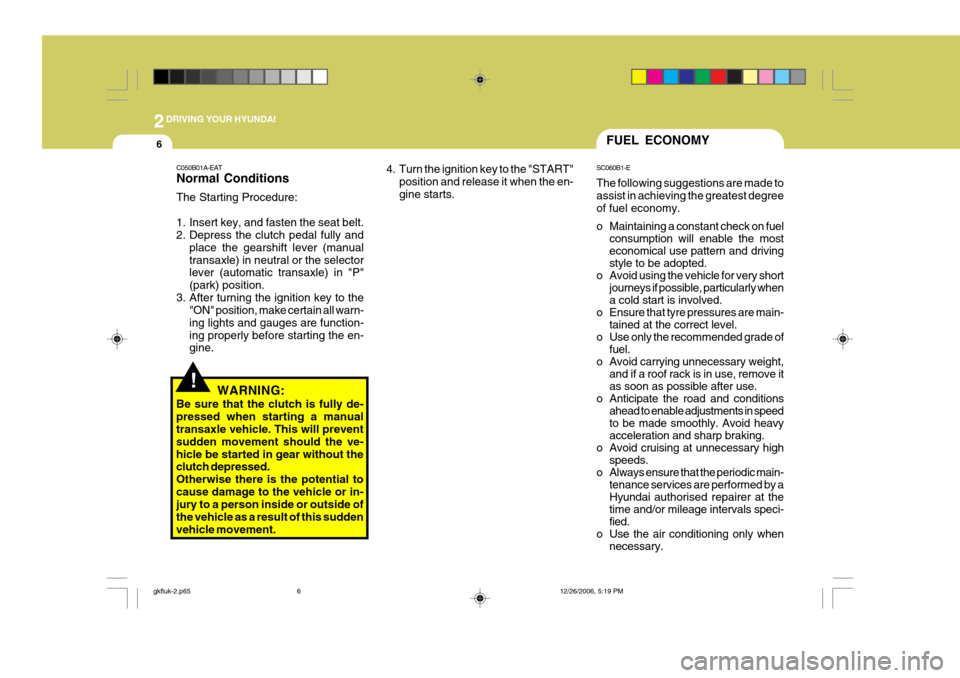
4. Turn the ignition key to the "START" position and release it when the en- gine starts. SC060B1-E The following suggestions are made to assist in achieving the greatest degree of fuel economy.
o Maintaining a constant check on fuel
consumption will enable the most economical use pattern and drivingstyle to be adopted.
o Avoid using the vehicle for very short journeys if possible, particularly whena cold start is involved.
o Ensure that tyre pressures are main- tained at the correct level.
o Use only the recommended grade of
fuel.
o Avoid carrying unnecessary weight, and if a roof rack is in use, remove itas soon as possible after use.
o Anticipate the road and conditions ahead to enable adjustments in speedto be made smoothly. Avoid heavyacceleration and sharp braking.
o Avoid cruising at unnecessary high speeds.
o Always ensure that the periodic main- tenance services are performed by aHyundai authorised repairer at the
time and/or mileage intervals speci-fied.
o Use the air conditioning only when necessary.
!
C050B01A-EAT Normal Conditions The Starting Procedure:
1. Insert key, and fasten the seat belt.
2. Depress the clutch pedal fully and
place the gearshift lever (manual transaxle) in neutral or the selector lever (automatic transaxle) in "P" (park) position.
3. After turning the ignition key to the "ON" position, make certain all warn-ing lights and gauges are function-ing properly before starting the en- gine.
WARNING:
Be sure that the clutch is fully de- pressed when starting a manual transaxle vehicle. This will prevent sudden movement should the ve-hicle be started in gear without the clutch depressed. Otherwise there is the potential tocause damage to the vehicle or in- jury to a person inside or outside of the vehicle as a result of this suddenvehicle movement.
gkfluk-2.p65 12/26/2006, 5:19 PM
6
Page 381 of 483
2
DRIVING YOUR HYUNDAI
9
C090A03Y-EAT OPERATING THE AUTOMATIC TRANSAXLE
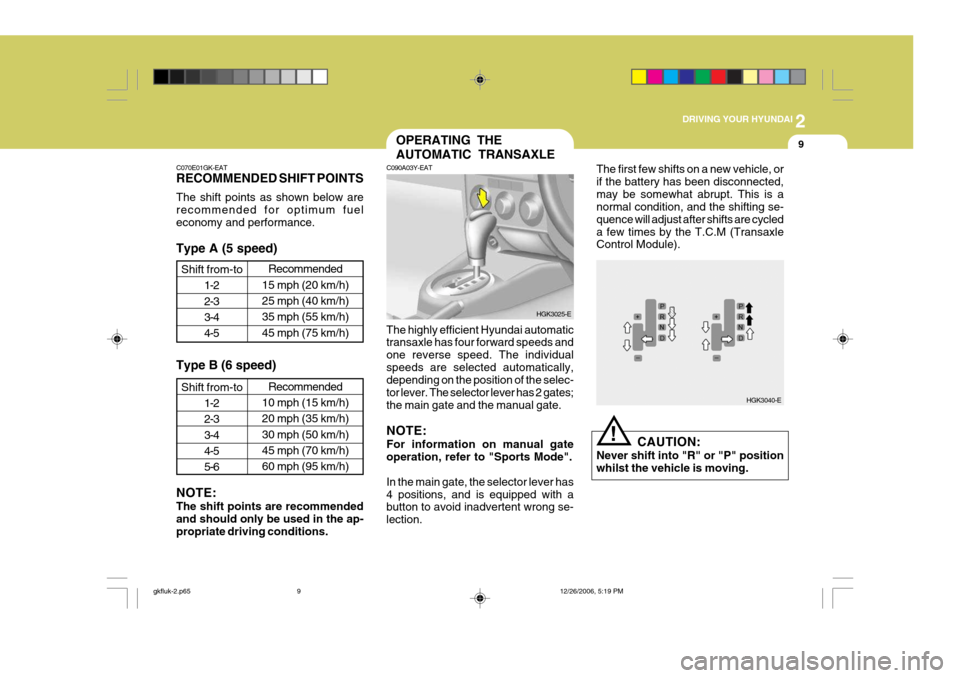
The highly efficient Hyundai automatic transaxle has four forward speeds and one reverse speed. The individualspeeds are selected automatically, depending on the position of the selec- tor lever. The selector lever has 2 gates;the main gate and the manual gate. NOTE: For information on manual gate operation, refer to "Sports Mode". In the main gate, the selector lever has 4 positions, and is equipped with a button to avoid inadvertent wrong se- lection. HGK3025-E
C070E01GK-EAT RECOMMENDED SHIFT POINTS The shift points as shown below are recommended for optimum fueleconomy and performance. Type A (5 speed)
Shift from-to 1-2 2-33-4 4-5 Recommended
15 mph (20 km/h)25 mph (40 km/h) 35 mph (55 km/h)45 mph (75 km/h)
Type B (6 speed)
Shift from-to 1-2 2-33-4 4-5 5-6 Recommended
10 mph (15 km/h)20 mph (35 km/h)30 mph (50 km/h) 45 mph (70 km/h) 60 mph (95 km/h)
NOTE: The shift points are recommended and should only be used in the ap- propriate driving conditions.
HGK3040-E
!
The first few shifts on a new vehicle, or if the battery has been disconnected,may be somewhat abrupt. This is a normal condition, and the shifting se- quence will adjust after shifts are cycleda few times by the T.C.M (Transaxle Control Module).
CAUTION:
Never shift into "R" or "P" positionwhilst the vehicle is moving.
gkfluk-2.p65 12/26/2006, 5:19 PM
9