Drive Hyundai Creta 2019 Owner's Guide
[x] Cancel search | Manufacturer: HYUNDAI, Model Year: 2019, Model line: Creta, Model: Hyundai Creta 2019Pages: 472, PDF Size: 13.39 MB
Page 47 of 472
2-27
Safety system of your vehicle
2
The sensor that activates the SRS
air bag is connected with the
pre–tensioner seat belts. The SRS
air bag warning light on the instru-
ment panel will illuminate for
approximately 6 seconds after the
ignition switch is placed to the ON
position, and then it should turn off.
If the pre-tensioner is not working
properly, the warning light will illu-
minate even if the SRS air bag is
not malfunctioning. If the warning
light does not illuminate, stays illu-
minated or illuminates when the
vehicle is being driven, we recom-
mend the pre-tensioner seat belts
and/or SRS air bags be inspected
by an authorized HYUNDAI dealer
as soon as possible.
Information
• Both the driver's and front passen-
ger's pre-tensioner seat belts may be
activated in certain frontal or side
collisions.
• The pre-tensioners will be activated
even if the seat belts are not worn at
the time of the collision.
• When the pre-tensioner seat belts
are activated, a loud noise may be
heard and fine dust, which may
appear to be smoke, may be visible
in the passenger compartment.
These are normal operating condi-
tions and are not hazardous.
• Although it is non-toxic, the fine
dust may cause skin irritation and
should not be breathed for pro-
longed periods. Wash all exposed
skin areas thoroughly after an acci-
dent in which the pre-tensioner seat
belts were activated.
Additional seat belt safety pre-
cautions
Seat belt use during pregnancy
The seat belt should always be used
during pregnancy. The best way to
protect your unborn child is to protect
yourself by always wearing the seat
belt.
Pregnant women should always wear
a lap-shoulder seat belt. Place the
shoulder belt across your chest, rout-
ed between your breasts and away
from your neck. Place the lap belt
below your belly so that it fits SNUGLY
across your hips and pelvic bone,
under the rounded part of the belly.
iNOTICE
To reduce the risk of serious
injury or death to an unborn
child during an accident, preg-
nant women should NEVER
place the lap portion of the seat
belt above or over the area of
the abdomen where the unborn
child is located.
WARNING
Page 49 of 472
2-29
Safety system of your vehicle
2
Seat belt use and injured people
A seat belt should be used when an
injured person is being transported.
Consult a physician for specific rec-
ommendations.
One person per belt
Two people (including children) should
never attempt to use a single seat belt.
This could increase the severity of
injuries in case of an accident.
Do not lie down
Sitting in a reclined position when
the vehicle is in motion can be dan-
gerous. Even when buckled up, the
protections of your restraint system
(seat belts and/or air bags) is greatly
reduced by reclining your seatback.
Seat belts must be snug against your
hips and chest to work properly. During
an accident, you could be thrown into
the seat belt, causing neck or other
injuries.
The more the seatback is reclined,
the greater chance the passenger’s
hips will slide under the lap belt or
the passenger’s neck will strike the
shoulder belt.
NEVER ride with a reclined
seatback when the vehicle is
moving.
Riding with a reclined seatback
increases your chance of seri-
ous or fatal injuries in the event
of a collision or sudden stop.
Driver and passengers should
always sit well back in their
seats, properly belted, and with
the seatbacks upright.
WARNING
Always make sure larger chil-
dren’s seat belts are worn and
properly adjusted.
NEVER allow the shoulder
belt to contact the child’s
neck or face.
Do not allow more than one
child to use a single seat belt.
WARNING
Page 52 of 472
2-32
Safety system of your vehicle
To reduce the chance of serious
or fatal injuries:
Children of all ages are safer
when restrained in the rear
seat. A child riding in the front
passenger seat can be force-
fully struck by an inflating air
bag resulting in serious or
fatal injuries.
Always follow the instructions
for installation and use of the
child restraint maker.
Always make sure the child
seat is secured properly in the
car and your child is securely
restrained in the child seat.
Never hold a child in your arms
or lap when riding in a vehicle.
The violent forces created dur-
ing a crash will tear the child
from your arms and throw the
child against the car’s interior.
(Continued)
WARNING (Continued)
Never put a seat belt over your-
self and a child. During a crash,
the belt could press deep into
the child causing serious inter-
nal injuries.
Never leave children unattend-
ed in a vehicle – not even for a
short time. The car can heat up
very quickly, resulting in seri-
ous injuries to children inside.
Even very young children may
inadvertently cause the vehicle
to move, entangle themselves
in the windows, or lock them-
selves or others inside the vehi-
cle.
Never allow two children, or any
two persons, to use the same
seat belt.
Children often squirm and
reposition themselves improp-
erly. Never let a child ride with
the shoulder belt under their
arm or behind their back.
Always properly position and
secure children in rear seat.
(Continued)
(Continued)
Never allow a child to stand-up
or kneel on the seat or floor-
board of a moving vehicle.
During a collision or sudden
stop, the child can be violently
thrown against the vehicles
interior, resulting in serious
injury.
Never use an infant carrier or a
child safety seat that "hooks"
over a seatback, it may not pro-
vide adequate security in an
accident.
Seat belts can become very
hot, especially when the car is
parked in direct sunlight.
Always check seat belt buck-
les before fastening them over
a child.
After an accident, we recom-
mend that the system be
checked by an authorized
HYUNDAI dealer.
If there is not enough space to
place the child restraint sys-
tem because of the driver's
seat, install the child restraint
system in the rear right seat.
Page 63 of 472
2-43
Safety system of your vehicle
2
A AI
IR
R
B
BA
AG
G
-
-
S
SU
UP
PP
PL
LE
EM
ME
EN
NT
TA
AL
L
R
RE
ES
ST
TR
RA
AI
IN
NT
T
S
SY
YS
ST
TE
EM
M
(
(S
SR
RS
S)
)
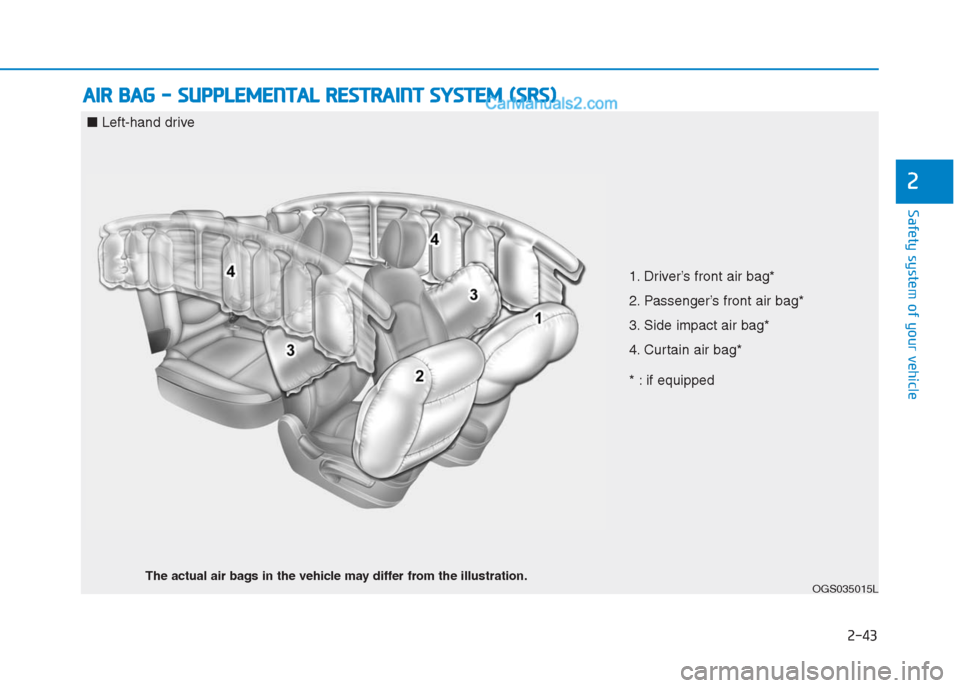
OGS035015L
1. Driver’s front air bag*
2. Passenger’s front air bag*
3. Side impact air bag*
4. Curtain air bag*
* : if equipped
■Left-hand drive
The actual air bags in the vehicle may differ from the illustration.
Page 64 of 472
2-44
Safety system of your vehicle
OGS035015
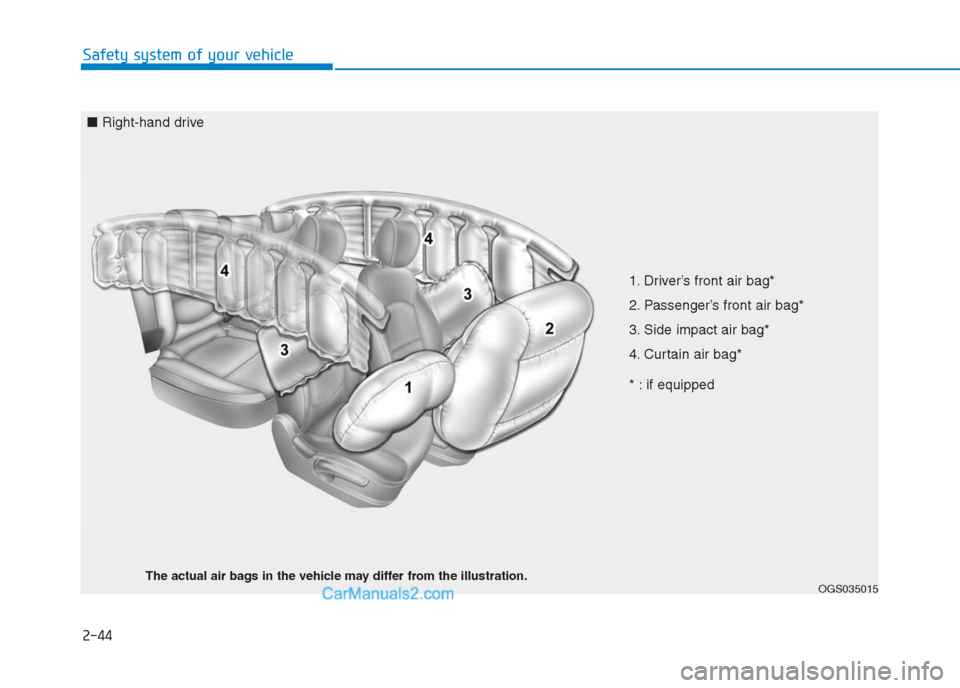
■Right-hand drive
1. Driver’s front air bag*
2. Passenger’s front air bag*
3. Side impact air bag*
4. Curtain air bag*
* : if equipped
The actual air bags in the vehicle may differ from the illustration.
Page 66 of 472
2-46
Safety system of your vehicle
There are even circumstances
under which contact with the
steering wheel air bag can cause
fatal injuries, especially if the
occupant is positioned exces-
sively close to the steering wheel.
Noise and smoke
When the air bags inflate, they make
a loud noise and they leave smoke
and powder in the air inside of the
vehicle. This is normal and is a result
of the ignition of the air bag inflator.
After the air bag inflates, you may
feel substantial discomfort in breath-
ing due to the contact of your chest
with both the seat belt and the air
bag, as well as from breathing the
smoke and powder.Open your
doors and/or windows as soon as
possible after impact in order to
reduce discomfort and prevent
prolonged exposure to the smoke
and powder.
Though smoke and powder are non-
toxic, it may cause irritation to the
skin (eyes, nose and throat, etc.). If
this is the case, wash and rinse with
cold water immediately and consult
with the doctor if the symptom per-
sists.
To avoid severe personal
injury or death caused by
deploying air bags in a colli-
sion, the driver should sit as
far back from the steering
wheel air bag as possible. The
front passenger should always
move their seat as far back as
possible and sit back in their
seat.
Air bag inflates instantly in an
event of a collision, passen-
gers may be injured by the air
bag expansion force if they
are not in a proper position.
Air bag inflation may cause
injuries including facial or
bodily abrasions, injuries
from broken glasses or burns.
When the air bags deploy, the
air bag related parts in the
steering wheel and/or instru-
ment panel and/or in both sides
of the roof rails above the front
and rear doors are very hot. To
prevent injury, do not touch the
air bag storage areas internal
components immediately after
an air bag has inflated.
WARNING
WARNING
Page 68 of 472
2-48
Safety system of your vehicle
Air bag warning and indicator
(if equipped)
Air bag warning light
The purpose of the air bag warning
light in your instrument panel is to
alert you of a potential problem with
your air bag - Supplemental Restraint
System (SRS).When the ignition switch is turned
ON, the warning light should illumi-
nate for approximately 6 seconds,
then go off.
Have the system checked if:
The light does not turn on briefly
when you turn the ignition ON.
The light stays on after illuminating
for approximately 6 seconds.
The light comes on while the vehi-
cle is in motion.
The light blinks when the ignition
switch is in ON position.
SRS components and functions
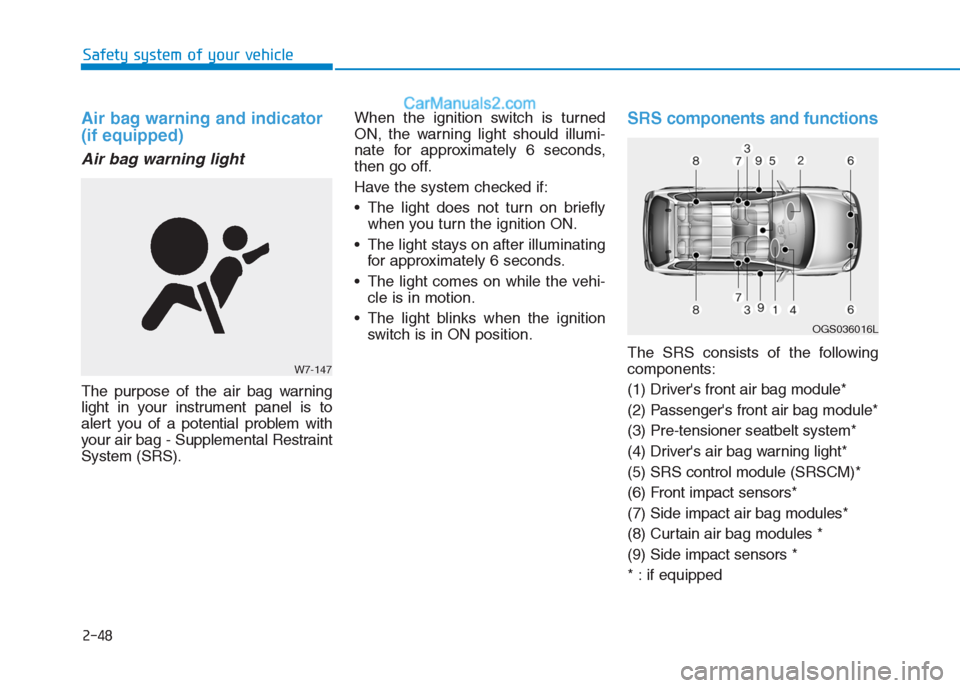
The SRS consists of the following
components:
(1) Driver's front air bag module*
(2) Passenger's front air bag module*
(3) Pre-tensioner seatbelt system*
(4) Driver's air bag warning light*
(5) SRS control module (SRSCM)*
(6) Front impact sensors*
(7) Side impact air bag modules*
(8) Curtain air bag modules *
(9) Side impact sensors *
* : if equipped
W7-147
OGS036016L
Page 69 of 472
2-49
Safety system of your vehicle
2
In case of the Left-hand drive vehi-
cle, the sensors and modules are in
the symmetrically opposite order.
The SRSCM continuously monitors
all SRS components while the igni-
tion switch is ON to determine if a
crash impact is severe enough to
require air bag deployment or pre-
tensioner seat belt deployment.
The SRS air bag warning light on the
instrument panel will illuminate for
about 6 seconds after the ignition
switch is turned to the ON position,
after which the air bag warning light
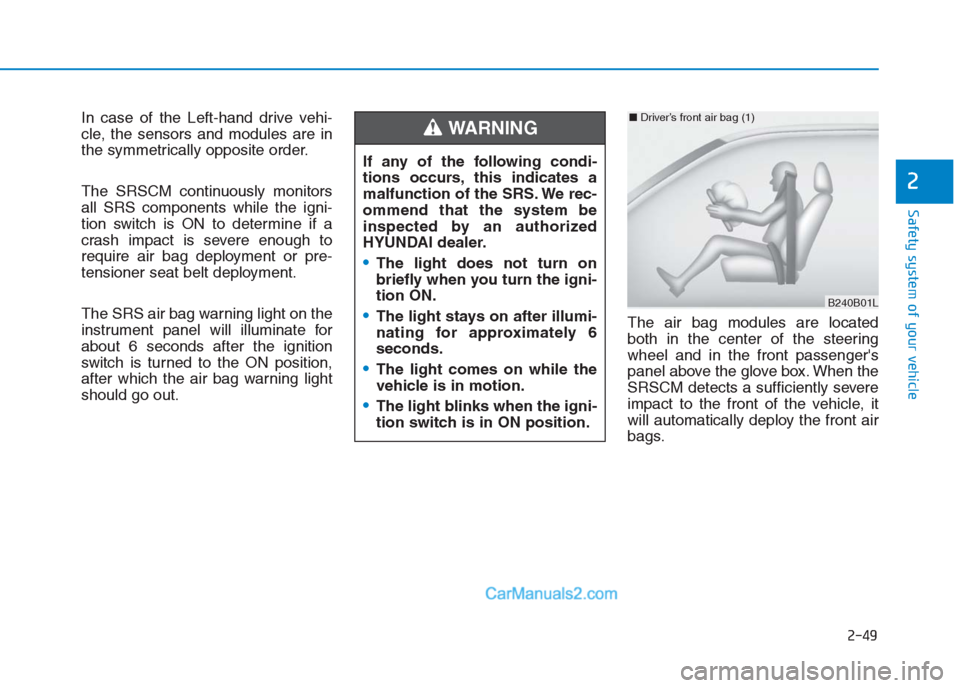
should go out.The air bag modules are located
both in the center of the steering
wheel and in the front passenger's
panel above the glove box. When the
SRSCM detects a sufficiently severe
impact to the front of the vehicle, it
will automatically deploy the front air
bags. If any of the following condi-
tions occurs, this indicates a
malfunction of the SRS. We rec-
ommend that the system be
inspected by an authorized
HYUNDAI dealer.
The light does not turn on
briefly when you turn the igni-
tion ON.
The light stays on after illumi-
nating for approximately 6
seconds.
The light comes on while the
vehicle is in motion.
The light blinks when the igni-
tion switch is in ON position.
WARNING
B240B01L
■Driver’s front air bag (1)
Page 70 of 472
2-50
Safety system of your vehicle
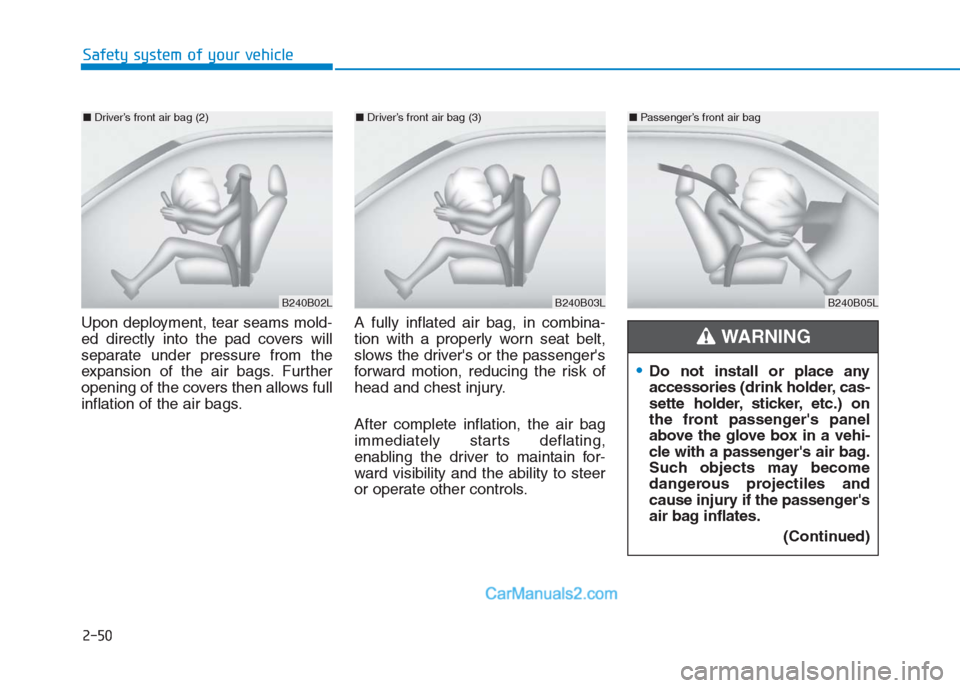
Upon deployment, tear seams mold-
ed directly into the pad covers will
separate under pressure from the
expansion of the air bags. Further
opening of the covers then allows full
inflation of the air bags.A fully inflated air bag, in combina-
tion with a properly worn seat belt,
slows the driver's or the passenger's
forward motion, reducing the risk of
head and chest injury.
After complete inflation, the air bag
immediately starts deflating,
enabling the driver to maintain for-
ward visibility and the ability to steer
or operate other controls.
B240B05L
■ Passenger’s front air bag
B240B03L
■Driver’s front air bag (3)
Do not install or place any
accessories (drink holder, cas-
sette holder, sticker, etc.) on
the front passenger's panel
above the glove box in a vehi-
cle with a passenger's air bag.
Such objects may become
dangerous projectiles and
cause injury if the passenger's
air bag inflates.
(Continued)
WARNING
B240B02L
■Driver’s front air bag (2)
Page 72 of 472
2-52
Safety system of your vehicle
Driver's and passenger's front
air bag (if equipped)
Your vehicle is equipped with a
Supplemental Restraint (Air Bag)
System and lap/shoulder belts at
both the driver and passenger seat-
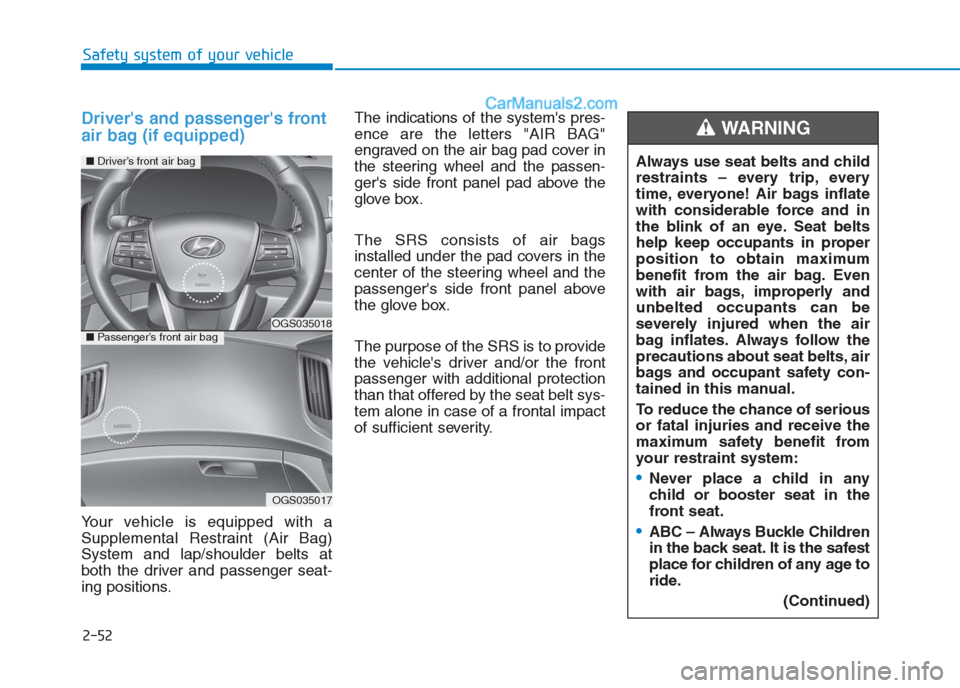
ing positions.The indications of the system's pres-
ence are the letters "AIR BAG"
engraved on the air bag pad cover in
the steering wheel and the passen-
ger's side front panel pad above the
glove box.
The SRS consists of air bags
installed under the pad covers in the
center of the steering wheel and the
passenger's side front panel above
the glove box.
The purpose of the SRS is to provide
the vehicle's driver and/or the front
passenger with additional protection
than that offered by the seat belt sys-
tem alone in case of a frontal impact
of sufficient severity.Always use seat belts and child
restraints – every trip, every
time, everyone! Air bags inflate
with considerable force and in
the blink of an eye. Seat belts
help keep occupants in proper
position to obtain maximum
benefit from the air bag. Even
with air bags, improperly and
unbelted occupants can be
severely injured when the air
bag inflates. Always follow the
precautions about seat belts, air
bags and occupant safety con-
tained in this manual.
To reduce the chance of serious
or fatal injuries and receive the
maximum safety benefit from
your restraint system:
Never place a child in any
child or booster seat in the
front seat.
ABC – Always Buckle Children
in the back seat. It is the safest
place for children of any age to
ride.
(Continued)
WARNING
OGS035018
OGS035017
■Driver’s front air bag
■Passenger’s front air bag