heating Hyundai Elantra 2003 User Guide
[x] Cancel search | Manufacturer: HYUNDAI, Model Year: 2003, Model line: Elantra, Model: Hyundai Elantra 2003Pages: 172, PDF Size: 2.82 MB
Page 71 of 172
FEATURES OF YOUR HYUNDAI FEATURES OF YOUR HYUNDAIFEATURES OF YOUR HYUNDAI FEATURES OF YOUR HYUNDAI
FEATURES OF YOUR HYUNDAI
1- 62
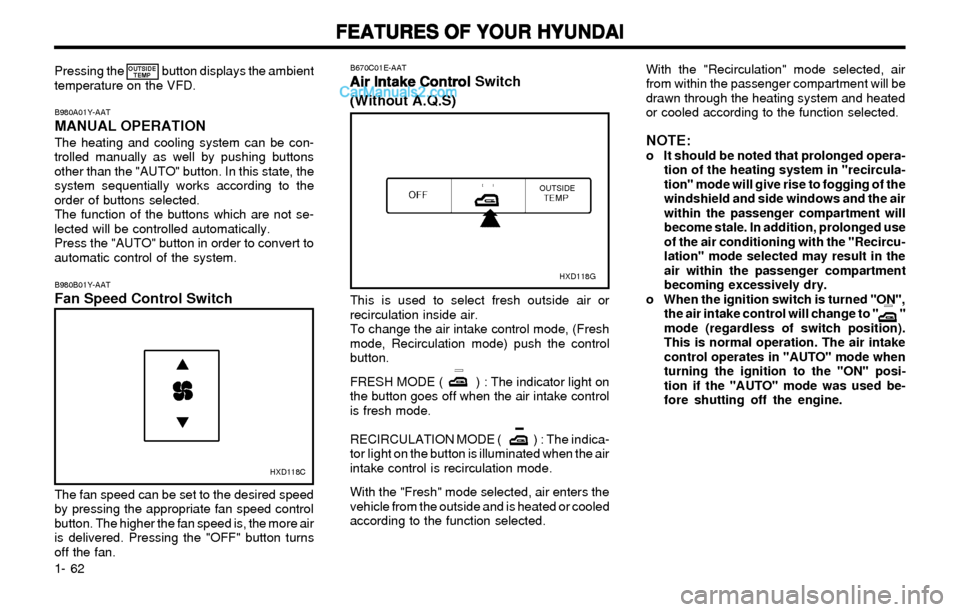
B980B01Y-AATFan Speed Control Switch
HXD118C
The fan speed can be set to the desired speed
by pressing the appropriate fan speed control
button. The higher the fan speed is, the more air
is delivered. Pressing the "OFF" button turns
off the fan.
B670C01E-AAT
Air Intake Control Air Intake ControlAir Intake Control Air Intake Control
Air Intake Control Switch
(Without A.Q.S)
HXD118G
This is used to select fresh outside air or
recirculation inside air.
To change the air intake control mode, (Fresh
mode, Recirculation mode) push the control
button.
FRESH MODE ( ) : The indicator light on
the button goes off when the air intake control
is fresh mode.
RECIRCULATION MODE ( ) : The indica-
tor light on the button is illuminated when the air
intake control is recirculation mode.
With the "Fresh" mode selected, air enters the
vehicle from the outside and is heated or cooled
according to the function selected.
With the "Recirculation" mode selected, air
from within the passenger compartment will be
drawn through the heating system and heated
or cooled according to the function selected.
NOTE:o It should be noted that prolonged opera-
tion of the heating system in "recircula-
tion" mode will give rise to fogging of the
windshield and side windows and the air
within the passenger compartment will
become stale. In addition, prolonged use
of the air conditioning with the "Recircu-
lation" mode selected may result in the
air within the passenger compartment
becoming excessively dry.
o When the ignition switch is turned "ON",
the air intake control will change to " "
mode (regardless of switch position).
This is normal operation. The air intake
control operates in "AUTO" mode when
turning the ignition to the "ON" posi-
tion if the "AUTO" mode was used be-
fore shutting off the engine.
B980A01Y-AATMANUAL OPERATIONThe heating and cooling system can be con-
trolled manually as well by pushing buttons
other than the "AUTO" button. In this state, the
system sequentially works according to the
order of buttons selected.
The function of the buttons which are not se-
lected will be controlled automatically.
Press the "AUTO" button in order to convert to
automatic control of the system. Pressing the button displays the ambient
temperature on the VFD.
OUTSIDE
TEMP
Page 72 of 172
FEATURES OF YOUR HYUNDAI FEATURES OF YOUR HYUNDAIFEATURES OF YOUR HYUNDAI FEATURES OF YOUR HYUNDAI
FEATURES OF YOUR HYUNDAI
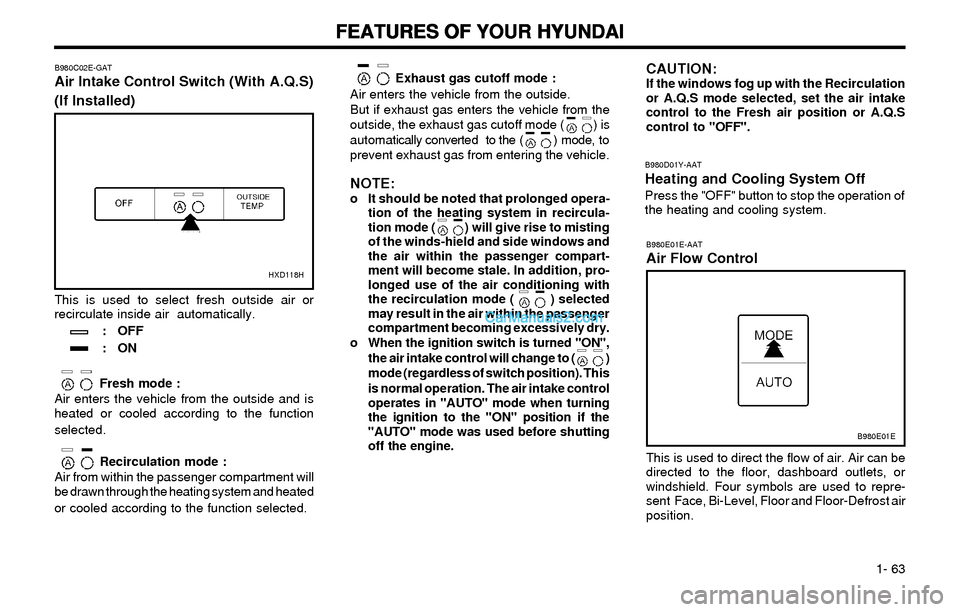
1- 63 This is used to direct the flow of air. Air can be
directed to the floor, dashboard outlets, or
windshield. Four symbols are used to repre-
sent Face, Bi-Level, Floor and Floor-Defrost air
position. Exhaust gas cutoff mode :
Air enters the vehicle from the outside.
But if exhaust gas enters the vehicle from the
outside, the exhaust gas cutoff mode ( ) is
automatically converted to the ( ) mode, to
prevent exhaust gas from entering the vehicle.
NOTE:o It should be noted that prolonged opera-
tion of the heating system in recircula-
tion mode ( ) will give rise to misting
of the winds-hield and side windows and
the air within the passenger compart-
ment will become stale. In addition, pro-
longed use of the air conditioning with
the recirculation mode ( ) selected
may result in the air within the passenger
compartment becoming excessively dry.
o When the ignition switch is turned "ON",
the air intake control will change to ( )
mode (regardless of switch position). This
is normal operation. The air intake control
operates in "AUTO" mode when turning
the ignition to the "ON" position if the
"AUTO" mode was used before shutting
off the engine.
B980D01Y-AATHeating and Cooling System Off
Press the "OFF" button to stop the operation of
the heating and cooling system.
B980E01E-AATAir Flow Control
B980E01E
This is used to select fresh outside air or
recirculate inside air automatically.
: OFF
:ON
Fresh mode :
Air enters the vehicle from the outside and is
heated or cooled according to the function
selected.
Recirculation mode :
Air from within the passenger compartment will
be drawn through the heating system and heated
or cooled according to the function selected.
B980C02E-GATAir Intake Control Switch (With A.Q.S)
(If Installed)
HXD118H
CAUTION:If the windows fog up with the Recirculation
or A.Q.S mode selected, set the air intake
control to the Fresh air position or A.Q.S
control to "OFF".
Page 86 of 172
FEATURES OF YOUR HYUNDAI FEATURES OF YOUR HYUNDAIFEATURES OF YOUR HYUNDAI FEATURES OF YOUR HYUNDAI
FEATURES OF YOUR HYUNDAI
1- 77
B260D02O-AAT
1. Playing CDo Insert the CD with the label facing upward.
o Insert the CD to start CD playback, during
radio operation.
o When a disc is in the CD deck, if you press
the play button, the CD player will begin
playing even if the radio is being used.
o The CD player can be used when the igni-
tion switch is in either the "ON" or "ACC"
position.
2. FF/REW ( / )If you want to fast forward or reverse through
the compact disc track, push and hold in the FF
( ) or REW ( ) button.
When you release the button, the compact disc
player will resume playing.
3. TRACK UP/DOWNo The desired track on the disc currently being
played can be selected using the track
number.
o Press once to skip forward to the beginn-
ing of the next track. Press once to skip
back to the beginning of the track.
4. SCAN Buttono Press the SCAN button to playback the first
10 seconds of each track.
o Press the SCAN button again within 10 sec.
for the desired track.
5. REPEAT Buttono To repeat the music you are listening to,
press the RPT button. To cancel , press
again.
o If you do not release RPT operation, when
the track ends, it will automatically be re-
played.
This process will be continued until you
push the button again.
6. EJECT ButtonWhen the EJECT button is pressed with the
CD loaded, the CD is ejected.
NOTE:o oo o
o
If the CD does not operate properly or if If the CD does not operate properly or ifIf the CD does not operate properly or if If the CD does not operate properly or if
If the CD does not operate properly or if
the ER2 fault code is displayed, use one the ER2 fault code is displayed, use onethe ER2 fault code is displayed, use one the ER2 fault code is displayed, use one
the ER2 fault code is displayed, use one
of two methods to reset the CD deck of two methods to reset the CD deckof two methods to reset the CD deck of two methods to reset the CD deck
of two methods to reset the CD deck
function. function.function. function.
function.
- -- -
-
Remove the audio fuse for 5 minutes. Remove the audio fuse for 5 minutes.Remove the audio fuse for 5 minutes. Remove the audio fuse for 5 minutes.
Remove the audio fuse for 5 minutes.
Then, reinstall the audio fuse. Then, reinstall the audio fuse.Then, reinstall the audio fuse. Then, reinstall the audio fuse.
Then, reinstall the audio fuse.
- -- -
-
Disconnect the negative terminal of Disconnect the negative terminal ofDisconnect the negative terminal of Disconnect the negative terminal of
Disconnect the negative terminal of
the battery and wait 5 minutes. the battery and wait 5 minutes.the battery and wait 5 minutes. the battery and wait 5 minutes.
the battery and wait 5 minutes.
Then reconnect the negative battery Then reconnect the negative batteryThen reconnect the negative battery Then reconnect the negative battery
Then reconnect the negative battery
terminal. terminal.terminal. terminal.
terminal.
o oo o
o
To assure proper operation of the unit, To assure proper operation of the unit,To assure proper operation of the unit, To assure proper operation of the unit,
To assure proper operation of the unit,
keep the vehicle interior temperature keep the vehicle interior temperaturekeep the vehicle interior temperature keep the vehicle interior temperature
keep the vehicle interior temperature
within a normal range by using the within a normal range by using thewithin a normal range by using the within a normal range by using the
within a normal range by using the
vehicle's air conditioning or heating vehicle's air conditioning or heatingvehicle's air conditioning or heating vehicle's air conditioning or heating
vehicle's air conditioning or heating
system. system.system. system.
system.
o oo o
o
When replacing the fuse, replace it with When replacing the fuse, replace it withWhen replacing the fuse, replace it with When replacing the fuse, replace it with
When replacing the fuse, replace it with
a fuse having the correct capacity. a fuse having the correct capacity.a fuse having the correct capacity. a fuse having the correct capacity.
a fuse having the correct capacity.
o oo o
o
The preset station frequencies are all The preset station frequencies are allThe preset station frequencies are all The preset station frequencies are all
The preset station frequencies are all
erased when the car battery is discon- erased when the car battery is discon-erased when the car battery is discon- erased when the car battery is discon-
erased when the car battery is discon-
nected. Therefore, all data will have to nected. Therefore, all data will have tonected. Therefore, all data will have to nected. Therefore, all data will have to
nected. Therefore, all data will have to
be set again if this should occur. be set again if this should occur.be set again if this should occur. be set again if this should occur.
be set again if this should occur.
o oo o
o
Do not add any oil to the rotating parts. Do not add any oil to the rotating parts.Do not add any oil to the rotating parts. Do not add any oil to the rotating parts.
Do not add any oil to the rotating parts.
Keep magnets, screwdrivers and other Keep magnets, screwdrivers and otherKeep magnets, screwdrivers and other Keep magnets, screwdrivers and other
Keep magnets, screwdrivers and other
metallic objects away from the tape metallic objects away from the tapemetallic objects away from the tape metallic objects away from the tape
metallic objects away from the tape
mechanism and head. mechanism and head.mechanism and head. mechanism and head.
mechanism and head.
o This equipment is designed to be used
only in a 12 volt DC battery system with
negative ground.
o This unit is made of precision parts. Do
not attempt to disassemble or adjust any
parts.
o When driving your vehicle, be sure to
keep the volume of the unit set low enough
to allow you to hear sounds coming from
the outside.
o Do not expose this equipment (including
the speakers) to water or excessive mois-
ture.
Page 95 of 172

FEATURES OF YOUR HYUNDAI FEATURES OF YOUR HYUNDAIFEATURES OF YOUR HYUNDAI FEATURES OF YOUR HYUNDAI
FEATURES OF YOUR HYUNDAI
1- 86
H290F01O-GAT1. CD Select Buttono Insert the CD with the label facing upward.
o Insert the CD to start CD playback, during
radio operation or cassette tape playing.
o When a disc is in the CD deck, if you press
the CD button the CD player will begin
playing even if the radio or cassette player
is being used.
o The CD player can be used when the igni-
tion switch is in either the "ON" or "ACC"
position.
2. FF/REW ( / )If you want to fast forward or reverse through
the compact disc track, push and hold the FF
( ) or REW ( ) button.
When you release the button, the compact disc
player will resume playing.
3. TRACK UP/DOWNo The desired track on the disc currently being
played can be selected using the track
number.
o Press button once to skip forward to the
beginning of the next track. Press button
once to skip back to the beginning of the
track.
4. REPEAT
o To repeat the track you are currently listen-
ing to, press the RPT button. To cancel,
press again.
o If you do not release RPT operation when
the track ends, it will automatically be re-
played.
This process will be continued until you
push the button again.
5. EQUALIZER Button
Press the EQ button to select the CLASSIC,
JAZZ, ROCK and DEFEAT MODE for the de-
sired tone quality. Each press of the button
changes the display as follows;
NOTE:o To assure proper operation of the unit,
keep the vehicle interior temperature
within a normal range by using the
vehicle's air conditioning or heating
system.
o When replacing the fuse, replace it with a
fuse having the correct capacity.
o The preset station frequencies are all
erased when the car battery is discon-
nected. Therefore, all data will have to be
set again if this should occur.
o Do not add any oil to the rotating parts.
Keep magnets, screwdrivers and other
metallic objects away from the tape
mechanism and head.
o This equipment is designed to be used
only in a 12 volt DC battery system with
negative ground.
o This unit is made of precision parts. Do
not attempt to disassemble or adjust any
parts.
o When driving your vehicle, be sure to
keep the volume of the unit set low enough
to allow you to hear sounds coming from
the outside.
o Do not expose this equipment (including
the speakers and tape) to water or exces-
sive moisture.
CLASSIC ® JAZZ ® ROCK ® DEFEAT
6. CD EJECT ButtonWhen the button is pressed with a CD loaded,
the CD will eject.
7. SCAN Buttono Press the SCAN button to playback the first
10 seconds of each track.
o Press the SCAN button again within 10 sec.
When you have reached the desired track.
Page 104 of 172
DRIVING YOUR HYUNDAI DRIVING YOUR HYUNDAIDRIVING YOUR HYUNDAI DRIVING YOUR HYUNDAI
DRIVING YOUR HYUNDAI
2- 3
C070C01E-1
o oo o
o
"LOCK" "LOCK""LOCK" "LOCK"
"LOCK"The key can be removed or inserted in this
position. To protect against theft, the steering
wheel locks by removing the key.
NOTE: NOTE:NOTE: NOTE:
NOTE:To unlock the steering wheel, insert the key, To unlock the steering wheel, insert the key,To unlock the steering wheel, insert the key, To unlock the steering wheel, insert the key,
To unlock the steering wheel, insert the key,
and then turn the steering wheel and key and then turn the steering wheel and keyand then turn the steering wheel and key and then turn the steering wheel and key
and then turn the steering wheel and key
simultaneously. simultaneously.simultaneously. simultaneously.
simultaneously.
C070C01A-AAT
To Remove the Ignition Key To Remove the Ignition KeyTo Remove the Ignition Key To Remove the Ignition Key
To Remove the Ignition Key
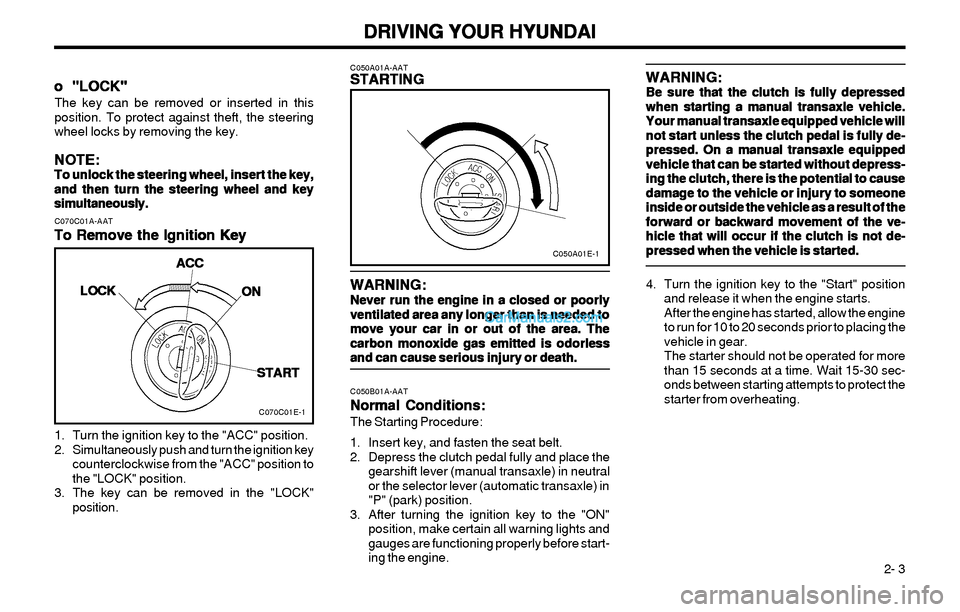
1. Turn the ignition key to the "ACC" position.
2. Simultaneously push and turn the ignition key
counterclockwise from the "ACC" position to
the "LOCK" position.
3. The key can be removed in the "LOCK"
position.
C050A01A-AATSTARTING STARTINGSTARTING STARTING
STARTING
WARNING: WARNING:WARNING: WARNING:
WARNING:
Never run the engine in a closed or poorly Never run the engine in a closed or poorlyNever run the engine in a closed or poorly Never run the engine in a closed or poorly
Never run the engine in a closed or poorly
ventilated area any longer than is needed to ventilated area any longer than is needed toventilated area any longer than is needed to ventilated area any longer than is needed to
ventilated area any longer than is needed to
move your car in or out of the area. The move your car in or out of the area. Themove your car in or out of the area. The move your car in or out of the area. The
move your car in or out of the area. The
carbon monoxide gas emitted is odorless carbon monoxide gas emitted is odorlesscarbon monoxide gas emitted is odorless carbon monoxide gas emitted is odorless
carbon monoxide gas emitted is odorless
and can cause serious injury or death. and can cause serious injury or death.and can cause serious injury or death. and can cause serious injury or death.
and can cause serious injury or death.
WARNING: WARNING:WARNING: WARNING:
WARNING:Be sure that the clutch is fully depressed Be sure that the clutch is fully depressedBe sure that the clutch is fully depressed Be sure that the clutch is fully depressed
Be sure that the clutch is fully depressed
when starting a manual transaxle vehicle. when starting a manual transaxle vehicle.when starting a manual transaxle vehicle. when starting a manual transaxle vehicle.
when starting a manual transaxle vehicle.
Your manual transaxle equipped vehicle will Your manual transaxle equipped vehicle willYour manual transaxle equipped vehicle will Your manual transaxle equipped vehicle will
Your manual transaxle equipped vehicle will
not start unless the clutch pedal is fully de- not start unless the clutch pedal is fully de-not start unless the clutch pedal is fully de- not start unless the clutch pedal is fully de-
not start unless the clutch pedal is fully de-
pressed. On a manual transaxle equipped pressed. On a manual transaxle equippedpressed. On a manual transaxle equipped pressed. On a manual transaxle equipped
pressed. On a manual transaxle equipped
vehicle that can be started without depress- vehicle that can be started without depress-vehicle that can be started without depress- vehicle that can be started without depress-
vehicle that can be started without depress-
ing the clutch, there is the potential to cause ing the clutch, there is the potential to causeing the clutch, there is the potential to cause ing the clutch, there is the potential to cause
ing the clutch, there is the potential to cause
damage to the vehicle or injury to someone damage to the vehicle or injury to someonedamage to the vehicle or injury to someone damage to the vehicle or injury to someone
damage to the vehicle or injury to someone
inside or outside the vehicle as a result of the inside or outside the vehicle as a result of theinside or outside the vehicle as a result of the inside or outside the vehicle as a result of the
inside or outside the vehicle as a result of the
forward or backward movement of the ve- forward or backward movement of the ve-forward or backward movement of the ve- forward or backward movement of the ve-
forward or backward movement of the ve-
hicle that will occur if the clutch is not de- hicle that will occur if the clutch is not de-hicle that will occur if the clutch is not de- hicle that will occur if the clutch is not de-
hicle that will occur if the clutch is not de-
pressed when the vehicle is started. pressed when the vehicle is started.pressed when the vehicle is started. pressed when the vehicle is started.
pressed when the vehicle is started.
4. Turn the ignition key to the "Start" position
and release it when the engine starts.
After the engine has started, allow the engine
to run for 10 to 20 seconds prior to placing the
vehicle in gear.
The starter should not be operated for more
than 15 seconds at a time. Wait 15-30 sec-
onds between starting attempts to protect the
starter from overheating.
C050A01E-1
C050B01A-AAT
Normal Conditions: Normal Conditions:Normal Conditions: Normal Conditions:
Normal Conditions:The Starting Procedure:
1. Insert key, and fasten the seat belt.
2. Depress the clutch pedal fully and place the
gearshift lever (manual transaxle) in neutral
or the selector lever (automatic transaxle) in
"P" (park) position.
3. After turning the ignition key to the "ON"
position, make certain all warning lights and
gauges are functioning properly before start-
ing the engine.
LOCK LOCKLOCK LOCK
LOCKACC ACCACC ACC
ACC
ON ONON ON
ON
START STARTSTART START
START
Page 108 of 172
DRIVING YOUR HYUNDAI DRIVING YOUR HYUNDAIDRIVING YOUR HYUNDAI DRIVING YOUR HYUNDAI
DRIVING YOUR HYUNDAI
2- 7 o Driving through water may get the brakes
wet. They can also get wet when the car is
washed. Wet brakes can be dangerous! Your
car will not stop as quickly if the brakes are
wet. Wet brakes may cause the car to pull to
one side. To dry the brakes, apply the brakes
lightly until the braking action returns to nor-
mal, taking care to keep the car under control
at all times. If the braking action does not
return to normal, stop as soon as it is safe to
do so and call your Hyundai dealer for assis-
tance.
o Don't coast down hills with the car out of gear.
This is extremely hazardous. Keep the car in
gear at all times, use the brakes to slow down,
then shift to a lower gear so that engine
braking will help you maintain a safe speed.
o Don't "ride" the brake pedal. Resting your foot
on the brake pedal while driving can be dan-
gerous because it can result in the brakes
overheating and losing their effectiveness. It
also increases the wear of the brake compo-
nents.
o If a tire goes flat while you are driving, apply
the brakes gently and keep the car pointed
straight ahead while you slow down. When
you are moving slowly enough for it to be safe
to do so, pull off the road and stop in a safe
place.
o If your car is equipped with an automatic
transaxle, don't let your car creep forward. To
avoid creeping forward, keep your foot on the
brake pedal when the car is stopped.
C130A01A-AAT
GOOD BRAKING PRACTICES GOOD BRAKING PRACTICESGOOD BRAKING PRACTICES GOOD BRAKING PRACTICES
GOOD BRAKING PRACTICES
WARNING: WARNING:WARNING: WARNING:
WARNING:
Nothing should be carried on top of the shelf Nothing should be carried on top of the shelfNothing should be carried on top of the shelf Nothing should be carried on top of the shelf
Nothing should be carried on top of the shelf
panel behind the rear seat. If there were an panel behind the rear seat. If there were anpanel behind the rear seat. If there were an panel behind the rear seat. If there were an
panel behind the rear seat. If there were an
accident or a sudden stop, such objects could accident or a sudden stop, such objects couldaccident or a sudden stop, such objects could accident or a sudden stop, such objects could
accident or a sudden stop, such objects could
move forward and cause damage to the ve- move forward and cause damage to the ve-move forward and cause damage to the ve- move forward and cause damage to the ve-
move forward and cause damage to the ve-
hicle or injure the occupants. hicle or injure the occupants.hicle or injure the occupants. hicle or injure the occupants.
hicle or injure the occupants.
o After being parked, check to be sure the
parking brake is not engaged and that the
parking brake indicator light is out before
driving away. gentle slope, it is recommended that the over-
drive switch be turned off. Turn the overdrive
switch back on immediately afterward.
WARNING: WARNING:WARNING: WARNING:
WARNING:o oo o
o
The risk of rollover is greatly increased if The risk of rollover is greatly increased ifThe risk of rollover is greatly increased if The risk of rollover is greatly increased if
The risk of rollover is greatly increased if
you lose control of your vehicle at high- you lose control of your vehicle at high-you lose control of your vehicle at high- you lose control of your vehicle at high-
you lose control of your vehicle at high-
way speeds. way speeds.way speeds. way speeds.
way speeds.
o oo o
o
Loss of control often occurs if two or more Loss of control often occurs if two or moreLoss of control often occurs if two or more Loss of control often occurs if two or more
Loss of control often occurs if two or more
wheels drop off the roadway and the driver wheels drop off the roadway and the driverwheels drop off the roadway and the driver wheels drop off the roadway and the driver
wheels drop off the roadway and the driver
oversteers to reenter the roadway. oversteers to reenter the roadway.oversteers to reenter the roadway. oversteers to reenter the roadway.
oversteers to reenter the roadway.
o oo o
o
In the event your vehicle leaves the road- In the event your vehicle leaves the road-In the event your vehicle leaves the road- In the event your vehicle leaves the road-
In the event your vehicle leaves the road-
way, do not steer sharply. Instead, slow way, do not steer sharply. Instead, slowway, do not steer sharply. Instead, slow way, do not steer sharply. Instead, slow
way, do not steer sharply. Instead, slow
down before pulling back into the travel down before pulling back into the traveldown before pulling back into the travel down before pulling back into the travel
down before pulling back into the travel
lanes. lanes.lanes. lanes.
lanes.
o oo o
o
In a collision crash, an unbelted person is In a collision crash, an unbelted person isIn a collision crash, an unbelted person is In a collision crash, an unbelted person is
In a collision crash, an unbelted person is
significantly more likely to die than a per- significantly more likely to die than a per-significantly more likely to die than a per- significantly more likely to die than a per-
significantly more likely to die than a per-
son wearing a seatbelt. son wearing a seatbelt.son wearing a seatbelt. son wearing a seatbelt.
son wearing a seatbelt.
o oo o
o
Never exceed posted speed limits. Never exceed posted speed limits.Never exceed posted speed limits. Never exceed posted speed limits.
Never exceed posted speed limits.
C090N03A-AAT
Good Driving Practices Good Driving PracticesGood Driving Practices Good Driving Practices
Good Driving Practiceso Never move the gear selector lever from "P"
or "N" to any other position with the acceler-
ator pedal depressed.
o Never move the gear selector lever into "P"
when the vehicle is in motion.
o Be sure the car is completely stopped before
you attempt to shift into "R".
o Never take the car out of gear and coast down
a hill. This may be extremely hazardous.
Always leave the car in gear when moving.
o Do not "ride" the brakes. This can cause them
to overheat and malfunction. Instead, when
you are driving down a long hill, slow down
and shift to a lower gear. When you do this,
engine braking will help slow the car.
o Slow down before shifting to a lower gear.
Otherwise, the lower gear may not be en-
gaged.
o Always use the parking brake. Do not depend
on placing the transaxle in "P" to keep the car
from moving.
o Exercise extreme caution when driving on a
slippery surface. Be especially careful when
braking, accelerating or shifting gears. On a
slippery surface, an abrupt change in vehicle
speed can cause the drive wheels to lose
traction and the vehicle to go out of control.
o Turn the overdrive switch on for good fuel
economy and smooth driving. If engine brak-
ing is needed in the "D" range or if repeated
upshifting and downshifting between the 3rd
and 4th gear is needed when climbing a
Page 112 of 172

DRIVING YOUR HYUNDAI DRIVING YOUR HYUNDAIDRIVING YOUR HYUNDAI DRIVING YOUR HYUNDAI
DRIVING YOUR HYUNDAI
2- 11 accordance with the maintenance schedule in
Section 5. Before winter, have your coolant test-
ed to assure that its freezing point is sufficient for
the temperatures anticipated during the winter.
C160D01A-AAT
Check Battery and Cables Check Battery and CablesCheck Battery and Cables Check Battery and Cables
Check Battery and CablesWinter puts additional burdens on the battery
system. Visually inspect the battery and cables
as described in Section 6. The level of charge in
your battery can be checked by your Hyundai
dealer or a service station.
C160E01A-AATChange to "Winter Weight" Oil if Change to "Winter Weight" Oil ifChange to "Winter Weight" Oil if Change to "Winter Weight" Oil if
Change to "Winter Weight" Oil if
Necessary NecessaryNecessary Necessary
Necessary
In some climates it is recommended that a lower
viscosity "winter weight" oil be used during cold
weather. See Section 9 for recommendations. If
you aren't sure what weight oil you should use,
consult your Hyundai dealer.
C160F01A-AATCheck Spark Plugs and Ignition Check Spark Plugs and IgnitionCheck Spark Plugs and Ignition Check Spark Plugs and Ignition
Check Spark Plugs and Ignition
System SystemSystem System
System
Inspect your spark plugs as described in Section
6 and replace them if necessary. Also check all
ignition wiring and components to be sure they
are not cracked, worn or damaged in any way.
C160G01A-AAT
To Keep Locks from Freezing To Keep Locks from FreezingTo Keep Locks from Freezing To Keep Locks from Freezing
To Keep Locks from FreezingTo keep the locks from freezing, squirt an ap-
proved de-icer fluid or glycerine into the key
opening. If a lock is covered with ice, squirt it with
an approved de-icing fluid to remove the ice. If
the lock is frozen internally, you may be able to
thaw it out by using a heated key. Handle the
heated key with care to avoid burning the fingers.
C160H01A-AATUse Approved Anti-Freeze in Window Use Approved Anti-Freeze in WindowUse Approved Anti-Freeze in Window Use Approved Anti-Freeze in Window
Use Approved Anti-Freeze in Window
Washer System Washer SystemWasher System Washer System
Washer System
To keep the water in the window washer system
from freezing, add an approved anti-freeze solu-
tion in accordance with instructions on the con-
tainer. Window washer anti-freeze is available
from Hyundai dealers and most auto parts out-
lets. Do not use engine coolant or other types of
anti-freeze as these may damage the finish.
C160I01A-AAT
Don't Let Your Parking Brake Freeze Don't Let Your Parking Brake FreezeDon't Let Your Parking Brake Freeze Don't Let Your Parking Brake Freeze
Don't Let Your Parking Brake FreezeUnder some conditions your parking brake can
freeze in the engaged position. This is most likely
to happen when there is an accumulation of snow
or ice around or near the rear brakes or if the
brakes are wet. If there is a risk the parking brake
may freeze, apply it only temporarily while you
put the gear selector lever in "P" (automatic) or in
first or reverse gear (manual transaxle) and
block the rear wheels so the car cannot roll. Then
release the parking brake.
C160K01A-AAT
Carry Emergency Equipment Carry Emergency EquipmentCarry Emergency Equipment Carry Emergency Equipment
Carry Emergency EquipmentDepending on the severity of the weather where
you drive your car, you should carry appropriate
emergency equipment. Some of the items you
may want to carry include tire chains, tow straps
or chains, flashlight, emergency flares, sand, a
shovel, jumper cables, a window scraper, gloves,
ground cloth, coveralls, a blanket, etc.
C160J01A-AAT
Don't Let Ice and Snow Accumulate Don't Let Ice and Snow AccumulateDon't Let Ice and Snow Accumulate Don't Let Ice and Snow Accumulate
Don't Let Ice and Snow Accumulate
Underneath UnderneathUnderneath Underneath
Underneath
Under some conditions, snow and ice can build
up under the fenders and interfere with the steer-
ing. When driving in severe winter conditions
where this may happen, you should periodically
check underneath the car to be sure the move-
ment of the front wheels and the steering compo-
nents is not obstructed.
C170A01A-AAT
HIGHER SPEED MOTORING HIGHER SPEED MOTORINGHIGHER SPEED MOTORING HIGHER SPEED MOTORING
HIGHER SPEED MOTORING
Pre-Trip Inspections Pre-Trip InspectionsPre-Trip Inspections Pre-Trip Inspections
Pre-Trip Inspections
1. Tires:
Adjust the tire inflation pressures to specifica-
tion. Low tire inflation pressures will result in
overheating and possible failure of the tires.
Avoid using worn or damaged tires which may
result in reduced traction or tire failure.
Page 113 of 172
DRIVING YOUR HYUNDAI DRIVING YOUR HYUNDAIDRIVING YOUR HYUNDAI DRIVING YOUR HYUNDAI
DRIVING YOUR HYUNDAI
2- 12
CAUTION: CAUTION:CAUTION: CAUTION:
CAUTION:Do not do any towing with your car during its Do not do any towing with your car during itsDo not do any towing with your car during its Do not do any towing with your car during its
Do not do any towing with your car during its
first 1,200 miles (2,000 km) in order to allow first 1,200 miles (2,000 km) in order to allowfirst 1,200 miles (2,000 km) in order to allow first 1,200 miles (2,000 km) in order to allow
first 1,200 miles (2,000 km) in order to allow
the engine to properly break in. Failure to the engine to properly break in. Failure tothe engine to properly break in. Failure to the engine to properly break in. Failure to
the engine to properly break in. Failure to
heed this caution may result in serious en- heed this caution may result in serious en-heed this caution may result in serious en- heed this caution may result in serious en-
heed this caution may result in serious en-
gine or transaxle damage. gine or transaxle damage.gine or transaxle damage. gine or transaxle damage.
gine or transaxle damage.
C190B01S-AAT
Trailer Hitches Trailer HitchesTrailer Hitches Trailer Hitches
Trailer HitchesSelect the proper hitch and ball combination,
making sure that it's location is compatible with
that of the trailer or vehicle being towed.
Use a quality non-equalizing hitch which distrib-
utes the tongue load uniformly throughout the
chassis.
The hitch should be bolted securely to the car
and installed by a qualified technician. DO NOT
USE A HITCH DESIGNED FOR TEMPORARY
INSTALLATION AND NEVER USE ONE THAT
ATTACHES ONLY TO THE BUMPER.
C190C03S-AAT
Trailer Brakes Trailer BrakesTrailer Brakes Trailer Brakes
Trailer BrakesIf your trailer is equipped with a braking system,
make sure it conforms to federal and/or local
regulations and that it is properly installed and
operating correctly.
NOTE: NOTE:NOTE: NOTE:
NOTE:If you tow a trailer or vehicle, your car will If you tow a trailer or vehicle, your car willIf you tow a trailer or vehicle, your car will If you tow a trailer or vehicle, your car will
If you tow a trailer or vehicle, your car will
require more frequent maintenance due to require more frequent maintenance due torequire more frequent maintenance due to require more frequent maintenance due to
require more frequent maintenance due to
the additional load. See "Maintenance Under the additional load. See "Maintenance Underthe additional load. See "Maintenance Under the additional load. See "Maintenance Under
the additional load. See "Maintenance Under
Severe Usage Conditions" on page 5-5. Severe Usage Conditions" on page 5-5.Severe Usage Conditions" on page 5-5. Severe Usage Conditions" on page 5-5.
Severe Usage Conditions" on page 5-5.
CAUTION: CAUTION:CAUTION: CAUTION:
CAUTION:o oo o
o
Never connect a trailer brake system di- Never connect a trailer brake system di-Never connect a trailer brake system di- Never connect a trailer brake system di-
Never connect a trailer brake system di-
rectly to the vehicle brake system. rectly to the vehicle brake system.rectly to the vehicle brake system. rectly to the vehicle brake system.
rectly to the vehicle brake system.
o oo o
o
When towing a trailer on steep grades (in When towing a trailer on steep grades (inWhen towing a trailer on steep grades (in When towing a trailer on steep grades (in
When towing a trailer on steep grades (in
excess of 12%) pay close attention to the excess of 12%) pay close attention to theexcess of 12%) pay close attention to the excess of 12%) pay close attention to the
excess of 12%) pay close attention to the
engine coolant temperature gauge to en- engine coolant temperature gauge to en-engine coolant temperature gauge to en- engine coolant temperature gauge to en-
engine coolant temperature gauge to en-
sure the engine does not overheat. If the sure the engine does not overheat. If thesure the engine does not overheat. If the sure the engine does not overheat. If the
sure the engine does not overheat. If the
needle of the coolant temperature gauge needle of the coolant temperature gaugeneedle of the coolant temperature gauge needle of the coolant temperature gauge
needle of the coolant temperature gauge
moves across the dial towards "H" (HOT), moves across the dial towards "H" (HOT),moves across the dial towards "H" (HOT), moves across the dial towards "H" (HOT),
moves across the dial towards "H" (HOT),
pull over and stop as soon as it is safe to pull over and stop as soon as it is safe topull over and stop as soon as it is safe to pull over and stop as soon as it is safe to
pull over and stop as soon as it is safe to
do so, and allow the engine to idle until it do so, and allow the engine to idle until itdo so, and allow the engine to idle until it do so, and allow the engine to idle until it
do so, and allow the engine to idle until it
cools down. You may proceed once the cools down. You may proceed once thecools down. You may proceed once the cools down. You may proceed once the
cools down. You may proceed once the
engine has cooled sufficiently. engine has cooled sufficiently.engine has cooled sufficiently. engine has cooled sufficiently.
engine has cooled sufficiently.
C190D01S-AAT
Safety Chains Safety ChainsSafety Chains Safety Chains
Safety ChainsShould the hitch connection between your car
and the trailer or vehicle you are towing fail, the
trailer or vehicle could wander dangerously across
other lanes of traffic and ultimately leave the
roadway. To eliminate this potentially dangerous
situation, safety chains, attached between your
car and the trailer or towed vehicle, are required
in most states.
NOTE: NOTE:NOTE: NOTE:
NOTE:Never exceed the maximum tire inflation pres- Never exceed the maximum tire inflation pres-Never exceed the maximum tire inflation pres- Never exceed the maximum tire inflation pres-
Never exceed the maximum tire inflation pres-
sure shown on the tires. sure shown on the tires.sure shown on the tires. sure shown on the tires.
sure shown on the tires.
2. Fuel, engine coolant and engine oil:
High speed travel consumes 1.5 times more fuel
than urban motoring. Do not forget to check both
engine coolant and engine oil.
3. Drive belt:
A loose or damaged drive belt may result in
overheating of the engine.
C180A01A-AAT
USE OF LIGHTS USE OF LIGHTSUSE OF LIGHTS USE OF LIGHTS
USE OF LIGHTSCheck your lights regularly for correct operation
and always keep them clean. When driving dur-
ing the day in conditions of poor visibility, it is
helpful to drive with headlights on low beam. This
enables you to be seen as well as to see.
C190A02S-AAT
TRAILER OR VEHICLE TOWING TRAILER OR VEHICLE TOWINGTRAILER OR VEHICLE TOWING TRAILER OR VEHICLE TOWING
TRAILER OR VEHICLE TOWINGIf you are considering towing with your car, you
should first check with your State's Department
of Motor Vehicles to determine their legal re-
quirements.
Since laws vary from State to State, the require-
ments for towing trailers, cars, other types of
vehicles, or apparatus may differ. Ask your
Hyundai dealer for further details before towing.
Page 115 of 172
DRIVING YOUR HYUNDAI DRIVING YOUR HYUNDAIDRIVING YOUR HYUNDAI DRIVING YOUR HYUNDAI
DRIVING YOUR HYUNDAI
2- 1415. If you have to stop while going uphill, do not
hold the vehicle in place by pressing on the
accelerator. This can cause the automatic
transaxle to overheat. Use the parking brake
or footbrake.
NOTE: NOTE:NOTE: NOTE:
NOTE:When towing check transaxle fluid more fre- When towing check transaxle fluid more fre-When towing check transaxle fluid more fre- When towing check transaxle fluid more fre-
When towing check transaxle fluid more fre-
quently. quently.quently. quently.
quently.
CAUTION: CAUTION:CAUTION: CAUTION:
CAUTION:If overheating should occur when towing, If overheating should occur when towing,If overheating should occur when towing, If overheating should occur when towing,
If overheating should occur when towing,
(the temperature gauge reads near red zone), (the temperature gauge reads near red zone),(the temperature gauge reads near red zone), (the temperature gauge reads near red zone),
(the temperature gauge reads near red zone),
taking the following action may reduce or taking the following action may reduce ortaking the following action may reduce or taking the following action may reduce or
taking the following action may reduce or
eliminate the problem. eliminate the problem.eliminate the problem. eliminate the problem.
eliminate the problem.
1. 1.1. 1.
1.
Turn off the air conditioner. Turn off the air conditioner.Turn off the air conditioner. Turn off the air conditioner.
Turn off the air conditioner.
2. 2.2. 2.
2.
Reduce highway speed. Reduce highway speed.Reduce highway speed. Reduce highway speed.
Reduce highway speed.
3. 3.3. 3.
3.
Select a lower gear when going uphill. Select a lower gear when going uphill.Select a lower gear when going uphill. Select a lower gear when going uphill.
Select a lower gear when going uphill.
4. 4.4. 4.
4.
While in stop and go traffic, place the gear While in stop and go traffic, place the gearWhile in stop and go traffic, place the gear While in stop and go traffic, place the gear
While in stop and go traffic, place the gear
selector in park or neutral and idle the selector in park or neutral and idle theselector in park or neutral and idle the selector in park or neutral and idle the
selector in park or neutral and idle the
engine at a higher speed. engine at a higher speed.engine at a higher speed. engine at a higher speed.
engine at a higher speed. 7. The vehicle/trailer combination is more af-
fected by crosswind and buffeting.
When being passed by a large vehicle, keep
a constant speed and steer straight ahead. If
there is too much wind buffeting slow down to
get out of the other vehicle's air turbulence.
8. When parking your car and trailer, especially
on a hill, be sure to follow all the normal
precautions. Turn your front wheel into the
curb, set the parking brake firmly, and put the
transaxle in 1st or Reverse (manual) or Park
(automatic). In addition, place wheel chocks
at each of the trailer's tires.
9. If the trailer has electric brakes, start your
vehicle and trailer moving, and then apply the
trailer brake controller by hand to be sure the
brakes are working. This lets you check your
electrical connection at the same time.
10. During your trip, occasionally check to be
sure that the load is secure, and that the
lights and any trailer brakes are still working.
11. Avoid jerky starts, sudden acceleration or
sudden stops.
12. Avoid sharp turns and rapid lane changes.
13. Avoid holding the brake pedal down too long
or too frequently. This could cause the brakes
to overheat, resulting in reduced braking effi-
ciency.
14. When going down a hill, shift into a lower gear
and use the engine braking effect.
When ascending a long grade, downshift the
transaxle to a lower gear and reduce speed to
reduce chances of engine overloading and/or
overheating.
Page 117 of 172

WHAT TO DO IN AN EMERGENCY WHAT TO DO IN AN EMERGENCYWHAT TO DO IN AN EMERGENCY WHAT TO DO IN AN EMERGENCY
WHAT TO DO IN AN EMERGENCY
3-2
WARNING: WARNING:WARNING: WARNING:
WARNING:The gas produced by the battery during the The gas produced by the battery during theThe gas produced by the battery during the The gas produced by the battery during the
The gas produced by the battery during the
jump-start operation is highly explosive. If jump-start operation is highly explosive. Ifjump-start operation is highly explosive. If jump-start operation is highly explosive. If
jump-start operation is highly explosive. If
these instructions are not followed exactly, these instructions are not followed exactly,these instructions are not followed exactly, these instructions are not followed exactly,
these instructions are not followed exactly,
serious personal injury and damage to the serious personal injury and damage to theserious personal injury and damage to the serious personal injury and damage to the
serious personal injury and damage to the
vehicle may occur! If you are not sure how to vehicle may occur! If you are not sure how tovehicle may occur! If you are not sure how to vehicle may occur! If you are not sure how to
vehicle may occur! If you are not sure how to
follow this procedure, seek qualified assis- follow this procedure, seek qualified assis-follow this procedure, seek qualified assis- follow this procedure, seek qualified assis-
follow this procedure, seek qualified assis-
tance. Automobile batteries contain sulfuric tance. Automobile batteries contain sulfurictance. Automobile batteries contain sulfuric tance. Automobile batteries contain sulfuric
tance. Automobile batteries contain sulfuric
acid. This is poisonous and highly corrosive. acid. This is poisonous and highly corrosive.acid. This is poisonous and highly corrosive. acid. This is poisonous and highly corrosive.
acid. This is poisonous and highly corrosive.
When jump starting, wear protective glasses When jump starting, wear protective glassesWhen jump starting, wear protective glasses When jump starting, wear protective glasses
When jump starting, wear protective glasses
and be careful not to get acid on yourself, and be careful not to get acid on yourself,and be careful not to get acid on yourself, and be careful not to get acid on yourself,
and be careful not to get acid on yourself,
your clothing or on the car. your clothing or on the car.your clothing or on the car. your clothing or on the car.
your clothing or on the car.
o If you should accidentally get acid on your
skin or in your eyes, immediately remove any
contaminated clothing and flush the area with
clear water for at least 15 minutes. Then
promptly obtain medical attention. If you must
be transported to an emergency facility, con-
tinue to apply water to the affected area with
a sponge or cloth.
o The gas produced by the battery during the
jump-start operation is highly explosive. Do
not smoke or allow a spark or an open flame
in the vicinity.
o The battery being used to provide the jump
start must be 12-volt. If you cannot determine
that it is a 12-volt battery, do not attempt to
use it for the jump start.
o To jump start a car with a discharged battery,
follow this procedure exactly:1. If the booster battery is installed in another
vehicle, be sure the two vehicles are not
touching.
2. Turn off all unnecessary lights and acces-
sories in both vehicles.
3. Attach the clamps of the jumper cable in the
exact location shown in the illustration. First,
attach one clamp of the jumper cable to the
positive (+) post or cable of the discharged
battery. Then attach the other end of the
same cable to the positive (+) post or cable
of the booster battery. Next, using the other
cable, attach one clamp to the negative (-)
post or cable of the booster battery. Then
attach the other end of that cable to a solid
metal part of the engine away from the
battery. Do not connect the cable to any
moving part.
4. Start the engine in the car with the booster
battery and let it run for a few minutes. This
will help to assure that the booster battery is
fully charged. During the jumping operation,
run the engine in this vehicle at about 2,000
rpm.
5. Start the engine in the car with the discharged
battery using the normal starting procedure.
After the engine starts, leave the jumper
cables connected and let the engine run at
fast idle or about 2,000 rpm for several min-
utes.
6. Carefully remove the jumper cables in the
reverse order of attachment.
If you do not know why your battery became
discharged (because the lights were left on,
D030A01A-AAT
IF THE ENGINE OVERHEATS IF THE ENGINE OVERHEATSIF THE ENGINE OVERHEATS IF THE ENGINE OVERHEATS
IF THE ENGINE OVERHEATSIf your temperature gauge indicates overheating,
you experience a loss of power, or hear loud
pinging or knocking and the engine is probably
too hot. If this happens and, you should:
1. Pull off the road and stop as soon as it is safe
to do so.
2. Place the gear selector lever in "P" (auto-
matic), or neutral (manual transaxle) and set
the parking brake. If the air conditioning is on,
turn it off.
3. If engine coolant is running out under the car
or steam is coming out from the hood, stop
the engine. Do not open the hood until the
engine coolant has stopped running or the
steaming has stopped. If there is no visible
loss of engine coolant and no steam, leave
the engine running and check to be sure the
engine cooling fan is operating. If the fan is
not running, turn the engine off.
4. Check to see if the water pump drive belt is
missing. If it is not missing, check to see that
it is tight. If the drive belt seems to be satis-
factory, check for engine coolant leaking from
the radiator, hoses or under the car. (If the air
conditioning had been in use, it is normal for
cold water to be draining from it when you
stop).
etc.), have the charging system checked by your
Hyundai dealer.