Hold Hyundai Elantra 2006 Owner's Guide
[x] Cancel search | Manufacturer: HYUNDAI, Model Year: 2006, Model line: Elantra, Model: Hyundai Elantra 2006Pages: 277, PDF Size: 10.18 MB
Page 178 of 277

2
DRIVING YOUR HYUNDAI
25
C190F01E-GAT Trailer or Vehicle Towing Tips
1. Before towing, check hitch and safety chain connections as well as proper operation of the trailer run- ning lights, brake lights, and turn signals.
2. Always drive your vehicle at a mod- erate speed (Less than 100 km/H)
3. Trailer towing requires more fuel than normal conditions.
4. To maintain engine braking effi-
ciency and electrical charging per-formance, do not use fifth gear (manual transmission) or overdrive (automatic transmission).
5. Always secure items in the trailer to prevent load shift while driving.
6. Check the condition and air pres- sure of all tires on the trailer and your vehicle. Low tire pressure can seriously affect the handling. Alsocheck the spare tire.
7. The vehicle/trailer combination is
more affected by crosswind andbuffeting. When being passed by a large ve-hicle, keep a constant speed andsteer straight ahead. If there is too much wind buffeting, slow down to get out of the other vehicle's airturbulence.
8. When parking your vehicle and trailer,
especially on a hill, be sure to followall the normal precautions. Turn your front wheel into the curb, set the parking brake firmly, and put thetransmission in 1st or Reverse (manual) or Park (automatic). In addition, place wheel chocks at eachof the trailer's tires.
9. If the trailer has electric brakes,
start your vehicle and trailer mov-ing, and then apply the trailer brake controller by hand to be sure the brakes are working. This lets youcheck your electrical connection at the same time.
10.During your trip, check occasion- ally to be sure that the load issecure, and that the lights and any trailer brakes are still working.
11.Avoid jerky starts, sudden accel- eration or sudden stops.
12.Avoid sharp turns and rapid lane changes. 13. Avoid holding the brake pedal down
too long or too frequently. This couldcause the brakes to overheat, re- sulting in reduced braking efficiency.
14.When going down a hill, shift into a lower gear and use the engine brak-ing effect. When ascending a long grade,downshift the transmission to a lower gear and reduce speed to reduce chances of engine over-loading and/or overheating.
15.If you have to stop while going
uphill, do not hold the vehicle inplace by pressing on the accelera- tor. This can cause the automatic transmission to overheat. Use theparking brake or footbrake.
NOTE: When towing check transaxle fluid more frequently.
Page 187 of 277
3 WHAT TO DO IN AN EMERGENCY
8
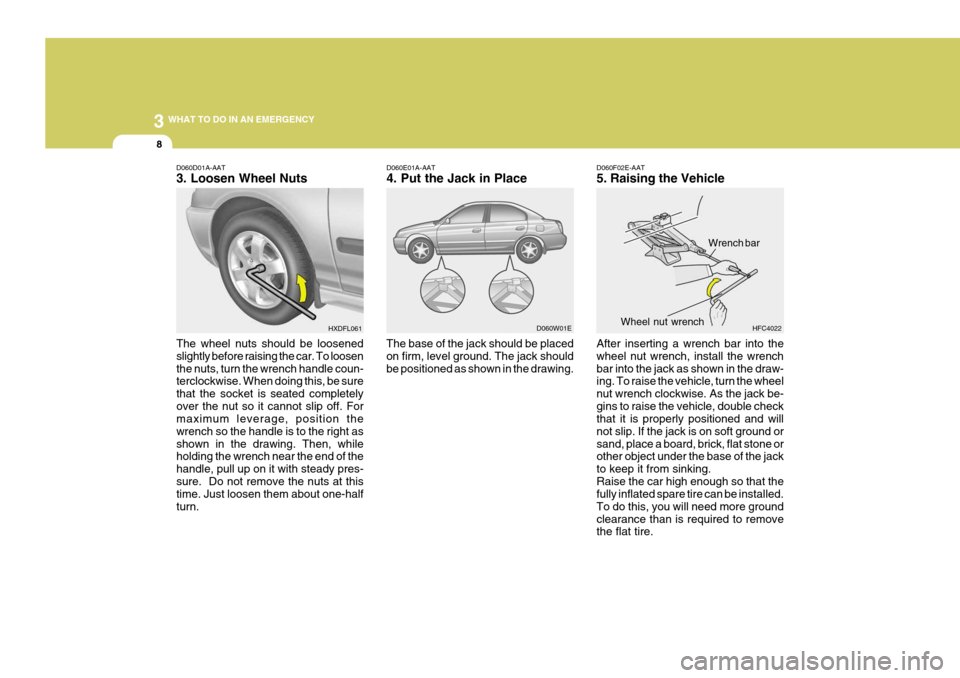
D060F02E-AAT 5. Raising the Vehicle After inserting a wrench bar into the wheel nut wrench, install the wrenchbar into the jack as shown in the draw- ing. To raise the vehicle, turn the wheel nut wrench clockwise. As the jack be-gins to raise the vehicle, double check that it is properly positioned and will not slip. If the jack is on soft ground orsand, place a board, brick, flat stone or other object under the base of the jack to keep it from sinking.Raise the car high enough so that the fully inflated spare tire can be installed. To do this, you will need more groundclearance than is required to remove the flat tire. HFC4022
Wrench bar
Wheel nut wrenchD060E01A-AAT 4. Put the Jack in Place
The base of the jack should be placed on firm, level ground. The jack shouldbe positioned as shown in the drawing. D060W01E
D060D01A-AAT 3. Loosen Wheel Nuts
HXDFL061
The wheel nuts should be loosened slightly before raising the car. To loosenthe nuts, turn the wrench handle coun- terclockwise. When doing this, be sure that the socket is seated completelyover the nut so it cannot slip off. For maximum leverage, position the wrench so the handle is to the right asshown in the drawing. Then, while holding the wrench near the end of the handle, pull up on it with steady pres-sure. Do not remove the nuts at this time. Just loosen them about one-half turn.
Page 189 of 277
3 WHAT TO DO IN AN EMERGENCY
10
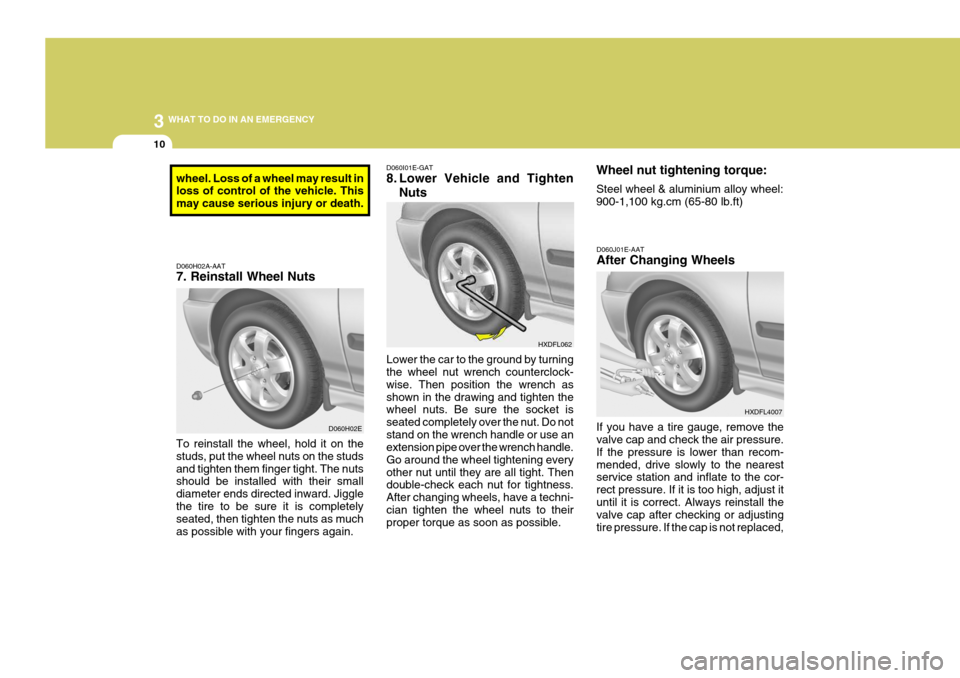
Lower the car to the ground by turning the wheel nut wrench counterclock- wise. Then position the wrench asshown in the drawing and tighten the wheel nuts. Be sure the socket is seated completely over the nut. Do notstand on the wrench handle or use an extension pipe over the wrench handle. Go around the wheel tightening everyother nut until they are all tight. Then double-check each nut for tightness. After changing wheels, have a techni-cian tighten the wheel nuts to their proper torque as soon as possible.
D060I01E-GAT
8. Lower Vehicle and Tighten
Nuts
HXDFL062Wheel nut tightening torque: Steel wheel & aluminium alloy wheel: 900-1,100 kg.cm (65-80 lb.ft)
D060J01E-AAT After Changing Wheels
If you have a tire gauge, remove the valve cap and check the air pressure. If the pressure is lower than recom-mended, drive slowly to the nearest service station and inflate to the cor- rect pressure. If it is too high, adjust ituntil it is correct. Always reinstall the valve cap after checking or adjusting tire pressure. If the cap is not replaced, HXDFL4007
D060H02A-AAT 7. Reinstall Wheel Nuts
To reinstall the wheel, hold it on the studs, put the wheel nuts on the studsand tighten them finger tight. The nuts should be installed with their small diameter ends directed inward. Jigglethe tire to be sure it is completely seated, then tighten the nuts as much as possible with your fingers again. D060H02E
wheel. Loss of a wheel may result in loss of control of the vehicle. This may cause serious injury or death.
Page 194 of 277
44CORROSION PREVENTION AND APPEARANCE CARE
2CORROSION PROTECTION
E010A01A-AAT Protecting Your Hyundai from Corrosion By using the most advanced design and construction practices to combatcorrosion, Hyundai produces cars of the highest quality, however, this is only part of the job. To achieve long-term corrosion resistance your Hyundai can deliver, the owner's cooperation and assistance is also required. E010C01A-AAT High-Corrosion Areas If you live in an area where your car is regularly exposed to corrosive materi-als, corrosion protection is particularly important. Some of the common causes of accelerated corrosion areroad salts, dust control chemicals, ocean air and industrial pollution.
E010B01A-AAT Common Causes of Corrosion The most common causes of corro- sion on your car are:
o Road salt, dirt and moisture that is allowed to accumulate underneath the car.
o Removal of paint or protective coat-
ings by stones, gravel, abrasion orminor scrapes and dents which leave unprotected metal exposed to cor- rosion. E010D01A-AAT Moisture Breeds Corrosion Moisture creates the conditions in which corrosion is most likely to occur.For example, corrosion is accelerated by high humidity, particularly when tem- peratures are just above freezing. Insuch conditions, the corrosive mate- rial is kept in contact with the car surfaces by moisture that is slow toevaporate. Mud is particulary corrosive because itis slow to dry and holds moisture incontact with the vehicle. Although the mud appears to be dry, it can still retain the moisture and promote corrosion.High temperatures can also acceler- ate corrosion of parts that are not properly ventilated so the moisturecan be dispersed. For all these rea- sons, it is particularly important to keep your car clean and free of mud oraccumulations of other materials. This applies not only to the visible surfaces but particularly to the underside of thecar.
Page 196 of 277

44CORROSION PREVENTION AND APPEARANCE CARE
4WASHING AND WAXING
E030A01A-AAT Washing Your Hyundai Never wash your car when the surface is hot from being in the sun. Alwayswash your car in the shade. Wash your car frequently. Dirt is abra- sive and can scratch the paint if it is not removed. Air pollution or acid rain may damage the paint and trim throughchemical action if pollutants are al- lowed to remain in contact with the surface. If you live near the ocean or inan area where road salts or dust con- trol chemicals are used, you should pay particular attention to the under-side of the car. Start by rinsing the car to remove dust and loose dirt. In win- ter, or if you have driven through mudor muddy water, be sure to thoroughly clean the underside as well. Use a hard direct stream of water to removeaccumulated mud or corrosive materi- als. Use a good quality car-washing solution and follow the manufacturer'sdirections on the package. These are available at your Hyundai dealer or auto parts outlet. Don't use strong house-hold detergents, gasoline, strong sol- vents or abrasive cleaning powders asthese may damage the finish.Use a clean sponge or cloth, rinse it frequently and don't damage the finish by rubbing too hard. For stubborn spots,dampen them frequently and remove them a little at a time. To clean whitewall tires, use a stiffbrush or soapy steel-wool scouring pad. To clean plastic wheel covers, use aclean sponge or soft cloth and water. To clean cast aluminum alloy wheels, use a mild soap or neutral detergent. Do not use abrasive cleaners. Protect the bare-metal surfaces by cleaning,polishing and waxing. Because alumi- num is subject to corrosion, be sure to give aluminum alloy wheels specialattention in winter. If you drive on salted roads, clean the wheels thor- oughly afterwards. After washing, be sure to rinse thor- oughly. If soapy water dries on thefinish, streaking will result. When the weather is warm and the
humidity low, you may find it necessary to rinse each section immediately afterwashing to avoid streaking. After rinsing, dry the car using a damp chamois or soft, absorbent cloth. The reason for drying the car is to remove water from the car so it will dry withoutwater spots. Don't rub, this can dam- age the finish. If you find any nicks or scratches in the paint, use touch-up paint to cover them to prevent corrosion. To protectthe paintwork of the car against corro- sion, you must clean your Hyundai (at least once a month). Give special at-tention to the removal of salt, mud and other substances on the underside of the splashboards of the car. Makesure that the outlets and the underside of the doors are open. Paint damage can be caused by small accumulationof tar, industrial precipitation, tree resin, insects and bird droppings, when not removed immediately. If water alone isnot strong enough to remove the accu- mulated dirt, use a mild car washing solution. Be sure to rinse the surface
Page 198 of 277

44CORROSION PREVENTION AND APPEARANCE CARE
6
E040E01A-AAT Cleaning the Windows You may use any household window cleaner on the windows. However, when cleaning the inside of the rear window be careful not to damage therear window defroster wiring. E050A01A-AAT Any Questions? If you have any questions about the care of your car, consult your Hyundaidealer.
E040C01A-AAT Cleaning the Carpets Use a foam-type carpet cleaner. Clean- ers of this type are available in aerosol cans in liquid form or powder. Read theinstructions and follow them exactly. Using a vacuum cleaner with the ap- propriate attachment, remove as muchdirt from the carpets as possible. Apply the foam following the manufacturer's directions, then rub in overlappingcircles. Do not add water. These clean- ers work best when the carpet is kept as dry as possible.
E040B01A-AAT To Clean the Leather Upholstery (If installed) In the normal course of use, leather upholstered surfaces will, like anymaterial, pick-up dust and dirt. This dust and dirt must be cleaned off or it may work into the surface of the leather,causing damage. Fine leather needs care, and should be cleaned when necessary. Washing leather thoroughly with soap and water will keep your leather lustrous, beauti-ful and ensure you have many years of wear. Take a piece of cheese cloth and usingany mild soap and lukewarm water, work up a good lather. Thoroughly wash the leather. Wipe clean with aslightly damp cloth and dry with soft cloth. Do this as often as the leather becomes soiled. During tanning operations, sufficient oils are incorporated through process-ing that none need be applied during the life of the leather. Oil applied to the finished surface will in no way help the leather and may do more harm thangood. Varnishes and furniture polishesshould never be used under any con- ditions.
E040D01A-AAT Cleaning the Seat Belts To clean the seat belts, use a cloth or sponge with mild soap or detergentand warm water. Do not use strong detergents, dye, bleach or abrasive materials on the seat belts as this mayweaken the fabric. While cleaning the belts, inspect them for excessive wear, cuts, fraying orother signs of damage and replace them if necessary
Page 221 of 277
6 DO-IT-YOURSELF MAINTENANCE
12
!
G040B03FC-GAT
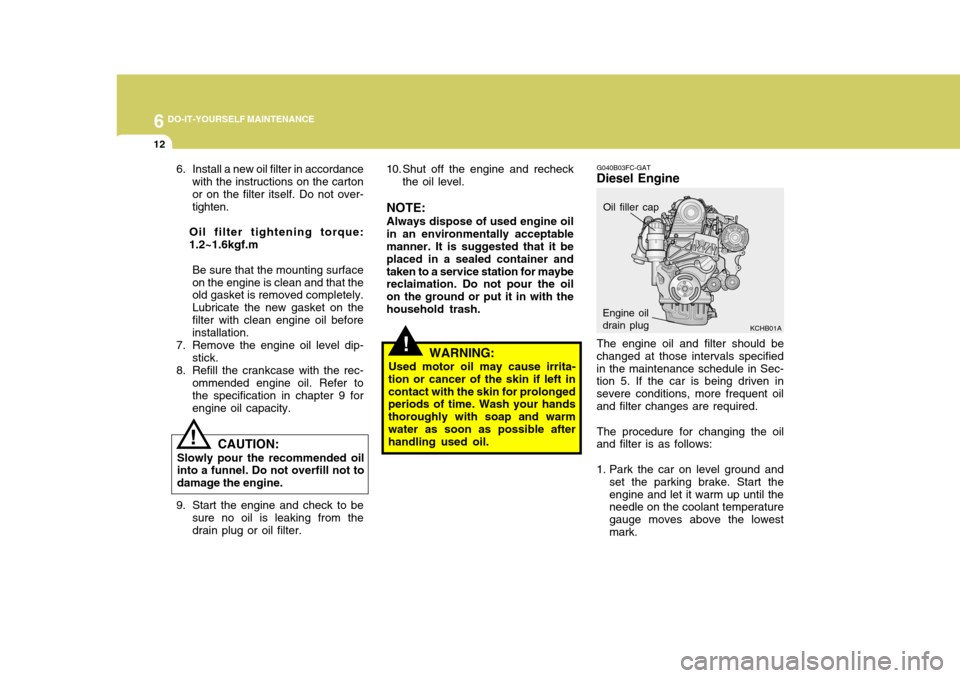
Diesel Engine
KCHB01A
The engine oil and filter should be
changed at those intervals specified in the maintenance schedule in Sec- tion 5. If the car is being driven in severe conditions, more frequent oiland filter changes are required.
The procedure for changing the oil
and filter is as follows:
1. Park the car on level ground and
set the parking brake. Start the engine and let it warm up until the needle on the coolant temperature gauge moves above the lowestmark.
10. Shut off the engine and recheck
the oil level.
NOTE: Always dispose of used engine oil in an environmentally acceptable manner. It is suggested that it be placed in a sealed container andtaken to a service station for maybe reclaimation. Do not pour the oil on the ground or put it in with thehousehold trash.
6. Install a new oil filter in accordance
with the instructions on the cartonor on the filter itself. Do not over- tighten.
Oil filter tightening torque: 1.2~1.6kgf.m Be sure that the mounting surfaceon the engine is clean and that the old gasket is removed completely. Lubricate the new gasket on thefilter with clean engine oil before installation.
7. Remove the engine oil level dip- stick.
8. Refill the crankcase with the rec- ommended engine oil. Refer tothe specification in chapter 9 for engine oil capacity. WARNING:
Used motor oil may cause irrita-
tion or cancer of the skin if left incontact with the skin for prolonged periods of time. Wash your hands thoroughly with soap and warmwater as soon as possible after handling used oil.
Oil filler cap
Engine oil drain plug
! CAUTION:
Slowly pour the recommended oil into a funnel. Do not overfill not to damage the engine.
9. Start the engine and check to be sure no oil is leaking from the drain plug or oil filter.
Page 223 of 277
6 DO-IT-YOURSELF MAINTENANCE
14
!!
CHECKING AND CHANGING THE ENGINE COOLANT
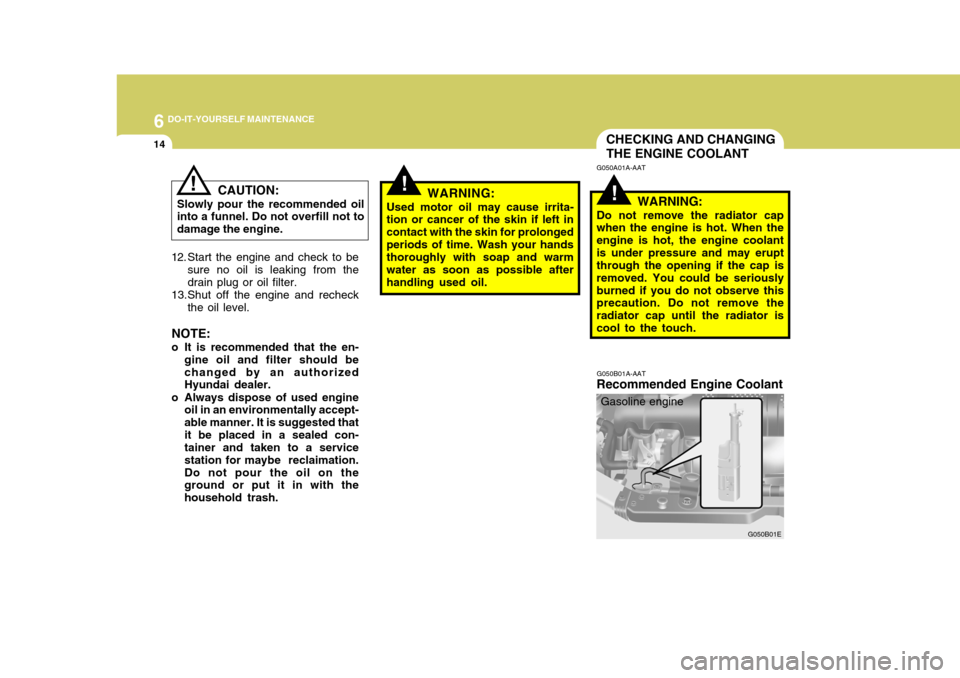
G050B01A-AAT
Recommended Engine Coolant
G050B01E
G050A01A-AAT
WARNING:
Do not remove the radiator cap when the engine is hot. When the engine is hot, the engine coolantis under pressure and may erupt through the opening if the cap is removed. You could be seriouslyburned if you do not observe this precaution. Do not remove the radiator cap until the radiator iscool to the touch.
WARNING:
Used motor oil may cause irrita- tion or cancer of the skin if left in contact with the skin for prolongedperiods of time. Wash your hands thoroughly with soap and warm water as soon as possible afterhandling used oil.
Gasoline engine
12. Start the engine and check to be
sure no oil is leaking from thedrain plug or oil filter.
13.Shut off the engine and recheck the oil level.
NOTE:
o It is recommended that the en- gine oil and filter should bechanged by an authorized Hyundai dealer.
o Always dispose of used engine oil in an environmentally accept- able manner. It is suggested thatit be placed in a sealed con- tainer and taken to a service station for maybe reclaimation.Do not pour the oil on the ground or put it in with the household trash.
! CAUTION:
Slowly pour the recommended oil into a funnel. Do not overfill not to damage the engine.
Page 239 of 277
6 DO-IT-YOURSELF MAINTENANCE
30
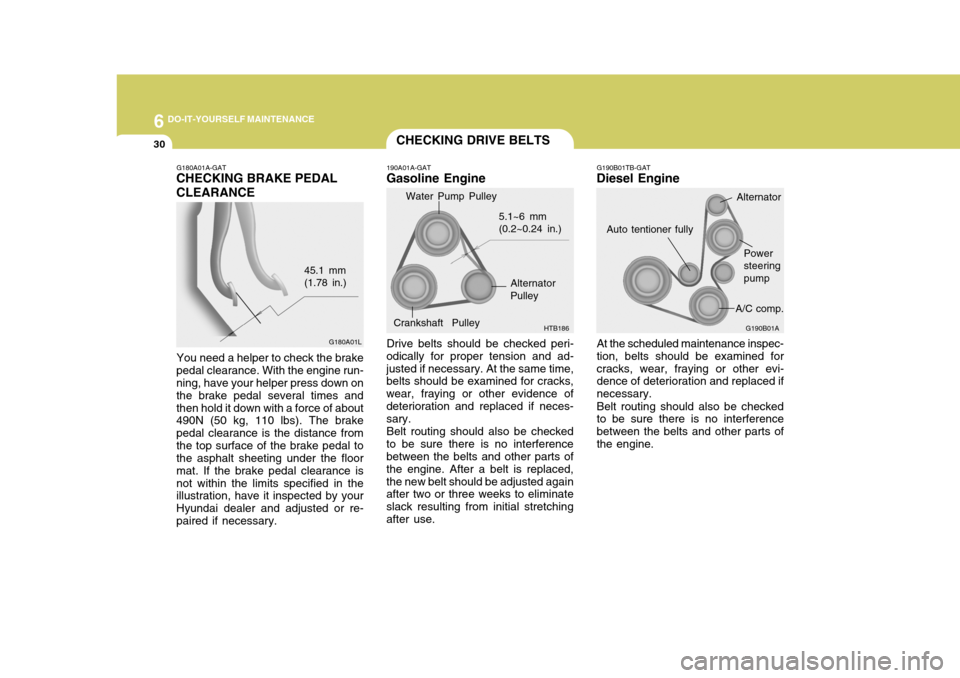
Water Pump Pulley
Alternator Pulley
Crankshaft Pulley 5.1~6 mm(0.2~0.24 in.)
HTB186
G190B01A
Power steeringpump
A/C comp.
Auto tentioner fully
Alternator
G190B01TB-GAT
Diesel Engine
At the scheduled maintenance inspec- tion, belts should be examined forcracks, wear, fraying or other evi- dence of deterioration and replaced if necessary. Belt routing should also be checked to be sure there is no interference between the belts and other parts ofthe engine.
190A01A-GAT
Gasoline Engine
Drive belts should be checked peri-
odically for proper tension and ad-justed if necessary. At the same time, belts should be examined for cracks, wear, fraying or other evidence ofdeterioration and replaced if neces- sary.
Belt routing should also be checked
to be sure there is no interferencebetween the belts and other parts of the engine. After a belt is replaced,the new belt should be adjusted again after two or three weeks to eliminate slack resulting from initial stretchingafter use.
G180A01A-GAT
CHECKING BRAKE PEDAL CLEARANCE
G180A01L
45.1 mm (1.78 in.)
You need a helper to check the brake
pedal clearance. With the engine run- ning, have your helper press down on the brake pedal several times andthen hold it down with a force of about 490N (50 kg, 110 lbs). The brake pedal clearance is the distance fromthe top surface of the brake pedal to the asphalt sheeting under the floor mat. If the brake pedal clearance isnot within the limits specified in the illustration, have it inspected by your Hyundai dealer and adjusted or re-paired if necessary. CHECKING DRIVE BELTS
Page 242 of 277
6
DO-IT-YOURSELF MAINTENANCE
33
o If battery fluid is on your skin, flush the affected areas with water for at least 15 minutes and then seek medical assistance.
o If battery fluid is in your eyes, rinse out your eyes with water and getmedical assistance as soon as possible. While you are being driven to get medical assistance, continueto rinse your eyes by using a sponge or soft cloth saturated with water.
o If you swallow battery fluid, drink a large quantity of water or milk fol-lowed by milk of magnesia, eat a raw egg or drink vegetable oil. Get medical assistance as soon as pos-sible.
While batteries are being charged (either by a battery charger or by the vehicle's generator), they produceexplosive gases. Always observe these warnings to prevent injuries from occurring:
o Charge batteries only in a well ven- tilated area.
o Do not permit flames, sparks or smoking in the area.
o Keep children away from the area.
!
G210B01Y-GET
Checking the Battery
Keep the battery clean. Any evidence of corrosion around the battery posts or terminals should be removed using a solution of household baking sodaand warm water. After the battery ter- minals are dry, cover them with a light coating of grease.
WARNING:Always read the followinginstructions carefully whenhandling a battery.Keep lighted cigarettes andall other flames or sparksaway from the battery.Hydrogen, which is a highlycombustible gas, is always present in battery cells and may explode if ignited.Keep batteries out of the reach of children becausebatteries contain highly cor- rosive SULFURIC ACID. Do not allow battery acid tocontact your skin, eyes, clothing or paint finish. If any electrolyte gets into your eyes, flush your eyes with clean water for at least15 minutes and get imme- diate medical attention. If possible, continue to applywater with a sponge or cloth until medical atten- tion is received. If electrolyte gets on your skin, thoroughly wash the contacted area.If you feel a pain or a burn-ing sensation, get medicalattention immediately.Wear eye protection whencharging or working near abattery.Always provide ventilationwhen working in an en- closed space.