warning Hyundai Equus 2016 Owner's Manual
[x] Cancel search | Manufacturer: HYUNDAI, Model Year: 2016, Model line: Equus, Model: Hyundai Equus 2016Pages: 477, PDF Size: 16.25 MB
Page 238 of 477
3-143
Convenient features of your vehicle03
Cool and warm box
(if equipped)
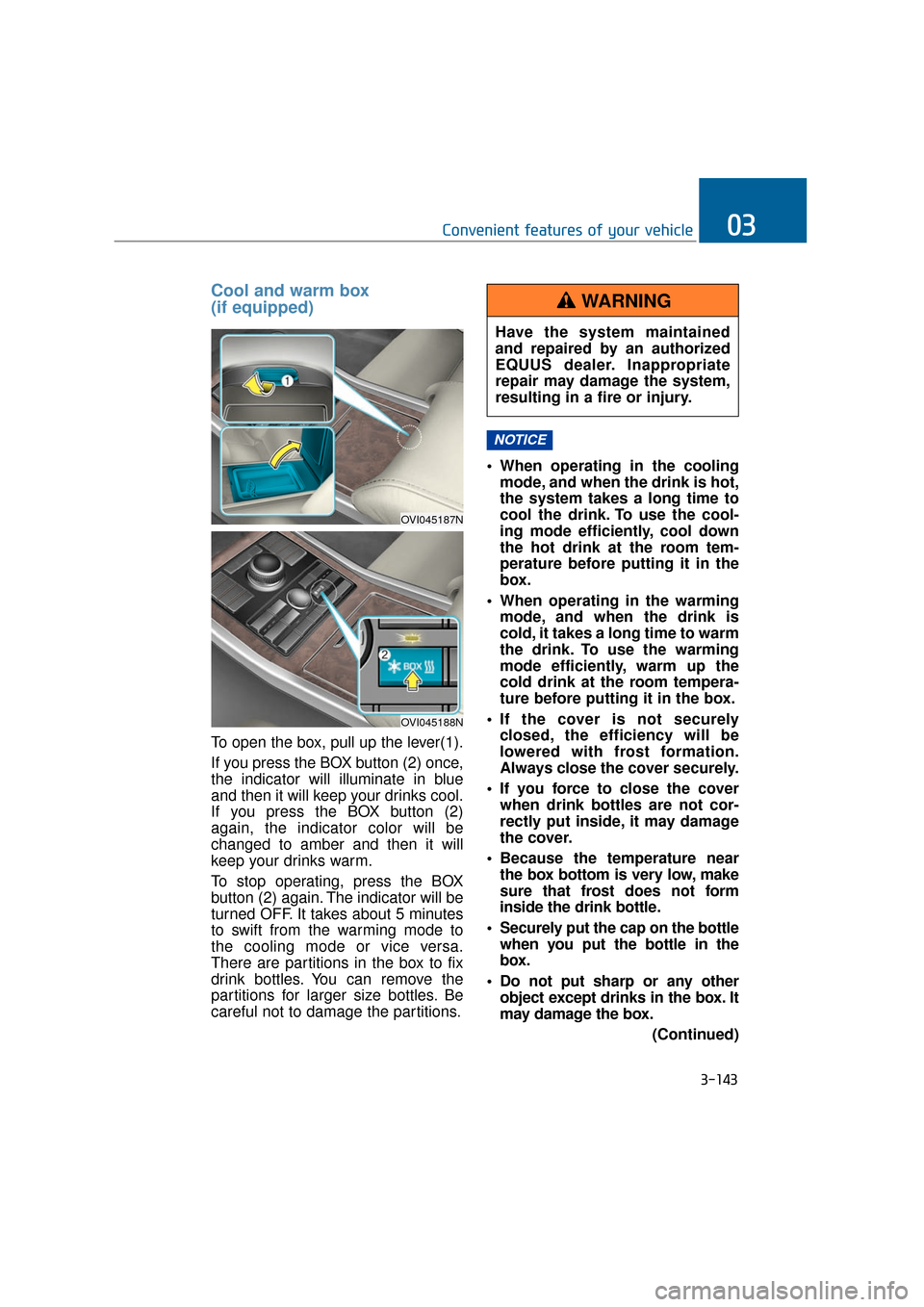
To open the box, pull up the lever(1).
If you press the BOX button (2) once,
the indicator will illuminate in blue
and then it will keep your drinks cool.
If you press the BOX button (2)
again, the indicator color will be
changed to amber and then it will
keep your drinks warm.
To stop operating, press the BOX
button (2) again. The indicator will be
turned OFF. It takes about 5 minutes
to swift from the warming mode to
the cooling mode or vice versa.
There are partitions in the box to fix
drink bottles. You can remove the
partitions for larger size bottles. Be
careful not to damage the partitions. When operating in the cooling
mode, and when the drink is hot,
the system takes a long time to
cool the drink. To use the cool-
ing mode efficiently, cool down
the hot drink at the room tem-
perature before putting it in the
box.
When operating in the warming mode, and when the drink is
cold, it takes a long time to warm
the drink. To use the warming
mode efficiently, warm up the
cold drink at the room tempera-
ture before putting it in the box.
If the cover is not securely closed, the efficiency will be
lowered with frost formation.
Always close the cover securely.
If you force to close the cover when drink bottles are not cor-
rectly put inside, it may damage
the cover.
Because the temperature near the box bottom is very low, make
sure that frost does not form
inside the drink bottle.
Securely put the cap on the bottle when you put the bottle in the
box.
Do not put sharp or any other object except drinks in the box. It
may damage the box.
(Continued)
NOTICE
OVI045187N
OVI045188N
Have the system maintained
and repaired by an authorized
EQUUS dealer. Inappropriate
repair may damage the system,
resulting in a fire or injury.
WARNING
Page 240 of 477
3-145
Convenient features of your vehicle03
Ashtray
Front
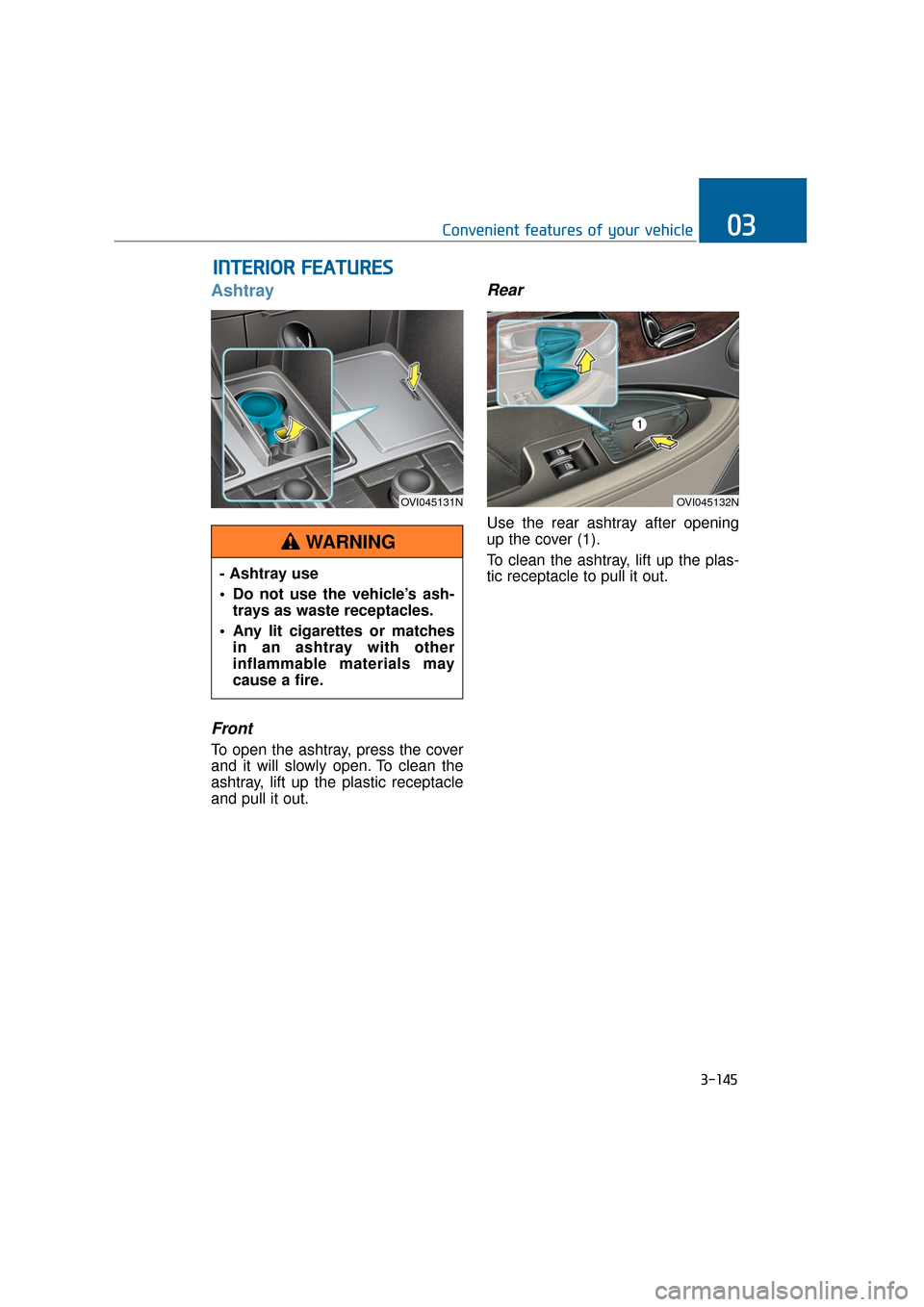
To open the ashtray, press the cover
and it will slowly open. To clean the
ashtray, lift up the plastic receptacle
and pull it out.
Rear
Use the rear ashtray after opening
up the cover (1).
To clean the ashtray, lift up the plas-
tic receptacle to pull it out.
I IN
N T
TE
ER
R I
IO
O R
R
F
F E
E A
A T
TU
U R
RE
ES
S
OVI045131N
- Ashtray use
Do not use the vehicle’s ash-
trays as waste receptacles.
Any lit cigarettes or matches in an ashtray with other
inflammable materials may
cause a fire.
WARNING
OVI045132N
Page 241 of 477
3-146
Convenient features of your vehicle
Cup holder
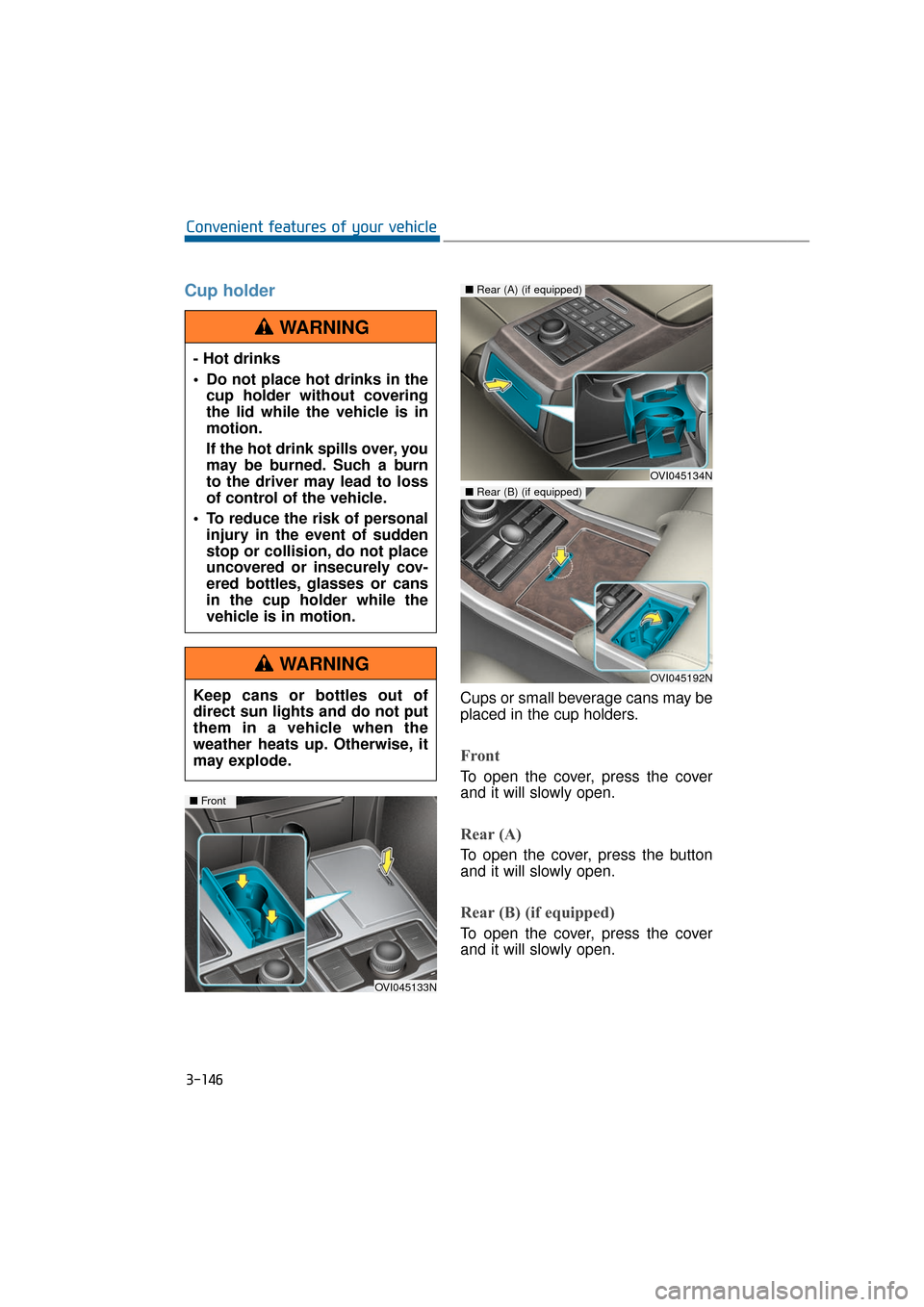
Cups or small beverage cans may be
placed in the cup holders.
Front
To open the cover, press the cover
and it will slowly open.
Rear (A)
To open the cover, press the button
and it will slowly open.
Rear (B) (if equipped)
To open the cover, press the cover
and it will slowly open.
- Hot drinks
Do not place hot drinks in the
cup holder without covering
the lid while the vehicle is in
motion.
If the hot drink spills over, you
may be burned. Such a burn
to the driver may lead to loss
of control of the vehicle.
To reduce the risk of personal injury in the event of sudden
stop or collision, do not place
uncovered or insecurely cov-
ered bottles, glasses or cans
in the cup holder while the
vehicle is in motion.
WARNING
Keep cans or bottles out of
direct sun lights and do not put
them in a vehicle when the
weather heats up. Otherwise, it
may explode.
WARNING
OVI045133N
■ Front
OVI045134N
■Rear (A) (if equipped)
OVI045192N
■Rear (B) (if equipped)
Page 244 of 477
3-149
Convenient features of your vehicle03
(Continued)
Some electronic devices cancause electronic interference
when plugged into a vehicle’s
power outlet. These devices may
cause excessive audio static
and malfunctions in other elec-
tronic systems or devices used
in your vehicle.Clock
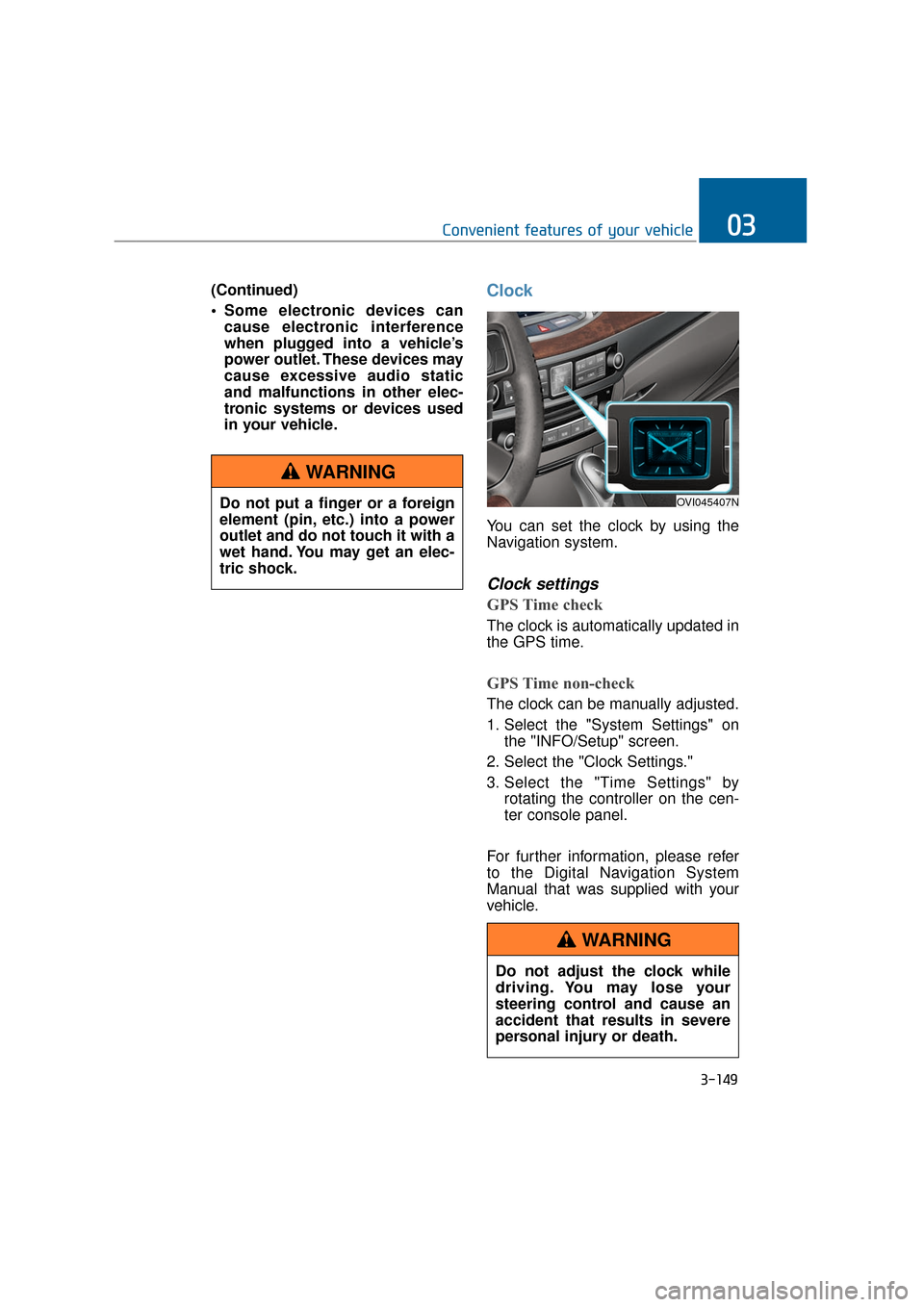
You can set the clock by using the
Navigation system.
Clock settings
GPS Time check
The clock is automatically updated in
the GPS time.
GPS Time non-check
The clock can be manually adjusted.
1. Select the "System Settings" on the "INFO/Setup" screen.
2. Select the "Clock Settings."
3. Select the "Time Settings" by rotating the controller on the cen-
ter console panel.
For further information, please refer
to the Digital Navigation System
Manual that was supplied with your
vehicle.
Do not put a finger or a foreign
element (pin, etc.) into a power
outlet and do not touch it with a
wet hand. You may get an elec-
tric shock.
WARNING
OVI045407N
Do not adjust the clock while
driving. You may lose your
steering control and cause an
accident that results in severe
personal injury or death.
WARNING
Page 245 of 477
3-150
Convenient features of your vehicle
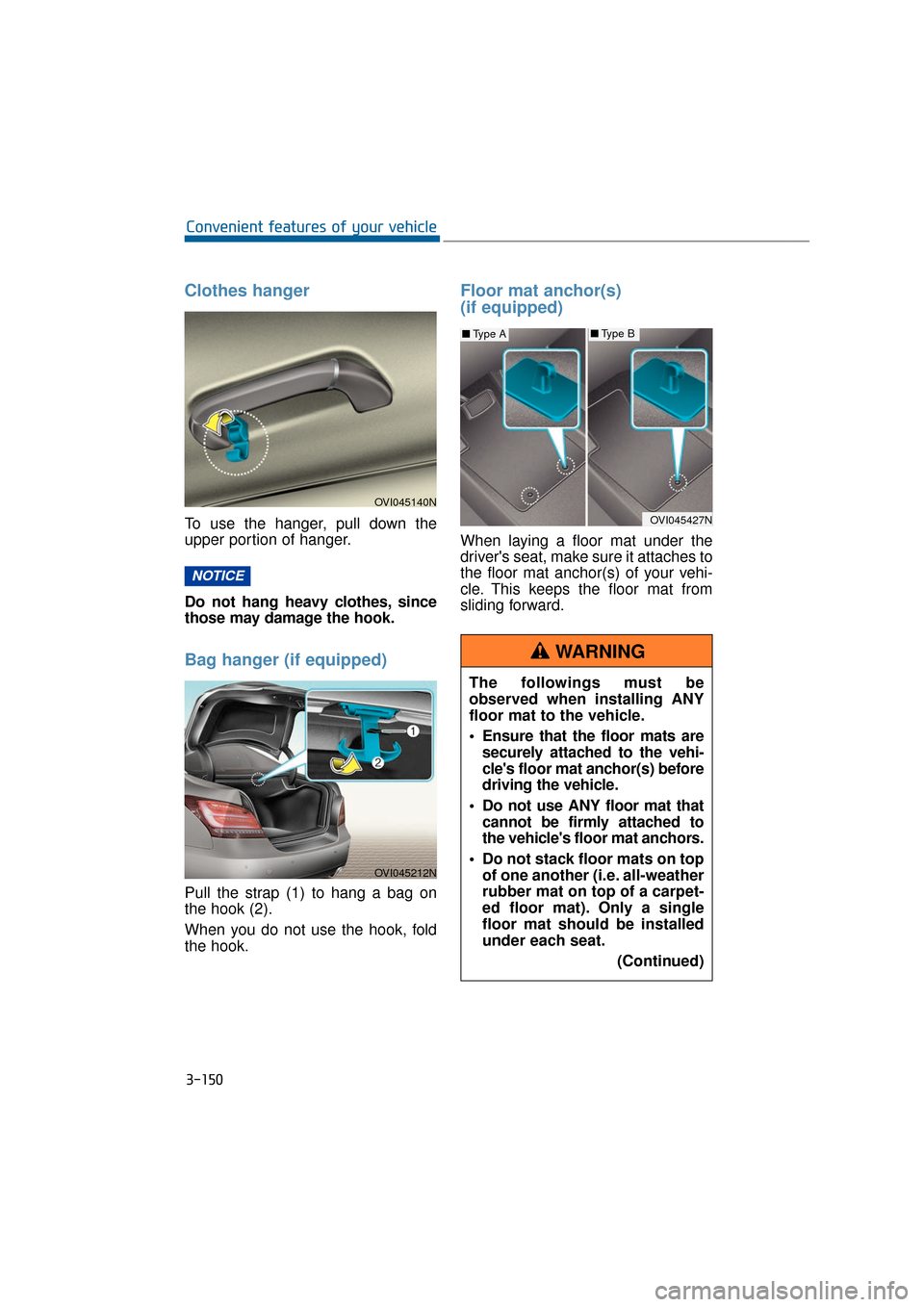
Clothes hanger
To use the hanger, pull down the
upper portion of hanger.
Do not hang heavy clothes, since
those may damage the hook.
Bag hanger (if equipped)
Pull the strap (1) to hang a bag on
the hook (2).
When you do not use the hook, fold
the hook.
Floor mat anchor(s)
(if equipped)
When laying a floor mat under the
driver's seat, make sure it attaches to
the floor mat anchor(s) of your vehi-
cle. This keeps the floor mat from
sliding forward.
NOTICE
OVI045140N
OVI045212N
OVI045427N
■Type A■Type B
The followings must be
observed when installing ANY
floor mat to the vehicle.
Ensure that the floor mats are
securely attached to the vehi-
cle's floor mat anchor(s) before
driving the vehicle.
Do not use ANY floor mat that cannot be firmly attached to
the vehicle's floor mat anchors.
Do not stack floor mats on top of one another (i.e. all-weather
rubber mat on top of a carpet-
ed floor mat). Only a single
floor mat should be installed
under each seat.
(Continued)
WARNING
Page 252 of 477
Driving your vehicle
Before driving.........................................................5-5
Before entering vehicle ...................................................5-5
Necessary inspections .....................................................5-5
Before starting .................................................................5-5
Engine start/stop button ......................................5-7
Illuminated Engine Start/Stop Button ..........................5-7
Engine Start/Stop Button position ...............................5-7
Starting the engine ................................................5-9
Automatic transmission .......................................5-11
Automatic transmission operation ..............................5-12
Good driving practices ...................................................5-15
Brake system ........................................................5-17
Power brakes ...................................................................5-17
Electric parking brake (EPB) ........................................5-19
Emergency braking .........................................................5-22
AUTO HOLD ......................................................................5-\
23
Anti-lock brake system (ABS) .....................................5-26
Electronic stability control (ESC) ................................5-28
Hill-start assist control (HAC) ......................................5-32
Good braking practices..................................................5-32
Drive mode integrated control system .............5-34
DRIVE mode / SNOW mode ..........................................5-34
Electronic controlled suspension (ECS) ...........5-36
To control the vehicle height .......................................5-36
ECS (Electronic Controlled Suspension) malfunction
warning message.............................................................5-37
Page 253 of 477
Driving your vehicle
Advanced smart cruise control system ............5-38
Smart cruise control speed ..........................................5-39
Smart cruise control vehicle-to-vehicle distance ..5-43
Vehicle-to-vehicle distance sensor ...........................5-45
To convert to the cruise control mode .....................5-46
Limitations of the system .............................................5-47
Lane departure warning system (LDWS) .........5-51
LDWS operation...............................................................5-52
Advanced vehicle safety management
(AVSM) ..................................................................5-55
Blind spot detection system (BSD) ...................5-58
Operating conditions ......................................................5-59
Warning types ..................................................................5-59
Detecting sensor .............................................................5-60
Warning message ............................................................5-61
RCTA (Rear cross traffic alert) ....................................5-62
Non-operating condition ...............................................5-63
Economical operation ..........................................5-65
Special driving conditions ...................................5-67
Hazardous driving conditions.......................................5-67
Rocking the vehicle ........................................................5-68
Smooth cornering ...........................................................5-69
Driving at night ................................................................5-69
Driving in the rain ...........................................................5-70
Driving in flooded areas ................................................5-70
Off-road driving ..............................................................5-70
Highway driving ...............................................................5-71
Page 255 of 477
5-4
Driving your vehicle
- ENGINE EXHAUST CAN BE DANGEROUS!
Engine exhaust fumes may be extremely dangerous. When, at any time, you
smell exhaust fumes inside the vehicle, immediately open the windows.
• Do not inhale exhaust fumes.Exhaust fumes contain carbon monoxide, the colorless, odorless gas that
may cause unconsciousness and death by asphyxiation.
The exhaust system should be checked whenever the vehicle is raised to
change the oil or for any other purpose. If you notice a change in the sound
of the exhaust system or if you drive over something that strikes the vehicle
underneath, have the exhaust system checked as soon as possible by an
authorized EQUUS dealer.
Letting the engine idle in a garage, even with the garage door open, is haz-
ardous. Never run the engine in your garage any longer than it takes to start
the engine and move out the vehicle.
Avoid idling the engine for a prolonged period of time with people inside the vehicle.
If it is necessary to idle the engine for a prolonged period of time with people
inside the vehicle, idle the engine in an open area with the air control in the
(fresh) air intake mode and the fan operating at a high speed. Thus, fresh air
can be taken into the interior.
When you need to drive with the trunk lid open because of the object you carry,
make sure the followings:
1. Close all windows.
2. Open side vents.
3. Set the air intake control in (fresh) air intake mode, the air flow directed toward "Floor" or "Face," and the fan at a high speed.
To assure proper ventilation, clear snow, ice, leaves or other substances from
the air inlet just in front of the windshield.
WARNING
Engine exhaust and a wide variety of automobile components and
parts, including components found in the interior furnishings in a
vehicle, contain or emit chemicals known to the State of California to
cause cancer and birth defects and reproductive harm. In addition,
certain fluids contained in vehicles and certain products of compo-
nent wear contain or emit chemicals known to the State of California
to cause cancer and birth defects or other reproductive harm.
California PROPOSITION 65 WARNING
Page 256 of 477
Before entering vehicle
• Be sure that all windows, outsidemirror(s), and outside lights are
clean.
Check the condition of the tires.
Check underneath the vehicle for any leakage sign.
Make sure there are no obstacles behind, when you intend to drive
backwards.
Necessary inspections
Fluid levels, such as engine oil,
engine coolant, brake fluid, and
washer fluid should be checked on a
regular basis, at exact intervals.
Further details are provided in the
chapter 7, "Maintenance".
Before starting
Close and lock all doors.
Check the seat position, so all con-trols are easily accessible.
Adjust the inside and outside rearview mirrors.
Make sure that all lights operate.
Check all gauges.
Check the operation of warning lights when the Engine Start/Stop
button is turned ON.
Release the parking brake and make sure the brake warning light
goes OFF.
For safe operation, make sure you
are familiar with your vehicle equip-
ment and operation.
B B E
EF
FO
O R
RE
E
D
D R
RI
IV
V I
IN
N G
G
5-5
Driving your vehicle05
Careless driving may result in a
loss of vehicle control, possibly
leading to an accident, severe
personal injury, and death. The
driver’s primary responsibility
is to drive in the safe and legal
manner. The use of any hand-
held devices, other equipment,
or vehicle systems, which take
the driver’s eyes, attention and
focus away from the safe opera-
tion of a vehicle or which are
not permissible by law, should
never be used in driving.
WARNINGAll passengers must be proper-
ly belted whenever the vehicle
is moving. Refer to "Seat belts"
in chapter 2 for more informa-
tion on the proper usage.
WARNING
Always take a look around your
vehicle for any passers-by,
especially children, before
changing the shift lever to D
(Drive) or R (Reverse).
WARNING
Page 257 of 477
5-6
Driving your vehicle- Driving under the influence of alcohol or drugs
DUI (driving under the influ-
ence) is dangerous. DUI is the
number one contributor to the
highway death toll each year.
Even a small amount of alcohol
will affect your reflexes, percep-
tions and judgment. Driving
under the influence of drugs is
as dangerous as or more dan-
gerous than driving under the
influence of alcohol.
You are much more likely to
have a serious accident if you
drive under the influence of
alcohol or drug. After you drink
alcohol or take drugs, do not
drive. Do not ride in a passen-
ger's seat when a driver drinks
or takes drugs.
Have a designated driver in
your group or call a cab.
WARNING
When you park or pull over the vehicle with the engine
ON, be careful not to depress
the accelerator pedal for a
long period of time. It may
overheat the engine or
exhaust system and cause
fire.
When you make a sudden stop or rapidly turn the steer-
ing wheel, any loose objects
may toss about inside the
vehicle and interfere with the
pedal operation, possibly
causing an accident. Keep all
things in the vehicle safely
stored.
If you are not concentrated while driving, it may cause an
accident. Be careful when
operating controls such as
the audio or heater. It is
always the driver's responsi-
bility to be attentive to the
driving safety.
WARNING