warning Hyundai Equus 2016 Owner's Manual
[x] Cancel search | Manufacturer: HYUNDAI, Model Year: 2016, Model line: Equus, Model: Hyundai Equus 2016Pages: 477, PDF Size: 16.25 MB
Page 258 of 477
E
EN
N G
GI
IN
N E
E
S
S T
T A
A R
RT
T/
/S
S T
T O
O P
P
B
B U
U T
TT
TO
O N
N
5-7
Driving your vehicle05
Illuminated Engine Start/Stop
Button
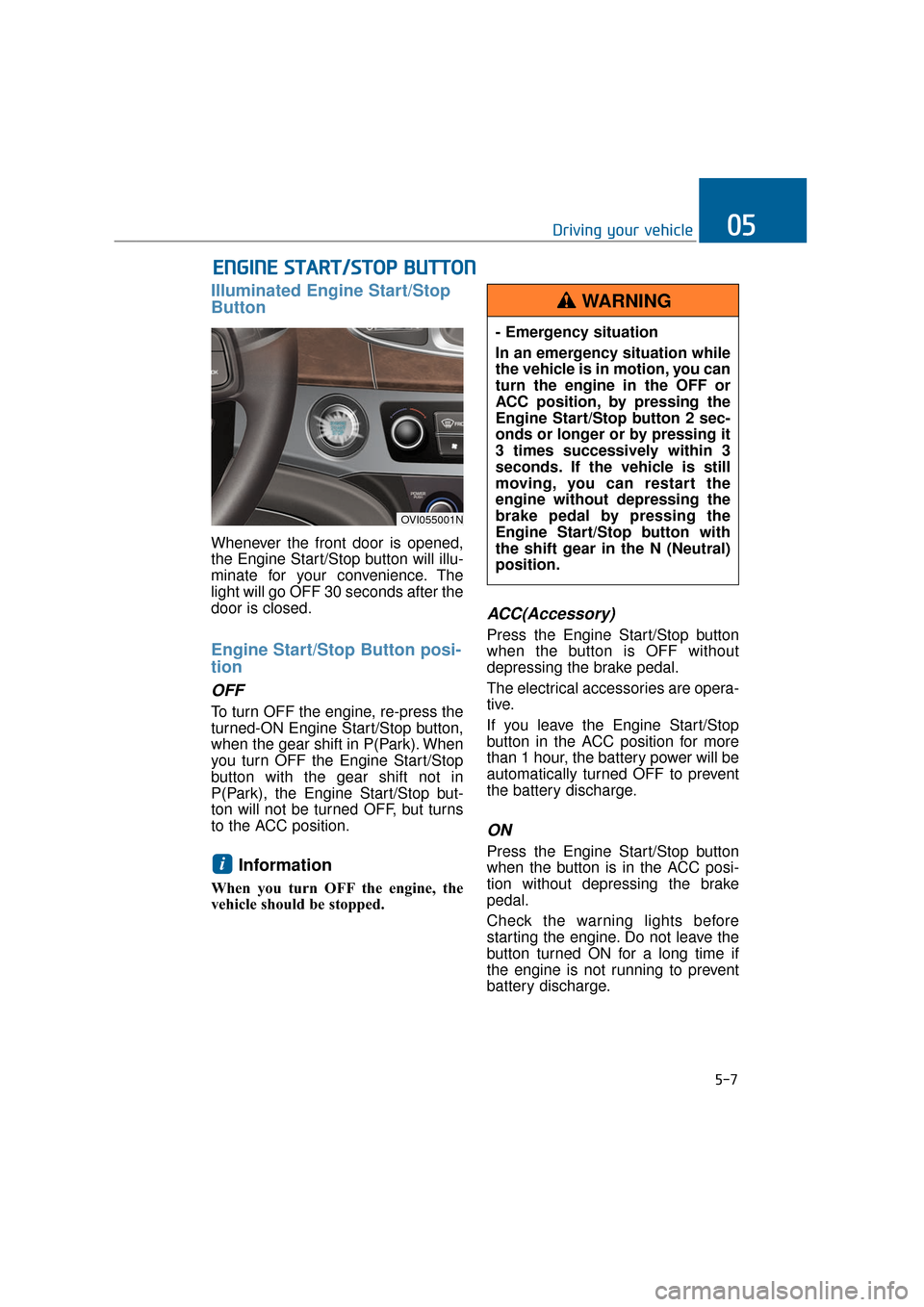
Whenever the front door is opened,
the Engine Start/Stop button will illu-
minate for your convenience. The
light will go OFF 30 seconds after the
door is closed.
Engine Start/Stop Button posi-
tion
OFF
To turn OFF the engine, re-press the
turned-ON Engine Start/Stop button,
when the gear shift in P(Park). When
you turn OFF the Engine Start/Stop
button with the gear shift not in
P(Park), the Engine Start/Stop but-
ton will not be turned OFF, but turns
to the ACC position.
Information
When you turn OFF the engine, the
vehicle should be stopped.
ACC(Accessory)
Press the Engine Start/Stop button
when the button is OFF without
depressing the brake pedal.
The electrical accessories are opera-
tive.
If you leave the Engine Start/Stop
button in the ACC position for more
than 1 hour, the battery power will be
automatically turned OFF to prevent
the battery discharge.
ON
Press the Engine Start/Stop button
when the button is in the ACC posi-
tion without depressing the brake
pedal.
Check the warning lights before
starting the engine. Do not leave the
button turned ON for a long time if
the engine is not running to prevent
battery discharge.i
OVI055001N
- Emergency situation
In an emergency situation while
the vehicle is in motion, you can
turn the engine in the OFF or
ACC position, by pressing the
Engine Start/Stop button 2 sec-
onds or longer or by pressing it
3 times successively within 3
seconds. If the vehicle is still
moving, you can restart the
engine without depressing the
brake pedal by pressing the
Engine Start/Stop button with
the shift gear in the N (Neutral)
position.
WARNING
Page 259 of 477
START
To start the engine, depress the
brake pedal and press the Engine
Start/Stop Button with the shift gear
in P(Park) or N(Neutral).
For your safety, start the engine with
the shift gear in P(Park).
Information
• If you press the Engine Start/Stopbutton without depressing the brake
pedal, the engine does not start.
When the Engine Start/Stop button
is pressed, it changes as follows:
OFF → →
ACC →
→
ON →
→
OFF
• If you leave the Engine Start/Stop Button in the ACC or the ON posi-
tion for a long time, the battery will
be discharged.
i
5-8
Driving your vehicle
Never press the Engine Start/Stop button while the
vehicle is in motion except in
an emergency situation. This
would turn the engine OFF,
resulting in loss of power
assist for the steering wheel
and brake. This may lead to
loss of directional control and
braking function, which could
cause an accident.
(Continued)
(Continued)
Before leaving the driver’sseat, always make sure the
shift gear is engaged in P
(Park), fully set the parking
brake and turn the engine
OFF. Unexpected and sudden
vehicle movement may occur
if these precautions are not
taken.
Never touch the Engine Start/Stop button, or any other
controls on the steering wheel
while the vehicle is in motion.
Reaching out for those con-
trols with your hand or arm
may cause a loss of vehicle
control, an accident, serious
bodily injury or death.
Do not place any loose objects around the driver’s
seat, as they may toss about
while driving, interfering with
the driver's pedal operation
and leading to an accident.
WARNING
Page 260 of 477
1.Carry the Smart Key inside thevehicle.
2.Check the parking brake is firmly applied.
3.Place the shift lever in P(Park).
4.Depress the brake pedal.
5.Press the Engine Start/Stop but- ton.
It should be started without
depressing the accelerator.
6.Do not wait for the engine to warm up while idling the engine.
Start driving at a moderate speed.
(Sudden accelerating and deceler-
ating should be avoided.)
If the engine stops while driving,
do not attempt to move the shift
lever to P (Park). When traffic and
road conditions permit, and while
the vehicle is still moving, you
may move the shift lever to
N(Neutral), and press the Engine
Start/Stop button to restart the
engine. Even though the Smart Key is
inside the vehicle, but when the
key is far away from the driver, the
engine may not start.
When the Engine Start/Stop button is in the ACC or ON position, and
when any door is open, the system
checks for the presence of the
Smart Key. If the Smart Key is not
inside the vehicle, the "Key not in
vehicle" indicator will illuminate.
When all doors are closed, the
chime will also sound for approxi-
mately 5 seconds. The indicator
will be turned OFF while the vehi-
cle is moving. Keep the Smart Key
inside the vehicle when the Engine
Start/Stop button is in the ACC or
ON position.
NOTICE
S ST
T A
A R
RT
TI
IN
N G
G
T
T H
H E
E
E
E N
N G
GI
IN
N E
E
5-9
Driving your vehicle05
Always wear proper shoes
when driving your vehicle.
Improper types of shoes (i.e.
high heels, slippers, ski boots,
etc.) may interfere with your
ability to control the brake and
accelerator pedal.
WARNING
Only when the Smart Key is
inside the vehicle, pressing the
Engine Start/Stop button will
start the engine. Never allow
children or any persons, who
are unfamiliar with the vehicle,
to touch the Engine Start/Stop
button or other related parts.
WARNING
Page 263 of 477
Automatic transmission opera-
tion
The automatic transmission has 8
forward speed levels and 1 reverse
speed level. Vehicle speed is auto-
matically selected, depending on the
shift lever position.
Information
A new vehicle may experience some-
what abrupt movement during the
first few shifts.
Always depress the brake pedalwhen moving the shift lever from N(Neutral) to a forward or reverse gear.
To avoid damage to your trans- mission, do not depress the
accelerator, when the shift lever
is in R (Reverse) or any forward
gear positions, and when the
brake is set.
(Continued)(Continued)
When a vehicle stops on a
slope, do not stop the vehicle
with the engine power.
Set the service brake or the
parking brake.
Do not shift from N(Neutral)/P(Park) to
D(Drive)/R(Reverse), when the
engine runs faster than the idle
speed.
Transmission ranges
The shift lever position is displayed
on the instrument cluster, when the
Engine Start/Stop button is ON.
P (Park)
Always completely stop the vehicle
before moving the shift lever to P
(Park). This locks the transmission
and prevents the drive wheels from
rotating.
NOTICE
i
5-12
Driving your vehicle
- Automatic transmission
Always take a look around your vehicle for any passers-
by, especially children, before
moving the shift lever to D
(Drive) or R (Reverse).
Before leaving the driver’s seat, always make sure the
shift lever is in P (Park). Then,
fully set the parking brake and
turn the engine OFF.
Unexpected and sudden vehi-
cle movement may occur
when these precautions are
not taken.
WARNING
Moving the shift lever to P(Park), while driving, locks the
drive wheels, possibly result-
ing in your loss of vehicle
control.
Do not set the shift lever in P (Park) instead of setting the
parking brake. Always make
sure the shift lever is latched
in P(Park) position, and the
parking brake is fully set.
Never leave a child unattend- ed in a vehicle.
WARNING
Page 265 of 477
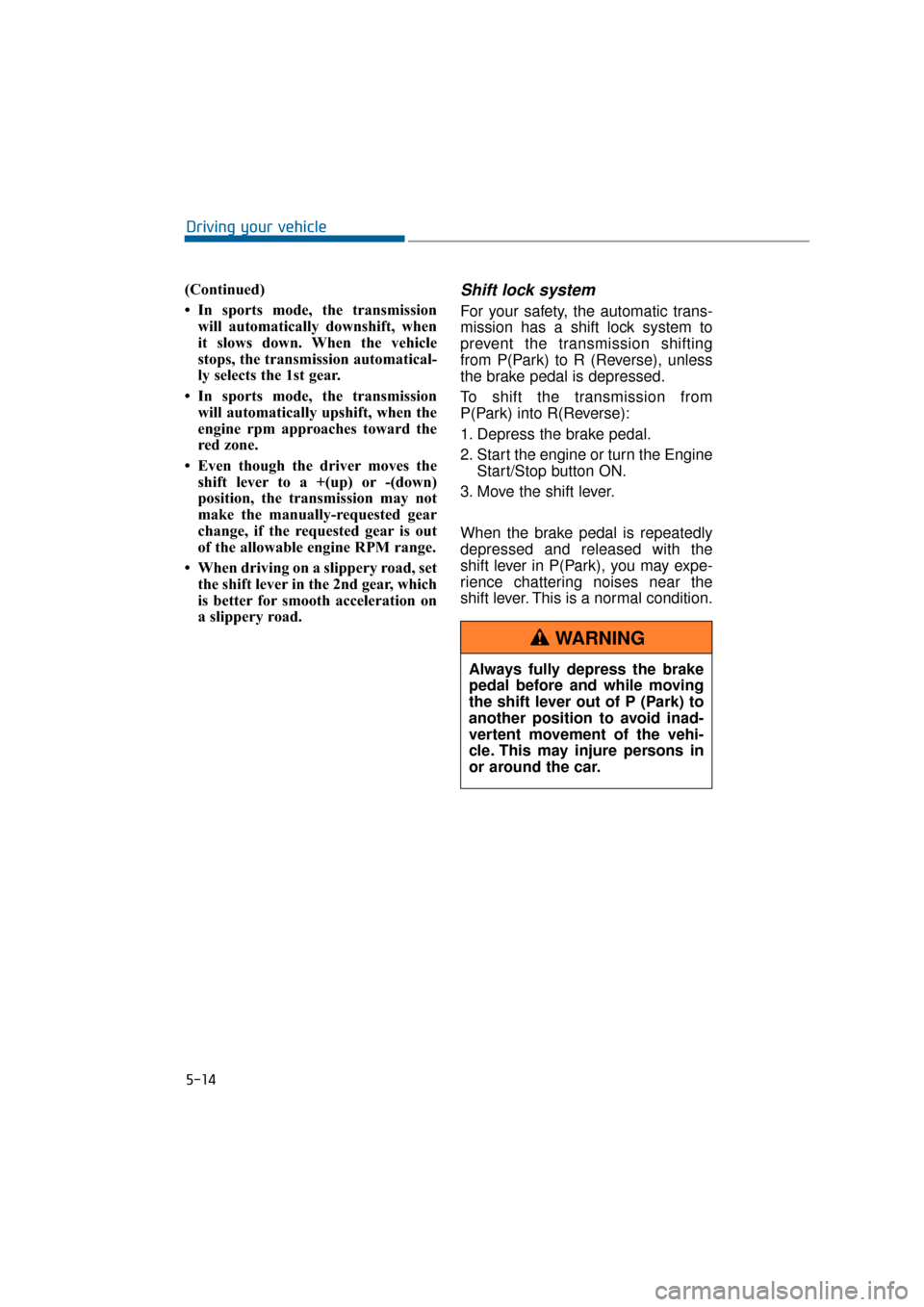
(Continued)
• In sports mode, the transmissionwill automatically downshift, when
it slows down. When the vehicle
stops, the transmission automatical-
ly selects the 1st gear.
• In sports mode, the transmission will automatically upshift, when the
engine rpm approaches toward the
red zone.
• Even though the driver moves the shift lever to a +(up) or -(down)
position, the transmission may not
make the manually-requested gear
change, if the requested gear is out
of the allowable engine RPM range.
• When driving on a slippery road, set the shift lever in the 2nd gear, which
is better for smooth acceleration on
a slippery road.Shift lock system
For your safety, the automatic trans-
mission has a shift lock system to
prevent the transmission shifting
from P(Park) to R (Reverse), unless
the brake pedal is depressed.
To shift the transmission from
P(Park) into R(Reverse):
1. Depress the brake pedal.
2. Start the engine or turn the Engine Start/Stop button ON.
3. Move the shift lever.
When the brake pedal is repeatedly
depressed and released with the
shift lever in P(Park), you may expe-
rience chattering noises near the
shift lever. This is a normal condition.
5-14
Driving your vehicle
Always fully depress the brake
pedal before and while moving
the shift lever out of P (Park) to
another position to avoid inad-
vertent movement of the vehi-
cle. This may injure persons in
or around the car.
WARNING
Page 267 of 477
Moving up a steep grade from astanding start
To drive up on a steep slope,
depress the brake pedal, move the
shift gear to D (Drive), and release
the parking brake. Gradually depress
the accelerator while releasing the
service brakes.
When accelerating on a steep
slope, the vehicle may have a ten-
dency to slide backwards. Shifting
to the 2nd gear (Second Gear) will
help prevent the vehicle from slid-
ing backwards.
5-16
Driving your vehicle
Always buckle up! In a colli- sion, an unbelted occupant is
more likely to be seriously
injured or killed than a proper-
ly belted occupant.
Avoid high speeds when cor- nering or turning.
Do not make quick wheel steering, such as sharp lane
changes or fast, sharp turns.
The risk of rollover is greatly increased when you lose con-
trol of your vehicle at a high
speed.
Loss of control often occurs, when two or more wheels are
swerved out of the roadway
and are overly steered to
reenter the roadway.
In the event your vehicle is swerved out of the roadway,
do not make a sharp steering.
Instead, slow down the vehi-
cle before reentering into the
lanes.
Never exceed posted speed limits.
WARNING
When your vehicle is stuck in
snow, mud, sand and others,
you may rock the vehicle by
moving it forward and back-
wards. Do not attempt this pro-
cedure when there are people
or objects near the vehicle.
During the rocking operation,
the vehicle may suddenly move
forwards or backwards as it
becomes unstuck, causing
injury or damage to nearby peo-
ple or objects.
WARNING
Page 268 of 477
Power brakes
Your vehicle is equipped with the
power-assisted brakes that automat-
ically adjust themselves in a normal
driving condition.
In the event that the power-assisted
brakes lose power because of a
stalled engine or some other rea-
sons, you can still stop your vehicle
by depressing the brake pedal hard-
er than you do in normal driving. A
braking distance, however, will be
longer.
When the engine is OFF, the reserve
brake power becomes partially
depleted each time the brake pedal
is depressed. Do not repeatedly
depress the brake pedal when the
power brake is automatically set.
Pump the brake pedal only when
necessary to maintain the steering
control on slippery surfaces.
B BR
RA
A K
KE
E
S
S Y
Y S
ST
T E
EM
M
5-17
Driving your vehicle05
- Brakes
Do not put your foot on the
brake pedal while driving. This
may abnormally increase the
brake temperatures, wear
down the brake lining/pad,
and increase the braking dis-
tances.
When driving down on a long or steep slope, shift to a lower
gear and avoid depressing the
brakes in a continuous man-
ner. Depressing brakes in a
continuous manner may over-
heat the brakes, resulting in a
temporary loss of braking per-
formance.
(Continued)
(Continued)
Wet brakes may impair thevehicle’s ability to safely slow
down. The vehicle may also be
swerved to one side when the
wet brakes are depressed.
Lightly depress the brakes to
verify whether the brakes are
wet and show the above
symptom. Always test your
brakes in this fashion after
driving through deep water.
To dry the wet brakes, lightly
depress the brakes, while
maintaining a safe driving
speed until the brake perform-
ance returns to normal.
Always confirm the positions of the brake and accelerator,
before driving. If you do not
so, you may be confused and
depress the accelerator
instead of the brake pedal. It
may cause a serious accident.
WARNING
Page 269 of 477
In the event of brake failure
When service brakes fail to operate
while driving, you can make an
emergency stop by setting the park-
ing brake. The braking distance,
however, will become longer than
normal.
Disc brakes wear indicator
Your vehicle is equipped with disc
brakes. When your brake pads are
worn down and new pads are
required, you will hear a high-pitched
warning sound from the front or rear
brakes. You may hear this beeping
sound or it may sound when the
brake pedal is depressed.
Please remember that some driving
conditions or climates may cause a
brake squeal when you first apply (or
lightly apply) the brakes. This is nor-
mal and does not indicate a problem
with your brakes.
To prevent costly brake repairs,do not drive continuously with
the worn-down brake pads.
Always replace brake pads in a set of a complete front and rear
axle.
NOTICE
5-18
Driving your vehicle
- Parking brake
Setting the parking brake while
driving at a normal speed may
cause a sudden loss of vehicle
control. If you must set the
parking brake to stop, set it with
great caution.
WARNING
- Brake wear
This brake wear warning sound
indicates that your vehicle
should be repaired. If you
ignore this audible warning
sound, you will eventually lose
braking performance, which
may lead to a serious accident.
WARNING
Page 270 of 477
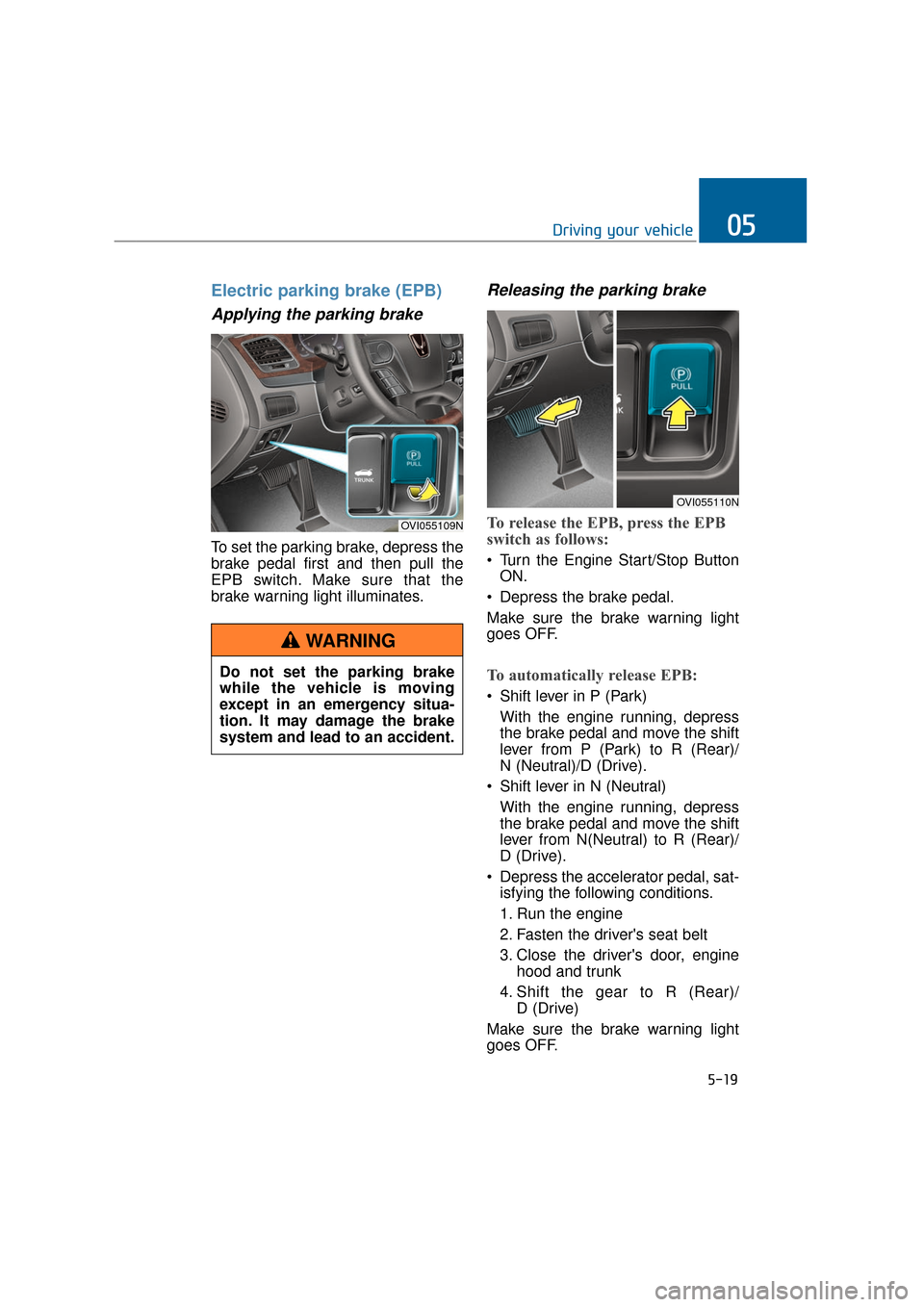
Electric parking brake (EPB)
Applying the parking brake
To set the parking brake, depress the
brake pedal first and then pull the
EPB switch. Make sure that the
brake warning light illuminates.
Releasing the parking brake
To release the EPB, press the EPB
switch as follows:
Turn the Engine Start/Stop ButtonON.
Depress the brake pedal.
Make sure the brake warning light
goes OFF.
To automatically release EPB:
Shift lever in P (Park) With the engine running, depress
the brake pedal and move the shift
lever from P (Park) to R (Rear)/
N (Neutral)/D (Drive).
Shift lever in N (Neutral) With the engine running, depress
the brake pedal and move the shift
lever from N(Neutral) to R (Rear)/
D (Drive).
Depress the accelerator pedal, sat- isfying the following conditions.
1. Run the engine
2. Fasten the driver's seat belt
3. Close the driver's door, engine hood and trunk
4. Shift the gear to R (Rear)/ D (Drive)
Make sure the brake warning light
goes OFF.
5-19
Driving your vehicle05
Do not set the parking brake
while the vehicle is moving
except in an emergency situa-
tion. It may damage the brake
system and lead to an accident.
WARNING
OVI055110N
OVI055109N
Page 271 of 477
Information
• You can set the EPB, even thoughthe Engine Start/Stop button is OFF.
However, for your safety, you can-
not release it.
• For your safety, depress the brake pedal and manually release the
parking brake by pressing the EPB
switch, when driving down on a
slope and driving back up.
When the parking brake warning light is still ON, even when the
EPB is released, have the sys-
tem be checked by an author-
ized EQUUS dealer.
Do not drive your vehicle with the EPB set. It may excessively
wear down the brake pad and
brake rotor.
EPB may automatically applies,
when:
It is requested by other systems.
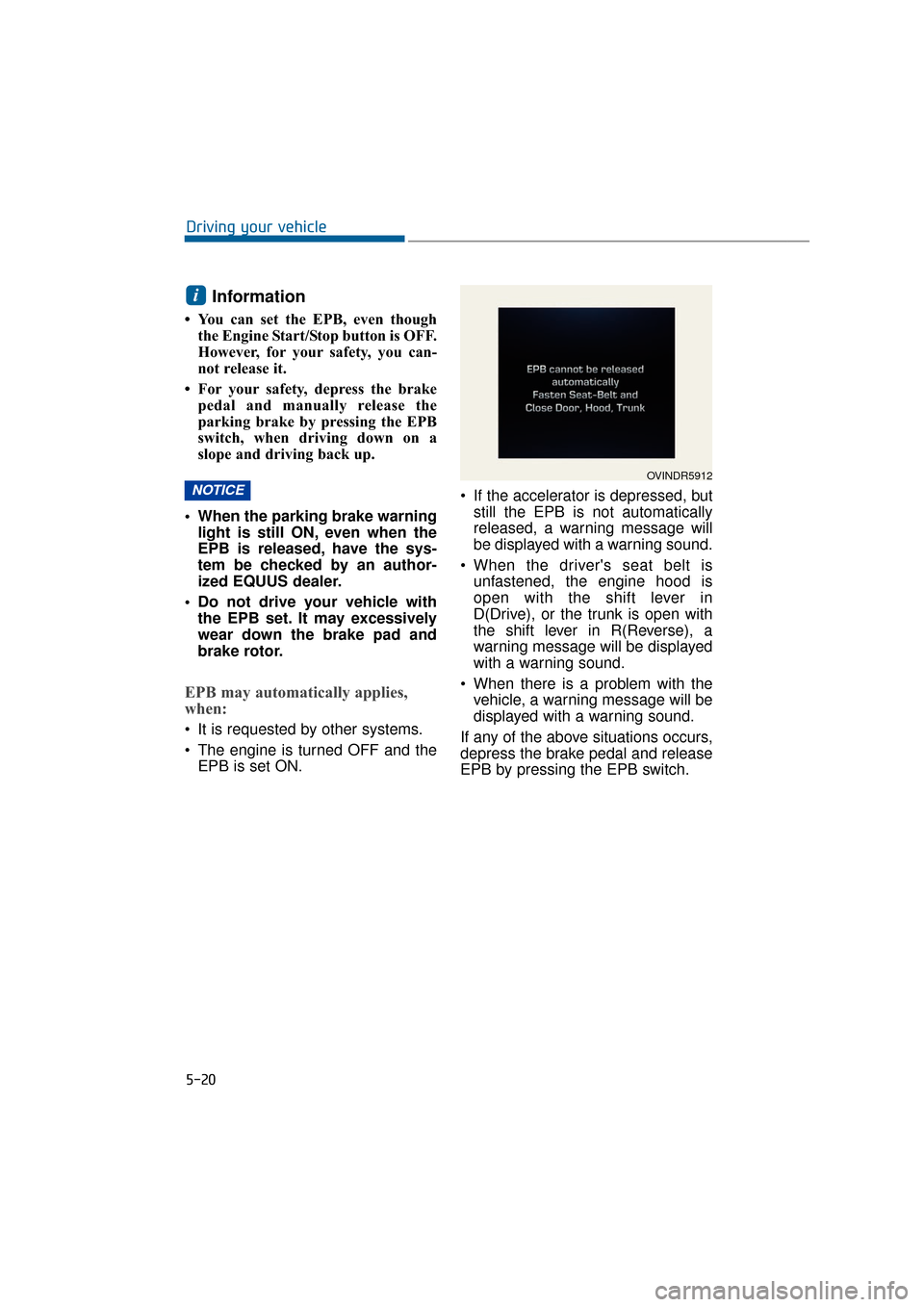
The engine is turned OFF and theEPB is set ON. If the accelerator is depressed, but
still the EPB is not automatically
released, a warning message will
be displayed with a warning sound.
When the driver's seat belt is unfastened, the engine hood is
open with the shift lever in
D(Drive), or the trunk is open with
the shift lever in R(Reverse), a
warning message will be displayed
with a warning sound.
When there is a problem with the vehicle, a warning message will be
displayed with a warning sound.
If any of the above situations occurs,
depress the brake pedal and release
EPB by pressing the EPB switch.
NOTICE
i
5-20
Driving your vehicle
OVINDR5912