trunk release Hyundai Equus 2016 User Guide
[x] Cancel search | Manufacturer: HYUNDAI, Model Year: 2016, Model line: Equus, Model: Hyundai Equus 2016Pages: 477, PDF Size: 16.25 MB
Page 276 of 477
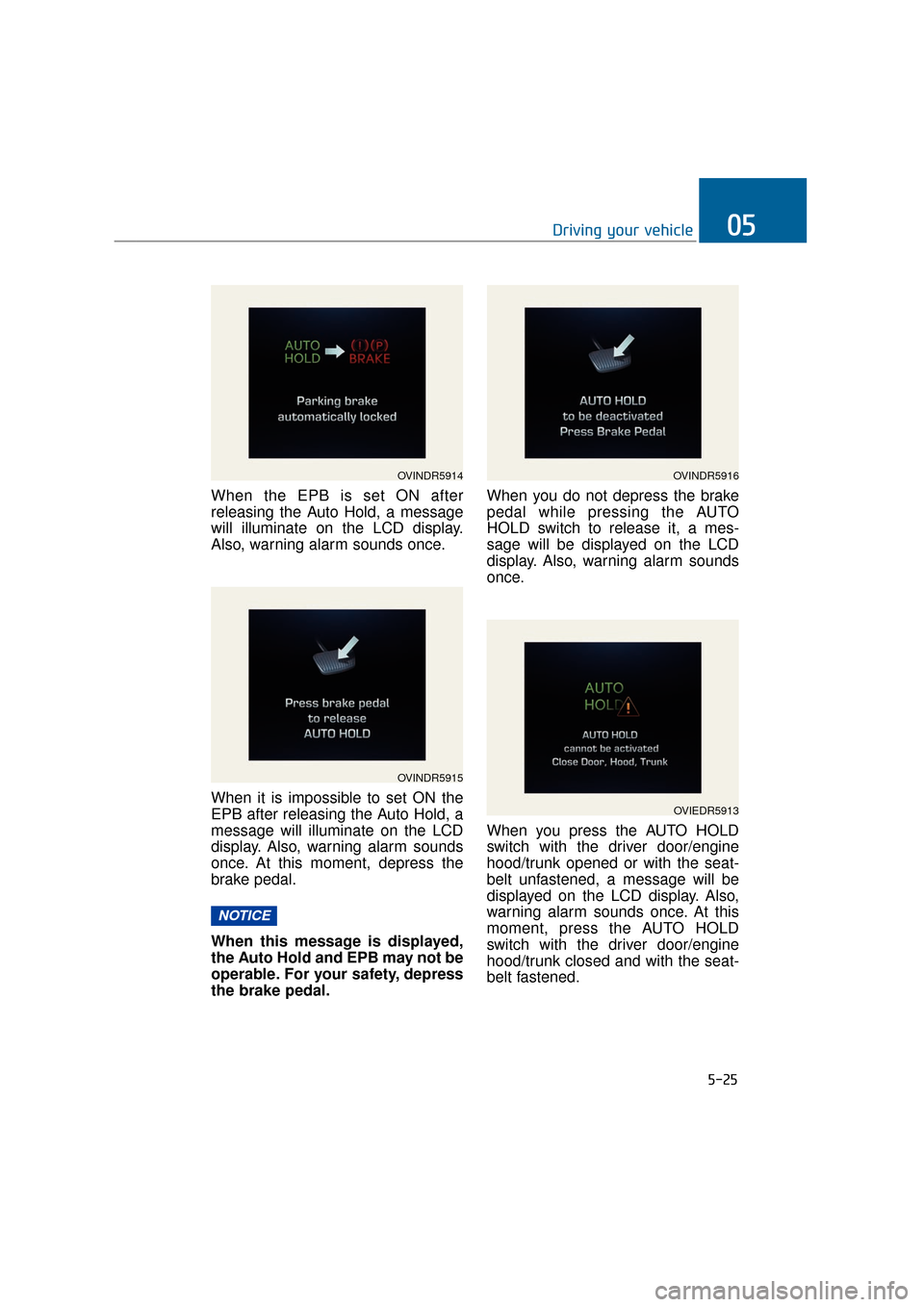
When the EPB is set ON after
releasing the Auto Hold, a message
will illuminate on the LCD display.
Also, warning alarm sounds once.
When it is impossible to set ON the
EPB after releasing the Auto Hold, a
message will illuminate on the LCD
display. Also, warning alarm sounds
once. At this moment, depress the
brake pedal.
When this message is displayed,
the Auto Hold and EPB may not be
operable. For your safety, depress
the brake pedal.When you do not depress the brake
pedal while pressing the AUTO
HOLD switch to release it, a mes-
sage will be displayed on the LCD
display. Also, warning alarm sounds
once.
When you press the AUTO HOLD
switch with the driver door/engine
hood/trunk opened or with the seat-
belt unfastened, a message will be
displayed on the LCD display. Also,
warning alarm sounds once. At this
moment, press the AUTO HOLD
switch with the driver door/engine
hood/trunk closed and with the seat-
belt fastened.
NOTICE
5-25
Driving your vehicle05
OVINDR5914
OVINDR5915
OVINDR5916
OVIEDR5913
Page 338 of 477
Jump starting procedure
Information
Your vehicle has a battery in the trunk
compartment. However, when you
jump start your vehicle, use the
jumper terminal in the engine com-
partment.
1.Make sure the booster battery is12-volt and that its negative termi-
nal is grounded.
2.When the booster battery is in another vehicle, separate the two
vehicles apart.
3.Turn OFF all unnecessary electri- cal systems.
4.Connect the jumper cables in the exact sequence as shown in the
illustration of the previous page.
First connect one of the jumper
cable ends to the positive terminal
of the jumper terminal (1), and then
connect the other end to the posi-
tive terminal on the booster battery
(2). Proceed to connect one of the
other jumper cable ends to the
negative terminal of the booster
battery (3), then the other end to
the negative terminal of the jumper
terminal (4). Clear the jump cables
away from any movable parts or
other battery terminals, when jump
starting.
Keep the jumper cables away from
any others except the correct bat-
tery terminal connections and the
correct grounding connections. Do
not apply unnecessary forces on
the battery when making connec-
tions. - Battery cables
When jump starting the dis-
charged battery in the trunk com-
partment, do not connect the
jumper cable between the nega-
tive terminal of the booster battery
and the negative terminal of the
discharged battery. This may
cause the discharged battery to
overheat, crack, or release the
acids.
Connect the jumper cable
between the negative terminal of
the booster battery and a solid,
stationary or metallic point often
discharges the battery.
5.First, start the engine of the vehicle
with the booster battery, over 2,000
rpm. Then, start your engine with
the discharged battery.
6.Turn your engine ON for at least 20 minutes either in the idling mode or
the driving mode. Otherwise, your
discharged battery is not
recharged enough to re-start the
vehicle.
When the cause of your battery dis-charging is not apparent, have yourvehicle checked by an authorizedEQUUS dealer.
Push-starting
A vehicle equipped with automatic
transmission cannot be push-start-
ed. Follow the instructions in "Jump
starting" of this chapter.
NOTICE
i
6-5
What to do in an emergency06
Page 472 of 477
.............................................................6-7
Tire rotation ........................................................................\
.........")
Tire pressure monitoring system (TPMS).............................................................6-7
Tire rotation ........................................................................\
.................................7-45
Tire specification and pressure label.....................................................................8-6\
Tires specifications........................................................................\
........................8-3
Tires and wheels........................................................................\
..........................7-42Checking tire inflation pressure ...................................................................7-44
Compact spare tire replacement ...................................................................7-47
Low aspect ratio tire ........................................................................\
.............7-51
Recommended cold tire inflation pressures .................................................7-42
Tire care ........................................................................\
................................7-42
Tire maintenance ........................................................................\
..................7-48
Tire replacement ........................................................................\
...................7-46
Tire rotation ........................................................................\
..........................7-45
Tire sidewall labeling ........................................................................\
...........7-48
Tire terminology and definitions ..................................................................7-52
Tire traction ........................................................................\
..........................7-47
Wheel alignment and tire balance ................................................................7-45
Wheel replacement ........................................................................\
...............7-47
Towing........................................................................\
.........................................6-20
Trailer towing ........................................................................\
..............................5-81
Transmission Automatic transmission ........................................................................\
........5-11
Trip A/B........................................................................\
.......................................3-86
Trip computer ........................................................................\
..............................3-86 Fuel Economy ........................................................................\
......................3-87
Trip A/B ........................................................................\
................................3-86
Trip computer mode ........................................................................\
....................3-70
Trunk Emergency trunk safety release ...................................................................3-23
Non-powered trunk ........................................................................\
..............3-18
Power trunk ........................................................................\
..........................3-19
Smart trunk ........................................................................\
...........................3-24
Trunk room lamp........................................................................\
.......................3-119
Turn by turn mode (TBT) ........................................................................\
...........3-70
Turn signals and lane change signals ................................................................3-112
User settings mode ........................................................................\
......................3-72
I-14
Index
U