battery Hyundai Equus 2016 Workshop Manual
[x] Cancel search | Manufacturer: HYUNDAI, Model Year: 2016, Model line: Equus, Model: Hyundai Equus 2016Pages: 477, PDF Size: 16.25 MB
Page 384 of 477
7-27
Maintenance07
The high-pressure cooling system
has a reservoir filled with the year-
round antifreeze coolant. The reser-
voir is already filled at the factory.
Check the antifreeze protection and
coolant level at least once a year, at
the beginning of the winter season,
and before traveling to a colder
region.
Checking the coolant level
E EN
N G
GI
IN
N E
E
C
C O
O O
OL
LA
A N
N T
T
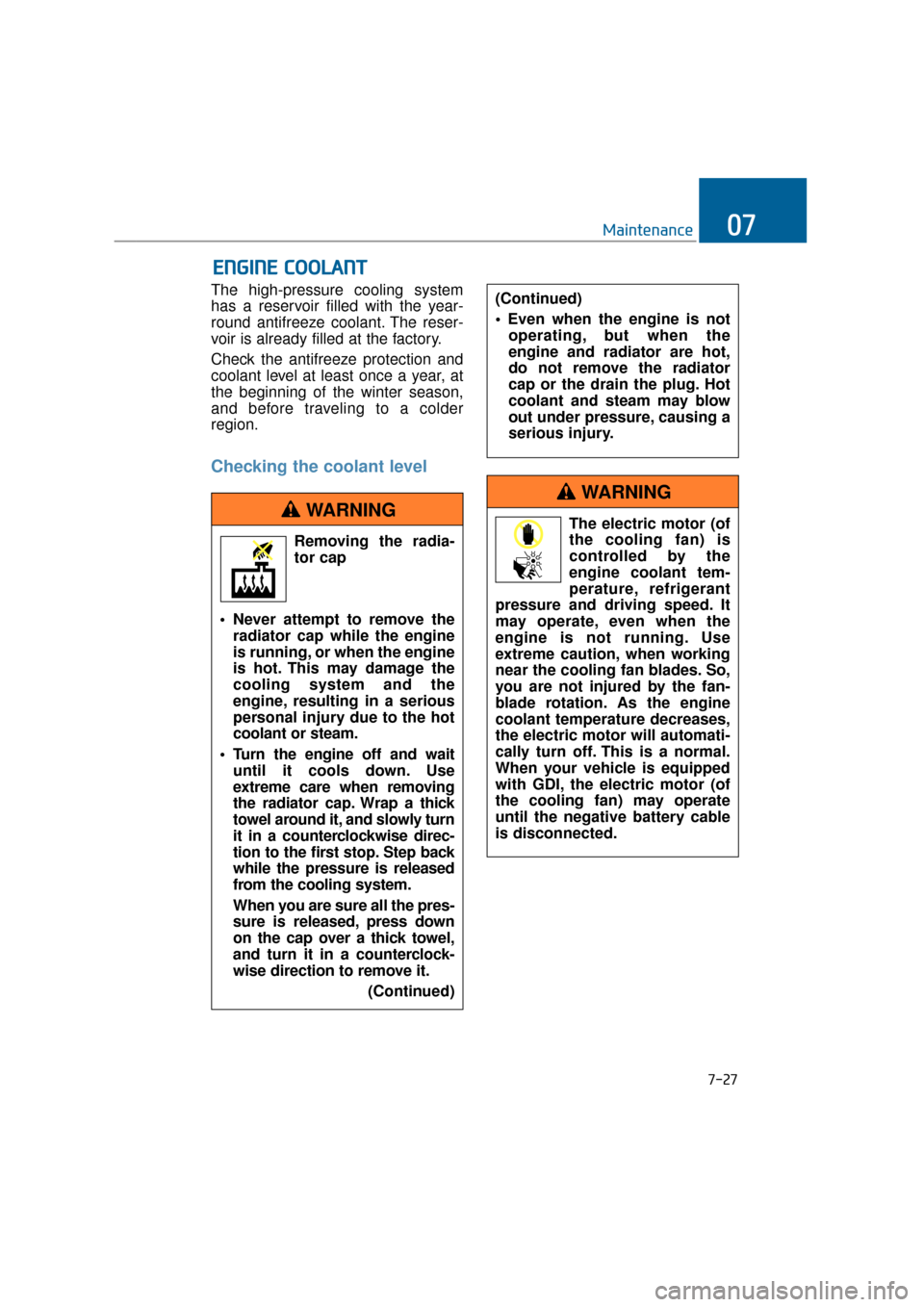
(Continued)
operating, but when the
engine and radiator are hot,
do not remove the radiator
cap or the drain the plug. Hot
coolant and steam may blow
out under pressure, causing a
serious injury.
The electric motor (of
the cooling fan) is
controlled by the
engine coolant tem-
perature, refrigerant
pressure and driving speed. It
may operate, even when the
engine is not running. Use
extreme caution, when working
near the cooling fan blades. So,
you are not injured by the fan-
blade rotation. As the engine
coolant temperature decreases,
the electric motor will automati-
cally turn off. This is a normal.
When your vehicle is equipped
with GDI, the electric motor (of
the cooling fan) may operate
until the negative battery cable
is disconnected.
WARNING
Removing the radia-
tor cap
Never attempt to remove the radiator cap while the engine
is running, or when the engine
is hot. This may damage the
cooling system and the
engine, resulting in a serious
personal injury due to the hot
coolant or steam.
Turn the engine off and wait until it cools down. Use
extreme care when removing
the radiator cap. Wrap a thick
towel around it, and slowly turn
it in a counterclockwise direc-
tion to the first stop. Step back
while the pressure is released
from the cooling system.
When you are sure all the pres-
sure is released, press down
on the cap over a thick towel,
and turn it in a counterclock-
wise direction to remove it.
(Continued)
WARNING
Page 396 of 477
7-39
Maintenance07
For best battery service
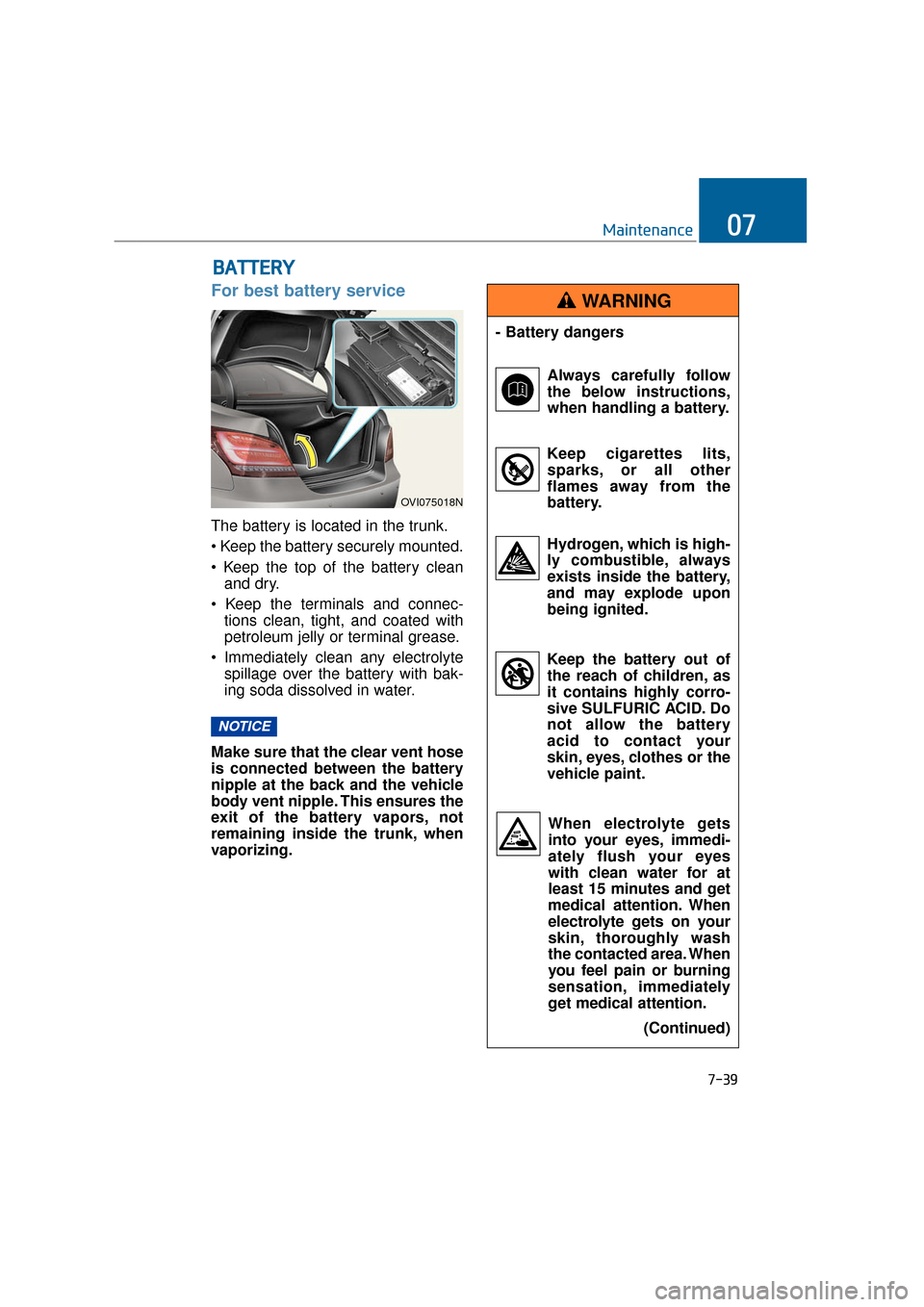
The battery is located in the trunk.
and dry.
tions clean, tight, and coated with
petroleum jelly or terminal grease.
spillage over the battery with bak-
ing soda dissolved in water.
Make sure that the clear vent hose
is connected between the battery
nipple at the back and the vehicle
body vent nipple. This ensures the
exit of the battery vapors, not
remaining inside the trunk, when
vaporizing.
NOTICE
B B A
A T
TT
TE
ER
R Y
Y
OVI075018N
- Battery dangers
Always carefully follow
the below instructions,
when handling a battery.
Keep cigarettes lits, sparks, or all other
flames away from the
battery.
Hydrogen, which is high- ly combustible, always
exists inside the battery,
and may explode upon
being ignited.
Keep the battery out of the reach of children, as
it contains highly corro-
sive SULFURIC ACID. Do
not allow the battery
acid to contact your
skin, eyes, clothes or the
vehicle paint.
When electrolyte getsinto your eyes, immedi-
ately flush your eyes
with clean water for at
least 15 minutes and get
medical attention. When
electrolyte gets on your
skin, thoroughly wash
the contacted area. When
you feel pain or burning
sensation, immediately
get medical attention.
(Continued)
WARNING
Page 397 of 477
7-40
Maintenance When your vehicle is not drivenfor a long period of time at a low
temperature, remove the battery
and keep it indoors.
The power trunk is not com-
pletely closed, when the battery
is removed. When you remove
the battery, refer to "Power
trunk" in the chapter 3.
Always fully charge the battery to prevent a case damage at a
low temperature.
When unauthorized electronic devices are connected with the
battery, it may discharge the bat-
tery. Never connect unautho-
rized devices.
NOTICE
(Continued)
Wear eye protectionwhen charging the bat-
tery or working some-
where near it. Always
provide proper ventila-
tion when working in an
enclosed space.
An inappropriately dis- posed battery may be
harmful to the environ-
ment and human health.
Dispose the battery in
accordance with your
local law(s) or regula-
tions.
When lifting up the battery in a plastic case, putting exces-
sive pressure on the case may
leak the battery acid, resulting
in a personal injury. Lift up the
battery case by holding the
both sides of it.
battery when the battery
cables are connected.
works with high voltage.
Never touch these compo-
nents, when the engine is run-
ning, or when the ignition
switch is turned on.
Failure to follow the above
warnings may result in a seri-
ous bodily injury or death.
Battery posts, terminals, and
related accessories contain
lead and lead compounds,
chemicals known to the State of
California to cause cancer, birth
defects and reproductive harm.
Batteries also contain other
chemicals known to the State of
California to cause cancer.
Wash hands after handling.
CALIFORNIA PROPOSI- TION 65 WARNING
Removing the battery from the
vehicle should be done at an
authorized EQUUS dealer.
WARNING
Page 398 of 477
7-41
Maintenance07
Battery recharging by battery
charger
Your vehicle has a maintenance-free,
calcium-based battery.
When the battery is discharged ina short period of time (possibly
because the headlamps or interior
lights remain on, while the vehicle
is not in use), slowly recharge it
(trickle) for 10 hours.
When the battery is gradually dis- charged due to high electric load,
while the vehicle is in use,
recharge it at 20-30A for 2 hours.
Battery recharging by vehicle
After jump-starting from a good bat-
tery, run the engine for 20-30 min-
utes in either the idle or driving
modes, before turning off the engine.
Your vehicle may not restart, when
the engine is shortly turned off with-
out having an adequate recharging
time.
- Recharging battery
When recharging the battery,
follow the below precautions:
The battery must be removed from the vehicle and placed in
a well-ventilated area.
Keep cigarette lits, sparks, or flames away from the battery.
(Continued)
(Continued)
Keep paying attention to thebattery condition, while
recharging. Stop or slow the
recharging rate, when the bat-
tery gas violently leaks (boil-
ing),or when an electrolyte
temperature exceeds 120°F
(49°C).
Wear the proper eye protection, while watching the battery
recharging conditions.
Disconnect the battery charger in the following order.
1. Turn off the main switch of the battery charger.
2. Unhook the negative clamp from the negative battery ter-
minal.
3. Unhook the positive clamp from the positive battery ter-
minal.
WARNING
Before maintaining orrecharging the battery, turn
off all accessories and stop
the engine.
The negative battery cable must be disconnected first, or
be connected last.
Operation related to the bat- tery should be done by an
authorized EQUUS dealer.
WARNING
Page 399 of 477
7-42
Maintenance
Keep the battery away from water or any other liquid.
The battery is located in the trunk. Thus, be careful when
loading a container filled with
liquid inside the trunk.
For your safety, use only the genuine HYUNDAI battery, when
replacing it.
Reset items
Items should be reset after either a
battery discharge or a battery dis-
connection.
Auto up/down window (See the chapter 3)
Rear door window curtains (See the chapter 3)
Sunroof (See the chapter 3)
Driver position memory system (See the chapter 3)
Trip computer (See the chapter 3)
Climate control system (See the chapter 3)
Clock (See DIS manual)
Audio (See DIS manual)
Power trunk (See the chapter 3)
Tire care
For the better maintenance, safety,
and fuel economy, you must always
maintain the recommended tire infla-
tion pressures, and follow the load
limits and weight distribution recom-
mendation.
Recommended cold tire infla-
tion pressures
The tire pressure (including the
spare) should be measured, when it
is cold. A “cold tire” means the vehi-
cle does not drive for the last 3 hours
or is driven shorter than 1 mile (1.6
km).
The recommended pressure must be
maintained for the best driving, han-
dling, and the minimum tire wear-out.
For the information about the recom-
mended inflation pressure, refer to
“Tire and wheels” in the chapter 8.
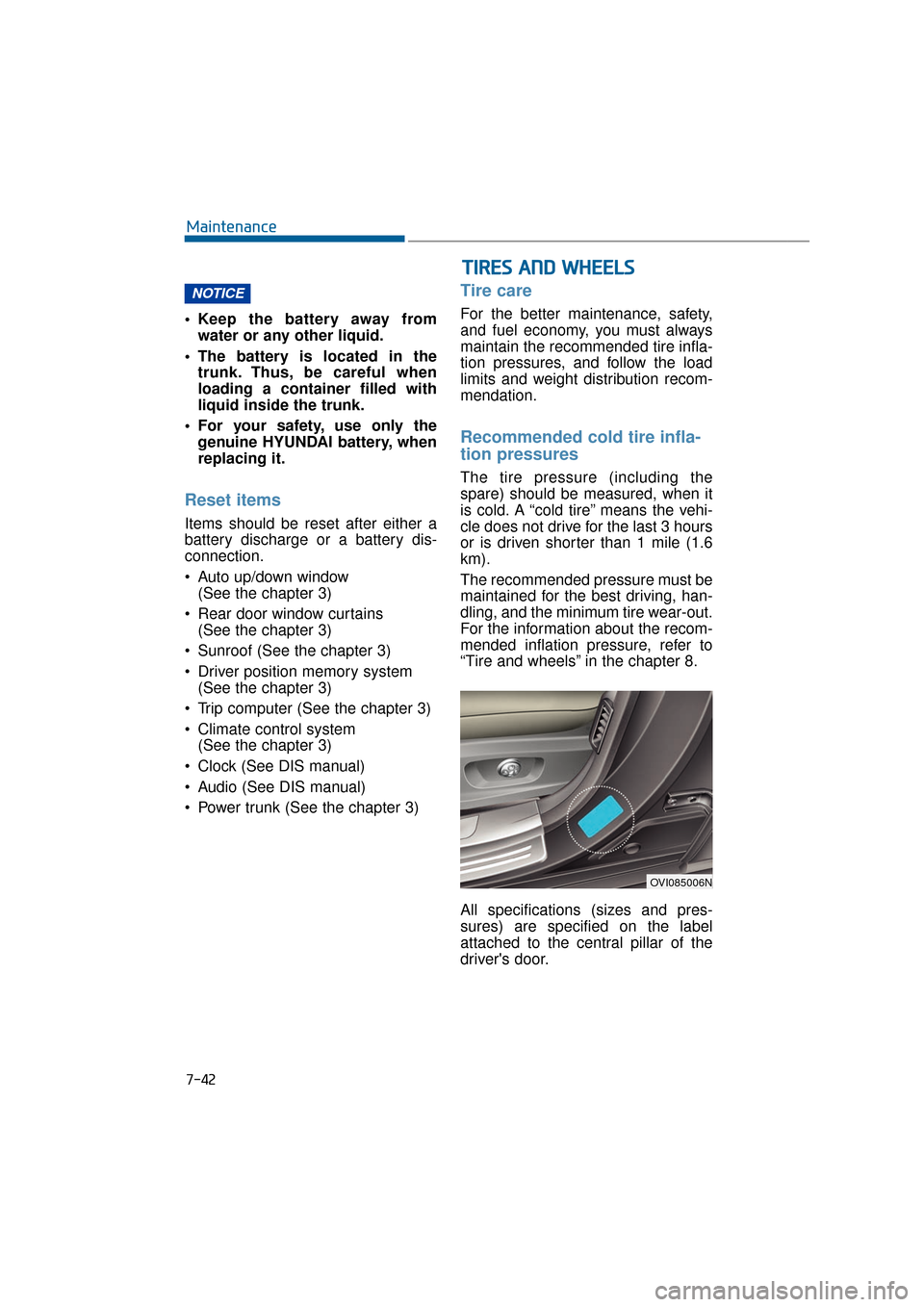
All specifications (sizes and pres-
sures) are specified on the label
attached to the central pillar of the
driver's door.
NOTICE
T T I
IR
R E
ES
S
A
A N
N D
D
W
W H
HE
EE
EL
LS
S
OVI085006N
Page 410 of 477
7-53
Maintenance07
Load Index:The numerical index,
on a scale of 1 to 279, to indicate a
tire loading capacity.
Maximum Inflation Pressure: The
maximum air pressure to which a
cold tire may be inflated. The maxi-
mum air pressure information is
specified on a tire side wall.
Maximum Load Rating: The load-
ing capacity for a tire, which is inflat-
ed to the maximum.
Maximum Loaded Vehicle Weight:
The sum of curb weight; accessory
weight; vehicle capacity weight; and
production options weight.
Normal Occupant Weight: The mul-
tiplication of the designated occu-
pant seat number by 150 pounds (68
kg).
Occupant Distribution: Designated
seating positions.
Outward Facing Sidewall: The side
of a asymmetrical tire that has a par-
ticular side that faces outward when
mounted on a vehicle. The outward
facing sidewall bears white lettering
or bears manufacturer, brand, and/or
model name molding that is higher or
deeper than the same moldings on
the inner facing sidewall.
Passenger (P-Metric) Tire: This tire
is for a passenger vehicle, a light
truck or a multipurpose vehicle.
Ply: A layer of rubber-coated parallel
cords
Pneumatic Tire: A mechanical
device made of rubber, chemicals,
fabric and steel or other materials,
that, when mounted on an automo-
tive wheel, provides the traction and
contains the gas or fluid that sustains
the load. Production Options Weight:
The
combined weight of installed regular
production options weighing over 5
lb.(2.3 kg) in excess of the standard
items which they replace, not previ-
ously considered in curb weight or
accessory weight, including heavy
duty brakes, ride levelers, roof rack,
heavy duty battery, and special trim.
Recommended Inflation Pressure:
Vehicle manufacturer's recommend-
ed pressure to inflate a tire. This is
specified on a tire placard.
Radial Ply Tire: A pneumatic tire in
which the ply cords that extend to the
beads are laid at 90 degrees to the
centerline of the tread.
Rim: A metal support for a tire and
upon which the tire beads are seat-
ed.
Sidewall: The portion of a tire
between the tread and the bead.
Speed Rating: An alphanumeric
code to indicate the maximum speed
to which a tire can operate.
Traction: The friction between a tire
and a road surface. The amount of
grip provided.
Tread: The contacting portion of a
tire with the road.
Treadwear Indicators: This is a nar-
row band, sometimes called "wear
bars." This appears across the tread,
when only 2/32 inch of tread
remains.
UTQGS: The Uniform Tire Quality
Grading Standards is the information
of traction, temperature and tread
abrasion. A rating is measured by a
tire manufacturer in accordance with
the government-specified testing
procedure. The rating information is
specified on the tire side wall.
Page 413 of 477
7-56
Maintenance
A vehicle’s electrical system is pro-
tected from a possible electrical
overloading damage by fuses.
This vehicle has 4 fuse panels - two
on the driver’s side, another on the
panel bolster of the passenger's
side, and the other in the engine
compartment.
When any of your lights, acces-
sories, or controls does not operate,
check the appropriate circuit fuse.
When a fuse is out, some elements
may melt inside.
When the electrical system does not
operate, check the fuse panel on the
driver's side first.
Before replacing the fuse, disconnect
the negative battery cable. Always
replace it with a fuse of the same rat-
ing. When the newly-replaced fuse
blows, there may be an electrical
problem. Avoid using any pertinent
systems. Immediately consult an
authorized EQUUS dealer.
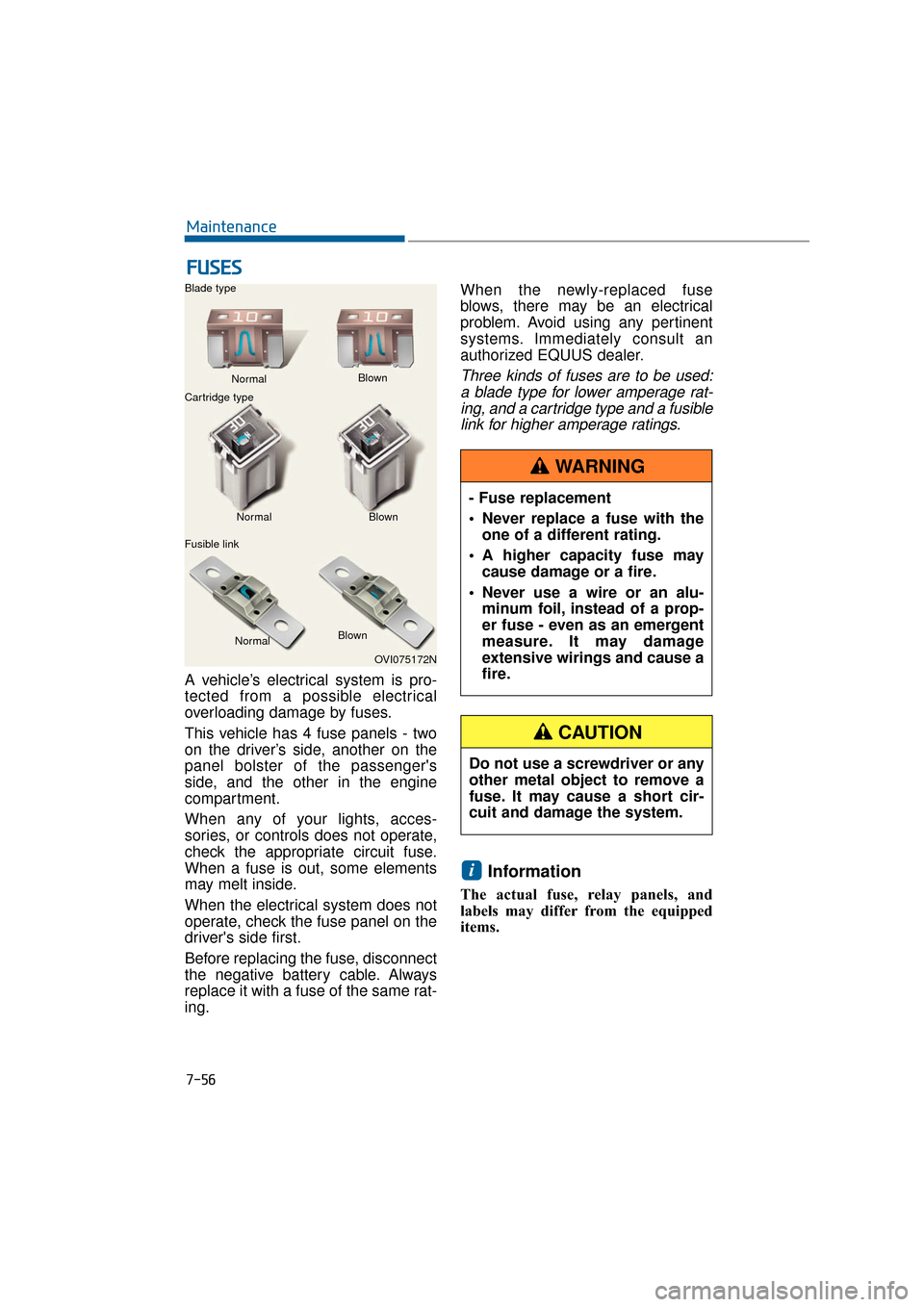
Three kinds of fuses are to be used:
a blade type for lower amperage rat-ing, and a cartridge type and a fusiblelink for higher amperage ratings.
Information
The actual fuse, relay panels, and
labels may differ from the equipped
items.
i
F F U
U S
SE
E S
S
OVI075172N
Normal
Normal
Blade type
Cartridge type
Fusible link Blown
Blown
Normal Blown
- Fuse replacement
Never replace a fuse with the
one of a different rating.
A higher capacity fuse may cause damage or a fire.
Never use a wire or an alu- minum foil, instead of a prop-
er fuse - even as an emergent
measure. It may damage
extensive wirings and cause a
fire.
WARNING
Do not use a screwdriver or any
other metal object to remove a
fuse. It may cause a short cir-
cuit and damage the system.
CAUTION
Page 415 of 477
7-58
Maintenance
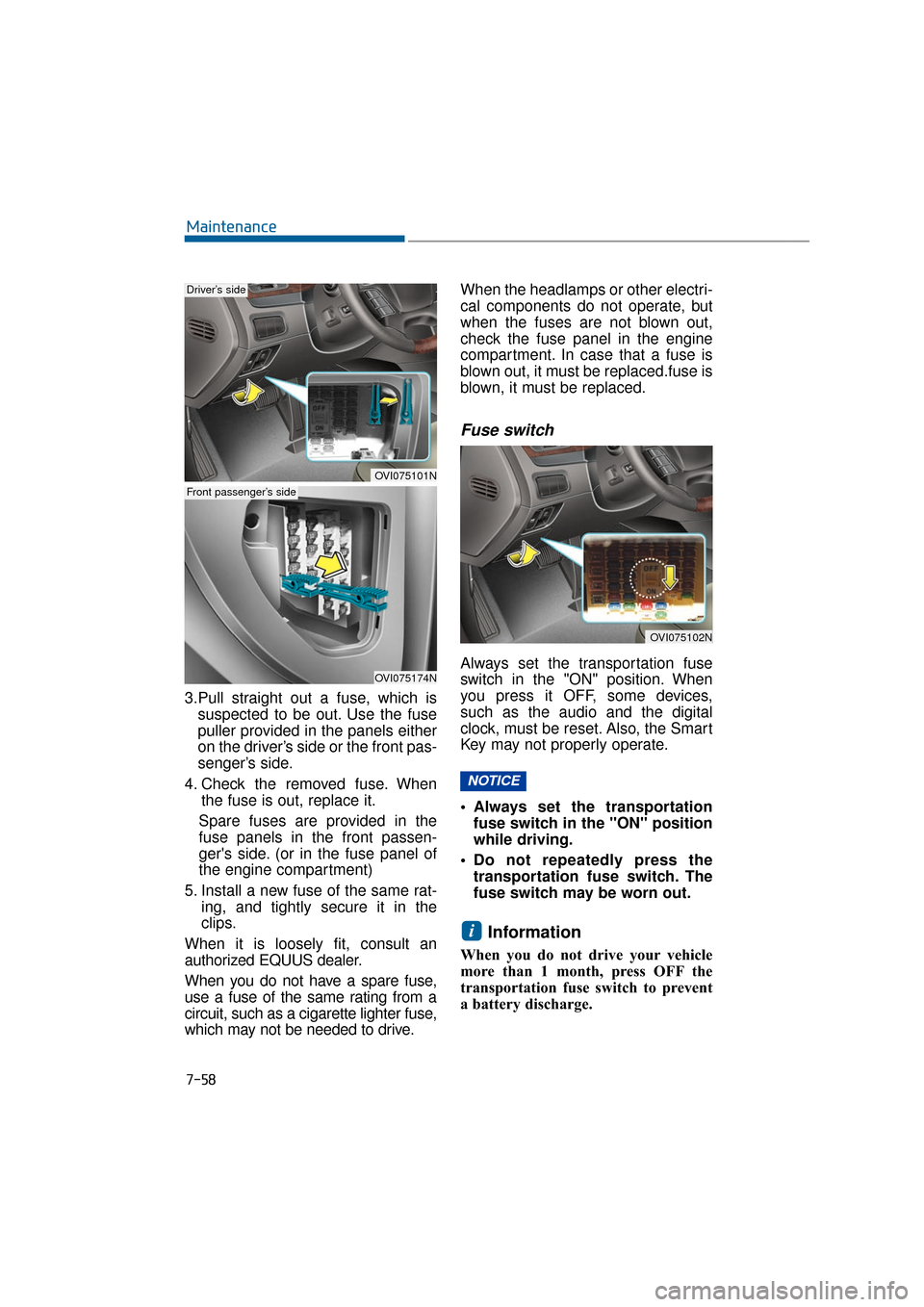
3.Pull straight out a fuse, which is suspected to be out. Use the fuse
puller provided in the panels either
on the driver’s side or the front pas-
senger’s side.
4. Check the removed fuse. When the fuse is out, replace it.
Spare fuses are provided in the
fuse panels in the front passen-
ger's side. (or in the fuse panel of
the engine compartment)
5. Install a new fuse of the same rat- ing, and tightly secure it in the
clips.
When it is loosely fit, consult an
authorized EQUUS dealer.
When you do not have a spare fuse,
use a fuse of the same rating from a
circuit, such as a cigarette lighter fuse,
which may not be needed to drive. When the headlamps or other electri-
cal components do not operate, but
when the fuses are not blown out,
check the fuse panel in the engine
compartment. In case that a fuse is
blown out, it must be replaced.fuse is
blown, it must be replaced.
Fuse switch
Always set the transportation fuse
switch in the "ON" position. When
you press it OFF, some devices,
such as the audio and the digital
clock, must be reset. Also, the Smart
Key may not properly operate.
Always set the transportation
fuse switch in the "ON" position
while driving.
Do not repeatedly press the transportation fuse switch. The
fuse switch may be worn out.
Information
When you do not drive your vehicle
more than 1 month, press OFF the
transportation fuse switch to prevent
a battery discharge.
i
NOTICE
OVI075101N
Driver’s side
OVI075174N
Front passenger’s side
OVI075102N
Page 427 of 477
7-70
Maintenance
Headlight, position light, turn
signal light, side marker light
and front fog light bulb
replacement
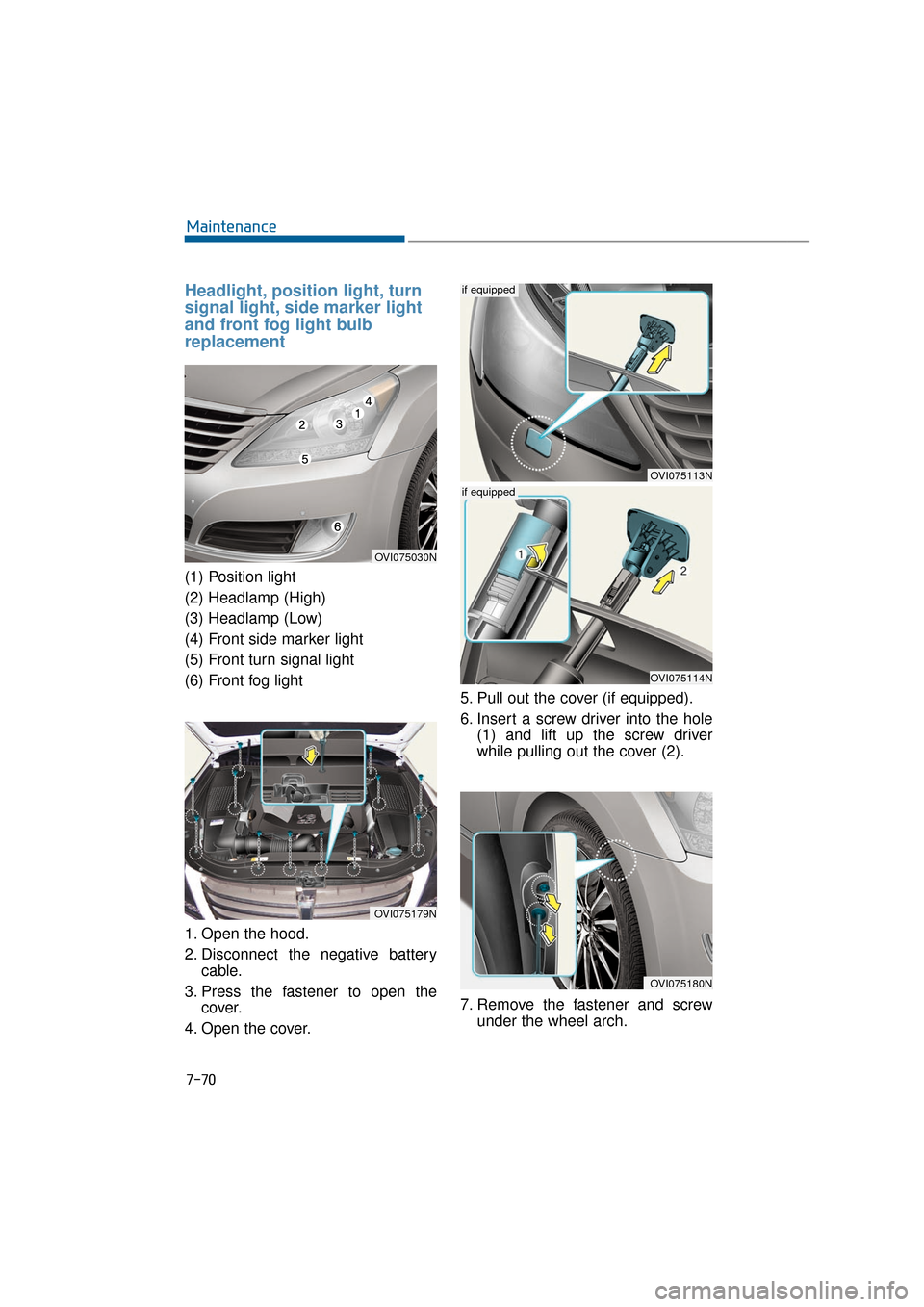
(1) Position light
(2) Headlamp (High)
(3) Headlamp (Low)
(4) Front side marker light
(5) Front turn signal light
(6) Front fog light
1. Open the hood.
2. Disconnect the negative batterycable.
3. Press the fastener to open the cover.
4. Open the cover. 5. Pull out the cover (if equipped).
6. Insert a screw driver into the hole
(1) and lift up the screw driver
while pulling out the cover (2).
7. Remove the fastener and screw under the wheel arch.
OVI075030N
OVI075179N
OVI075113N
if equipped
OVI075114N
if equipped
OVI075180N
Page 432 of 477
7-75
Maintenance07
Rear combination light bulb
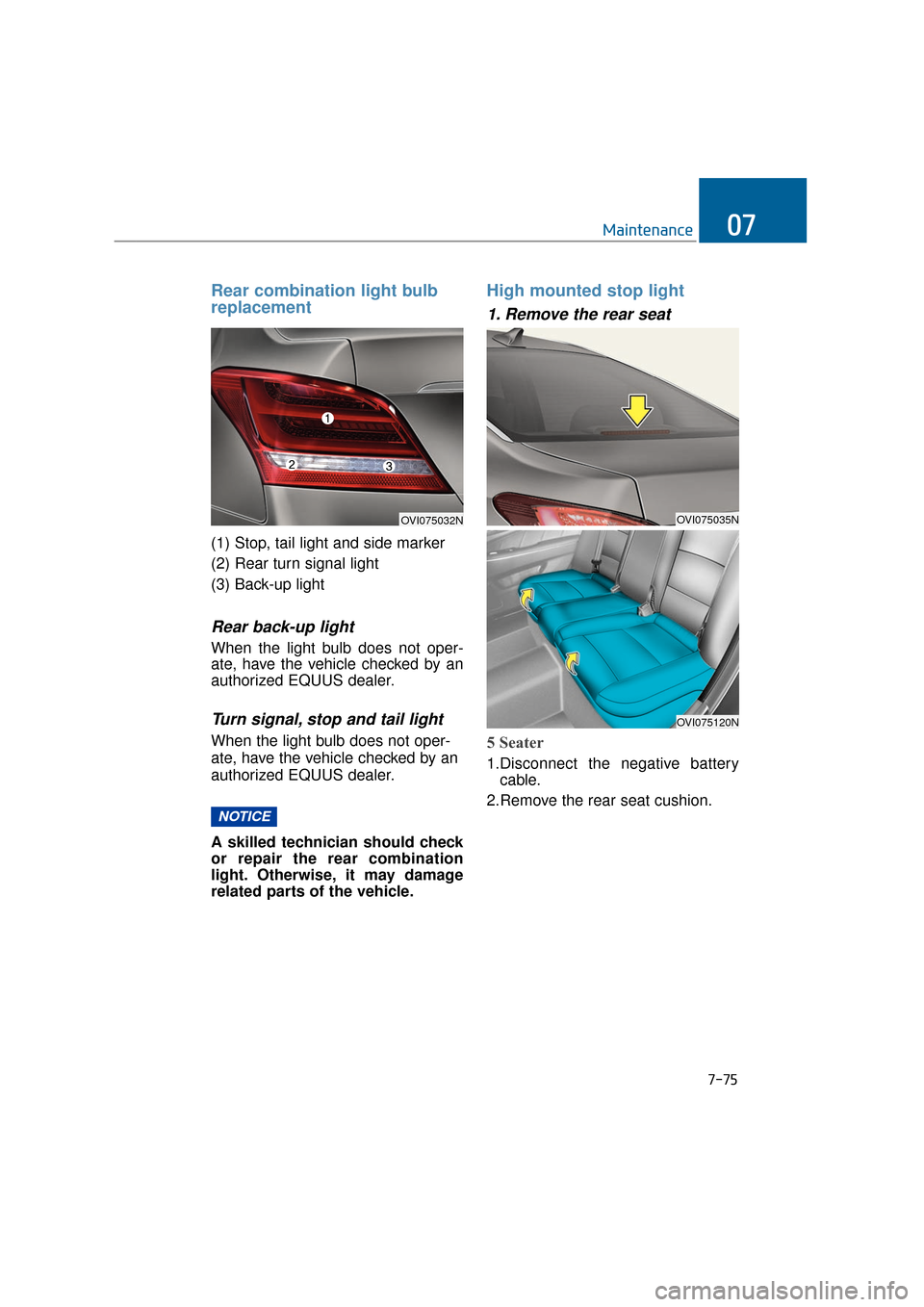
replacement
(1) Stop, tail light and side marker
(2) Rear turn signal light
(3) Back-up light
Rear back-up light
When the light bulb does not oper-
ate, have the vehicle checked by an
authorized EQUUS dealer.
Turn signal, stop and tail light
When the light bulb does not oper-
ate, have the vehicle checked by an
authorized EQUUS dealer.
A skilled technician should check
or repair the rear combination
light. Otherwise, it may damage
related parts of the vehicle.
High mounted stop light
1. Remove the rear seat
5 Seater
1.Disconnect the negative batterycable.
2.Remove the rear seat cushion.
NOTICE
OVI075032NOVI075035N
OVI075120N