battery Hyundai Equus 2016 Service Manual
[x] Cancel search | Manufacturer: HYUNDAI, Model Year: 2016, Model line: Equus, Model: Hyundai Equus 2016Pages: 477, PDF Size: 16.25 MB
Page 278 of 477
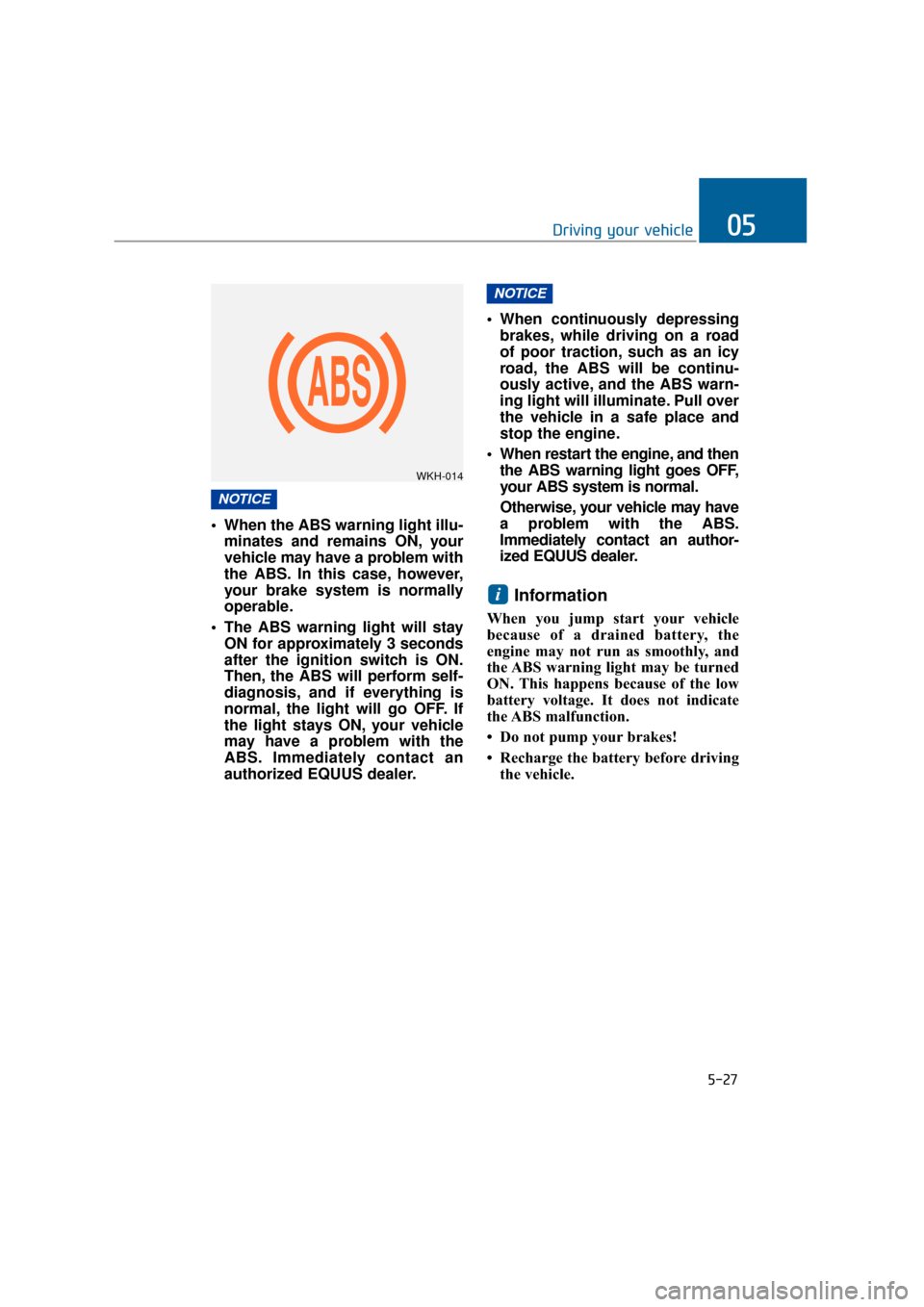
When the ABS warning light illu-minates and remains ON, your
vehicle may have a problem with
the ABS. In this case, however,
your brake system is normally
operable.
The ABS warning light will stay ON for approximately 3 seconds
after the ignition switch is ON.
Then, the ABS will perform self-
diagnosis, and if everything is
normal, the light will go OFF. If
the light stays ON, your vehicle
may have a problem with the
ABS. Immediately contact an
authorized EQUUS dealer. When continuously depressing
brakes, while driving on a road
of poor traction, such as an icy
road, the ABS will be continu-
ously active, and the ABS warn-
ing light will illuminate. Pull over
the vehicle in a safe place and
stop the engine.
When restart the engine, and then the ABS warning light goes OFF,
your ABS system is normal.
Otherwise, your vehicle may have
a problem with the ABS.
Immediately contact an author-
ized EQUUS dealer.
Information
When you jump start your vehicle
because of a drained battery, the
engine may not run as smoothly, and
the ABS warning light may be turned
ON. This happens because of the low
battery voltage. It does not indicate
the ABS malfunction.
• Do not pump your brakes!
• Recharge the battery before drivingthe vehicle.
i
NOTICE
NOTICE
5-27
Driving your vehicle05
WKH-014
Page 288 of 477
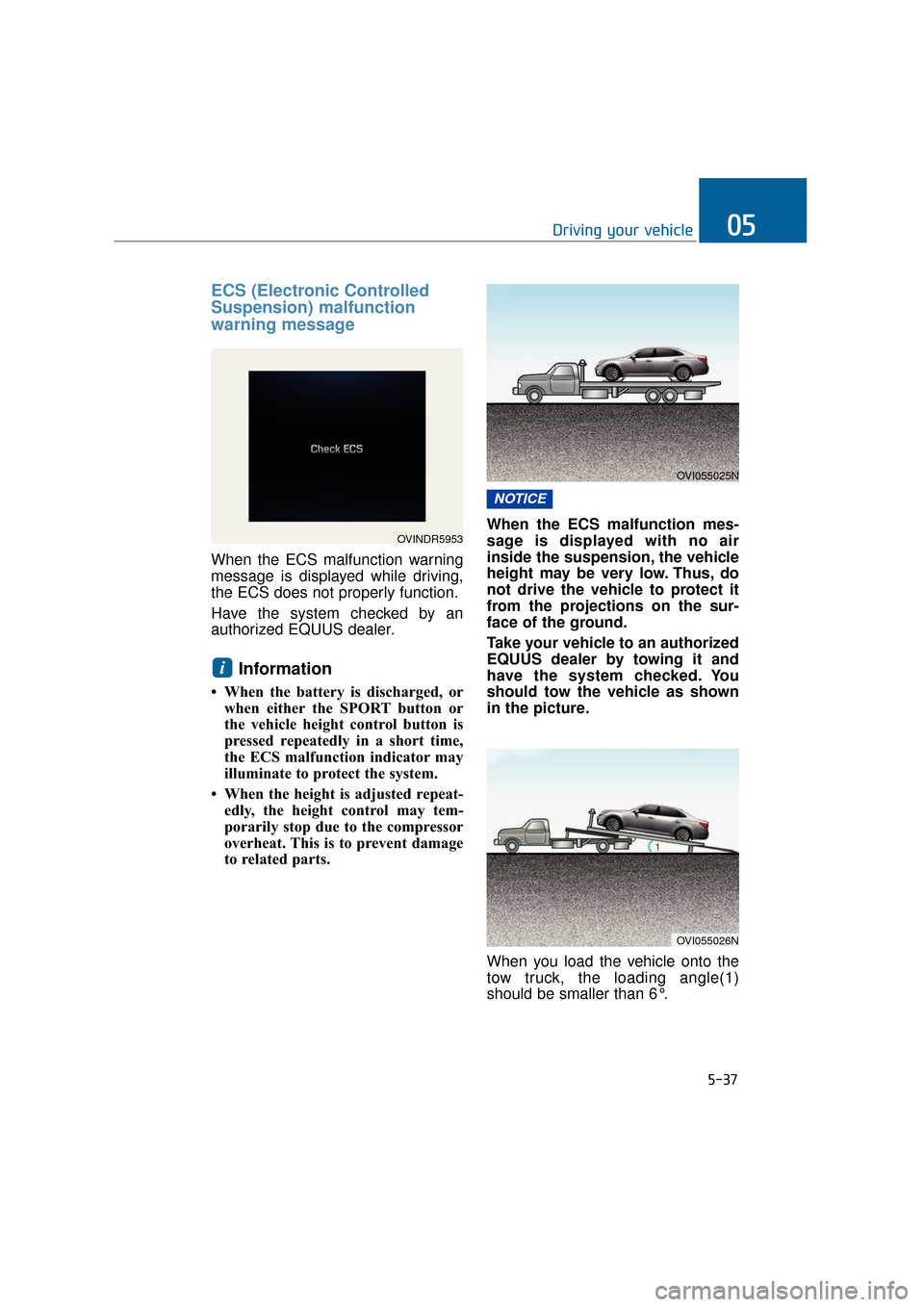
ECS (Electronic Controlled
Suspension) malfunction
warning message
When the ECS malfunction warning
message is displayed while driving,
the ECS does not properly function.
Have the system checked by an
authorized EQUUS dealer.
Information
• When the battery is discharged, orwhen either the SPORT button or
the vehicle height control button is
pressed repeatedly in a short time,
the ECS malfunction indicator may
illuminate to protect the system.
• When the height is adjusted repeat- edly, the height control may tem-
porarily stop due to the compressor
overheat. This is to prevent damage
to related parts. When the ECS malfunction mes-
sage is displayed with no air
inside the suspension, the vehicle
height may be very low. Thus, do
not drive the vehicle to protect it
from the projections on the sur-
face of the ground.
Take your vehicle to an authorized
EQUUS dealer by towing it and
have the system checked. You
should tow the vehicle as shown
in the picture.
When you load the vehicle onto the
tow truck, the loading angle(1)
should be smaller than 6°.
NOTICE
i
5-37
Driving your vehicle05
OVINDR5953
OVI055025N
OVI055026N
Page 325 of 477
5-74
Driving your vehicle
An AutoSock, which is in the wrong size or is improperly
installed, may damage brake
lines, suspension, body and
wheels of your vehicle.
Stop driving and retighten the AutoSock, whenever there are
snapping sounds between the
vehicle and the AutoSock.
Use high quality ethylene gly-
col coolant
The cooling system of your vehicle is
filled with the high-quality ethylene
glycol coolant when being delivered.
It is the only type of coolant that your
vehicle is filled with, because it pre-
vents corrosion of the cooling sys-
tem, lubricates the water pump and
prevents freezing. Refill the cooling
system in accordance with your
maintenance schedule in the chapter
7. Before winter, check your coolant
to assure that the freezing point is
sufficiently lower than the expected
winter temperature.
Check battery and cables
The winter temperature increases
the battery consumption. Inspect the
battery and cables, as described in
the chapter 7. The battery charging
level can be checked by an author-
ized EQUUS dealer or in a service
station.
Change to "winter weight" oil,
if necessary
In some regions during the cold win-
ter, it is recommended to use the
"winter weight" oil with lower viscosi-
ty. For further information about this,
refer to the chapter 8. When you can-
not be sure about a type of winter
weight oil, consult an authorized
EQUUS dealer.
Check spark plugs and ignition
system
Inspect your spark plugs and, if nec-
essary, replace them. Also check all
ignition wirings and components for
any cracks, wear-out, and damage.
NOTICE
- Chain installation
When installing the AutoSock,
park the vehicle on level ground
away from other vehicles. Press
ON the Hazard Warning flasher
and place a warning triangle
behind your vehicle, if available.
Place the shift lever in P(Park),
set the parking brake and turn
OFF the engine, before
installing the AutoSock.
WARNING
- Tire chains
The use of the AutoSock may
adversely affect vehicle han-
dling.
Do not drive faster than the lower of the two - 20 mph (30
km/h) and the AutoSock manu-
facturer’s recommended
speed limit.
Drive carefully and avoid bumps, holes, sharp turns, and
other road hazards, which may
bounce the vehicle.
Avoid turning sharply or lock- ing the wheel brake.
WARNING
Page 336 of 477
If engine stalls while driving
1.Gradually reduce your drivingspeed while driving straight ahead.
Cautiously drive off the road to a
safe place.
2.Press the emergency hazard flash- er.
3.Try to re-start the engine again. When your vehicle does not re-
start, contact an authorized
EQUUS dealer for the qualified
assistance.When the engine does not
revolve, or slowly revolves
1.Make sure that the shift lever is inN(Neutral) or P (Park), and the
emergency brake is set.
2.Check that the battery connections are clean and tight.
3.Turn ON the interior light. When the light dims or goes out upon operat-
ing the starter, the battery is dis-
charged.
4.Check that the starter connections are securely tightened.
5.Do not push or pull the vehicle to start it. Follow instructions provided
in "Jump starting".
When the engine normally
revolves, but does not start
1.Check the fuel level.
2.With the Engine Start/Stop Buttonin the OFF position, check all con-
nectors of the ignition coils and the
spark plugs. Reconnect any dis-
connected or loose parts.
3.If the engine still does not start, contact an authorized EQUUS
dealer for the qualified assistance
6-3
What to do in an emergency06
I IF
F
T
T H
H E
E
E
E N
N G
GI
IN
N E
E
W
W I
IL
L L
L
N
N O
O T
T
S
S T
T A
A R
RT
T
When the engine does not start,
do not push or pull the car to
start it. This may result in a col-
lision or cause other damage.
CAUTION
Page 337 of 477
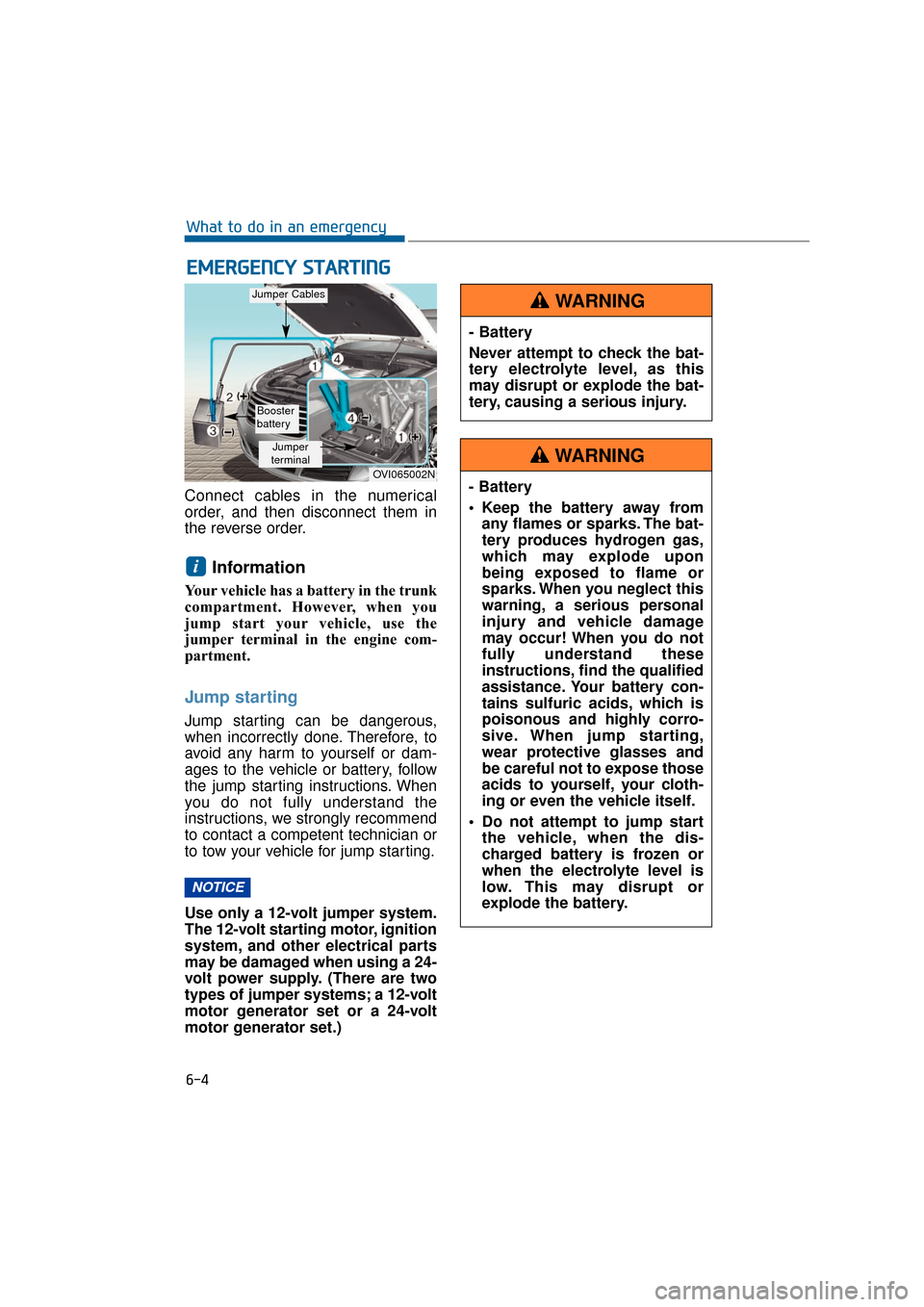
Connect cables in the numerical
order, and then disconnect them in
the reverse order.
Information
Your vehicle has a battery in the trunk
compartment. However, when you
jump start your vehicle, use the
jumper terminal in the engine com-
partment.
Jump starting
Jump starting can be dangerous,
when incorrectly done. Therefore, to
avoid any harm to yourself or dam-
ages to the vehicle or battery, follow
the jump starting instructions. When
you do not fully understand the
instructions, we strongly recommend
to contact a competent technician or
to tow your vehicle for jump starting.
Use only a 12-volt jumper system.
The 12-volt starting motor, ignition
system, and other electrical parts
may be damaged when using a 24-
volt power supply. (There are two
types of jumper systems; a 12-volt
motor generator set or a 24-volt
motor generator set.)
NOTICE
i
E EM
M E
ER
R G
G E
EN
N C
CY
Y
S
S T
T A
A R
RT
TI
IN
N G
G
6-4
What to do in an emergency
OVI065002N
Jumper
terminal
Jumper Cables
Booster
battery
- Battery
Never attempt to check the bat-
tery electrolyte level, as this
may disrupt or explode the bat-
tery, causing a serious injury.
WARNING
- Battery
• Keep the battery away from any flames or sparks. The bat-
tery produces hydrogen gas,
which may explode upon
being exposed to flame or
sparks. When you neglect this
warning, a serious personal
injury and vehicle damage
may occur! When you do not
fully understand these
instructions, find the qualified
assistance. Your battery con-
tains sulfuric acids, which is
poisonous and highly corro-
sive. When jump starting,
wear protective glasses and
be careful not to expose those
acids to yourself, your cloth-
ing or even the vehicle itself.
Do not attempt to jump start the vehicle, when the dis-
charged battery is frozen or
when the electrolyte level is
low. This may disrupt or
explode the battery.
WARNING
Page 338 of 477
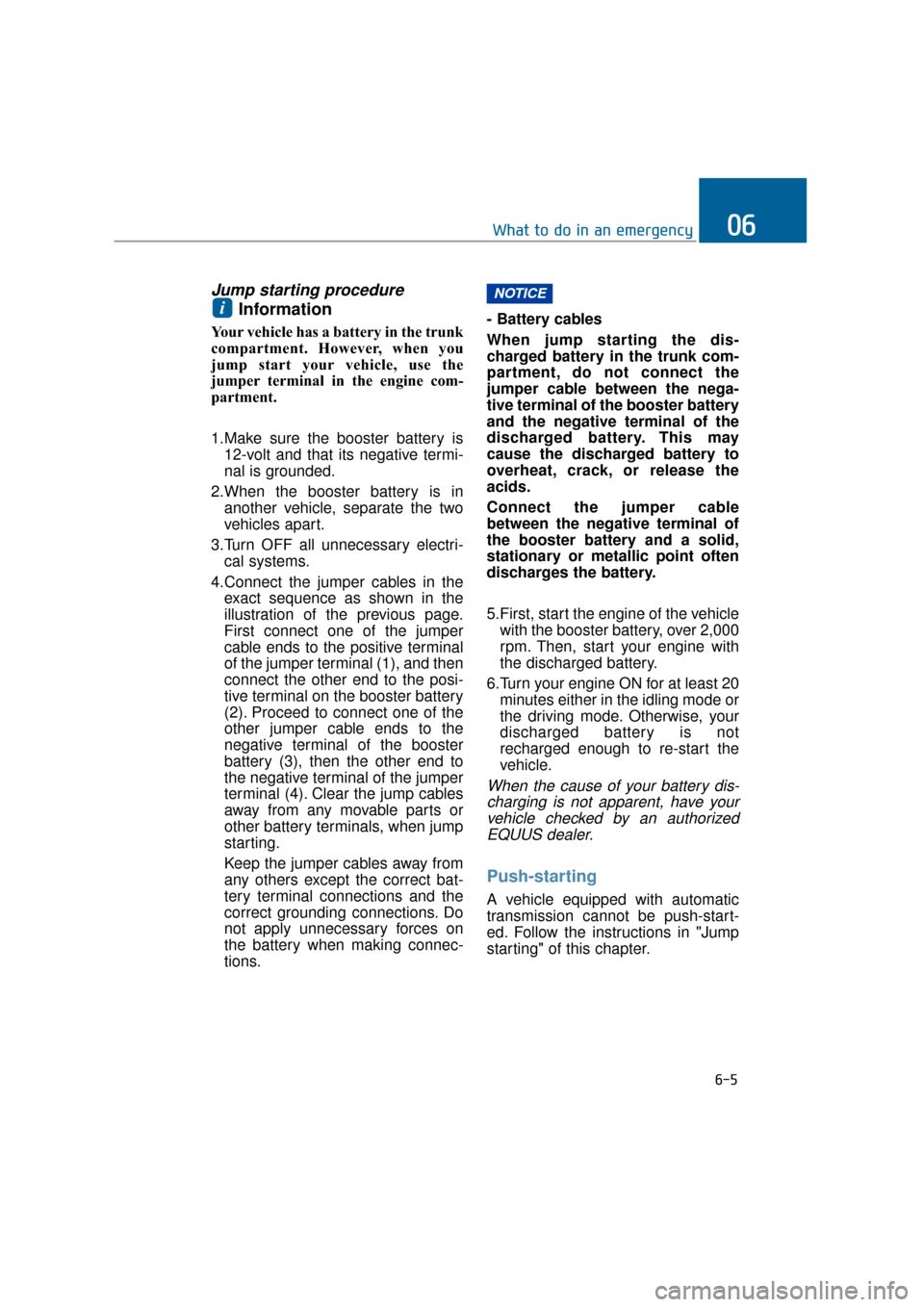
Jump starting procedure
Information
Your vehicle has a battery in the trunk
compartment. However, when you
jump start your vehicle, use the
jumper terminal in the engine com-
partment.
1.Make sure the booster battery is12-volt and that its negative termi-
nal is grounded.
2.When the booster battery is in another vehicle, separate the two
vehicles apart.
3.Turn OFF all unnecessary electri- cal systems.
4.Connect the jumper cables in the exact sequence as shown in the
illustration of the previous page.
First connect one of the jumper
cable ends to the positive terminal
of the jumper terminal (1), and then
connect the other end to the posi-
tive terminal on the booster battery
(2). Proceed to connect one of the
other jumper cable ends to the
negative terminal of the booster
battery (3), then the other end to
the negative terminal of the jumper
terminal (4). Clear the jump cables
away from any movable parts or
other battery terminals, when jump
starting.
Keep the jumper cables away from
any others except the correct bat-
tery terminal connections and the
correct grounding connections. Do
not apply unnecessary forces on
the battery when making connec-
tions. - Battery cables
When jump starting the dis-
charged battery in the trunk com-
partment, do not connect the
jumper cable between the nega-
tive terminal of the booster battery
and the negative terminal of the
discharged battery. This may
cause the discharged battery to
overheat, crack, or release the
acids.
Connect the jumper cable
between the negative terminal of
the booster battery and a solid,
stationary or metallic point often
discharges the battery.
5.First, start the engine of the vehicle
with the booster battery, over 2,000
rpm. Then, start your engine with
the discharged battery.
6.Turn your engine ON for at least 20 minutes either in the idling mode or
the driving mode. Otherwise, your
discharged battery is not
recharged enough to re-start the
vehicle.
When the cause of your battery dis-charging is not apparent, have yourvehicle checked by an authorizedEQUUS dealer.
Push-starting
A vehicle equipped with automatic
transmission cannot be push-start-
ed. Follow the instructions in "Jump
starting" of this chapter.
NOTICE
i
6-5
What to do in an emergency06
Page 346 of 477
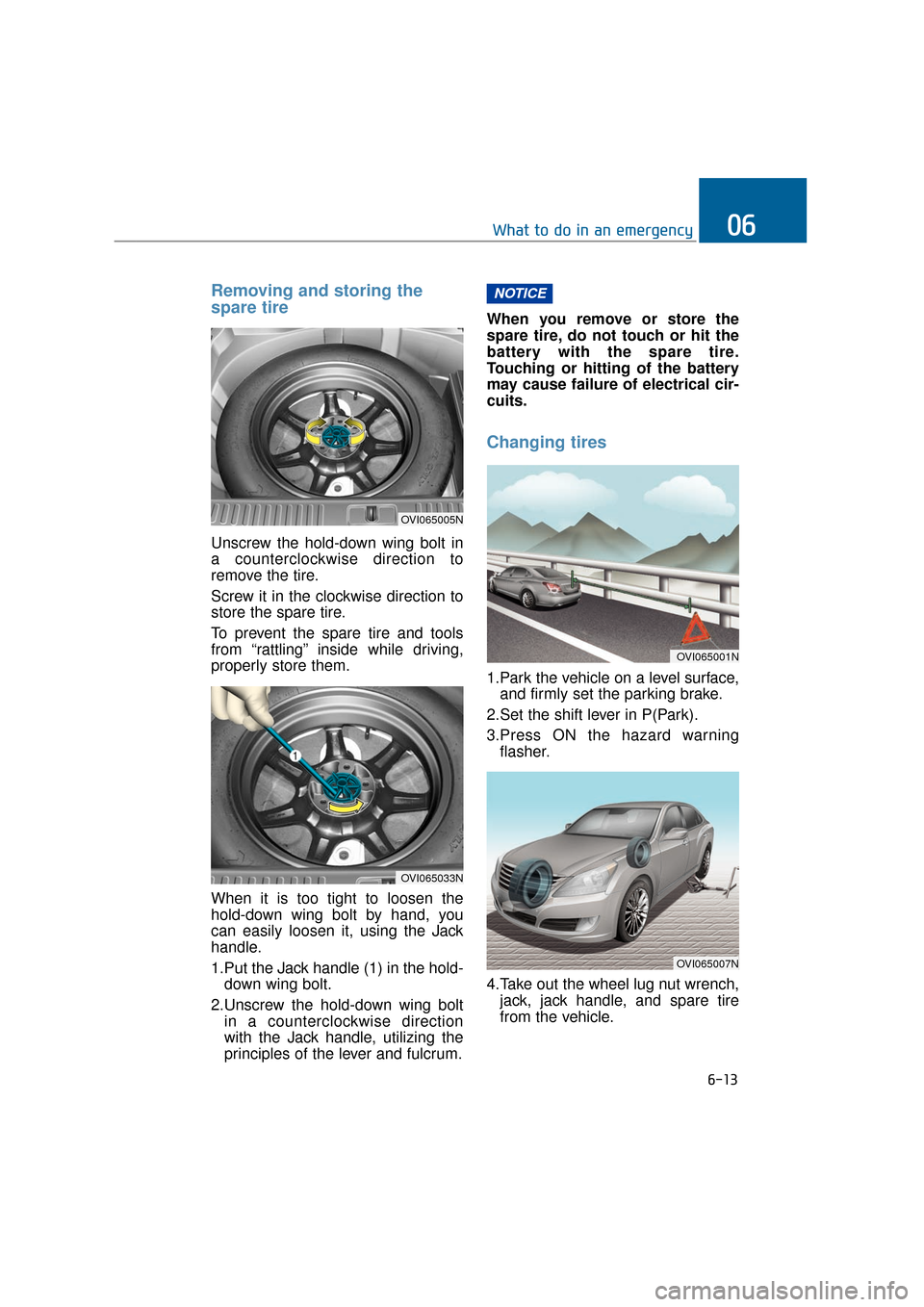
Removing and storing the
spare tire
Unscrew the hold-down wing bolt in
a counterclockwise direction to
remove the tire.
Screw it in the clockwise direction to
store the spare tire.
To prevent the spare tire and tools
from “rattling” inside while driving,
properly store them.
When it is too tight to loosen the
hold-down wing bolt by hand, you
can easily loosen it, using the Jack
handle.
1.Put the Jack handle (1) in the hold-down wing bolt.
2.Unscrew the hold-down wing bolt in a counterclockwise direction
with the Jack handle, utilizing the
principles of the lever and fulcrum. When you remove or store the
spare tire, do not touch or hit the
battery with the spare tire.
Touching or hitting of the battery
may cause failure of electrical cir-
cuits.
Changing tires
1.Park the vehicle on a level surface,
and firmly set the parking brake.
2.Set the shift lever in P(Park).
3.Press ON the hazard warning flasher.
4.Take out the wheel lug nut wrench, jack, jack handle, and spare tire
from the vehicle.
NOTICE
6-13
What to do in an emergency06
OVI065005N
OVI065033N
OVI065001N
OVI065007N
Page 359 of 477
Maintenance
Climate control air filter .....................................7-35
Filter inspection ...............................................................7-35
Filter replacement ...........................................................7-35
Wiper blades .........................................................7-36
Blade inspection ..............................................................7-36
Blade replacement ..........................................................7-36
Battery...................................................................7-39
For best battery service................................................7-39
Battery recharging by battery charger ....................7-41
Battery recharging by vehicle .....................................7-41
Reset items .......................................................................7\
-42
Tires and wheels ..................................................7-42
Tire care ........................................................................\
....7-42
Recommended cold tire inflation pressures.............7-42
Checking tire inflation pressure ..................................7-44
Tire rotation ....................................................................7-45\
Wheel alignment and tire balance ..............................7-45
Tire replacement .............................................................7-46
Wheel replacement .........................................................7-47
Tire traction ......................................................................7-\
47
Tire maintenance ...........................................................7-48
Tire sidewall labeling ......................................................7-48
Low aspect ratio tire ......................................................7-51
Tire terminology and definitions.................................7-52
All season tires ...............................................................7-54
Summer tires ...................................................................7-54
Snow tires ........................................................................\
.7-54
Tire chains ........................................................................\
7-55
Radial-ply tires ................................................................7-55
Page 361 of 477
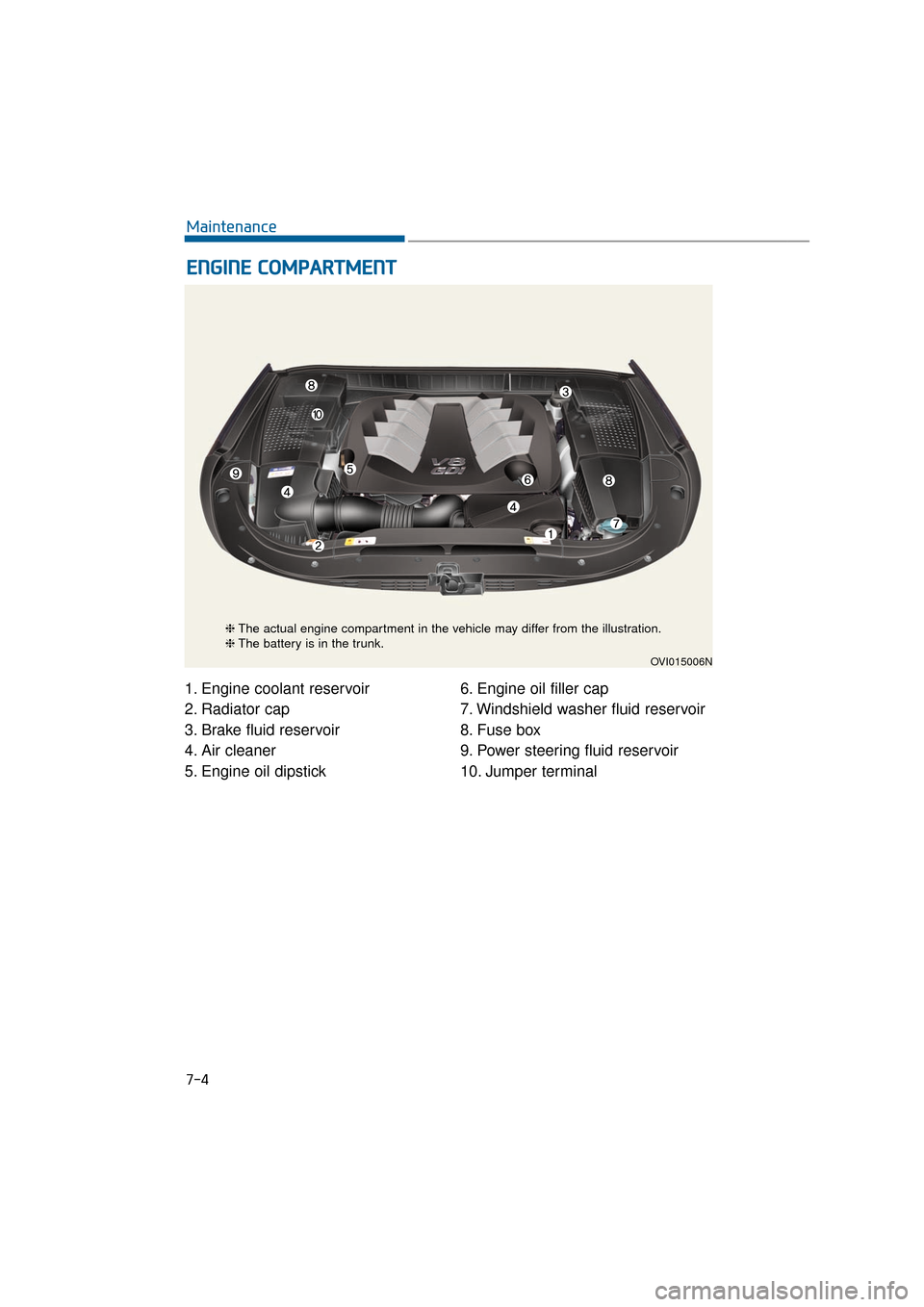
1. Engine coolant reservoir
2. Radiator cap
3. Brake fluid reservoir
4. Air cleaner
5. Engine oil dipstick6. Engine oil filler cap
7. Windshield washer fluid reservoir
8. Fuse box
9. Power steering fluid reservoir
10. Jumper terminal
E E
N
N G
GI
IN
N E
E
C
C O
O M
M P
PA
A R
RT
TM
M E
EN
N T
T
7-4
OVI015006N
Maintenance
❈ The actual engine compartment in the vehicle may differ from the illustration.
❈ The battery is in the trunk.
Page 365 of 477
At least twice a year (i.e., everyspring and fall):
Check for any leaks or damages
from the hoses of the radiator,
heater and A/C.
and wiper operation. Clean wiper
blades with a clean cloth with
washer fluid.
shields and clamps.
tions of the lap/shoulder belts.
wheel lug nut looseness.
At least once a year:
Clean the vehicle body and doordrain holes.
Lubricate the door/hood hinges.
Lubricate the door/hood locks and latches.
Lubricate the door rubber weather strips.
Check the A/C system.
Check the power steering fluid level.
Check the automatic transmission linkage and controls, and lubricate
them.
Clean the battery and terminals.
Check the brake fluid level. Follow the Normal Maintenance
Schedule, unless you drive under one
of the following conditions. Follow the
Maintenance Under Severe Usage
Conditions, when you drive under one
of the following conditions.
Repeated short distance driving.
Driving in dust or on sand.
Extensive use of brakes.
Driving in areas where salt or other
corrosive materials are abundant.
Driving on rough or muddy roads.
Driving in mountainous areas.
Idling or low-speed driving for an extended period of time.
Driving in extremely cold or humid weathers for a prolonged period of
time.
50%-or-more driving in the heavy traffic area at a hot temperature
above 90°F (32°C).
When you drive under one of theabove conditions, you should morefrequently inspect, replace or refillthan the following NormalMaintenance Schedule. After drivingover 120 months or 150,000 miles(240,000 km), keep following the list-ed maintenance schedules.
7-8
Maintenance
S S C
C H
H E
ED
D U
U L
LE
E D
D
M
M A
AI
IN
N T
TE
EN
N A
AN
N C
CE
E
S
S E
E R
R V
V I
IC
C E
E