ECO mode Hyundai Getz 2004 Service Manual
[x] Cancel search | Manufacturer: HYUNDAI, Model Year: 2004, Model line: Getz, Model: Hyundai Getz 2004Pages: 445, PDF Size: 12.16 MB
Page 357 of 445
2- 14 DRIVING YOUR HYUNDAI
!WARNING:
ABS will not prevent accidents due to improper or dangerous drivingmaneuvers. Even though vehicle control is improved during emer- gency braking, always maintain asafe distance between you and ob-jects ahead. Vehicle speeds shouldalways be reduced during extremeroad conditions. The braking distance for cars equipped with an anti-lock brakingsystem may be longer than for thosewithout it in the following road con-ditions.
o Driving on rough, gravel or snow- covered roads.
o Driving with tyre chains installed.
o Driving on roads where the road
surface is pitted or has differentsurface height. These roads should be driven at reduced speeds. The safety features of an ABS equipped vehicle shouldnot be tested by high speed drivingor cornering. This could endangerthe safety of yourself or others. SC150A1-F DRIVING FOR ECONOMY You can save fuel and get more miles from your car if you follow these sug-gestions:
o Drive smoothly. Accelerate at a
moderate rate. Don't make "jack- rabbit" starts or full-throttle shiftsand maintain a steady cruisingspeed. Don't race between stop-lights. Try to adjust your speed tothat of the other traffic so you don't have to change speeds unneces- sarily.Avoid heavy traffic whenever pos-sible. Al-ways maintain a safe dis-tance from other vehicles so youcan avoid unnecessary braking. This also reduces brake wear. o Drive at a moderate speed. The
faster you drive, the more fuel your car uses. Driving at a moderatespeed, especially on the highway, isone of the most effective ways to reduce fuel consumption.
o Don't "ride" the brake or clutch pedal. This can increase fuel consumption and also increase wear on thesecomponents. In addition, driving withyour foot resting on the brake pedal may cause the brakes to overheat, which reduces their effectivenessand may lead to more serious con-sequences.
o Take care of your tyres. Keep them inflated to the recommended pres- sure. Incorrect infla-tion, either too much or too little, results in unnec-essary tyre wear. Check the tyrepres-sures at least once a month.
o Be sure that the wheels are aligned correctly. Improper alignment can result from hitting curbs or driving too fast over irregular surfaces. Pooralignment causes faster tyre wearand may also result in other prob-lems as well as greater fuel con-sumption.
tbuk-2.p65 3/23/04, 4:55 PM
14
Page 360 of 445
DRIVING YOUR HYUNDAI 2- 17
!
o The formation of snow or ice built up
inside the wheel arches may inter- fere with the road wheels or steeringmechanism. In such instances, un-usual noises or an increase in steer- ing effort may result. Therefore, ensure that the wheel arches arechecked periodically and any accu-mulated snow or ice removed.
o It is advisable to carry emergency equipment including, torch, shovel, tow rope, blankets etc., if a journey is to be undertaken into areas ofsevere road conditions.
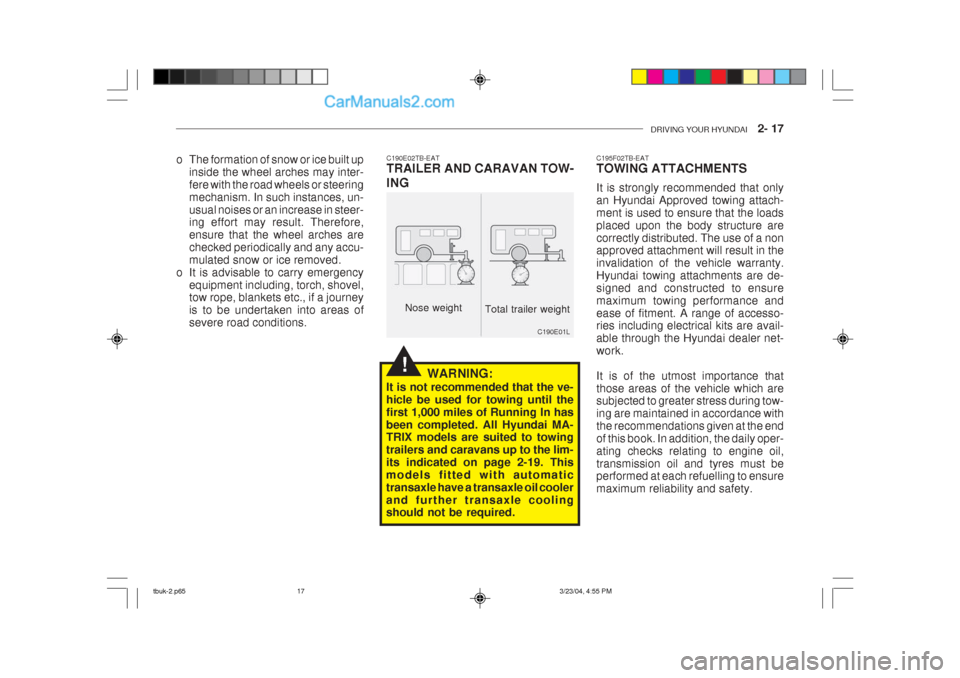
Nose weight Total trailer weight
C190E01L C195F02TB-EAT TOWING ATTACHMENTS It is strongly recommended that only an Hyundai Approved towing attach-ment is used to ensure that the loadsplaced upon the body structure arecorrectly distributed. The use of a non approved attachment will result in the invalidation of the vehicle warranty.Hyundai towing attachments are de-signed and constructed to ensuremaximum towing performance andease of fitment. A range of accesso- ries including electrical kits are avail- able through the Hyundai dealer net-work. It is of the utmost importance that those areas of the vehicle which are subjected to greater stress during tow- ing are maintained in accordance withthe recommendations given at the endof this book. In addition, the daily oper-ating checks relating to engine oil,transmission oil and tyres must be performed at each refuelling to ensure maximum reliability and safety.
C190E02TB-EAT TRAILER AND CARAVAN TOW- ING
WARNING:
It is not recommended that the ve- hicle be used for towing until thefirst 1,000 miles of Running In hasbeen completed. All Hyundai MA- TRIX models are suited to towing trailers and caravans up to the lim-its indicated on page 2-19. Thismodels fitted with automatictransaxle have a transaxle oil coolerand further transaxle cooling should not be required.
tbuk-2.p65 3/23/04, 4:55 PM
17
Page 368 of 445
WHAT TO DO IN AN EMERGENCY 3- 5
!
D040A01TB-EAT
TEMPORARY SPARE TYRE
(Not all models)
The following instructions for the tem-
porary spare tyre should be observed:
1. Check inflation pressure as soon as
practical after installing the spare
tyre, and adjust to the specified
pressure. The tyre pressure should
be periodically checked and main-
tained at the specified pressure
while the tyre is stored.
6. If the cause of the overheating can- not be found, wait until the engine
temperature has returned to nor-
mal. Then, if coolant has been lost,
carefully remove the radiator cap
and add water to bring the fluid level
in the reservoir up to the base of the
radiator fill opening. Fill the coolant
expansion tank to the halfway mark.
7. Proceed with caution until it is es-
tablished that the engine is operat-
ing normally. If the engine over-
heats repeatedly, the advice of a
Hyundai dealer should be sought. WARNING:
Do not remove the radiator cap when
the engine is hot since steam and
boiling water may be ejected from
the radiator resulting in burns or
scalding.
Inflation Pressure
Tyre Size
T105/70D14
420 kPa (60 psi)
2. The spare tyre should only be used temporarily and should be returned
to the luggage compartment as soon
as the original tyre can be repaired
or replaced.
3. Continuous use at speeds of over 50 mph(80 km/h) is not recom-
mended.
4. As the temporary spare tyre is spe- cifically designed for your car, it
should not be used on any other
vehicle.
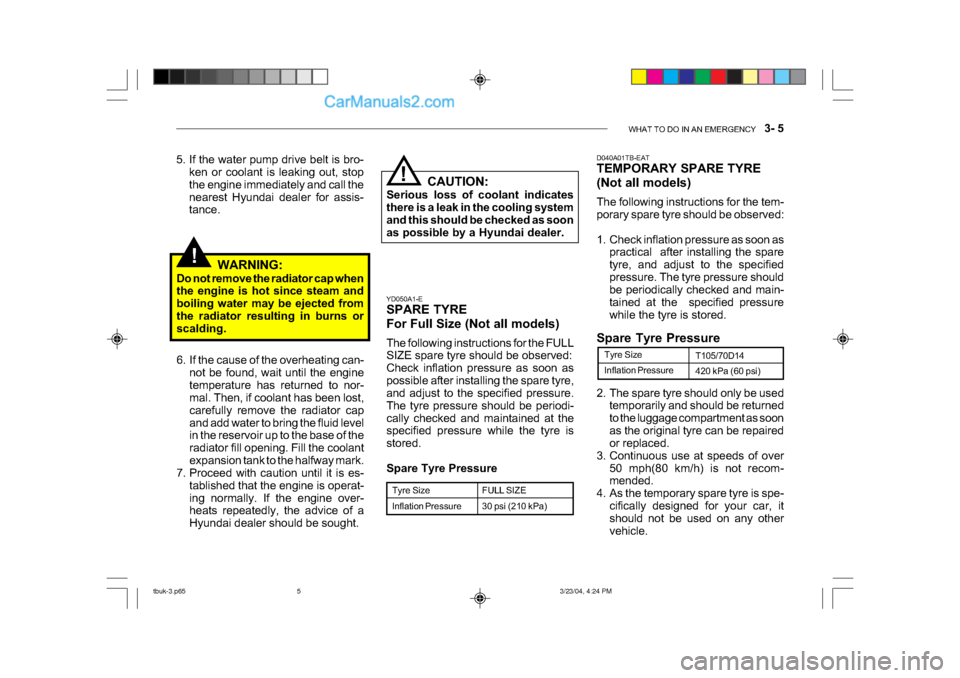
Spare Tyre Pressure
YD050A1-E
SPARE TYRE
For Full Size (Not all models)
The following instructions for the FULL
SIZE spare tyre should be observed:
Check inflation pressure as soon as
possible after installing the spare tyre,
and adjust to the specified pressure.
The tyre pressure should be periodi-
cally checked and maintained at the
specified pressure while the tyre is
stored.
Spare Tyre Pressure
Tyre Size
Inflation Pressure
FULL SIZE
30 psi (210 kPa)
5. If the water pump drive belt is bro-
ken or coolant is leaking out, stop
the engine immediately and call the
nearest Hyundai dealer for assis-
tance.
! CAUTION:
Serious loss of coolant indicates
there is a leak in the cooling system
and this should be checked as soon
as possible by a Hyundai dealer.
tbuk-3.p65 3/23/04, 4:24 PM
5
Page 405 of 445
6- 14 DO-IT-YOURSELF MAINTENANCE
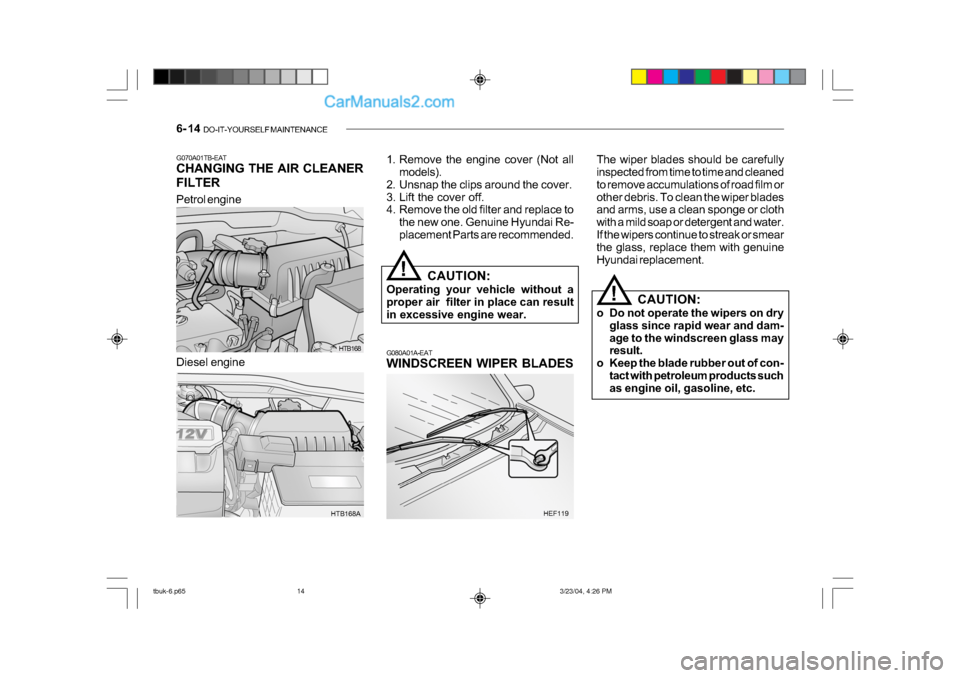
Petrol engine
HTB168
HTB168A
G070A01TB-EAT
CHANGING THE AIR CLEANER
FILTER
1. Remove the engine cover (Not all
models).
2. Unsnap the clips around the cover.
3. Lift the cover off.
4. Remove the old filter and replace to the new one. Genuine Hyundai Re-
placement Parts are recommended.
CAUTION:
Operating your vehicle without a
proper air filter in place can result
in excessive engine wear.
!
G080A01A-EAT
WINDSCREEN WIPER BLADES The wiper blades should be carefully
inspected from time to time and cleaned
to remove accumulations of road film or
other debris. To clean the wiper blades
and arms, use a clean sponge or cloth
with a mild soap or detergent and water.
If the wipers continue to streak or smear
the glass, replace them with genuine
Hyundai replacement.
HEF119
Diesel engine
CAUTION:
o Do not operate the wipers on dry glass since rapid wear and dam-
age to the windscreen glass may
result.
o Keep the blade rubber out of con- tact with petroleum products such
as engine oil, gasoline, etc.
!
tbuk-6.p65 3/23/04, 4:26 PM
14
Page 411 of 445
6- 20 DO-IT-YOURSELF MAINTENANCE
B145A01TB-EAT
CHANGING THE POLLEN FIL-
TER (In Front of evaporator unit)
(Not all models)
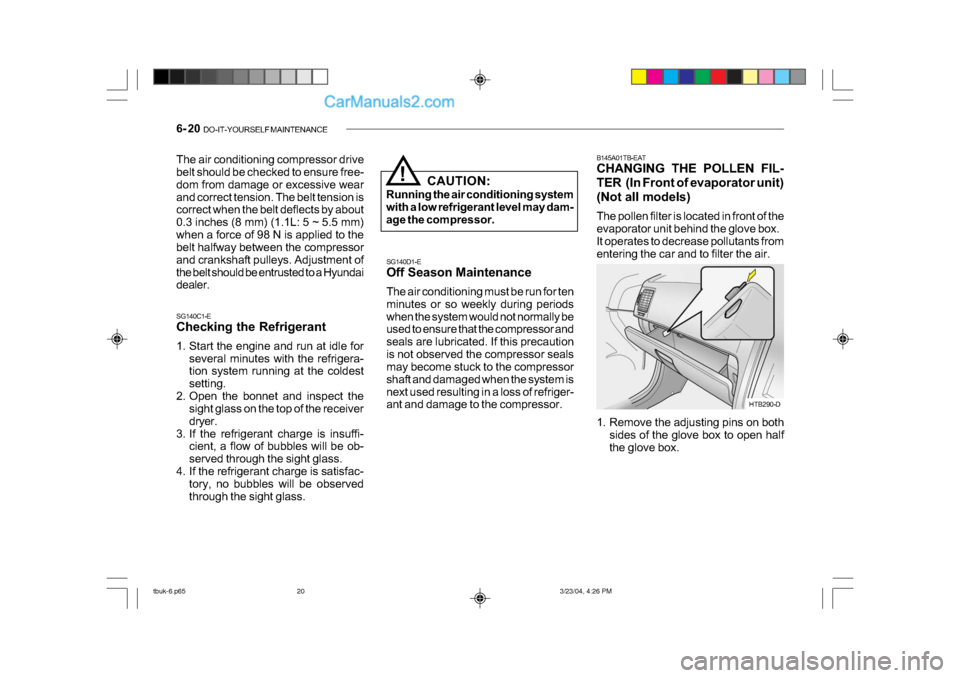
The pollen filter is located in front of the
evaporator unit behind the glove box.
It operates to decrease pollutants from
entering the car and to filter the air.
1. Remove the adjusting pins on both
sides of the glove box to open half
the glove box.
HTB290-D
SG140D1-E
Off Season Maintenance
The air conditioning must be run for ten
minutes or so weekly during periods
when the system would not normally be
used to ensure that the compressor and
seals are lubricated. If this precaution
is not observed the compressor seals
may become stuck to the compressor
shaft and damaged when the system is
next used resulting in a loss of refriger-
ant and damage to the compressor.
SG140C1-E
Checking the Refrigerant
1. Start the engine and run at idle for
several minutes with the refrigera-
tion system running at the coldest
setting.
2. Open the bonnet and inspect the sight glass on the top of the receiver
dryer.
3. If the refrigerant charge is insuffi- cient, a flow of bubbles will be ob-
served through the sight glass.
4. If the refrigerant charge is satisfac- tory, no bubbles will be observed
through the sight glass. CAUTION:
Running the air conditioning system
with a low refrigerant level may dam-
age the compressor.
!
The air conditioning compressor drive
belt should be checked to ensure free-
dom from damage or excessive wear
and correct tension. The belt tension is
correct when the belt deflects by about
0.3 inches (8 mm) (1.1L: 5 ~ 5.5 mm)
when a force of 98 N is applied to the
belt halfway between the compressor
and crankshaft pulleys. Adjustment of
the belt should be entrusted to a Hyundai
dealer.
tbuk-6.p65
3/23/04, 4:26 PM
20
Page 428 of 445
7- 2 EMISSION CONTROL SYSTEMS
SH010A1-E EMISSION CONTROL SYSTEMS (Not all models) Depending upon the market for which the vehicle is destined, the emissioncontrol system will comprise one or more of the following emission con- trol devices. 1) Crankcase emission control sys-
tem
2) Evaporative emission control sys-
tem
z3) Exhaust emission control systemIn order that the proper functioning of the emission control systems may be ensured, it is recommended that the vehicle is inspected and maintainedby an authorized Hyundai dealer in accordance with the maintenance schedule in this manual. SH010B1-E
1. CRANKCASE EMISSION
CONTROLSYSTEM
The positive crankcase ventilation
system is employed to prevent airpollution caused by blow-by gasesbeing emitted from the crankcase by introducing fresh air to the crankcase through the air cleaner where thismixes with blow-by gases and then passes through the PCV valve into the intake manifold from where it sub-sequently enters the combustion chamber and is burned.
SH010C1-E
2. EVAPORATIVE EMISSION
CONTROL SYSTEM
The Evaporative Emission Control
System is designed to prevent fuel vapours from escaping into the atmo- sphere through the fuel tank ventila- tion system.
Whilst the engine is not running, fuel
vapours generated inside the fuel tankare absorbed and stored in a char-coal canister. When the engine is started, the vapours stored in the canister are drawn into the induction SH010D1-E
3. EXHAUST EMISSION CON
TROL SYSTEM
The exhaust emission control system
is a highly effective system whichcontrols exhaust emission while main- taining good vehicle performance.
system through the purge control so-lenoid valve and are subsequently burned.
The purge control solenoid valve is
controlled by the ECU; when the en-gine coolant temperature is low or the engine is idling, the purge control valve is closed and fuel vapours re-main stored in the canister. Under normal running conditions when the engine is warm, the valve opens andthe vapours are drawn into the inlet tract and subsequently burned in the combustion chamber.
tbuk-7.p65 7/3/2008, 4:10 PM
2
Page 429 of 445
EMISSION CONTROL SYSTEMS 7- 3
H020A01TB-EAT
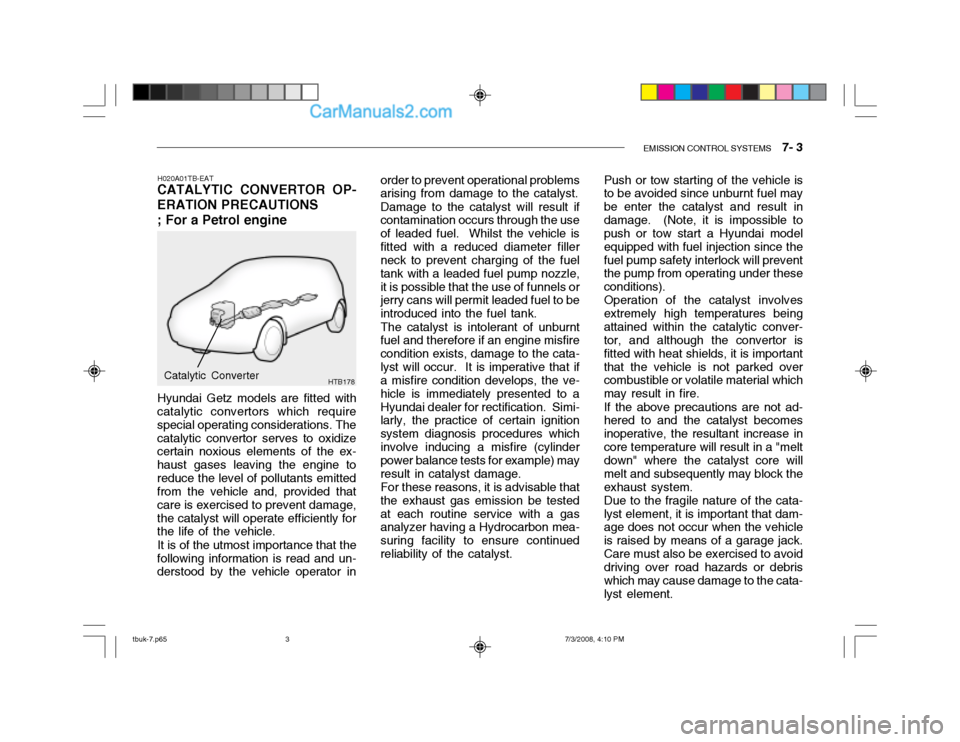
CATALYTIC CONVERTOR OP- ERATION PRECAUTIONS ; For a Petrol engine
Hyundai Getz models are fitted with
catalytic convertors which require special operating considerations. Thecatalytic convertor serves to oxidize certain noxious elements of the ex- haust gases leaving the engine toreduce the level of pollutants emitted from the vehicle and, provided that care is exercised to prevent damage,the catalyst will operate efficiently for the life of the vehicle.
It is of the utmost importance that the
following information is read and un-derstood by the vehicle operator in
HTB178Catalytic Converter order to prevent operational problems arising from damage to the catalyst.
Damage to the catalyst will result if
contamination occurs through the use of leaded fuel. Whilst the vehicle isfitted with a reduced diameter filler neck to prevent charging of the fuel tank with a leaded fuel pump nozzle,it is possible that the use of funnels or jerry cans will permit leaded fuel to be introduced into the fuel tank.
The catalyst is intolerant of unburnt
fuel and therefore if an engine misfirecondition exists, damage to the cata-lyst will occur. It is imperative that if a misfire condition develops, the ve- hicle is immediately presented to aHyundai dealer for rectification. Simi- larly, the practice of certain ignition system diagnosis procedures whichinvolve inducing a misfire (cylinder power balance tests for example) may result in catalyst damage.
For these reasons, it is advisable that
the exhaust gas emission be testedat each routine service with a gas analyzer having a Hydrocarbon mea- suring facility to ensure continuedreliability of the catalyst. Push or tow starting of the vehicle is to be avoided since unburnt fuel may be enter the catalyst and result indamage. (Note, it is impossible to push or tow start a Hyundai model equipped with fuel injection since thefuel pump safety interlock will prevent the pump from operating under these conditions).Operation of the catalyst involvesextremely high temperatures beingattained within the catalytic conver- tor, and although the convertor is fitted with heat shields, it is importantthat the vehicle is not parked over combustible or volatile material which may result in fire. If the above precautions are not ad- hered to and the catalyst becomes inoperative, the resultant increase incore temperature will result in a "melt down" where the catalyst core will melt and subsequently may block theexhaust system.Due to the fragile nature of the cata-lyst element, it is important that dam- age does not occur when the vehicle is raised by means of a garage jack.Care must also be exercised to avoid driving over road hazards or debris which may cause damage to the cata-lyst element.
tbuk-7.p65
7/3/2008, 4:10 PM
3