automatic Hyundai Grand i10 2015 Service Manual
[x] Cancel search | Manufacturer: HYUNDAI, Model Year: 2015, Model line: Grand i10, Model: Hyundai Grand i10 2015Pages: 343, PDF Size: 29.47 MB
Page 196 of 343
Driving your vehicle
8
5
START/RUN
With manual transaxle
To start the engine, depress the clutch
and brake pedals and press the engine
start/stop button with the shift lever in
neutral.
With automatic transaxle
To start the engine, depress the brake
pedal and press the engine start/stop
button with the shift lever in the P (Park)
or the N (Neutral) position. For your safe-
ty, start the engine with the shift lever in
the P (Park) position.
✽✽
NOTICE
If you press the engine start/stop button
without depressing the clutch pedal for
manual transaxle vehicles or without
depressing the brake pedal for automat-
ic transaxle vehicles, the engine will not
start and the engine start/stop button
changes as follow:
OFF ➔
➔
ACC ➔➔
ON ➔➔
OFF or ACC
WARNING
NEVER press the engine start/stop button while the vehi-
cle is in motion except in an
emergency. This will result in theengine turning off and loss of
power assist for the steering and
brake systems. This may lead to
loss of directional control and
braking function, which couldcause an accident.
Before leaving the driver's seat, always make sure the shift lever
is in the P (Park) position, set the
parking brake, press the engine
start/stop button to the OFF posi-
tion, and take the smart key with
you. Unexpected vehicle move-
ment may occur if these precau-
tions are not followed.
NEVER reach through the steer- ing wheel for the engine
start/stop button, or any other
control, while the vehicle is in
motion. The presence of your
hand or arm in this area may
cause a loss of vehicle controlresulting in an accident.
Page 197 of 343

59
Driving your vehicle
Starting the engine✽✽
NOTICE
The engine will start by pressing the engine start/stop button, only when
the smart key is in the vehicle.
Even if the smart key is in the vehicle, if it is far away from the driver, the
engine may not start.
When the Engine Start/Stop button is
in the ACC or ON position, if any door
is open, the system checks for the
smart key. If the smart key is not in
the vehicle, the indicator "KEY OUT"
will blink, and if all doors are closed,
the chime will also sound for about 5
seconds. The indicator will turn off
while the vehicle is moving. Keep the
smart key in the vehicle when using
the ACC position or if the vehicle
engine is ON.1. Carry the smart key or leave it insidethe vehicle.
2. Make sure the parking brake is firmly applied.
3. Manual Transaxle - Depress the
clutch pedal fully and shift the
transaxle into Neutral. Keep the clutch
pedal and brake pedal depressed
while starting the engine.
Automatic Transaxle - Place the
transaxle shift lever in P (Park).
Depress the brake pedal fully.
You can also start the engine when
the shift lever is in the N (Neutral)
position.
4. Press the engine start/stop button.
✽✽
NOTICE
Whether the engine is cold or warm, always start the vehicle with your foot
on the brake pedal. Do not depress the
accelerator while starting the vehicle.
Do not race the engine while warming
it up.
In extremely cold weather (below - 18°C / 0°F) or after the vehicle has
not been operated for several days, let
the engine warm up without depress-
ing the accelerator pedal.
WARNING
Always wear appropriate shoes
when operating your vehicle.
Unsuitable shoes (high heels, ski
boots,etc.) may interfere with yourability to use the brake and acceler-ator pedals.
Page 202 of 343
Driving your vehicle
14
5
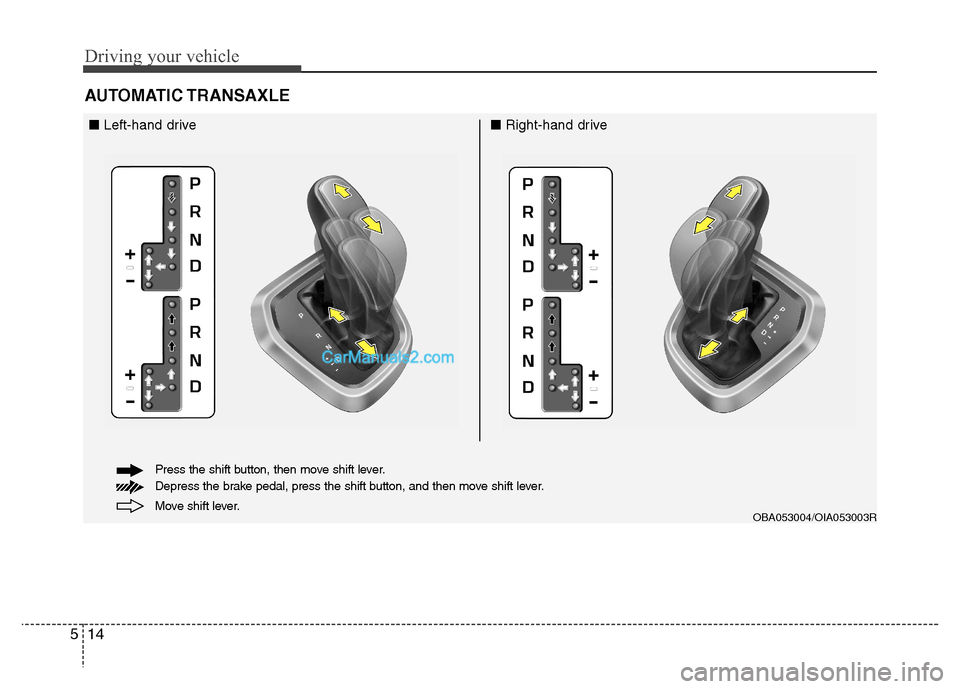
AUTOMATIC TRANSAXLE
OBA053004/OIA053003R
■ Left-hand drive ■Right-hand drive
Move shift lever.
Press the shift button, then move shift lever.
Depress the brake pedal, press the shift button, and then move shift lever.
Page 203 of 343
515
Driving your vehicle
Automatic transaxle operation
The automatic transaxle has four forward
speeds and one reverse speed. The indi-
vidual speeds are selected automatically,
in the D (Drive) position.The indicator in the instrument cluster
displays the shift lever position when the
ignition switch is in the ON position.
P (Park)
Always come to a complete stop before
shifting into P (Park).
To shift from P (Park), you must depress
firmly on the brake pedal and make sure
your foot is off the accelerator pedal.
The shift lever must be in P (Park) before
turning the engine off.
R (Reverse)
Use this position to drive the vehicle
backward.
WARNING
To reduce the risk of serious injury or death:
ALWAYS check the surrounding areas near your vehicle for peo-
ple, especially children, before
shifting a vehicle into D (Drive) or
R (Reverse).
Before leaving the driver’s seat, always make sure the shift lever
is in the P (Park) position, then
set the parking brake, and place
the ignition switch in the
LOCK/OFF position. Unexpected
and sudden vehicle movementcan occur if these precautions
are not followed.
WARNING
Shifting into P (Park) while the vehicle is in motion may cause
you to lose control of the vehicle.
After the vehicle has stopped, always make sure the shift lever
is in P (Park), apply the parking
brake, and turn the engine off.
Do not use the P (Park) position in place of the parking brake.
CAUTION
Always come to a complete stop
before shifting into or out of R(Reverse); you may damage thetransaxle if you shift into R
(Reverse) while the vehicle is inmotion.
Page 204 of 343
Driving your vehicle
16
5
N (Neutral)
The wheels and transaxle are not engaged.
Use N (Neutral) if you need to restart a
stalled engine, or if it is necessary to stop
with the engine ON. Shift into P (Park) if
you need to leave your vehicle for anyreason.
Always depress the brake pedal when
you are shifting from N (Neutral) to
another gear.
D (Drive)
This is the normal driving position. The
transaxle will automatically shift through
a 4-gear sequence, providing the best
fuel economy and power.
For extra power when passing another
vehicle or driving uphill, depress the
accelerator fully. The transaxle will auto-
matically downshift to the next lower gear
(or gears, as appropriate).
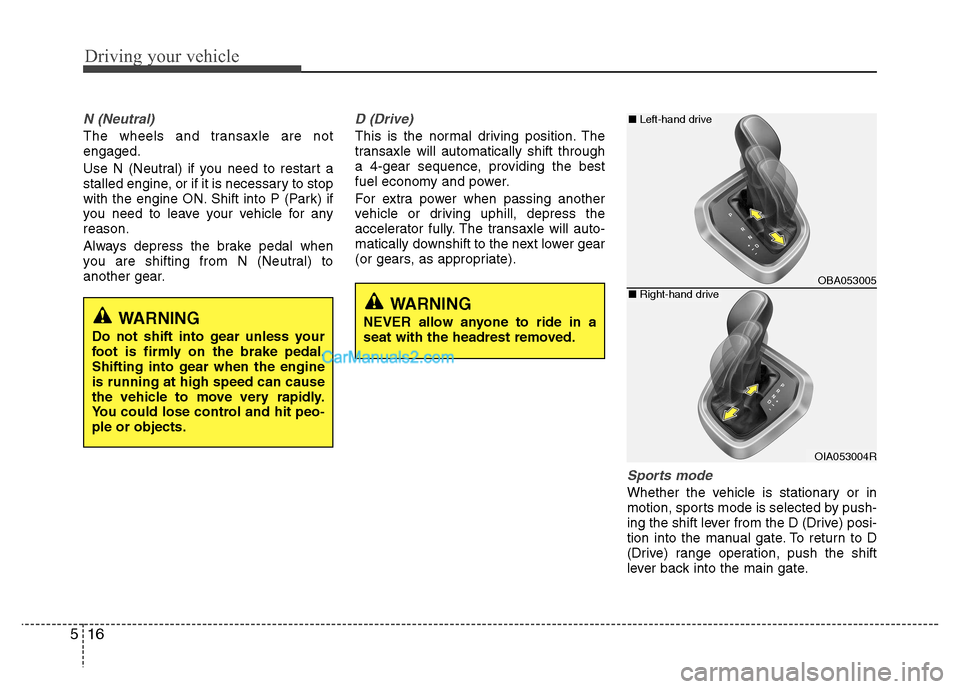
Sports mode
Whether the vehicle is stationary or in
motion, sports mode is selected by push-
ing the shift lever from the D (Drive) posi-
tion into the manual gate. To return to D
(Drive) range operation, push the shift
lever back into the main gate.
WARNING
Do not shift into gear unless your
foot is firmly on the brake pedal.
Shifting into gear when the engineis running at high speed can cause
the vehicle to move very rapidly.
You could lose control and hit peo-ple or objects.WARNING
NEVER allow anyone to ride in a
seat with the headrest removed.
OBA053005
OIA053004R
■ Left-hand drive
■Right-hand drive
Page 205 of 343
517
Driving your vehicle
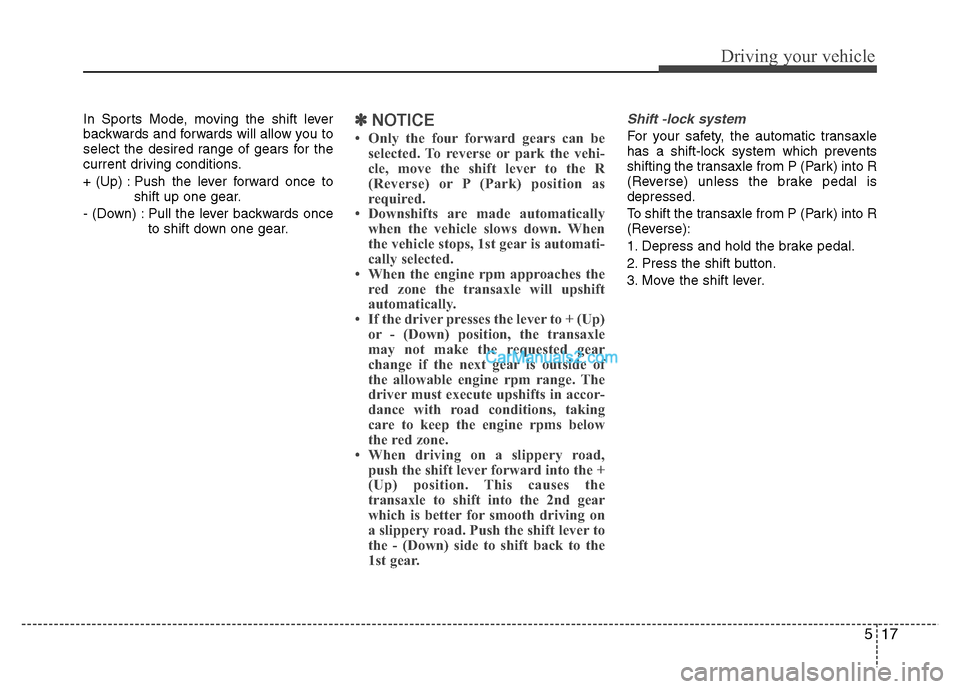
In Sports Mode, moving the shift lever
backwards and forwards will allow you to
select the desired range of gears for the
current driving conditions.
+ (Up) : Push the lever forward once toshift up one gear.
- (Down) : Pull the lever backwards once to shift down one gear.✽✽
NOTICE
Only the four forward gears can be selected. To reverse or park the vehi-
cle, move the shift lever to the R
(Reverse) or P (Park) position as
required.
Downshifts are made automatically when the vehicle slows down. When
the vehicle stops, 1st gear is automati-
cally selected.
When the engine rpm approaches the red zone the transaxle will upshift
automatically.
If the driver presses the lever to + (Up)
or - (Down) position, the transaxle
may not make the requested gear
change if the next gear is outside of
the allowable engine rpm range. The
driver must execute upshifts in accor-
dance with road conditions, taking
care to keep the engine rpms below
the red zone.
When driving on a slippery road, push the shift lever forward into the +
(Up) position. This causes the
transaxle to shift into the 2nd gear
which is better for smooth driving on
a slippery road. Push the shift lever to
the - (Down) side to shift back to the
1st gear.Shift -lock system
For your safety, the automatic transaxle
has a shift-lock system which prevents
shifting the transaxle from P (Park) into R
(Reverse) unless the brake pedal isdepressed.
To shift the transaxle from P (Park) into R
(Reverse):
1. Depress and hold the brake pedal.
2. Press the shift button.
3. Move the shift lever.
Page 208 of 343
Driving your vehicle
20
5
Power brakes
Your vehicle has power-assisted brakes
that adjust automatically through normal
usage.
If the engine is not running or is turned
off while driving, the power assist for the
brakes will not work. You can still stop
your vehicle by applying greater force to
the brake pedal than typical. The stop-
ping distance, however, will be longer
than with power brakes.
When the engine is not running, the
reserve brake power is partially depleted
each time the brake pedal is applied. Do
not pump the brake pedal when the
power assist has been interrupted.
Pump the brake pedal only when neces-
sary to maintain steering control on slip-
pery surfaces. BRAKING SYSTEM (Continued)
To dry the brakes, lightly tap the brake pedal to heat up the brakes
while maintaining a safe forward
speed until brake performance
returns to normal. Avoid drivingat high speeds until the brakes
function correctly.WARNING
Take the following precautions:
Do not drive with your foot rest- ing on the brake pedal. This will create abnormal high brake tem-
peratures, excessive brake lining
and pad wear, and increasedstopping distances.
When descending a long or steep hill, shift to a lower gear and
avoid continuous application of
the brakes. Applying the brakes
continuously will cause the
brakes to overheat and could
result in a temporary loss of brak-
ing performance.
Wet brakes may impair the vehi- cle’s ability to safely slow down;
the vehicle may also pull to oneside when the brakes are applied.
Applying the brakes lightly will
indicate whether they have been
affected in this way. Always test
your brakes in this fashion after
driving through deep water.
(Continued)
Page 210 of 343
Driving your vehicle
22
5
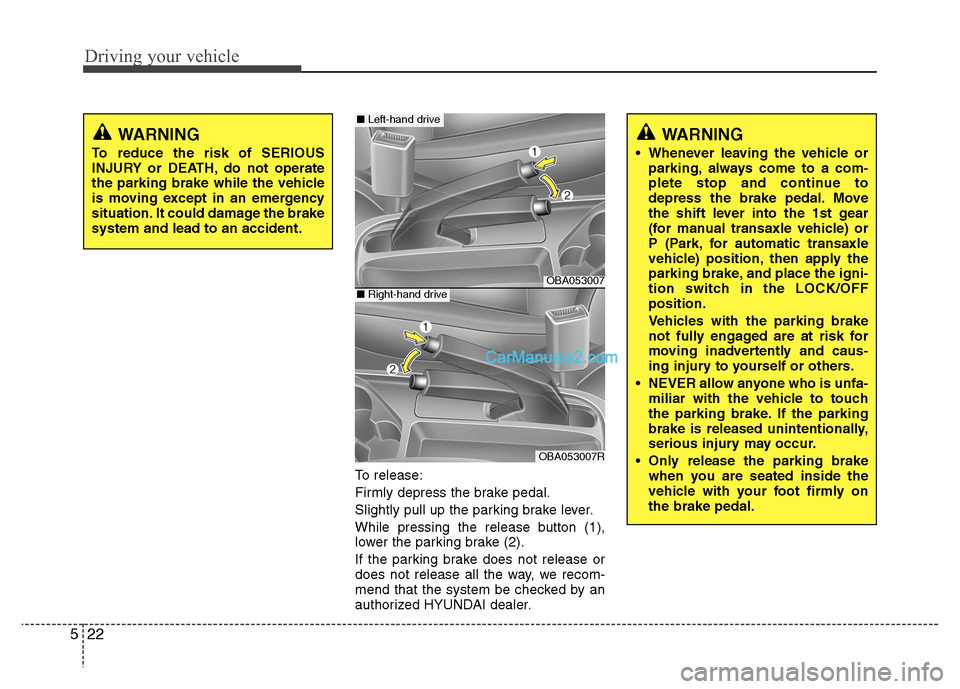
To release:
Firmly depress the brake pedal.
Slightly pull up the parking brake lever.
While pressing the release button (1),
lower the parking brake (2).
If the parking brake does not release or
does not release all the way, we recom-
mend that the system be checked by an
authorized HYUNDAI dealer.
WARNING
Whenever leaving the vehicle or parking, always come to a com-
plete stop and continue to
depress the brake pedal. Move
the shift lever into the 1st gear
(for manual transaxle vehicle) or
P (Park, for automatic transaxle
vehicle) position, then apply the
parking brake, and place the igni-
tion switch in the LOCK/OFFposition.
Vehicles with the parking brake
not fully engaged are at risk for
moving inadvertently and caus-
ing injury to yourself or others.
NEVER allow anyone who is unfa- miliar with the vehicle to touch
the parking brake. If the parking
brake is released unintentionally,
serious injury may occur.
Only release the parking brake when you are seated inside the
vehicle with your foot firmly onthe brake pedal.
OBA053007
OBA053007R
WARNING
To reduce the risk of SERIOUS
INJURY or DEATH, do not operate
the parking brake while the vehicle
is moving except in an emergency
situation. It could damage the brakesystem and lead to an accident.
■ Left-hand drive
■Right-hand drive
Page 215 of 343
527
Driving your vehicle
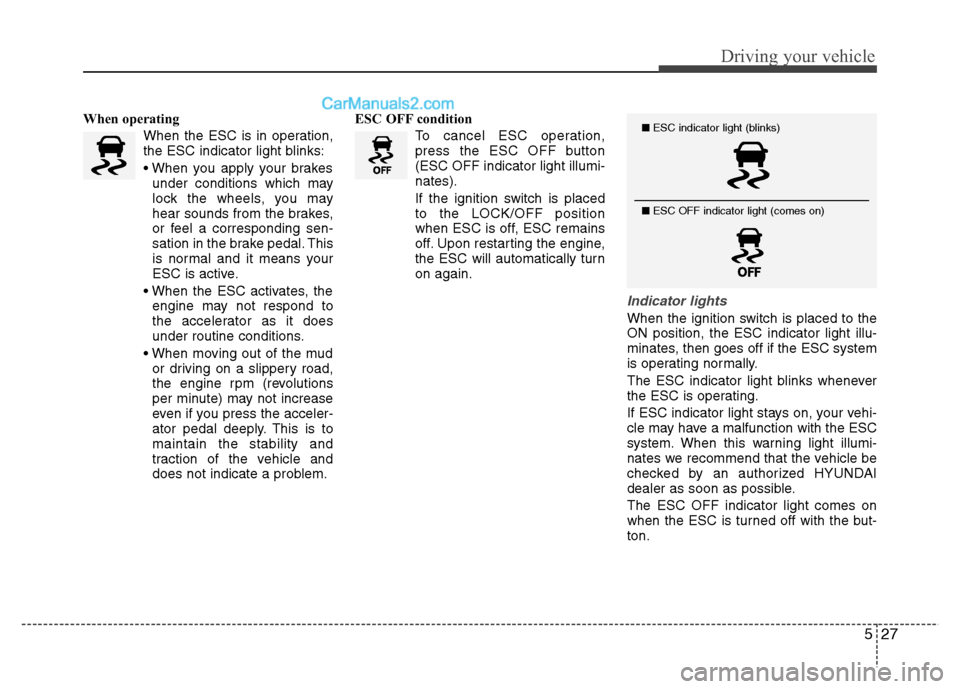
When operatingWhen the ESC is in operation,
the ESC indicator light blinks:
under conditions which may
lock the wheels, you may
hear sounds from the brakes,
or feel a corresponding sen-
sation in the brake pedal. This
is normal and it means your
ESC is active.
engine may not respond to
the accelerator as it does
under routine conditions.
or driving on a slippery road,
the engine rpm (revolutions
per minute) may not increase
even if you press the acceler-
ator pedal deeply. This is tomaintain the stability and
traction of the vehicle and
does not indicate a problem. ESC OFF condition
To cancel ESC operation,
press the ESC OFF button(ESC OFF indicator light illumi-nates).
If the ignition switch is placed to the LOCK/OFF position
when ESC is off, ESC remains
off. Upon restarting the engine,
the ESC will automatically turnon again.
Indicator lights
When the ignition switch is placed to the ON position, the ESC indicator light illu-
minates, then goes off if the ESC system
is operating normally.
The ESC indicator light blinks whenever
the ESC is operating.
If ESC indicator light stays on, your vehi-
cle may have a malfunction with the ESC
system. When this warning light illumi-
nates we recommend that the vehicle be
checked by an authorized HYUNDAI
dealer as soon as possible. The ESC OFF indicator light comes on
when the ESC is turned off with the but-ton.
■ESC indicator light (blinks)
■ ESC OFF indicator light (comes on)
Page 218 of 343
Driving your vehicle
30
5
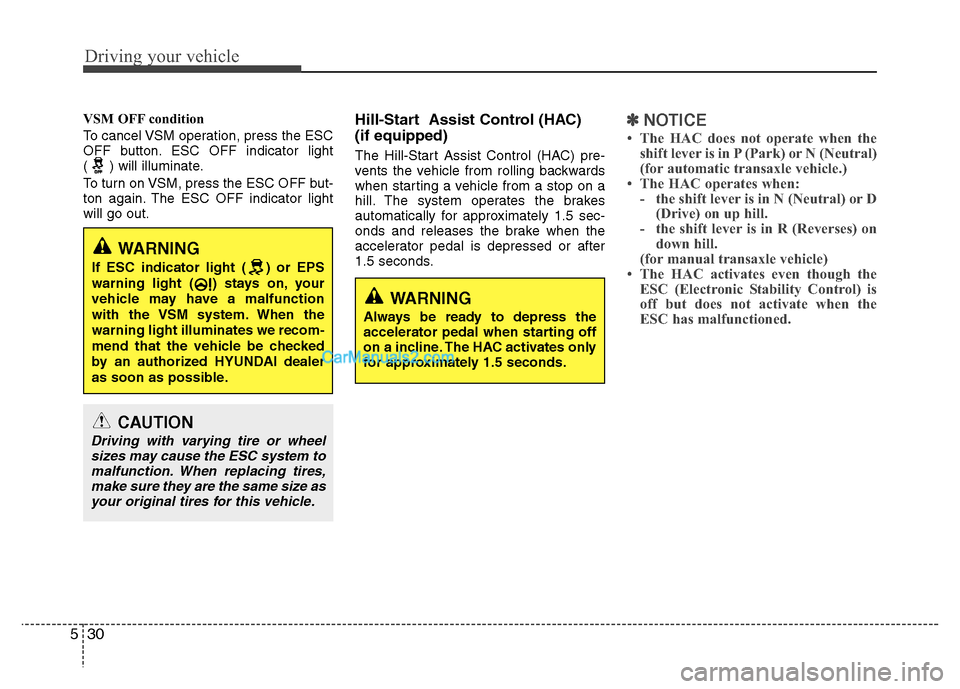
VSM OFF condition
To cancel VSM operation, press the ESC
OFF button. ESC OFF indicator light
( ) will illuminate.
To turn on VSM, press the ESC OFF but-
ton again. The ESC OFF indicator lightwill go out. Hill-Start Assist Control (HAC) (if equipped)
The Hill-Start Assist Control (HAC) pre-
vents the vehicle from rolling backwards
when starting a vehicle from a stop on a
hill. The system operates the brakes
automatically for approximately 1.5 sec-
onds and releases the brake when the
accelerator pedal is depressed or after
1.5 seconds.✽✽
NOTICE
The HAC does not operate when the shift lever is in P (Park) or N (Neutral)
(for automatic transaxle vehicle.)
The HAC operates when: - the shift lever is in N (Neutral) or D
(Drive) on up hill.
- the shift lever is in R (Reverses) on
down hill.
(for manual transaxle vehicle)
The HAC activates even though the ESC (Electronic Stability Control) is
off but does not activate when the
ESC has malfunctioned.
WARNING
If ESC indicator light ( ) or EPS
warning light ( ) stays on, your
vehicle may have a malfunction
with the VSM system. When thewarning light illuminates we recom-
mend that the vehicle be checked
by an authorized HYUNDAI dealer
as soon as possible.
WARNING
Always be ready to depress the
accelerator pedal when starting off
on a incline. The HAC activates only
for approximately 1.5 seconds.
CAUTION
Driving with varying tire or wheel sizes may cause the ESC system tomalfunction. When replacing tires,make sure they are the same size asyour original tires for this vehicle.