automatic Hyundai Grand i10 2015 Repair Manual
[x] Cancel search | Manufacturer: HYUNDAI, Model Year: 2015, Model line: Grand i10, Model: Hyundai Grand i10 2015Pages: 343, PDF Size: 29.47 MB
Page 254 of 343
77
Maintenance
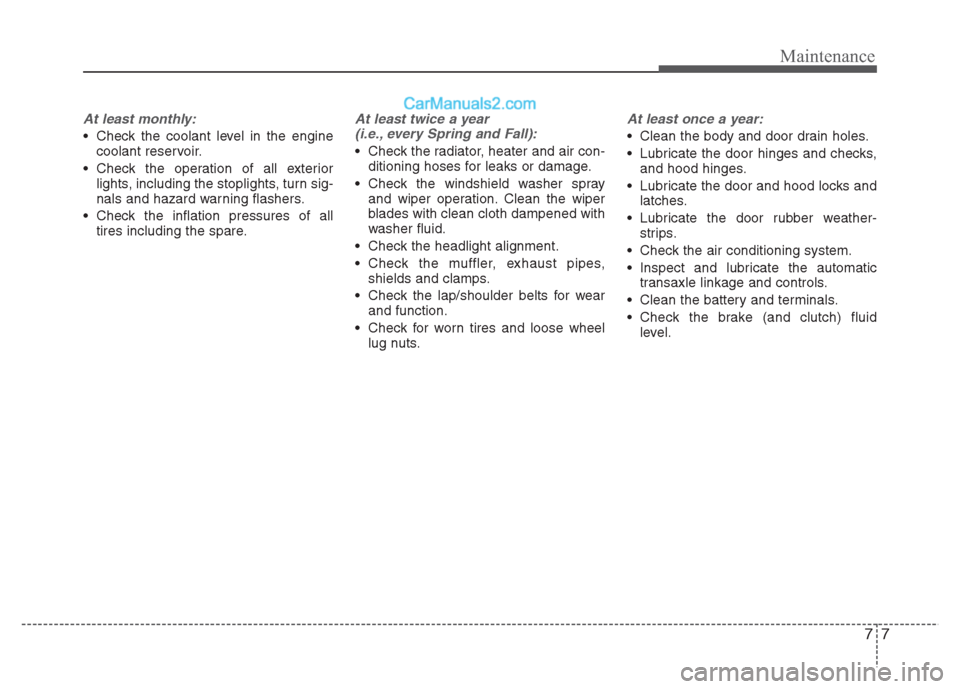
At least monthly:
Check the coolant level in the enginecoolant reservoir.
Check the operation of all exterior lights, including the stoplights, turn sig-
nals and hazard warning flashers.
Check the inflation pressures of all tires including the spare.
At least twice a year
(i.e., every Spring and Fall):
Check the radiator, heater and air con- ditioning hoses for leaks or damage.
Check the windshield washer spray and wiper operation. Clean the wiper
blades with clean cloth dampened with
washer fluid.
Check the headlight alignment.
Check the muffler, exhaust pipes, shields and clamps.
Check the lap/shoulder belts for wear and function.
Check for worn tires and loose wheel lug nuts.
At least once a year:
Clean the body and door drain holes.
Lubricate the door hinges and checks,and hood hinges.
Lubricate the door and hood locks and latches.
Lubricate the door rubber weather- strips.
Check the air conditioning system.
Inspect and lubricate the automatic transaxle linkage and controls.
Clean the battery and terminals.
Check the brake (and clutch) fluid level.
Page 259 of 343
Maintenance
12
7
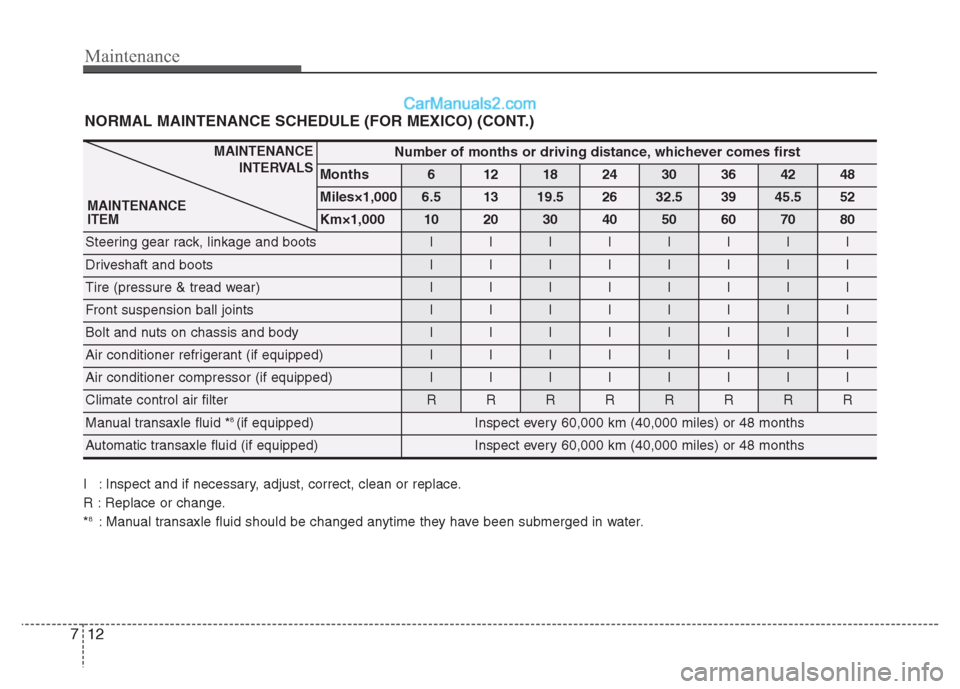
NORMAL MAINTENANCE SCHEDULE (FOR MEXICO) (CONT.)
Number of months or driving distance, whichever comes first
Months612182430364248
Miles×1,0006.51319.52632.53945.552
Km×1,0001020304050607080
Steering gear rack, linkage and bootsIIIIIIII
Driveshaft and bootsIIIIIIII
Tire (pressure & tread wear) IIIIIIII
Front suspension ball jointsIIIIIIII
Bolt and nuts on chassis and bodyIIIIIIII
Air conditioner refrigerant (if equipped)IIIIIIII
Air conditioner compressor (if equipped)IIIIIIII
Climate control air filter RRRRRRRR
Manual transaxle fluid * 8
(if equipped)Inspect every 60,000 km (40,000 miles) or 48 months
Automatic transaxle fluid (if equipped) Inspect every 60,000 km (40,000 miles) or 48 months
I : Inspect and if necessary, adjust, correct, clean or replace.
R : Replace or change.*8
: Manual transaxle fluid should be changed anytime they have been submerged in water.
MAINTENANCE
INTERVALS
MAINTENANCE ITEM
Page 263 of 343
Maintenance
16
7
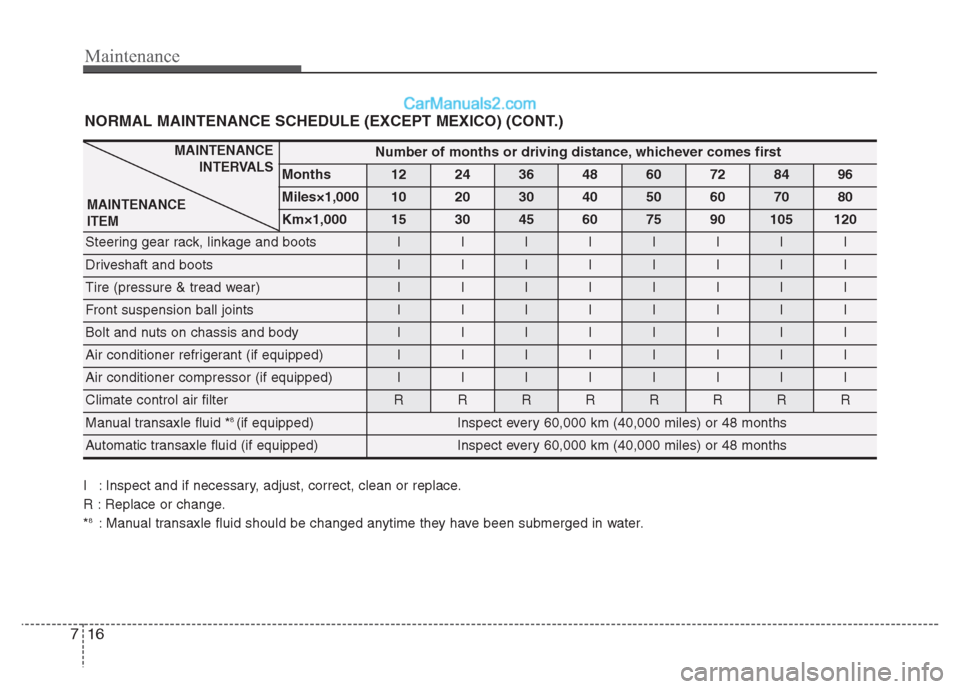
NORMAL MAINTENANCE SCHEDULE (EXCEPT MEXICO) (CONT.)
Number of months or driving distance, whichever comes first
Months1224364860728496
Miles×1,0001020304050607080
Km×1,000153045607590105120
Steering gear rack, linkage and bootsIIIIIIII
Driveshaft and bootsIIIIIIII
Tire (pressure & tread wear) IIIIIIII
Front suspension ball jointsIIIIIIII
Bolt and nuts on chassis and bodyIIIIIIII
Air conditioner refrigerant (if equipped)IIIIIIII
Air conditioner compressor (if equipped)IIIIIIII
Climate control air filter RRRRRRRR
Manual transaxle fluid * 8
(if equipped)Inspect every 60,000 km (40,000 miles) or 48 months
Automatic transaxle fluid (if equipped) Inspect every 60,000 km (40,000 miles) or 48 months
MAINTENANCE
INTERVALS
MAINTENANCE ITEM
I : Inspect and if necessary, adjust, correct, clean or replace.
R : Replace or change.* 8
: Manual transaxle fluid should be changed anytime they have been submerged in water.
Page 264 of 343
717
Maintenance
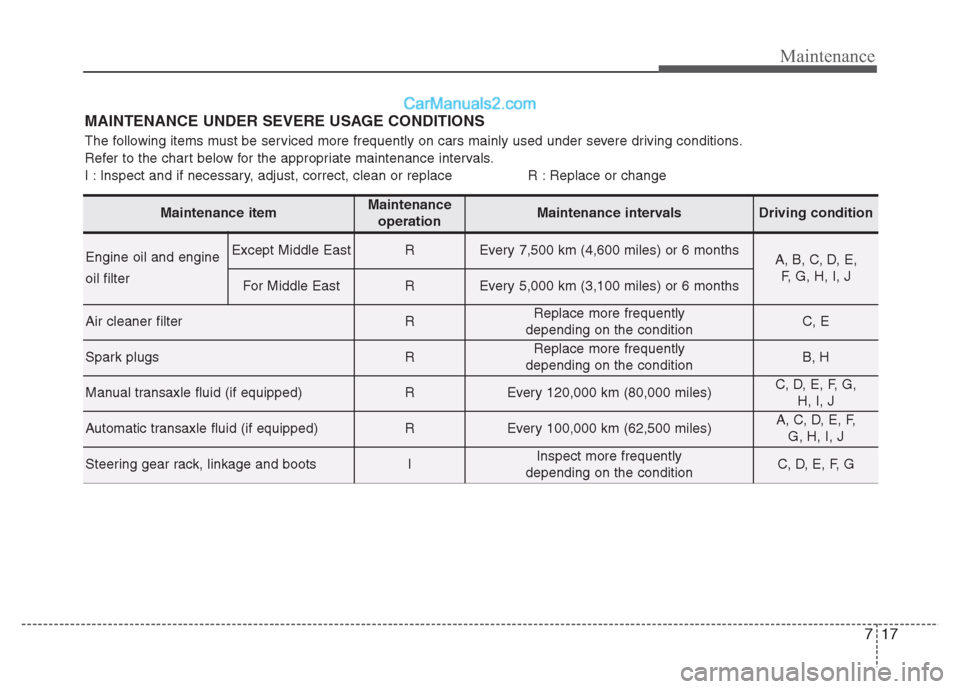
MAINTENANCE UNDER SEVERE USAGE CONDITIONS
The following items must be serviced more frequently on cars mainly used under severe driving conditions.
Refer to the chart below for the appropriate maintenance intervals.
I : Inspect and if necessary, adjust, correct, clean or replace R : Replace or change
Maintenance itemMaintenanceoperationMaintenance intervalsDriving condition
Engine oil and engine oil filterExcept Middle EastREvery 7,500 km (4,600 miles) or 6 months A, B, C, D, E, F, G, H, I, J
For Middle EastREvery 5,000 km (3,100 miles) or 6 months
Air cleaner filterRReplace more frequently
depending on the conditionC, E
Spark plugsRReplace more frequently
depending on the conditionB, H
Manual transaxle fluid (if equipped)REvery 120,000 km (80,000 miles)C, D, E, F, G, H, I, J
Automatic transaxle fluid (if equipped)REvery 100,000 km (62,500 miles)A, C, D, E, F,G, H, I, J
Steering gear rack, linkage and bootsIInspect more frequently
depending on the conditionC, D, E, F, G
Page 267 of 343
Maintenance
20
7
Air cleaner filter
When replacing the air cleaner filter, we
recommend that you use HYUNDAI gen-
uine parts. Spark plugs
Make sure to install new spark plugs of
the correct heat range.
Valve clearance (if equipped)
Inspect for excessive valve noise and/or
engine vibration and adjust if necessary.
We recommend that the system be serv-
iced by an authorized HYUNDAI dealer. Cooling system
Check the cooling system components,
such as the radiator, coolant reservoir,
hoses and connections for leakage and
damage. Replace any damaged parts. Coolant The coolant should be changed at the
intervals specified in the maintenance
schedule.
Manual transaxle fluid (if equipped)
Inspect the manual transaxle fluid
according to the maintenance schedule.
Automatic transaxle fluid (if equipped)
Inspect the automatic transaxle fluid
according to the maintenance schedule.
Brake hoses and lines
Visually check for proper installation,
chafing, cracks, deterioration and any
leakage. Replace any deteriorated or
damaged parts immediately. Brake fluid
Check the brake fluid level in the brake
fluid reservoir. The level should be
between “MIN” and “MAX” marks on the
side of the reservoir. Use only hydraulic
brake fluid conforming to DOT 3 or DOT4 specification.
Parking brake
Inspect the parking brake system includ-
ing the parking brake lever and cables.
Page 271 of 343
Maintenance
24
7
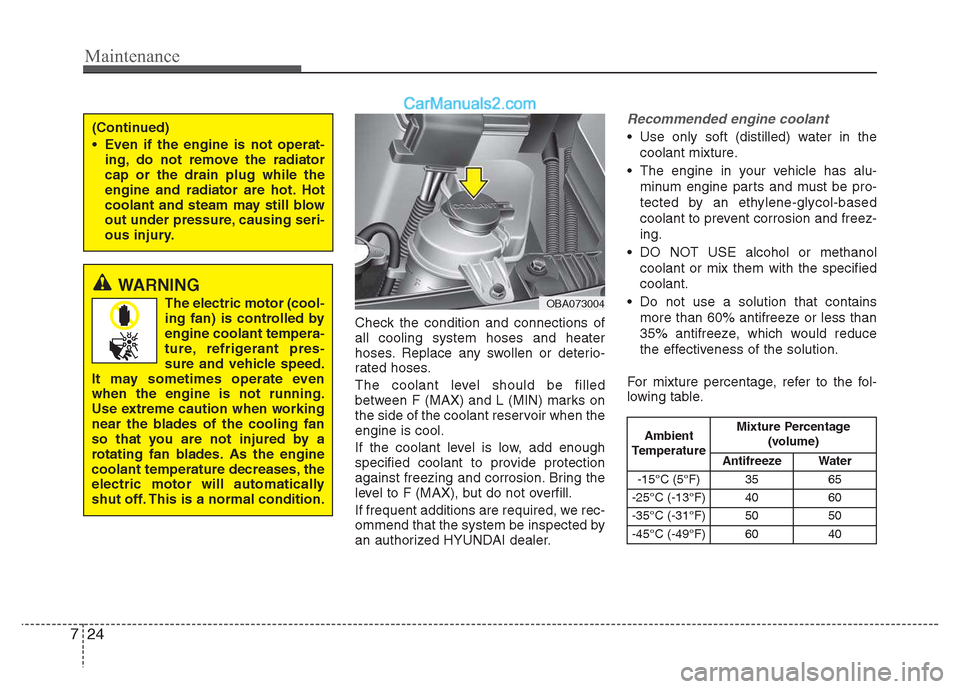
Check the condition and connections of all cooling system hoses and heater
hoses. Replace any swollen or deterio-
rated hoses.
The coolant level should be filled
between F (MAX) and L (MIN) marks on
the side of the coolant reservoir when theengine is cool.
If the coolant level is low, add enough
specified coolant to provide protection
against freezing and corrosion. Bring the
level to F (MAX), but do not overfill.
If frequent additions are required, we rec-
ommend that the system be inspected by
an authorized HYUNDAI dealer.
Recommended engine coolant
Use only soft (distilled) water in the
coolant mixture.
The engine in your vehicle has alu- minum engine parts and must be pro-
tected by an ethylene-glycol-based
coolant to prevent corrosion and freez-ing.
DO NOT USE alcohol or methanol coolant or mix them with the specifiedcoolant.
Do not use a solution that contains more than 60% antifreeze or less than
35% antifreeze, which would reduce
the effectiveness of the solution.
For mixture percentage, refer to the fol-
lowing table.(Continued)
Even if the engine is not operat- ing, do not remove the radiator cap or the drain plug while the
engine and radiator are hot. Hot
coolant and steam may still blow
out under pressure, causing seri-
ous injury.
WARNING
The electric motor (cool-
ing fan) is controlled byengine coolant tempera-
ture, refrigerant pres-
sure and vehicle speed.
It may sometimes operate evenwhen the engine is not running.
Use extreme caution when working
near the blades of the cooling fan
so that you are not injured by a
rotating fan blades. As the engine
coolant temperature decreases, the
electric motor will automatically
shut off. This is a normal condition.
OBA073004
Ambient
Temperature Mixture Percentage
(volume)
Antifreeze Water
-15°C (5°F) 35 65
-25°C (-13°F) 40 60
-35°C (-31°F) 50 50
-45°C (-49°F) 60 40
Page 274 of 343
727
Maintenance
AUTOMATIC TRANSAXLE FLUID (IF EQUIPPED)
Checking the automatic transaxle
fluid level
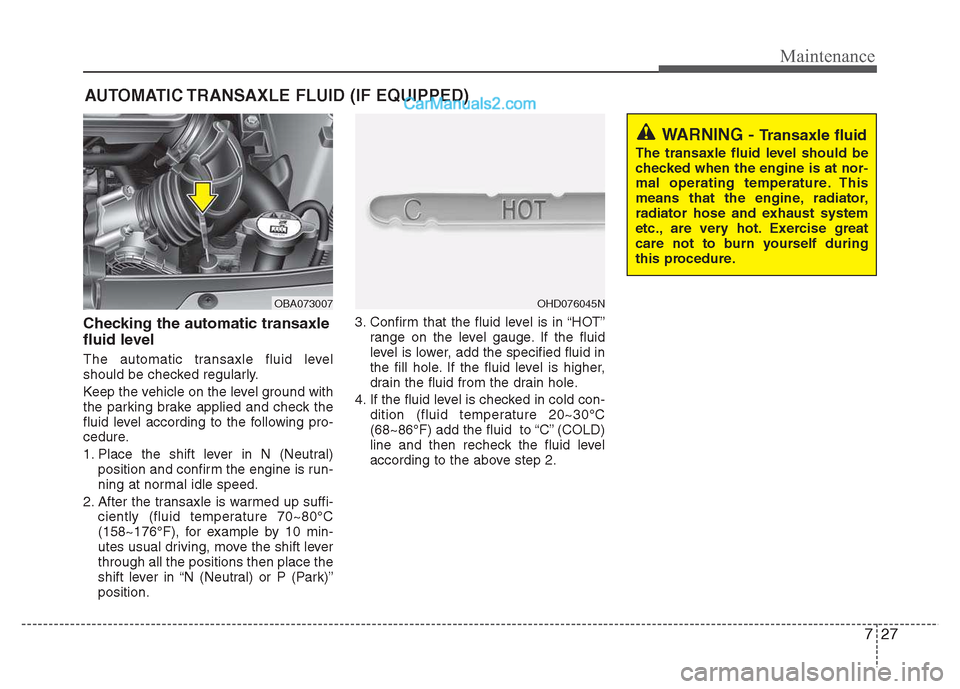
The automatic transaxle fluid level
should be checked regularly.
Keep the vehicle on the level ground with
the parking brake applied and check the
fluid level according to the following pro-
cedure.
1. Place the shift lever in N (Neutral) position and confirm the engine is run-
ning at normal idle speed.
2. After the transaxle is warmed up suffi- ciently (fluid temperature 70~80°C
(158~176°F), for example by 10 min-
utes usual driving, move the shift leverthrough all the positions then place the
shift lever in “N (Neutral) or P (Park)”position. 3. Confirm that the fluid level is in “HOT”
range on the level gauge. If the fluid
level is lower, add the specified fluid in
the fill hole. If the fluid level is higher,
drain the fluid from the drain hole.
4. If the fluid level is checked in cold con- dition (fluid temperature 20~30°C
(68~86°F) add the fluid to “C” (COLD)
line and then recheck the fluid level
according to the above step 2.
OBA073007OHD076045N
WARNING - Transaxle fluid
The transaxle fluid level should be
checked when the engine is at nor-
mal operating temperature. This
means that the engine, radiator,
radiator hose and exhaust system
etc., are very hot. Exercise great
care not to burn yourself during
this procedure.
Page 275 of 343
Maintenance
28
7
✽✽
NOTICE
“C” (COLD) range is for reference only
and should NOT be used to determine
the transaxle fluid level. ✽
✽
NOTICE
A new automatic transaxle fluid should
be red. The red dye is added so the
assembly plant can identify it as auto-
matic transaxle fluid and distinguish it
from engine oil or antifreeze. The red
dye, which is not an indicator of fluid
quality, is not permanent. As the vehicle
is driven, the automatic transaxle fluid
will begin to look darker. The color may
eventually appear light brown.
Therefore, we recommend that the sys-
tem be replaced by an authorized
HYUNDAI dealer according to the
Scheduled Maintenance at the begin-
ning of this chapter.
Use only the specified automatic
transaxle fluid. (Refer to “Recommended
lubricants and capacities” in chapter 8.) Changing the automatic transaxle fluid
We recommend that the system be
replaced by an authorized HYUNDAI
dealer.
WARNING
- Parking brake
To avoid sudden movement of the
vehicle, apply the parking brake
and depress the brake pedal before
moving the shift lever.
CAUTION
Low fluid level causes transaxle shift slippage. Overfilling can
cause foaming, loss of fluid andtransaxle malfunction.
The use of a non-specified fluid could result in transaxle malfunc-
tion and failure.
Page 335 of 343
Specifications & Consumer information
4
8
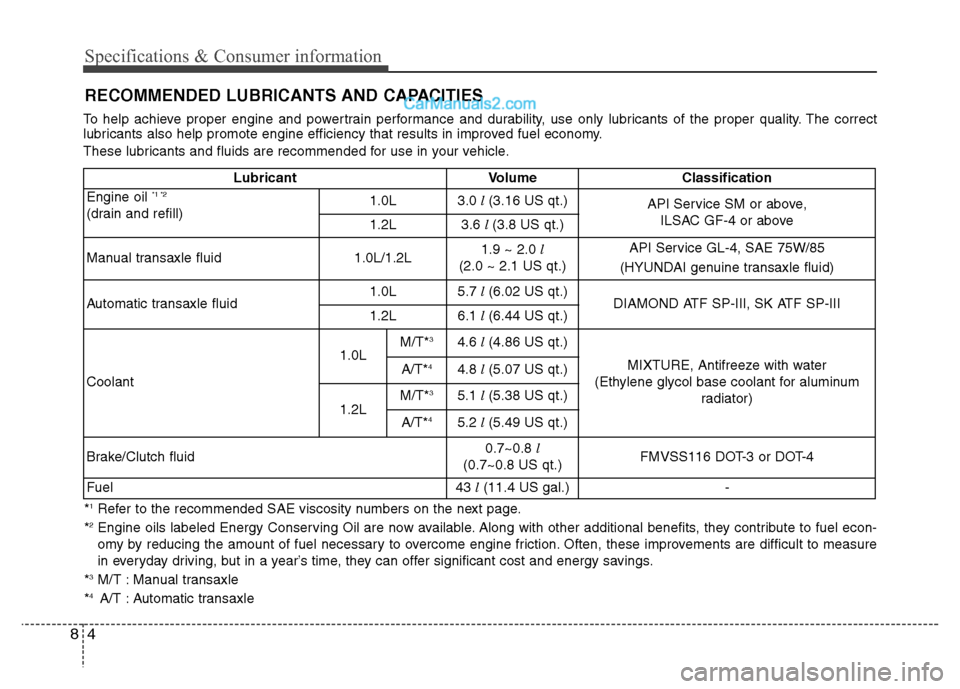
RECOMMENDED LUBRICANTS AND CAPACITIES
To help achieve proper engine and powertrain performance and durability, use only lubricants of the proper quality. The correct
lubricants also help promote engine efficiency that results in improved fuel economy.
These lubricants and fluids are recommended for use in your vehicle.
Lubricant Volume Classification
Engine oil *1 *2
(drain and refill)
1.0L 3.0
l (3.16 US qt.)
API Service SM or above,
ILSAC GF-4 or above
1.2L 3.6
l (3.8 US qt.)
Manual transaxle fluid
1.0L/1.2L 1.9 ~ 2.0
l
(2.0 ~ 2.1 US qt.) API Service GL-4, SAE 75W/85
(HYUNDAI genuine transaxle fluid)
Automatic transaxle fluid
1.0L 5.7
l (6.02 US qt.)
DIAMOND ATF SP-III, SK ATF SP-III
1.2L6.1
l (6.44 US qt.)
Coolant
1.0LM/T* 34.6
l (4.86 US qt.)
MIXTURE, Antifreeze with water
(Ethylene glycol base coolant for aluminum radiator)A/T*44.8
l (5.07 US qt.)
1.2LM/T* 35.1
l (5.38 US qt.)
A/T* 45.2
l (5.49 US qt.)
Brake/Clutch fluid0.7~0.8 l
(0.7~0.8 US qt.)FMVSS116 DOT-3 or DOT-4
Fuel43 l(11.4 US gal.)-
*1
Refer to the recommended SAE viscosity numbers on the next page.
* 2
Engine oils labeled Energy Conserving Oil are now available. Along with other additional benefits, they contribute to fuel econ-
omy by reducing the amount of fuel necessary to overcome engine friction. Often, these improvements are difficult to measure
in everyday driving, but in a year’s time, they can offer significant cost and energy savings.
* 3
M/T : Manual transaxle
* 4
A/T : Automatic transaxle