h12 Hyundai Ioniq Electric 2017 Owner's Manual
[x] Cancel search | Manufacturer: HYUNDAI, Model Year: 2017, Model line: Ioniq Electric, Model: Hyundai Ioniq Electric 2017Pages: 582, PDF Size: 37.73 MB
Page 8 of 582
EEllee ccttrr iicc VV eehh iicc llee SS yyssttee mm OO vvee rrvv iiee ww
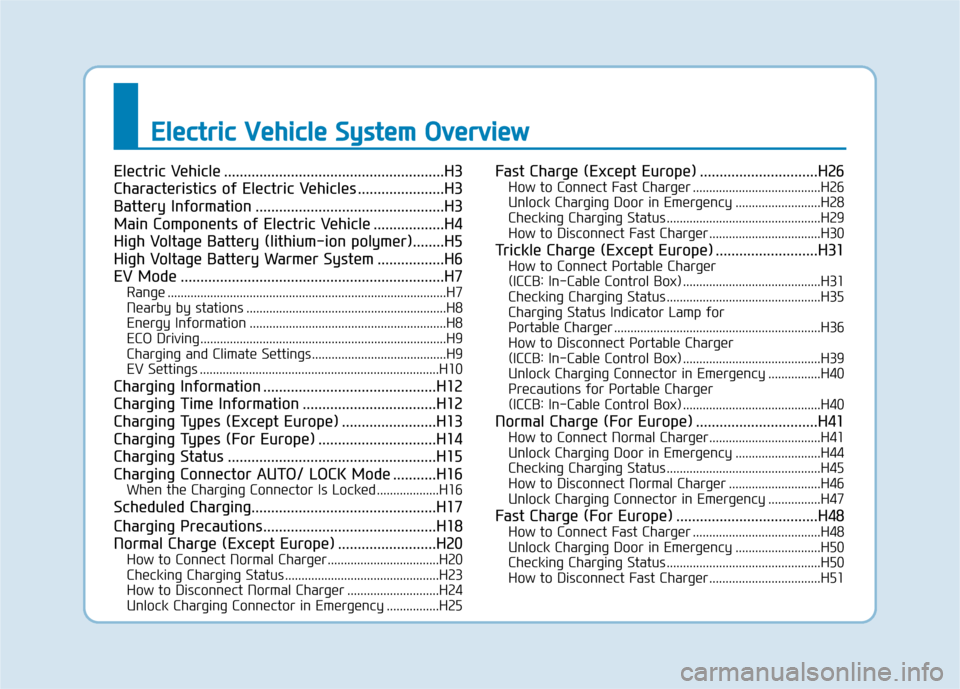
Electric Vehicle ........................................................H3
Characteristics of Electric Vehicles ......................H3
Battery Information ................................................H3
Main Components of Electric Vehicle ..................H4
High Voltage Battery (lithium-ion polymer)........H5
High Voltage Battery Warmer System .................H6
EV Mode ...................................................................H7
Range .....................................................................................H7
Nearby by stations .............................................................H8
Energy Information ............................................................H8
ECO Driving ...........................................................................H9
Charging and Climate Settings.........................................H9
EV Settings .........................................................................H10
Charging Information ............................................H12
Charging Time Information ..................................H12
Charging Types (Except Europe) ........................H13
Charging Types (For Europe) ..............................H14
Charging Status .....................................................H15
Charging Connector AUTO/ LOCK Mode ...........H16 When the Charging Connector Is Locked ...................H16
Scheduled Charging...............................................H17
Charging Precautions............................................H18
Normal Charge (Except Europe) .........................H20 How to Connect Normal Charger..................................H20
Checking Charging Status ...............................................H23
How to Disconnect Normal Charger ............................H24
Unlock Charging Connector in Emergency ................H25 Fast Charge (Except Europe) ..............................H26
How to Connect Fast Charger .......................................H26
Unlock Charging Door in Emergency ..........................H28
Checking Charging Status ...............................................H29
How to Disconnect Fast Charger ..................................H30
Trickle Charge (Except Europe) ..........................H31 How to Connect Portable Charger
(ICCB: In-Cable Control Box) ..........................................H31Checking Charging Status ...............................................H35
Charging Status Indicator Lamp for
Portable Charger ...............................................................H36
How to Disconnect Portable Charger
(ICCB: In-Cable Control Box) ..........................................H39 Unlock Charging Connector in Emergency ................H40
Precautions for Portable Charger
(ICCB: In-Cable Control Box) ..........................................H40
Normal Charge (For Europe) ...............................H41 How to Connect Normal Charger..................................H41
Unlock Charging Door in Emergency ..........................H44
Checking Charging Status ...............................................H45
How to Disconnect Normal Charger ............................H46
Unlock Charging Connector in Emergency ................H47
Fast Charge (For Europe) ....................................H48 How to Connect Fast Charger .......................................H48
Unlock Charging Door in Emergency ..........................H50
Checking Charging Status ...............................................H50
How to Disconnect Fast Charger ..................................H51
Page 19 of 582
H12
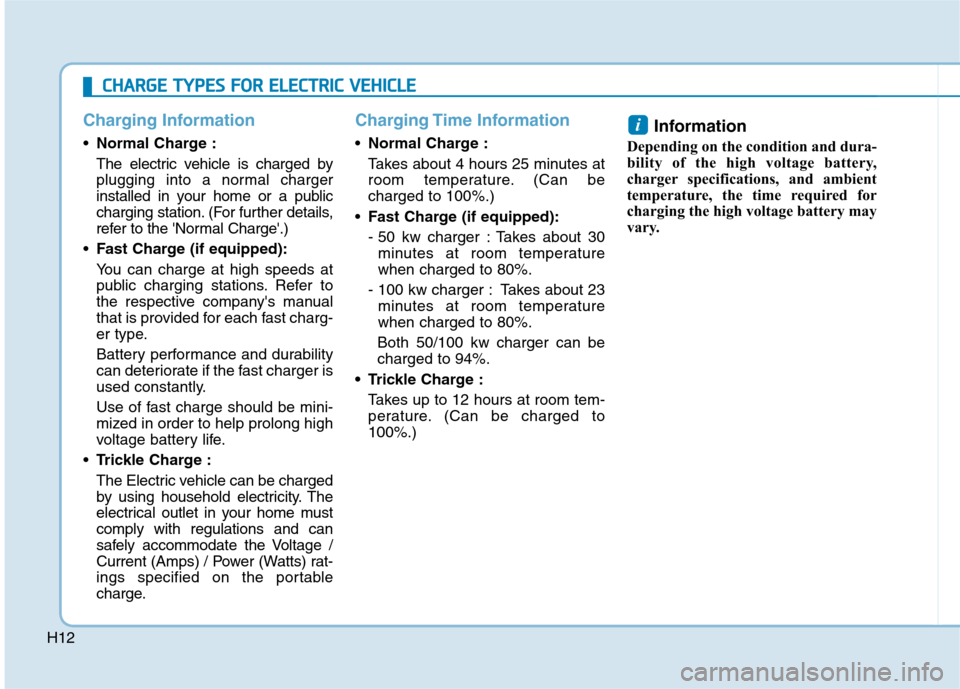
Charging Information
Normal Charge :
The electric vehicle is charged by
plugging into a normal charger
installed in your home or a public
charging station. (For further details,
refer to the 'Normal Charge'.)
Fast Charge (if equipped):
You can charge at high speeds at
public charging stations. Refer to
the respective company's manual
that is provided for each fast charg-
er type.
Battery performance and durability
can deteriorate if the fast charger is
used constantly.
Use of fast charge should be mini-
mized in order to help prolong high
voltage battery life.
Trickle Charge :
The Electric vehicle can be charged
by using household electricity. The
electrical outlet in your home mustcomply with regulations and can
safely accommodate the Voltage /
Current (Amps) / Power (Watts) rat-
ings specified on the portable
charge.
Charging Time Information
Normal Charge :
Takes about 4 hours 25 minutes at
room temperature. (Can becharged to 100%.)
Fast Charge (if equipped):
- 50 kw charger : Takes about 30
minutes at room temperature when charged to 80%.
- 100 kw charger : Takes about 23 minutes at room temperaturewhen charged to 80%.
Both 50/100 kw charger can becharged to 94%.
Trickle Charge :
Takes up to 12 hours at room tem-
perature. (Can be charged to100%.) Information
Depending on the condition and dura-
bility of the high voltage battery,
charger specifications, and ambient
temperature, the time required for
charging the high voltage battery may
vary.
i
CC HH AARRGG EE TT YY PPEESS FF OO RR EE LLEE CCTT RR IICC VV EEHH IICC LLEE