wheel size Hyundai Ioniq Hybrid 2017 User Guide
[x] Cancel search | Manufacturer: HYUNDAI, Model Year: 2017, Model line: Ioniq Hybrid, Model: Hyundai Ioniq Hybrid 2017Pages: 553, PDF Size: 59.51 MB
Page 466 of 553
7-45
7
Maintenance
Wheel alignment and tire bal- ance
The wheels on your vehicle were aligned and balanced carefully at the
factory to give you the longest tire life
and best overall performance.
In most cases, you will not need to
have your wheels aligned again.
However, if you notice unusual tire
wear or your vehicle pulling one way
or the other, the alignment may needto be reset.
If you notice your vehicle vibrating
when driving on a smooth road, your
wheels may need to be rebalanced.
Improper wheel weights can dam-
age your vehicle’s aluminum
wheels. Use only approved wheelweights.
Tire replacement
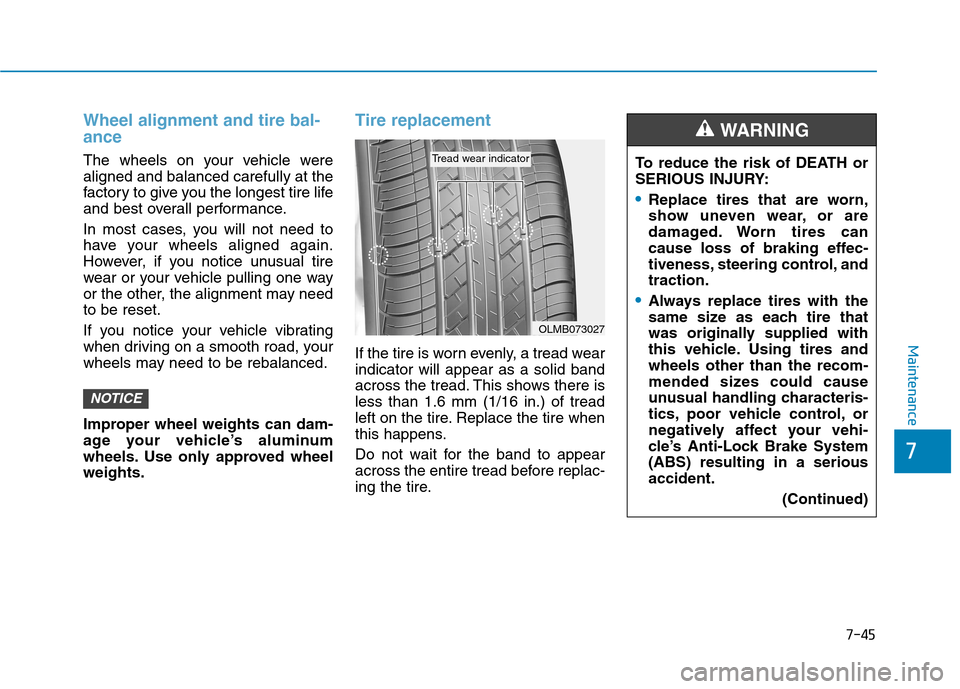
If the tire is worn evenly, a tread wear indicator will appear as a solid band
across the tread. This shows there isless than 1.6 mm (1/16 in.) of tread
left on the tire. Replace the tire when
this happens.
Do not wait for the band to appear
across the entire tread before replac-
ing the tire.
NOTICE
OLMB073027
Tread wear indicatorTo reduce the risk of DEATH or
SERIOUS INJURY:
Replace tires that are worn,
show uneven wear, or are
damaged. Worn tires can
cause loss of braking effec-
tiveness, steering control, andtraction.
Always replace tires with the
same size as each tire that
was originally supplied with
this vehicle. Using tires andwheels other than the recom-
mended sizes could cause
unusual handling characteris-
tics, poor vehicle control, or
negatively affect your vehi-
cle’s Anti-Lock Brake System(ABS) resulting in a seriousaccident.
(Continued)
WARNING
Page 467 of 553
7-46
Maintenance
Compact spare tire replacement(if equipped)
A compact spare tire has a shorter
tread life than a regular size tire.
Replace it when you can see the
tread wear indicator bars on the tire.The replacement compact spare tire
should be the same size and design
tire as the one provided with your
new vehicle and should be mountedon the same compact spare tire
wheel. The compact spare tire is notdesigned to be mounted on a regular
size wheel, and the compact spare
tire wheel is not designed for mount-
ing a regular size tire.
Wheel replacement
When replacing the metal wheels for
any reason, make sure the new
wheels are equivalent to the original
factory units in diameter, rim widthand offset.
Tire traction
Tire traction can be reduced if you
drive on worn tires, tires that are
improperly inflated or on slippery
road surfaces. Tires should be
replaced when tread wear indicators
appear. To reduce the possibility of
losing control, slow down whenever
there is rain, snow or ice on the road.
(Continued)
When replacing tires (or
wheels), it is recommended to
replace the two front or two
rear tires (or wheels) as a pair.Replacing just one tire can
seriously affect your vehicle’shandling.
Tires degrade over time, even
when they are not being used.
Regardless of the remaining
tread, HYUNDAI recommendsthat tires be replaced after six
(6) years of normal service.
Heat caused by hot climates or frequent high loading condi-
tions can accelerate the aging
process. Failure to follow this
warning may cause sudden
tire failure, which could lead to
a loss of vehicle control result-ing in an accident.
The original tire should be repaired or replaced as soon as
possible to avoid failure of the
spare and loss of vehicle control
resulting in an accident. The com-
pact spare tire is for emergency
use only. Do not operate your
vehicle over 80 km/h (50 mph)when using the compact spare
tire.
WARNING
Page 468 of 553
7-47
7
Maintenance
Tire maintenance
In addition to proper inflation, correct wheel alignment helps to decrease
tire wear. If you find a tire is worn
unevenly, have your dealer check thewheel alignment.
When you have new tires installed,
make sure they are balanced. This
will increase vehicle ride comfort and
tire life. Additionally, a tire should
always be rebalanced if it is removedfrom the wheel.
Tire sidewall labeling
This information identifies and
describes the fundamental charac-
teristics of the tire and also provides
the tire identification number (TIN)
for safety standard certification. TheTIN can be used to identify the tire incase of a recall.
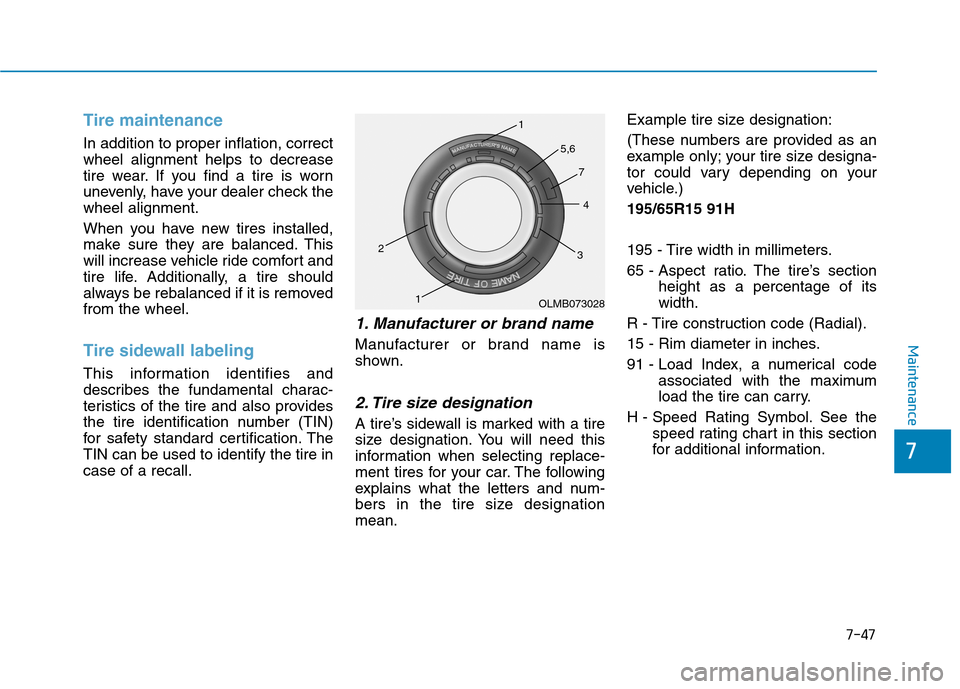
1. Manufacturer or brand name
Manufacturer or brand name is
shown.
2. Tire size designation
A tire’s sidewall is marked with a tire
size designation. You will need this
information when selecting replace-
ment tires for your car. The following
explains what the letters and num-
bers in the tire size designationmean.Example tire size designation:
(These numbers are provided as an
example only; your tire size designa-
tor could vary depending on your
vehicle.) 195/65R15 91H
195 - Tire width in millimeters.
65 - Aspect ratio. The tire’s section
height as a percentage of its width.
R - Tire construction code (Radial).
15 - Rim diameter in inches.
91 - Load Index, a numerical code associated with the maximum
load the tire can carry.
H - Speed Rating Symbol. See the speed rating chart in this section
for additional information.
OLMB073028
1
1
2
34
5,6
7
Page 469 of 553
7-48
Maintenance
Wheel size designation
Wheels are also marked with impor-
tant information that you need if you
ever have to replace one. The follow-
ing explains what the letters and
numbers in the wheel size designa-tion mean.
Example wheel size designation:6.5JX16
6.5 - Rim width in inches.J - Rim contour designation.
16 - Rim diameter in inches.
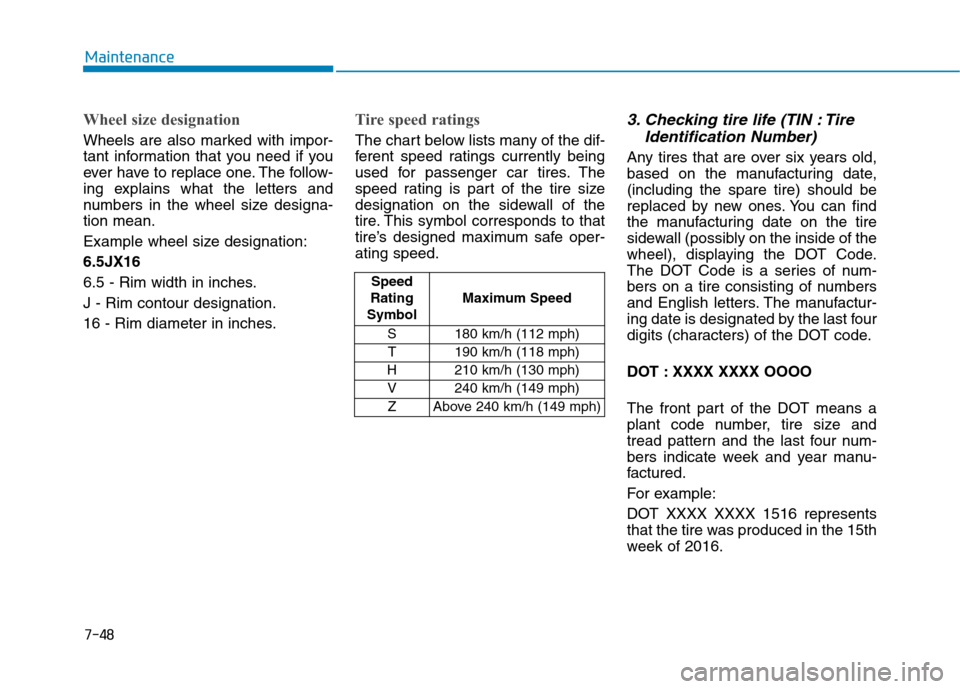
Tire speed ratings
The chart below lists many of the dif-
ferent speed ratings currently being
used for passenger car tires. The
speed rating is part of the tire size
designation on the sidewall of the
tire. This symbol corresponds to that
tire’s designed maximum safe oper-ating speed.
3. Checking tire life (TIN : TireIdentification Number)
Any tires that are over six years old,
based on the manufacturing date,(including the spare tire) should be
replaced by new ones. You can find
the manufacturing date on the tire
sidewall (possibly on the inside of the
wheel), displaying the DOT Code.
The DOT Code is a series of num-
bers on a tire consisting of numbers
and English letters. The manufactur-
ing date is designated by the last four
digits (characters) of the DOT code.
DOT : XXXX XXXX OOOO
The front part of the DOT means a
plant code number, tire size and
tread pattern and the last four num-
bers indicate week and year manu-
factured.
For example:
DOT XXXX XXXX 1516 represents
that the tire was produced in the 15th
week of 2016.
Speed
Rating
Symbol Maximum Speed
S 180 km/h (112 mph) T 190 km/h (118 mph)
H 210 km/h (130 mph) V 240 km/h (149 mph) Z Above 240 km/h (149 mph)
Page 518 of 553
8-4
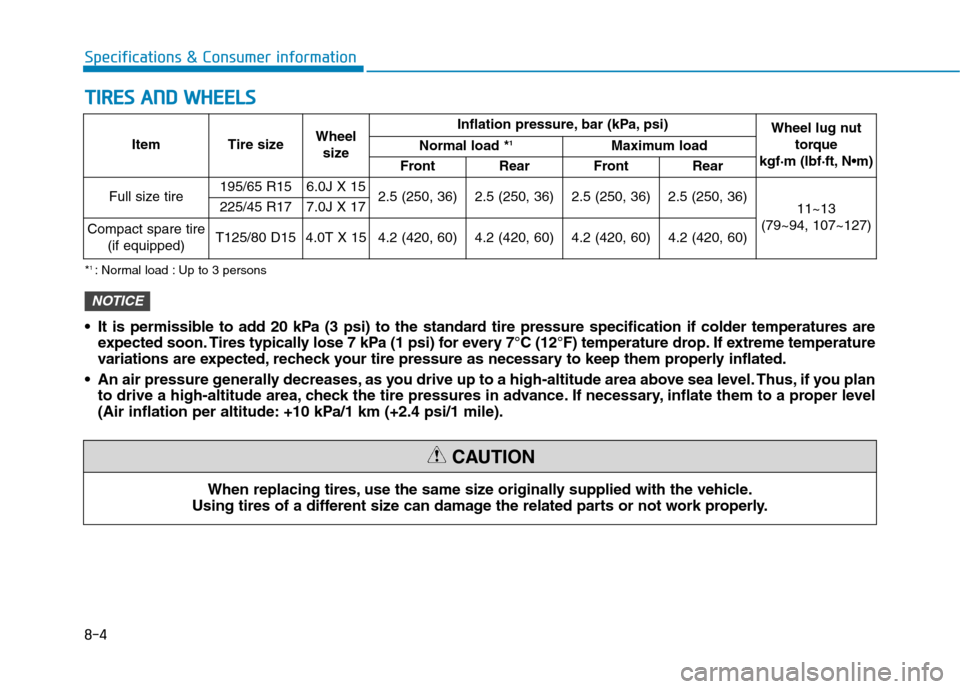
Specifications & Consumer informationT
T IIRR EESS AA NN DD WW HHEEEELLSS
Item Tire size Wheel
size Inflation pressure, bar (kPa, psi)
Wheel lug nut
torque
kgf·m (lbf·ft, N
Normal load *
1
Maximum load
Front Rear Front Rear
Full size tire 195/65 R15 6.0J X 15
2.5 (250, 36) 2.5 (250, 36) 2.5 (250, 36) 2.5 (250, 36)
11~13
(79~94, 107~127)
225/45 R17 7.0J X 17
Compact spare tire
(if equipped)T125/80 D154.0T X 154.2 (420, 60)4.2 (420, 60)4.2 (420, 60)4.2 (420, 60)
When replacing tires, use the same size originally supplied with the vehicle.
Using tires of a different size can damage the related parts or not work properly.
CAUTION
* 1
: Normal load : Up to 3 persons
It is permissible to add 20 kPa (3 psi) to the standard tire pressure specification if colder temperatures are expected soon. Tires typically lose 7 kPa (1 psi) for every 7°C (12°F) temperature drop. If extreme temperature
variations are expected, recheck your tire pressure as necessary to keep them properly inflated.
An air pressure generally decreases, as you drive up to a high-altitude area above sea level. Thus, if you plan to drive a high-altitude area, check the tire pressures in advance. If necessary, inflate them to a proper level
(Air inflation per altitude: +10 kPa/1 km (+2.4 psi/1 mile).
NOTICE
Page 519 of 553
8-5
8
Specifications & Consumer information
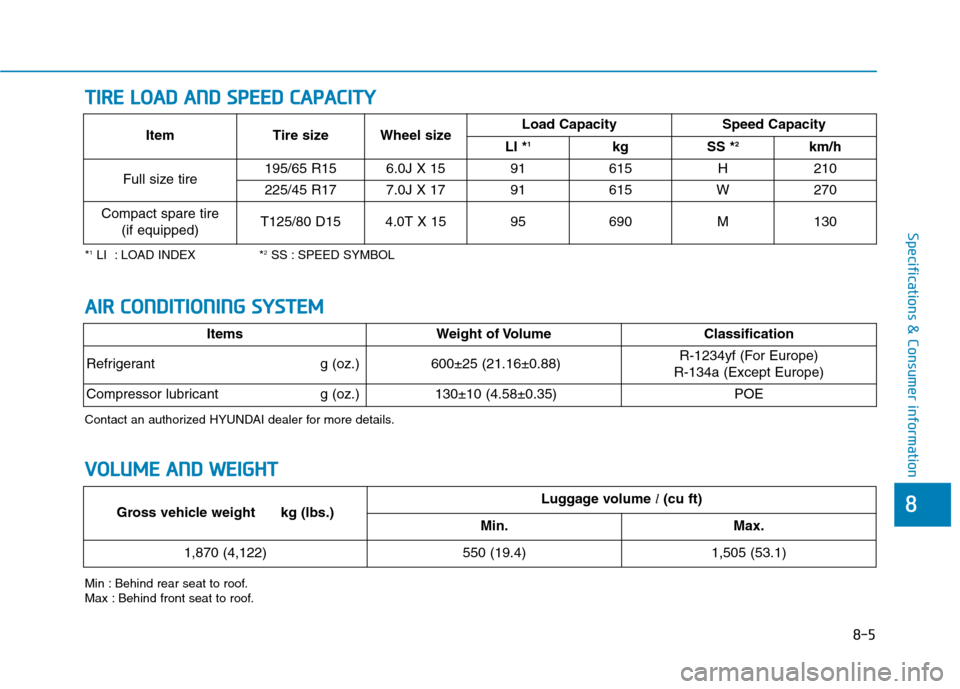
TTIIRR EE LL OO AADD AA NN DD SS PP EEEE DD CC AA PPAA CCIITT YY
*1
LI : LOAD INDEX * 2
SS : SPEED SYMBOL
Min : Behind rear seat to roof.
Max : Behind front seat to roof. Item Tire size Wheel size
Load Capacity Speed Capacity
LI * 1
kg SS * 2
km/h
Full size tire 195/65 R15 6.0J X 15 91 615 H 210
225/45 R17 7.0J X 17 91 615 W 270
Compact spare tire
(if equipped)T125/80 D154.0T X 1595690M130
VVOO LLUU MM EE AA NN DD WW EEIIGG HH TT
Gross vehicle weight kg (lbs.)Luggage volume l(cu ft)
Min.Max.
1,870 (4,122)550 (19.4)1,505 (53.1)
AA IIRR CC OO NNDDIITT IIOO NNIINN GG SS YY SSTT EEMM
ItemsWeight of Volume Classification
Refrigerant g (oz.)600±25 (21.16±0.88)R-1234yf (For Europe)
R-134a (Except Europe)
Compressor lubricant g (oz.)130±10 (4.58±0.35)POE
Contact an authorized HYUNDAI dealer for more details.