air condition Hyundai Matrix 2003 User Guide
[x] Cancel search | Manufacturer: HYUNDAI, Model Year: 2003, Model line: Matrix, Model: Hyundai Matrix 2003Pages: 312, PDF Size: 4.1 MB
Page 91 of 312
FEATURES OF YOUR HYUNDAI 1- 83
H290F01O-GAT
1. CD Select Button
o Insert the CD with the label facing upward.
o Insert the CD to start CD playback, during
radio operation or cassette tape playing.
o When a disc is in the CD deck, if you press the CD button the CD player will beginplaying even if the radio or cassette playeris being used.
o The CD player can be used when the igni- tion switch is in either the "ON" or "ACC"position.
2. FF/REW ( / ) If you want to fast forward or reverse through the compact disc track, push and hold in the FF( ) or REW ( ) button.When you release the button, the compact discplayer will resume playing.
3. TRACK UP/DOWN
o The desired track on the disc currently being played can be selected using the track number.
o Press button once to skip forward to the beginning of the next track. Press buttononce to skip back to the beginning of thetrack. 4. REPEAT
o To repeat the track you are currently listen-
ing to, press the RPT button. To cancel , press again.
o If you do not release RPT operation when the track ends, it will automatically be re-played.This process will be continued until youpush the button again.
5. EQUALIZER Button Press the EQ button to select the CLASSIC, JAZZ, ROCK and DEFEAT MODE for the de-sired tone quality. Each press of the buttonchanges the display as follows; NOTE:
o To assure proper operation of the unit,
keep the vehicle interior temperaturewithin a normal range by using thevehicle's air conditioning or heating sys-tem.
o When replacing the fuse, replace it with a fuse having the correct capacity.
o The preset station frequencies are all erased when the car battery is discon-nected. Therefore, all data will have to beset again if this should occur.
o Do not add any oil to the rotating parts. Keep magnets, screwdrivers and othermetallic objects away from the tapemechanism and head.
o This equipment is designed to be used only in a 12 volt DC battery system withnegative ground.
o This unit is made of precision parts. Do not attempt to disassemble or adjust anyparts.
o When driving your vehicle, be sure to keep the volume of the unit set low enoughto allow you to hear sounds coming fromthe outside.
o Do not expose this equipment (including the speakers and tape) to water or exces-sive moisture.
CLASSIC JAZZ ROCK DEFEAT
6. CD EJECT Button When the button is pressed with a CD loaded, the CD will eject.
7. SCAN Button (If installed)
o Press the SCAN button to playback the first 10 seconds of each track.
o Press the SCAN button again within 10 sec. for the desired track.
Page 107 of 312
DRIVING YOUR HYUNDAI
2- 10 C150A01A-AAT
SMOOTH CORNERING
Avoid braking or gear changing in corners, espe- cially when roads are wet. Ideally, corners should always be taken under gentle acceleration. If you follow these suggestions, tire wear will be held to a minimum.
curbs or driving too fast over irregular surfac- es. Poor alignment causes faster tire wear and may also result in other problems as well as greater fuel consumption.
o Keep your car in good condition. For better
fuel economy and reduced maintenance costs, maintain your car in accordance with the maintenance schedule in Section 5. If you drive your car in severe conditions, more frequent maintenance is required (see Sec- tion 5 for details).
o Keep your car clean. For maximum service, your Hyundai should be kept clean and free of corrosive materials. It is especially important that mud, dirt, ice, etc. not be allowed to accumulate on the underside of the car. This extra weight can result in increased fuel con- sumption and also contribute to corrosion.
o Travel lightly. Don't carry unnecessary weight
in your car. Weight reduces fuel economy.
o Don't let the engine idle longer than neces-
sary. If you are waiting (and not in traffic), turn off your engine and restart only when you're ready to go.
o Remember, your Hyundai does not require
extended warm-up. As soon as the engine is running smoothly, you can drive away. In very cold weather, however, give your engine a slightly longer warm-up period.
o Don't "lug" or "over-rev" the engine. Lugging is driving too slowly in too high a gear result- ing in the engine bucking. If this happens, shift to a lower gear. Over-revving is racing the engine beyond its safe limit. This can be C160A01A-AAT WINTER DRIVING The more severe weather conditions of winter result in greater wear and other problems. To minimize the problems of winter driving, you should follow these suggestions: C160B01A-GAT Snowy or Icy ConditionsTo drive your vehicle in deep snow, it may be necessary to use snow tires or to install tire chains on your tires. If snow tires are needed, it is necessary to select tires equivalent in size and type to the original equipment tires. Failure to do so may adversely affect the safety and handling of your car. Speeding, rapid acceleration, sud- den brake applications, and sharp turns are potentially very hazardous practices. During
C140A01A-GAT DRIVING FOR ECONOMY You can save fuel and get more kilometers from your car if you follow these suggestions:
o Drive smoothly. Accelerate at a moderate
rate. Don't make "jack-rabbit" starts or full- throttle shifts and maintain a steady cruising speed. Don't race between stoplights. Try to adjust your speed to that of the other traffic so you don't have to change speeds unneces- sarily. Avoid heavy traffic whenever possible. Always maintain a safe distance from other vehicles so you can avoid unnecessary brak- ing. This also reduces brake wear.
o Drive at a moderate speed. The faster you drive, the more fuel your car uses. Driving at a moderate speed, especially on the high- way, is one of the most effective ways to reduce fuel consumption.
o Don't "ride" the brake or clutch pedal. This
can increase fuel consumption and also in- crease wear on these components. In addi- tion, driving with your foot resting on the brake pedal may cause the brakes to overheat, which reduces their effectiveness and may lead to more serious consequences.
o Take care of your tires. Keep them inflated to the recommended pressure. Incorrect infla- tion, either too much or too little, results in unnecessary tire wear. Check the tire pres- sures at least once a month.
o Be sure that the wheels are aligned correctly.
Improper alignment can result from hitting avoided by shifting at the recommendedspeeds.
o Use your air conditioning sparingly. The air
conditioning system is operated by engine power so your fuel economy is reduced when you use it.
Page 111 of 312
DRIVING YOUR HYUNDAI
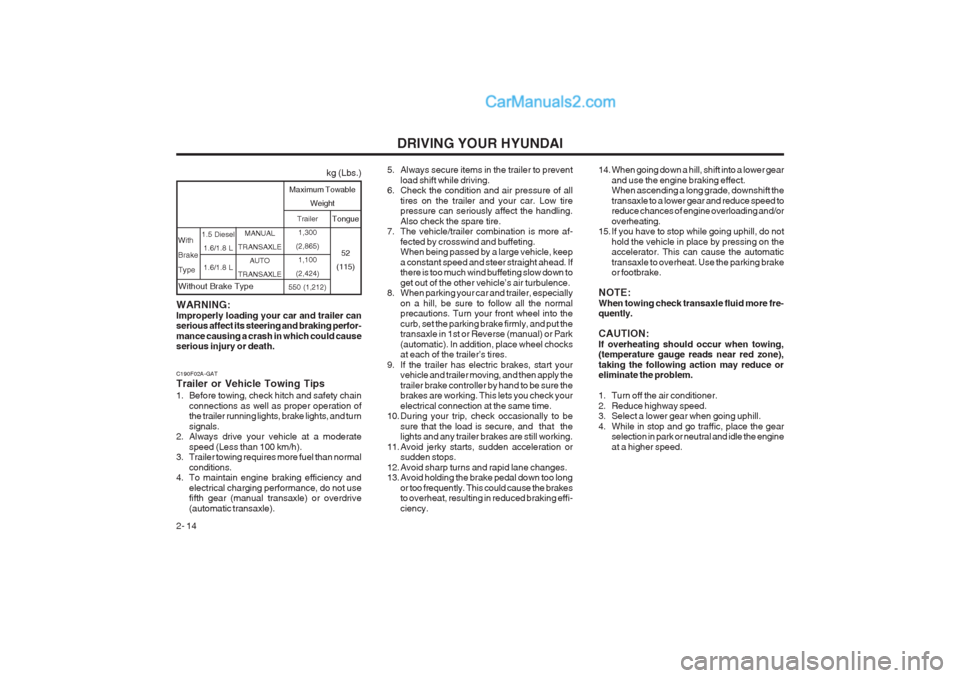
2- 14 MANUAL
TRANSAXLE AUTO
TRANSAXLE Trailer
1,300
(2,865) 1,100
(2,424)
550 (1,212) Tongue
52
(115)
kg (Lbs.)
Maximum Towable Weight
With BrakeType
1.5 Diesel 1.6/1.8 L 1.6/1.8 L
WARNING: Improperly loading your car and trailer can serious affect its steering and braking perfor- mance causing a crash in which could cause serious injury or death.
Without Brake Type
5. Always secure items in the trailer to prevent load shift while driving.
6. Check the condition and air pressure of all
tires on the trailer and your car. Low tire pressure can seriously affect the handling. Also check the spare tire.
7. The vehicle/trailer combination is more af-
fected by crosswind and buffeting. When being passed by a large vehicle, keep a constant speed and steer straight ahead. If there is too much wind buffeting slow down to get out of the other vehicle’s air turbulence.
8. When parking your car and trailer, especially
on a hill, be sure to follow all the normal precautions. Turn your front wheel into the curb, set the parking brake firmly, and put the transaxle in 1st or Reverse (manual) or Park (automatic). In addition, place wheel chocks at each of the trailer’s tires.
9. If the trailer has electric brakes, start your vehicle and trailer moving, and then apply the trailer brake controller by hand to be sure the brakes are working. This lets you check your electrical connection at the same time.
10. During your trip, check occasionally to be
sure that the load is secure, and that the lights and any trailer brakes are still working.
11. Avoid jerky starts, sudden acceleration or sudden stops.
12. Avoid sharp turns and rapid lane changes.
13. Avoid holding the brake pedal down too long or too frequently. This could cause the brakesto overheat, resulting in reduced braking effi- ciency. 14. When going down a hill, shift into a lower gear
and use the engine braking effect. When ascending a long grade, downshift the transaxle to a lower gear and reduce speed to reduce chances of engine overloading and/or overheating.
15. If you have to stop while going uphill, do not
hold the vehicle in place by pressing on the accelerator. This can cause the automatic transaxle to overheat. Use the parking brake or footbrake.
NOTE: When towing check transaxle fluid more fre- quently. CAUTION: If overheating should occur when towing, (temperature gauge reads near red zone), taking the following action may reduce or eliminate the problem.
1. Turn off the air conditioner.
2. Reduce highway speed.
3. Select a lower gear when going uphill.
4. While in stop and go traffic, place the gear selection in park or neutral and idle the engineat a higher speed.
C190F02A-GAT Trailer or Vehicle Towing Tips
1. Before towing, check hitch and safety chain
connections as well as proper operation of the trailer running lights, brake lights, and turn signals.
2. Always drive your vehicle at a moderate
speed (Less than 100 km/h).
3. Trailer towing requires more fuel than normal
conditions.
4. To maintain engine braking efficiency and
electrical charging performance, do not use fifth gear (manual transaxle) or overdrive (automatic transaxle).
Page 113 of 312
WHAT TO DO IN AN EMERGENCY
3-2
When jump starting, wear protective glasses and be careful not to get acid on yourself, your clothing or on the car.
o If you should accidentally get acid on your
skin or in your eyes, immediately remove any contaminated clothing and flush the area with clear water for at least 15 minutes. Then promptly obtain medical attention. If you must be transported to an emergency facility, con- tinue to apply water to the affected area with a sponge or cloth.
o The gas produced by the battery during the
jump-start operation is highly explosive. Do not smoke or allow a spark or an open flame in the vicinity.
o The battery being used to provide the jump
start must be 12-volt. If you cannot determine that it is a 12-volt battery, do not attempt to use it for the jump start.
o To jump start a car with a discharged battery,
follow this procedure exactly:
1. If the booster battery is installed in another vehicle, be sure the two vehicles are nottouching.
2. Turn off all unnecessary lights and acces-
sories in both vehicles. 3. Attach the clamps of the jumper cable in the
exact location shown. First, attach one clamp of the jumper cable to the positive (+) post or cable of the discharged battery. Then attach the other end of the same cable to the positive (+) post or cable of the booster battery. Next, using the other cable, attach one clamp to the negative (-) post or cable of the booster battery. Then attach the other end of that cable to a solid metal part of the engine away from the battery. Do not connect the cable to any moving part.
4. Start the engine in the car with the booster
battery and let it run for a few minutes. This will help to assure that the booster battery is fully charged. During the jumping operation, run the engine in this vehicle at about 2,000 rpm.
5. Start the engine in the car with the discharged
battery using the normal starting procedure. After the engine starts, leave the jumper cables connected and let the engine run at fast idle or about 2,000 rpm for several min- utes.
6. Carefully remove the jumper cables in the
reverse order of attachment.
If you do not know why your battery became discharged (because the lights were left on, etc.), have the charging system checked by your Hyundai dealer. D030A02A-AAT IF THE ENGINE OVERHEATS If your temperature gauge indicates overheating, you experience a loss of power, or hear loud pinging or knocking, the engine is probably too hot. If this happens to you, you should:
1. Pull off the road and stop as soon as it is safe
to do so.
2. Place the gear selector lever in "P" (auto- matic), or neutral (manual transaxle) and set the parking brake. If the air conditioning is on, turn it off.
3. If engine coolant is running out under the car or steam is coming out from the hood, stop the engine. Do not open the hood until the engine coolant has stopped running or the steaming has stopped. If there is no visible loss of engine coolant and no steam, leave the engine running and check to be sure the engine cooling fan is operating. If the fan is not running, turn the engine off.
4. Check to see if the water pump drive belt is
missing. If it is not missing, check to see that it is tight. If the drive belt seems to be satis- factory, check for coolant leaking from the radiator, hoses or under the car. (If the air conditioning had been in use, it is normal for cold water to be draining from it when you stop).
Page 122 of 312
CORROSION PREVENTION AND APPEARANCE CARE 4-1
4. CORROSIONPREVENTION AND
APPEARANCE CAREE020B01A-AAT Keep Your Car Clean The best way to prevent corrosion is to keep your car clean and free of corrosive materials. Atten- tion to the underside of the car is particularly important.
o If you live in a high-corrosion area — whereroad salts are used, near the ocean, areas with industrial pollution, acid rain, etc.—, you should take extra care to prevent corrosion. In winter, hose off the underside of your car at least once a month and be sure to clean the underside thoroughly when winter is over.
o When cleaning underneath the car, give par- ticular attention to the components under the fenders and other areas that are hidden from view. Do a thorough job; just dampening the accumulated mud rather than washing it away will accelerate corrosion rather than prevent it. Water under high pressure and steam are particularly effective in removing accumulat- ed mud and corrosive materials.
o When cleaning lower door panels, rocker
panels and frame members, be sure that drain holes are kept open so that moisture can escape and not be trapped inside to ac- celerate corrosion.
E010A01A-AAT CORROSION PROTECTION Protecting Your Hyundai from Corro- sion By using the most advanced design and con- struction practices to combat corrosion, Hyundai produces cars of the highest quality, however, this is only part of the job. To achieve the long- term corrosion resistance your Hyundai can de- liver, the owner’s cooperation and assistance is also required.
E010C01A-AAT High-Corrosion Areas If you live in an area where your car is regularly exposed to corrosive materials, corrosion pro- tection is particularly important. Some of the common causes of accelerated corrosion are road salts, dust control chemicals, ocean air and industrial pollution.
E010B01A-AAT Common Causes of Corrosion The most common causes of corrosion on your car are:
o Road salt, dirt and moisture that is allowed to accumulate underneath the car.
o Removal of paint or protective coatings by stones, gravel, abrasion or minor scrapes and dents which leave unprotected metal exposed to corrosion. E010D01A-AAT Moisture Breeds CorrosionMoisture creates the conditions in which corro- sion is most likely to occur. For example, corro- sion is accelerated by high humidity, particularly when temperatures are just above freezing. In such conditions, the corrosive material is kept in contact with the car surfaces by moisture that isslow to evaporate. Mud is particulary corrosive because it is slow to dry and holds moisture in contact with the ve- hicle. Although the mud appears to be dry, it can still retain the moisture and promote corrosion. High temperatures can also accelerate corro- sion of parts that are not properly ventilated so the moisture can be dispersed. For all these reasons, it is particularly important to keep your car clean and free of mud or accumulations of other materials. This applies not only to the visible surfaces but particularly to the underside of the car. E020A01A-AAT TO HELP PREVENT CORROSION You can help prevent corrosion from getting started by observing the following:
4
Page 123 of 312
CORROSION PREVENTION AND APPEARANCE CARE
4-2
E020C01A-AAT Keep Your Garage Dry Don’t park your car in a damp, poorly ventilated garage. This creates a favorable environment for corrosion. This is particularly true if you wash your car in the garage or drive it into the garage when it is still wet or covered with snow, ice or mud. Even a heated garage can contribute to corrosion unless it is well ventilated so moisture is dispersed. E020D01A-AAT Keep Paint and Trim in Good Condition Scratches or chips in the finish should be cov- ered with "touch-up" paint as soon as possible to reduce the possibility of corrosion. If bare metal is showing through, the attention of a qualified body and paint shop is recommended. E020E01A-AAT Don’t Neglect the Interior Moisture can collect under the floor mats and carpeting to cause corrosion. Check under the mats periodically to be sure the carpeting is dry. Use particular care if you carry fertilizers, clean- ing materials or chemicals in the car. These should be carried only in proper contain- ers and any spills or leaks should be cleaned up, flushed with clear water and thoroughly dried.
E030A01A-AAT WASHING AND WAXING Washing Your Hyundai Never wash your car when the surface is hot from being in the sun. Always wash your car in the shade. Wash your car frequently. Dirt is abrasive and can scratch the paint if it is not removed. Air pollution or acid rain may damage the paint and trim through chemical action if pollutants are allowed to remain in contact with the surface. If you live near the ocean or in an area where road salts or dust control chemicals are used, you should pay particular attention to the underside of the car. Start by rinsing the car to remove dust and loose dirt. In winter, or if you have driven through mud or muddy water, be sure to thor- oughly clean the underside as well. Use a hard direct stream of water to remove accumulations of mud or corrosive materials. Use a good quality car-washing solution and follow the manufacturer’s directions on the package. These are available at your Hyundai dealer or auto parts outlet. Don’t use strong household detergents, gasoline, strong solvents or abrasive cleaning powders as these may damage the finish. Use a clean sponge or cloth, rinse it frequently and don’t damage the finish by rubbing too hard. For stubborn spots, dampen them frequently and remove them a little at a time. To clean whitewall tires, use a stiff brush or soapy steel-wool scouring pad. To clean plastic wheel covers, use a clean sponge or soft cloth and water.To clean cast aluminum alloy wheels, use a mildsoap or neutral detergent. Do not use abrasive cleaners. Protect the bare-metal surfaces by cleaning, polishing and waxing. Because alumi- num is subject to corrosion, be sure to give aluminum alloy wheels special attention in win- ter. If you drive on salted roads, clean the wheels thoroughly afterwards. After washing, be sure to rinse thoroughly. If soapy water dries on the finish, streaking will result. When the weather is warm and the humidity low, you may find it necessary to rinse each section immediately after washing to avoid streaking. After rinsing, dry the car using a damp chamois or soft, absorbent cloth. The reason for drying the car is to remove water from the car so it will dry without water spots. Don’t rub, this can damage the finish. If you find any nicks or scratches in the paint, use touch-up paint to cover them to prevent corro- sion. To protect the paintwork of the car against corrosion, you must clean your Hyundai (at least once a month). Give special attention to the removal of salt, mud and other substances on the underside of the splashboards of the car. Make sure that the outlets and the underside of the doors are open. Paint damage can be caused by small accumulation of tar, industrial precipita- tion, tree resin, insects and bird droppings, when not removed immediately. If water alone is not strong enough to remove the accumulated dirt, use a mild car washing solution. Be sure to rinse
Page 126 of 312
VEHICLE MAINTENANCE REQUIREMENTS 5-1
F010C01A-GAT Specified Scheduled ProceduresThese are the procedures such as inspections, adjustments and replacements that are listed in the maintenance charts starting on page 5-2. These procedures must be performed at the intervals shown in the maintenance schedule to assure that your warranty remains in effect. Although it is strongly recommended that they be performed by the factory-trained or distribu- tor-trained technicians at your Hyundai dealer, these procedures may be performed at any qualified service facility. It is suggested that genuine Hyundai service parts be used for any required repairs or re- placements. Other parts of equivalent quality such as engine oil, engine coolant, manual or auto transaxle oil, brake fluid and so on which are not supplied by Hyundai Motor Company orits distributor may be used without affecting your warranty coverage but you should always be sure these are equivalent to the quality of the original Hyundai parts. Your Service Passport provides further information about your warran- ty coverage.
5. VEHICLE MAINTE-
NANCE REQUIRE- MENTS F010E01A-AAT Do-It-Yourself Maintenance If you are mechanically inclined, own a few tools that are required and want to take the time to do so, you can inspect and service a number of items. For more information about doing it your- self, see Section 6.
F010D01A-AAT General ChecksThese are the regular checks you should per- form when you drive your Hyundai or you fill the fuel tank. A list of these items will be found on page 6-4.
F010A01A-GAT MAINTENANCE INTERVALS Service Requirements To assure that you receive the greatest number of kilometers of satisfying operation from your Hyundai, certain maintenance procedures must be performed. Although careful design and en- gineering have reduced these to a minimum, those that are required are of the utmost impor- tance.It is your responsibility to have these mainte- nance procedures performed to comply with the terms of the warranties covering your new Hyundai. The Service Passport supplied with your new vehicle provides further information about these warranties. F010B01A-AAT Maintenance Requirements The maintenance required for your Hyundai can be divided into three main areas: o Specified scheduled procedures o General checks o Do-it-yourself maintenance F010F01A-AAT A Few Tips
o Whenever you have your Hyundai serviced,
keep copies of the service records in your glovebox. This will help assure you can document the required procedures being performed to keep your warranties in effect. This is especially important when service is not performed by an authorized Hyundai dealer.
o If you choose to do your own maintenance and repairs, you may find it helpful to havean official Hyundai Shop Manual. A copy of this publication may be purchased at your Hyundai dealer's parts department.
F020A03S-GAT SCHEDULED MAINTENANCE REQUIREMENTS Inspection should be performed any time a malfunction is experienced or suspected. Re- ceipts for all emission control system services should be retained to demonstrate compliance with conditions of the emissions system war- ranty.For severe usage maintenance requirements, see page 5-5 of this section.
5
Page 129 of 312
VEHICLE MAINTENANCE REQUIREMENTS
5- 4
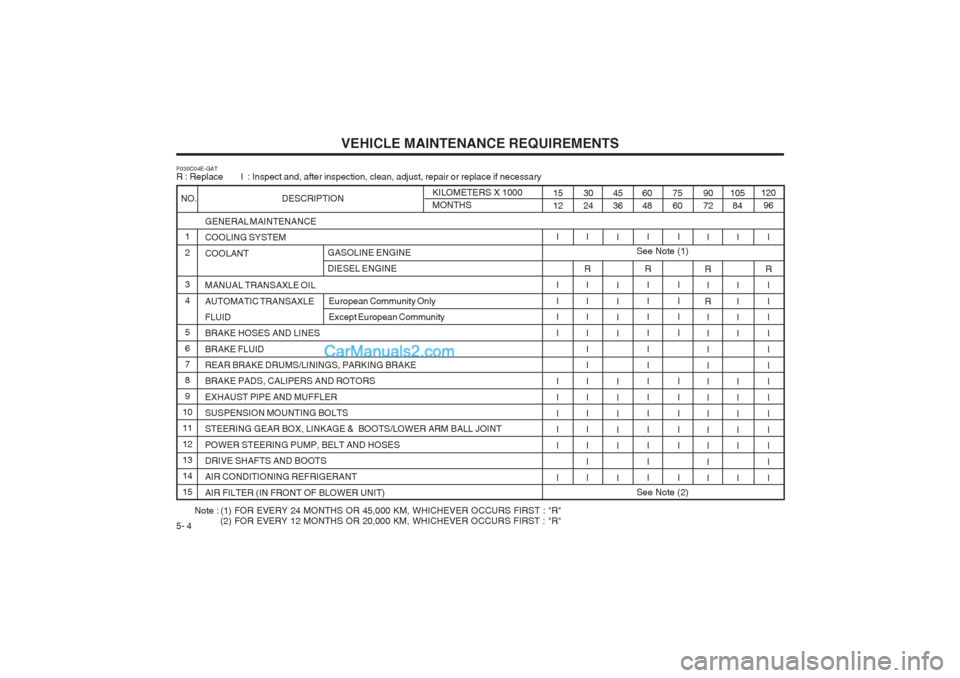
Note : (1) FOR EVERY 24 MONTHS OR 45,000 KM, WHICHEVER OCCURS FIRST : "R" (2) FOR EVERY 12 MONTHS OR 20,000 KM, WHICHEVER OCCURS FIRST : "R"
F030C04E-GAT R : Replace I : Inspect and, after inspection, clean, adjust, repair or replace if necessary
GENERAL MAINTENANCE COOLING SYSTEM COOLANT MANUAL TRANSAXLE OIL AUTOMATIC TRANSAXLE FLUIDBRAKE HOSES AND LINES BRAKE FLUID REAR BRAKE DRUMS/LININGS, PARKING BRAKEBRAKE PADS, CALIPERS AND ROTORS EXHAUST PIPE AND MUFFLER SUSPENSION MOUNTING BOLTSSTEERING GEAR BOX, LINKAGE & BOOTS/LOWER ARM BALL JOINT POWER STEERING PUMP, BELT AND HOSES DRIVE SHAFTS AND BOOTSAIR CONDITIONING REFRIGERANT AIR FILTER (IN FRONT OF BLOWER UNIT)
120
96
I
R I I I III I III I II
105
84
I I I I I I III I I
90 72
7560
6048
I
R I
R I III I III I II
I I I I I I III I I
I
R I I I III I III I II
45 36
3024
I I I I I I III I I
I
R I I I II I III I III
15 12
I I I I I I II I I I
KILOMETERS X 1000 MONTHS
NO. DESCRIPTION
1 2 3 4 5 6 78 9
10 11 12 1314 15
European Community Only Except European Community
See Note (2)
See Note (1)
GASOLINE ENGINE DIESEL ENGINE
Page 130 of 312
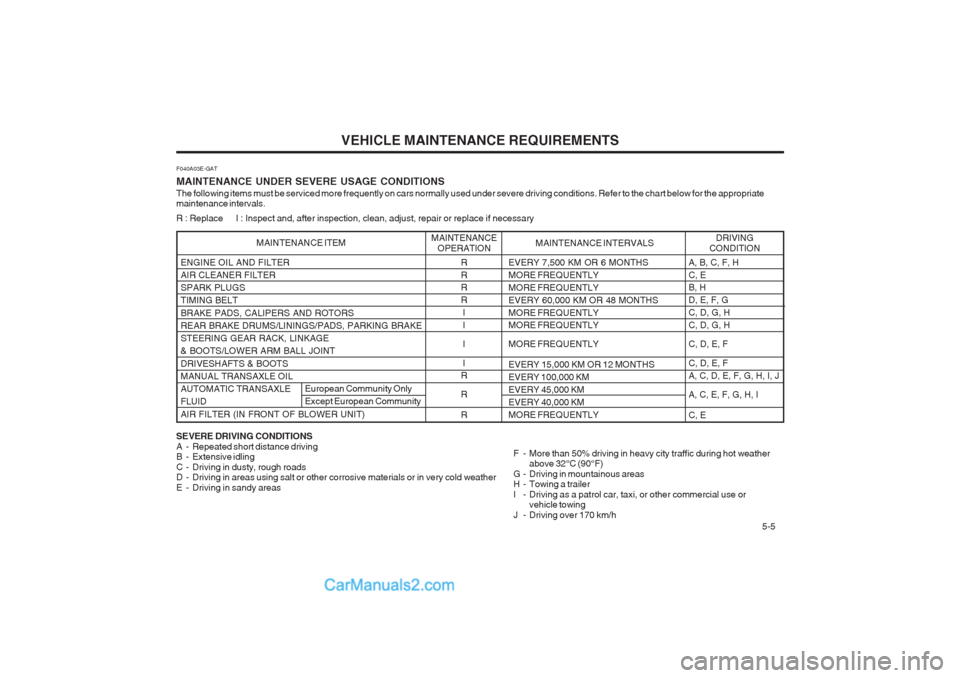
VEHICLE MAINTENANCE REQUIREMENTS 5-5
ENGINE OIL AND FILTER AIR CLEANER FILTERSPARK PLUGSTIMING BELT BRAKE PADS, CALIPERS AND ROTORS REAR BRAKE DRUMS/LININGS/PADS, PARKING BRAKESTEERING GEAR RACK, LINKAGE& BOOTS/LOWER ARM BALL JOINT DRIVESHAFTS & BOOTS MANUAL TRANSAXLE OILAUTOMATIC TRANSAXLEFLUID AIR FILTER (IN FRONT OF BLOWER UNIT)
European Community Only Except European Community EVERY 7,500 KM OR 6 MONTHSMORE FREQUENTLYMORE FREQUENTLYEVERY 60,000 KM OR 48 MONTHSMORE FREQUENTLY MORE FREQUENTLY MORE FREQUENTLY EVERY 15,000 KM OR 12 MONTHS EVERY 100,000 KMEVERY 45,000 KMEVERY 40,000 KMMORE FREQUENTLY
MAINTENANCE UNDER SEVERE USAGE CONDITIONS
The following items must be serviced more frequently on cars normally used under severe driving conditions. Refer to the chart below for the appropriate maintenance intervals. R : Replace I : Inspect and, after inspection, clean, adjust, repair or replace if necessary
F040A03E-GAT
MAINTENANCE
OPERATION
F - More than 50% driving in heavy city traffic during hot weather above 32°C (90°F)
G - Driving in mountainous areas
H - Towing a trailer
I - Driving as a patrol car, taxi, or other commercial use or vehicle towing
J - Driving over 170 km/h
SEVERE DRIVING CONDITIONS
A - Repeated short distance driving
B - Extensive idling
C - Driving in dusty, rough roads
D - Driving in areas using salt or other corrosive materials or in very cold weather
E - Driving in sandy areas
MAINTENANCE ITEM
R R R RII I I
R R R A, B, C, F, H C, E B, H D, E, F, GC, D, G, HC, D, G, H C, D, E, F C, D, E, F A, C, D, E, F, G, H, I, J A, C, E, F, G, H, I C, EMAINTENANCE INTERVALS
DRIVING
CONDITION
Page 133 of 312
VEHICLE MAINTENANCE REQUIREMENTS
5- 8 F070L01A-AAT
o Suspension Mounting Bolts Check the suspension connections for loose-
ness or damage. Retighten to the specified torque. F070M01A-AAT
o Steering Gear Box, Linkage & Boots/
Lower arm Ball Joint
With the vehicle stopped and engine off, check for excessive free-play in the steering wheel. Check the linkage for bends or damage. Check the dust boots and ball joints for deterioration, cracks, or damage. Replace any damaged parts. F070N01A-AAT o
Power Steering Pump, Belt and HosesCheck the power steering pump and hoses for leakage and damage. Replace any damaged or leaking parts immediately. Inspect the power steering belt for evidence of cuts, cracks, ex- cessive wear, oiliness and proper tension. Re- place or adjust it if necessary. F070P01A-AAT o Driveshafts and Boots Check the drive shafts, boots and clamps for cracks, deterioration, or damage. Replace any damaged parts and, if necessary, repack the grease. F070Q01A-AAT
o Air Conditioning Refrigerant Check the air conditioning lines and connec- tions for leakage and damage. Check air condi- tioning performance according to the relevant shop manual if necessary.