belt Hyundai Matrix 2003 User Guide
[x] Cancel search | Manufacturer: HYUNDAI, Model Year: 2003, Model line: Matrix, Model: Hyundai Matrix 2003Pages: 312, PDF Size: 4.1 MB
Page 28 of 312
FEATURES OF YOUR HYUNDAI
1- 20
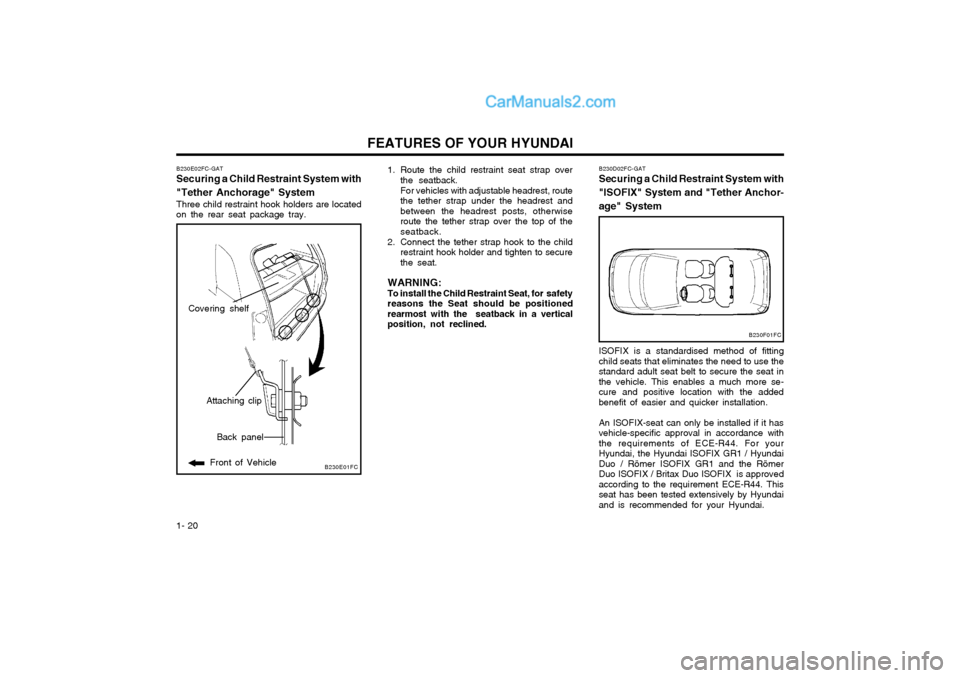
B230E01FC
Back panel
Front of Vehicle
Attaching clip
B230E02FC-GAT Securing a Child Restraint System with "Tether Anchorage" System Three child restraint hook holders are located on the rear seat package tray. 1. Route the child restraint seat strap over
the seatback. For vehicles with adjustable headrest, route the tether strap under the headrest andbetween the headrest posts, otherwiseroute the tether strap over the top of theseatback.
2. Connect the tether strap hook to the child restraint hook holder and tighten to securethe seat.
WARNING:
To install the Child Restraint Seat, for safetyreasons the Seat should be positionedrearmost with the seatback in a verticalposition, not reclined.
Covering shelf B230D02FC-GAT
Securing a Child Restraint System with "ISOFIX" System and "Tether Anchor-age" System
B230F01FC
ISOFIX is a standardised method of fitting child seats that eliminates the need to use thestandard adult seat belt to secure the seat inthe vehicle. This enables a much more se-cure and positive location with the addedbenefit of easier and quicker installation. An ISOFIX-seat can only be installed if it has vehicle-specific approval in accordance withthe requirements of ECE-R44. For yourHyundai, the Hyundai ISOFIX GR1 / HyundaiDuo / Römer ISOFIX GR1 and the RömerDuo ISOFIX / Britax Duo ISOFIX is approvedaccording to the requirement ECE-R44. Thisseat has been tested extensively by Hyundaiand is recommended for your Hyundai.
Page 29 of 312
FEATURES OF YOUR HYUNDAI 1- 21
NOTE: At present, this seat is the only one com- plying with that provision. In case thatother manufacturers will furnish proof ofa respective certification, Hyundai is go-ing to evaluate this seat carefully and willgive a recommendation provided that seatcomplies to the law. Please ask yourHyundai dealer in this respect.
bench not allowed to be moved beyond themiddle position to the forward direction. NOTE: An ISOFIX-child-seat can only be installed if the seat has a vehicle-specific approvalaccording to ECE-R44. Before using theISOFIX-child-seat, which was bought foranother car, ask your Hyundai-dealerwhether this seat-type is approved andrecommended for your Hyundai. To secure the child restraint seat
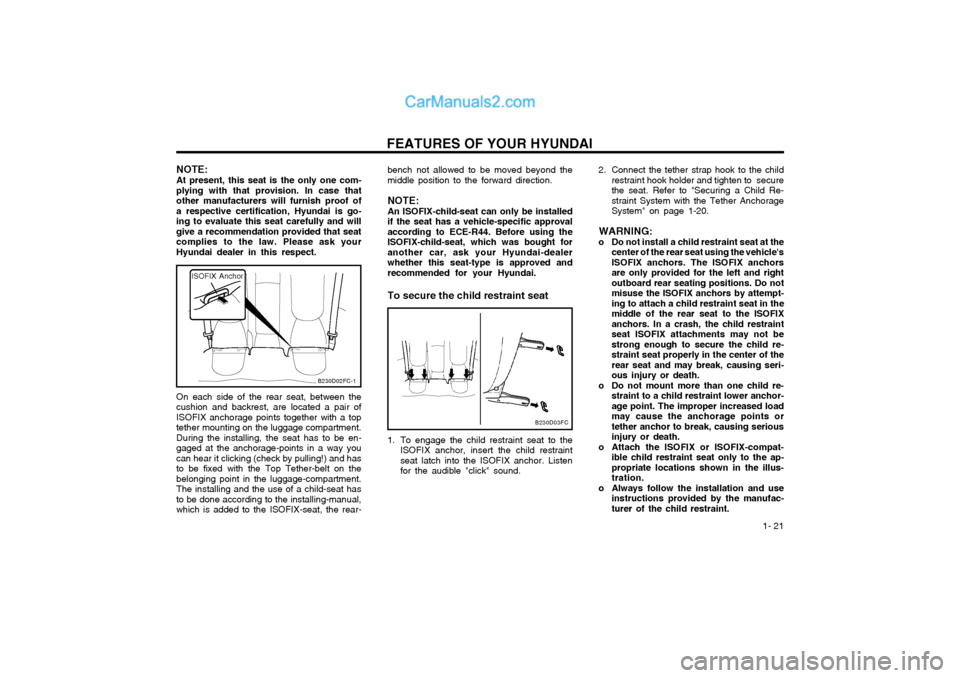
ISOFIX Anchor
On each side of the rear seat, between the cushion and backrest, are located a pair ofISOFIX anchorage points together with a toptether mounting on the luggage compartment.During the installing, the seat has to be en-gaged at the anchorage-points in a way youcan hear it clicking (check by pulling!) and hasto be fixed with the Top Tether-belt on thebelonging point in the luggage-compartment.The installing and the use of a child-seat hasto be done according to the installing-manual,which is added to the ISOFIX-seat, the rear-
B230D02FC-1
B230D03FC
1. To engage the child restraint seat to the ISOFIX anchor, insert the child restraint seat latch into the ISOFIX anchor. Listenfor the audible "click" sound. 2. Connect the tether strap hook to the child
restraint hook holder and tighten to securethe seat. Refer to "Securing a Child Re-straint System with the Tether AnchorageSystem" on page 1-20.
WARNING:
o Do not install a child restraint seat at the center of the rear seat using the vehicle'sISOFIX anchors. The ISOFIX anchorsare only provided for the left and rightoutboard rear seating positions. Do notmisuse the ISOFIX anchors by attempt-ing to attach a child restraint seat in themiddle of the rear seat to the ISOFIXanchors. In a crash, the child restraintseat ISOFIX attachments may not bestrong enough to secure the child re-straint seat properly in the center of therear seat and may break, causing seri-ous injury or death.
o Do not mount more than one child re- straint to a child restraint lower anchor-age point. The improper increased loadmay cause the anchorage points ortether anchor to break, causing seriousinjury or death.
o Attach the ISOFIX or ISOFIX-compat- ible child restraint seat only to the ap-propriate locations shown in the illus-tration.
o Always follow the installation and use instructions provided by the manufac-turer of the child restraint.
Page 30 of 312
FEATURES OF YOUR HYUNDAI
1- 22 B180B01A-GAT Pre-tensioner Seat Belt (If Installed)Your Hyundai vehicle is equipped with driver's and front passenger's pre-tensioner seat belts.The purpose of the pre-tensioner is to makesure that the seat belts fit tightly against theoccupant's body in certain frontal collisions.The pre-tensioner seat belts can be activatedwith the airbags.
B180B01S
B180B02S
Driver's airbag
1
2
3
Passenger's airbag
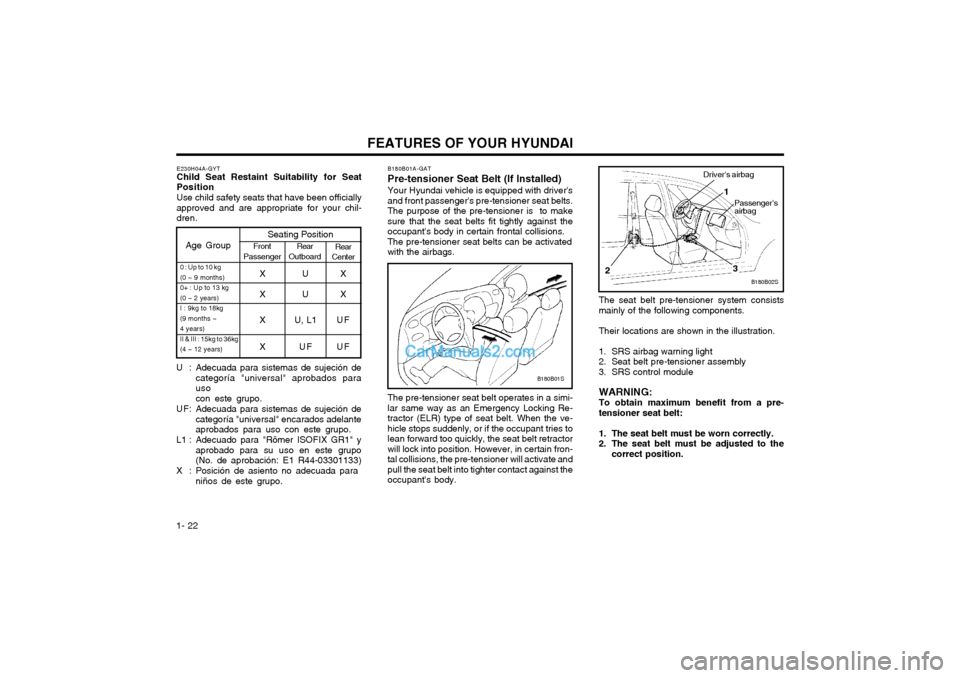
The seat belt pre-tensioner system consists mainly of the following components. Their locations are shown in the illustration.
1. SRS airbag warning light
2. Seat belt pre-tensioner assembly
3. SRS control module WARNING: To obtain maximum benefit from a pre-tensioner seat belt:
1. The seat belt must be worn correctly.
2. The seat belt must be adjusted to the correct position.
The pre-tensioner seat belt operates in a simi-lar same way as an Emergency Locking Re-tractor (ELR) type of seat belt. When the ve-hicle stops suddenly, or if the occupant tries tolean forward too quickly, the seat belt retractorwill lock into position. However, in certain fron-tal collisions, the pre-tensioner will activate andpull the seat belt into tighter contact against theoccupant's body.
Age Group
Seating PositionFront
Passenger Rear
Outboard Rear
Center
0 : Up to 10 kg (0 ~ 9 months)0+ : Up to 13 kg(0 ~ 2 years)I : 9kg to 18kg(9 months ~4 years)II & III : 15kg to 36kg(4 ~ 12 years)XUX
XUX
X U, L1 U F XU FUF
E230H04A-GYT Child Seat Restaint Suitability for Seat Position
Use child safety seats that have been officiallyapproved and are appropriate for your chil-dren.
U : Adecuada para sistemas de sujeción de categoría "universal" aprobados parauso con este grupo.
U F: Adecuada para sistemas de sujeción de categoría "universal" encarados adelante aprobados para uso con este grupo.
L1 : Adecuado para "Römer ISOFIX GR1" y aprobado para su uso en este grupo(No. de aprobación: E1 R44-03301133)
X : Posición de asiento no adecuada para niños de este grupo.
Page 31 of 312
FEATURES OF YOUR HYUNDAI 1- 23
CAUTION:
o Because the sensor that activates the
SRS airbag is connected with the pre-tensioner seat belt, the SRS airbag warn-ing light on the instrument panel willblink for approximately 6 seconds afterthe ignition key has been turned to the"ON" position, and then it should turnoff.
o If the pre-tensioner seat belt is not work- ing properly, this warning light will illu-minate even if there is no malfunction ofthe SRS airbag system . If the SRS airbagwarning light does not illuminate whenthe ignition key is turned to "ON", or if itremains illuminated after blinking forapproximately 6 seconds, or if it illumi-nates while the vehicle is being driven,please have an authorized Hyundai deal-er inspect the pre-tensioner seat belt orSRS airbag system as soon as possible. WARNING:
o Pre-tensioners are designed to operate
only one time. After activation, pre-tensioner seat belts must be replaced.All seat belts, of any type, should alwaysbe replaced after they have been wornduring a collision.
o The pre-tensioner seat belt assembly mechanisms become hot during activa-tion. Do not touch the pre-tensioner seatbelt assemblies for several minutes afterthey have been activated.
o Do not attempt to inspect or replace the pre-tensioner seat belts yourself. Thismust be done by an authorized Hyundaidealer.
o Do not strike the pre-tensioner seat belt assemblies.
o Do not attempt to service or repair the pre-tensioner seat belt system in anymanner.
o Improper handling of the pre-tensioner seat belt assemblies, and failure to heedthe warnings to not strike, modify, in-spect, replace, service or repair the pre-tensioner seat belt assemblies may leadto improper operation or inadvertent ac-tivation and serious injury.
o Always wear the seat belts when driving or riding in a motor vehicle.
NOTE:
o Both the driver's and front passenger's pre-tensioner seat belts will be activatedin certain frontal collisions. The pre-tensioner seat belts can be activatedwith the airbags. The pre-tensioners willbe activated under these conditions evenif the seat belts are not being worn at thetime of the collision.
o When the pre-tensioner seat belts are activated, a loud noise may be heard andfine dust, which may appear to be smoke,may be visible in the passenger compart-ment. These are normal operating condi-tions and are not hazardous.
o Although it is harmless, the fine dust may cause skin irritation and should notbe breathed for prolonged periods. Washyour hands and face thoroughly after anaccident in which the pre-tensioner seatbelts were activated.
Page 32 of 312
FEATURES OF YOUR HYUNDAI
1- 24
B240C01FC
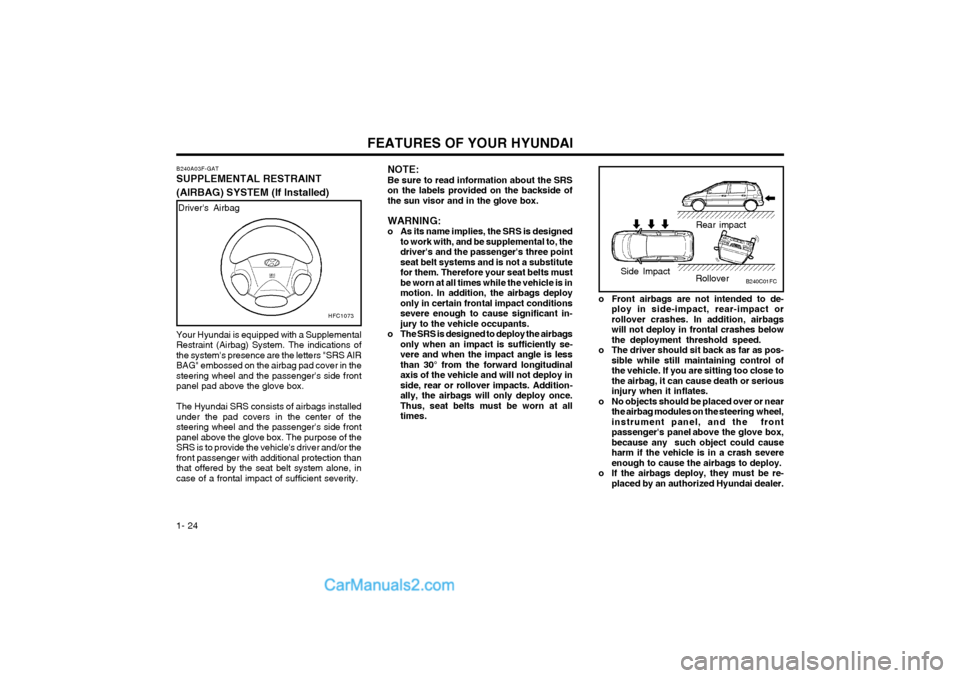
Rear impact
Side Impact Rollover
o Front airbags are not intended to de- ploy in side-impact, rear-impact or rollover crashes. In addition, airbagswill not deploy in frontal crashes belowthe deployment threshold speed.
o The driver should sit back as far as pos- sible while still maintaining control ofthe vehicle. If you are sitting too close tothe airbag, it can cause death or seriousinjury when it inflates.
o No objects should be placed over or near the airbag modules on the steering wheel,instrument panel, and the frontpassenger's panel above the glove box,because any such object could causeharm if the vehicle is in a crash severeenough to cause the airbags to deploy.
o If the airbags deploy, they must be re- placed by an authorized Hyundai dealer.
NOTE: Be sure to read information about the SRSon the labels provided on the backside ofthe sun visor and in the glove box. WARNING:
o As its name implies, the SRS is designedto work with, and be supplemental to, thedriver's and the passenger's three pointseat belt systems and is not a substitutefor them. Therefore your seat belts mustbe worn at all times while the vehicle is inmotion. In addition, the airbags deployonly in certain frontal impact conditionssevere enough to cause significant in-jury to the vehicle occupants.
o The SRS is designed to deploy the airbags only when an impact is sufficiently se-vere and when the impact angle is lessthan 30° from the forward longitudinalaxis of the vehicle and will not deploy inside, rear or rollover impacts. Addition-ally, the airbags will only deploy once.Thus, seat belts must be worn at alltimes.
Your Hyundai is equipped with a SupplementalRestraint (Airbag) System. The indications ofthe system's presence are the letters "SRS AIRBAG" embossed on the airbag pad cover in thesteering wheel and the passenger's side frontpanel pad above the glove box. The Hyundai SRS consists of airbags installed
under the pad covers in the center of thesteering wheel and the passenger's side frontpanel above the glove box. The purpose of theSRS is to provide the vehicle's driver and/or thefront passenger with additional protection thanthat offered by the seat belt system alone, incase of a frontal impact of sufficient severity.
Driver's Airbag
B240A03F-GAT SUPPLEMENTAL RESTRAINT (AIRBAG) SYSTEM (If Installed)
HFC1073
Page 33 of 312
FEATURES OF YOUR HYUNDAI 1- 25
SSA1110D
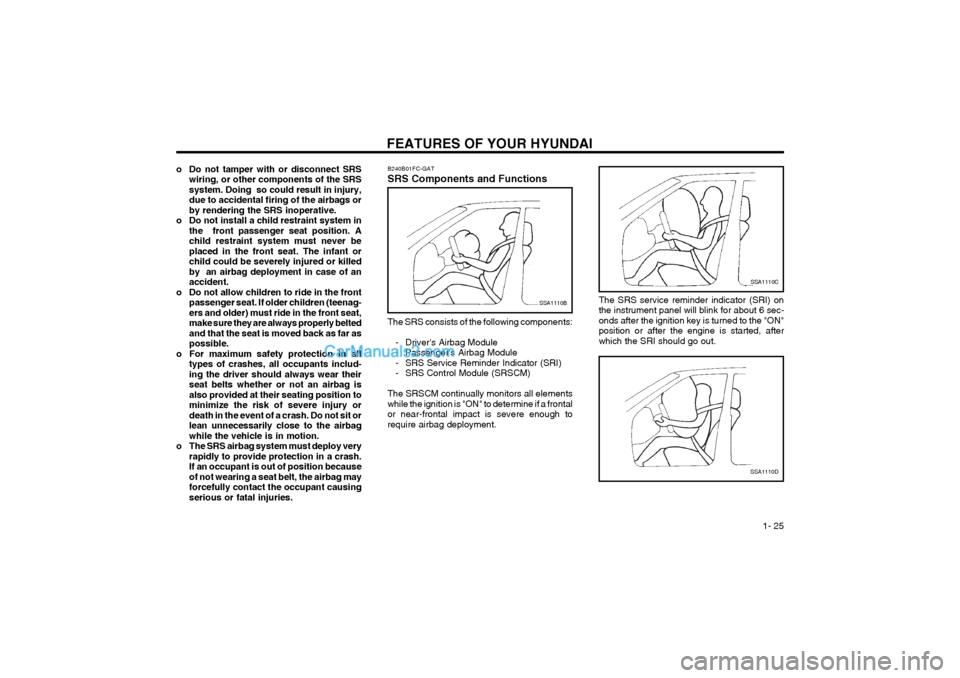
The SRS service reminder indicator (SRI) on the instrument panel will blink for about 6 sec-onds after the ignition key is turned to the "ON"position or after the engine is started, afterwhich the SRI should go out.
SSA1110C
The SRS consists of the following components:- Driver's Airbag Module
- Passenger's Airbag Module
- SRS Service Reminder Indicator (SRI)
- SRS Control Module (SRSCM)
The SRSCM continually monitors all elementswhile the ignition is "ON" to determine if a frontalor near-frontal impact is severe enough torequire airbag deployment.
B240B01FC-GAT SRS Components and Functions
SSA1110B
o Do not tamper with or disconnect SRS
wiring, or other components of the SRS system. Doing so could result in injury,due to accidental firing of the airbags orby rendering the SRS inoperative.
o Do not install a child restraint system in the front passenger seat position. Achild restraint system must never beplaced in the front seat. The infant orchild could be severely injured or killedby an airbag deployment in case of anaccident.
o Do not allow children to ride in the front passenger seat. If older children (teenag-ers and older) must ride in the front seat,make sure they are always properly beltedand that the seat is moved back as far aspossible.
o For maximum safety protection in all types of crashes, all occupants includ-ing the driver should always wear theirseat belts whether or not an airbag isalso provided at their seating position tominimize the risk of severe injury ordeath in the event of a crash. Do not sit orlean unnecessarily close to the airbagwhile the vehicle is in motion.
o The SRS airbag system must deploy very rapidly to provide protection in a crash.If an occupant is out of position becauseof not wearing a seat belt, the airbag mayforcefully contact the occupant causingserious or fatal injuries.
Page 34 of 312
FEATURES OF YOUR HYUNDAI
1- 26 parts. If the liquid from the air freshener does leak onto these areas, wash them withwater immediately. WARNING:
o When the SRS is activated, there may be
a loud noise and fine dust will be re-leased throughout the vehicle. These con-ditions are normal and are not hazard-ous. However, the fine dust generatedduring airbag deployment may causeskin irritation. Wash your hands and facethoroughly with lukewarm water and amild soap after an accident in which theairbags were deployed.
o The SRS can function only when the ignition key is in the "ON" position. If theSRS SRI does not come on, or continu-ously remains on, after flashing for about6 seconds when the ignition key is turnedto the "ON" position, or after the engineis started, comes on while driving, theSRS is not working properly. If this oc-curs, have your vehicle immediately in-spected by your Hyundai dealer.
o Before you replace a fuse or disconnect a battery terminal, turn the ignition key tothe "LOCK" position or remove the igni-tion key. Never remove or replace the airbag related fuse(s) when the ignition keyis in the "ON" position. Failure to heedthis warning will cause the SRS SRI toilluminate.
Passenger's Airbag
YR10353A
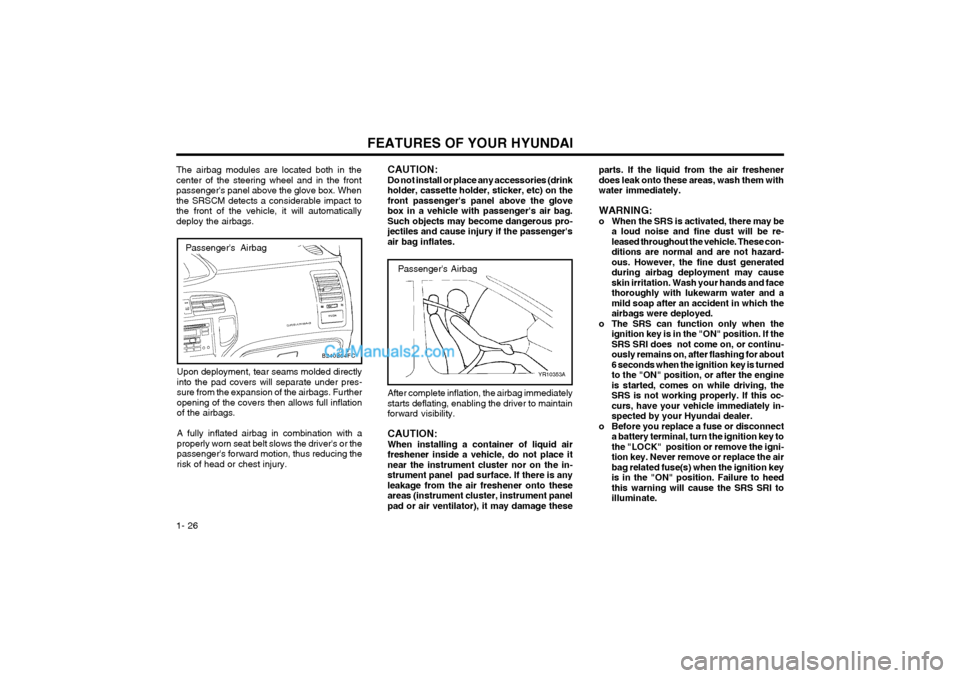
After complete inflation, the airbag immediately starts deflating, enabling the driver to maintainforward visibility. CAUTION: When installing a container of liquid airfreshener inside a vehicle, do not place itnear the instrument cluster nor on the in-strument panel pad surface. If there is anyleakage from the air freshener onto theseareas (instrument cluster, instrument panelpad or air ventilator), it may damage these
CAUTION:Do not install or place any accessories (drinkholder, cassette holder, sticker, etc) on thefront passenger's panel above the glovebox in a vehicle with passenger's air bag.Such objects may become dangerous pro-jectiles and cause injury if the passenger'sair bag inflates.
Passenger's Airbag
The airbag modules are located both in the center of the steering wheel and in the frontpassenger's panel above the glove box. Whenthe SRSCM detects a considerable impact tothe front of the vehicle, it will automaticallydeploy the airbags.
Upon deployment, tear seams molded directlyinto the pad covers will separate under pres-sure from the expansion of the airbags. Furtheropening of the covers then allows full inflationof the airbags. A fully inflated airbag in combination with a properly worn seat belt slows the driver's or thepassenger's forward motion, thus reducing therisk of head or chest injury.
B240B04FC
Page 35 of 312
FEATURES OF YOUR HYUNDAI 1- 27
o Do not place any objects over the airbagor between the airbag and yourself.
o Do not place any objects (an umbrella, bag, etc.) between the front door and the front seat. Such objects may becomedangerous projectiles and cause injury ifthe supplemental side impact air baginflates.
o To prevent unexpected deployment of the side impact air bag that may result inpersonal injury, avoid impact to the sideairbag sensor when the ignition key ison.
B240C03Y-GAT SRS CareThe SRS is virtually maintenance-free and there are no parts you can safely service byyourself. The entire SRS system must be in-spected by an authorized Hyundai dealer 10years after the date that the vehicle was manu-factured. Any work on the SRS system, such as remov- ing, installing, repairing, or any work on thesteering wheel must be performed by a quali-fied Hyundai technician. Improper handling ofthe SRS system may result in serious personalinjury.
HFC2092
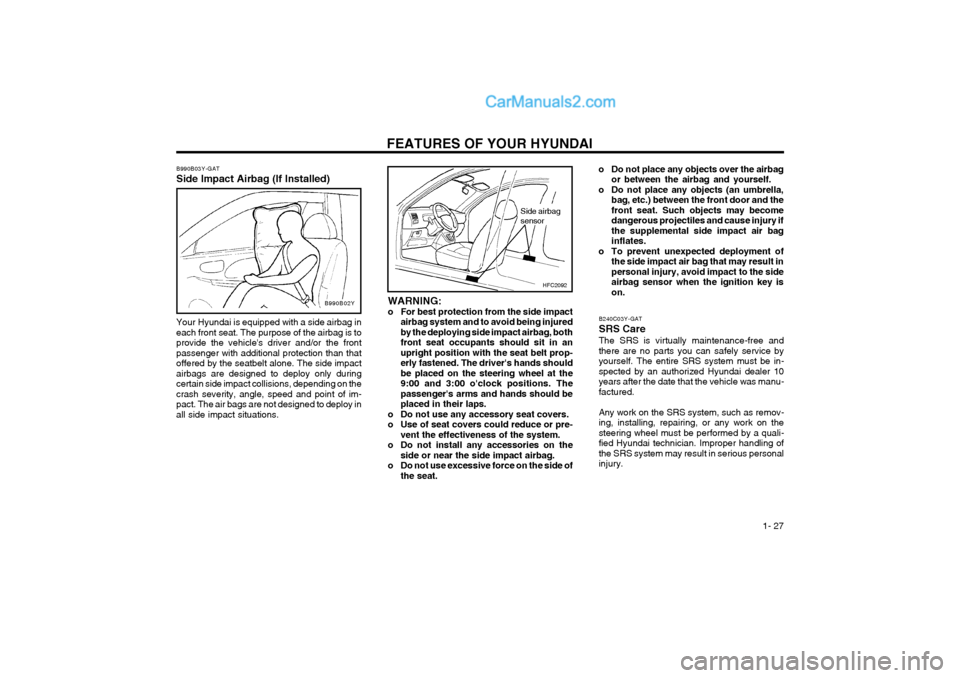
Side airbag sensor
WARNING:
o For best protection from the side impact airbag system and to avoid being injuredby the deploying side impact airbag, bothfront seat occupants should sit in anupright position with the seat belt prop-erly fastened. The driver's hands shouldbe placed on the steering wheel at the9:00 and 3:00 o'clock positions. Thepassenger's arms and hands should beplaced in their laps.
o Do not use any accessory seat covers.
o Use of seat covers could reduce or pre- vent the effectiveness of the system.
o Do not install any accessories on the side or near the side impact airbag.
o Do not use excessive force on the side of the seat.
B990B03Y-GAT Side Impact Airbag (If Installed)B990B02Y
Your Hyundai is equipped with a side airbag in each front seat. The purpose of the airbag is toprovide the vehicle's driver and/or the frontpassenger with additional protection than thatoffered by the seatbelt alone. The side impactairbags are designed to deploy only duringcertain side impact collisions, depending on thecrash severity, angle, speed and point of im-pact. The air bags are not designed to deploy inall side impact situations.
Page 41 of 312
FEATURES OF YOUR HYUNDAI 1- 33
B260J01S-GAT
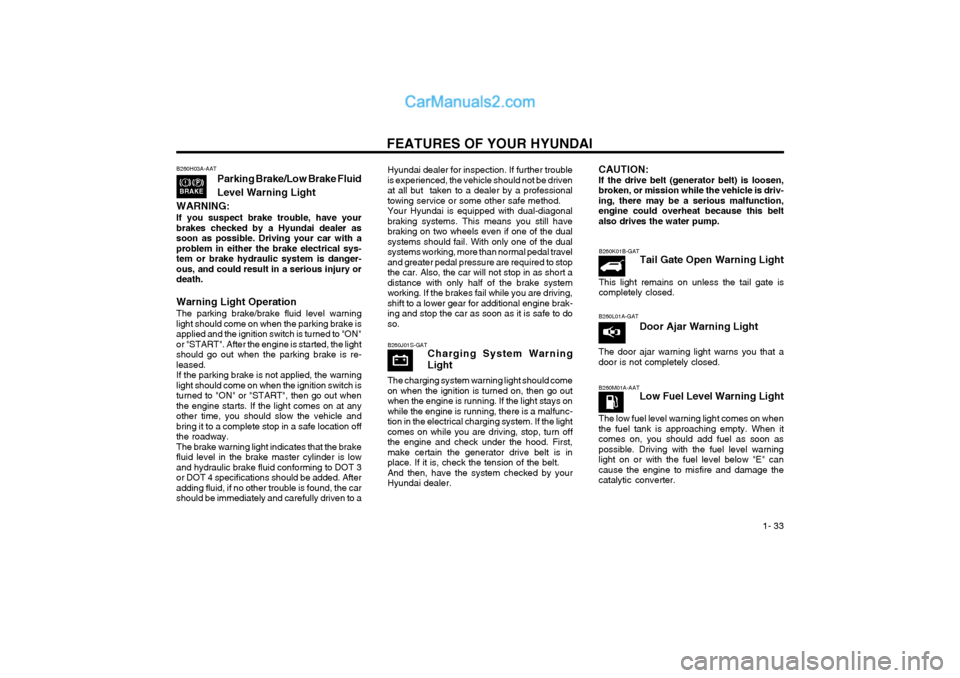
Charging System Warning Light
The charging system warning light should come on when the ignition is turned on, then go outwhen the engine is running. If the light stays onwhile the engine is running, there is a malfunc-tion in the electrical charging system. If the lightcomes on while you are driving, stop, turn offthe engine and check under the hood. First,make certain the generator drive belt is inplace. If it is, check the tension of the belt.And then, have the system checked by yourHyundai dealer.
CAUTION: If the drive belt (generator belt) is loosen,broken, or mission while the vehicle is driv-ing, there may be a serious malfunction,engine could overheat because this beltalso drives the water pump. B260L01A-GAT Door Ajar Warning Light
The door ajar warning light warns you that a door is not completely closed.B260H03A-AAT Parking Brake/Low Brake Fluid Level Warning Light
WARNING: If you suspect brake trouble, have your brakes checked by a Hyundai dealer assoon as possible. Driving your car with aproblem in either the brake electrical sys-tem or brake hydraulic system is danger-ous, and could result in a serious injury ordeath. Warning Light Operation The parking brake/brake fluid level warning light should come on when the parking brake isapplied and the ignition switch is turned to "ON"or "START". After the engine is started, the lightshould go out when the parking brake is re-leased.If the parking brake is not applied, the warninglight should come on when the ignition switch isturned to "ON" or "START", then go out whenthe engine starts. If the light comes on at anyother time, you should slow the vehicle andbring it to a complete stop in a safe location offthe roadway.The brake warning light indicates that the brakefluid level in the brake master cylinder is lowand hydraulic brake fluid conforming to DOT 3or DOT 4 specifications should be added. Afteradding fluid, if no other trouble is found, the carshould be immediately and carefully driven to a Hyundai dealer for inspection. If further troubleis experienced, the vehicle should not be drivenat all but taken to a dealer by a professionaltowing service or some other safe method.Your Hyundai is equipped with dual-diagonalbraking systems. This means you still havebraking on two wheels even if one of the dualsystems should fail. With only one of the dualsystems working, more than normal pedal traveland greater pedal pressure are required to stopthe car. Also, the car will not stop in as short adistance with only half of the brake systemworking. If the brakes fail while you are driving,shift to a lower gear for additional engine brak-ing and stop the car as soon as it is safe to doso.
B260K01B-GAT
Tail Gate Open Warning Light
This light remains on unless the tail gate is completely closed.
B260M01A-AAT Low Fuel Level Warning Light
The low fuel level warning light comes on whenthe fuel tank is approaching empty. When itcomes on, you should add fuel as soon aspossible. Driving with the fuel level warninglight on or with the fuel level below "E" cancause the engine to misfire and damage thecatalytic converter.
Page 43 of 312
FEATURES OF YOUR HYUNDAI 1- 35
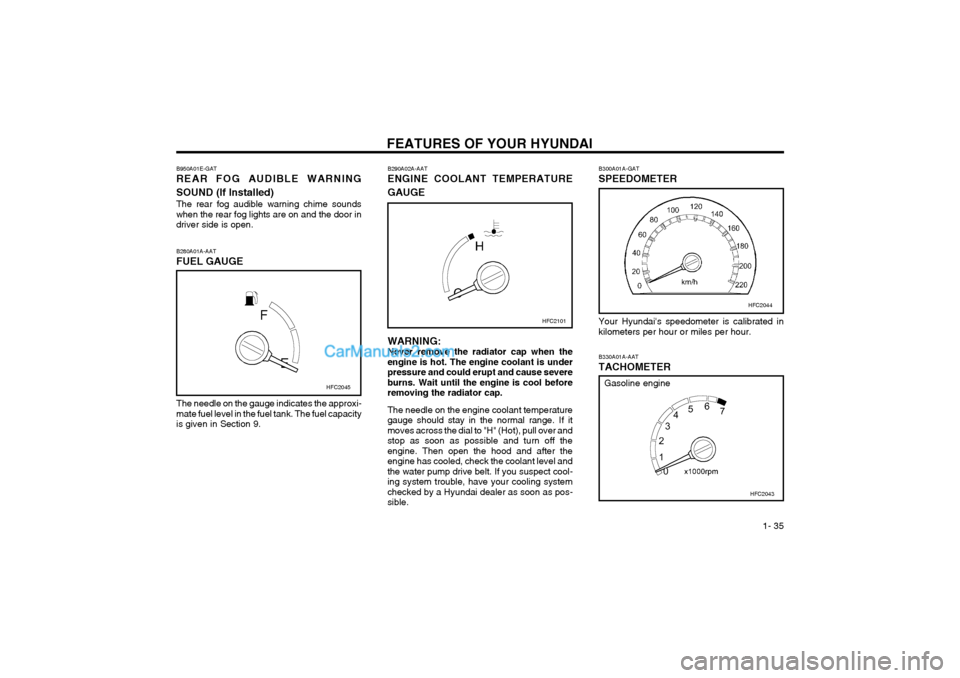
Your Hyundai's speedometer is calibrated in
kilometers per hour or miles per hour. B330A01A-AAT TACHOMETER
HFC2043
HFC2101
B290A02A-AAT ENGINE COOLANT TEMPERATURE GAUGE
B300A01A-GAT SPEEDOMETER
HFC2044
WARNING: Never remove the radiator cap when theengine is hot. The engine coolant is underpressure and could erupt and cause severeburns. Wait until the engine is cool beforeremoving the radiator cap. The needle on the engine coolant temperature gauge should stay in the normal range. If itmoves across the dial to "H" (Hot), pull over andstop as soon as possible and turn off theengine. Then open the hood and after theengine has cooled, check the coolant level andthe water pump drive belt. If you suspect cool-ing system trouble, have your cooling systemchecked by a Hyundai dealer as soon as pos-sible.
The needle on the gauge indicates the approxi-mate fuel level in the fuel tank. The fuel capacityis given in Section 9.
B950A01E-GAT REAR FOG AUDIBLE WARNING SOUND (If Installed) The rear fog audible warning chime sounds
when the rear fog lights are on and the door indriver side is open. B280A01A-AAT FUEL GAUGE
HFC2045Gasoline engine