change time Hyundai Matrix 2005 Owner's Guide
[x] Cancel search | Manufacturer: HYUNDAI, Model Year: 2005, Model line: Matrix, Model: Hyundai Matrix 2005Pages: 407, PDF Size: 10.31 MB
Page 283 of 407
1
FEATURES OF YOUR HYUNDAI
119
B290H03FC-GAT The CD auto changer is located under the front passenger seat.
o To use the CD auto changer.
1. Open the sliding lid of the CD autochanger.
2. To eject the compact disc maga-
zine, press the EJECT button lo- cated inside the CD auto changer.
3. Insert the discs into the maga-
zine.
4. Push the magazine into the CD
auto changer and close the sliding lid.
o The CD auto changer can be used when the ignition switch is in either "ON" or "ACC" position.
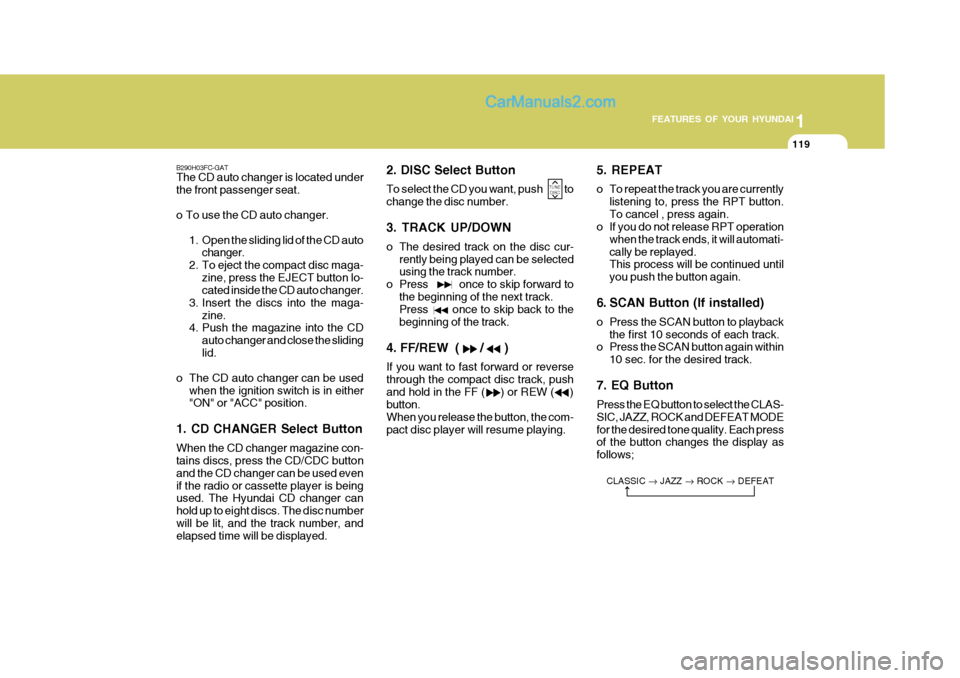
1. CD CHANGER Select Button When the CD changer magazine con- tains discs, press the CD/CDC button and the CD changer can be used evenif the radio or cassette player is being used. The Hyundai CD changer can hold up to eight discs. The disc numberwill be lit, and the track number, and elapsed time will be displayed. 2. DISC Select Button To select the CD you want, push to change the disc number. 3. TRACK UP/DOWN
o The desired track on the disc cur-
rently being played can be selected using the track number.
o Press once to skip forward to
the beginning of the next track.Press once to skip back to the beginning of the track.
4. FF/REW ( / ) If you want to fast forward or reverse through the compact disc track, pushand hold in the FF ( ) or REW ( ) button. When you release the button, the com-pact disc player will resume playing. 5. REPEAT
o To repeat the track you are currently
listening to, press the RPT button. To cancel , press again.
o If you do not release RPT operation
when the track ends, it will automati-cally be replayed. This process will be continued until you push the button again.
6. SCAN Button (If installed)
o Press the SCAN button to playback the first 10 seconds of each track.
o Press the SCAN button again within
10 sec. for the desired track.
7. EQ ButtonPress the EQ button to select the CLAS- SIC, JAZZ, ROCK and DEFEAT MODEfor the desired tone quality. Each press of the button changes the display as follows; CLASSIC JAZZ ROCK DEFEAT
TUNE
DISC
Page 291 of 407

2 DRIVING YOUR HYUNDAI
2
C010A01O-AAT
WARNING: ENGINE EXHAUST CAN BE DANGEROUS!
Engine exhaust fumes can be extremely dangerous. If, at any time, you smell exhaust fumes inside the vehicle, open the windows immediately. o Do not inhale exhaust fumes. Exhaust fumes contain carbon monoxide, a colorless, odorless gas that can cause unconsciousness and death by asphyxiation. o Be sure the exhaust system does not leak. The exhaust system should be checked whenever the vehicle is raised to change the oil or for any other purpose.If you hear a change in the sound of the exhaust or if you drive over something that strikes the underneath side of the car, have the exhaust system checked as soon as possible by your Hyundai dealer. o Do not run the engine in an enclosed area. Letting the engine idle in your garage, even with the garage door open, is a hazardous practice. Never run theengine in your garage any longer than it takes to start the engine and back the car out. o Avoid idling the engine for prolonged periods with people inside the car. If it is necessary to idle the engine for a prolonged period with people inside the car, be sure to do so only in an open area with the air intake set at "Fresh" and fan operating at one of the higher speeds so fresh air is drawn into the interior. If you must drive with the tail gate open because you are carrying objects that make this necessary: 1. Close all windows. 2. Open side vents. 3. Set the air intake control at "Fresh", the air flow control at "Floor" or "Face" and the fan at one of the higher speeds.
To assure proper operation of the ventilation system, be sure the ventilation air intakes located just in front ofthe windshield are kept clear of snow, ice, leaves or other obstructions.
!
Page 305 of 407

2 DRIVING YOUR HYUNDAI
16DRIVING FOR ECONOMY
C140A01A-GAT You can save fuel and get more kilo- meters from your car if you follow these suggestions:
o Drive smoothly. Accelerate at a moderate rate. Don't make "jack- rabbit" starts or full-throttle shiftsand maintain a steady cruising speed. Don't race between stop- lights. Try to adjust your speed tothat of the other traffic so you don't have to change speeds unneces- sarily. Avoid heavy traffic wheneverpossible. Always maintain a safe distance from other vehicles so you can avoidunnecessary braking. This also re- duces brake wear.
o Drive at a moderate speed. The faster you drive, the more fuel yourcar uses. Driving at a moderate speed, especially on the highway, isone of the most effective ways to reduce fuel consumption.
o Don't "ride" the brake or clutch pedal. This can increase fuel consumptionand also increase wear on these components. In addition, driving with
gear (manual transaxle). If your caris facing downhill, turn the frontwheels into the curb to help keep the car from rolling. If your car is facing uphill, turn the front wheels awayfrom the curb to help keep the car from rolling. If there is no curb or if it is requiredby other conditions to keep the car from rolling, block the wheels.
o Under some conditions your park- ing brake can freeze in the engagedposition. This is most likely to hap- pen when there is an accumulationof snow or ice around or near the rear brakes or if the brakes are wet. If there is a risk that the parkingbrake may freeze, apply it only tem- porarily while you put the gear se- lector lever in "P" (automatic) or infirst or reverse gear (manual transaxle) and block the rear wheels so the car cannot roll. Then releasethe parking brake.
o Do not hold the vehicle on the up-
grade with the accelerator pedal.This can cause the transmission to overheat. Always use the brake pedal or parking brake.
o Don't coast down hills with the car
out of gear. This is extremely haz-ardous. Keep the car in gear at all times, use the brakes to slow down, then shift to a lower gear so thatengine braking will help you main- tain a safe speed.
o Don't "ride" the brake pedal. Rest- ing your foot on the brake pedalwhile driving can be dangerous be- cause it can result in the brakesoverheating and losing their effec- tiveness. It also increases the wear of the brake components.
o If a tire goes flat while you are driving, apply the brakes gently andkeep the car pointed straight aheadwhile you slow down. When you are moving slowly enough for it to be safe to do so, pull off the road andstop in a safe place.
o If your car is equipped with an auto-
matic transaxle, don't let your carcreep forward. To avoid creeping forward, keep your foot on the brake pedal when the car is stopped.
o Use caution when parking on a hill. Engage the parking brake and placethe gear selector lever in "P" (auto-matic transaxle) or in first or reverse
Page 313 of 407

2 DRIVING YOUR HYUNDAI
24
CAUTION:
If overheating should occur when towing, (temperature gauge reads near red zone), taking the following action may reduce or eliminate theproblem.
1. Turn off the air conditioner.
2. Reduce highway speed.
3. Select a lower gear when going uphill.
4. While in stop and go traffic, place the gear selection in park or neu- tral and idle the engine at a higherspeed.
!
8. When parking your car and trailer,
especially on a hill, be sure to follow all the normal precautions. Turn your front wheel into the curb, set the parking brake firmly, and putthe transaxle in 1st or Reverse (manual) or Park (automatic). In addition, place wheel chocks ateach of the trailer's tires.
9. If the trailer has electric brakes,
start your vehicle and trailer mov-ing, and then apply the trailer brake controller by hand to be sure the brakes are working. This lets youcheck your electrical connection at the same time.
10.During your trip, check occasion- ally to be sure that the load issecure, and that the lights and any trailer brakes are still working.
11.Avoid jerky starts, sudden accel- eration or sudden stops.
12.Avoid sharp turns and rapid lane changes.
13.Avoid holding the brake pedal down
too long or too frequently. This couldcause the brakes to overheat, re- sulting in reduced braking efficiency. 14.When going down a hill, shift into a
lower gear and use the engine brak- ing effect. When ascending a long grade, downshift the transaxle to a lowergear and reduce speed to reduce chances of engine overloading and/ or overheating.
15.If you have to stop while going uphill, do not hold the vehicle inplace by pressing on the accelera-tor. This can cause the automatic transaxle to overheat. Use the park- ing brake or footbrake.
NOTE: When towing check transaxle fluid more frequently.
Page 355 of 407
6 DO-IT-YOURSELF MAINTENANCE
10
CAUTION:
Slowly pour the recommended oil using by a funnel. Do not overfillnot to damage engine.
!
NOTE: Always dispose of used engine oil in an environmentally acceptablemanner. It is suggested that it be placed in a sealed container and taken to a service station for maybereclaimation. Do not pour the oil on the ground or put it in with the household trash.
Be sure that the mounting surfaceon the engine is clean and that theold gasket is removed completely. Lubricate the new gasket on the filter with clean engine oil beforeinstallation.
7. Remove the engine oil level dip- stick.
8. Refill the crankcase with the rec-
ommended engine oil. Refer tothe specification in chapter 9 for engine oil capacity.
!
9. Start the engine and check to be sure no oil is leaking from the drain plug or oil filter.
10.Shut off the engine and recheck the oil level. WARNING:
Used motor oil may cause irrita-
tion or cancer of the skin if left in contact with the skin for prolongedperiods of time. Wash your hands thoroughly with soap and warm water as soon as possible afterhandling used oil. G040B04FC-GAT
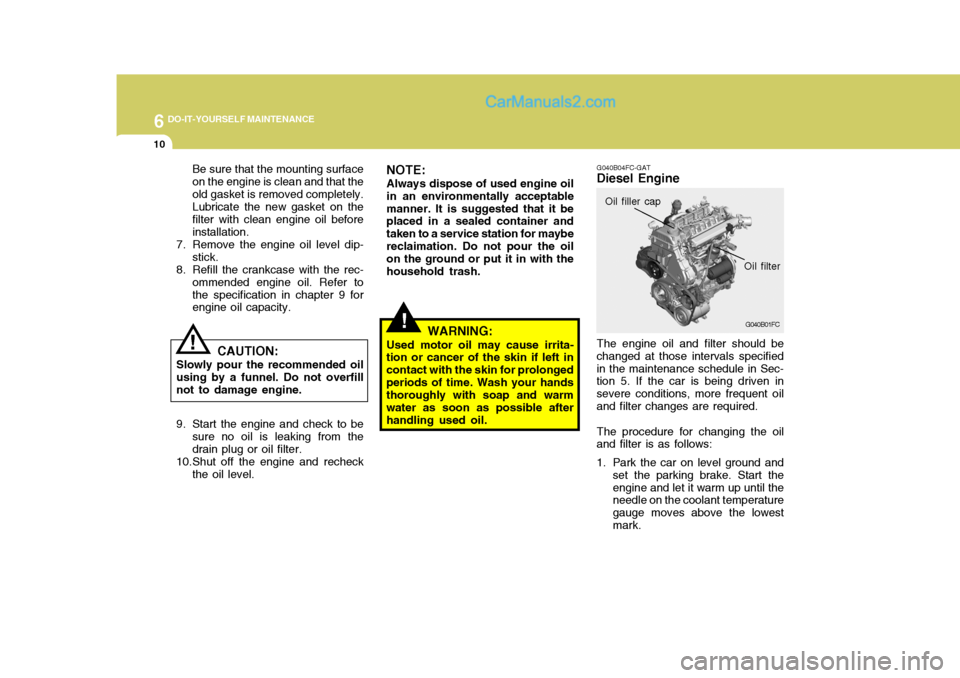
Diesel Engine
Oil filter
G040B01FC
Oil filler cap
The engine oil and filter should be
changed at those intervals specified in the maintenance schedule in Sec- tion 5. If the car is being driven in severe conditions, more frequent oiland filter changes are required.
The procedure for changing the oil
and filter is as follows:
1. Park the car on level ground and
set the parking brake. Start the engine and let it warm up until the needle on the coolant temperature gauge moves above the lowestmark.
Page 357 of 407

6 DO-IT-YOURSELF MAINTENANCE
12
!
!
CHECKING AND CHANGING THE ENGINE COOLANT
G050B01A-AAT
Recommended Engine Coolant
G050B01FC
G050A01A-AAT
WARNING:
Do not remove the radiator cap
when the engine is hot. When the engine is hot, the engine coolant is under pressure and may eruptthrough the opening if the cap is removed. You could be seriously burned if you do not observe thisprecaution. Do not remove the radiator cap until the radiator is cool to the touch.
G050B02FC
Gasoline engine
Diesel engine
Use a high quality ethylene-glycol
coolant in a 50/50 mix with water.
10.Start the engine and check to be
sure no oil is leaking from thedrain plug or oil filter.
11.Shut off the engine and recheck
the oil level.
NOTE:
o It is recommended that the en- gine oil and filter should be changed by an authorized Hyundai dealer.
o Always dispose of used engine oil in an environmentally accept-able manner. It is suggested that it be placed in a sealed container and taken to a service station formaybe reclaimation. Do not pour the oil on the ground or put it into the household trash.
WARNING:
Used motor oil may cause irrita- tion or cancer of the skin if left in contact with the skin for prolongedperiods of time. Wash your hands thoroughly with soap and warm water as soon as possible afterhandling used oil.
Page 360 of 407
6
DO-IT-YOURSELF MAINTENANCE
15
!
SPARK PLUGS
WARNING:
The cooling fan is controlled by engine coolant temperature and may sometimes operate even when the engine is not running. Useextreme caution when working near the blades of the cooling fan so that you are not injured by arotating fan blade. As the engine coolant temperature decreases, the fan will automatically shut off. Thisis a normal condition. G060A01L
G060B02S-GAT
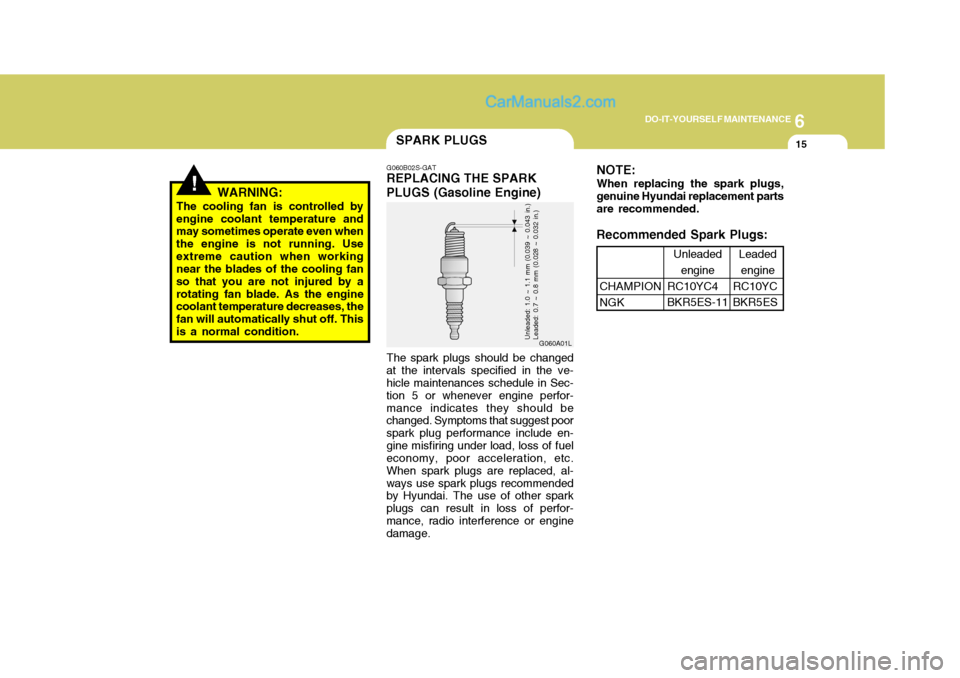
REPLACING THE SPARK PLUGS (Gasoline Engine)
The spark plugs should be changed
at the intervals specified in the ve- hicle maintenances schedule in Sec- tion 5 or whenever engine perfor-mance indicates they should be changed. Symptoms that suggest poor spark plug performance include en-gine misfiring under load, loss of fuel economy, poor acceleration, etc. When spark plugs are replaced, al-ways use spark plugs recommended by Hyundai. The use of other spark plugs can result in loss of perfor-mance, radio interference or engine damage.
Unleaded: 1.0 ~ 1.1 mm (0.039 ~ 0.043 in.) Leaded: 0.7 ~ 0.8 mm (0.028 ~ 0.032 in.)
NOTE: When replacing the spark plugs, genuine Hyundai replacement partsare recommended.
Recommended Spark Plugs:
CHAMPION NGK Leaded
engine
RC10YCBKR5ES
Unleaded
engine
RC10YC4BKR5ES-11
Page 361 of 407

6 DO-IT-YOURSELF MAINTENANCE
16
!WARNING:
It is recommended that the engine
be cool or cold when changing the spark plugs. If the engine is hot, you could burn yourself on theinsulated connector, the spark plug or the engine itself. HGK2574. When preparing to remove the old
spark plug, guide the socket down over the spark plug, being careful not to damage the ceramic insula- tor.
5. To remove the spark plug, turn the wrench handle in a counterclock-wise direction.
6. To install the new spark plug, guide
the socket down over the sparkplug, being careful not to damage the ceramic insulator.
HGK258
3. To remove the spark plug cable,
pull straight up on the insulated connector, not the cable. Pulling on the cable may damage the car- bon core conductor.
G060C01S-GAT Changing the Spark Plugs You will find it easier to change spark plugs if the engine is cold. Always change one spark plug at a time. This helps avoid getting the wires mixedup.
1. Remove the center cover on the
engine rocker cover.
2. Using a clean cloth, remove any dirt that has accumulated around the spark plug so it cannot fall intothe cylinder when the spark plug is removed. HGK256
Page 373 of 407

6 DO-IT-YOURSELF MAINTENANCE
28
G170A01A-GAT Brake pedal
HXGS508
3 ~ 8 mm (0.12 ~ 0.31 in.)
With the engine off, press down on the brake pedal several times to re-duce the vacuum in the brake booster.Then, using your hand, press downslowly on the brake pedal until you feel a change in resistance. This is the brake pedal freeplay. The freeplayshould be within the limits specified in the illustration. If it is not, have it inspected by your Hyundai dealer andadjusted or repaired if necessary.
Water Pump Pulley Alternator Pulley
Crankshaft Pulley 5.1~6 mm(0.2~0.24 in.)
HTB186
G190A01A-GAT
Gasoline Engine Drive belts should be checked peri- odically for proper tension and ad-justed if necessary. At the same time, belts should be examined for cracks, wear, fraying or other evidence ofdeterioration and replaced if neces- sary. Belt routing should also be checked to be sure there is no interference between the belts and other parts of the engine. After a belt is replaced,the new belt should be adjusted again after two or three weeks to eliminate slack resulting from initial stretchingafter use.
G180A01A-GAT
CHECKING BRAKE PEDAL CLEARANCE
G180A01L
45.1 mm (1.78 in.)
You need a helper to check the brake pedal clearance. With the engine run- ning, have your helper press down on the brake pedal several times andthen hold it down with a force of about 490N (50 kg, 110 lbs). The brake pedal clearance is the distance fromthe top surface of the brake pedal to the asphalt sheeting under the floor mat. If the brake pedal clearance isnot within the limits specified in the illustration, have it inspected by your Hyundai dealer and adjusted or re-paired if necessary. CHECKING DRIVE BELTS