ignition Hyundai Matrix 2005 Manual PDF
[x] Cancel search | Manufacturer: HYUNDAI, Model Year: 2005, Model line: Matrix, Model: Hyundai Matrix 2005Pages: 407, PDF Size: 10.31 MB
Page 300 of 407

2
DRIVING YOUR HYUNDAI
11
C090H01A-GAT NOTE:
o For smooth and safe operation, depress the brake pedal when shifting from "N"(Neutral) posi-tion or "P"(Park) position to a forward or "R"(Reverse) gear.
o The brake pedal fully depressed in order to move the shift leverfrom the "P" (Park) position to any of the other positions.
o It is always possible to shift from "R", "N", "D", "2", "L" position to"P" position. The vehicle mustbe fully stopped to avoid transaxle damage. C090I02A-AAT
CAUTION:
o Shift into "R" and "P" position only when the vehicle has com- pletely stopped.
o Do not accelerate the engine in reverse or any of the forwardpositions with the brakes applied.
o Always apply the footbrake when shifting from "P" or "N", to "R",
"D", "2" or "L" position.
o Do not use the "P" (Park) posi- tion in place of the parking brake.Always set the parking brake,shift the transaxle into "P" (Park) position and turn off the ignition when you leave the vehicle, evenmomentarily. Never leave the ve- hicle unattended while the en- gine is running.
o Check the automatic transaxle fluid level regularly, and add fluidas necessary.See the maintenance schedule for the proper fluid recommen- dation.
!
C090G01S-GAT o L (Low gear): Use for driving up a very steep grade or for engine braking when descendingsteep hills. When downshifting to "L", the transaxle will temporarily remain in second gear until the vehicle hasslowed enough for low gear to engage. Do not exceed 50 km/h (30 mph) in low gear."L" shifts to 1st gear only. However, shift up to 2nd is performed when the car exceeds a certain speed and, asspeed increases, the transaxle will shift up to 3rd gear to prevent over-revving the engine.
Page 304 of 407

2
DRIVING YOUR HYUNDAI
15
C300D02O-GAT Indicator and Warning The TCS indicator should illuminate when the ignition key is turned to "ON"or "START", but should go out after three seconds. If the indicator does not illuminate,have it checked by an authorized Hyundai dealer. Should there be any unusual condi- tions in the device, TCS illuminates as a warning.If TCS illuminates, pull your car to a safe place and stop the engine. Then, start the engine again to checkif the TCS indicator goes out. If the indicator remains lit even after the engine has been started, haveyour car checked by an authorized Hyundai dealer. NOTE: When the TCS indicator illuminates, traction control is automatically de- activated for safety.
C300B01O-GAT TCS ON Mode In the TCS ON mode, the indicator in the instrument cluster will not be illumi-nated. NOTE:
1) Turn off the engine. Then restart
the engine, and the TCS mode will automatically turn "ON".
2) When the traction control is op-
erating properly, you can feel aslight pulsation in the vehicle. This is only the effect of brakecontrol and indicates nothing unusual.
3) When the engine starts, a click is heard from the engine compart-ment; however, this is only the sound of traction control beingchecked.
4) When moving out of the mud or
fresh snow, pressing the accel-erator pedal may not cause the engine speed to increase.
!
C130A01A-AAT Good braking practices
WARNING:
Nothing should be carried on top of the shelf panel behind the rear seat.If there were an accident or a sud- den stop, such objects could move forward and cause damage to thevehicle or injure the occupants.
o After being parked, check to be sure the parking brake is not engagedand that the parking brake indicator light is out before driving away.
o Driving through water may get the
brakes wet. They can also get wetwhen the car is washed. Wet brakes can be dangerous! Your car will notstop as quickly if the brakes are wet. Wet brakes may cause the car to pull to one side. To dry the brakes,apply the brakes lightly until the braking action returns to normal, taking care to keep the car undercontrol at all times. If the braking action does not return to normal, stop as soon as it is safe to do soand call your Hyundai dealer for assistance.
Page 308 of 407

2
DRIVING YOUR HYUNDAI
19
C160H01A-AAT Use Approved Anti-Freeze in Window Washer System To keep the water in the window washer system from freezing, add an approvedanti-freeze solution in accordance with instructions on the container. Window washer anti-freeze is available fromHyundai dealers and most auto parts outlets. Do not use engine coolant or other types of anti-freeze as thesemay damage the finish.
C160G02A-GAT To Keep Locks from Freezing To keep the locks from freezing, squirt an approved de-icer fluid or glycerineinto the key opening. If a lock is cov- ered with ice, squirt it with an approved de-icing fluid to remove the ice. If thelock is frozen internally, you may be able to thaw it out by using a heated key. Handle the heated key with careto avoid injury. NOTE: The proper temperature for using the immobilizer key is from -40°C (-40°F) to 80°C(176°F). If you heat the immobilizer key over 80°C toopen the frozen lock, it may cause damage to the transponder in its head.
C160D01A-AAT Check Battery and Cables Winter puts additional burdens on the battery system. Visually inspect thebattery and cables as described in Section 6. The level of charge in your battery can be checked by your Hyundaidealer or a service station.
C160F01A-AAT Check Spark Plugs and Ignition System Inspect your spark plugs as described in Section 6 and replace them if neces-sary. Also check all ignition wiring and components to be sure they are not cracked, worn or damaged in any way.
C160E01A-AAT Change to "Winter Weight" Oil if Necessary In some climates it is recommended that a lower viscosity "winter weight" oil be used during cold weather. See Section 9 for recommendations. If youaren't sure what weight oil you should use, consult your Hyundai dealer.
C160I01A-AAT Don't Let Your Parking Brake Freeze Under some conditions your parking brake can freeze in the engaged posi- tion. This is most likely to happenwhen there is an accumulation of snow or ice around or near the rear brakes or if the brakes are wet. If there is a riskthe parking brake may freeze, apply it only temporarily while you put the gear selector lever in "P" (automatic) or infirst or reverse gear (manual transaxle) and block the rear wheels so the car cannot roll. Then release the parkingbrake.
Page 315 of 407
3 WHAT TO DO IN AN EMERGENCY
2
!
IF THE ENGINE WILL NOT START
D010A01A-AAT D010B02A-AAT
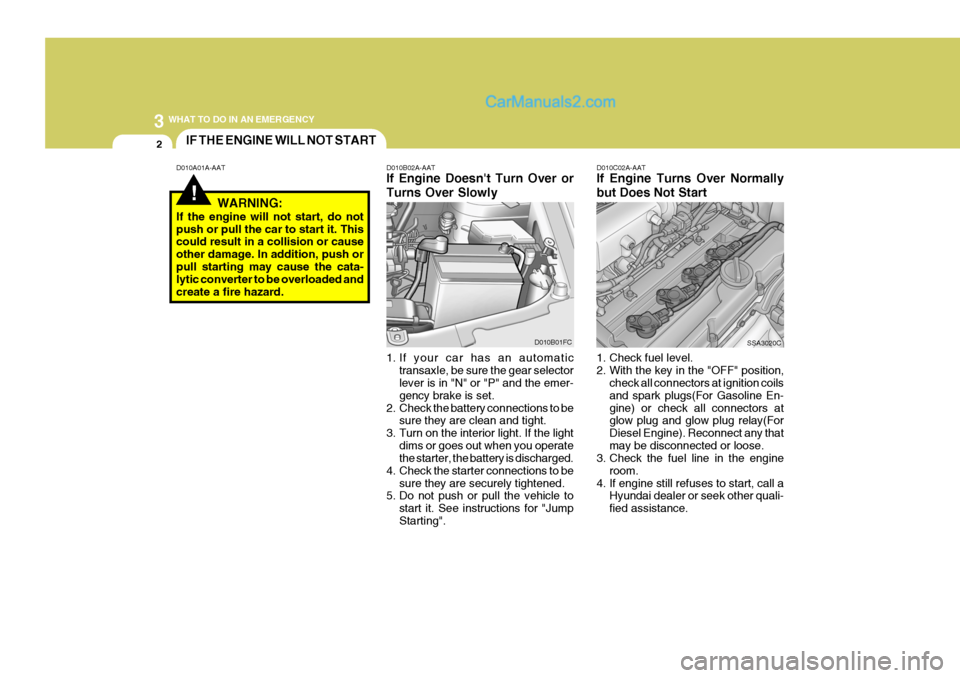
If Engine Doesn't Turn Over or Turns Over Slowly
1. If your car has an automatic
transaxle, be sure the gear selector lever is in "N" or "P" and the emer- gency brake is set.
2. Check the battery connections to be sure they are clean and tight.
3. Turn on the interior light. If the light dims or goes out when you operate the starter, the battery is discharged.
4. Check the starter connections to be sure they are securely tightened.
5. Do not push or pull the vehicle to
start it. See instructions for "Jump Starting". D010C02A-AAT If Engine Turns Over Normally but Does Not Start
D010B01FC
WARNING:
If the engine will not start, do not push or pull the car to start it. This could result in a collision or cause other damage. In addition, push orpull starting may cause the cata- lytic converter to be overloaded and create a fire hazard.
1. Check fuel level.2. With the key in the "OFF" position,check all connectors at ignition coilsand spark plugs(For Gasoline En-gine) or check all connectors at glow plug and glow plug relay(For Diesel Engine). Reconnect any thatmay be disconnected or loose.
3. Check the fuel line in the engine
room.
4. If engine still refuses to start, call a Hyundai dealer or seek other quali-fied assistance. SSA3020C
Page 326 of 407
3
WHAT TO DO IN AN EMERGENCY
13
o When towing the vehicle, take
care not to cause damage to the bumper or underbody of the ve- hicle.
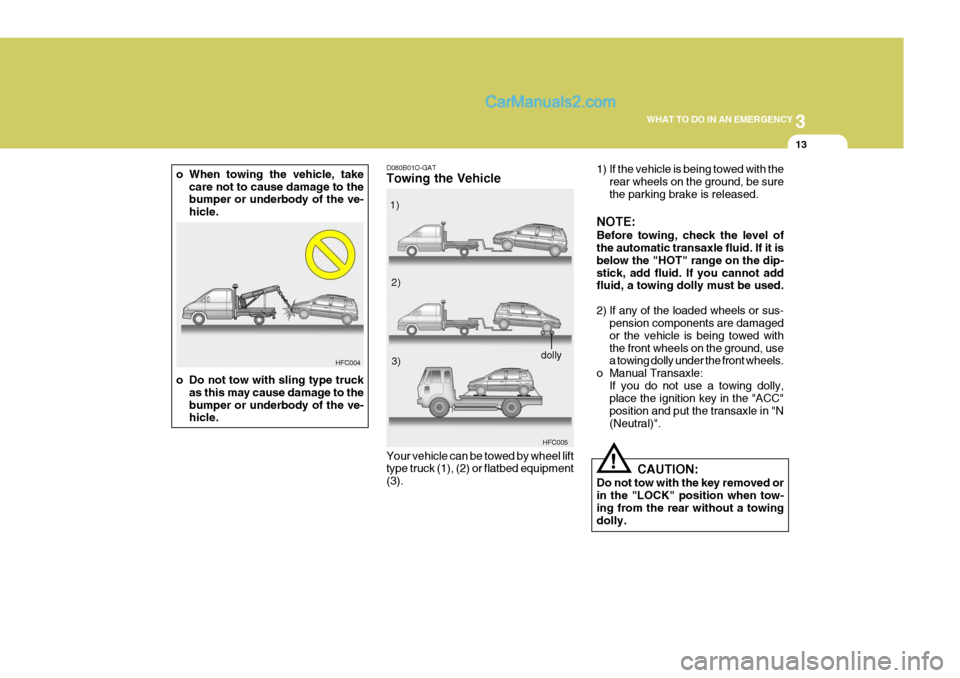
o Do not tow with sling type truck as this may cause damage to thebumper or underbody of the ve- hicle. HFC004D080B01O-GAT Towing the Vehicle
HFC005
Your vehicle can be towed by wheel lift type truck (1), (2) or flatbed equipment (3).
!
1) If the vehicle is being towed with the
rear wheels on the ground, be sure the parking brake is released.
NOTE: Before towing, check the level of the automatic transaxle fluid. If it is below the "HOT" range on the dip-stick, add fluid. If you cannot add fluid, a towing dolly must be used.
2) If any of the loaded wheels or sus- pension components are damaged or the vehicle is being towed withthe front wheels on the ground, use a towing dolly under the front wheels.
o Manual Transaxle: If you do not use a towing dolly,place the ignition key in the "ACC" position and put the transaxle in "N(Neutral)".
1)
2)
3)
dolly
CAUTION:
Do not tow with the key removed or in the "LOCK" position when tow- ing from the rear without a towing dolly.
Page 375 of 407
6 DO-IT-YOURSELF MAINTENANCE
30
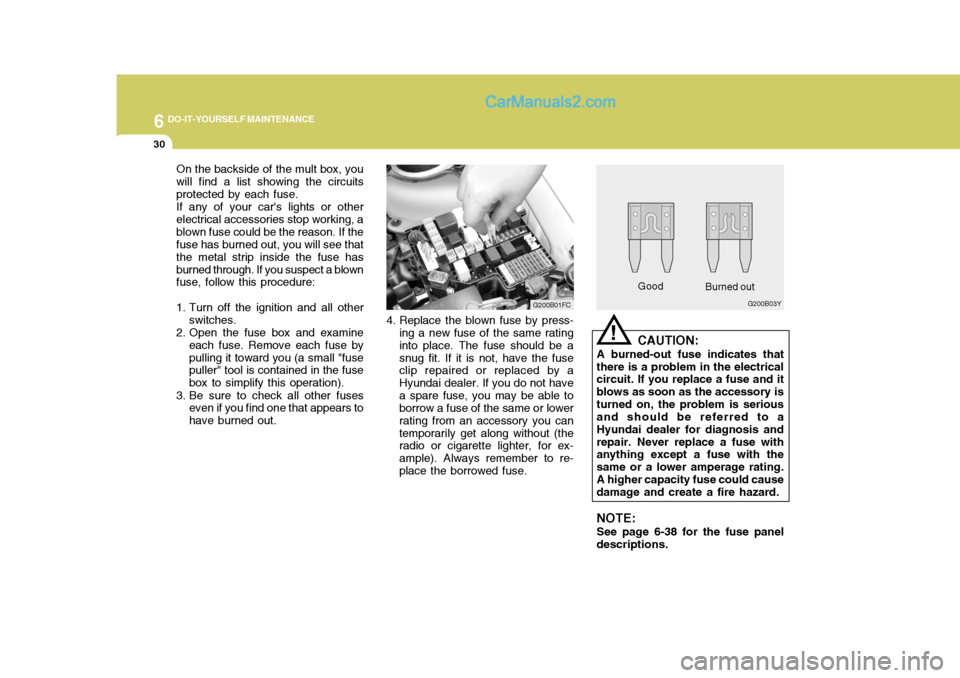
On the backside of the mult box, you will find a list showing the circuitsprotected by each fuse.If any of your car's lights or otherelectrical accessories stop working, ablown fuse could be the reason. If the fuse has burned out, you will see that the metal strip inside the fuse hasburned through. If you suspect a blown fuse, follow this procedure:
1. Turn off the ignition and all other switches.
2. Open the fuse box and examine
each fuse. Remove each fuse by pulling it toward you (a small "fuse puller" tool is contained in the fuse box to simplify this operation).
3. Be sure to check all other fuses even if you find one that appears tohave burned out. Good
G200B03Y
Burned out
CAUTION:
A burned-out fuse indicates that
there is a problem in the electrical circuit. If you replace a fuse and it blows as soon as the accessory isturned on, the problem is serious and should be referred to a Hyundai dealer for diagnosis andrepair. Never replace a fuse with anything except a fuse with the same or a lower amperage rating.A higher capacity fuse could cause damage and create a fire hazard.
NOTE: See page 6-38 for the fuse panel
descriptions.
!
G200B01FC
4. Replace the blown fuse by press- ing a new fuse of the same rating into place. The fuse should be a snug fit. If it is not, have the fuse clip repaired or replaced by a Hyundai dealer. If you do not havea spare fuse, you may be able to borrow a fuse of the same or lower rating from an accessory you cantemporarily get along without (the radio or cigarette lighter, for ex- ample). Always remember to re-place the borrowed fuse.
Page 377 of 407

6 DO-IT-YOURSELF MAINTENANCE
32
To check the power steering fluid level, be sure the ignition is "OFF",then check to make certain that the power steering fluid level is between the "MAX" and "MIN" level markingson the fluid reservoir. NOTE: Grinding noise from the power steering pump may be heard im- mediately after the engine is startedin extremely cold conditions (be- low - 20°C). If the noise stops dur- ing warm up, there is no abnormalfunction in the system. It is due to a power steering fluid characteris- tic in extremely cold conditions. Recommended Fluid Use PSF-3 type fluid NOTE: Do not start the engine when the power steering oil reservoir is empty.
!
CHECKING ELECTRIC COOLING FANS
G220A01A-AAT
WARNING:
The cooling fan is controlled by engine coolant temperature and may sometimes operate even whenthe engine is not running. Use extreme caution when working near the blades of the cooling fan,so that you are not injured by a rotating fan blade. As the engine coolant temperature decreases thefan will automatically shut off. This is a normal condition.POWER STEERING FLUID LEVEL
G220B01A-AAT
Checking Engine Cooling Fan
The engine cooling fan should come on automatically if the engine coolant temperature is high. G220C01A-AAT
Checking Condenser Cooling Fan
The condenser cooling fan should come on automatically whenever the air conditioning is in operation. G230A03A-GAT
HFC5004
G230A02FC
Gasoline engine
Diesel engine
The power steering fluid level should be checked regularly.
Page 379 of 407

6 DO-IT-YOURSELF MAINTENANCE
34
G300A02FC
G300A01B-GAT
REMOVAL OF WATER FROM THE FUEL FILTER (Diesel Engine)
If the fuel filter warning light illumi- nates during driving, it indicates that water has accumulated in the fuelfilter. If this occurs, remove the water as described.
1. Loosen the drain plug at the bot- tom of the fuel filter.
2. Tighten the drain plug when water no longer comes out.
3. Check to be sure that the warning lamp illuminates when the ignition key is turned to "ON", and that it goes off when the engine is started. If in doubt, consult your nearest authorized HYUNDAI dealer.
NOTE: It is recommended that water ac-
cumulated in the fuel filter should be removed by an authorized Hyundai dealer. G300B02FC
!WARNING:
o Do not smoke or have any other open flame near the vehicle while bleeding the fuel system.
o Be sure to carefully wipe away
any water drained out in thismanner, because the fuel mixed in the water might be ignited and result in a fire.
Page 384 of 407
6
DO-IT-YOURSELF MAINTENANCE
39FUSE PANEL DESCRIPTION
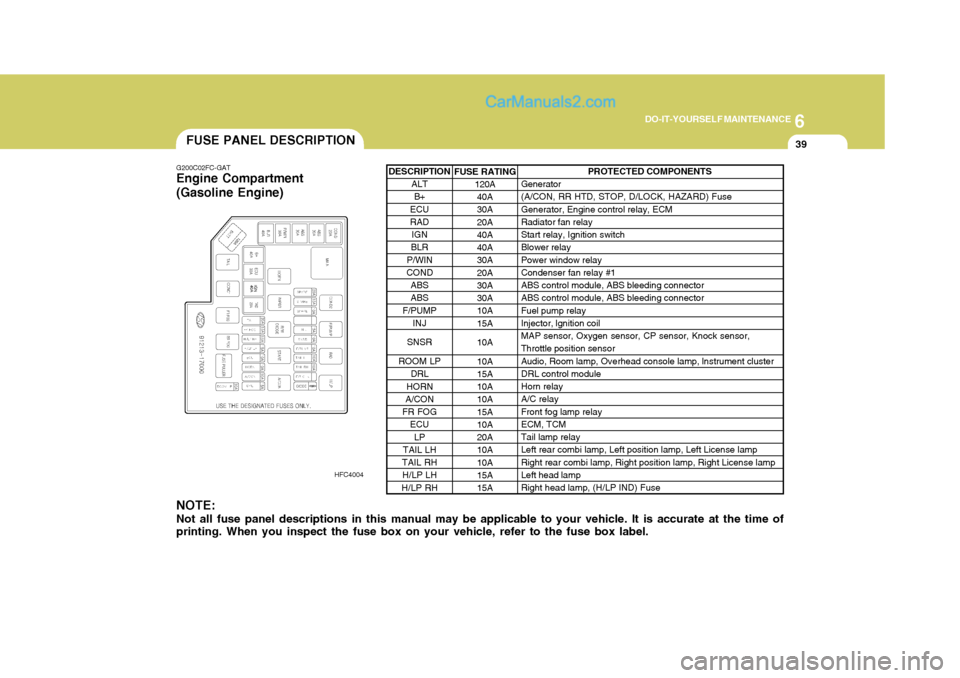
G200C02FC-GAT
Engine Compartment (Gasoline Engine)
HFC4004
NOTE: Not all fuse panel descriptions in this manual may be applicable to your vehicle. It is accurate at the time of printing. When you inspect the fuse box on your vehicle, refer to the fuse box label.
PROTECTED COMPONENTS
Generator (A/CON, RR HTD, STOP, D/LOCK, HAZARD) Fuse Generator, Engine control relay, ECM Radiator fan relay Start relay, Ignition switch Blower relay Power window relay Condenser fan relay #1 ABS control module, ABS bleeding connector ABS control module, ABS bleeding connector Fuel pump relay Injector, lgnition coil MAP sensor, Oxygen sensor, CP sensor, Knock sensor, Throttle position sensor Audio, Room lamp, Overhead console lamp, lnstrument cluster DRL control module Horn relay A/C relay Front fog lamp relay ECM, TCM Tail lamp relay Left rear combi lamp, Left position lamp, Left License lamp Right rear combi lamp, Right position lamp, Right License lamp Left head lamp Right head lamp, (H/LP IND) Fuse
FUSE RATING
120A
40A 30A 20A 40A 40A 30A 20A 30A 30A 10A 15A 10A10A 15A 10A 10A 15A 10A 20A 10A 10A 15A 15A
DESCRIPTION
ALTB+
ECU RAD IGN
BLR
P/WIN
COND
ABSABS
F/PUMP INJ
SNSR
ROOM LP DRL
HORN
A/CON
FR FOG ECU
LP
TAIL LH
TAIL RH H/LP LH
H/LP RH
Page 386 of 407
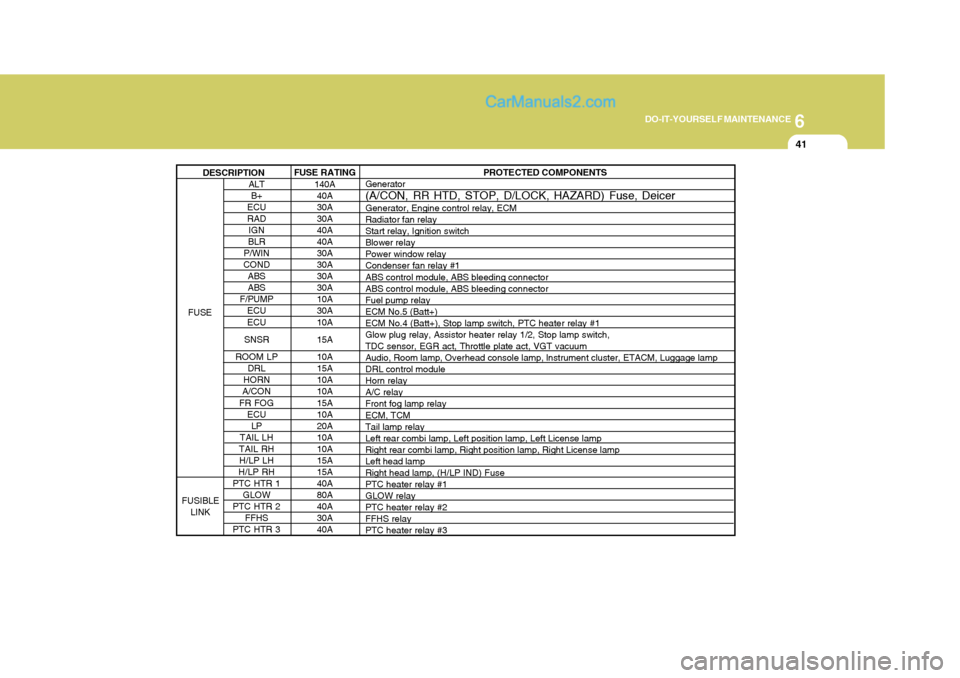
6
DO-IT-YOURSELF MAINTENANCE
41
ALT B+
ECU RAD
IGN
BLR
P/WIN
COND ABSABS
F/PUMP ECU ECU
SNSR
ROOM LP DRL
HORN
A/CON
FR FOG ECU
LP
TAIL LH
TAIL RH H/LP LH
H/LP RH
PTC HTR 1
GLOW
PTC HTR 2 FFHS
PTC HTR 3 PROTECTED COMPONENTS
Generator (A/CON, RR HTD, STOP, D/LOCK, HAZARD) Fuse, Deicer Generator, Engine control relay, ECM Radiator fan relayStart relay, Ignition switchBlower relayPower window relayCondenser fan relay #1 ABS control module, ABS bleeding connector ABS control module, ABS bleeding connectorFuel pump relayECM No.5 (Batt+)ECM No.4 (Batt+), Stop lamp switch, PTC heater relay #1Glow plug relay, Assistor heater relay 1/2, Stop lamp switch, TDC sensor, EGR act, Throttle plate act, VGT vacuum Audio, Room lamp, Overhead console lamp, lnstrument cluster, ETACM, Luggage lampDRL control moduleHorn relayA/C relayFront fog lamp relay ECM, TCM Tail lamp relayLeft rear combi lamp, Left position lamp, Left License lampRight rear combi lamp, Right position lamp, Right License lampLeft head lampRight head lamp, (H/LP IND) Fuse PTC heater relay #1 GLOW relayPTC heater relay #2FFHS relayPTC heater relay #3
FUSE RATING
140A40A30A30A40A40A 30A 30A30A30A10A30A 10A 15A 10A 15A10A10A 15A 10A20A10A10A15A 15A 40A80A40A30A40A
FUSE
FUSIBLE LINK DESCRIPTION