belt Hyundai Matrix 2005 Owner's Manual
[x] Cancel search | Manufacturer: HYUNDAI, Model Year: 2005, Model line: Matrix, Model: Hyundai Matrix 2005Pages: 407, PDF Size: 10.31 MB
Page 11 of 407
1- 3
CONTROLS AND EQUIPMENT
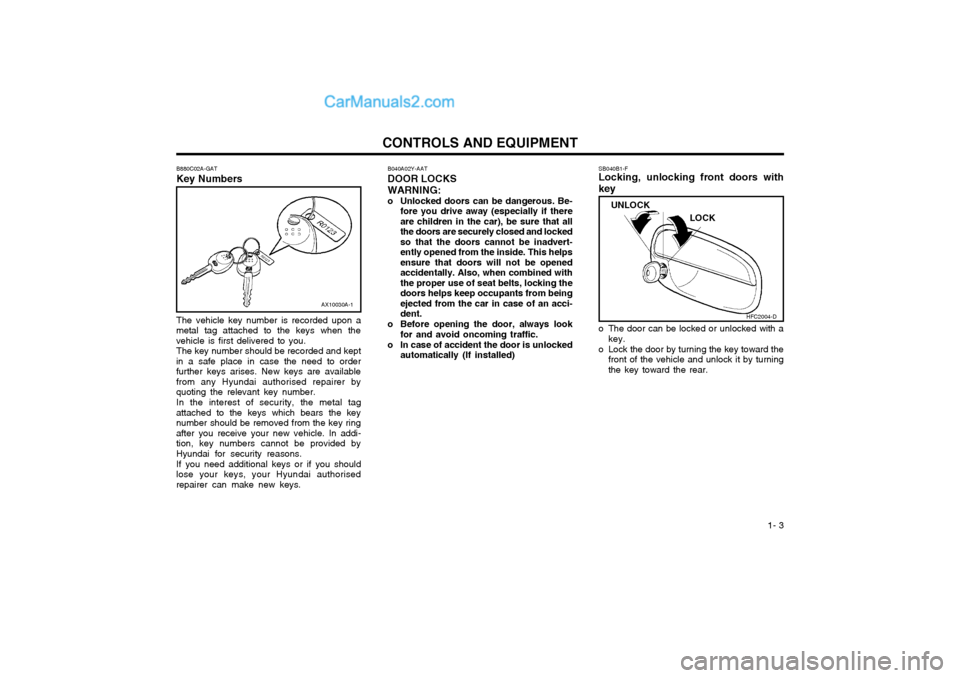
B880C02A-GAT
Key Numbers
The vehicle key number is recorded upon a
metal tag attached to the keys when the vehicle is first delivered to you. The key number should be recorded and kept
in a safe place in case the need to orderfurther keys arises. New keys are availablefrom any Hyundai authorised repairer byquoting the relevant key number.
In the interest of security, the metal tag
attached to the keys which bears the keynumber should be removed from the key ringafter you receive your new vehicle. In addi-tion, key numbers cannot be provided byHyundai for security reasons.
If you need additional keys or if you should
lose your keys, your Hyundai authorisedrepairer can make new keys. SB040B1-F Locking, unlocking front doors with key
o The door can be locked or unlocked with a
key.
o Lock the door by turning the key toward the front of the vehicle and unlock it by turning the key toward the rear.
AX10030A-1
B040A02Y-AAT DOOR LOCKS WARNING:
o Unlocked doors can be dangerous. Be- fore you drive away (especially if there are children in the car), be sure that allthe doors are securely closed and lockedso that the doors cannot be inadvert-ently opened from the inside. This helpsensure that doors will not be openedaccidentally. Also, when combined withthe proper use of seat belts, locking thedoors helps keep occupants from beingejected from the car in case of an acci-dent.
o Before opening the door, always look for and avoid oncoming traffic.
o In case of accident the door is unlocked automatically (If installed)
LOCK
UNLOCK
HFC2004-D
Page 20 of 407
CONTROLS AND EQUIPMENT
1- 12 o Objects should not extend higher than
the top of the front seatbacks. This could allow cargo to slide forward andcause injury or damage during suddenstops.
o When you return the folded down seatback to its upright position, alwaysbe sure to install the headrests in theirproper positions. Headrests are impor-tant to the safety of occupants in a rearcollision. If the headrests are not in-stalled in their proper position, seriousinjury or death could result if a rear endcollision occurs.
B100A01FC-EAT
SEAT WARMER (Not all models)
The seat warmer is provided to warm the front
seats during cold weather. When the engine is running, push either of the switches to warmthe driver's seat or the passenger's seat.
B100A01FC
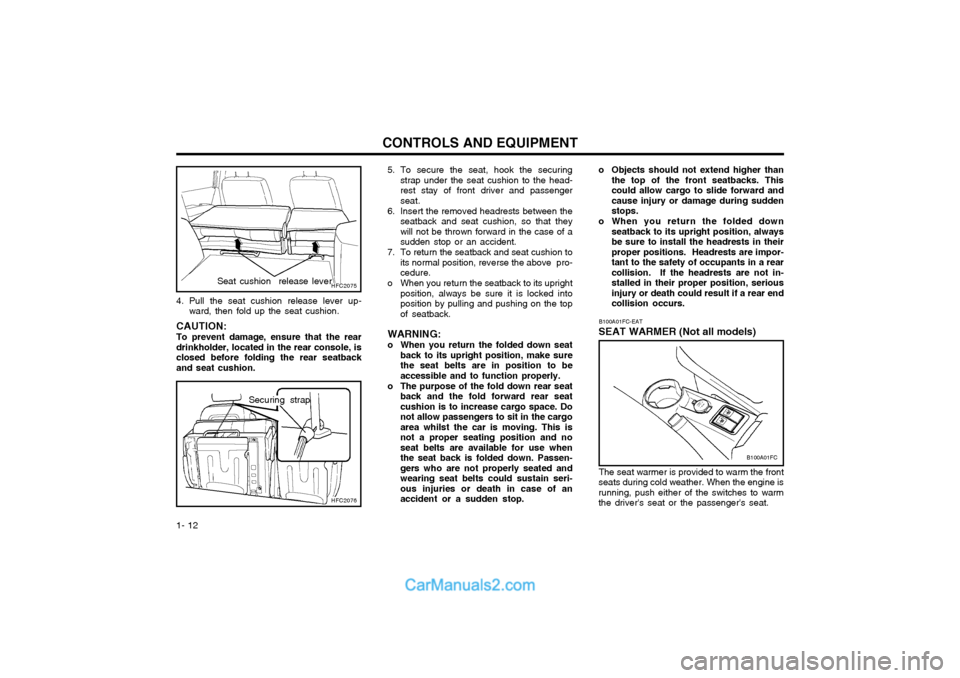
5. To secure the seat, hook the securing strap under the seat cushion to the head- rest stay of front driver and passengerseat.
6. Insert the removed headrests between the seatback and seat cushion, so that theywill not be thrown forward in the case of asudden stop or an accident.
7. To return the seatback and seat cushion to its normal position, reverse the above pro-cedure.
o When you return the seatback to its upright position, always be sure it is locked intoposition by pulling and pushing on the topof seatback.
WARNING:
o When you return the folded down seat back to its upright position, make sure the seat belts are in position to beaccessible and to function properly.
o The purpose of the fold down rear seat back and the fold forward rear seatcushion is to increase cargo space. Donot allow passengers to sit in the cargoarea whilst the car is moving. This isnot a proper seating position and noseat belts are available for use whenthe seat back is folded down. Passen-gers who are not properly seated andwearing seat belts could sustain seri-ous injuries or death in case of anaccident or a sudden stop.
CAUTION: To prevent damage, ensure that the rear drinkholder, located in the rear console, isclosed before folding the rear seatbackand seat cushion.
4. Pull the seat cushion release lever up-
ward, then fold up the seat cushion.
HFC2075
HFC2076
Seat cushion release lever
Securing strap
Page 21 of 407
1- 13
CONTROLS AND EQUIPMENTSB090O1-E Pregnant Women The use of a seat belt is recommended for pregnant women. The seat belt should beworn as low and snugly as possible acrossthe hips, not across the abdomen. A qualifiedMedical Practitioner should be consulted forfurther information. SB090F1-E Seat Belt OccupancyThe seat belts are designed to be used by one seat occupant only. The use of a seat belt bymore than one person increases the levels ofinjury which may be sustained in the event ofan accident.
SB090E1-E Injured PersonsA seat belt should be used when an injured person is being transported. For specific rec-ommendations, the advice of a qualified Med-ical Practioner should be sought. SE090G1-E Do Not Lie Down To ensure that the maximum level of protec- tion may be afforded by the seat belt system,all passengers should be sitting in an uprightposition throughout the journey. The seat beltwill be unable to afford maximum protection ifthe front seats are at or near the fully reclinedposition.
SB090A1-E SEAT BELT PRECAUTIONS Seat belts should be worn at all times by all occupants front and rear. The possibility ofinjury or the severity of injuries suffered in theevent of an accident will be greatly reduced bythe wearing of seat belts. In addition the following recommendations should be observed. SB090B1-E Babies/Small ChildrenBabies and small children must be restrained using a restraint system specifically designedfor this purpose. Under no circumstancesshould a child be carried in the vehicle withoutthe use of a suitable restraint which meets theregulations in force in the country where thevehicle is in operation. SB090C1-E Larger ChildrenLarger children should occupy the rear seat and be restrained at all times. The restraintmay take the form of a special safety belt orthe original factory fitted seat belt used inconjunction with an approved booster cushiondepending upon the size and weight of thechild. Under no circumstances should childrenbe allowed to travel standing, kneeling or lyingon the seat. Never allow children to ride in the front pas- senger seat.
During mild weather or under conditions wherethe operation of the seat warmer is not needed,keep the switches in the "OFF" position.
B140A01B-GAT REAR SEAT WARNING
B140A01FC
For the safety of all vehicle occupants, lug-
gage or other cargo should not be piled higher than the top of the seatback.
Page 22 of 407
CONTROLS AND EQUIPMENT
1- 14 SB090P1-E
SEAT BELTS (3-Point Type) To Fasten The Seat Belt
SSD1090P
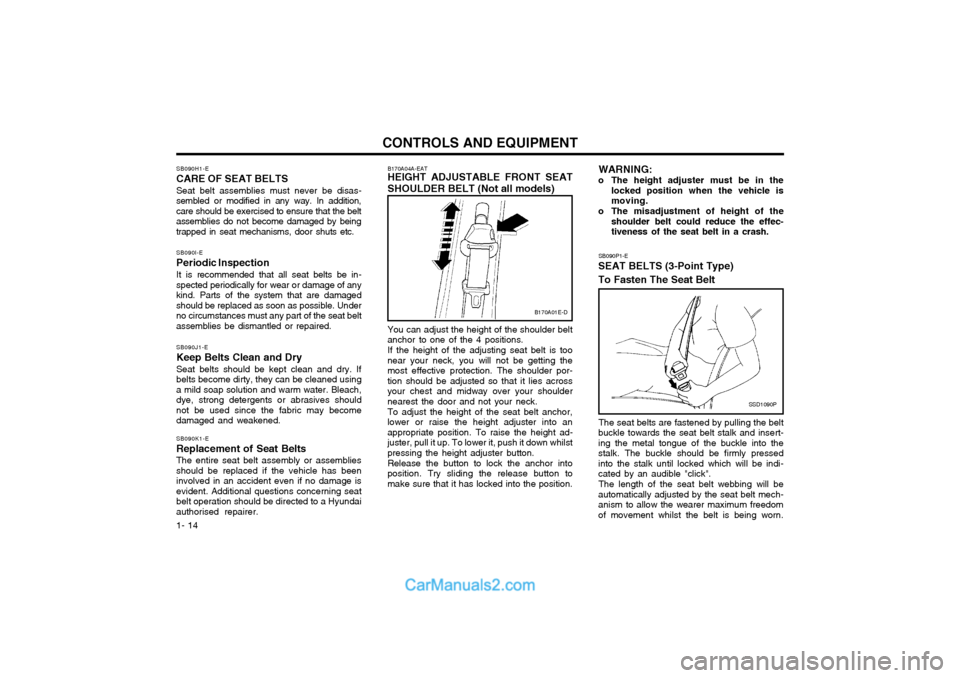
The seat belts are fastened by pulling the belt
buckle towards the seat belt stalk and insert- ing the metal tongue of the buckle into thestalk. The buckle should be firmly pressedinto the stalk until locked which will be indi-cated by an audible "click".
The length of the seat belt webbing will be
automatically adjusted by the seat belt mech-anism to allow the wearer maximum freedomof movement whilst the belt is being worn. WARNING:
o The height adjuster must be in the locked position when the vehicle ismoving.
o The misadjustment of height of the shoulder belt could reduce the effec-tiveness of the seat belt in a crash.
B170A01E-D
B170A04A-EAT HEIGHT ADJUSTABLE FRONT SEAT SHOULDER BELT (Not all models) You can adjust the height of the shoulder belt anchor to one of the 4 positions. If the height of the adjusting seat belt is too near your neck, you will not be getting themost effective protection. The shoulder por-tion should be adjusted so that it lies acrossyour chest and midway over your shouldernearest the door and not your neck. To adjust the height of the seat belt anchor, lower or raise the height adjuster into anappropriate position. To raise the height ad-juster, pull it up. To lower it, push it down whilstpressing the height adjuster button. Release the button to lock the anchor into position. Try sliding the release button tomake sure that it has locked into the position.
SB090H1-E
CARE OF SEAT BELTS
Seat belt assemblies must never be disas-
sembled or modified in any way. In addition,care should be exercised to ensure that the beltassemblies do not become damaged by beingtrapped in seat mechanisms, door shuts etc.
SB090I-E Periodic InspectionIt is recommended that all seat belts be in- spected periodically for wear or damage of anykind. Parts of the system that are damagedshould be replaced as soon as possible. Underno circumstances must any part of the seat beltassemblies be dismantled or repaired. SB090J1-E Keep Belts Clean and Dry Seat belts should be kept clean and dry. If belts become dirty, they can be cleaned usinga mild soap solution and warm water. Bleach,dye, strong detergents or abrasives shouldnot be used since the fabric may becomedamaged and weakened. SB090K1-E Replacement of Seat Belts The entire seat belt assembly or assemblies should be replaced if the vehicle has beeninvolved in an accident even if no damage isevident. Additional questions concerning seatbelt operation should be directed to a Hyundaiauthorised repairer.
Page 23 of 407
1- 15
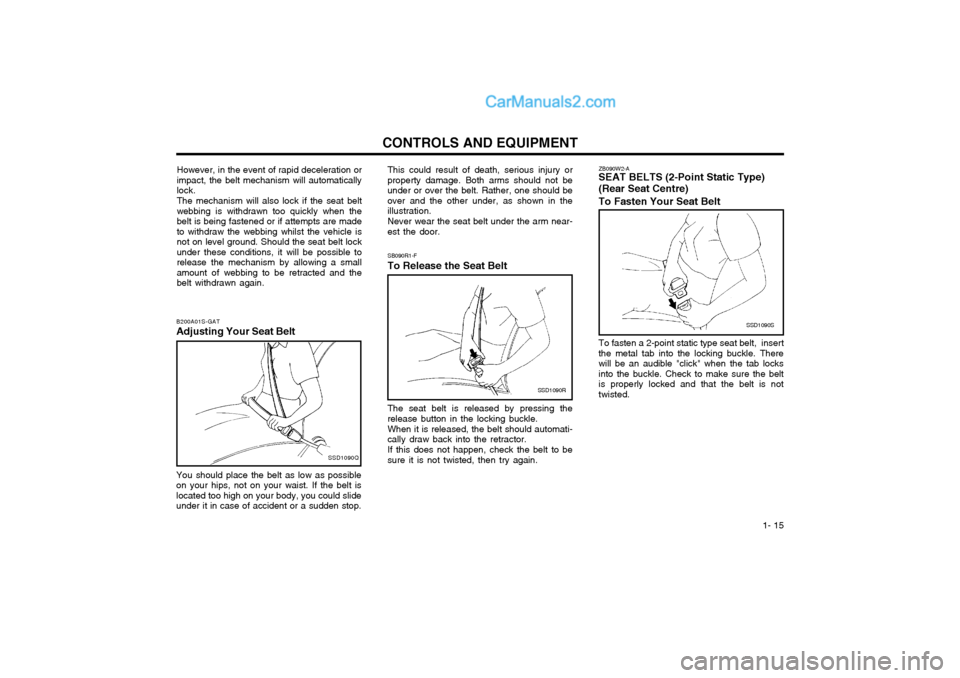
CONTROLS AND EQUIPMENTSB090R1-F To Release the Seat Belt
SSD1090R
The seat belt is released by pressing the release button in the locking buckle. When it is released, the belt should automati- cally draw back into the retractor. If this does not happen, check the belt to be sure it is not twisted, then try again.
However, in the event of rapid deceleration orimpact, the belt mechanism will automaticallylock. The mechanism will also lock if the seat belt webbing is withdrawn too quickly when thebelt is being fastened or if attempts are madeto withdraw the webbing whilst the vehicle isnot on level ground. Should the seat belt lockunder these conditions, it will be possible torelease the mechanism by allowing a smallamount of webbing to be retracted and thebelt withdrawn again.
SSD1090Q
B200A01S-GAT Adjusting Your Seat Belt You should place the belt as low as possible on your hips, not on your waist. If the belt islocated too high on your body, you could slideunder it in case of accident or a sudden stop. This could result of death, serious injury orproperty damage. Both arms should not beunder or over the belt. Rather, one should beover and the other under, as shown in theillustration. Never wear the seat belt under the arm near- est the door.
To fasten a 2-point static type seat belt, insertthe metal tab into the locking buckle. Therewill be an audible "click" when the tab locksinto the buckle. Check to make sure the beltis properly locked and that the belt is nottwisted.ZB090W2-A
SEAT BELTS (2-Point Static Type) (Rear Seat Centre) To Fasten Your Seat Belt
SSD1090S
Page 24 of 407
CONTROLS AND EQUIPMENT
1- 16
ZB090Y1-E To Release the Seat Belt
B220C01FC
When you want to release the seat belt, press the button in the locking buckle. WARNING: The centre lap belt latching mechanism is different from those for the rear seat shoul-der belts. When fastening the rear seatshoulder belts or the centre lap belt, makesure they are inserted into the correctbuckle to obtain maximum protection fromthe seat belt system and assure properoperation.
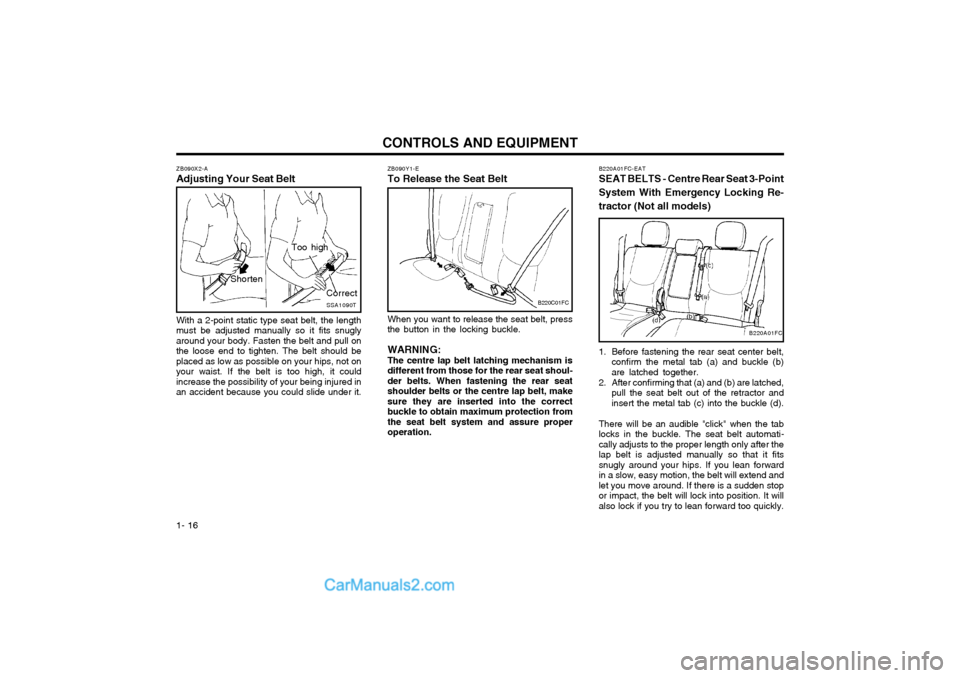
ZB090X2-A Adjusting Your Seat Belt
SSA1090T
Shorten Correct
Too high
With a 2-point static type seat belt, the length must be adjusted manually so it fits snuglyaround your body. Fasten the belt and pull onthe loose end to tighten. The belt should beplaced as low as possible on your hips, not onyour waist. If the belt is too high, it couldincrease the possibility of your being injured inan accident because you could slide under it. B220A01FC-EAT SEAT BELTS - Centre Rear Seat 3-Point System With Emergency Locking Re-tractor (Not all models)
1. Before fastening the rear seat center belt,
confirm the metal tab (a) and buckle (b) are latched together.
2. After confirming that (a) and (b) are latched, pull the seat belt out of the retractor andinsert the metal tab (c) into the buckle (d).
There will be an audible "click" when the tablocks in the buckle. The seat belt automati-cally adjusts to the proper length only after thelap belt is adjusted manually so that it fitssnugly around your hips. If you lean forwardin a slow, easy motion, the belt will extend andlet you move around. If there is a sudden stopor impact, the belt will lock into position. It willalso lock if you try to lean forward too quickly.
B220A01FC
Page 25 of 407
1- 17
CONTROLS AND EQUIPMENT
B230A04P-EAT
CHILD RESTRAINT SYSTEM
Children riding in the car should sit in the rear
seat and must always be properly restrained to minimise the risk of injury in an accident,sudden stop or sudden maneuver. Accordingto accident statistics, children are safer whenproperly restrained in the rear seats than inthe front seat. Larger children should use oneof the seat belts provided.
You are required by law to use safety re-
straints for children. If small children ride inyour vehicle you must put them in a childrestraint system (safety seat).
Children could be injured or killed in a crash if
their restraints are not properly secured. Forsmall children and babies, a child seat orinfant seat must be used. Before buying aparticular child restraint system, make sure itfits your car and seat belts, and fits your child.Follow all the instructions provided by themanufacturer when installing the child restraintsystem.
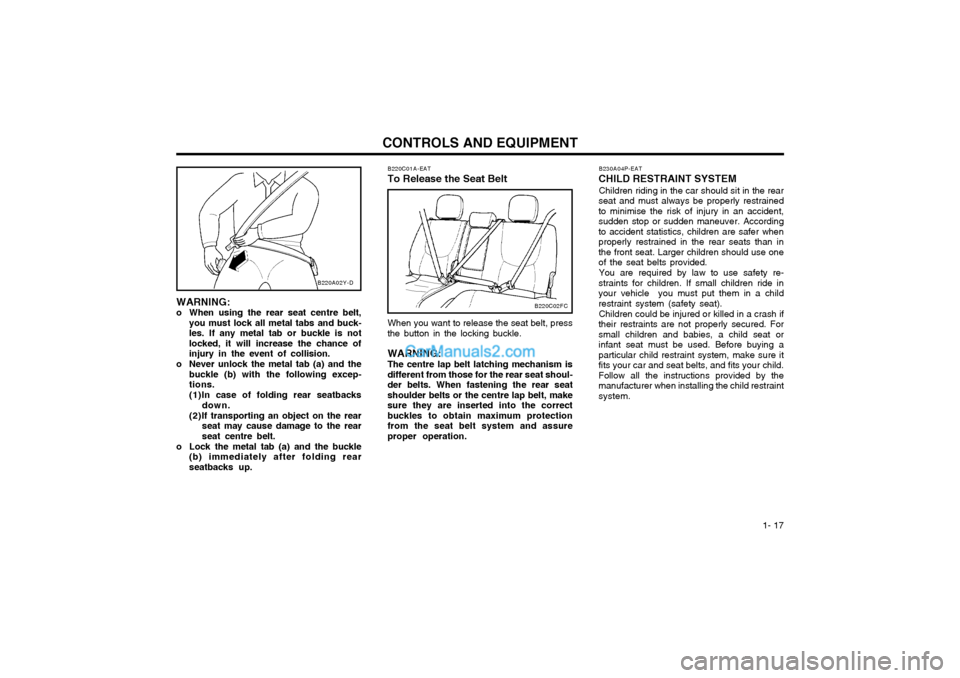
WARNING:
o When using the rear seat centre belt, you must lock all metal tabs and buck-les. If any metal tab or buckle is notlocked, it will increase the chance ofinjury in the event of collision.
o Never unlock the metal tab (a) and the buckle (b) with the following excep-tions.
(1) In case of folding rear seatbacksdown.
(2) If transporting an object on the rear seat may cause damage to the rear seat centre belt.
o Lock the metal tab (a) and the buckle (b) immediately after folding rearseatbacks up. B220C01A-EAT To Release the Seat Belt When you want to release the seat belt, press the button in the locking buckle. WARNING: The centre lap belt latching mechanism is different from those for the rear seat shoul-der belts. When fastening the rear seatshoulder belts or the centre lap belt, makesure they are inserted into the correctbuckles to obtain maximum protectionfrom the seat belt system and assureproper operation.
B220A02Y-D
B220C02FC
Page 26 of 407
CONTROLS AND EQUIPMENT
1- 18
WARNING:
o A child restraint system must be placed in the rear seat. Never install a child or infant seat on the front passenger's seat. Should an accident occur and cause the passenger side airbag to deploy, itcould severely injure or kill an infant orchild seated in an infant or child seat.Thus, only use a child restraint in therear seat of your vehicle.
o Since a safety belt or child restraint system can become very hot if it is leftin a closed vehicle, be sure to check theseat cover and buckles before placing achild there.
o When the child restraint system is not in use, fasten it with a safety belt so thatit will not be thrown forward in the caseof a sudden stop or an accident.
o Children who are too large to be in a child restraint should still sit in the rearseat and be restrained with the avail-able lap/shoulder belts. Never allowchildren to ride in the front passengerseat.
o Always make sure that the shoulder belt portion of the outboard lap/shoulder beltis positioned midway over the shoul-der, never across the neck or behindthe back. Moving the child closer to thecenter of the vehicle may help provide agood shoulder belt fit. The lap belt portion of the lap/shoulderbelt or the center seat lap belt mustalways be positioned as low as pos-sible on the child's hips and as snug aspossible.
o If the seat belt will not properly fit the child, we recommend the use of anapproved booster seat in the rear seatin order to raise the child's seatingheight so that the seat belt will prop-erly fit the child.
o Never allow a child to stand up or kneel on the seat.
o Never use an infant carrier or child safety seat that "hooks" over aseatback; it may not provide adequatesecurity in an accident.
o Never allow a child to be held in a person's arms whilst they are in a mov-ing vehicle, as this could result in se-rious injury to the child in the event ofan accident or a sudden stop. Holdinga child in a moving vehicle does notprovide the child with any means ofprotection during an accident, even ifthe person holding the child is wearinga seat belt.
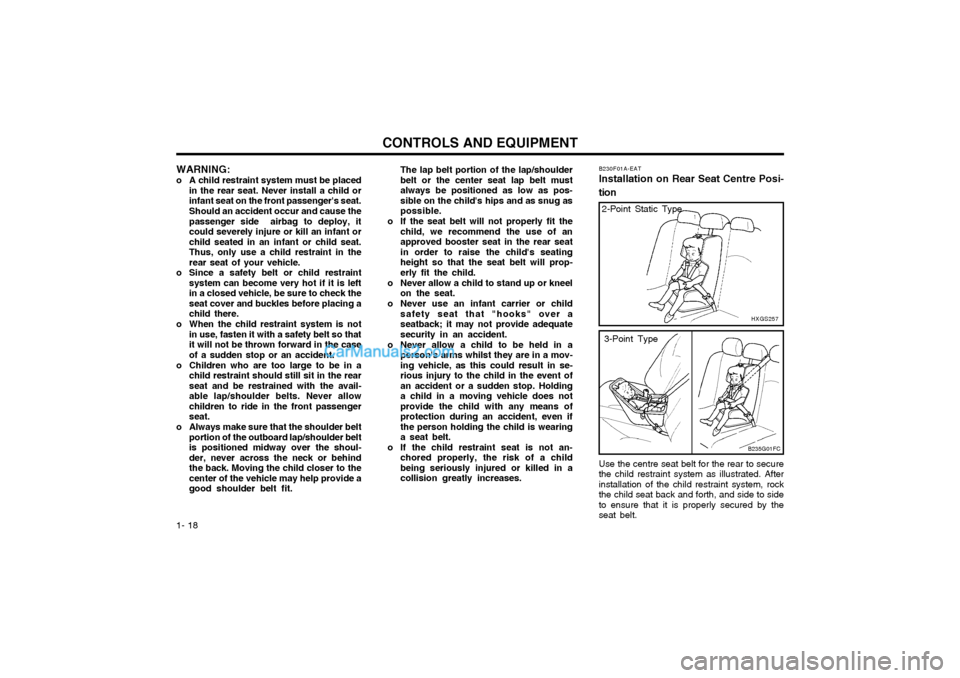
o If the child restraint seat is not an- chored properly, the risk of a childbeing seriously injured or killed in acollision greatly increases. B230F01A-EAT Installation on Rear Seat Centre Posi- tion Use the centre seat belt for the rear to secure the child restraint system as illustrated. Afterinstallation of the child restraint system, rockthe child seat back and forth, and side to sideto ensure that it is properly secured by theseat belt.
HXGS257
B235G01FC
2-Point Static Type
3-Point Type
Page 27 of 407
1- 19
CONTROLS AND EQUIPMENT
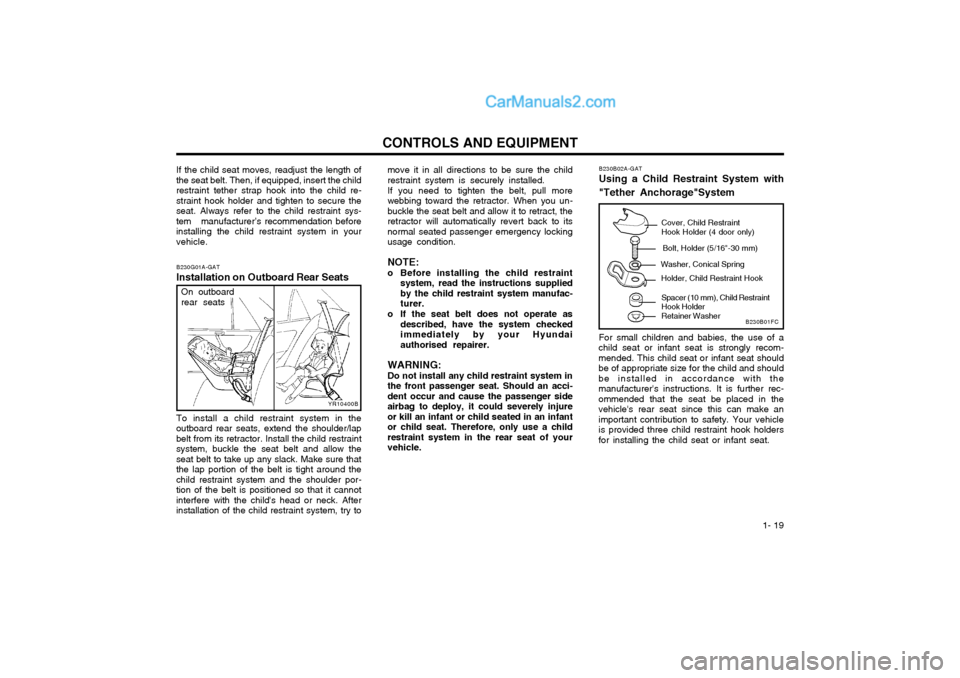
B230G01A-GAT
Installation on Outboard Rear Seats move it in all directions to be sure the child restraint system is securely installed. If you need to tighten the belt, pull more webbing toward the retractor. When you un-buckle the seat belt and allow it to retract, theretractor will automatically revert back to itsnormal seated passenger emergency lockingusage condition. NOTE:
o Before installing the child restraint
system, read the instructions supplied by the child restraint system manufac-turer.
o If the seat belt does not operate as described, have the system checkedimmediately by your Hyundaiauthorised repairer.
WARNING:Do not install any child restraint system inthe front passenger seat. Should an acci-dent occur and cause the passenger sideairbag to deploy, it could severely injureor kill an infant or child seated in an infantor child seat. Therefore, only use a childrestraint system in the rear seat of yourvehicle.
To install a child restraint system in the
outboard rear seats, extend the shoulder/lapbelt from its retractor. Install the child restraintsystem, buckle the seat belt and allow theseat belt to take up any slack. Make sure thatthe lap portion of the belt is tight around thechild restraint system and the shoulder por-tion of the belt is positioned so that it cannotinterfere with the child's head or neck. Afterinstallation of the child restraint system, try to
YR10400B
On outboard rear seats
B230B02A-GAT Using a Child Restraint System with "Tether Anchorage"System For small children and babies, the use of a
child seat or infant seat is strongly recom- mended. This child seat or infant seat shouldbe of appropriate size for the child and shouldbe installed in accordance with themanufacturer's instructions. It is further rec-ommended that the seat be placed in thevehicle's rear seat since this can make animportant contribution to safety. Your vehicleis provided three child restraint hook holdersfor installing the child seat or infant seat.
Cover, Child Restraint Hook Holder (4 door only)
Bolt, Holder (5/16"-30 mm)
Washer, Conical Spring Holder, Child Restraint Hook
Spacer (10 mm), Child Restraint Hook Holder Retainer Washer
B230B01FC
If the child seat moves, readjust the length of
the seat belt. Then, if equipped, insert the child restraint tether strap hook into the child re-straint hook holder and tighten to secure theseat. Always refer to the child restraint sys-tem manufacturer’s recommendation beforeinstalling the child restraint system in yourvehicle.
Page 28 of 407
CONTROLS AND EQUIPMENT
1- 20
B230E01FC
Back panel
Front of Vehicle
Tether straphook
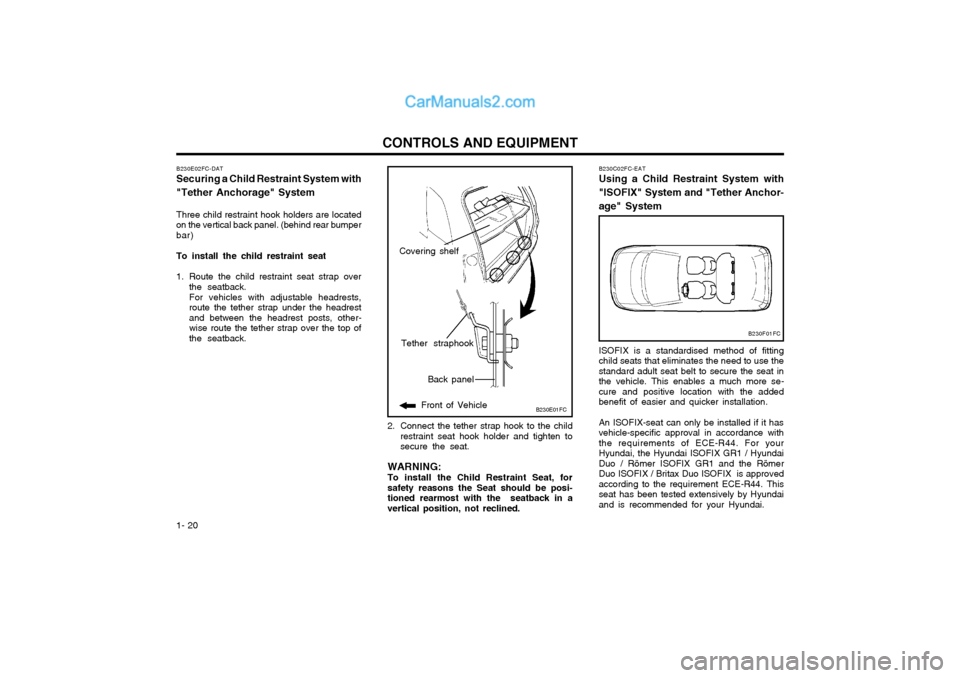
B230E02FC-DAT Securing a Child Restraint System with "Tether Anchorage" System Three child restraint hook holders are located on the vertical back panel. (behind rear bumperbar) To install the child restraint seat
1. Route the child restraint seat strap over the seatback. For vehicles with adjustable headrests, route the tether strap under the headrestand between the headrest posts, other-wise route the tether strap over the top ofthe seatback.
2. Connect the tether strap hook to the childrestraint seat hook holder and tighten tosecure the seat.
WARNING:
To install the Child Restraint Seat, for safety reasons the Seat should be posi-tioned rearmost with the seatback in avertical position, not reclined.
Covering shelf
B230F01FC
B230C02FC-EAT Using a Child Restraint System with "ISOFIX" System and "Tether Anchor-age" System ISOFIX is a standardised method of fitting child seats that eliminates the need to use thestandard adult seat belt to secure the seat inthe vehicle. This enables a much more se-cure and positive location with the addedbenefit of easier and quicker installation. An ISOFIX-seat can only be installed if it has vehicle-specific approval in accordance withthe requirements of ECE-R44. For yourHyundai, the Hyundai ISOFIX GR1 / HyundaiDuo / Römer ISOFIX GR1 and the RömerDuo ISOFIX / Britax Duo ISOFIX is approvedaccording to the requirement ECE-R44. Thisseat has been tested extensively by Hyundaiand is recommended for your Hyundai.