engine compartment Hyundai Santa Fe 2013 Owner's Manual
[x] Cancel search | Manufacturer: HYUNDAI, Model Year: 2013, Model line: Santa Fe, Model: Hyundai Santa Fe 2013Pages: 711, PDF Size: 14.72 MB
Page 13 of 711
Your vehicle at a glance
Exterior overview . . . . . . . . . . . . . . . . . . . . . . . . . . . 2-2
Interior overview (I) . . . . . . . . . . . . . . . . . . . . . . . . . 2-4
Interior overview (II) . . . . . . . . . . . . . . . . . . . . . . . . 2-6
Instrument panel overview . . . . . . . . . . . . . . . . . . . 2-8
Engine compartment . . . . . . . . . . . . . . . . . . . . . . . 2-10
2
Page 22 of 711
Your vehicle at a glance
10 2
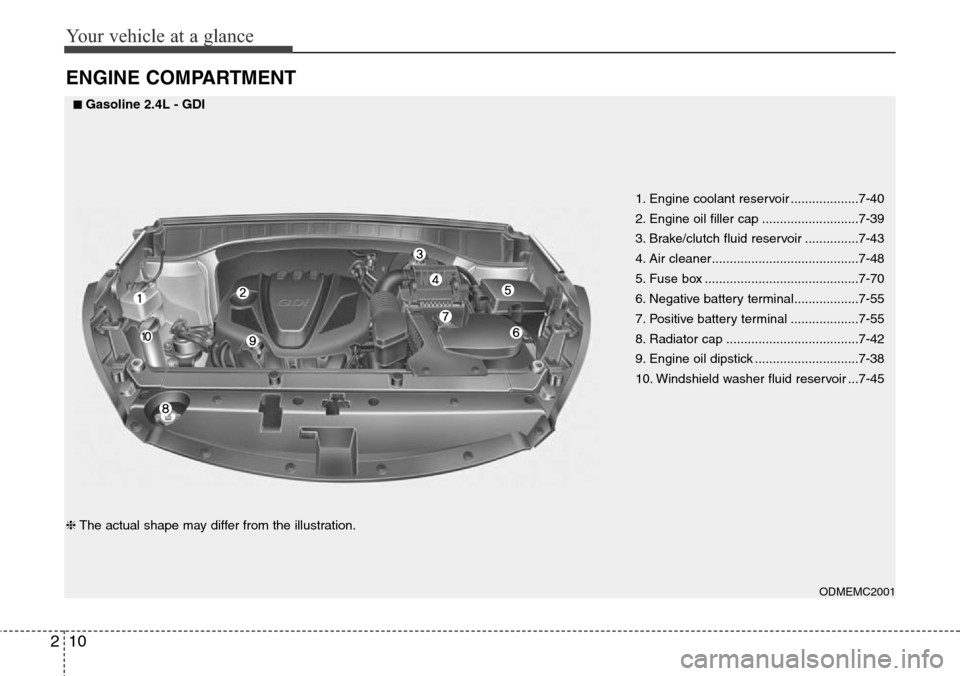
ENGINE COMPARTMENT
1. Engine coolant reservoir ...................7-40
2. Engine oil filler cap ...........................7-39
3. Brake/clutch fluid reservoir ...............7-43
4. Air cleaner.........................................7-48
5. Fuse box ...........................................7-70
6. Negative battery terminal..................7-55
7. Positive battery terminal ...................7-55
8. Radiator cap .....................................7-42
9. Engine oil dipstick .............................7-38
10. Windshield washer fluid reservoir ...7-45
ODMEMC2001
■Gasoline 2.4L - GDI
❈The actual shape may differ from the illustration.
Page 134 of 711

433
Features of your vehicle
Closing the hood
1. Before closing the hood, check the
following:
• All filler caps in engine compart-
ment must be correctly installed.
• Gloves, rags or any other com-
bustible material must be
removed from the engine com-
partment.
2. Lower the hood halfway and push
it down. Make sure the hood is
locked securelyWARNING
• Always double check to be
sure that the hood is firmly
latched before driving away. If
it is not latched, the hood
could fly open while the vehi-
cle is being driven, causing a
total loss of visibility, which
might result in an accident.
• Do not move the vehicle with
the hood raised. The view will
be blocked and the hood
could fall or be damaged.
WARNING
When you check the engine
compartment, please make sure
your head is not injured by the
hood safety hook which is
located inside of the hood.WARNING - Hood
• Before closing the hood,
ensure that all obstructions
are removed from the hood
opening. Closing the hood
with an obstruction present in
the hood opening may result
in property damage or severe
personal injury.
• Do not leave gloves, rags or
any other combustible materi-
al in the engine compartment.
Doing so may cause a heat-
induced fire.
ODMNMC2034
Page 137 of 711

Features of your vehicle
36 4
Emergency fuel filler lid
release
If the fuel filler lid does not open
using the remote fuel filler lid
release, you can open it manually.
Remove the panel in the luggage
compartment area. Pull the handle
out slightly.
(Continued)
• When refueling, always shut
the engine off. Sparks pro-
duced by electrical compo-
nents related to the engine
can ignite fuel vapors causing
a fire. Once refueling is com-
plete, check to make sure the
filler cap and filler door are
securely closed, before start-
ing the engine.
• DO NOT use matches or a
lighter and DO NOT SMOKE or
leave a lit cigarette in your
vehicle while at a gas station
especially during refueling.
Automotive fuel is highly
flammable and can, when
ignited, result in fire.
• If a fire breaks out during refu-
eling, leave the vicinity of the
vehicle, and immediately con-
tact the manager of the gas
station and then contact the
local fire department. Follow
any safety instructions they
provide.CAUTION
• Make sure to refuel your vehi-
cle according to the "Fuel
requirements" suggested in
section 1.
• If the fuel filler cap requires
replacement, please make
sure that you use parts
designed for replacement in
your vehicle. An incorrect fuel
filler cap can result in a seri-
ous malfunction of the fuel
system or emission control
system. For more detailed
information, we recommend
that you contact an authorized
HYUNDAI dealer.
• Do not spill fuel on the exteri-
or surfaces of the vehicle. Any
type of fuel spilled on painted
surfaces may damage the
paint.
• After refueling, make sure the
fuel cap is installed securely
to prevent fuel spillage in the
event of an accident.
CAUTION
Do not pull the handle exces-
sively, otherwise the luggage
compartment area trim or
release handle may be damaged.
ODM042027
Page 234 of 711

4133
Features of your vehicle
Windshield washers
(if equipped)
In the OFF position, pull the lever
gently toward you to spray washer
fluid on the windshield and to run the
wipers 1-3 cycles.Use this function when the wind-
shield is dirty.
The spray and wiper operation will
continue until you release the lever.
If the washer does not work, check
the washer fluid level. If the fluid level
is not sufficient, you will need to add
appropriate non-abrasive windshield
washer fluid to the washer reservoir.
The reservoir filler neck is located in
the front of the engine compartment
on the passenger side.
CAUTION
When washing the vehicle, set
the wiper switch in the OFF
position to stop the auto wiper
operation.
The wiper may operate and be
damaged if the switch is set in
the AUTO mode while washing
the vehicle.
Do not remove the sensor cover
located on the upper end of the
passenger side windshield
glass. Damage to system parts
could occur and may not be cov-
ered by your vehicle warranty.
When starting the vehicle in
winter, set the wiper switch in
the OFF position. Otherwise,
wipers may operate and ice may
damage the windshield wiper
blades. Always remove all snow
and ice and defrost the wind-
shield properly prior to operat-
ing the windshield wipers.
ODMECO2021
ODM042257 ■Type A
■Type B
Page 501 of 711

Driving your vehicle
52 5
The ABS continuously senses the
speed of the wheels. If the wheels
are going to lock, the ABS system
repeatedly modulates the hydraulic
brake pressure to the wheels.
When you apply your brakes under
conditions which may lock the
wheels, you may hear a “tik-tik’’
sound from the brakes, or feel a cor-
responding sensation in the brake
pedal. This is normal and it means
your ABS is active.
In order to obtain the maximum ben-
efit from your ABS in an emergency
situation, do not attempt to modulate
your brake pressure and do not try to
pump your brakes. Press your brake
pedal as hard as possible or as hard
as the situation warrants and allow
the ABS to control the force being
delivered to the brakes.✽NOTICE
A click sound may be heard in the
engine compartment when the vehi-
cle begins to move after the engine is
started. These conditions are normal
and indicate that the anti-lock brake
system is functioning properly.
• Even with the anti-lock brake sys-
tem, your vehicle still requires suf-
ficient stopping distance. Always
maintain a safe distance from the
vehicle in front of you.
• Always slow down when cornering.
The anti-lock brake system cannot
prevent accidents resulting from
excessive speeds.
• On loose or uneven road surfaces,
operation of the anti-lock brake
system may result in a longer stop-
ping distance than for vehicles
equipped with a conventional
brake system.
CAUTION
• If the ABS warning light is on
and stays on, you may have a
problem with the ABS. In this
case, however, your regular
brakes will work normally.
• The ABS warning light will stay
on for approximately 3 seconds
after the ignition switch is ON.
During that time, the ABS will
go through self-diagnosis and
the light will go off if everything
is normal. If the light stays on,
you may have a problem with
your ABS. We recommend that
you contact an authorized
HYUNDAI dealer .
W-78
Page 503 of 711

Driving your vehicle
54 5
ESC checks where you are steering
and where the vehicle is actually
going.
ESC applies the brakes at individual
wheels and intervenes with engine
management system to stabilize the
vehicle.The Electronic Stability Control
(ESC) system is an electronic sys-
tem designed to help the driver main-
tain vehicle control under adverse
conditions. It is not a substitute for
safe driving practices. Factors includ-
ing speed, road conditions and driv-
er steering input can all affect
whether ESC will be effective in pre-
venting a loss of control. It is still your
responsibility to drive and corner at
reasonable speeds and to leave a
sufficient margin of safety.
When you apply your brakes under
conditions which may lock the
wheels, you may hear a “tik-tik’’
sound from the brakes, or feel a cor-
responding sensation in the brake
pedal. This is normal and it means
your ESC is active.
✽NOTICE
A click sound may be heard in the
engine compartment when the vehi-
cle begins to move after the engine is
started. These conditions are normal
and indicate that the Electronic
Stability Control (ESC) System is
functioning properly.
ESC operation
ESC ON condition
• When the ignition is turned
ON, ESC and ESC OFF
indicator lights illuminate
for approximately 3 sec-
onds, then ESC is turned
on.
• Press the ESC OFF but-
ton for at least half a sec-
ond after turning the igni-
tion ON to turn ESC off.
(ESC OFF indicator will
illuminate). To turn the
ESC on, press the ESC
OFF button (ESC OFF
indicator light will go off).
• When starting the engine,
you may hear a slight tick-
ing sound. This is the ESC
performing an automatic
system self-check and
does not indicate a prob-
lem.
-
WARNING
Never drive too fast for the road
conditions or too quickly when
cornering. Electronic stability
control (ESC) will not prevent
accidents. Excessive speed in
turns, abrupt maneuvers and
hydroplaning on wet surfaces
can still result in serious acci-
dents. Only a safe and attentive
driver can prevent accidents by
avoiding maneuvers that cause
the vehicle to lose traction.
Even with ESC installed, always
follow all the normal precau-
tions for driving - including driv-
ing at safe speeds for the condi-
tions.
Page 554 of 711

What to do in an emergency
4 6
IF THE ENGINE WILL NOT START
If engine doesn't turn over or
turns over slowly
1.If your vehicle has an automatic
transaxle, be sure the shift lever is
in N (Neutral) or P (Park) and the
emergency brake is set.
2.Check the battery connections to
be sure they are clean and tight.
3.Turn on the interior light. If the light
dims or goes out when you operate
the starter, the battery is dis-
charged.
4.Check the starter connections to
be sure they are securely tight-
ened.
5.Do not push or pull the vehicle to
start it. See instructions for "Jump
starting".
If engine turns over normally
but does not start
1.Check fuel level.
2.With the ignition switch in the
LOCK/OFF position, check all con-
nectors at ignition, coil and spark
plugs. Reconnect any that may be
disconnected or loose.
3.Check the fuel line in the engine
compartment.
4.If the engine still does not start, we
recommend that you call an
authorized HYUNDAI dealer.
WARNING
If the engine will not start, do
not push or pull the vehicle to
start it. This could result in a
collision or cause other dam-
age. In addition, push or pull
starting may cause the catalytic
converter to be overloaded and
create a fire hazard.
Page 586 of 711

Maintenance
7
Engine compartment . . . . . . . . . . . . . . . . . . . . . . . . 7-3
Maintenance services . . . . . . . . . . . . . . . . . . . . . . . . 7-5
• Owner’s responsibility . . . . . . . . . . . . . . . . . . . . . . . . . 7-5
• Owner maintenance precautions . . . . . . . . . . . . . . . . . 7-5
• Engine compartment precautions (Diesel engine) . . . 7-7
Owner maintenance . . . . . . . . . . . . . . . . . . . . . . . . . 7-8
• Owner maintenance schedule. . . . . . . . . . . . . . . . . . . . 7-8
Scheduled maintenance service. . . . . . . . . . . . . . . 7-10
• For europe, Except Russia . . . . . . . . . . . . . . . . . . . . . 7-11
• Except europe, For Russia . . . . . . . . . . . . . . . . . . . . . 7-22
Explanation of scheduled maintenance items . . . 7-34
Engine oil. . . . . . . . . . . . . . . . . . . . . . . . . . . . . . . . . 7-38
• Checking the engine oil level . . . . . . . . . . . . . . . . . . . 7-38
• Changing the engine oil and filter . . . . . . . . . . . . . . . 7-39
Engine coolant . . . . . . . . . . . . . . . . . . . . . . . . . . . . 7-40
• Checking the coolant level . . . . . . . . . . . . . . . . . . . . . 7-40
• Changing the coolant . . . . . . . . . . . . . . . . . . . . . . . . . 7-42
Brake/clutch fluid . . . . . . . . . . . . . . . . . . . . . . . . . . 7-43
• Checking the brake/clutch fluid level . . . . . . . . . . . . 7-43
Power steering fluid . . . . . . . . . . . . . . . . . . . . . . . . 7-44
• Checking the power steering fluid level . . . . . . . . . 7-44
• Checking the power steering hose . . . . . . . . . . . . . . . 7-44
Washer fluid . . . . . . . . . . . . . . . . . . . . . . . . . . . . . . 7-45
• Checking the washer fluid level . . . . . . . . . . . . . . . . . 7-45
Parking brake . . . . . . . . . . . . . . . . . . . . . . . . . . . . . 7-46
• Checking the parking brake. . . . . . . . . . . . . . . . . . . . 7-46
Fuel filter (for Diesel) . . . . . . . . . . . . . . . . . . . . . . . 7-47
• Draining water from fuel filter . . . . . . . . . . . . . . . . . 7-47
Air cleaner. . . . . . . . . . . . . . . . . . . . . . . . . . . . . . . . 7-48
• Filter replacement . . . . . . . . . . . . . . . . . . . . . . . . . . . . 7-48
Climate control air filter . . . . . . . . . . . . . . . . . . . . 7-50
• Filter inspection . . . . . . . . . . . . . . . . . . . . . . . . . . . . . . 7-50
• Filter replacement . . . . . . . . . . . . . . . . . . . . . . . . . . . . 7-50
Wiper blades . . . . . . . . . . . . . . . . . . . . . . . . . . . . . . 7-52
• Blade inspection . . . . . . . . . . . . . . . . . . . . . . . . . . . . . . 7-52
• Blade replacement . . . . . . . . . . . . . . . . . . . . . . . . . . . . 7-52
Battery . . . . . . . . . . . . . . . . . . . . . . . . . . . . . . . . . . . 7-55
• For best battery service . . . . . . . . . . . . . . . . . . . . . . . 7-55
• Battery capacity label . . . . . . . . . . . . . . . . . . . . . . . . . 7-56
• Battery recharging . . . . . . . . . . . . . . . . . . . . . . . . . . . 7-57
• Reset items . . . . . . . . . . . . . . . . . . . . . . . . . . . . . . . . . . 7-58
Tires and wheels . . . . . . . . . . . . . . . . . . . . . . . . . . . 7-58
• Tire care . . . . . . . . . . . . . . . . . . . . . . . . . . . . . . . . . . . . 7-58
• Recommended cold tire inflation pressures . . . . . . . 7-58
• Checking tire inflation pressure. . . . . . . . . . . . . . . . . 7-60
• Tire rotation . . . . . . . . . . . . . . . . . . . . . . . . . . . . . . . . . 7-61
• Wheel alignment and tire balance . . . . . . . . . . . . . . . 7-62
• Tire replacement . . . . . . . . . . . . . . . . . . . . . . . . . . . . . 7-62
• Wheel replacement . . . . . . . . . . . . . . . . . . . . . . . . . . . 7-64
Page 588 of 711

73
Maintenance
ENGINE COMPARTMENT
1. Engine coolant reservoir
2. Engine oil filler cap
3. Brake/clutch fluid reservoir
4. Air cleaner
5. Fuse box
6. Negative battery terminal
7. Positive battery terminal
8. Radiator cap
9. Engine oil dipstick
10. Power steering fluid reservoir
(if equipped)
11. Windshield washer fluid reservoir
ODMEMC2001/ODMNMC2020
■Gasoline Engine (Theta II 2.4L) - GDI
* The actual engine room in the vehicle may differ from the illustration.
■■Gasoline Engine (Theta II 2.4L) - MPI