HYUNDAI SONATA HYBRID 2023 Owners Manual
Manufacturer: HYUNDAI, Model Year: 2023, Model line: SONATA HYBRID, Model: HYUNDAI SONATA HYBRID 2023Pages: 549
Page 241 of 549
Convenience Features
5-94
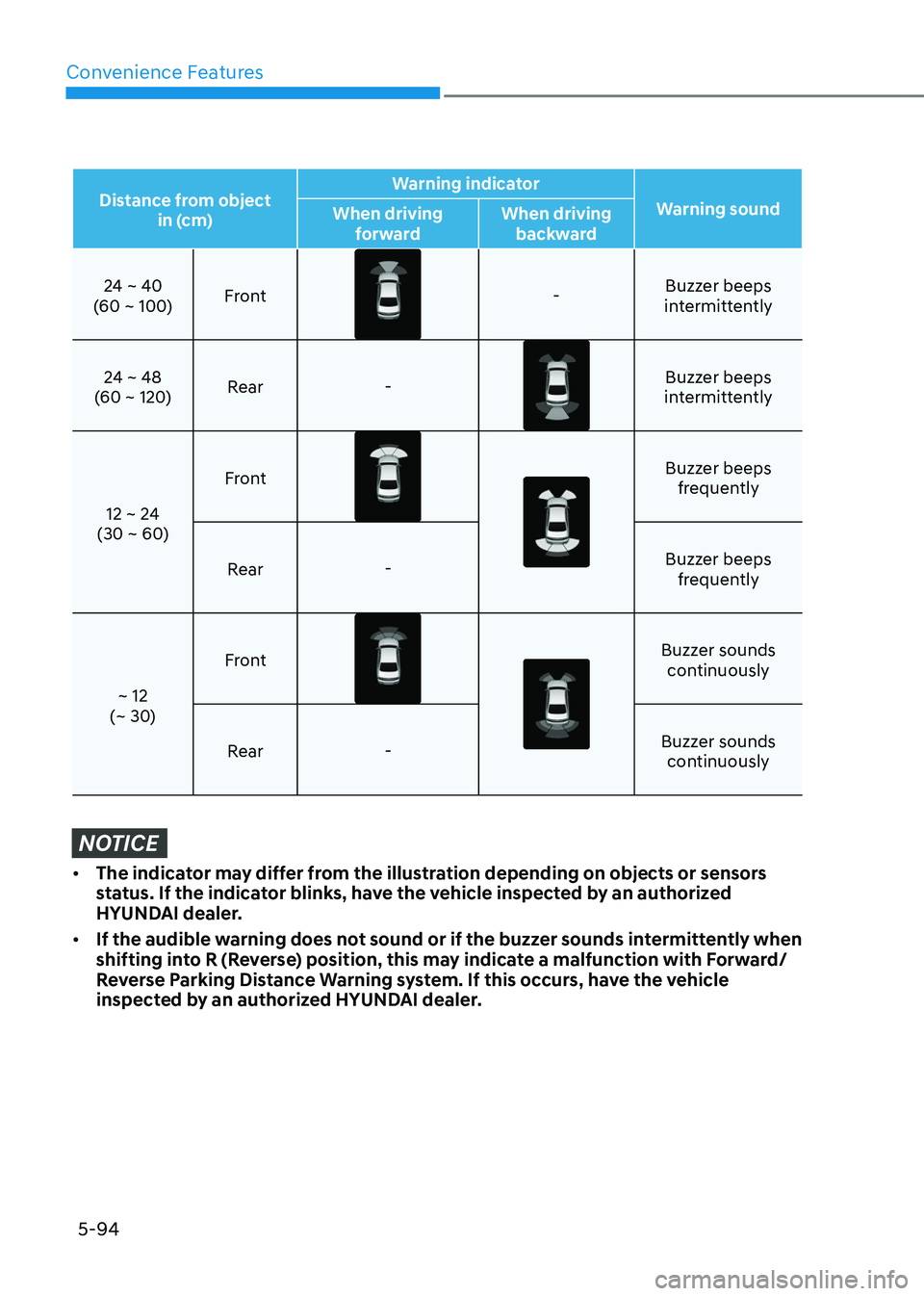
Distance from object in (cm) Warning indicator
Warning sound
When driving
forward When driving
backward
24 ~ 40
(60 ~ 100) Front
-Buzzer beeps
intermittently
24 ~ 48
(60 ~ 120) Rear
-
Buzzer beeps intermittently
12 ~ 24
(30 ~ 60) Front
Buzzer beeps frequently
Rear - Buzzer beeps
frequently
~ 12
(~ 30) Front
Buzzer sounds continuously
Rear - Buzzer sounds
continuously
NOTICE
• The indicator may differ from the illustration depending on objects or sensors
status. If the indicator blinks, have the vehicle inspected by an authorized
HYUNDAI dealer.
• If the audible warning does not sound or if the buzzer sounds intermittently when
shifting into R (Reverse) position, this may indicate a malfunction with Forward/
Reverse Parking Distance Warning system. If this occurs, have the vehicle
inspected by an authorized HYUNDAI dealer.
Page 242 of 549
05
5-95
Non-Operational Conditions
of Forward/Reverse Parking
Distance Warning
Forward/Reverse Parking Distance
Warning may not operate normally
when:
• Moisture is frozen to the sensor.
• Sensor is covered with foreign matter,
such as snow or water, or the sensor
cover is blocked.
There is a possibility of Forward/
Reverse Parking Distance Warning
malfunction when:
• Driving on uneven road surfaces such
as unpaved roads, gravel, bumps, or
gradient.
• Objects generating excessive
noise such as vehicle horns, loud
motorcycle engines, or truck air
brakes can interfere with the sensor.
• Heavy rain or water spray is present.
• Wireless transmitters or mobile
phones are present near the sensor.
• The sensor is covered with snow.
• Any non-factory equipment or
accessories have been installed, or if
the vehicle bumper height or sensor
installation has been modified.
Detecting range may decrease
when:
Outside air temperature is extremely hot
or cold.
The following objects may not be
recognized by the sensor:
• Sharp or slim objects such as ropes,
chains or small poles.
• Objects, which tend to absorb sensor
frequency such as clothes, spongy
material or snow.
• Undetectable objects smaller than 40
in (100 cm) and narrower than 6 in (14
cm) in diameter.
WARNING
Your new vehicle warranty does not
cover any accidents or damage to the
vehicle or injuries to its occupants
related to Forward/Reverse Parking
Distance Warning system. Always drive
safely and cautiously.
Forward/Reverse Parking
Distance Warning Precautions
• Forward/Reverse Parking Distance
Warning system may not sound
consistently depending on the speed
and shapes of the objects detected.
• Forward/Reverse Parking Distance
Warning system may malfunction if
the vehicle bumper height or sensor
installation has been modified or
damaged. Any non-factory installed
equipment or accessories may also
interfere with the sensor performance.
• The sensor may not recognize objects
less than 12 in (30 cm) from the
sensor, or it may sense an incorrect
distance. Use caution.
• When the sensor is frozen or stained
with snow, dirt, or water, the sensor
may be inoperative until the stains are
removed using a soft cloth.
• Do not push, scratch or strike the
sensor. Sensor damage could occur.
• Do not spray the sensors or its
surrounding area directly with a high
pressure washer. Shock applied from
high pressure water may cause the
device to not operate normally.
Page 243 of 549
Convenience Features
5-96
Reverse Parking Collision-Avoidance
Assist is a supplemental function that
can warn the driver or apply braking
force to reduce the possibility of collision
with pedestrians when the vehicle is
reversing.
WARNING
• Always look around your vehicle to
make sure there are no objects or
pedestrian before moving the vehicle
in any direction to prevent a collision.
• Do not solely rely on Reverse Parking
Collision-Avoidance Assist system.
The function might not assist the
driver leading to pedestrian injury or
vehicle damage.
• Be aware that some objects may
not be visible on the screen or be
detected by the rear ultrasonic
sensors, due to the objects’ distance,
size or material, all of which can limit
the effectiveness of the sensors.
Reverse Parking Collision
Avoidance Assist Setting and
Operation
System setting
Parking Collision-Avoidance Assist-
Reverse can be activated from the
Settings menu in the LCD display or
infotainment system display by following
the procedure below.
1. Set the Engine Start/Stop button to
the ON or START position.
2. Select ‘User Settings → Driver
Assistance → Parking Safety → Active
Assist / Warning Only / Off’ in the
LCD display or infotainment system
display.
-The function is ready for operation
when ‘Active Assist’ is selected. In
the event of an imminent collision
with a pedestrian or an object, the
system warns the driver or applies
braking force to help avoid the
collision.
-The function is ready for operation
when ‘Warning Only’ is selected. In
the event of an imminent collision
with a pedestrian, the system warns
the driver but does not assist in
braking.
-The function deactivates when ‘Off’
is selected.
REVERSE PARKING COLLISION-AVOIDANCE ASSIST (PCA)
Page 244 of 549
05
5-97
Operating conditions
Reverse Parking Collision-Avoidance
Assist enters the ready status, when
‘Active Assist’ or ‘Warning Only’ is
selected in the H/UNIT system screen
and the following conditions are
satisfied:
• The trunk is closed
• The shift lever is in R (Reverse)
• Vehicle speed is below 6 mph (10
km/h)
• System components such as the rear
view camera and the rear ultrasonic
sensors are in normal conditions
The driver needs to select ‘Active Assist’
on the LCD display or infotainment
system display for collision-avoidance
assist.
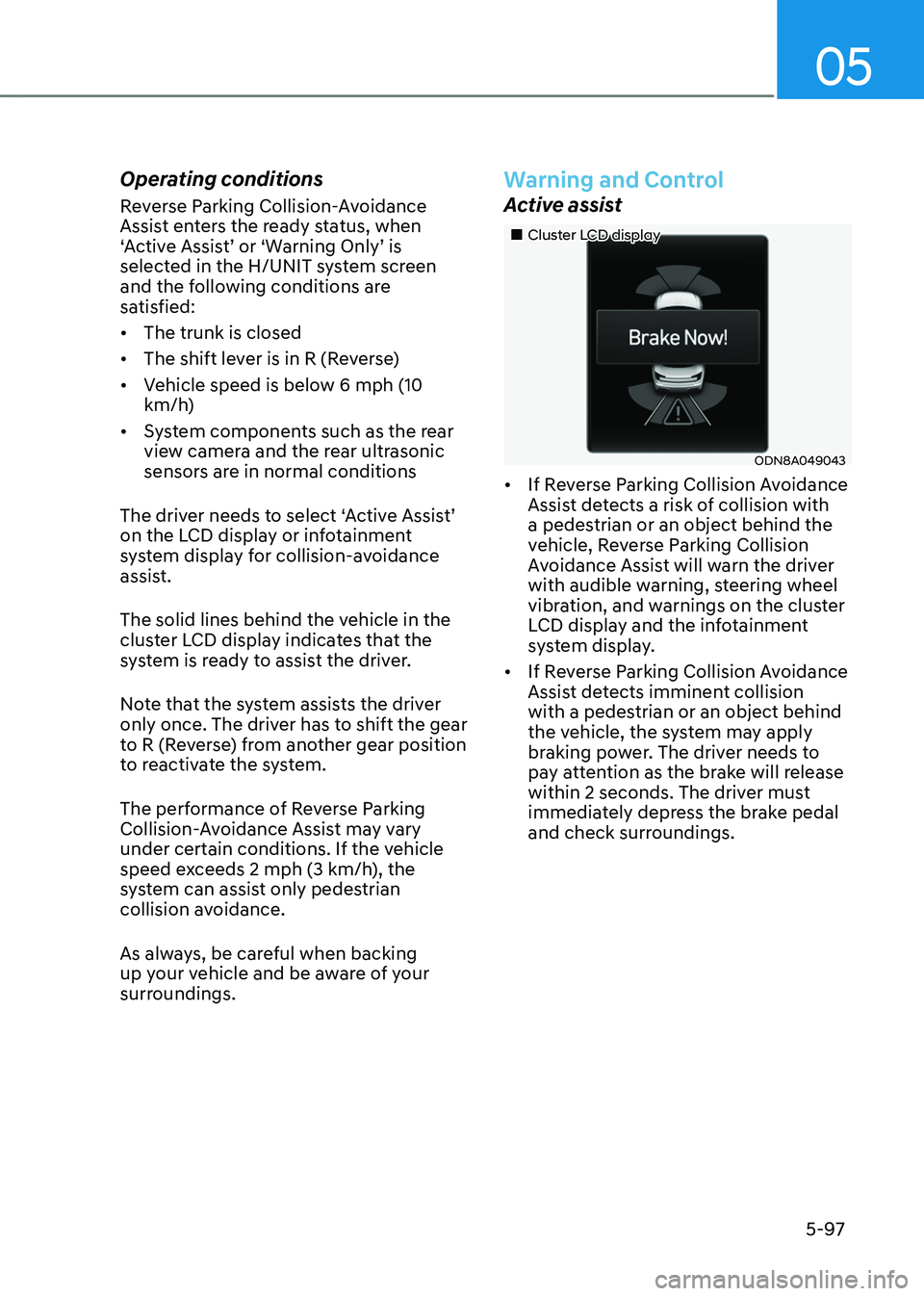
The solid lines behind the vehicle in the
cluster LCD display indicates that the
system is ready to assist the driver.
Note that the system assists the driver
only once. The driver has to shift the gear
to R (Reverse) from another gear position
to reactivate the system.
The performance of Reverse Parking
Collision-Avoidance Assist may vary
under certain conditions. If the vehicle
speed exceeds 2 mph (3 km/h), the
system can assist only pedestrian
collision avoidance.
As always, be careful when backing
up y our vehicle and be aware of your
surroundings.
Warning and Control
Active assist
Page 245 of 549
Convenience Features
5-98
The brake assist will turn off when:
• The driver shifts the gear to P (Park) or
D (Drive)
• The driver depresses the brake pedal
with sufficient power
• The braking has been assisted for
approximately 2 seconds
The warning will turn off when:
• The driver shifts the gear to P (Park), N
(Neutral), or D (Driv e)
The brake control may not operate
properly depending on the status of the
ESC (Electronic Stability Control). There
will only be a warning when:
• The ESC (Electronic Stability Control)
warning light is on
• The ESC (Electronic Stability Control)
is engaged in a different function
Warning only
• If Reverse Parking Collision Avoidance
Assist detects a risk of collision with
a pedestrian or an object, the system
will warn the driver with audible
warning and warnings on the cluster
LCD display or infotainment system
display.
• If ‘Warning Only’ is selected, braking
will not be assisted.
The warning will turn off when:
• The driver shifts the gear to P (Park), N
(Neutral), or D (Drive)
WARNING
• Reverse Parking Collision-Avoidance
Assist may not operate properly or
may operate unnecessarily in some
circumstances.
• Always pay extreme caution while
driving. The driver is responsible for
controlling the brake appropriately.
CAUTION
• Always pay attention to road and
traffic conditions while driving,
whether or not there is a warning.
• Playing the vehicle audio system at
high volume may prevent occupants
from hearing Reverse Parking
Collision-Avoidance Assist warning
sounds.
• If any other warning sound, such
as seat belt warning chime, is
already generated, Reverse Parking
Collision-Avoidance Assist warning
may not sound.
Information
Reverse Parking Collision Avoidance
Assist can detect a pedestrian or an object
when:
• A pedestrian is standing behind the
vehicle.
• A large obstacle, such as a vehicle, is
parked in the rear center of the vehicle.
Page 246 of 549
05
5-99
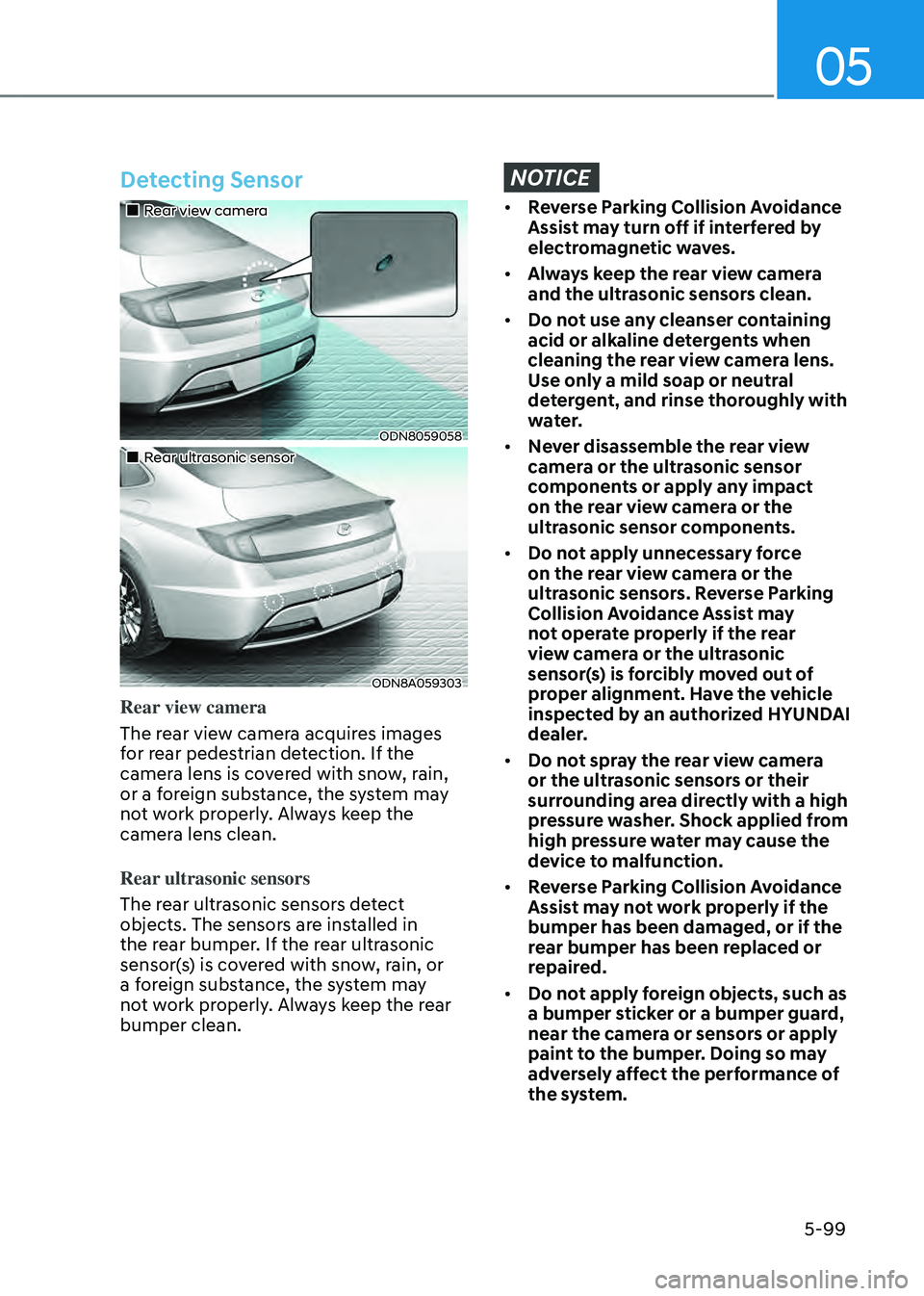
Detecting Sensor
Page 247 of 549
Convenience Features
5-100
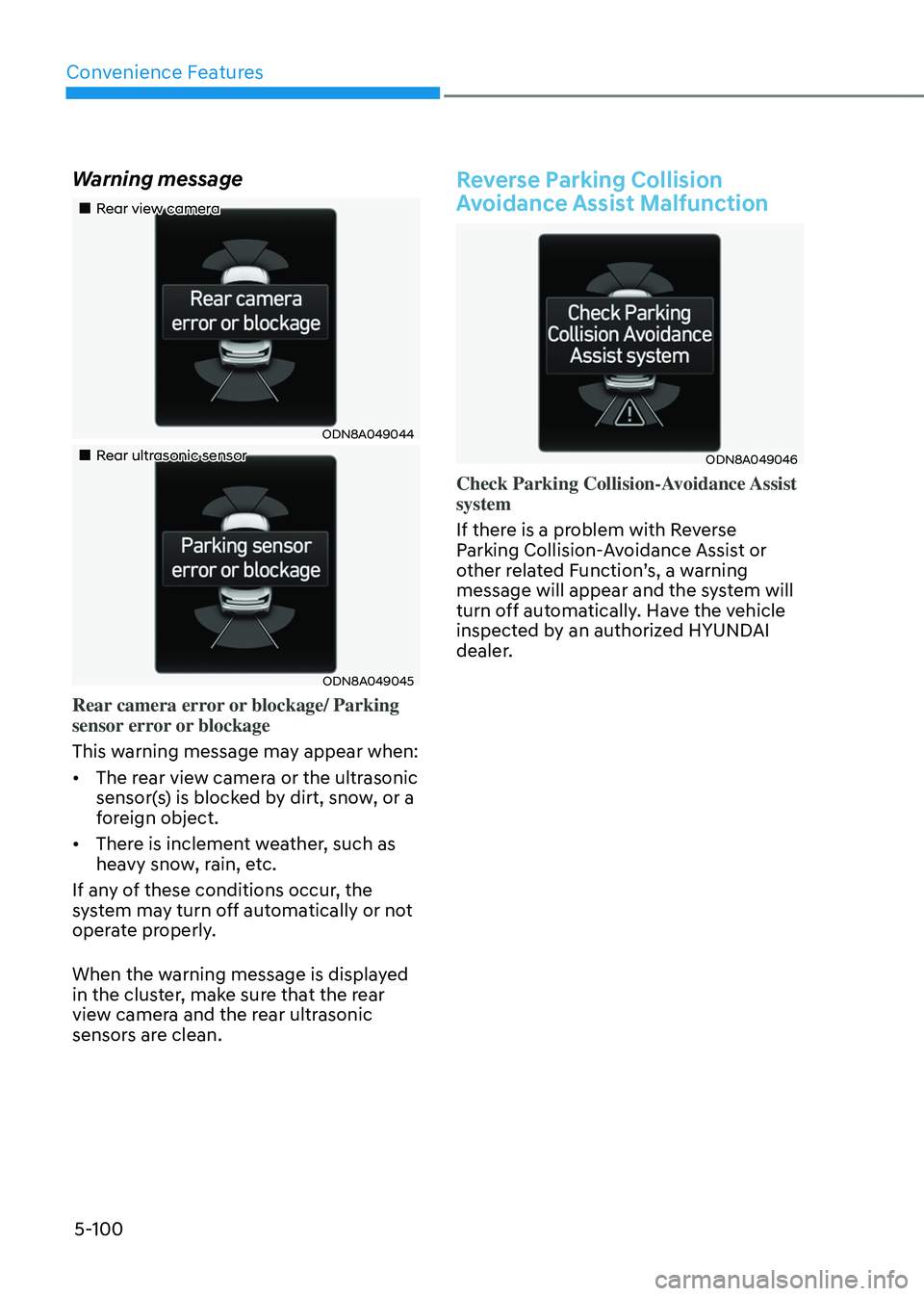
Warning message
Page 248 of 549
05
5-101
Limitations of Reverse Parking
Collision Avoidance Assist
Reverse Parking Collision-Avoidance
Assist may not assist braking or alert the
driver under the following conditions
even if there are pedestrians or objects.
• Any non-factory equipment or
accessories have been installed.
• The condition of the vehicle is
unstable due to an accident or other
causes.
• The height of the bumper or the
sensor installation has been modified.
• The rear view camera or the ultrasonic
sensor(s) is damaged.
• The rear view camera or the ultrasonic
sensor(s) is stained with foreign
matter, such as snow, dirt, etc.
• The rear view camera is obscured
by a light source or by bad weather
conditions, such as heavy rain, fog,
snow, etc.
• The surrounding is either too dark or
too bright.
• Outside air temperature is hot or cold.
• The wind is either strong (over 12 mph
(20 km/h)) or blowing perpendicular
to the rear bumper.
• Objects generating excessive
noise, such as vehicle horns, loud
motorcycle engines, or truck air
brakes, are near the vehicle.
• An ultrasonic sensor with a similar
frequency is near the vehicle.
• There is ground height difference
between the vehicle and the
pedestrian.
• The image of the pedestrian in the
rear view camera is indistinguishable
from the background.
• The pedestrian is near the rear edge of
the vehicle.
• The pedestrian is not standing upright.
• The pedestrian is either too short or
too tall for the system to recognize.
• The pedestrian is wearing clothes that
are hard for the system to recognize.
• The pedestrian is wearing a cloth that
does not reflect ultrasound well.
• The size, thickness, height, or shape of
the object does not reflect ultrasound
well (for example, pole, bush, curbs,
carts, edge of a wall, etc.).
• The pedestrian or the object is
moving.
• The pedestrian or the object is very
close to the rear of the vehicle.
• A wall is behind the pedestrian or the
object.
• The object is not at the rear center of
the vehicle.
• The plane of the obstacle is not
parallel to the rear bumper.
• The road is slippery or inclined.
• The driver backs up the vehicle
immediately after shifting to R
(Reverse).
• The driver accelerates or turns the
vehicle.
Page 249 of 549
Convenience Features
5-102
Reverse Parking Collision-Avoidance
Assist may alert the driver or apply
brake power unnecessarily under the
following conditions even if there are
“no” pedestrians or objects.
• Any non-factory equipment or
accessories have been installed.
• The condition of the vehicle is
unstable due to an accident or other
causes.
• The height of the bumper or the
sensor installation has been modified.
• The bumper height has changed due
to heavy loads, tire pressure change,
etc.
• The rear view camera or the ultrasonic
sensor(s) is stained with foreign
matter, such as snow, dirt, etc.
• The pattern on the road is mistaken
for a pedestrian.
• There is a shadow or a light reflecting
on the ground.
• Pedestrians or objects are around the
path of the vehicle.
• Objects generating excessive
noise, such as vehicle horns, loud
motorcycle engines, or truck air
brakes, are near the vehicle.
• The vehicle is backing towards a
narrow passage or parking space.
• The vehicle is backing towards an
uneven road surface, such as unpaved
road, gravel, bump, gradient, etc.
• A trailer is attached to the vehicle
Page 250 of 549
05
5-103
REMOTE SMART PARKING ASSIST (RSPA) (IF EQUIPPED)
Remote Smart Parking Assist helps
drivers recognize surrounding objects by
using sensors to detect parking spaces
control the steering wheel, shift the gear
and adjust vehicle speed automatically.
Remote moving forward and backward
function provides assistance for forward
and backward movement as well as
taking the vehicle out of the parking
space with driver outside the vehicle.
The driver should check the distance
between the parking space and the
objects in direct and be careful to
operate.
Due to the surrounding environment and
array or shape of the parked vehicles, the
vehicle may not be parked or exit at the
exact spot you have wished.
ÃRSPA stands for Remote Smart
Parking Assist.
Remote Smart Parking Assist system button
Parking Distance Warning system button
Function
Remote Moving Forward/
Backward Available
Deactivate Remote Smart Parking Assist
and park/exit your vehicle manually if it
is necessary. While using Remote Smart
Parking Assist system, Parking Distance
Warning system activates as well.
Remote Smart Parking Assist system will
be cancelled if Parking Distance Warning
system is cancelled by pressing the
button to the OFF position.
For operation of Parking Distance
Warning system, refer to the relevant
description in this manual.
WARNING
• Remote Smart Parking Assist may not
operate normally if the vehicle needs
wheel alignment adjustment. Have
the vehicle checked by an authorized
HYUNDAI dealer.
• If you use a different tire or
wheel size rather than the size
recommended by the HYUNDAI
dealer, Remote Smart Parking Assist
may not work properly. Always use
the same size tire and wheel.
• Do not use Remote Smart Parking
Assist when under the influence of
alcohol or drugs.
• Remote Smart Parking Assist may not
operate properly depending on the
surrounding environment and other
conditions.
• Remote Smart Parking Assist may not
recognize the object too close to the
vehicle.
• When operating Remote Smart
Parking Assist, be careful of the
objects such as flower pots or
parking blocks located above or
below the sensor position. Such
object may damage the vehicle or
other objects.
• Remote Smart Parking Assist
should only be considered as a
supplementary function. The driver
must check the front and rear view
for objects. The operational function
of the system can be affected by
many factors and conditions of the
surroundings, so the responsibility
rests always with the driver.
• Do not let children or other person to
use the smart key.